ignition Peugeot 306 Break 2002 Owner's Guide
[x] Cancel search | Manufacturer: PEUGEOT, Model Year: 2002, Model line: 306 Break, Model: Peugeot 306 Break 2002Pages: 131, PDF Size: 2.25 MB
Page 89 of 131
108
DRIVING YOUR 306
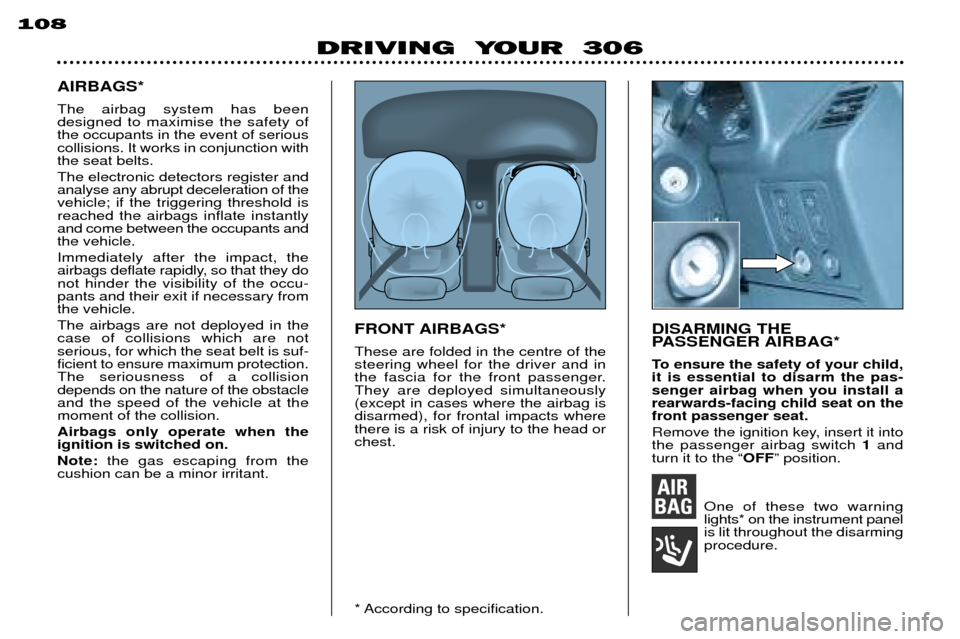
AIRBAGS* The airbag system has been designed to maximise the safety ofthe occupants in the event of seriouscollisions. It works in conjunction withthe seat belts. The electronic detectors register and analyse any abrupt deceleration of thevehicle; if the triggering threshold isreached the airbags inflate instantlyand come between the occupants andthe vehicle. Immediately after the impact, the
airbags deflate rapidly, so that they donot hinder the visibility of the occu-pants and their exit if necessary fromthe vehicle. The airbags are not deployed in the case of collisions which are notserious, for which the seat belt is suf-ficient to ensure maximum protection.The seriousness of a collisiondepends on the nature of the obstacleand the speed of the vehicle at themoment of the collision. Airbags only operate when the ignition is switched on. Note:the gas escaping from the
cushion can be a minor irritant. FRONT AIRBAGS* These are folded in the centre of the steering wheel for the driver and in
the fascia for the front passenger.They are deployed simultaneously(except in cases where the airbag isdisarmed), for frontal impacts wherethere is a risk of injury to the head orchest.
DISARMING THE
PASSENGER AIRBAG*
To ensure the safety of your child, it is essential to disarm the pas-senger airbag when you install arearwards-facing child seat on thefront passenger seat.
Remove the ignition key, insert it into the passenger airbag switch
1and
turn it to the Ò OFFÓ position.
One of these two warninglights* on the instrument panel
is lit throughout the disarmingprocedure.
* According to specification.
Page 90 of 131
109
DRIVING YOUR 306
In the ÒOFFÓ position, the passenger
airbag will not be triggered in the event of an impact. As soon as you remove the rear- wards-facing child seat from the frontpassenger seat, turn the airbag switchto the Ò ONÓ position, to arm the airbag
and thus ensure the safety of yourpassenger in an impact. Passenger airbag precautions
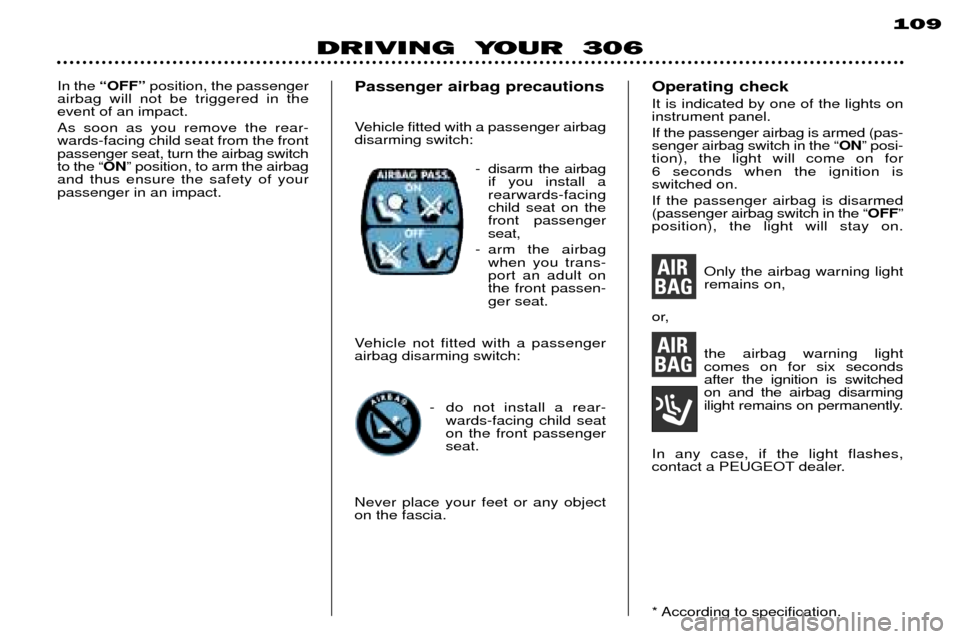
Vehicle fitted with a passenger airbag disarming switch:
- disarm the airbagif you install arearwards-facingchild seat on thefront passengerseat,
- arm the airbag when you trans-port an adult onthe front passen-ger seat.
Vehicle not fitted with a passengerairbag disarming switch:
- do not install a rear-wards-facing child seaton the front passengerseat.
Never place your feet or any object on the fascia. Operating check It is indicated by one of the lights on instrument panel. If the passenger airbag is armed (pas- senger airbag switch in the Ò
ONÓ posi-
tion), the light will come on for 6 seconds when the ignition isswitched on. If the passenger airbag is disarmed (passenger airbag switch in the Ò OFFÓ
position), the light will stay on.
Only the airbag warning lightremains on,
or,
the airbag warning lightcomes on for six secondsafter the ignition is switched
on and the airbag disarming
ilight remains on permanently.
In any case, if the light flashes,
contact a PEUGEOT dealer.
* According to specification.
Page 91 of 131
110
SIDE AIRBAGS*
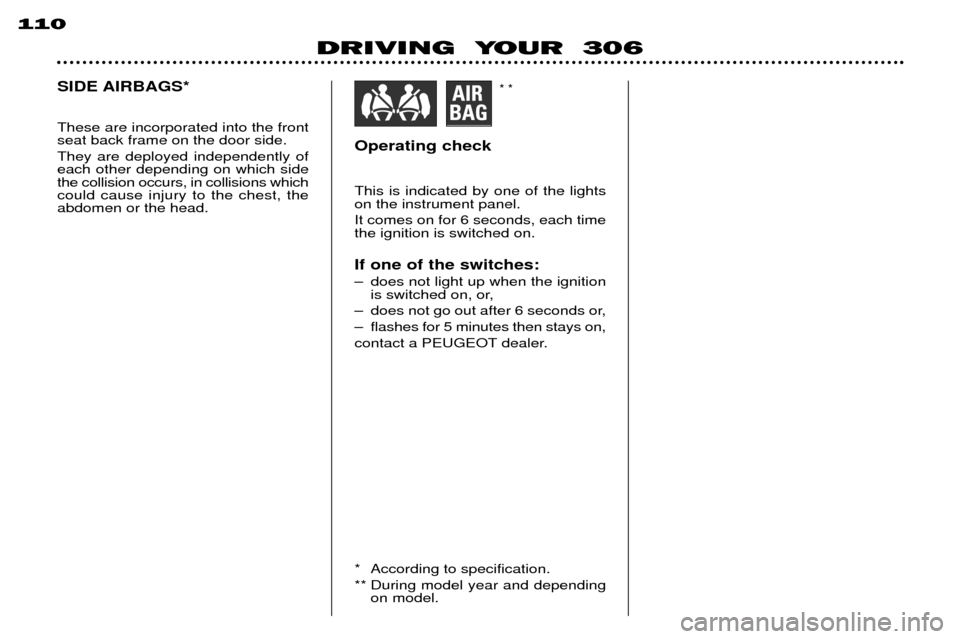
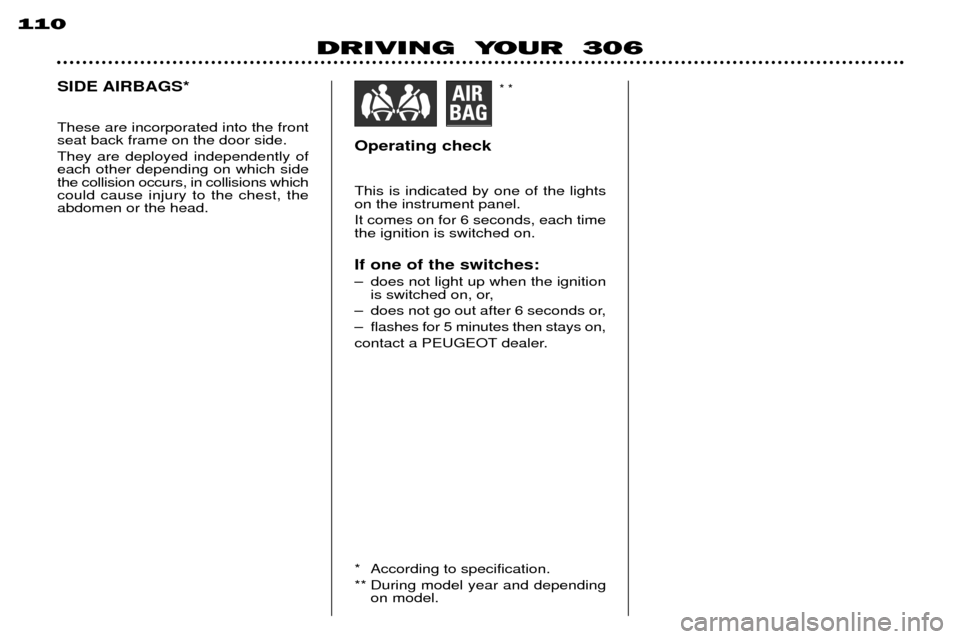
DRIVING YOUR 306This is indicated by one of the lights on the instrument panel. It comes on for 6 seconds, each time the ignition is switched on.
Operating check If one of the switches:
Ð does not light up when the ignition
is switched on, or,
Ð does not go out after 6 seconds or,
Ð flashes for 5 minutes then stays on,
contact a PEUGEOT dealer.
* According to specification.
** During model year and depending on model.
These are incorporated into the front seat back frame on the door side. They are deployed independently of each other depending on which sidethe collision occurs, in collisions whichcould cause injury to the chest, theabdomen or the head.
* *
Page 93 of 131
110
SIDE AIRBAGS*
DRIVING YOUR 306This is indicated by one of the lights on the instrument panel. It comes on for 6 seconds, each time the ignition is switched on.
Operating check If one of the switches:
Ð does not light up when the ignition
is switched on, or,
Ð does not go out after 6 seconds or,
Ð flashes for 5 minutes then stays on,
contact a PEUGEOT dealer.
* According to specification.
** During model year and depending on model.
These are incorporated into the front seat back frame on the door side. They are deployed independently of each other depending on which sidethe collision occurs, in collisions whichcould cause injury to the chest, theabdomen or the head.
* *
Page 99 of 131
MAINTENANCE OF YOUR 306
30
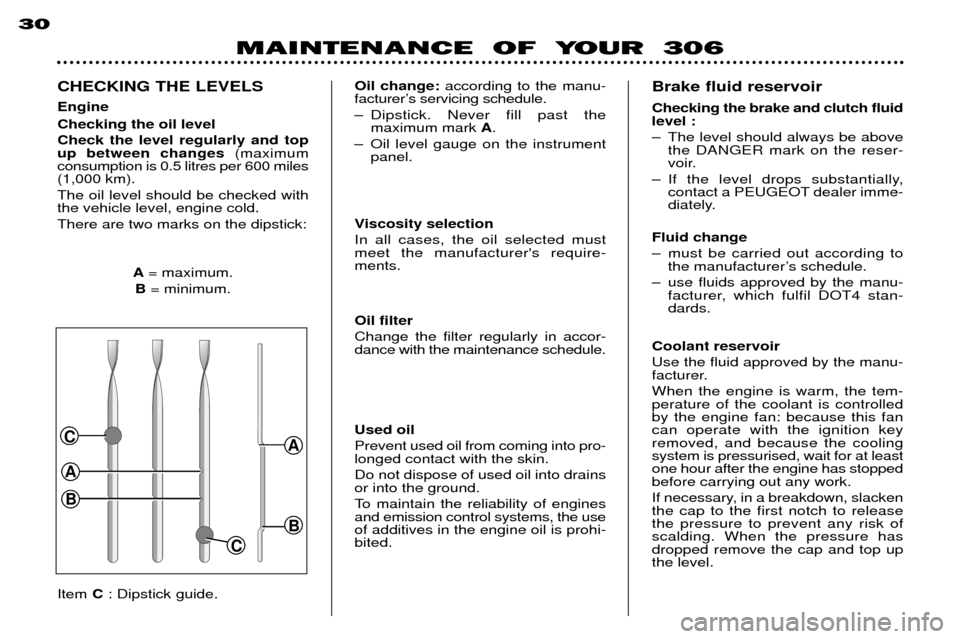
CHECKING THE LEVELS Engine Checking the oil level Check the level regularly and top up between changes
(maximum
consumption is 0.5 litres per 600 miles(1,000 km). The oil level should be checked with the vehicle level, engine cold. There are two marks on the dipstick:
A= maximum.
B = minimum. Oil change:
according to the manu-
facturerÕs servicing schedule.
Ð Dipstick. Never fill past the maximum mark A.
Ð Oil level gauge on the instrument panel.
Viscosity selection In all cases, the oil selected must meet the manufacturer's require-ments. Oil filter Change the filter regularly in accor- dance with the maintenance schedule. Used oil Prevent used oil from coming into pro- longed contact with the skin. Do not dispose of used oil into drains or into the ground.
To maintain the reliability of engines and emission control systems, the useof additives in the engine oil is prohi-bited. Brake fluid reservoir Checking the brake and clutch fluid level :
Ð The level should always be above
the DANGER mark on the reser-
voir.
Ð If the level drops substantially, contact a PEUGEOT dealer imme-
diately.
Fluid change
Ð must be carried out according to the manufacturerÕs schedule.
Ð use fluids approved by the manu- facturer, which fulfil DOT4 stan- dards.
Coolant reservoir Use the fluid approved by the manu-
facturer. When the engine is warm, the tem- perature of the coolant is controlledby the engine fan: because this fancan operate with the ignition keyremoved, and because the coolingsystem is pressurised, wait for at leastone hour after the engine has stoppedbefore carrying out any work.
If necessary, in a breakdown, slacken the cap to the first notch to releasethe pressure to prevent any risk ofscalding. When the pressure hasdropped remove the cap and top upthe level.
Item C: Dipstick guide.
A
C
B
A
B
C
Page 116 of 131

MAINTENANCE OF YOUR 306
44
Battery
To charge the battery using a battery charger:
- Disconnect the battery, starting with the negative (-) terminal.
- Follow the instructions for use given by the battery charger manufacturer.
- Reconnect starting with the positive (+) terminal.
- Check that the terminals and connectors are clean. If they are covered with sul-phate deposits (white or greenish deposit), disconnect them and clean them.
To start the vehicle and charge the battery from another battery: Ensure that the connections are good:
- Connect the red cable to the positive (+) terminals of the two batteries.
- Connect one end of the green or black cable to the negative (-) terminal of the slave battery.
- Connect the other end of the green or black cable to an earth point on the broken down vehicle as far as possible from the battery.
Operate the starter, let the engine run.
Wait for the engine to return to idle, and disconnect the cables.
- Never disconnect a terminal when the engine is running.
- Never charge a battery without first disconnecting the terminals.
- After every disconnection of the battery, switch on the ignitionand wait 10 seconds beforestarting. If slight difficulties areexperienced after this, please
contact a PEUGEOT dealer.
It is advisable to disconnect the battery if the vehicle
is not to be used for a period of more than one month.