steering Peugeot 308 2014 Owner's Guide
[x] Cancel search | Manufacturer: PEUGEOT, Model Year: 2014, Model line: 308, Model: Peugeot 308 2014Pages: 400, PDF Size: 10.05 MB
Page 167 of 400
165
4
Driving
308_EN_CHAP04_CONDUITE_ED02-2013
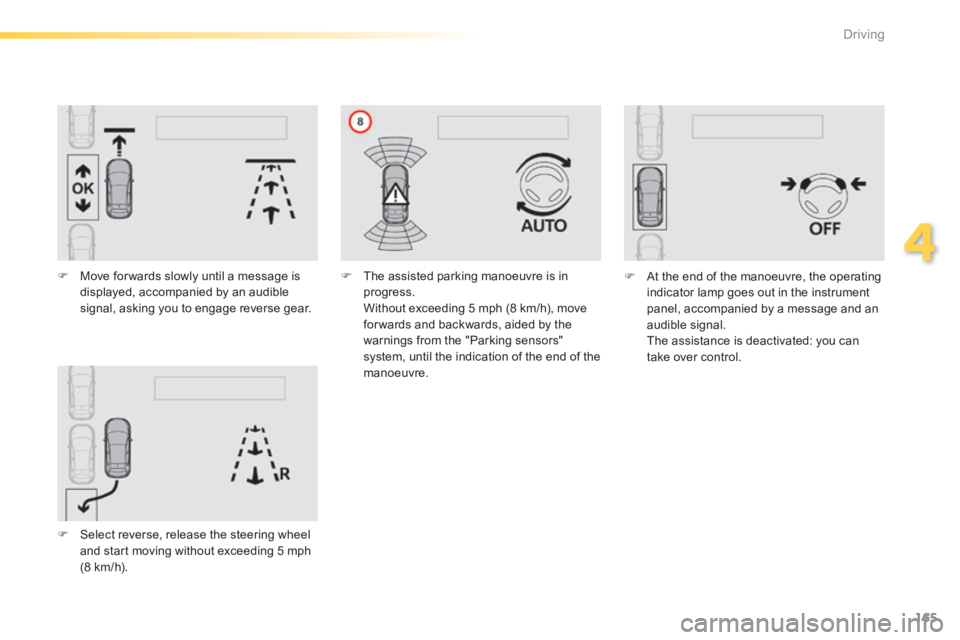
Move for wards slowly until a message is displayed, accompanied by an audible signal, asking you to engage reverse gear.
Select reverse, release the steering wheel and start moving without exceeding 5 mph (8 km/h).
The assisted parking manoeuvre is in progress. Without exceeding 5 mph (8 km/h), move for wards and backwards, aided by the warnings from the "Parking sensors" system, until the indication of the end of the manoeuvre.
At the end of the manoeuvre, the operating indicator lamp goes out in the instrument panel, accompanied by a message and an audible signal. The assistance is deactivated: you can take over control.
Page 168 of 400
166
Driving
308_EN_CHAP04_CONDUITE_ED02-2013
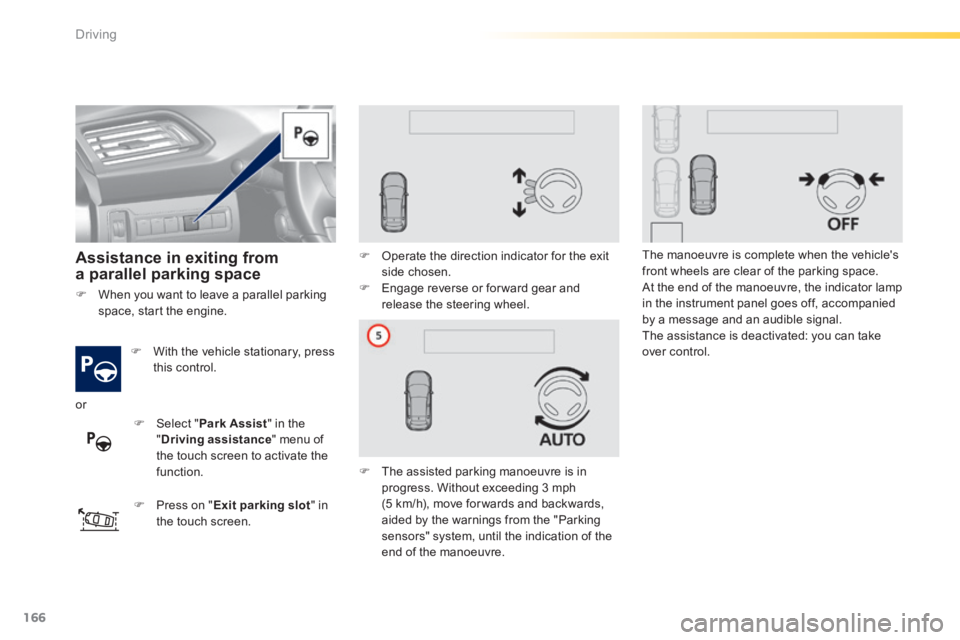
Assistance in exiting from a parallel parking space
With the vehicle stationary, press this control.
Press on " Exit parking slot " in the touch screen.
Operate the direction indicator for the exit side chosen. Engage reverse or for ward gear and release the steering wheel.
The assisted parking manoeuvre is in progress. Without exceeding 3 mph (5 km/h), move for wards and backwards, aided by the warnings from the "Parking sensors" system, until the indication of the end of the manoeuvre.
The manoeuvre is complete when the vehicle's front wheels are clear of the parking space. At the end of the manoeuvre, the indicator lamp in the instrument panel goes off, accompanied by a message and an audible signal. The assistance is deactivated: you can take over control.
When you want to leave a parallel parking space, start the engine.
or
Select " Park Assist " in the " Driving assistance " menu of the touch screen to activate the function.
Page 169 of 400
167
4
Driving
308_EN_CHAP04_CONDUITE_ED02-2013
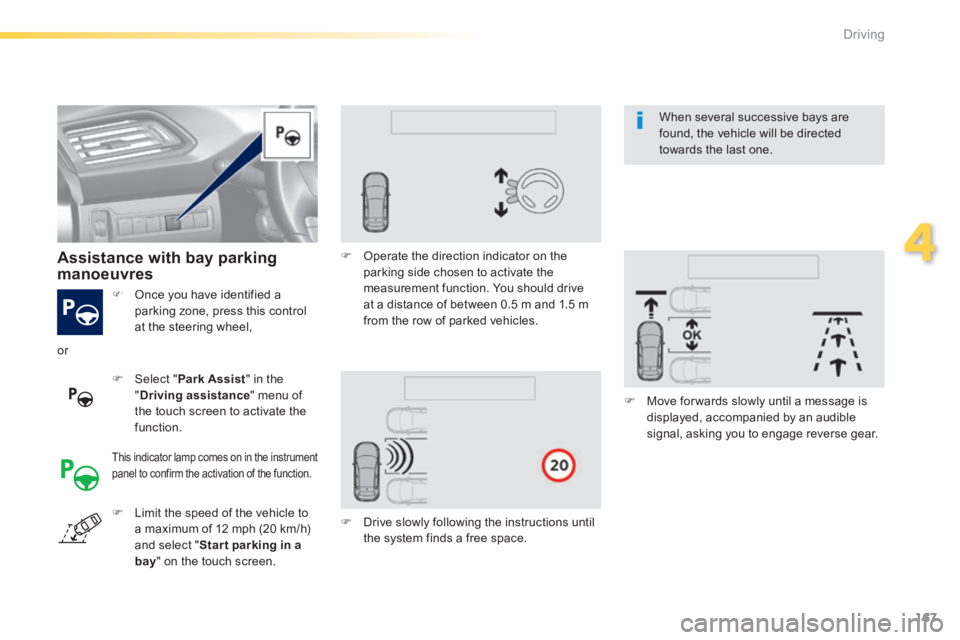
Once you have identified a parking zone, press this control at the steering wheel,
Assistance with bay parking manoeuvres
Select " Park Assist " in the " Driving assistance " menu of the touch screen to activate the function.
This indicator lamp comes on in the instrument panel to confirm the activation of the function.
Operate the direction indicator on the parking side chosen to activate the measurement function. You should drive at a distance of between 0.5 m and 1.5 m from the row of parked vehicles.
Drive slowly following the instructions until
the system finds a free space.
Move for wards slowly until a message is displayed, accompanied by an audible
signal, asking you to engage reverse gear.
or
Limit the speed of the vehicle to a maximum of 12 mph (20 km/h)
and select " Star t parking in a bay " on the touch screen.
When several successive bays are found, the vehicle will be directed towards the last one.
Page 170 of 400
168
Driving
308_EN_CHAP04_CONDUITE_ED02-2013
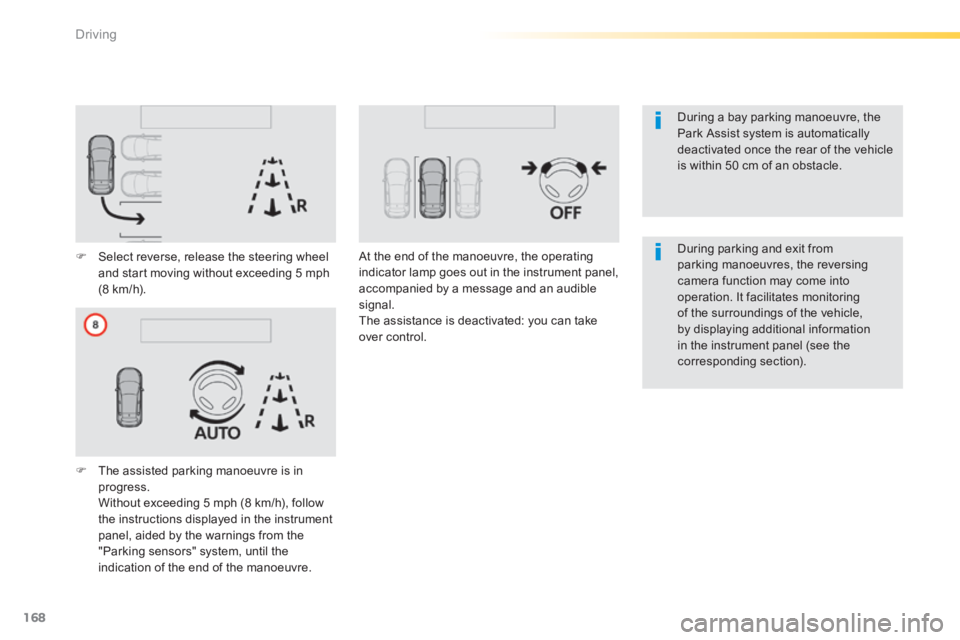
During a bay parking manoeuvre, the Park Assist system is automatically deactivated once the rear of the vehicle is within 50 cm of an obstacle.
Select reverse, release the steering wheel and start moving without exceeding 5 mph (8 km/h).
The assisted parking manoeuvre is in progress. Without exceeding 5 mph (8 km/h), follow the instructions displayed in the instrument
panel, aided by the warnings from the "Parking sensors" system, until the indication of the end of the manoeuvre.
At the end of the manoeuvre, the operating indicator lamp goes out in the instrument panel, accompanied by a message and an audible signal. The assistance is deactivated: you can take over control.
During parking and exit from parking manoeuvres, the reversing camera function may come into operation. It facilitates monitoring of the surroundings of the vehicle, by displaying additional information in the instrument panel (see the corresponding section).
Page 171 of 400
169
4
Driving
308_EN_CHAP04_CONDUITE_ED02-2013
The system is deactivated automatically: - on switching off the ignition, - if the engine stalls, - if no manoeuvre is started within 5 minutes of selection of the type of manoeuvre, - after a prolonged stop of the vehicle during a manoeuvre, - if the road wheel anti-slip regulation (ASR) is triggered, - if the speed of the vehicle exceeds the stated limit, - when the driver interrupts movement of the steering wheel, - if the driver presses the Park Assist control, - after 4 manoeuvre cycles, - on opening the driver's door, - if one of the front wheels encounters an obstacle.
The operation indicator lamp goes off in the instrument panel and a message is displayed accompanied by an audible signal. The driver should then take back control of the vehicle's steering.
Deactivation
If the system is deactivated during a manoeuvre, the drive should reactivate it manually to repeat the measurement.
The system is switched off automatically: - when towing a trailer, - if the driver's door is opened, - if the speed of the vehicle is above 42 mph (70 km/h). To switch the system of for a prolonged period, contact a PEUGEOT dealer or a qualified workshop.
In the event of a fault with the system, this warning lamp is displayed in the instrument panel and a message appears, accompanied by an audible signal.
Operating faults
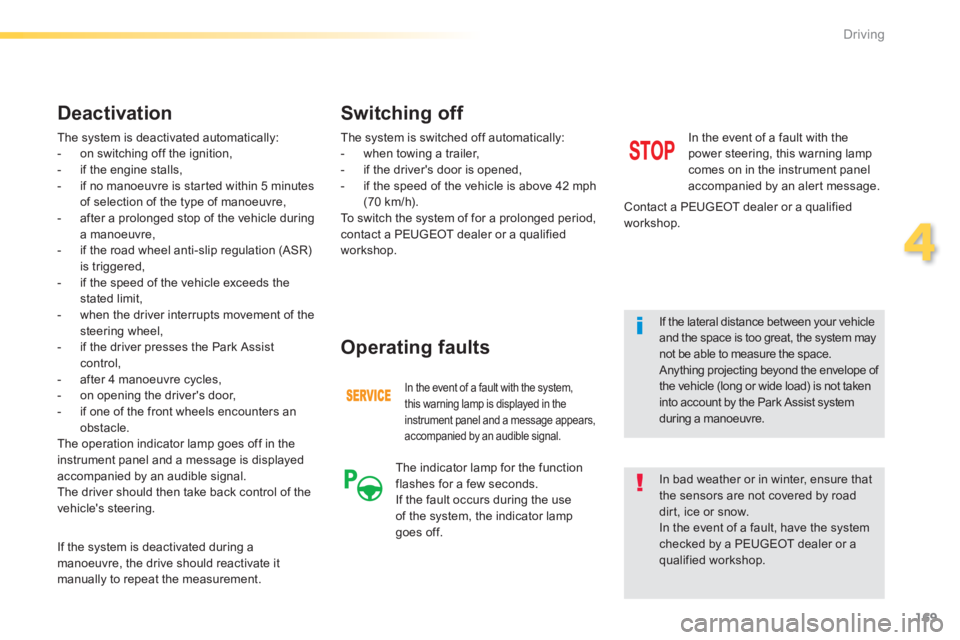
In the event of a fault with the power steering, this warning lamp comes on in the instrument panel accompanied by an alert message.
Contact a PEUGEOT dealer or a qualified workshop.
Switching off
If the lateral distance between your vehicle and the space is too great, the system may not be able to measure the space. Anything projecting beyond the envelope of the vehicle (long or wide load) is not taken into account by the Park Assist system during a manoeuvre.
In bad weather or in winter, ensure that the sensors are not covered by road dirt, ice or snow. In the event of a fault, have the system checked by a PEUGEOT dealer or a qualified workshop.
The indicator lamp for the function flashes for a few seconds. If the fault occurs during the use of the system, the indicator lamp goes off.
Page 190 of 400
188
Safety
308_EN_CHAP06_SECURITE_ED02-2013
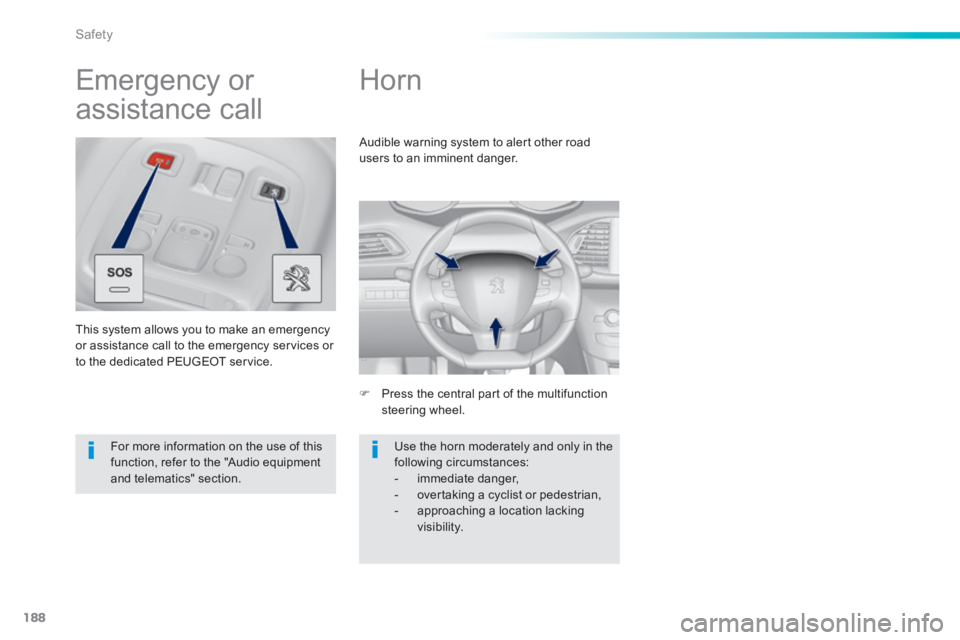
Horn
Press the central part of the multifunction steering wheel.
Audible warning system to alert other road users to an imminent danger.
Use the horn moderately and only in the following circumstances: - immediate danger, - overtaking a cyclist or pedestrian, - approaching a location lacking visibility.
Emergency or
assistance call
This system allows you to make an emergency or assistance call to the emergency services or to the dedicated PEUGEOT service.
For more information on the use of this function, refer to the "Audio equipment and telematics" section.
Page 192 of 400
190
Safety
308_EN_CHAP06_SECURITE_ED02-2013
Under-inflation alert Reinitialisation
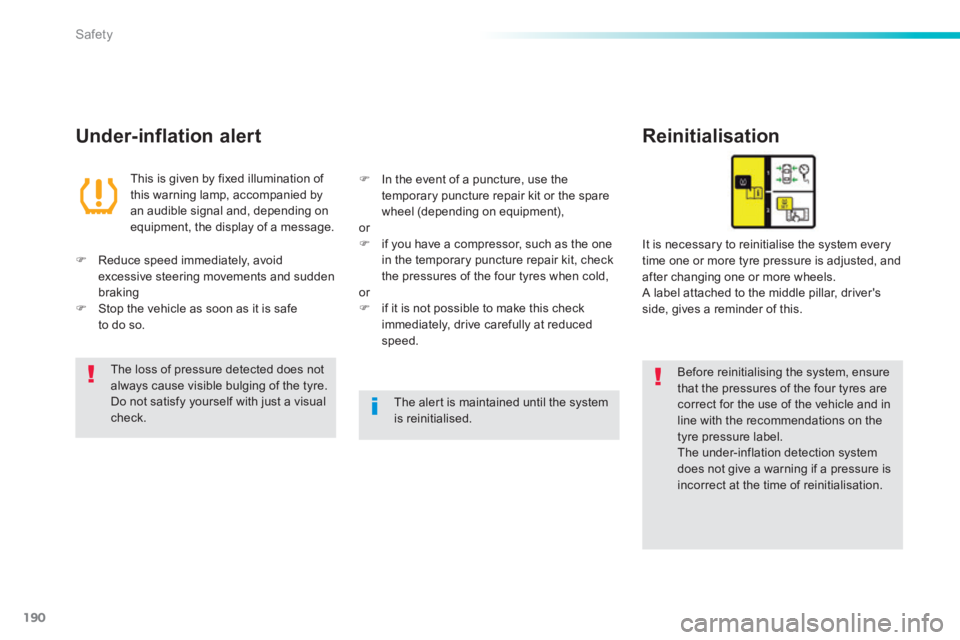
Before reinitialising the system, ensure that the pressures of the four tyres are correct for the use of the vehicle and in line with the recommendations on the tyre pressure label. The under-inflation detection system does not give a warning if a pressure is incorrect at the time of reinitialisation.
This is given by fixed illumination of this warning lamp, accompanied by an audible signal and, depending on
equipment, the display of a message.
It is necessary to reinitialise the system every time one or more tyre pressure is adjusted, and after changing one or more wheels. A label attached to the middle pillar, driver's side, gives a reminder of this.
Reduce speed immediately, avoid excessive steering movements and sudden braking Stop the vehicle as soon as it is safe to do so.
In the event of a puncture, use the temporary puncture repair kit or the spare wheel (depending on equipment), or if you have a compressor, such as the one in the temporary puncture repair kit, check the pressures of the four tyres when cold, or if it is not possible to make this check immediately, drive carefully at reduced speed.
The loss of pressure detected does not always cause visible bulging of the tyre. Do not satisfy yourself with just a visual check. The alert is maintained until the system is reinitialised.
Page 202 of 400
200
Safety
308_EN_CHAP06_SECURITE_ED02-2013
Deactivating the passenger's front airbag
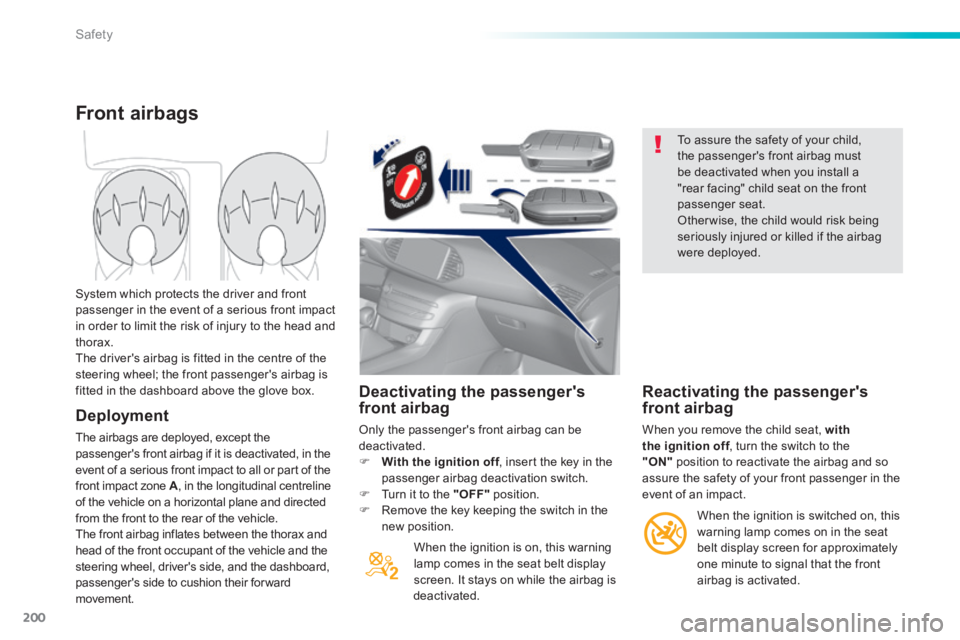
Only the passenger's front airbag can be deactivated. With the ignition off , insert the key in the With the ignition off , insert the key in the With the ignition offpassenger airbag deactivation switch. Turn it to the "OFF" position. Remove the key keeping the switch in the new position.
When the ignition is on, this warning lamp comes in the seat belt display screen. It stays on while the airbag is deactivated.
To assure the safety of your child, the passenger's front airbag must be deactivated when you install a "rear facing" child seat on the front passenger seat. Otherwise, the child would risk being seriously injured or killed if the airbag were deployed.
Reactivating the passenger's front airbag
When you remove the child seat, with the ignition off , turn the switch to the the ignition off , turn the switch to the the ignition off"ON" position to reactivate the airbag and so assure the safety of your front passenger in the event of an impact.
Front airbags
Deployment
The airbags are deployed, except the passenger's front airbag if it is deactivated, in the event of a serious front impact to all or part of the front impact zone A , in the longitudinal centreline of the vehicle on a horizontal plane and directed from the front to the rear of the vehicle. The front airbag inflates between the thorax and head of the front occupant of the vehicle and the steering wheel, driver's side, and the dashboard, passenger's side to cushion their for ward movement.
System which protects the driver and front passenger in the event of a serious front impact in order to limit the risk of injury to the head and thorax. The driver's airbag is fitted in the centre of the steering wheel; the front passenger's airbag is fitted in the dashboard above the glove box.
When the ignition is switched on, this warning lamp comes on in the seat belt display screen for approximately one minute to signal that the front airbag is activated.
Page 205 of 400
203
6
Safety
308_EN_CHAP06_SECURITE_ED02-2013
Sit in a normal upright position. Wear a correctly adjusted seat belt. Do not leave anything between the occupants and the airbags (a child, pet, object...). This could hamper the operation of
the airbags or injure the occupants. After an accident or if the vehicle has been stolen or broken into, have the airbag systems checked. All work on the airbag system must be carried out by a PEUGEOT dealer or a qualified workshop. Even if all of the precautions mentioned are observed, a risk of injury or of minor burns to the head, chest or arms when an airbag is deployed cannot be ruled out. The bag inflates almost instantly (within a few milliseconds) then deflates within the same time discharging the hot gas via openings provided for this purpose.
Lateral airbags
Use only approved covers on the seats, compatible with the deployment the lateral airbags. For information on the range of seat covers suitable for your vehicle, you can contact a PEUGEOT dealer. Refer to the "Accessories" section. Do not fix or attach anything to the seat backs (clothing...). This could cause injury to the chest or arms if the lateral airbag is deployed. Do not sit with the upper part of the body any nearer to the door than necessary.
Front airbags
Do not drive holding the steering wheel by its spokes or resting your hands on the centre part of the wheel. Passengers must not place their feet on the dashboard. If possible, do not smoke as deployment of the airbags can cause burns or the risk of injury from a cigarette or pipe. Never remove or pierce the steering wheel or hit it violently.
For the airbags to be fully effective, observe the following safety rules:
Curtain airbags
Do not fix or attach anything to the roof. This could cause injury to the head if the curtain airbag is deployed. If fitted on your vehicle, do not remove the grab handles installed on the roof, they play a part in securing the curtain airbags.
Page 224 of 400
222
Practical information
308_EN_CHAP07_INFO PR ATIQUES_ED02-2013
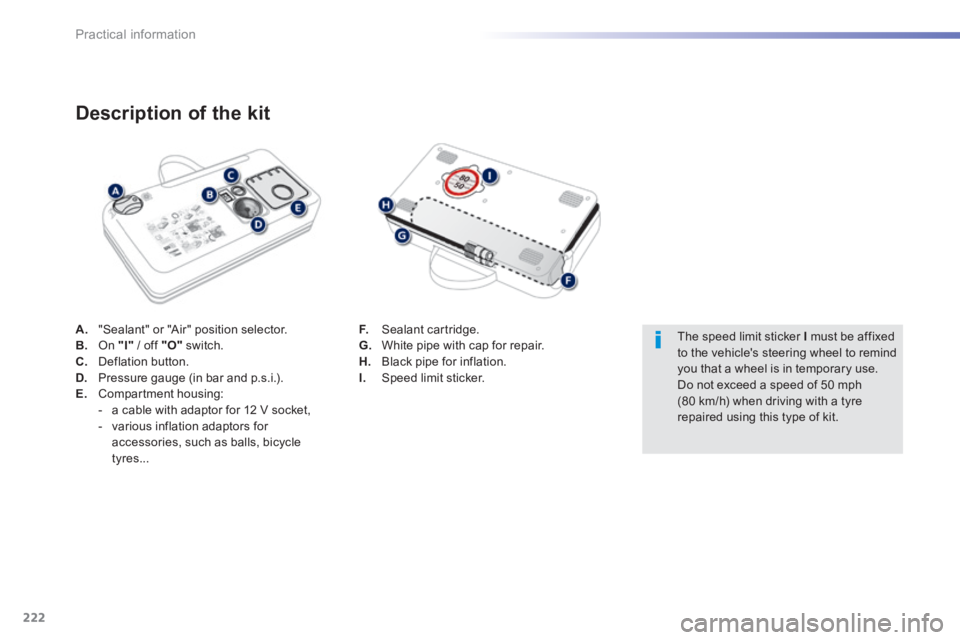
A. "Sealant" or "Air" position selector. B. On "I" / off "O" switch. C. Deflation button. D. Pressure gauge (in bar and p.s.i.). E. Compartment housing: - a cable with adaptor for 12 V socket, - various inflation adaptors for accessories, such as balls, bicycle tyres...
Description of the kit
F. Sealant cartridge. G. White pipe with cap for repair. H. Black pipe for inflation. I. Speed limit sticker.
The speed limit sticker I must be affixed to the vehicle's steering wheel to remind you that a wheel is in temporary use. Do not exceed a speed of 50 mph (80 km/h) when driving with a tyre repaired using this type of kit.