engine Peugeot 308 2014 Manual Online
[x] Cancel search | Manufacturer: PEUGEOT, Model Year: 2014, Model line: 308, Model: Peugeot 308 2014Pages: 400, PDF Size: 10.05 MB
Page 251 of 400
249
7
Practical information
308_EN_CHAP07_INFO PR ATIQUES_ED02-2013
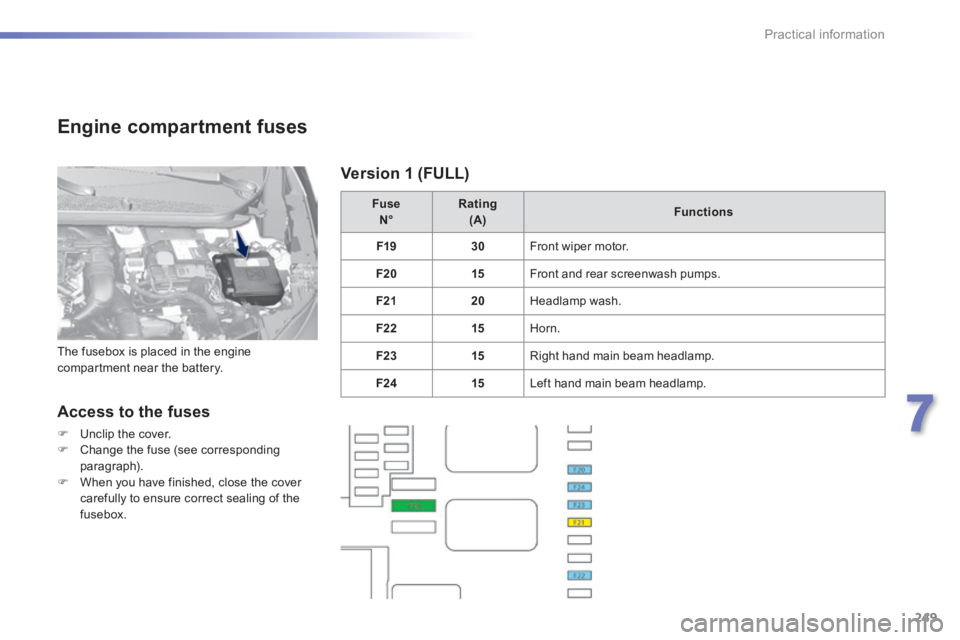
Engine compartment fuses
Access to the fuses
Unclip the cover. Change the fuse (see corresponding paragraph). When you have finished, close the cover carefully to ensure correct sealing of the fusebox.
Fuse N° Rating (A)Functions
F1930 Front wiper motor.
F2015 Front and rear screenwash pumps.
F2120 Headlamp wash.
F2215 Horn.
F2315 Right hand main beam headlamp.
F2415 Left hand main beam headlamp.
The fusebox is placed in the engine compartment near the battery.
Version 1 (FULL)
Page 253 of 400
251
7
Practical information
308_EN_CHAP07_INFO PR ATIQUES_ED02-2013
12 V battery
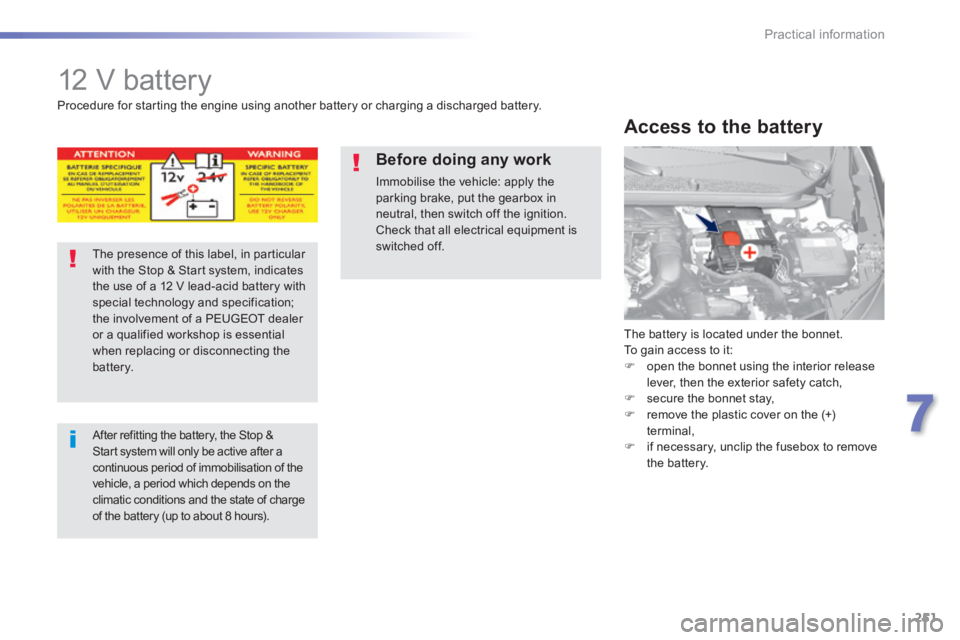
The battery is located under the bonnet. To gain access to it: open the bonnet using the interior release lever, then the exterior safety catch, secure the bonnet stay, remove the plastic cover on the (+) terminal, if necessary, unclip the fusebox to remove the battery.
Access to the battery
Procedure for starting the engine using another battery or charging a discharged battery.
The presence of this label, in particular with the Stop & Start system, indicates the use of a 12 V lead-acid battery with special technology and specification; the involvement of a PEUGEOT dealer or a qualified workshop is essential when replacing or disconnecting the battery.
After refitting the battery, the Stop & Start system will only be active after a continuous period of immobilisation of the vehicle, a period which depends on the climatic conditions and the state of charge of the battery (up to about 8 hours).
Before doing any work
Immobilise the vehicle: apply the parking brake, put the gearbox in neutral, then switch off the ignition.
Check that all electrical equipment is switched off.
Page 255 of 400
253
7
Practical information
308_EN_CHAP07_INFO PR ATIQUES_ED02-2013
Starting using another
battery
First check that the slave battery has a nominal voltage of 12 V and a capacity at least equal to that of the discharged battery. Do not try to start the engine by connecting a battery charger. Do not disconnect the (+) terminal when the engine is running.
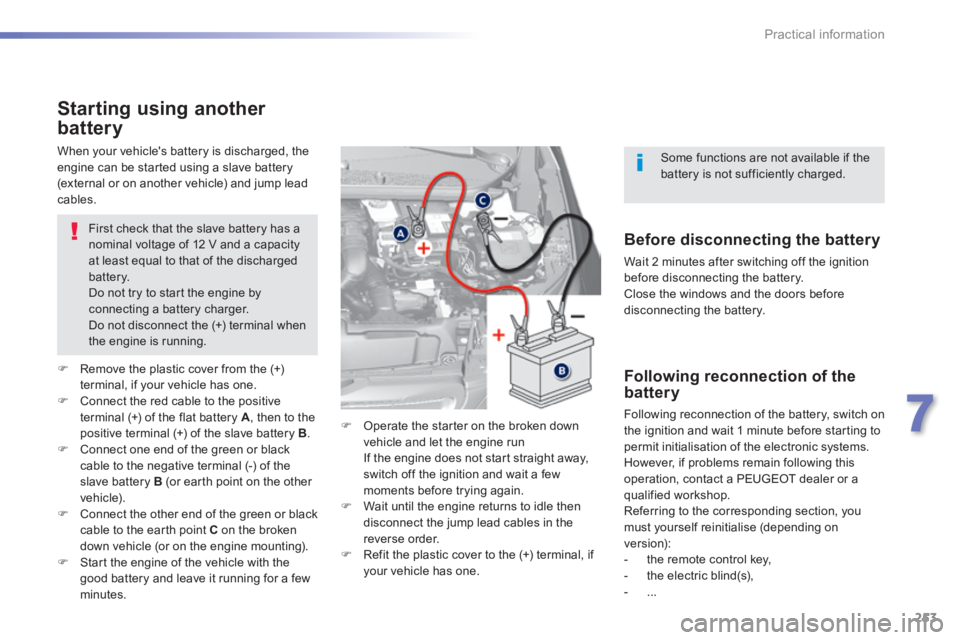
Remove the plastic cover from the (+) terminal, if your vehicle has one. Connect the red cable to the positive terminal (+) of the flat battery A , then to the
positive terminal (+) of the slave battery B . Connect one end of the green or black cable to the negative terminal (-) of the slave battery B (or earth point on the other vehicle). Connect the other end of the green or black cable to the earth point C on the broken down vehicle (or on the engine mounting). Start the engine of the vehicle with the good battery and leave it running for a few minutes.
Operate the starter on the broken down vehicle and let the engine run If the engine does not start straight away, switch off the ignition and wait a few moments before trying again. Wait until the engine returns to idle then disconnect the jump lead cables in the reverse order. Refit the plastic cover to the (+) terminal, if your vehicle has one.
When your vehicle's battery is discharged, the engine can be started using a slave battery (external or on another vehicle) and jump lead cables.
Before disconnecting the battery
Wait 2 minutes after switching off the ignition before disconnecting the battery. Close the windows and the doors before disconnecting the battery.
Following reconnection of the battery
Following reconnection of the battery, switch on
the ignition and wait 1 minute before starting to permit initialisation of the electronic systems. However, if problems remain following this operation, contact a PEUGEOT dealer or a qualified workshop. Referring to the corresponding section, you must yourself reinitialise (depending on version): - the remote control key, - the electric blind(s), - ...
Some functions are not available if the battery is not sufficiently charged.
Page 256 of 400
254
Practical information
308_EN_CHAP07_INFO PR ATIQUES_ED02-2013
The batteries contain harmful substances such as sulphuric acid and lead. They must be disposed of in accordance with regulations and must not, in any circumstances, be discarded with household waste. Take used remote control batteries and vehicle batteries to a special collection point.
It is advisable to disconnect the battery if the vehicle is to be left unused for more than one month.
Protect your eyes and face before handling the battery. All operations on the battery must be carried out in a well ventilated area and away from naked flames and sources of sparks, so as to avoid the risk of explosion or fire. Do not try to charge a frozen battery; the battery must first be thawed out to avoid the risk of explosion. If the battery has been frozen, before charging have it checked by a PEUGEOT dealer or a qualified workshop who will check that the internal components have not been damaged and the casing is not cracked, which could cause a leak of toxic and corrosive acid. Do not reverse the polarity and use only a 12 V charger. Do not disconnect the terminals while the engine is running. Do not charge the batteries without disconnecting the terminals first. Wash your hands after wards.
With Stop & Start, the battery does not have to be disconnected for charging.
Disconnect the battery from the vehicle. Follow the instructions for use provided by the manufacturer of the charger. Connect the battery starting with the negative terminal (-). Check that the terminals and connectors are clean. If they are covered with sulphate (whitish or greenish deposit), remove them and clean them.
Charging the battery using
a battery charger
Page 257 of 400
255
7
Practical information
308_EN_CHAP07_INFO PR ATIQUES_ED02-2013
System which manages the duration of use of certain functions to conserve a sufficient level of charge in the battery. After the engine has stopped, you can still use functions such as the audio and telematics system, windscreen wipers, dipped beam headlamps, courtesy lamps, etc. for a maximum combined duration of about forty minutes.
Energy economy mode
Switching to economy
mode
A message then appears in the instrument panel screen indicating that the vehicle has switched to economy mode and the active functions are put on standby.
If a telephone call is being made at this time, it will be maintained for around 10 minutes with the Bluetooth hands-free system of your audio system.
Exiting economy mode
These functions are reactivated automatically next time the vehicle is driven. In order to restore the use of these functions immediately, start the engine and let it run: - for less than ten minutes, to use the equipment for approximately five minutes, - for more than ten minutes, to use the equipment for up to approximately thirty minutes. Let the engine run for the duration specified to ensure that the battery charge is sufficient. Do not repeatedly and continuously restart the engine in order to charge the battery. A flat battery prevents the engine from starting (refer to the "Battery" section).
Load reduction mode
System which manages the use of certain functions according to the level of charge remaining in the battery. When the vehicle is being driven, the load reduction function temporarily deactivates certain functions, such as the air conditioning, the heated rear screen... The deactivated functions are reactivated automatically as soon as conditions permit.
Page 259 of 400
257
7
Practical information
308_EN_CHAP07_INFO PR ATIQUES_ED02-2013
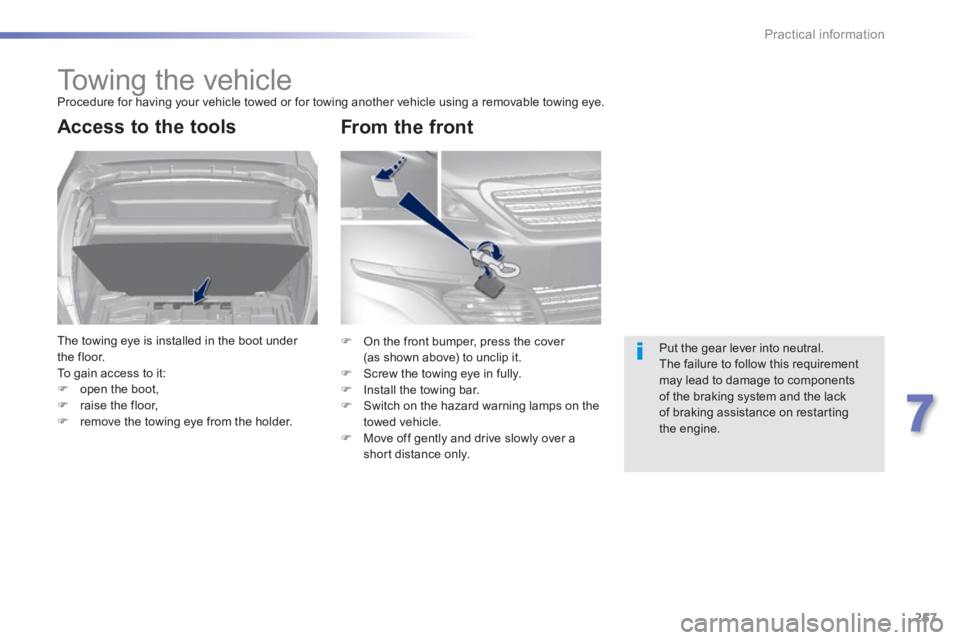
Towing the vehicle Procedure for having your vehicle towed or for towing another vehicle using a removable towing eye.
Access to the tools
The towing eye is installed in the boot under the floor. To gain access to it: open the boot, raise the floor, remove the towing eye from the holder.
Put the gear lever into neutral. The failure to follow this requirement may lead to damage to components of the braking system and the lack of braking assistance on restarting the engine.
On the front bumper, press the cover (as shown above) to unclip it. Screw the towing eye in fully. Install the towing bar. Switch on the hazard warning lamps on the towed vehicle. Move off gently and drive slowly over a short distance only.
From the front
Page 260 of 400
258
Practical information
308_EN_CHAP07_INFO PR ATIQUES_ED02-2013
General recommendations
Observe the legislation in force in your country. Ensure that the weight of the towing vehicle is higher than that of the towed vehicle. The driver must remain at the wheel of the towed vehicle and must have a valid driving licence. When towing a vehicle with all four wheels on the ground, always use an approved towing bar; rope and straps are prohibited. The towing vehicle must move off gently. When towing a vehicle with the engine off, there is no longer any power assistance for braking or steering. In the following cases, you must always call on a professional recovery service: - vehicle broken down on a motor way or fast road, - four-wheel drive vehicle, - when it is not possible to put the gearbox into neutral, unlock the steering, or release the parking brake, - towing with only two wheels on the ground, - where there is no approved towing bar available...
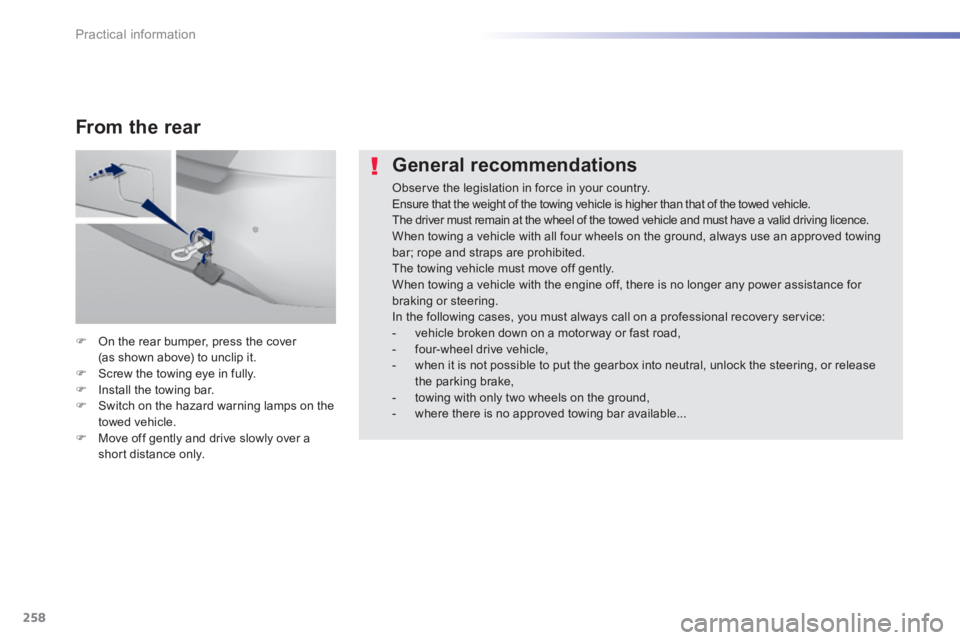
On the rear bumper, press the cover (as shown above) to unclip it. Screw the towing eye in fully. Install the towing bar. Switch on the hazard warning lamps on the towed vehicle. Move off gently and drive slowly over a short distance only.
From the rear
Page 261 of 400
259
7
Practical information
308_EN_CHAP07_INFO PR ATIQUES_ED02-2013
Very cold climate screen
Before fitting or removing the screen, ensure that the engine is off and the cooling fan has stopped. It is recommended that the screen be fitted and removed by a PEUGEOT dealer or a qualified workshop.
Fitting
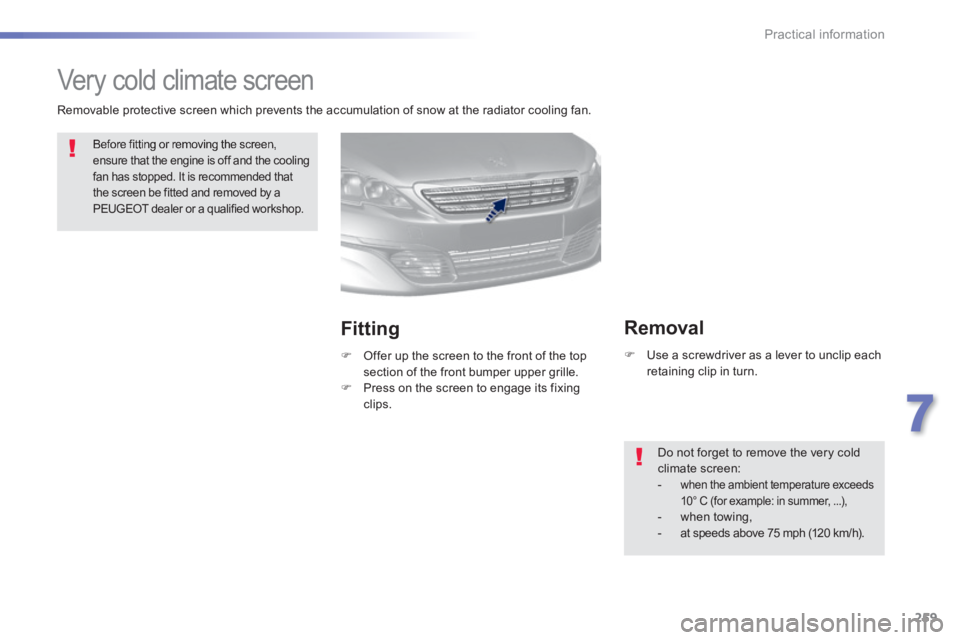
Offer up the screen to the front of the top section of the front bumper upper grille. Press on the screen to engage its fixing clips.
Removal
Use a screwdriver as a lever to unclip each retaining clip in turn.
Do not forget to remove the very cold climate screen: - when the ambient temperature exceeds 10° C (for example: in summer, ...), - when towing, - at speeds above 75 mph (120 km/h).
Removable protective screen which prevents the accumulation of snow at the radiator cooling fan.
Page 263 of 400
261
7
Practical information
308_EN_CHAP07_INFO PR ATIQUES_ED02-2013
Driving advice
Distribution of loads
Distribute the load in the trailer so that the heaviest items are as close as possible to the axle and the nose weight approaches the maximum permitted without
exceeding it. Air density decreases with altitude, thus reducing engine performance. Above 1 000 metres, the maximum towed load must be reduced by 10 % for every 1 000 metres of altitude.
Side wind
Take into account the increased sensitivity to side wind.
Cooling
Towing a trailer on a slope increases the temperature of the coolant. As the fan is electrically controlled, its cooling capacity is not dependent on the engine speed.
To lower the engine speed, reduce your speed. The maximum towed load on a long incline depends on the gradient and the ambient temperature. In all cases, keep a check on the coolant temperature.
If the warning lamp and the STOP warning lamp come on, stop the vehicle and switch off the engine as soon as possible.
Braking
Towing a trailer increases the braking distance. To avoid overheating of the brakes on a long mountain type of descent, the use of engine braking is recommended.
Ty r e s
Check the tyre pressures of the towing vehicle and of the trailer, observing the recommended pressures.
Lighting
Check the electrical lighting and signalling on the trailer.
The rear parking sensors will be deactivated automatically if a genuine PEUGEOT towbar is used.
Refer to the "Technical data" section for details of the weights and towed loads which apply to your vehicle.
Page 268 of 400
266
Checks
308_EN_CHAP08_VERIFICATIONS_ED02-2013
PEUGEOT & TOTAL
Partners in performance and
protection of the environment
Innovation at the service of performance
The TOTAL Research and Development teams develop lubricants for PEUGEOT which satisfy the requirements of the latest technical innovations incorporated in PEUGEOT vehicles. This ensures that you obtain the best per formance and the maximum engine life.
Reduced exhaust emissions
TOTAL lubricants are formulated to optimise the efficiency of engines and the protection of the emissions post-treatment systems. It is crucial to
observe the servicing recommendations made by PEUGEOT to ensure correct operation.
RECOMMENDS RECOMMENDS