start Peugeot 308 2016 Manual PDF
[x] Cancel search | Manufacturer: PEUGEOT, Model Year: 2016, Model line: 308, Model: Peugeot 308 2016Pages: 398, PDF Size: 9.38 MB
Page 238 of 398
236
308_en_Chap07_info-pratiques_ed02-2015
Range indicators
Once the AdBlue® tank is on reserve or after
detection of a fault with the SCR emissions
control system, when the ignition is switched
on, an indicator displays an estimate of the
distance that can be covered, the range, before
engine starting is prevented.
In the event of simultaneous system fault and
low AdBlue
® level, the shortest range figure is
the one displayed.
In the event of the risk of non-starting related to a lack of AdBlue®
the engine start prevention system
r equired by regulations is activated
automatically once the AdBlue
® tank is
e m pt y.
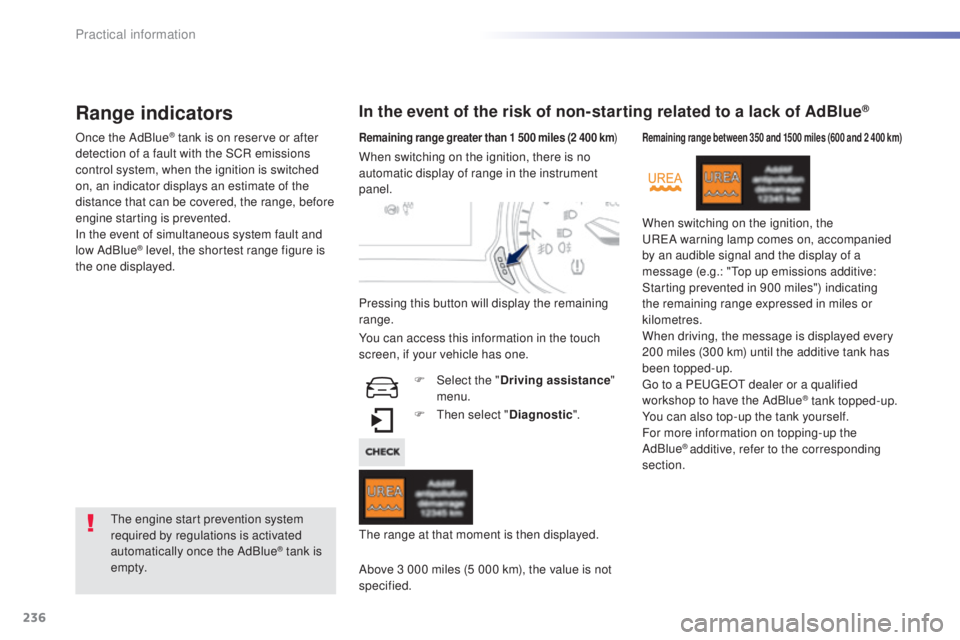
Remaining range greater than 1 500 miles (2 400 km )
Pressing this button will display the remaining
range.
F
t
hen se
lect "Diagnostic ".
Above 3 000 miles (5 000 km), the value is not
specified. When switching on the ignition, there is no
automatic display of range in the instrument
panel.
the r
ange at that moment is then displayed.
You can access this information in the touch
screen, if your vehicle has one.
F
Selec
t the "Driving assistance "
menu.
Remaining range between 350 and 1500 miles (600 and 2 400 km)
When switching on the ignition, the uReA w arning lamp comes on, accompanied
by an audible signal and the display of a
message (e.g.: "
top u
p emissions additive:
Starting prevented in 900 miles") indicating
the remaining range expressed in miles or
kilometres.
When driving, the message is displayed every
200 miles (300 km) until the additive tank has
been topped-up.
go to a Peu
ge
Ot d
ealer or a qualified
workshop to have the AdBlue
® tank topped-up.
You can also top-up the tank yourself.
For more information on topping-up the
AdBlue
® additive, refer to the corresponding
section.
Practical information
Page 239 of 398
237
308_en_Chap07_info-pratiques_ed02-2015
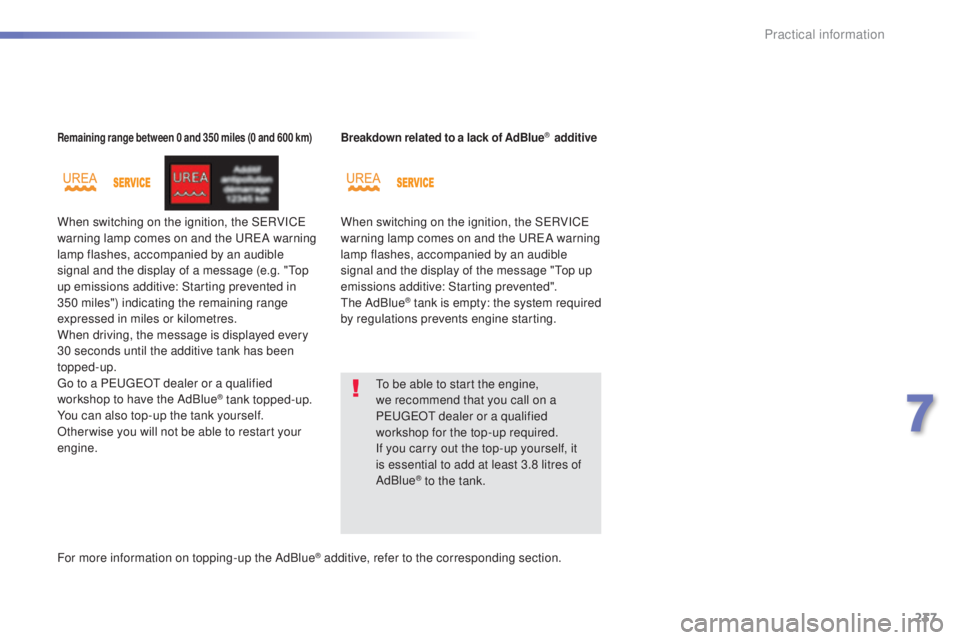
Remaining range between 0 and 350 miles (0 and 600 km)
When switching on the ignition, the SeRVICe
w arning lamp comes on and the uReA wa rning
lamp flashes, accompanied by an audible
signal and the display of a message (e.g. "
top
u
p emissions additive: Starting prevented in
350 miles") indicating the remaining range
expressed in miles or kilometres.
When driving, the message is displayed every
30 seconds until the additive tank has been
topped-up.
go to a Peu
ge
Ot d
ealer or a qualified
workshop to have the AdBlue
® tank topped-up.
You can also top-up the tank yourself.
Other wise you will not be able to restart your
engine.
Breakdown related to a lack of AdBlue® additive
When switching on the ignition, the SeRV ICe
w arning lamp comes on and the uReA wa rning
lamp flashes, accompanied by an audible
signal and the display of the message "
top u
p
emissions additive: Starting prevented".
the
AdBlue
® tank is empty: the system required
by regulations prevents engine starting.
to be a
ble to start the engine,
we recommend that you call on a
P
eu
ge
Ot d
ealer or a qualified
workshop for the top-up required.
If you carry out the top-up yourself, it
is essential to add at least 3.8 litres of
AdBlue
® to the tank.
For more information on topping-up the AdBlue
® additive, refer to the corresponding section.
7
Practical information
Page 240 of 398
238
308_en_Chap07_info-pratiques_ed02-2015
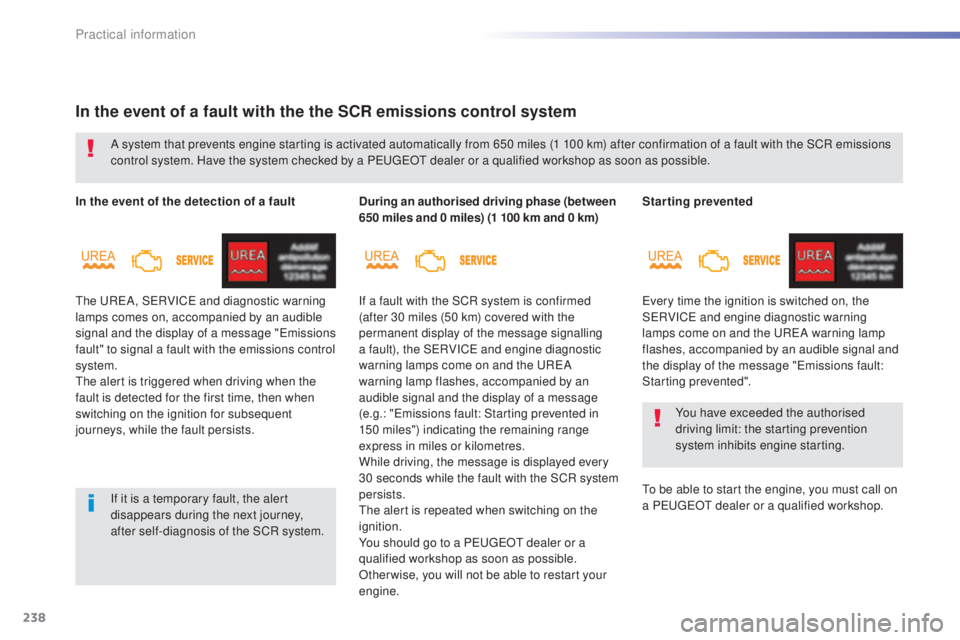
Starting prevented
eve
ry time the ignition is switched on, the
S
eRV
IC
e and
engine diagnostic warning
lamps come on and the
uReA wa
rning lamp
flashes, accompanied by an audible signal and
the display of the message "
emi
ssions fault:
Starting prevented".
You have exceeded the authorised
driving limit: the starting prevention
system inhibits engine starting.
to be a
ble to start the engine, you must call on
a P
eu
ge
Ot d
ealer or a qualified workshop.
In the event of a fault with the the SCR emissions control system
A system that prevents engine starting is activated automatically from 650 miles (1 100 km) after confirmation of a fault with the SCR emissions
co ntrol system. Have the system checked by a Peu geOt d ealer or a qualified workshop as soon as possible.
If it is a temporary fault, the alert
disappears during the next journey,
after self-diagnosis of the SCR system.
In the event of the detection of a fault
the uReA, SeRV
IC
e a
nd diagnostic warning
lamps comes on, accompanied by an audible
signal and the display of a message "
emi
ssions
fault" to signal a fault with the emissions control
system.
the a
lert is triggered when driving when the
fault is detected for the first time, then when
switching on the ignition for subsequent
journeys, while the fault persists. During an authorised driving phase (between
650 miles and 0 miles) (1 100 km and 0 km)
If a fault with the SCR system is confirmed
(after 30 miles (50 km) covered with the
permanent display of the message signalling
a fault), the S
eRV
IC
e a
nd engine diagnostic
warning lamps come on and the
uReA
war
ning lamp flashes, accompanied by an
audible signal and the display of a message
(e.g.: "
emi
ssions fault: Starting prevented in
150
m
iles") indicating the remaining range
express in miles or kilometres.
While driving, the message is displayed every
30 seconds while the fault with the SCR system
persists.
the a
lert is repeated when switching on the
ignition.
You should go to a P
eu
ge
Ot d
ealer or a
qualified workshop as soon as possible.
Other wise, you will not be able to restart your
engine.
Practical information
Page 241 of 398
239
308_en_Chap07_info-pratiques_ed02-2015
Topping-up the AdBlue® additive
Filling the AdBlue® tank is an operation
included in every routine service on your
vehicle by a P
eu
ge
Ot d
ealer or a qualified
workshop.
Nevertheless, given the capacity of the tank,
it may be necessary to top-up the additive
between services, more particularly if an alert
(warning lamps and a message) signals the
requirement.
You can got to a P
eu
ge
Ot d
ealer or a
qualified workshop.
If you envisage topping-up yourself, please
read the following warnings carefully.Precautions in use
Keep AdBlue® out of the reach of
children, in its original bottle.
Never transfer AdBlue
® to another
container: it would lose its purity.
use
only AdBlue
® additive that meets the
ISO 22241 standard.
Never dilute the additive with water.
Never pour the additive into the Diesel
fuel tank.
the s
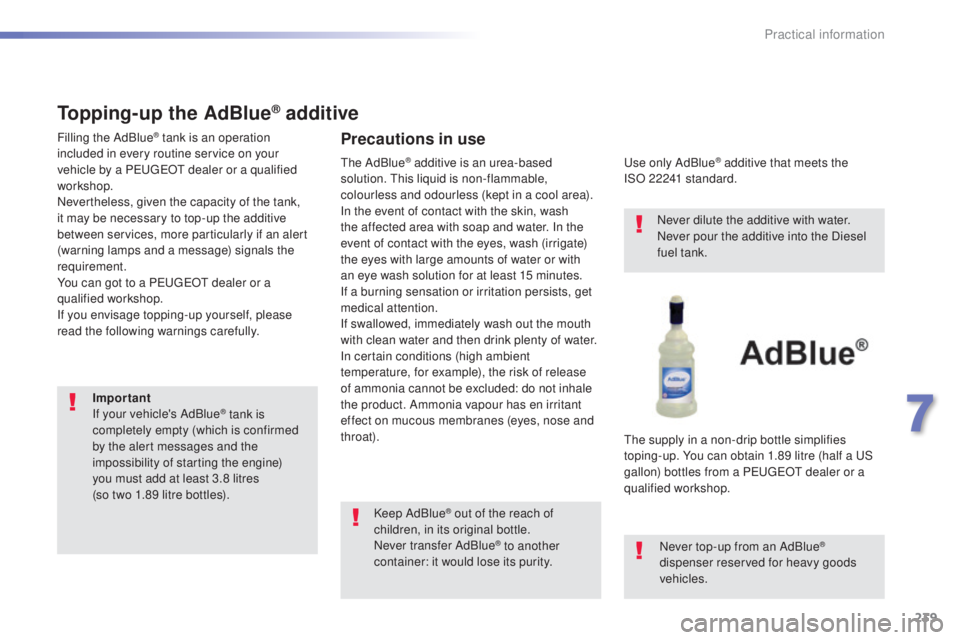
upply in a non-drip bottle simplifies
toping-up. You can obtain 1.89 litre (half a
uS
ga
llon) bottles from a P
eu
ge
Ot d
ealer or a
qualified workshop.
Never top-up from an AdBlue
®
dispenser reserved for heavy goods
vehicles.
the
AdBlue
® additive is an urea-based
solution. thi
s liquid is non-flammable,
colourless and odourless (kept in a cool area).
In the event of contact with the skin, wash
the affected area with soap and water. In the
event of contact with the eyes, wash (irrigate)
the eyes with large amounts of water or with
an eye wash solution for at least 15 minutes.
If a burning sensation or irritation persists, get
medical attention.
If swallowed, immediately wash out the mouth
with clean water and then drink plenty of water.
In certain conditions (high ambient
temperature, for example), the risk of release
of ammonia cannot be excluded: do not inhale
the product. Ammonia vapour has en irritant
effect on mucous membranes (eyes, nose and
throat).
Important
If your vehicle's AdBlue
® tank is
co
mpletely empty (which is confirmed
by the alert messages and the
impossibility of starting the engine)
you must add at least 3.8 litres
(so two 1.89 litre bottles).
7
Practical information
Page 243 of 398
241
308_en_Chap07_info-pratiques_ed02-2015
Never dispose of AdBlue® additive
bottles in the household waste. Place
them in a special container provided
this purpose or take them to your dealer.
F
Af
ter emptying the bottle, wipe away any
spillage around the tank filler using a damp
cloth. If any additive is split or splashed, wash
immediately with cold water or wipe with
a damp cloth.
If the additive has crystallised, clean it
off using a sponge and hot water.
F
Re
fit the blue cap to the tank and turn it a
6
th of a turn clockwise, to its stop.
F Re fit the black cap and turn it a quarter of
a turn clockwise without pressing.
ens
ure
that the indicator on the cap lines up with
the indicator on the support.
F
De
pending on equipment, return the spare
wheel and/or the storage box to the bottom
of the boot.
F
Re
fit the boot carpet and close the tailgate. Important: when topping
-up after
running out of additive , signalled
by the message "
top u
p emissions
additive: Starting prevented", you
must wait for about 5 minutes before
switching on the ignition, without
opening the driver's door, unlocking
the vehicle, introducing the key
into the ignition switch, or placing
the key of the "Keyless Entr y and
Star ting" system inside the vehicle .
Switch on the ignition, then wait for
10
se
conds before starting the engine.
F
Ob
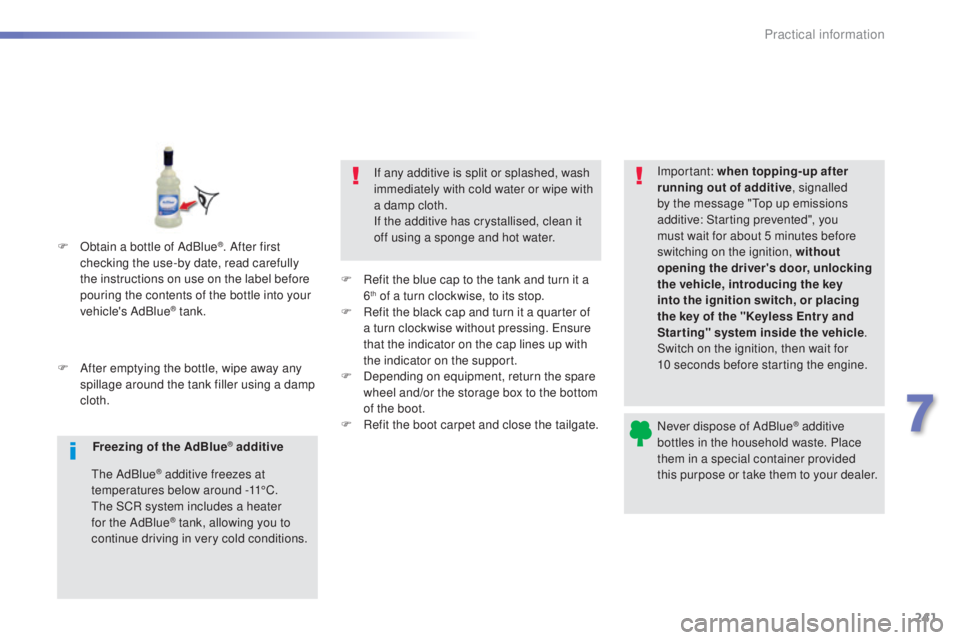
tain a bottle of AdBlue
®. After first
checking the use-by date, read carefully
the instructions on use on the label before
pouring the contents of the bottle into your
vehicle's AdBlue
® tank.
Freezing of the AdBlue
® additive
the
AdBlue
® additive freezes at
temperatures below around -11°C.
the S
CR system includes a heater
for the AdBlue
® tank, allowing you to
continue driving in very cold conditions.
7
Practical information
Page 248 of 398
246
308_en_Chap08_en-cas-de-panne_ed02-2015
Repair procedure
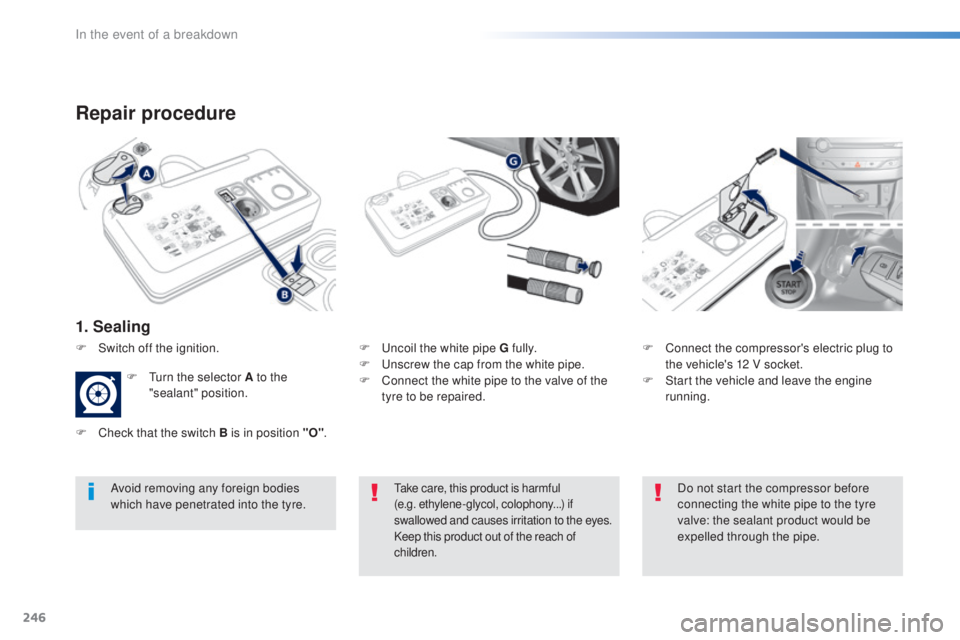
1. Sealing
F uncoil the white pipe G fully.
F uns crew the cap from the white pipe.
F
Co
nnect the white pipe to the valve of the
tyre to be repaired. F Co
nnect the compressor's electric plug to
the vehicle's 12 V socket.
F
St
art the vehicle and leave the engine
running.
take care, this product is harmful
( e.g. e thylene-glycol, colophony...) if
swallowed and causes irritation to the eyes.
Keep this product out of the reach of
children.Avoid removing any foreign bodies
which have penetrated into the tyre. Do not start the compressor before
connecting the white pipe to the tyre
valve: the sealant product would be
expelled through the pipe.
F
Swi
tch off the ignition.
F
t
ur
n the selector A to the
"sealant" position.
F
Ch
eck that the switch B is in position "O"
.
In the event of a breakdown
Page 252 of 398
250
308_en_Chap08_en-cas-de-panne_ed02-2015
Changing a wheel
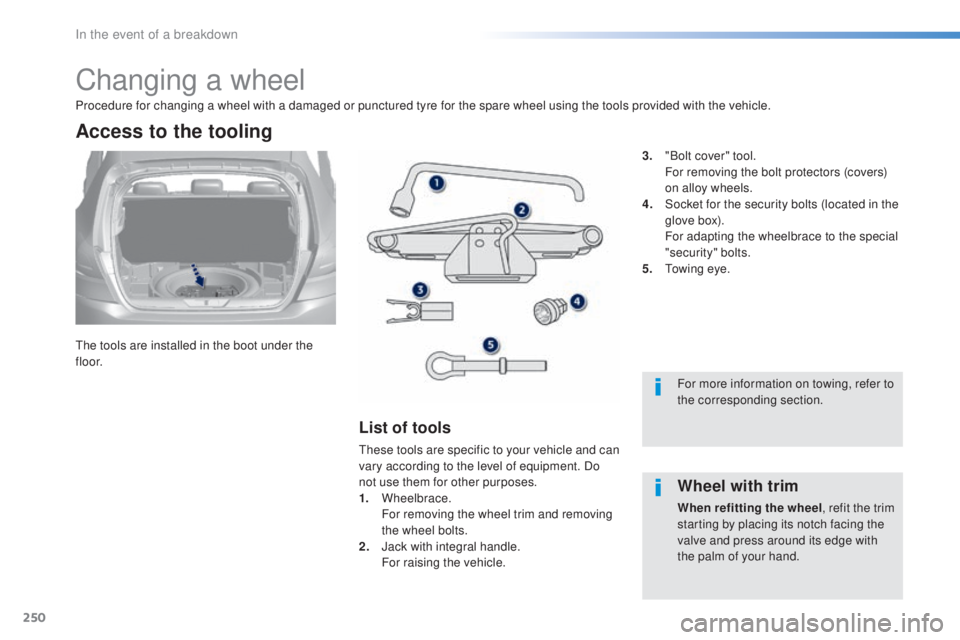
the tools are installed in the boot under the
f l o o r.
Access to the tooling
List of tools
these tools are specific to your vehicle and can
v ary according to the level of equipment. Do
not use them for other purposes.
1.
W
heelbrace.
Fo
r removing the wheel trim and removing
the wheel bolts.
2.
Ja
ck with integral handle.
Fo
r raising the vehicle. 3.
"B
olt cover" tool.
Fo
r removing the bolt protectors (covers)
on alloy wheels.
4.
So
cket for the security bolts (located in the
glove box).
Fo
r adapting the wheelbrace to the special
"security" bolts.
5.
tow
ing eye.
Procedure for changing a wheel with a damaged or punctured tyre for the spare wheel using the tools provided with the vehicle.
For more information on towing, refer to
the corresponding section.
Wheel with trim
When refitting the wheel, refit the trim
starting by placing its notch facing the
valve and press around its edge with
the palm of your hand.
In the event of a breakdown
Page 270 of 398
268
308_en_Chap08_en-cas-de-panne_ed02-2015
Dashboard fuses
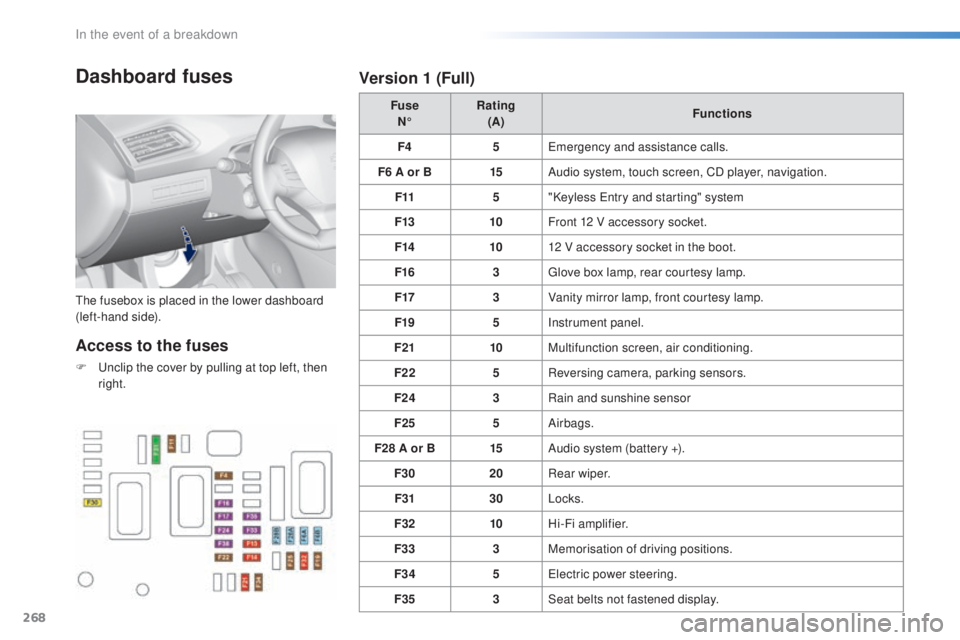
the fusebox is placed in the lower dashboard
( left-hand side). Fuse
N° Rating
(A) Functions
F4 5
eme
rgency and assistance calls.
F6 A or B 15Audio system, touch screen, CD player, navigation.
F11 5"Keyless
ent
ry and starting" system
F13 10Front 12 V accessory socket.
F14 1012 V accessory socket in the boot.
F16 3
glov
e box lamp, rear courtesy lamp.
F17 3Vanity mirror lamp, front courtesy lamp.
F19 5Instrument panel.
F21 10Multifunction screen, air conditioning.
F22 5Reversing camera, parking sensors.
F24 3Rain and sunshine sensor
F25 5Airbags.
F28 A or B 15Audio system (battery +).
F30 20Rear wiper.
F31 30Locks.
F32 10Hi-Fi amplifier.
F33 3Memorisation of driving positions.
F34 5
ele
ctric power steering.
F35 3Seat belts not fastened display.
Access to the fuses
F unclip the cover by pulling at top left, then
r ight.
Version 1 (Full)
In the event of a breakdown
Page 274 of 398
272
308_en_Chap08_en-cas-de-panne_ed02-2015
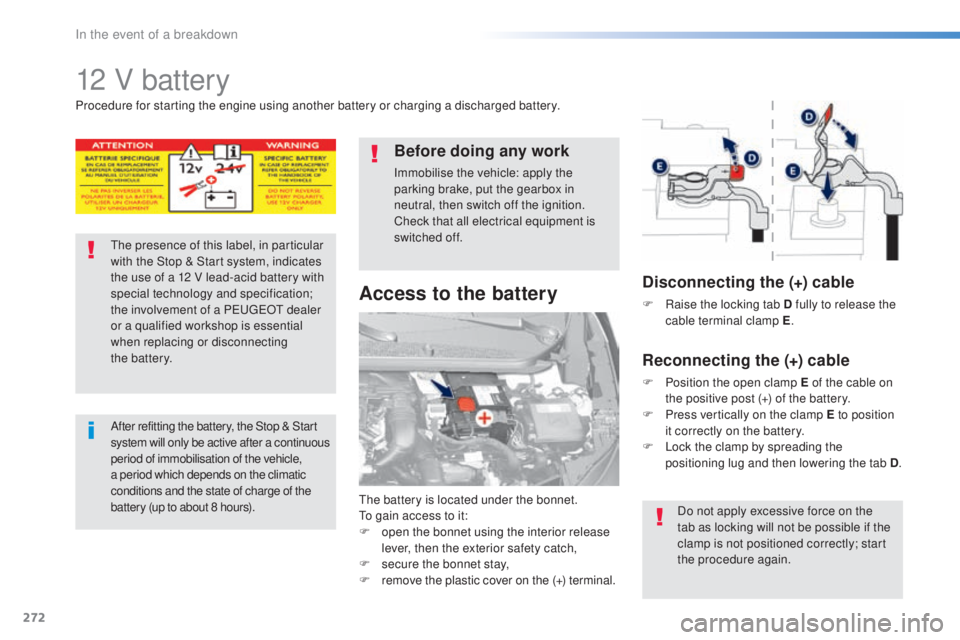
12 V battery
the battery is located under the bonnet.to ga
in access to it:
F
op
en the bonnet using the interior release
lever, then the exterior safety catch,
F
se
cure the bonnet stay,
F
re
move the plastic cover on the (+)
t
erminal.
Access to the battery
Procedure for starting the engine using another battery or charging a discharged battery.
the
presence of this label, in particular
with the Stop & Start system, indicates
the use of a 12 V lead-acid battery with
special technology and specification;
the involvement of a P
eu
ge
Ot d
ealer
or a qualified workshop is essential
when replacing or disconnecting
the
b
attery.
After refitting the battery, the Stop & Start
sy stem will only be active after a continuous
period of immobilisation of the vehicle,
a period which depends on the climatic
conditions and the state of charge of the
battery (up to about 8 hours).
Before doing any work
Immobilise the vehicle: apply the
parking brake, put the gearbox in
neutral, then switch off the ignition.
Check that all electrical equipment is
switched off.
Disconnecting the (+) cable
F Raise the locking tab D fully to release the
c able terminal clamp E .
Reconnecting the (+) cable
F Position the open clamp E of the cable on
t
he positive post (+) of the battery.
F
Pr
ess vertically on the clamp E to position
it correctly on the battery.
F
Lo
ck the clamp by spreading the
positioning lug and then lowering the tab D .
Do not apply excessive force on the
tab as locking will not be possible if the
clamp is not positioned correctly; start
the procedure again.
In the event of a breakdown
Page 275 of 398
273
308_en_Chap08_en-cas-de-panne_ed02-2015
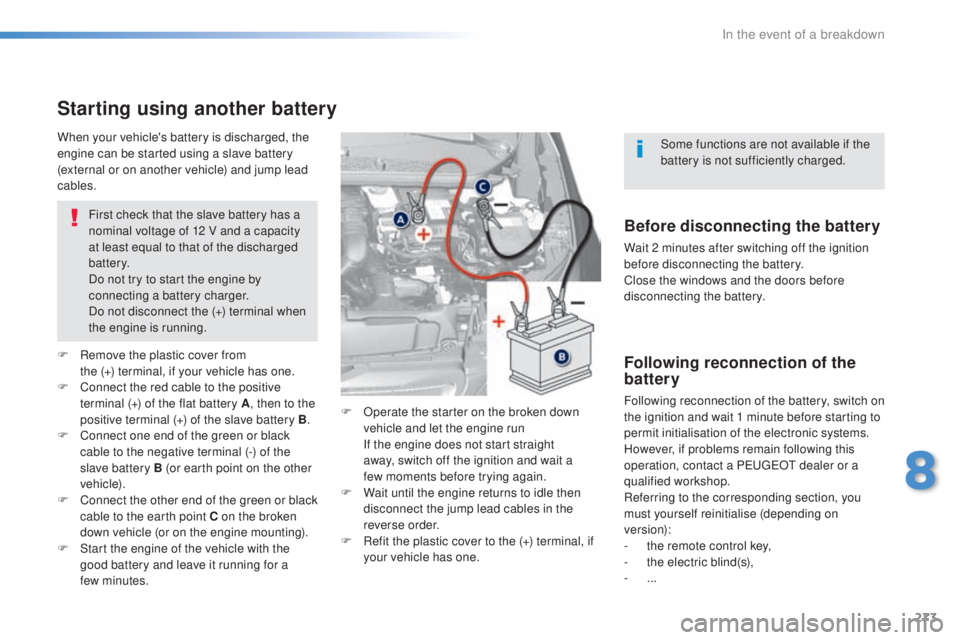
Starting using another battery
First check that the slave battery has a
nominal voltage of 12 V and a capacity
at least equal to that of the discharged
battery.
Do not try to start the engine by
connecting a battery charger.
Do not disconnect the (+) terminal when
the engine is running.
F
Re
move the plastic cover from
the
(
+)
t
erminal, if your vehicle has one.
F
Co
nnect the red cable to the positive
terminal (+) of the flat battery A , then to the
positive terminal (+) of the slave battery B.
F
Co
nnect one end of the green or black
cable to the negative terminal (-) of the
slave battery B (or earth point on the other
vehicle).
F
Co
nnect the other end of the green or black
cable to the earth point C on the broken
down vehicle (or on the engine mounting).
F
St
art the engine of the vehicle with the
good battery and leave it running for a
few
m
inutes. F
Op
erate the starter on the broken down
vehicle and let the engine run
If t
he engine does not start straight
away, switch off the ignition and wait a
few
m
oments before trying again.
F
Wa
it until the engine returns to idle then
disconnect the jump lead cables in the
reverse order.
F
Re
fit the plastic cover to the (+) terminal, if
your vehicle has one.
When your vehicle's battery is discharged, the
engine can be started using a slave battery
(external or on another vehicle) and jump lead
cables.Before disconnecting the battery
Wait 2 minutes after switching off the ignition
before disconnecting the battery.
Close the windows and the doors before
disconnecting the battery.
Following reconnection of the
battery
Following reconnection of the battery, switch on
the ignition and wait 1 minute before starting to
permit initialisation of the electronic systems.
However, if problems remain following this
operation, contact a P
eu
ge
Ot d
ealer or a
qualified workshop.
Referring to the corresponding section, you
must yourself reinitialise (depending on
version):
-
th
e remote control key,
-
th
e electric blind(s),
-
... S
ome functions are not available if the
battery is not sufficiently charged.
8
In the event of a breakdown