Rear Peugeot 308 CC 2011 Service Manual
[x] Cancel search | Manufacturer: PEUGEOT, Model Year: 2011, Model line: 308 CC, Model: Peugeot 308 CC 2011Pages: 292, PDF Size: 40.04 MB
Page 114 of 292
7
i
11 2
SAFETY
Lateral airbags
System which protects the driver and
front passenger in the event of a seri-
ous side impact in order to limit the risk
of injury to the pelvis, chest and head.
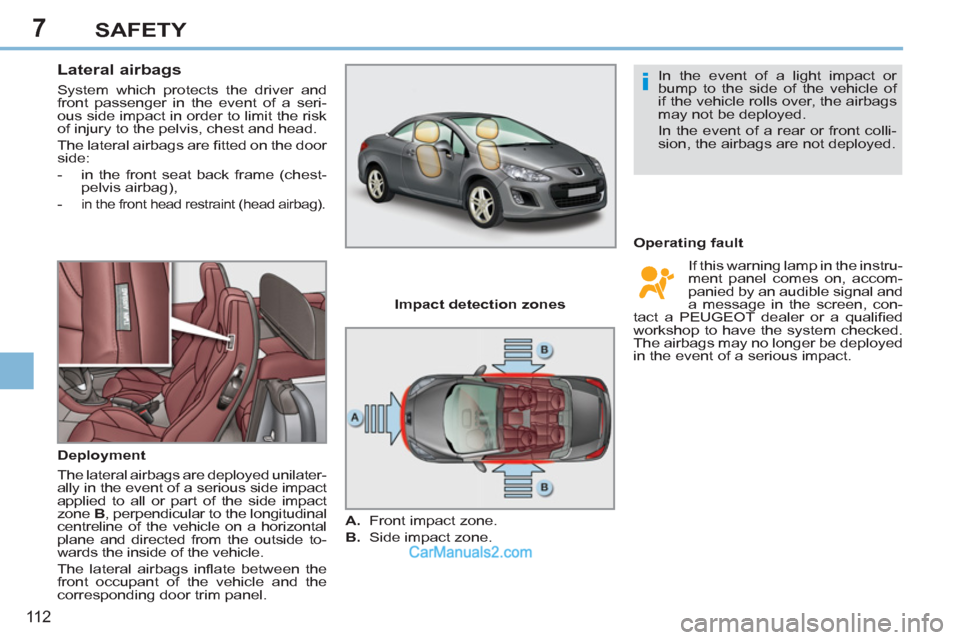
The lateral airbags are fi tted on the door
side:
- in the front seat back frame (chest-
pelvis airbag),
-
in the front head restraint (head airbag).
Deployment
The lateral airbags are deployed unilater-
ally in the event of a serious side impact
applied to all or part of the side impact
zone B
, perpendicular to the longitudinal
centreline of the vehicle on a horizontal
plane and directed from the outside to-
wards the inside of the vehicle.
The lateral airbags infl ate between the
front occupant of the vehicle and the
corresponding door trim panel.
Operating fault
Impact detection zones
A.
Front impact zone.
B.
Side impact zone. If this warning lamp in the instru-
ment panel comes on, accom-
panied by an audible signal and
a message in the screen, con-
tact a PEUGEOT dealer or a qualifi ed
workshop to have the system checked.
The airbags may no longer be deployed
in the event of a serious impact.
In the event of a light impact or
bump to the side of the vehicle of
if the vehicle rolls over, the airbags
may not be deployed.
In the event of a rear or front colli-
sion, the airbags are not deployed.
Page 116 of 292
7
i
11 4
SAFETY
PEUGEOT recommends
that chil-
dren should travel in the rear seats
of your vehicle:
- "rearwards-facing"
up to the
age of 2,
- "forwards-facing"
over the
age of 2.
GENERAL POINTS RELATING
TO CHILD SEATS CHILD SEAT IN THE FRONT
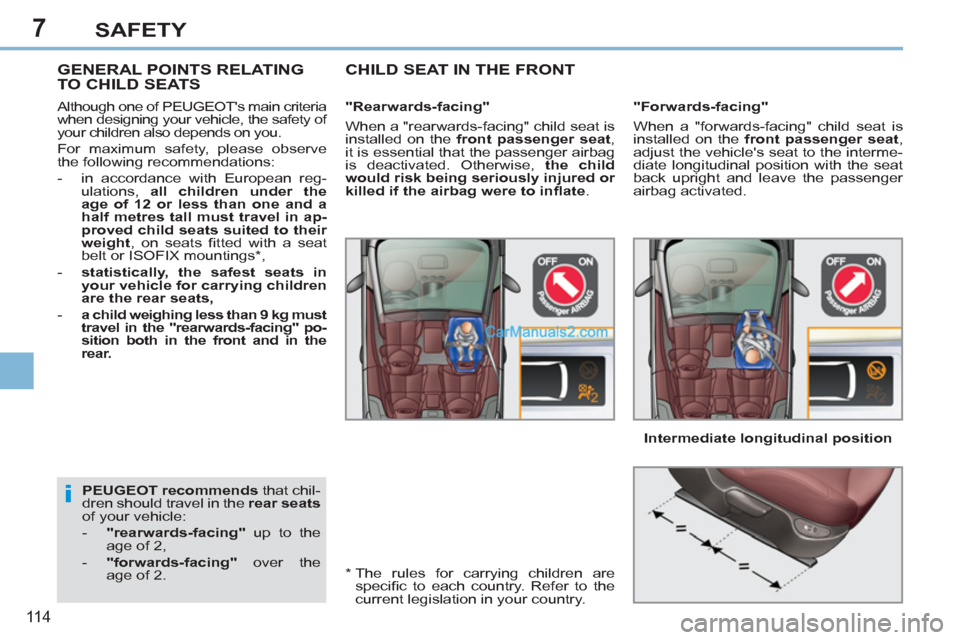
"Forwards-facing"
When a "forwards-facing" child seat is
installed on the front passenger seat
,
adjust the vehicle's seat to the interme-
diate longitudinal position with the seat
back upright and leave the passenger
airbag activated.
"Rearwards-facing"
When a "rearwards-facing" child seat is
installed on the front passenger seat
,
it is essential that the passenger airbag
is deactivated. Otherwise, the child
would risk being seriously injured or
killed if the airbag were to infl ate
.
*
The rules for carrying children are
specifi c to each country. Refer to the
current legislation in your country. Although one of PEUGEOT's main criteria
when designing your vehicle, the safety of
your children also depends on you.
For maximum safety, please observe
the following recommendations:
- in accordance with European reg-
ulations, all children under the
age of 12 or less than one and a
half metres tall must travel in ap-
proved child seats suited to their
weight
, on seats fi tted with a seat
belt or ISOFIX mountings * ,
- statistically, the safest seats in
your vehicle for carrying children
are the rear seats,
- a child weighing less than 9 kg must
travel in the "rearwards-facing" po-
sition both in the front and in the
rear.
Intermediate longitudinal position
Page 117 of 292
7
!
11 5
SAFETY
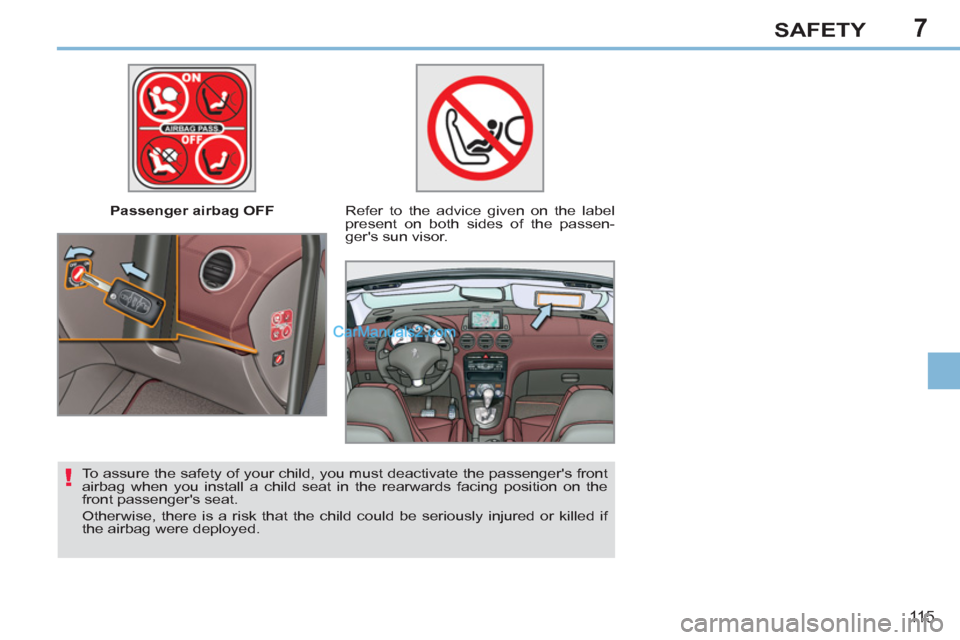
Passenger airbag OFF
Refer to the advice given on the label
present on both sides of the passen-
ger's sun visor.
To assure the safety of your child, you must deactivate the passenger's front
airbag when you install a child seat in the rearwards facing position on the
front passenger's seat.
Otherwise, there is a risk that the child could be seriously injured or killed if
the airbag were deployed.
Page 118 of 292
7
11 6
SAFETY
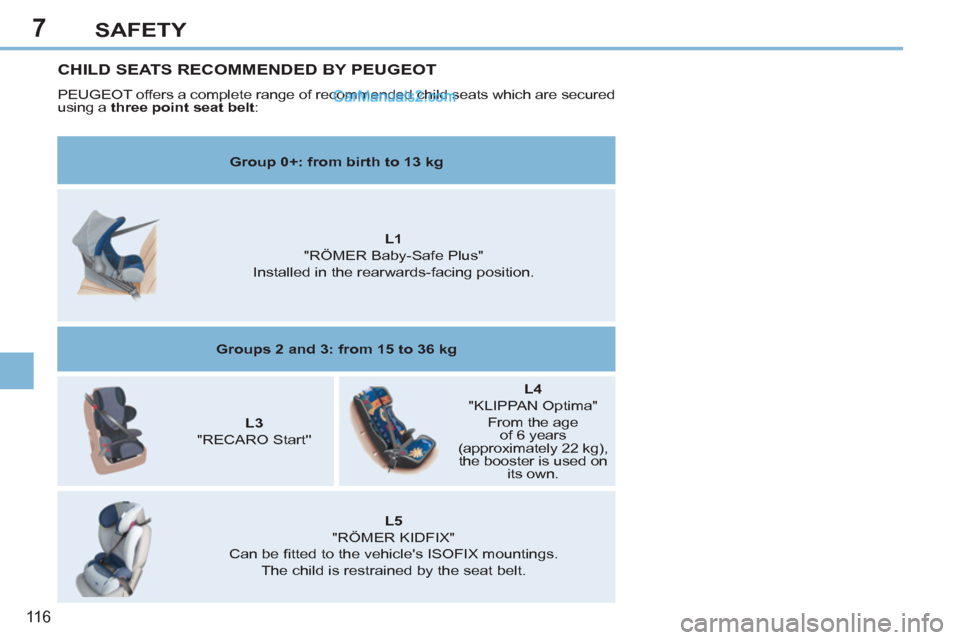
CHILD SEATS RECOMMENDED BY PEUGEOT
PEUGEOT offers a complete range of recommended child seats which are secured
using a three point seat belt
:
Group 0+: from birth to 13 kg
L1
"RÖMER Baby-Safe Plus"
Installed in the rearwards-facing position.
Groups 2 and 3: from 15 to 36 kg
L3
"RECARO Start''
L4
"KLIPPAN Optima"
From the age
of 6 years
(approximately 22 kg),
the booster is used on
its own.
L5
"RÖMER KIDFIX"
Can be fi tted to the vehicle's ISOFIX mountings.
The child is restrained by the seat belt.
Page 119 of 292
7
11 7
SAFETY
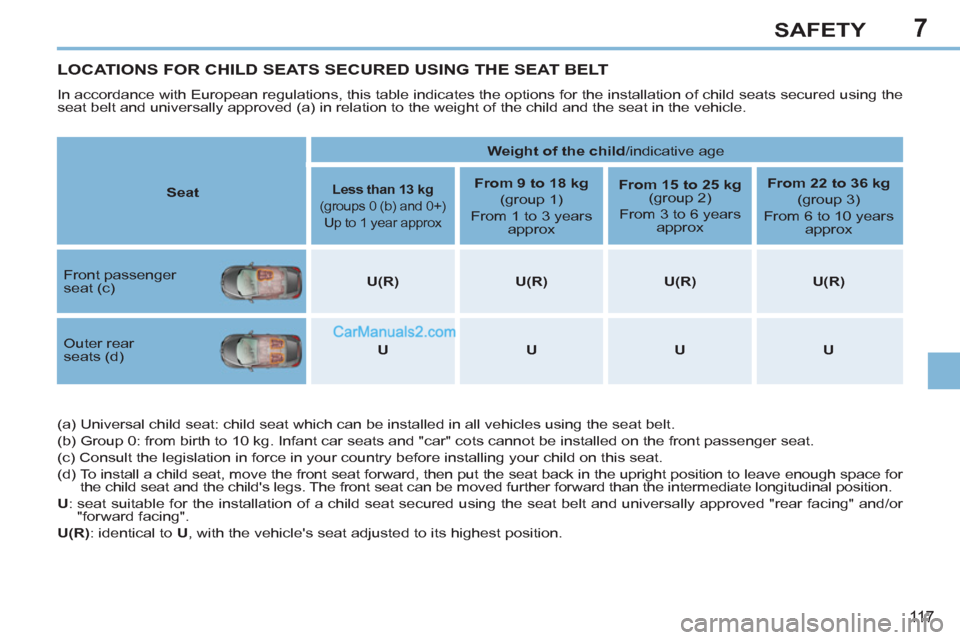
LOCATIONS FOR CHILD SEATS SECURED USING THE SEAT BELT
In accordance with European regulations, this table indicates the options for the installation of child seats secured using the
seat belt and universally approved (a) in relation to the weight of the child and the seat in the vehicle.
(a) Universal child seat: child seat which can be installed in all vehicles using the seat belt.
(b) Group 0: from birth to 10 kg. Infant car seats and "car" cots cannot be installed on the front passenger seat.
(c) Consult the legislation in force in your country before installing your child on this seat.
(d) To install a child seat, move the front seat forward, then put the seat back in the upright position to leave enough space for
the child seat and the child's legs. The front seat can be moved further forward than the intermediate longitudinal position.
U
: seat suitable for the installation of a child seat secured using the seat belt and universally approved "rear facing" and/or
"forward facing".
U(R)
: identical to U
, with the vehicle's seat adjusted to its highest position.
Seat
Weight of the child
/indicative age
Less than 13 kg
(groups 0 (b) and 0+)
Up to 1 year approx
From 9 to 18 kg
(group 1)
From 1 to 3 years
approx
From 15 to 25 kg
(group 2)
From 3 to 6 years
approx
From 22 to 36 kg
(group 3)
From 6 to 10 years
approx
Front passenger
seat (c)
U(R)
U(R)
U(R)
U(R)
Outer rear
seats (d)
U
U
U
U
Page 120 of 292
7
!
11 8
SAFETY
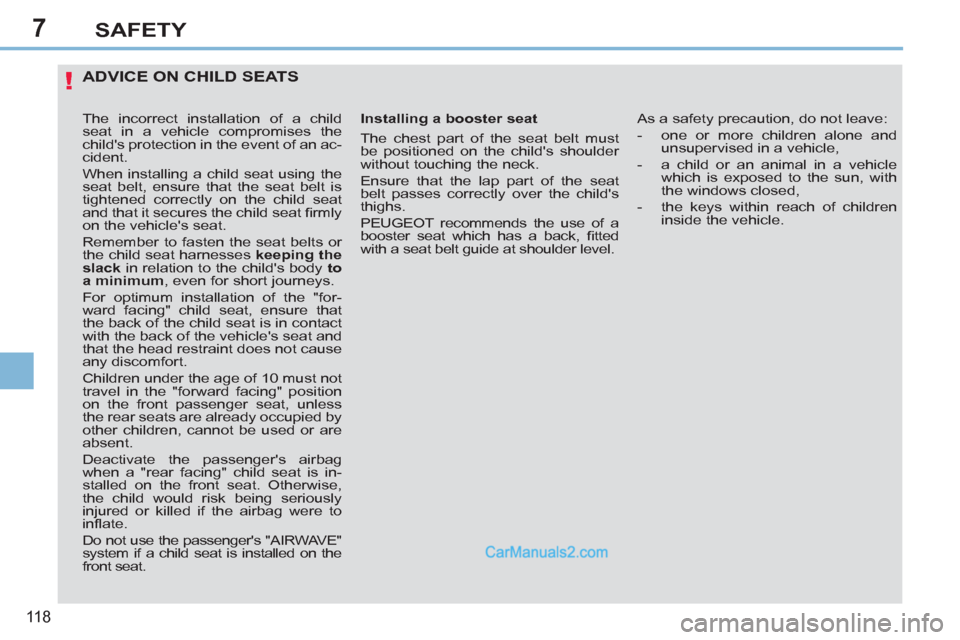
ADVICE ON CHILD SEATS
Installing a booster seat
The chest part of the seat belt must
be positioned on the child's shoulder
without touching the neck.
Ensure that the lap part of the seat
belt passes correctly over the child's
thighs.
PEUGEOT recommends the use of a
booster seat which has a back, fi tted
with a seat belt guide at shoulder level. As a safety precaution, do not leave:
- one or more children alone and
unsupervised in a vehicle,
- a child or an animal in a vehicle
which is exposed to the sun, with
the windows closed,
- the keys within reach of children
inside the vehicle.
The incorrect installation of a child
seat in a vehicle compromises the
child's protection in the event of an ac-
cident.
When installing a child seat using the
seat belt, ensure that the seat belt is
tightened correctly on the child seat
and that it secures the child seat fi rmly
on the vehicle's seat.
Remember to fasten the seat belts or
the child seat harnesses keeping
the
slack
in relation to the child's body to
a minimum
, even for short journeys.
For optimum installation of the "for-
ward facing" child seat, ensure that
the back of the child seat is in contact
with the back of the vehicle's seat and
that the head restraint does not cause
any discomfort.
Children under the age of 10 must not
travel in the "forward facing" position
on the front passenger seat, unless
the rear seats are already occupied by
other children, cannot be used or are
absent.
Deactivate the passenger's airbag
when a "rear facing" child seat is in-
stalled on the front seat. Otherwise,
the child would risk being seriously
injured or killed if the airbag were to
infl ate.
Do not use the passenger's "AIRWAVE"
system if a child seat is installed on the
front seat.
Page 123 of 292
7
121
SAFETY
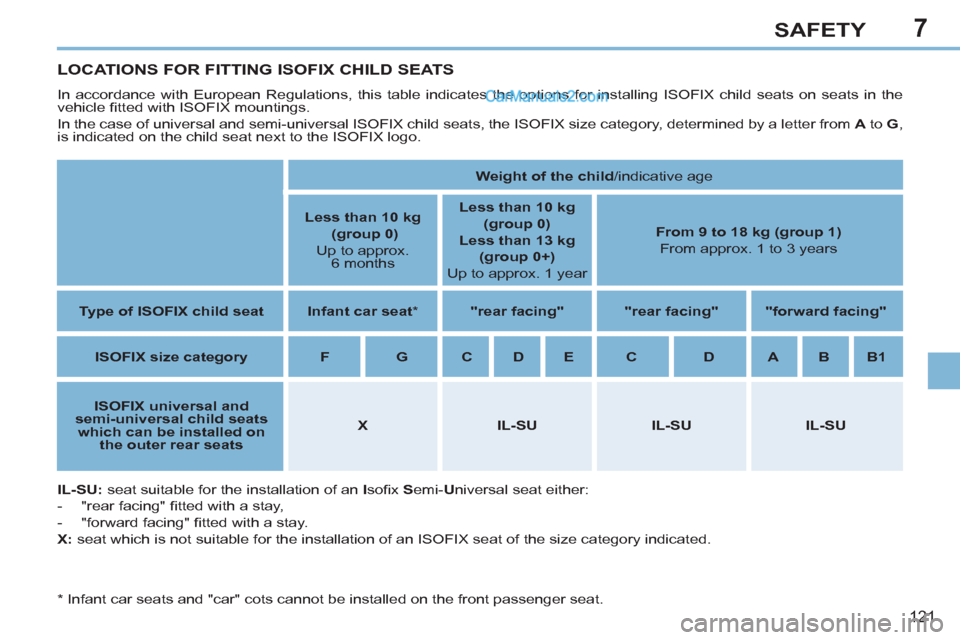
LOCATIONS FOR FITTING ISOFIX CHILD SEATS
In accordance with European Regulations, this table indicates the options for installing ISOFIX child seats on seats in the
vehicle fi tted with ISOFIX mountings.
In the case of universal and semi-universal ISOFIX child seats, the ISOFIX size category, determined by a letter from A
to G
,
is indicated on the child seat next to the ISOFIX logo.
IL-SU:
seat suitable for the installation of an I
sofi x S
emi- U
niversal seat either:
- "rear facing" fi tted with a stay,
- "forward facing" fi tted with a stay.
X:
seat which is not suitable for the installation of an ISOFIX seat of the size category indicated.
Weight of the child
/indicative age
Less than 10 kg
(group 0)
Up to approx.
6 months
Less than 10 kg
(group 0)
Less than 13 kg
(group 0+)
Up to approx. 1 year
From 9 to 18 kg (group 1)
From approx. 1 to 3 years
Type of ISOFIX child seat
Infant car seat
*
"rear facing"
"rear facing"
"forward facing"
ISOFIX size category
F
G
C
D
E
C
D
A
B
B1
ISOFIX
universal and
semi-universal
child seats
which can be installed on
the
outer rear seats
X
IL-SU
IL-SU
IL-SU
* Infant car seats and "car" cots cannot be installed on the front passenger seat.
Page 127 of 292
8
125
DRIVING
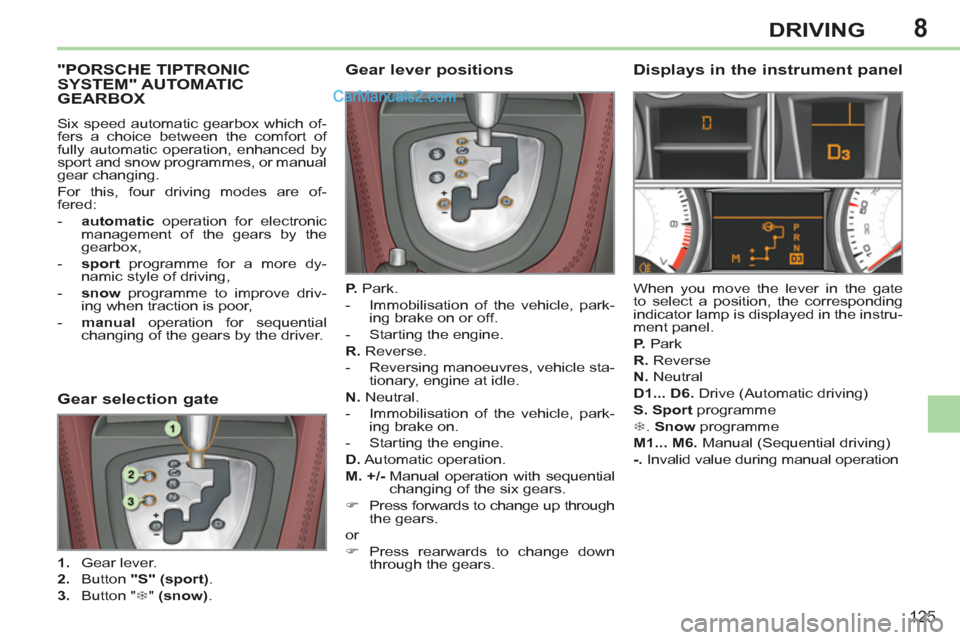
"PORSCHE TIPTRONIC
SYSTEM" AUTOMATIC
GEARBOX
Six speed automatic gearbox which of-
fers a choice between the comfort of
fully automatic operation, enhanced by
sport and snow programmes, or manual
gear changing.
For this, four driving modes are of-
fered:
- automatic
operation for electronic
management of the gears by the
gearbox,
- sport
programme for a more dy-
namic style of driving,
- snow
programme to improve driv-
ing when traction is poor,
- manual
operation for sequential
changing of the gears by the driver.
Gear lever positions
P.
Park.
- Immobilisation of the vehicle, park-
ing brake on or off.
- Starting the engine.
R.
Reverse.
- Reversing manoeuvres, vehicle sta-
tionary, engine at idle.
N.
Neutral.
- Immobilisation of the vehicle, park-
ing brake on.
- Starting the engine.
D.
Automatic operation.
M. +/-
Manual operation with sequential
changing of the six gears.
)
Press forwards to change up through
the gears.
or
)
Press rearwards to change down
through the gears.
Displays in the instrument panel
When you move the lever in the gate
to select a position, the corresponding
indicator lamp is displayed in the instru-
ment panel.
P.
Park
R.
Reverse
N.
Neutral
D1... D6.
Drive (Automatic driving)
S.
Sport
programme
7
. Snow
programme
M1... M6.
Manual (Sequential driving)
-.
Invalid value during manual operation
Gear selection gate
1.
Gear lever.
2.
Button "S"
(sport)
.
3.
Button " 7
" (snow)
.
Page 137 of 292
8
!
135
DRIVING
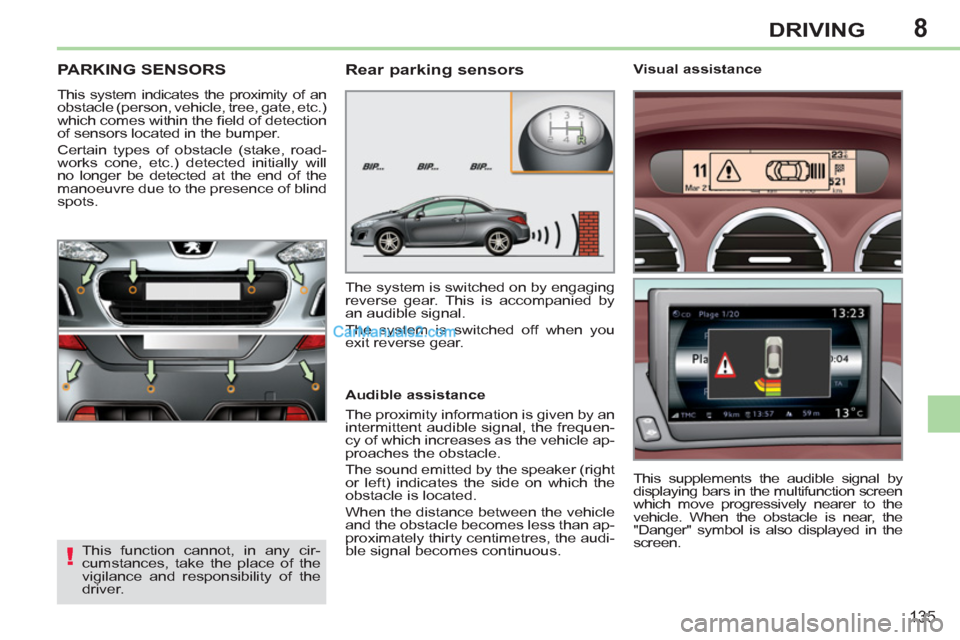
PARKING SENSORS
This system indicates the proximity of an
obstacle (person, vehicle, tree, gate, etc.)
which comes within the fi eld of detection
of sensors located in the bumper.
Certain types of obstacle (stake, road-
works cone, etc.) detected initially will
no longer be detected at the end of the
manoeuvre due to the presence of blind
spots.
This function cannot, in any cir-
cumstances, take the place of the
vigilance and responsibility of the
driver.
Rear parking sensors
Audible assistance
The proximity information is given by an
intermittent audible signal, the frequen-
cy of which increases as the vehicle ap-
proaches the obstacle.
The sound emitted by the speaker (right
or left) indicates the side on which the
obstacle is located.
When the distance between the vehicle
and the obstacle becomes less than ap-
proximately thirty centimetres, the audi-
ble signal becomes continuous.
The system is switched on by engaging
reverse gear. This is accompanied by
an audible signal.
The system is switched off when you
exit reverse gear.
This supplements the audible signal by
displaying bars in the multifunction screen
which move progressively nearer to the
vehicle. When the obstacle is near, the
"Danger" symbol is also displayed in the
screen.
Visual assistance
Page 138 of 292
8
ii
136
DRIVING
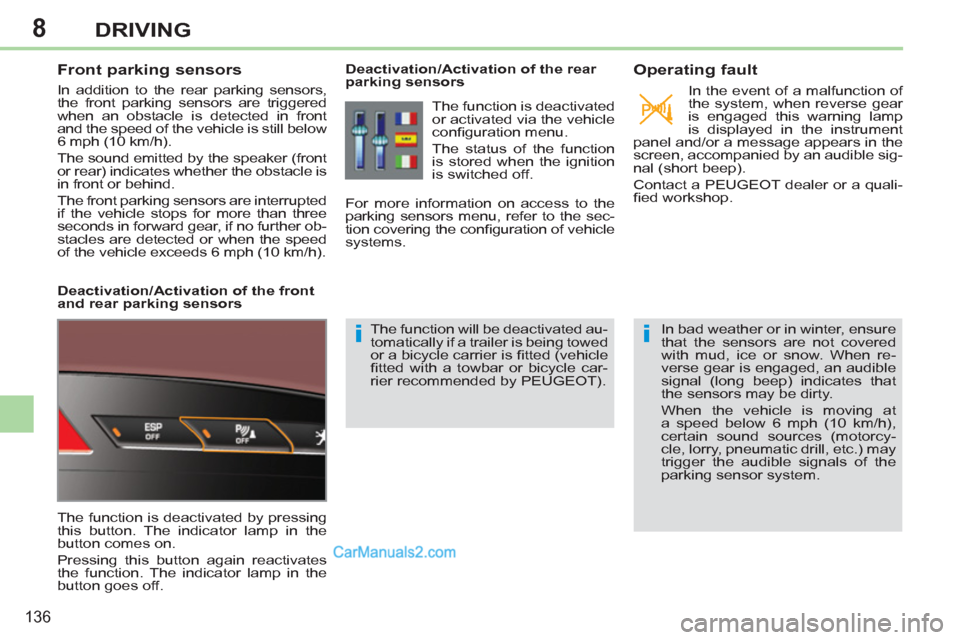
Front parking sensors
In addition to the rear parking sensors,
the front parking sensors are triggered
when an obstacle is detected in front
and the speed of the vehicle is still below
6 mph (10 km/h).
The sound emitted by the speaker (front
or rear) indicates whether the obstacle is
in front or behind.
The front parking sensors are interrupted
if the vehicle stops for more than three
seconds in forward gear, if no further ob-
stacles are detected or when the speed
of the vehicle exceeds 6 mph (10 km/h).
Deactivation/Activation of the front
and rear parking sensors
The function is deactivated by pressing
this button. The indicator lamp in the
button comes on.
Pressing this button again reactivates
the function. The indicator lamp in the
button goes off.
Deactivation/Activation of the rear
parking sensors
The function will be deactivated au-
tomatically if a trailer is being towed
or a bicycle carrier is fi tted (vehicle
fi tted with a towbar or bicycle car-
rier recommended by PEUGEOT).
Operating fault
In the event of a malfunction of
the system, when reverse gear
is engaged this warning lamp
is displayed in the instrument
panel and/or a message appears in the
screen, accompanied by an audible sig-
nal (short beep).
Contact a PEUGEOT dealer or a quali-
fi ed workshop.
In bad weather or in winter, ensure
that the sensors are not covered
with mud, ice or snow. When re-
verse gear is engaged, an audible
signal (long beep) indicates that
the sensors may be dirty.
When the vehicle is moving at
a speed below 6 mph (10 km/h),
certain sound sources (motorcy-
cle, lorry, pneumatic drill, etc.) may
trigger the audible signals of the
parking sensor system.
The function is deactivated
or activated via the vehicle
confi guration menu.
The status of the function
is stored when the ignition
is switched off.
For more information on access to the
parking sensors menu, refer to the sec-
tion covering the confi guration of vehicle
systems.