seats PEUGEOT 5008 2014 Owner's Manual
[x] Cancel search | Manufacturer: PEUGEOT, Model Year: 2014, Model line: 5008, Model: PEUGEOT 5008 2014Pages: 404, PDF Size: 23.34 MB
Page 134 of 404
Child safety
132
General points relating to child seats
Although one of PEUGEOT main criteria when designing your vehicle, the safety of your children also depends on you.
For maximum safety, please observe the following recommendations: - in accordance with European regulations, all children under the age of 12 or less than one and a half metres tall must travel in approved child seats suited to their weight , on seats fitted with a seat belt or ISOFIX mountings * , - statistically, the safest seats in your vehicle for carr ying children are the rear seats, - a child weighing less than 9 kg must travel in the "rearward facing" position both in the front and in the rear.
* The rules for carrying children are specific to each country. Refer to the legislation in force in your country.
PEUGEOT recommends that children should travel in the outer outer outerrear seats of your vehicle: - "rearward facing" up to the age of 3,
- "forward facing" over the age of 3.
Page 135 of 404
7
Child safety133
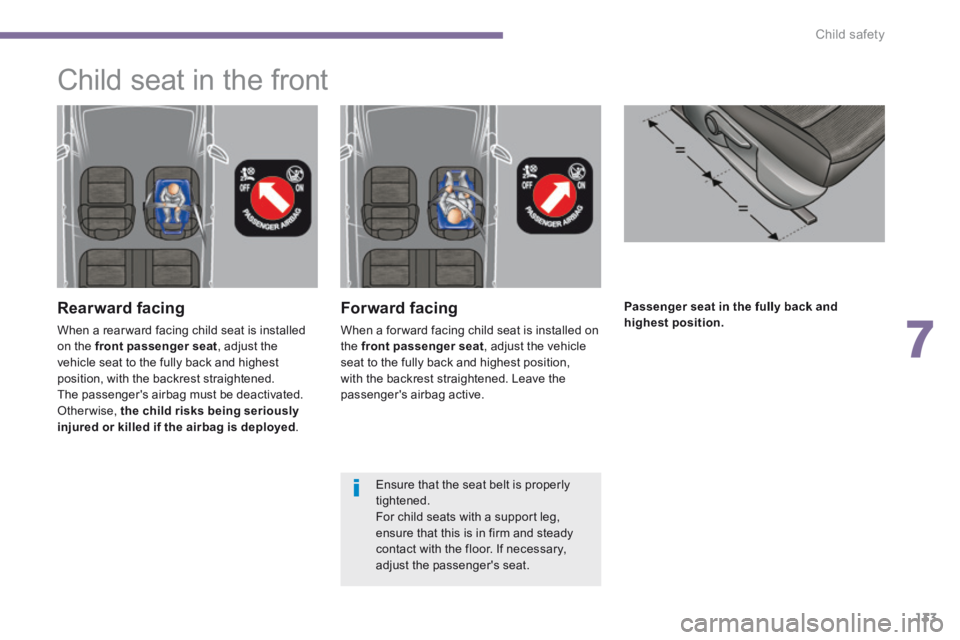
Passenger seat in the fully back and highest position. Forward facing
When a for ward facing child seat is installed on the front passenger seat , adjust the vehicle seat to the fully back and highest position, with the backrest straightened. Leave the passenger's airbag active.
Rearward facing
When a rear ward facing child seat is installed on the front passenger seat , adjust the vehicle seat to the fully back and highest position, with the backrest straightened. The passenger's airbag must be deactivated. Otherwise, the child risks being seriously injured or killed if the airbag is deployed .
Child seat in the front
Ensure that the seat belt is properly tightened. For child seats with a support leg, ensure that this is in firm and steady contact with the floor. If necessary, adjust the passenger's seat.
Page 139 of 404
7
Child safety137
Child seat at the rear
"Rearward facing"
When a "rear ward facing" child seat is installed on a rear passenger seat , move the vehicle's front seat for wards and straighten the backrest so that the "rear ward facing" child seat does not touch the vehicle's front seat.
"Forward facing"
When a "for ward facing" child seat is installed on a rear passenger seat , move the vehicle's front seat for wards and straighten the backrest so that the legs of the child in the "for ward facing" child seat do not touch the vehicle's front seat.
Seats in the
3
rd row
When a child seat is installed on a 3 rd row passenger seat , move the 2 nd row seat for wards and straighten the backrest so that the child seat and the legs of the child do not touch the 2 nd row seat. A child seat with a stay must never be installed on a 3 rd row passenger seat .
Page 141 of 404
7
Child safety139
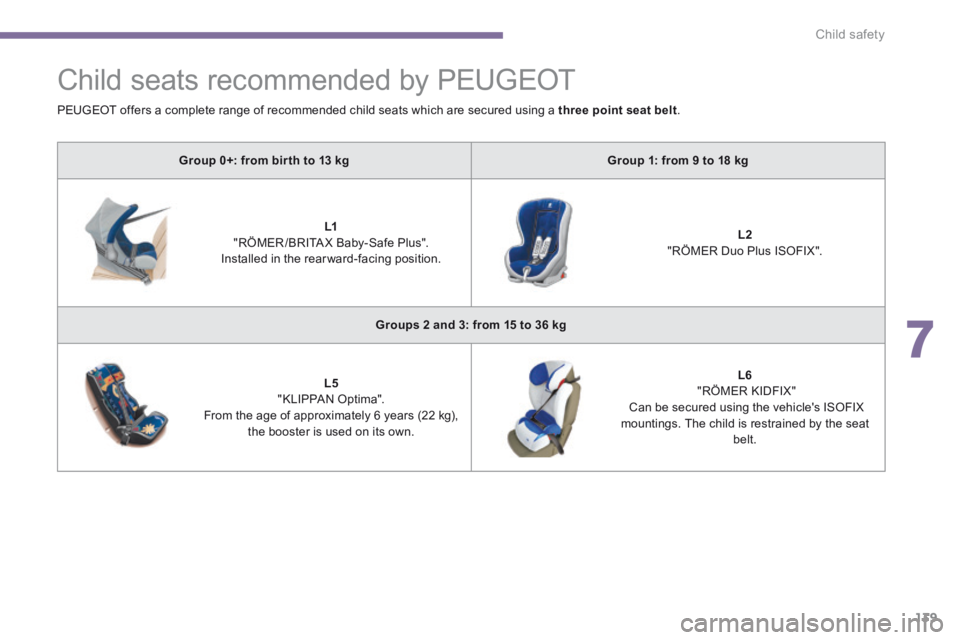
Child seats recommended by PEUGEOT
Group 0+: from bir th to 13 kgGroup 1: from 9 to 18 kg
L1 "RÖMER /BRITA X Baby-Safe Plus". Installed in the rearward-facing position.
L2 "RÖMER Duo Plus ISOFIX".
Groups 2 and 3: from 15 to 36 kg
L5 "KLIPPAN Optima". From the age of approximately 6 years (22 kg),
the booster is used on its own.
L6 "RÖMER KIDFIX" Can be secured using the vehicle's ISOFIX mountings. The child is restrained by the seat
belt.
PEUGEOT offers a complete range of recommended child seats which are secured using a three point seat belt .
Page 142 of 404
Child safety
140
Installing child seats using the seat belt
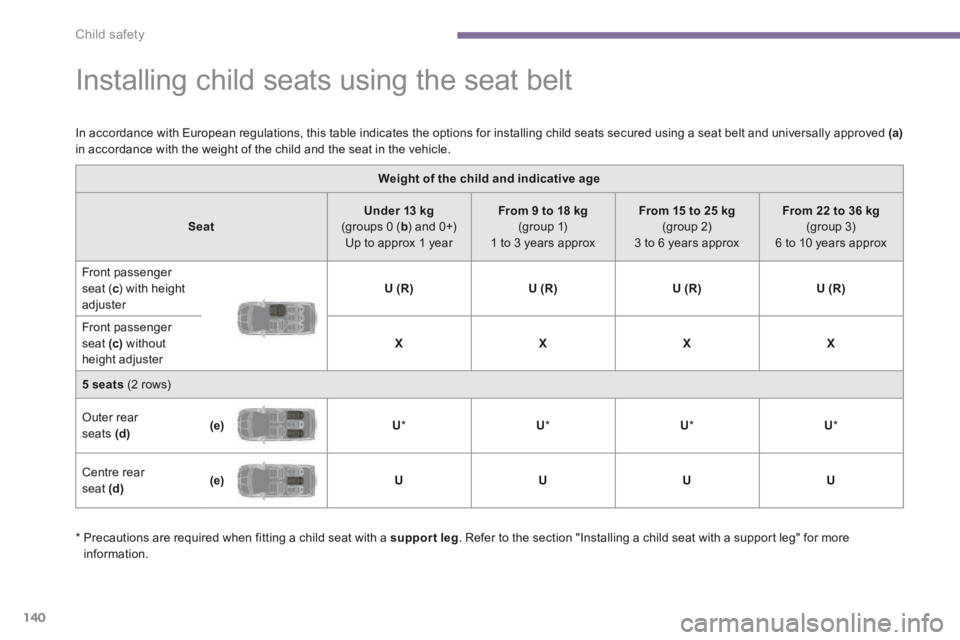
In accordance with European regulations, this table indicates the options for installing child seats secured using a seat belt and universally approved (a)in accordance with the weight of the child and the seat in the vehicle.
Weight of the child and indicative age
Seat
Under 13 kg
(groups 0 ( b ) and 0+) Up to approx 1 year
From 9 to 18 kg
(group 1) 1 to 3 years approx
From 15 to 25 kg
(group 2) 3 to 6 years approx
From 22 to 36 kg
(group 3) 6 to 10 years approx
Front passenger seat ( c ) with height c ) with height cadjuster
U (R)U (R)U (R)U (R)
Front passenger seat (c) without height adjuster XXXX
5 seats (2 rows)
Outer rear seats (d)(e)U * U * U * U *
Centre rear seat (d)(e)UUUU
* Precautions are required when fitting a child seat with a support leg . Refer to the section "Installing a child seat with a support leg" for more information.
Page 143 of 404
7
Child safety141
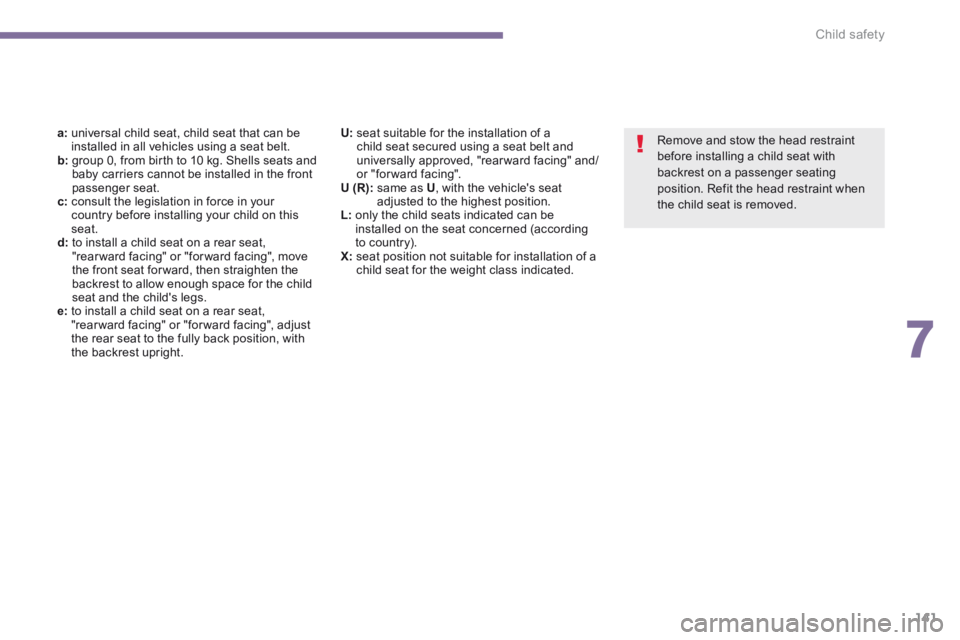
Remove and stow the head restraint before installing a child seat with backrest on a passenger seating position. Refit the head restraint when the child seat is removed.
a: universal child seat, child seat that can be installed in all vehicles using a seat belt. b: group 0, from birth to 10 kg. Shells seats and baby carriers cannot be installed in the front passenger seat. c: consult the legislation in force in your country before installing your child on this seat. d: to install a child seat on a rear seat, "rear ward facing" or "for ward facing", move the front seat for ward, then straighten the backrest to allow enough space for the child seat and the child's legs. e: to install a child seat on a rear seat, "rearward facing" or "forward facing", adjust the rear seat to the fully back position, with the backrest upright.
U: seat suitable for the installation of a child seat secured using a seat belt and universally approved, "rearward facing" and/or "for ward facing". U (R): same as U , with the vehicle's seat adjusted to the highest position. L: only the child seats indicated can be installed on the seat concerned (according to country). X: seat position not suitable for installation of a child seat for the weight class indicated.
Page 144 of 404
Child safety
142
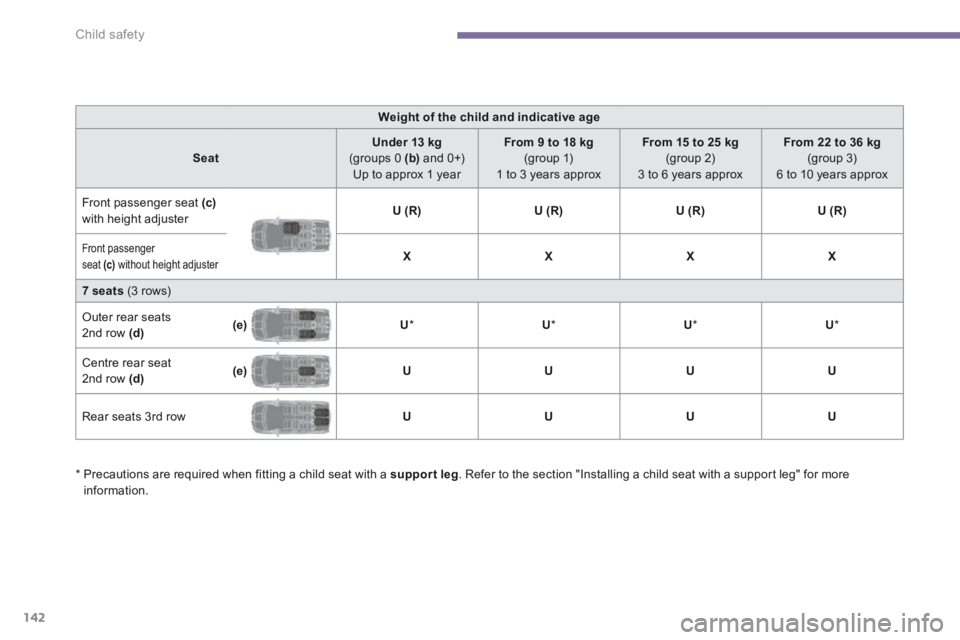
Weight of the child and indicative age
SeatUnder 13 kg (groups 0 (b) and 0+) Up to approx 1 year
From 9 to 18 kg (group 1) 1 to 3 years approx
From 15 to 25 kg (group 2) 3 to 6 years approx
From 22 to 36 kg (group 3) 6 to 10 years approx
Front passenger seat (c)with height adjuster
U (R)U (R)U (R)U (R)
Front passenger seat (c) without height adjuster XXXX
7 seats (3 rows)
Outer rear seats 2nd row (d)(e)U * U * U * U *
Centre rear seat 2nd row (d)(e)UUUU
Rear seats 3rd row UUUU
* Precautions are required when fitting a child seat with a support leg . Refer to the section "Installing a child seat with a support leg" for more information.
Page 145 of 404
7
Child safety143
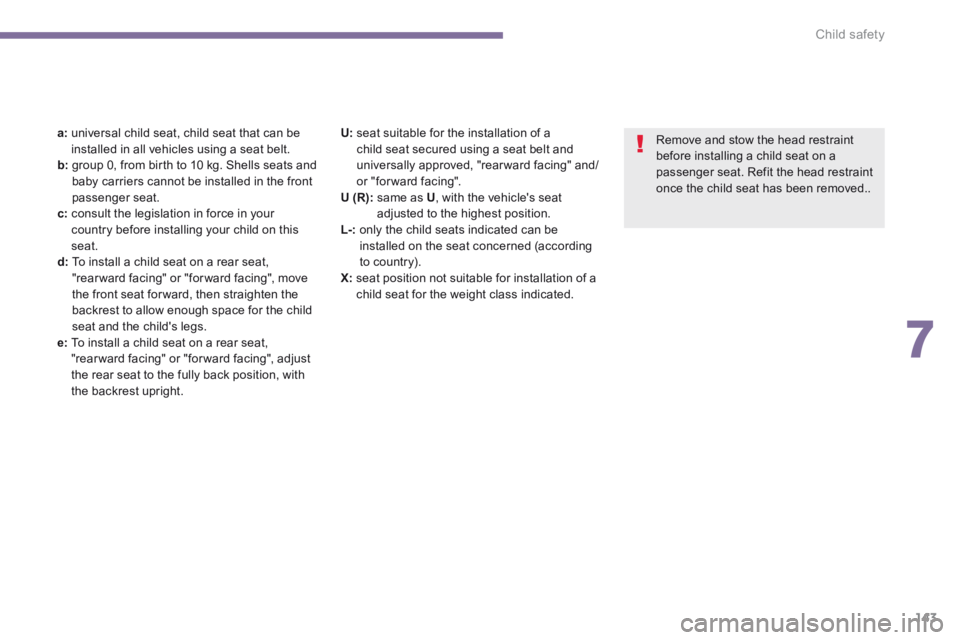
a: universal child seat, child seat that can be installed in all vehicles using a seat belt. b: group 0, from birth to 10 kg. Shells seats and baby carriers cannot be installed in the front passenger seat. c: consult the legislation in force in your country before installing your child on this seat. d: To install a child seat on a rear seat, "rear ward facing" or "for ward facing", move the front seat for ward, then straighten the backrest to allow enough space for the child seat and the child's legs. e: To install a child seat on a rear seat, "rearward facing" or "forward facing", adjust the rear seat to the fully back position, with the backrest upright.
Remove and stow the head restraint before installing a child seat on a passenger seat. Refit the head restraint once the child seat has been removed..
U: seat suitable for the installation of a child seat secured using a seat belt and universally approved, "rearward facing" and/or "for ward facing". U (R): same as U , with the vehicle's seat adjusted to the highest position. L-: only the child seats indicated can be installed on the seat concerned (according to country). X: seat position not suitable for installation of a child seat for the weight class indicated.
Page 146 of 404
Child safety
144
"ISOFIX" mountings
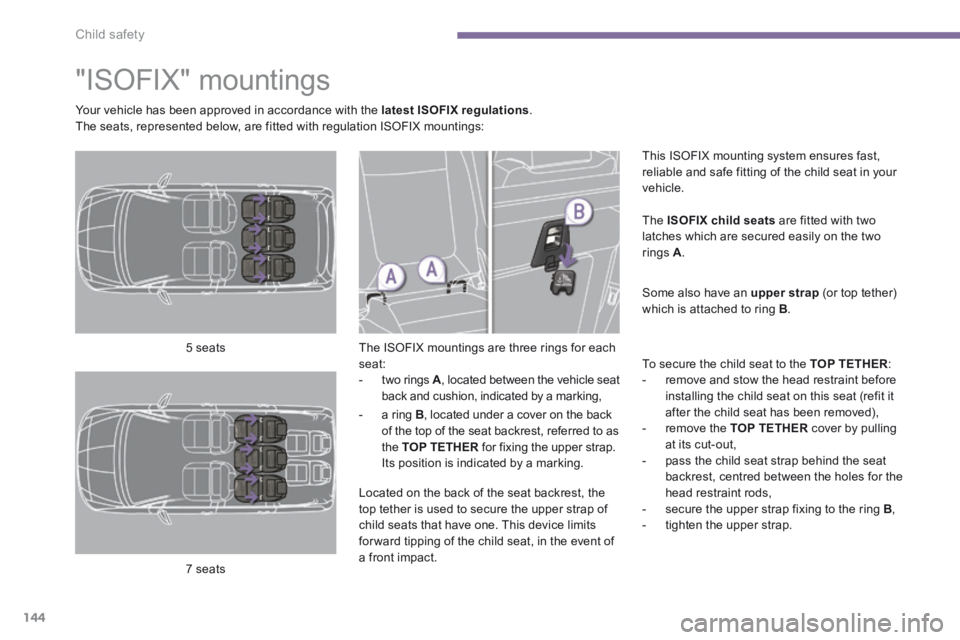
The ISOFIX mountings are three rings for each seat: - two rings A , located between the vehicle seat back and cushion, indicated by a marking,
This ISOFIX mounting system ensures fast, reliable and safe fitting of the child seat in your vehicle.
The ISOFIX child seats are fitted with two latches which are secured easily on the two rings A .
Some also have an upper strap (or top tether) which is attached to ring B .
To secure the child seat to the TOP TETHER : - remove and stow the head restraint before installing the child seat on this seat (refit it after the child seat has been removed), - remove the TOP TETHER cover by pulling at its cut-out, - pass the child seat strap behind the seat backrest, centred between the holes for the head restraint rods, - secure the upper strap fixing to the ring B , - tighten the upper strap.
5 seats
7 seats
Your vehicle has been approved in accordance with the latest ISOFIX regulations . The seats, represented below, are fitted with regulation ISOFIX mountings:
- a ring B , located under a cover on the back
of the top of the seat backrest, referred to as the TOP TETHER for fixing the upper strap. TOP TETHER for fixing the upper strap. TOP TETHER Its position is indicated by a marking.
Located on the back of the seat backrest, the top tether is used to secure the upper strap of child seats that have one. This device limits for ward tipping of the child seat, in the event of a front impact.
Page 147 of 404
7
Child safety145
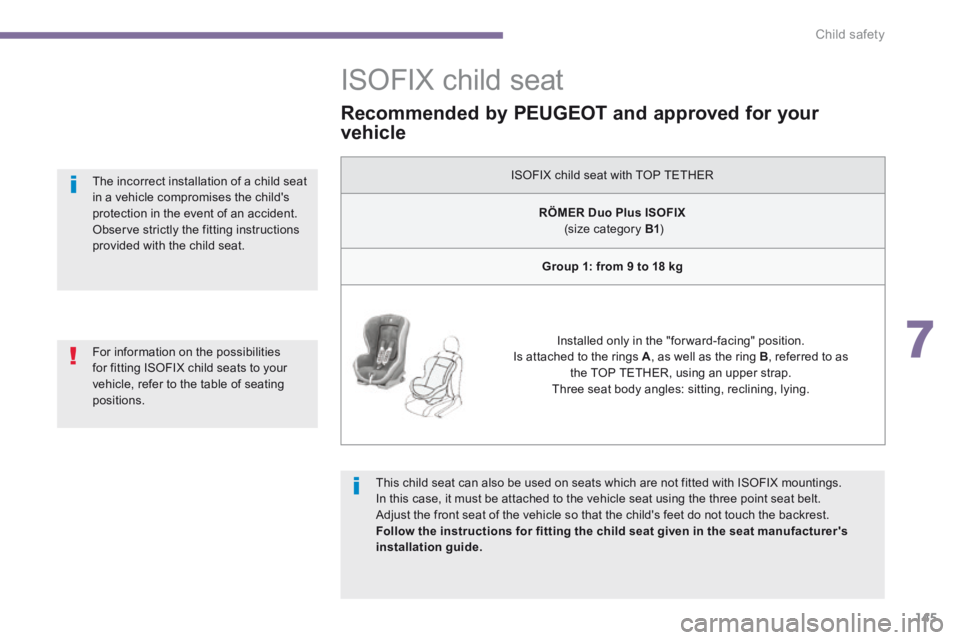
ISOFIX child seat
This child seat can also be used on seats which are not fitted with ISOFIX mountings. In this case, it must be attached to the vehicle seat using the three point seat belt. Adjust the front seat of the vehicle so that the child's feet do not touch the backrest. Follow the instructions for fitting the child seat given in the seat manufacturer's
installation guide.
For information on the possibilities for fitting ISOFIX child seats to your vehicle, refer to the table of seating positions.
The incorrect installation of a child seat in a vehicle compromises the child's protection in the event of an accident. Observe strictly the fitting instructions provided with the child seat.
Recommended by PEUGEOT and approved for your
vehicle
ISOFIX child seat with TOP TETHER
RÖMER Duo Plus ISOFIX
(size category B1 )
Group 1: from 9 to 18 kg
Installed only in the "forward-facing" position. Is attached to the rings A , as well as the ring B , referred to as the TOP TETHER, using an upper strap. Three seat body angles: sitting, reclining, lying.