wheel PEUGEOT 5008 2014 Owner's Guide
[x] Cancel search | Manufacturer: PEUGEOT, Model Year: 2014, Model line: 5008, Model: PEUGEOT 5008 2014Pages: 404, PDF Size: 23.34 MB
Page 225 of 404
11
Practical information223
Changing a wheel *
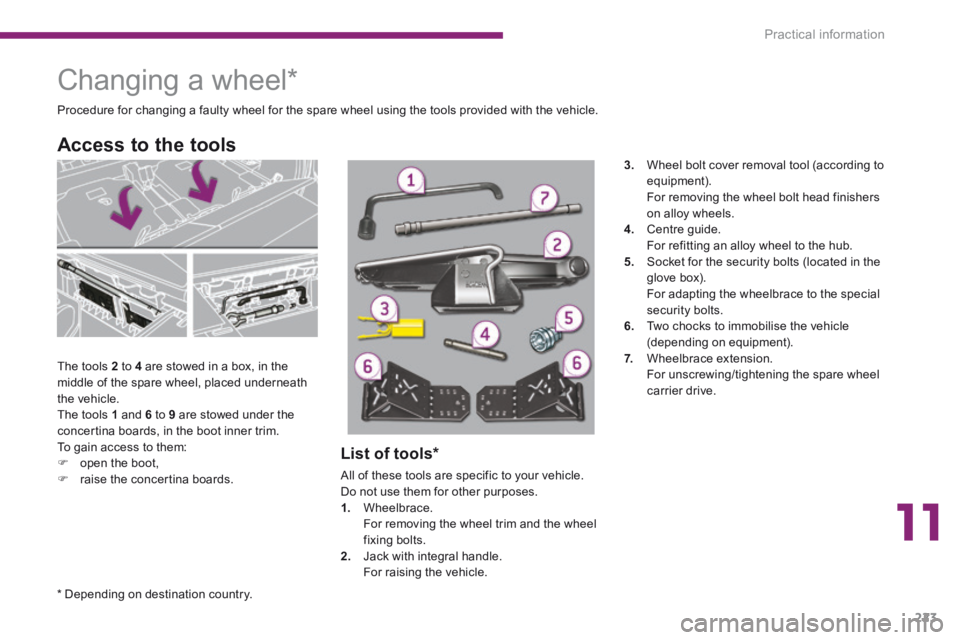
The tools 2 to 4 are stowed in a box, in the middle of the spare wheel, placed underneath the vehicle. The tools 1 and 6 to 9 are stowed under the concertina boards, in the boot inner trim. To gain access to them: open the boot, raise the concertina boards.
Access to the tools
Procedure for changing a faulty wheel for the spare wheel using the tools provided with the vehicle.
List of tools *
All of these tools are specific to your vehicle. Do not use them for other purposes. 1. Wheelbrace. For removing the wheel trim and the wheel fixing bolts. 2. Jack with integral handle. For raising the vehicle.
3. Wheel bolt cover removal tool (according to equipment). For removing the wheel bolt head finishers on alloy wheels. 4. Centre guide. For refitting an alloy wheel to the hub. 5. Socket for the security bolts (located in the glove box). For adapting the wheelbrace to the special security bolts. 6. Two chocks to immobilise the vehicle (depending on equipment). 7. Wheelbrace extension. For unscrewing/tightening the spare wheel carrier drive.
* Depending on destination country.
Page 226 of 404
Practical information
224
Other accessory
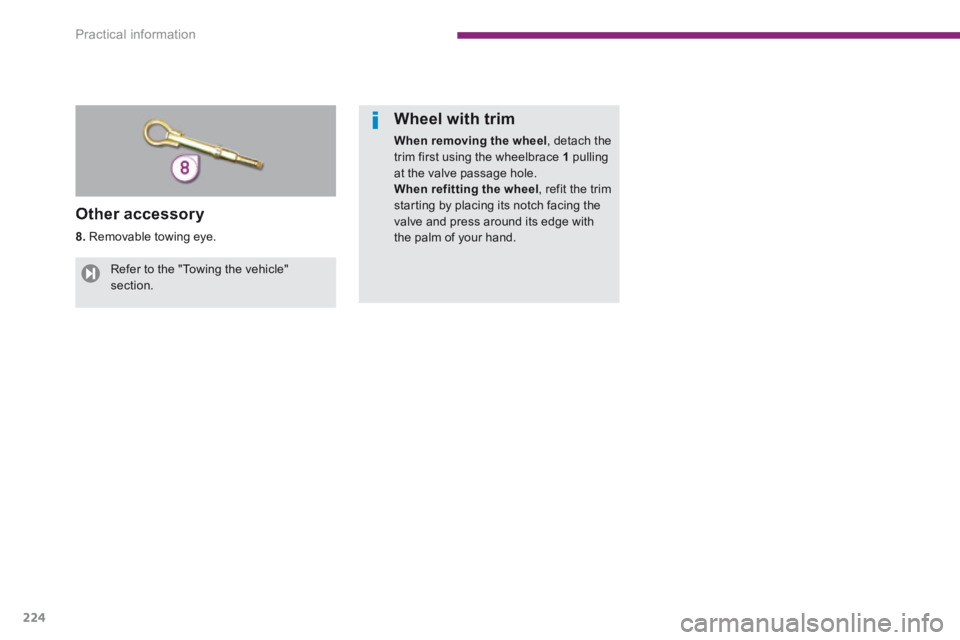
8. Removable towing eye.
Wheel with trim
When removing the wheel , detach the trim first using the wheelbrace 1 pulling at the valve passage hole. When refitting the wheel , refit the trim starting by placing its notch facing the valve and press around its edge with the palm of your hand.
Refer to the "Towing the vehicle" section.
Page 227 of 404
11
Practical information225
Access to the spare wheel *
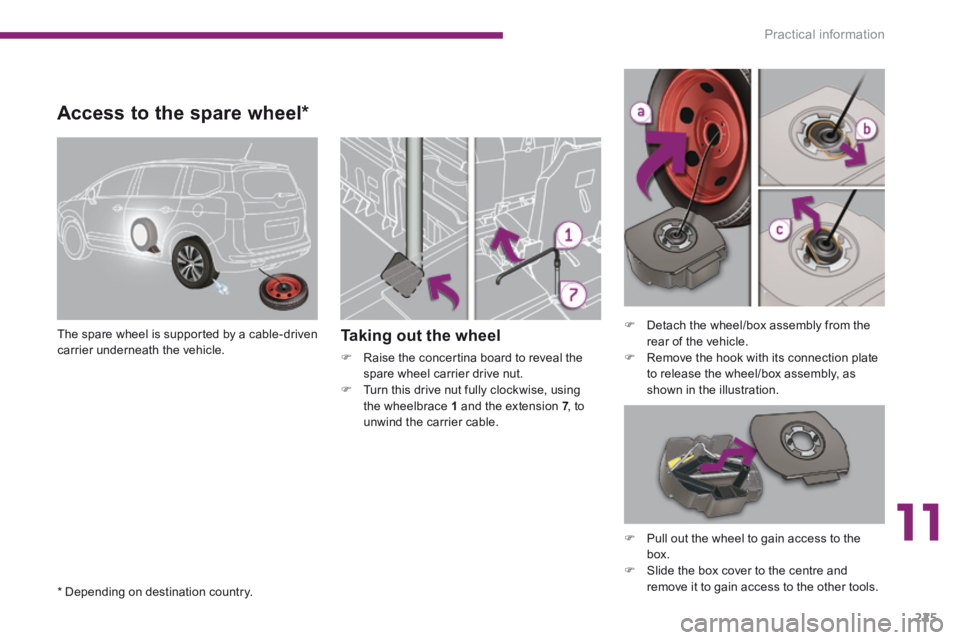
The spare wheel is supported by a cable-driven carrier underneath the vehicle. Taking out the wheel
Raise the concertina board to reveal the spare wheel carrier drive nut. Turn this drive nut fully clockwise, using the wheelbrace 1 and the extension 7 , to 7 , to 7unwind the carrier cable.
Detach the wheel/box assembly from the rear of the vehicle. Remove the hook with its connection plate to release the wheel/box assembly, as shown in the illustration.
Pull out the wheel to gain access to the box. Slide the box cover to the centre and remove it to gain access to the other tools. * Depending on destination country.
Page 228 of 404
Practical information
226
Putting the wheel back in place
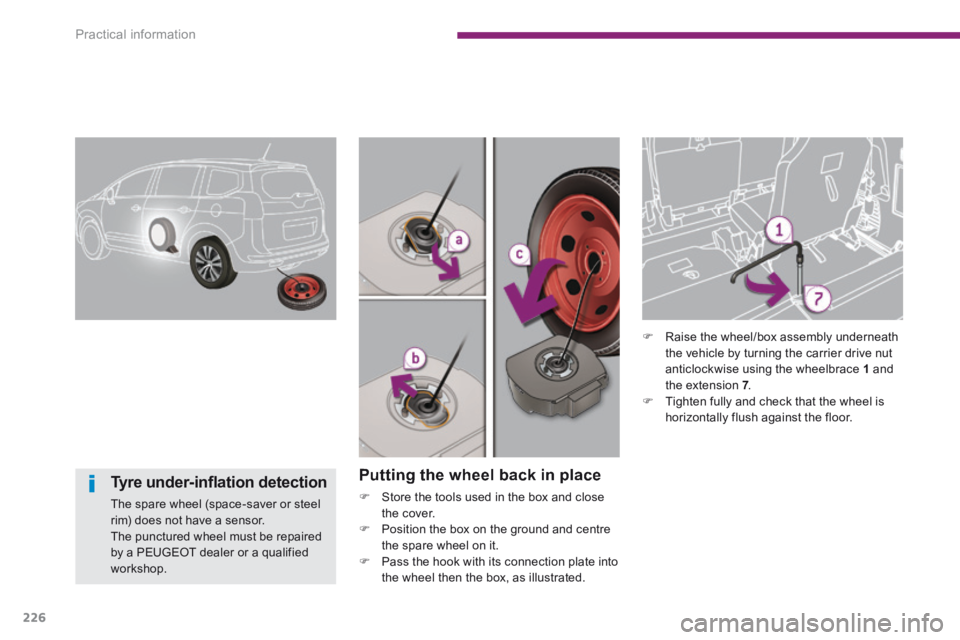
Store the tools used in the box and close the cover. Position the box on the ground and centre the spare wheel on it. Pass the hook with its connection plate into the wheel then the box, as illustrated.
Raise the wheel/box assembly underneath the vehicle by turning the carrier drive nut anticlockwise using the wheelbrace 1 and the extension 7 . 7 . 7 Tighten fully and check that the wheel is horizontally flush against the floor.
Tyre under-infl ation detection
The spare wheel (space-saver or steel rim) does not have a sensor. The punctured wheel must be repaired by a PEUGEOT dealer or a qualified workshop.
Page 229 of 404
11
Practical information227
Removing a wheel
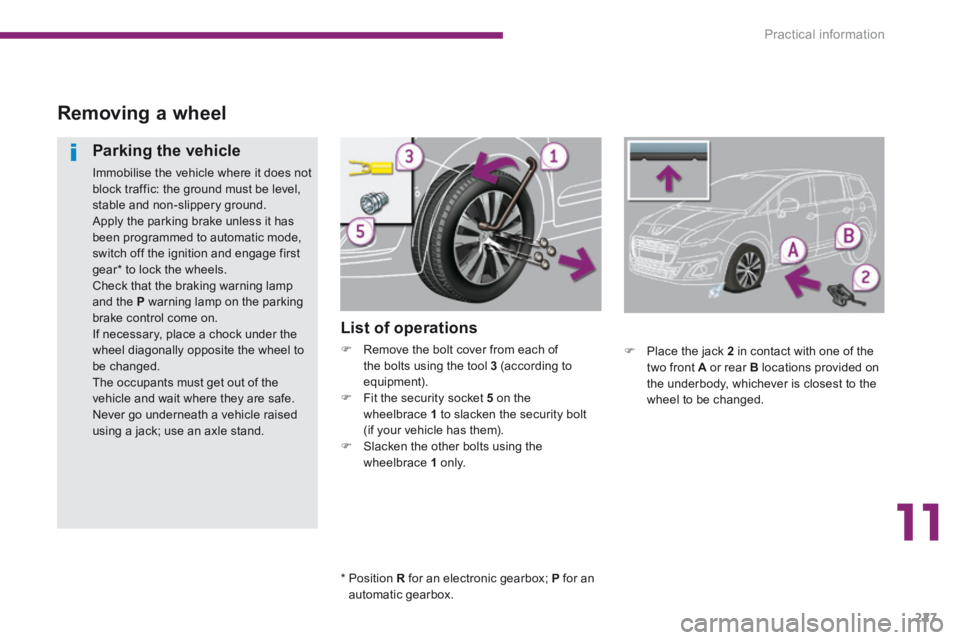
List of operations
Remove the bolt cover from each of the bolts using the tool 3 (according to equipment). Fit the security socket 5 on the wheelbrace 1 to slacken the security bolt (if your vehicle has them). Slacken the other bolts using the wheelbrace 1 o n l y.
Parking the vehicle
Immobilise the vehicle where it does not block traffic: the ground must be level, stable and non-slippery ground. Apply the parking brake unless it has been programmed to automatic mode, switch off the ignition and engage first gear * to lock the wheels. Check that the braking warning lamp and the P warning lamp on the parking brake control come on. If necessary, place a chock under the wheel diagonally opposite the wheel to be changed. The occupants must get out of the vehicle and wait where they are safe. Never go underneath a vehicle raised using a jack; use an axle stand.
Place the jack 2 in contact with one of the two front A or rear B locations provided on the underbody, whichever is closest to the wheel to be changed.
* Position R for an electronic gearbox; P for an automatic gearbox.
Page 230 of 404
Practical information
228
Fitting the "space-saver" spare wheel
If your vehicle is fitted with alloy wheels, when tightening the bolts on fitting it is normal to notice that the washers do not come into contact with the "space-saver" spare wheel. The wheel is secured by the conical contact of each bolt.
After changing a wheel
To store the punctured wheel in the boot correctly, first remove the central cover. When using the "space-saver" type spare wheel, do not exceed 50 mph (80 km/h). Have the tightening of the bolts and the pressure of the spare wheel checked by a PEUGEOT dealer or a qualified workshop without delay. Have the punctured wheel repaired and replace it on the vehicle as soon as possible.
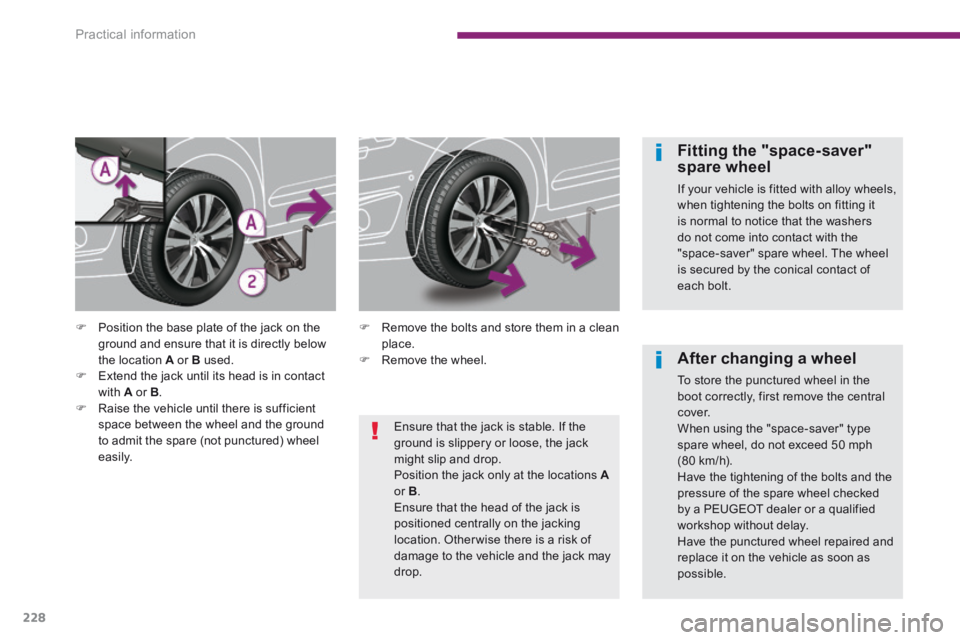
Position the base plate of the jack on the ground and ensure that it is directly below the location A or B used. Extend the jack until its head is in contact with A or B . Raise the vehicle until there is sufficient space between the wheel and the ground
to admit the spare (not punctured) wheel easily.
Remove the bolts and store them in a clean place. Remove the wheel.
Ensure that the jack is stable. If the ground is slippery or loose, the jack might slip and drop. Position the jack only at the locations Aor B . Ensure that the head of the jack is positioned centrally on the jacking location. Otherwise there is a risk of damage to the vehicle and the jack may drop.
Page 231 of 404
11
Practical information229
Fitting a wheel
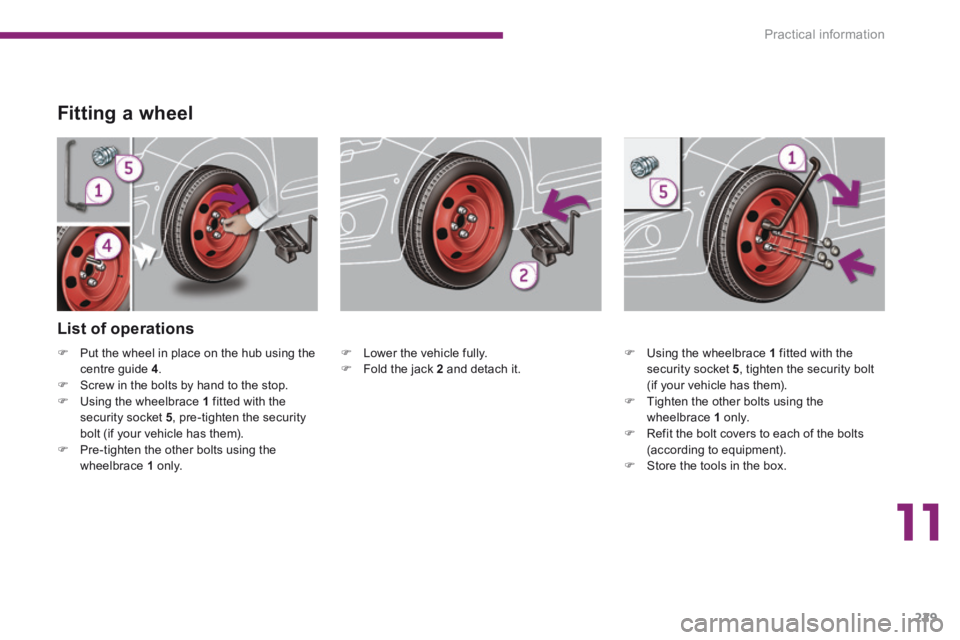
Lower the vehicle fully. Fold the jack 2 and detach it.
List of operations
Using the wheelbrace 1 fitted with the security socket 5 , tighten the security bolt (if your vehicle has them). Tighten the other bolts using the wheelbrace 1 o n l y. Refit the bolt covers to each of the bolts (according to equipment). Store the tools in the box.
Put the wheel in place on the hub using the centre guide 4 . Screw in the bolts by hand to the stop. Using the wheelbrace 1 fitted with the security socket 5 , pre-tighten the security bolt (if your vehicle has them). Pre-tighten the other bolts using the wheelbrace 1 o n l y.
Page 232 of 404
Practical information
230
Snow chains
In wintry conditions, snow chains improve traction as well as the behaviour of the vehicle when braking.
The snow chains must be fitted only to the front wheels. They must never be fitted to "space-saver" type spare wheels.
Take account of the legislation in force
in your country on the use of snow chains and the maximum running speed authorised.
Advice on installation
If you have to fit the chains during a journey, stop the vehicle on a flat sur face on the side of the road. Apply the parking brake and position any wheel chocks to prevent movement of your vehicle. Fit the chains following the instructions provided by the manufacturer. Move off gently and drive for a few moments, without exceeding 30 mph (50 km/h). Stop your vehicle and check that the snow chains are correctly tightened.
Avoid driving on roads that have been cleared of snow, to avoid damaging your vehicle's tyres and the road sur face. It is recommended that before you leave, you practise fitting the snow chains on a level and dry sur face. If your vehicle is fitted with alloy wheels, check that no part of the chain or its
fixings is in contact with the wheel rim.
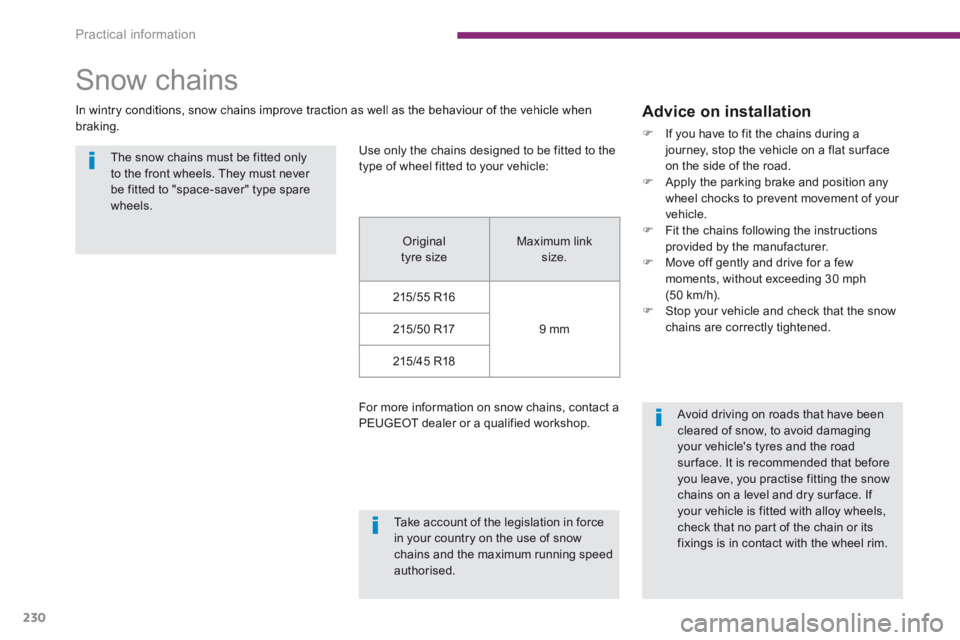
Use only the chains designed to be fitted to the type of wheel fitted to your vehicle:
Original tyre size Maximum link size.
215/55 R16
9 mm 215/50 R17
215/45 R18
For more information on snow chains, contact a PEUGEOT dealer or a qualified workshop.
Page 251 of 404
11
Practical information249
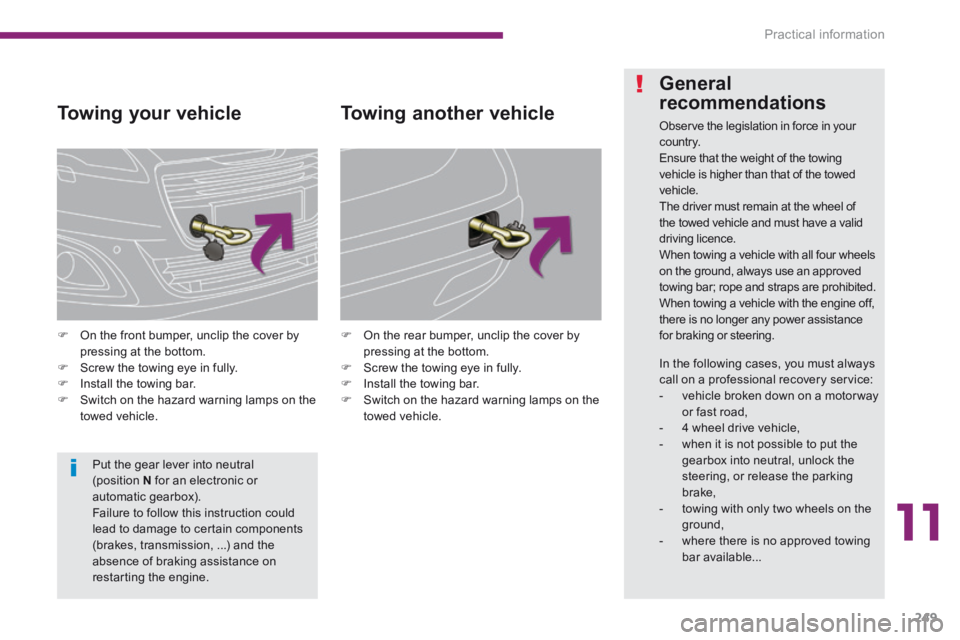
Towing your vehicle
On the front bumper, unclip the cover by pressing at the bottom. Screw the towing eye in fully. Install the towing bar. Switch on the hazard warning lamps on the towed vehicle.
On the rear bumper, unclip the cover by pressing at the bottom. Screw the towing eye in fully. Install the towing bar. Switch on the hazard warning lamps on the towed vehicle.
Towing another vehicle
Put the gear lever into neutral (position N for an electronic or automatic gearbox). Failure to follow this instruction could lead to damage to certain components
(brakes, transmission, ...) and the absence of braking assistance on restarting the engine.
General
recommendations
Observe the legislation in force in your c o unt r y. Ensure that the weight of the towing vehicle is higher than that of the towed vehicle. The driver must remain at the wheel of the towed vehicle and must have a valid driving licence. When towing a vehicle with all four wheels on the ground, always use an approved towing bar; rope and straps are prohibited. When towing a vehicle with the engine off, there is no longer any power assistance for braking or steering.
In the following cases, you must always call on a professional recovery service: - vehicle broken down on a motor way or fast road, - 4 wheel drive vehicle, - when it is not possible to put the gearbox into neutral, unlock the steering, or release the parking brake, - towing with only two wheels on the ground,
- where there is no approved towing bar available...
Page 256 of 404
Practical information
254
"Protection"
Mats * , boot liner, luggage net, style mud flaps ** , seat covers, pet range, boot sill protector...
"Safety and security"
Anti-theft alarm, window etching, wheel security bolts, child seats and booster cushions, first aid kit, breathalyzer, warning triangle, high visibility vest, stolen vehicle tracking system, dog guard, winter equipment (snow chains, non-slip covers...)...
Accessories
"Style"
Alloy wheels, door sill trims, chrome-plated door handle shells, spoiler, gear lever knob...
"Transport solutions"
Roof bars, towbars, bicycle carrier on towbar, bicycle carrier on roof bars, ski carrier, rigid and flexible roof boxes... Trailer towbar, which must be fitted by a PEUGEOT dealer.
"Comfort"
Door deflectors, parking sensors, side window
blinds, coat-hanger, insulated module...
A wide range of accessories and genuine parts is available from the PEUGEOT dealer network. These accessories and parts have been tested and approved for reliability and safety. They are all adapted to your vehicle and benefit from PEUGEOT's recommendation and warranty.
* To avoid any risk of jamming of the pedals: - ensure that the mat is positioned and secured correctly, - never fit one mat on top of another.
** The configuration of the vehicle requires that it be fitted with mud flaps at the rear.