heating Peugeot 508 2016 User Guide
[x] Cancel search | Manufacturer: PEUGEOT, Model Year: 2016, Model line: 508, Model: Peugeot 508 2016Pages: 371, PDF Size: 12.12 MB
Page 91 of 371
89
508_en_Chap03_ergonomie-et-confort_ed01-2016
With Stop & Start, when demisting has
been activated, the StOP mode is not
available.
On entering the vehicle, if the interior
temperature is much colder or warmer
than the comfort value, there is no
need to change the value displayed in
order to obtain the comfort required.
th
e system corrects the difference
in temperature automatically and as
quickly as possible.
For maximum cooling or heating of the
passenger compartment, it is possible
to exceed the minimum value 14 or the
maximum value 28.
F tu rn control 2 or 3 to the left
until
"LO" is displayed or to the
right until "HI" is displayed.
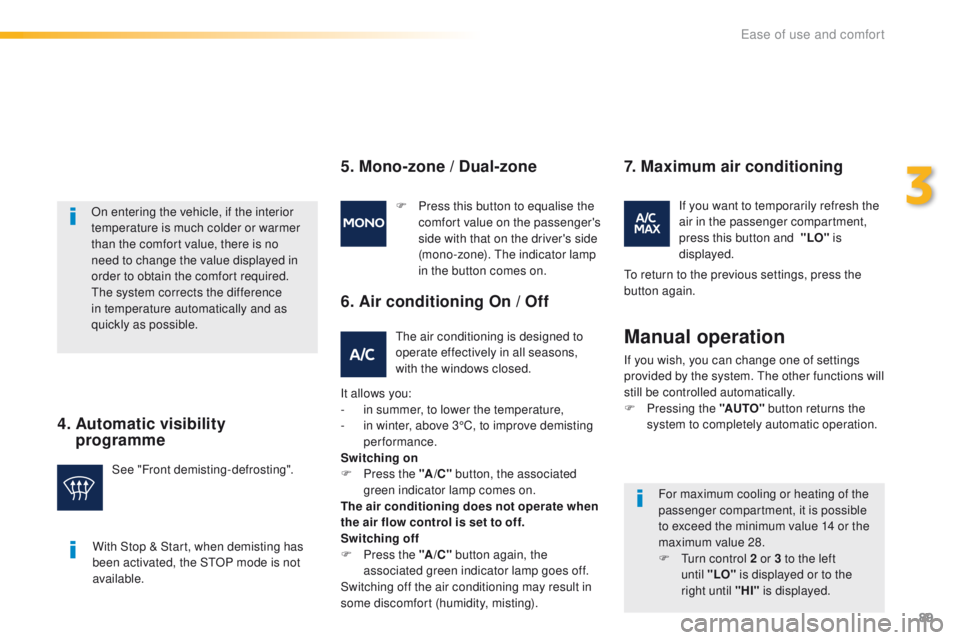
4. Automatic visibility
programme
See "Front demisting-defrosting". F
P
ress this button to equalise the
comfort value on the passenger's
side with that on the driver's side
(mono-zone). t
h
e indicator lamp
in the button comes on.
5. Mono-zone / Dual-zone
the air conditioning is designed to
operate effectively in all seasons,
with the windows closed.
6. Air conditioning On / Off
It allows you:
-
i n summer, to lower the temperature,
-
i
n winter, above 3°C, to improve demisting
performance.
Switching on
F
P
ress the " A/C" button, the associated
green indicator lamp comes on.
The air conditioning does not operate when
the air flow control is set to off.
Switching off
F
P
ress the "A /C " button again, the
associated green indicator lamp goes off.
Switching off the air conditioning may result in
some discomfort (humidity, misting). If you want to temporarily refresh the
air in the passenger compartment,
press this button and
"LO" is
displayed.
7. Maximum air conditioning
to return to the previous settings, press the
button again.
Manual operation
If you wish, you can change one of settings
provided by the system. th e other functions will
still be controlled automatically.
F
P
ressing the "AUTO" button returns the
system to completely automatic operation.
3
ease of use and comfort
Page 94 of 371
92
508_en_Chap03_ergonomie-et-confort_ed01-2016
With Stop & Start, when demisting has
been activated, the StOP mode is not
available.
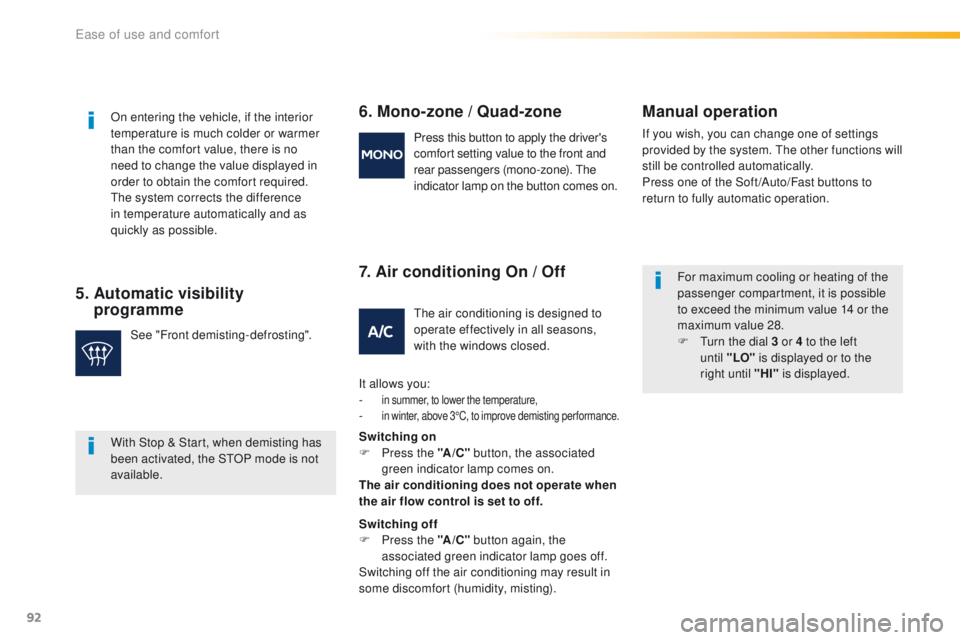
5. Automatic visibility programme 6. Mono-zone
/ Quad-zone
7. Air conditioning On / OffManual operation
If you wish, you can change one of settings
provided by the system.
th e other functions will
still be controlled automatically.
Press one of the Soft /Auto/Fast buttons to
return to fully automatic operation.
On entering the vehicle, if the interior
temperature is much colder or warmer
than the comfort value, there is no
need to change the value displayed in
order to obtain the comfort required.
th
e system corrects the difference
in temperature automatically and as
quickly as possible.
See "Front demisting-defrosting". Press this button to apply the driver's
comfort setting value to the front and
rear passengers (mono-zone).
t
he
indicator lamp on the button comes on.
th
e air conditioning is designed to
operate effectively in all seasons,
with the windows closed.
It allows you:
-
in summer, to lower the temperature,- in winter, above 3°C, to improve demisting per formance.
Switching on
F P ress the "A /C " button, the associated
green indicator lamp comes on.
The air conditioning does not operate when
the air flow control is set to off.
Switching off
F
P
ress the "A /C " button again, the
associated green indicator lamp goes off.
Switching off the air conditioning may result in
some discomfort (humidity, misting). For maximum cooling or heating of the
passenger compartment, it is possible
to exceed the minimum value 14 or the
maximum value 28.
F
t
u
rn the dial 3 or 4 to the left
until "LO" is displayed or to the
right until "HI" is displayed.
ease of use and comfort
Page 99 of 371
97
508_en_Chap03_ergonomie-et-confort_ed01-2016
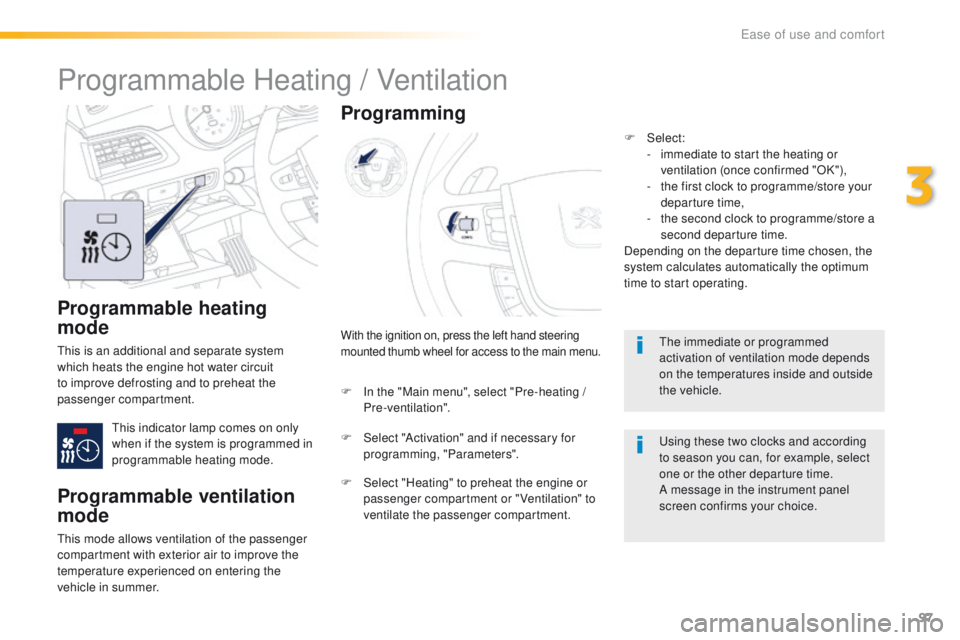
Programmable heating
mode
this is an additional and separate system
which heats the engine hot water circuit
to improve defrosting and to preheat the
passenger compartment.
th
is indicator lamp comes on only
when if the system is programmed in
programmable heating mode.With the ignition on, press the left hand steering
mounted thumb wheel for access to the main menu.
Programming
F In the "Main menu", select "Pre-heating /
Pre-ventilation".
F
S
elect "Activation" and if necessary for
programming, "Parameters".
F
S
elect "Heating" to preheat the engine or
passenger compartment or "Ventilation" to
ventilate the passenger compartment.
Programmable Heating / Ventilation
Programmable ventilation
mode
this mode allows ventilation of the passenger
compartment with exterior air to improve the
temperature experienced on entering the
vehicle in summer. F
Select:
-
i
mmediate to start the heating or
ventilation (once confirmed "OK"),
-
t
he first clock to programme/store your
departure time,
-
t
he second clock to programme/store a
second departure time.
Depending on the departure time chosen, the
system calculates automatically the optimum
time to start operating.
th
e immediate or programmed
activation of ventilation mode depends
on the temperatures inside and outside
the vehicle.
us
ing these two clocks and according
to season you can, for example, select
one or the other departure time.
A message in the instrument panel
screen confirms your choice.
3
ease of use and comfort
Page 100 of 371
98
508_en_Chap03_ergonomie-et-confort_ed01-2016
Always switch off the programmable
heating while refuelling to avoid any risk
of fire or explosion.
to a
void the risk of intoxication and
asphyxiation, the programmable
heating must not be used, even for
short periods, in an enclosed area such
as a garage or workshop not equipped
with exhaust gas extraction.
Do not park the vehicle on an
inflammable sur face (dry grass, dead
leaves, paper…), there is a risk of fire.
Only one programmed or immediate
preheating/preventilation can be
activated between two starts of
the
vehicle.the
heating and the ventilation in
immediate or programmable mode is
not activated when:
-
t
he fuel level is too low,
-
t
he battery is not sufficiently
charged.
to p
rogramme the heating and the
ventilation, it is necessary to first
deactivate the alarm volumetric and tilt
monitoring.
For more information on the alarm, refer
to the corresponding section.
ease of use and comfort
Page 161 of 371
159
508_en_Chap06_conduite_ed01-2016
Driving recommendations
Observe the driving regulations and remain
vigilant whatever the traffic conditions.
Pay close attention to the traffic and keep your
hands on the wheel so that you are ready to
react at any time to any eventuality.
On a long journey, a break every two hours is
strongly recommended.
In difficult weather, drive smoothly, anticipate
the need to brake and increase the distance
from other vehicles.Never drive with the parking brake
applied - Risk of overheating and
damage to the braking system!
Do not park or run the engine when
stationary in areas where inflammable
substances and materials (dry grass,
dead leaves...) might come into contact
with the hot exhaust system - Risk of
fire!
Never leave a vehicle unsupervised
with the engine running. If you have
to leave your vehicle with the engine
running, apply the parking brake
and put the gearbox into neutral or
position
N or P, depending on the type
of gearbox.
Driving on flooded
roads
We strongly advise against driving on flooded
roads, as this could cause serious damage
to the engine or gearbox, as well as to the
electrical systems of your vehicle.
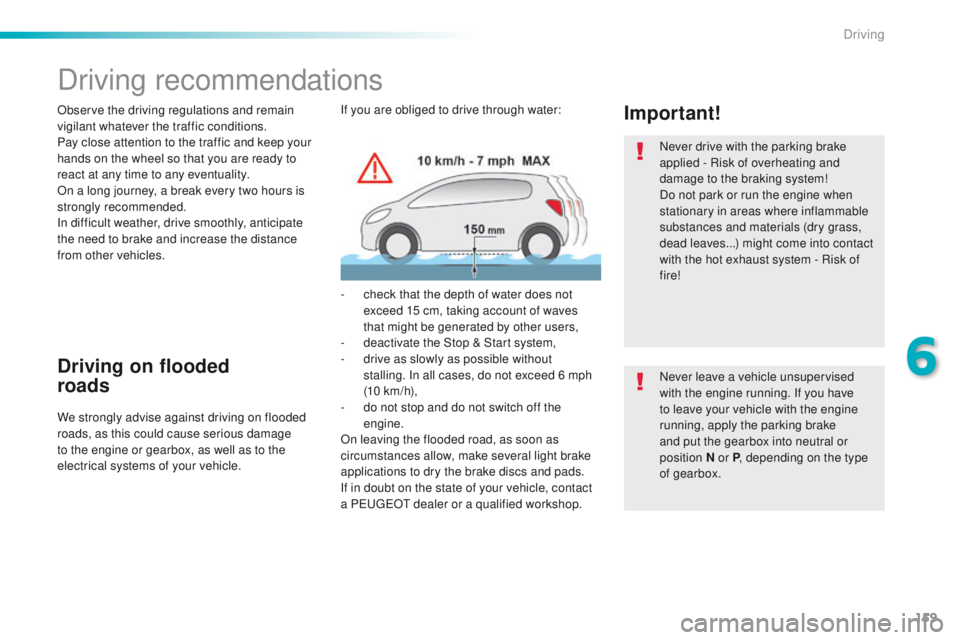
Important!If you are obliged to drive through water:
-
c
heck that the depth of water does not
exceed 15 cm, taking account of waves
that might be generated by other users,
-
d
eactivate the Stop & Start system,
-
d
rive as slowly as possible without
stalling. In all cases, do not exceed 6 mph
(10
km/h),
-
d
o not stop and do not switch off the
engine.
On leaving the flooded road, as soon as
circumstances allow, make several light brake
applications to dry the brake discs and pads.
If in doubt on the state of your vehicle, contact
a P
e
uge
Ot
dealer or a qualified workshop.
6
Driving
Page 162 of 371
160
508_en_Chap06_conduite_ed01-2016
When towing
Distribution of loads
F Distribute the load in the trailer so that the heaviest items are as close as possible to
the axle and the nose weight approaches
the maximum permitted without
exceeding
it.
Air density decreases with altitude, thus
reducing engine performance. Above
1
000 metres, the maximum towed load must
be reduced by 10
% for every 1 000 metres of
altitude.
Side wind
F take into account the increased sensitivity to side wind.
Cooling
towing a trailer on a slope increases the
temperature of the coolant.
As the fan is electrically controlled, its cooling
capacity is not dependent on the engine speed.
F
t
o l
ower the engine speed, reduce your
speed.
th
e maximum towed load on a long incline
depends on the gradient and the ambient
temperature.
In all cases, keep a check on the coolant
temperature.
F
I
f the warning lamp and the
STOP warning lamp come on,
stop the vehicle and switch off
the engine as soon as possible.
Braking
towing a trailer increases the braking distance.to a void overheating of the brakes, the use of
engine braking is recommended.
Ty r e s
F Check the tyre pressures of the towing vehicle and of the trailer, observing the
recommended pressures.
Lighting
F Check the electrical lighting and signalling on the trailer and the hadlamp beam height
of your vehicle.
For more information on adjusting the
headlamp beam height, refer to the
corresponding section.
th
e rear parking sensors will be
deactivated automatically if a genuine
P
e
uge
Ot
towbar is used.
For more information on weights (and
the towed loads which apply to your
vehicle) refer to the corresponding
section.
Driving
Page 164 of 371
162
508_en_Chap06_conduite_ed01-2016
In certain circumstances, you may have
to apply some force to turn the wheels
(if the wheels are against a kerb, for
example).
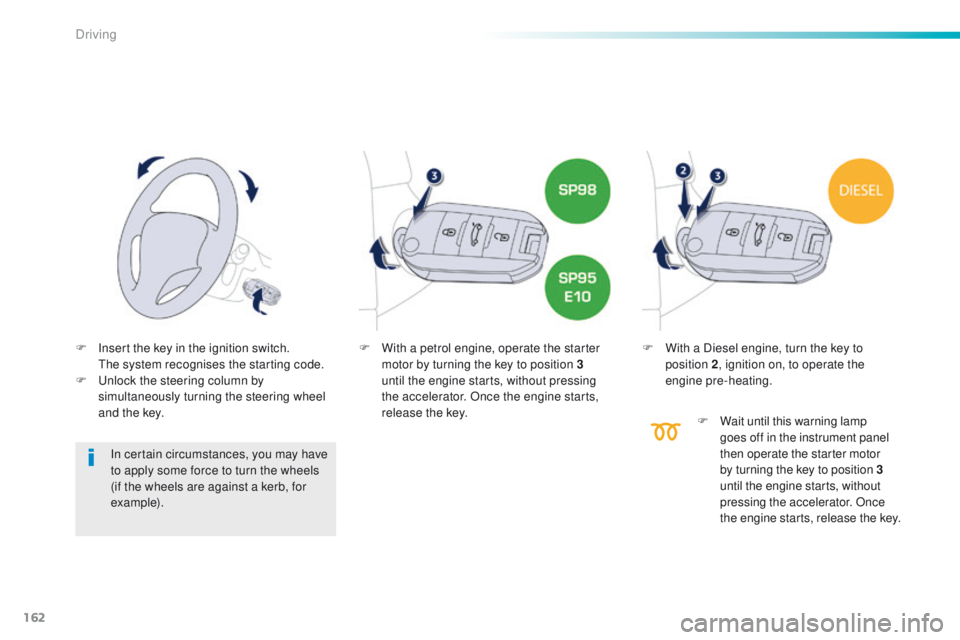
F
I
nsert the key in the ignition switch.
t
h
e system recognises the starting code.
F
u
n
lock the steering column by
simultaneously turning the steering wheel
and the key. F
W
ith a petrol engine, operate the starter
motor by turning the key to position 3
until the engine starts, without pressing
the accelerator. Once the engine starts,
release the key. F
W
ith a Diesel engine, turn the key to
position 2 , ignition on, to operate the
engine pre-heating.
F
W
ait until this warning lamp
goes off in the instrument panel
then operate the starter motor
by turning the key to position 3
until the engine starts, without
pressing the accelerator. Once
the engine starts, release the key.
Driving
Page 356 of 371
354
508_en_Chap11_index-alpha_ed01-2016
gauge, fuel.............................................. 13, 20 0ge
arbox,
automatic
........ 1
1, 16, 176, 180, 183, 222, 253
ge
arbox, manual
......11, 16, 174, 180, 183, 222
gea
r lever, automatic gearbox
..................... 17
6
ge
ar lever, manual gearbox
.........................174
ge
ar shift indicator
....................................... 175
gl
ove box ...................................................... 101
gr
ound clearance
......................................... 272
gu
ide-me-home
.................................... 121, 124Identification, vehicle
....................................
2
73
Immobiliser, electronic
................
52, 61, 69, 167
Indicator, coolant temperature
........................ 3
0
Indicator, engine oil level ................................
31
Indicator lamps ................................................
14
Indicators, direction ......................................120
Inflating tyres
..........................................11, 2 7 3
Inflating tyres and accessories (using the kit)
..............................
................234
Input, auxiliary
.............................. 1
08, 292, 346
Instrument panel
...............................
..............13
Instruments and controls
..................................7
I
ntelligent t
ra
ction Control
............................13
4
ISOFIX
...................................................152-15 6
Hazard warning lamps
..........................
132, 2 27
Headlamp adjustment
...................................
126
Headlamps, automatic illumination
......
118 , 12 1
Headlamps, dipped beam
.............
117, 242, 244
Headlamps, halogen
.............................
242, 244
Headlamps, main beam
................ 1
17, 242, 244
Headlamp wash
............................................
128
Head restraints, front ................................
75, 78
Head restraints, rear .....................................
109
Head-up display
............................
18 4, 188, 19 0
Heating
.........................................
83, 86, 88, 91
Heating, programmable (Webasto)
................ 97
H
ill start assist
...............................................
18
3
Horn ............................................................... 132
Filling the fuel tank
............................... 20
0, 202
Filter, air
...............
......................................... 221
Filter, oil
......................................................... 221
Filter, particle
........................................ 220, 221
G
I
E
H
F
Driving positions (storing) ...............................77
Dynamic stability control (DSC) ........ 1
8, 22, 133Filter, passenger compartment
.....................221
Fitting a wheel ............................... ................240
Fitting roof bars
.............................................212
Fittings, boot
......................................... 11
2 , 113
Fittings, front
...................................................99
Fittings, rear
...............................
...................111
Flap, fuel filler
...............................
.................200
Flashing indicators
................................120, 125
Foglamps, front
.............................119, 123, 242
Foglamps, rear
..............................119, 245, 246
Folding the rear seats
...................................109
Folding/unfolding the door mirrors
.................80
Frequency (radio)
..........................................288
Fuel ................................................................ 202
Fuel consumption
............................................ 11
F
usebox, dashboard
.....................................250
Fusebox, engine compartment
.....................252
Fuses
.............................................................249
e
BA
............................................................... 13 3
ec
o-driving (advice)
........................................ 11
el
ectronic brake force distribution
(
eB
FD)
........................................................ 13 3
em
ergency call
..................................... 1
3 2 , 2 74
em
ergency switching off
............................... 16
6
em
ergency warning lamps
................... 13
2, 2 27
em
issions control system, SCR .............25, 223
en
ergy economy mode
.................................261
en
gine compartment
.............................215 -217
en
gine,
Diesel
............16, 202, 216, 217, 228, 266, 268
en
gine, petrol
....................... 202, 215, 264, 265
en
vironment
......................... 1
1, 54, 63, 96, 179,
186, 220, 226, 253
Alphabetical index