check engine Peugeot 508 Hybrid 2014 Owner's Manual
[x] Cancel search | Manufacturer: PEUGEOT, Model Year: 2014, Model line: 508 Hybrid, Model: Peugeot 508 Hybrid 2014Pages: 380, PDF Size: 10.94 MB
Page 5 of 380
.
.
508_en_Chap00a_sommaire_ed02-2014
Child seats 155
Deactivating the passenger's front airbag
1
58
ISOFIX child seats
1
64
Child lock
1
70
Child safety
Direction indicators 1 71
em
ergency or assistance call
1
72
H o r n
172
Warning triangle
1
73
Tyre under-inflation detection
1
74
e
SC system
1
76
Seat belts
1
79
Airbags
1
82
Safety
temporary puncture repair kit 186
Changing a wheel
1
92
Snow chains
1
99
Changing a bulb
2
00
Changing a fuse
2
07
12 V battery
2
11
Removing - refitting the battery
2
15
en
ergy economy mode
2
19
Changing a wiper blade
2
20
to
wing the vehicle
2
21
to
wing a trailer
2
23
Fitting roof bars
2
25
Very cold climate screen
2
26
Accessories
227
Practical information
Opening the bonnet 2 30
Running out of fuel (Diesel)
2
31
Petrol engines
2
32
Diesel engines
2
34
BlueHDi Diesel engines
2
36
Checking levels
23
7
Checks
240
AdBlue
® additive and SCR system
(BlueHDi Diesel) 2 42
Checks
Petrol engines 2 50
Petrol weights
2
52
Diesel engines
2
54
Diesel weights
2
58
Dimensions
262
Identification markings
2
64
technical data
emergency or assistance 2 65
JBL equipment
2
67
7-inch touch screen
2
69
Audio system
3
41
Audio equipment and telematics
Alphabetical indexVisual search
Contents
Page 13 of 380
11
Limit the causes of excess consumption
Spread loads throughout the vehicle; place the heaviest items in the
bottom of the boot, as close as possible to the rear seats.
Limit the loads carried in the vehicle and reduce wind resistance (roof
bars, roof rack, bicycle carrier, trailer...). u
s
e a roof box in preference.
Remove roof bars and roof racks after use.
At the end of winter, remove snow tyres and refit your summer tyres.
Observe the recommendations on
maintenance
Check the tyre pressures regularly, when cold, referring to the label in
the door aperture, driver's side.
Carry out this check in particular:
-
b
efore a long journey,
-
a
t each change of season,
-
a
fter a long period out of use.
Don't forget the spare wheel and the tyres on any trailer or caravan.
Have your vehicle serviced regularly (engine oil, oil filter, air filter,
passenger compartment filter...) and observe the schedule of
operations recommended in the warranty and maintenance record.
When refuelling, do not continue after the third cut-off of the nozzle to
avoid any over flow.
At the wheel of your new vehicle, it is only after the first 1 800 miles
(3 000 kilometres) that you will see the fuel consumption settle down to
a consistent average.
.
Eco-driving
Page 22 of 380
20
Warning / indicator lampStateCause Action / Observations
Electric parking
brake flashing.
th
e electric parking brake is not
applied automatically.
th
e application/release is faulty.You must stop as soon as it is safe to do so.
Park on flat level ground, engage a gear (or place the
lever in position P for an automatic gearbox), switch
off the ignition and contact a P
e
uge
Ot
dealer or a
qualified workshop.
Electric parking
brake fault fixed.
th
e electric parking brake has a fault. Contact a P
e
uge
Ot
dealer or a qualified workshop
without delay.
For more information on the electric parking brake,
refer to the corresponding section.
Braking fixed.
th
e brake fluid level has dropped
significantly. You must stop as soon as it is safe to do so.
to
p up with brake fluid listed by P
e
uge
Ot.
I
f the problem persists, have the system checked by a
P
e
uge
Ot
dealer or a qualified workshop.
+ fixed, associated
with the ABS warning
lamp.
th
e electronic brake force distribution
(
eB
FD) system has a fault.You must stop as soon as it is safe to do so.
Have it checked by a P
e
uge
Ot
dealer or a qualified
workshop.
Deactivation of
the automatic
functions of the
electric parking
brake
fixed.
th
e "automatic application" (on
switching off the engine) and
"automatic release" functions are
deactivated or faulty. Activate the function (according to country) via the
vehicle configuration menu or contact a P
e
uge
Ot
dealer or a qualified workshop if automatic
application
/ release is not possible.
For more information on the electric parking brake,
refer to the corresponding section.
Monitoring
Page 23 of 380
21
Warning / indicator lampStateCause Action / Observations
Dynamic
stability control
(DSC/ASR) flashing.
th
e DSC/ASR regulation is
operating.
th
e system optimises traction and improves the
directional stability of the vehicle in the event of loss of
grip or trajectory.
fixed.
th
e DSC/ASR system has a fault. Have it checked by a P
e
uge
Ot
dealer or a qualified
workshop.
Engine
autodiagnosis
system flashing.
the
engine management system has
a fault. Risk of destruction of the catalytic converter.
Have it checked by a P
e
uge
Ot
dealer or a qualified
workshop.
fixed.
th
e emission control system has a
fault.
the warning lamp should go off when the engine is started.
If it does not go off, contact a Pe ugeOt dealer or qualified
workshop without delay.
Low fuel level fixed with the needle
in the red zone. When it first comes on there remains
approximately 7 litres of fuel in the
tank.
At this point, you begin to use the fuel
reserve. Refuel as soon as possible to avoid running out of
fuel.
th
is warning lamp will come on every time the ignition
is switched on, until a sufficient addition of fuel is
made.
Never continue to drive until you run out of fuel, as
this could damage the emission control and injection
systems.
Anti-lock
Braking System
(ABS)
fixed.
th
e anti-lock braking system has a
fault.
th
e vehicle retains conventional braking.
Drive carefully at reduced speed and contact a
P
e
uge
Ot
dealer or a qualified workshop without
d e l ay.
1
Monitoring
Page 27 of 380
25
Warning / indicator lampStateCause Action / Observations
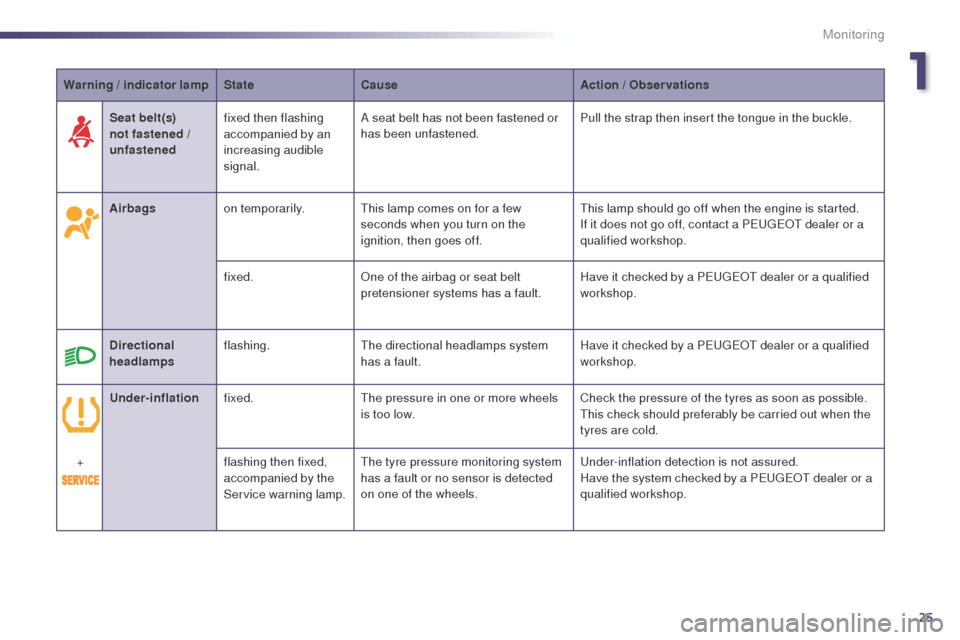
Airbags on temporarily.
th
is lamp comes on for a few
seconds when you turn on the
ignition, then goes off.
th
is lamp should go off when the engine is started.
If it does not go off, contact a P
e
uge
Ot
dealer or a
qualified workshop.
fixed. One of the airbag or seat belt
pretensioner systems has a fault. Have it checked by a P
e
uge
Ot
dealer or a qualified
workshop.
Directional
headlamps flashing.
th
e directional headlamps system
has a fault. Have it checked by a P
e
uge
Ot
dealer or a qualified
workshop.
Seat belt(s)
not fastened /
unfastened
fixed then flashing
accompanied by an
increasing audible
signal. A seat belt has not been fastened or
has been unfastened.
Pull the strap then insert the tongue in the buckle.
Under-inflation fixed.
th
e pressure in one or more wheels
is too low. Check the pressure of the tyres as soon as possible.
th
is check should preferably be carried out when the
tyres are cold.
+ flashing then fixed,
accompanied by the
Service warning lamp.
th
e tyre pressure monitoring system
has a fault or no sensor is detected
on one of the wheels.
un
der-inflation detection is not assured.
Have the system checked by a P
e
uge
Ot
dealer or a
qualified workshop.
1
Monitoring
Page 29 of 380
27
* According to country.
CHECK (vehicle autotest)
Automatic CHECK
With the key in the ignition on position, all of the
warning lamps for the functions tested are displayed.
th
ey are switched off after a few seconds.
At the same time, an automatic CHeC K
(vehicle autotest) is carried out.
In the presence of a fault
A "minor" fault has been detected: the warning
lamp(s) are displayed then go off.
You can start your vehicle; however, contact a
P
e
uge
Ot
dealer or a qualified workshop as
soon as possible.
A "major" fault has been detected: the
associated warning lamps(s) remain on
accompanied by the S
tO
P or S
eR
VIC
e
warning lamp.
Do not start your vehicle.
Call a P
e
uge
Ot
dealer or a qualified
workshop without delay.
Manual CHECK
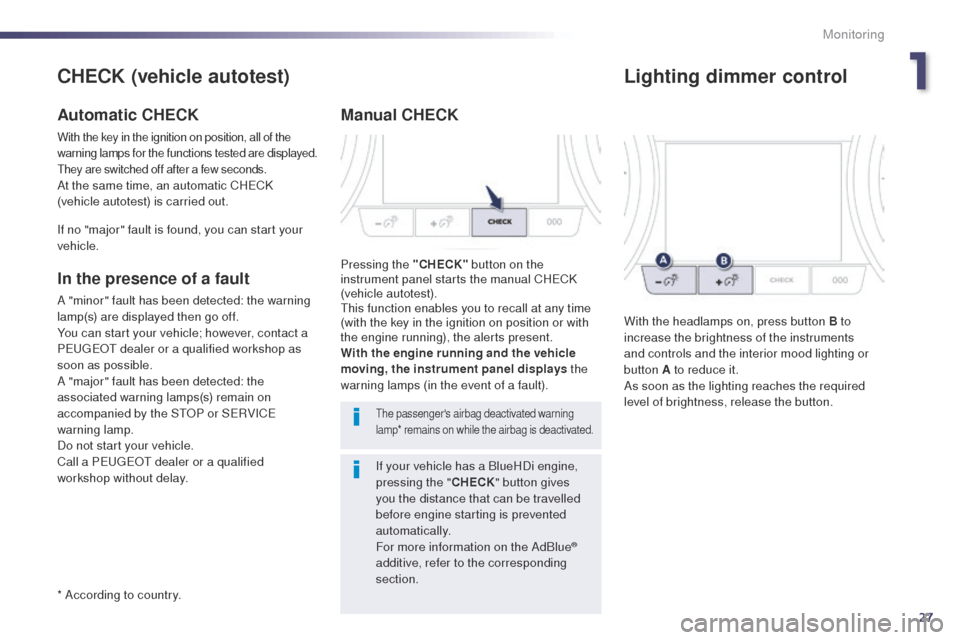
Pressing the "CHECK" button on the
instrument panel starts the manual CHeC K
(vehicle autotest).
th
is function enables you to recall at any time
(with the key in the ignition on position or with
the engine running), the alerts present.
the passenger's airbag deactivated warning
lamp* remains on while the airbag is deactivated.
With the engine running and the vehicle
moving, the instrument panel displays the
warning lamps (in the event of a fault).
If no "major" fault is found, you can start your
vehicle.
Lighting dimmer control
With the headlamps on, press button B to
increase the brightness of the instruments
and controls and the interior mood lighting or
button
A to reduce it.
As soon as the lighting reaches the required
level of brightness, release the button.
If your vehicle has a BlueHDi engine,
pressing the " CHECK" button gives
you the distance that can be travelled
before engine starting is prevented
automatically.
For more information on the AdBlue
®
additive, refer to the corresponding
section.
1
Monitoring
Page 30 of 380
28
Service indicator
More than 1 800 miles (3 000 km)
remain before the next service is due
When the ignition is switched on, no service
information appears in the screen.
th
is is a check against the planned servicing
intervals in the manufacturer's servicing
schedule.
It is calculated from the last service indicator
reset according to the number of miles travelled
and the time elapsed since the last service.
For BlueHDi Diesel versions only (depending
on country of sale), the level of deterioration of
the engine oil is also taken into account.
Between 600 miles (1 000 km) and
1 800 miles (3 000 km) remain before
the next service is due
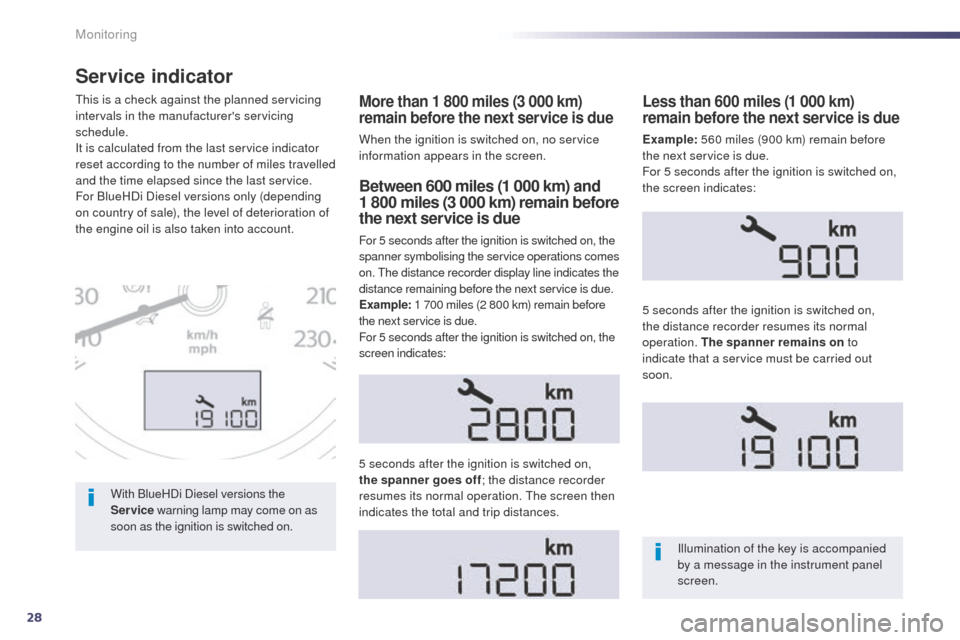
For 5 seconds after the ignition is switched on, the
spanner symbolising the service operations comes
on.
t
h
e distance recorder display line indicates the
distance remaining before the next service is due.
Example: 1 700 miles (2 800 km) remain before
the next service is due.
For 5 seconds after the ignition is switched on, the
screen indicates:
5 seconds after the ignition is switched on,
the spanner goes off ; the distance recorder
resumes its normal operation.
t
h
e screen then
indicates the total and trip distances.
Less than 600 miles (1 000 km)
remain before the next service is due
Example: 560 miles (900 km) remain before
the next service is due.
For 5 seconds after the ignition is switched on,
the screen indicates:
5 seconds after the ignition is switched on,
the distance recorder resumes its normal
operation. The spanner remains on to
indicate that a service must be carried out
soon.
Illumination of the key is accompanied
by a message in the instrument panel
screen.
With BlueHDi Diesel versions the
Service
warning lamp may come on as
soon as the ignition is switched on.
Monitoring
Page 32 of 380
30
Engine oil level indicator*
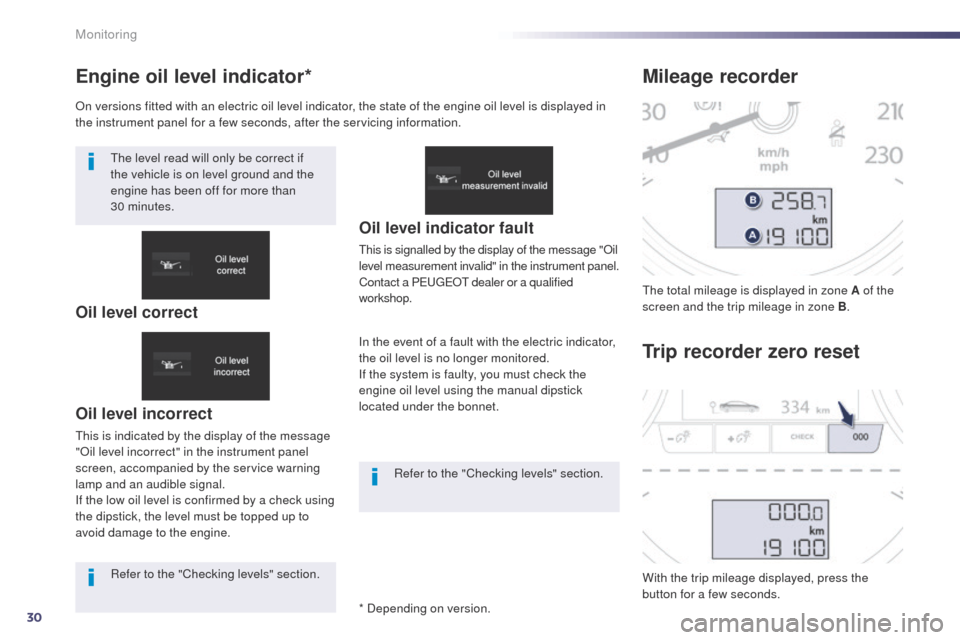
Oil level incorrect
this is indicated by the display of the message
"Oil level incorrect" in the instrument panel
screen, accompanied by the service warning
lamp and an audible signal.
If the low oil level is confirmed by a check using
the dipstick, the level must be topped up to
avoid damage to the engine.
Oil level indicator fault
this is signalled by the display of the message "Oil
level measurement invalid" in the instrument panel.
Contact a P
e
uge
Ot
dealer or a qualified
workshop.
In the event of a fault with the electric indicator,
the oil level is no longer monitored.
If the system is faulty, you must check the
engine oil level using the manual dipstick
located under the bonnet.
th
e total mileage is displayed in zone A of the
screen and the trip mileage in zone B .
With the trip mileage displayed, press the
button for a few seconds.
Mileage recorder
Trip recorder zero reset
On versions fitted with an electric oil level indicator, the state of the engine oil level is displayed in
the instrument panel for a few seconds, after the servicing information.
th
e level read will only be correct if
the vehicle is on level ground and the
engine has been off for more than
30
minutes.
Oil level correct
* Depending on version.Refer to the "Checking levels" section.
Refer to the "Checking levels" section.
Monitoring
Page 66 of 380
64
508_en_Chap02_ouvertures_ed02-2014
Low fuel level
When the low fuel level in the
tank is reached, this warning lamp
comes on in the instrument panel,
accompanied by an audible warning
and a message in the instrument
panel screen.
When it first comes on, around 7 litres of fuel
remain in the tank.
You must refuel as soon as possible to avoid
running out.
Fuel supply cut-off
Your vehicle is equipped with a safety device
which cuts off the fuel supply in the event of a
collision. It is still possible to use a fuel can to fill
the tank but this must be done slowly.
In order to ensure a good flow of fuel,
do not place the nozzle of the fuel can
in direct contact with the flap of the
misfuel prevention device.
Diesel misfuel prevention
Mechanical device which prevents filling the tank of a Diesel vehicle with petrol. It avoids the risk of
engine damage that can result from filling with the wrong fuel.
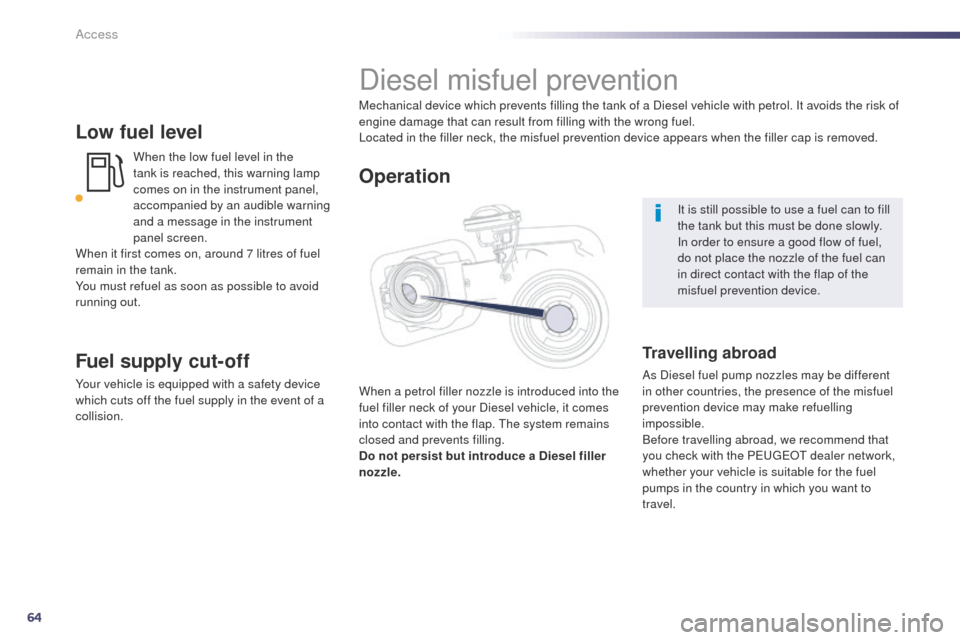
Located in the filler neck, the misfuel prevention device appears when the filler cap is removed.
When a petrol filler nozzle is introduced into the
fuel filler neck of your Diesel vehicle, it comes
into contact with the flap.
t
h
e system remains
closed and prevents filling.
Do not persist but introduce a Diesel filler
nozzle.
Operation
Travelling abroad
As Diesel fuel pump nozzles may be different
in other countries, the presence of the misfuel
prevention device may make refuelling
impossible.
Before travelling abroad, we recommend that
you check with the P
e
uge
Ot
dealer network,
whether your vehicle is suitable for the fuel
pumps in the country in which you want to
travel.
Access
Page 71 of 380
69
508_en_Chap03_confort_ed02-2014
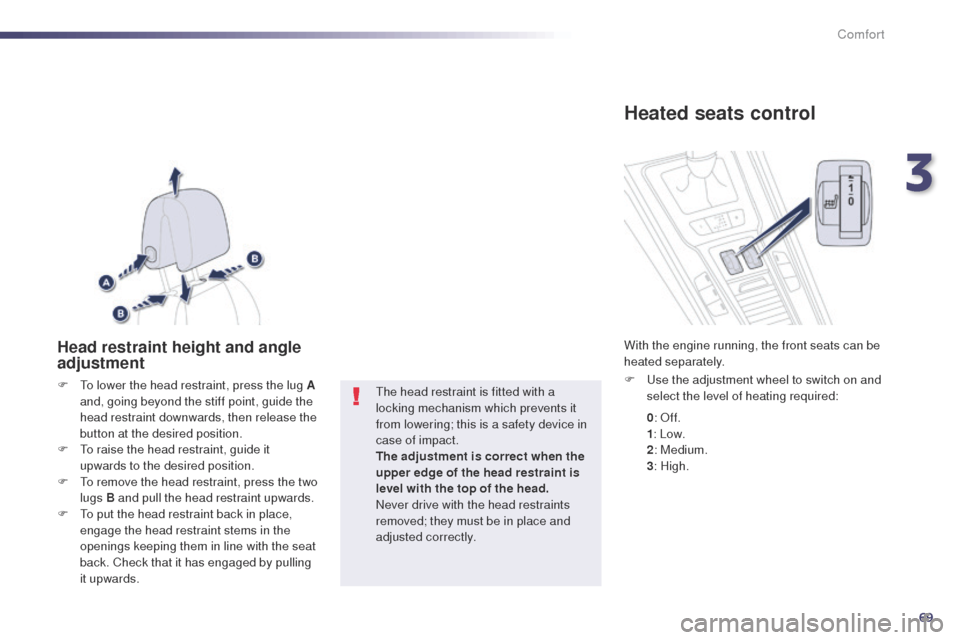
Head restraint height and angle
adjustment
F to lower the head restraint, press the lug A and, going beyond the stiff point, guide the
head restraint downwards, then release the
button at the desired position.
F
t
o r
aise the head restraint, guide it
upwards to the desired position.
F
t
o r
emove the head restraint, press the two
lugs B and pull the head restraint upwards.
F
t
o p
ut the head restraint back in place,
engage the head restraint stems in the
openings keeping them in line with the seat
back. Check that it has engaged by pulling
it upwards.th e head restraint is fitted with a
locking mechanism which prevents it
from lowering; this is a safety device in
case of impact.
The adjustment is correct when the
upper edge of the head restraint is
level with the top of the head.
Never drive with the head restraints
removed; they must be in place and
adjusted correctly.
Heated seats control
F use the adjustment wheel to switch on and select the level of heating required:
With the engine running, the front seats can be
heated separately.
0: Of f.
1 : Low.
2 : Medium.
3 : High.
3
Comfort