wheel Peugeot 508 RXH 2013 User Guide
[x] Cancel search | Manufacturer: PEUGEOT, Model Year: 2013, Model line: 508 RXH, Model: Peugeot 508 RXH 2013Pages: 308, PDF Size: 8.95 MB
Page 35 of 308
.
33
Hybrid system
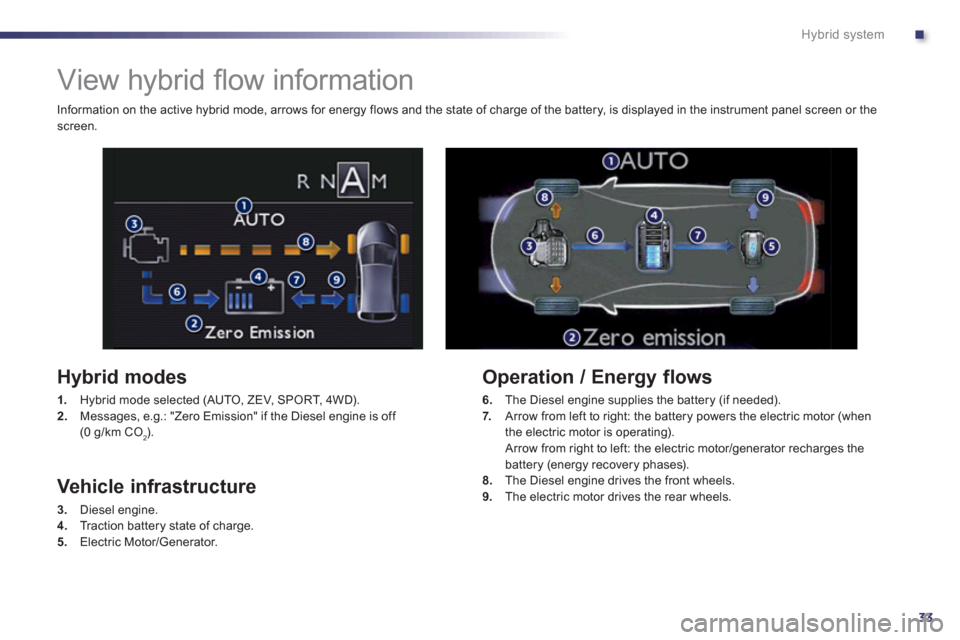
View hybrid fl ow information
Hybrid modes
1.
Hybrid mode selected (AUTO, ZEV, SPORT, 4WD). 2.Messages, e.g.: "Zero Emission" if the Diesel engine is off (0 g/km CO2).
Vehicle infrastructure
3.Diesel engine.4.
Tr a c t i o n b a t t e ry state of charge.
5. Electric Motor/Generator.
Operation / Energy flows
6.
The Diesel engine supplies the battery (if needed).
7.Arrow from left to right: the battery powers the electric motor (when
the electric motor is operating).
Arrow from right to left: the electric motor/generator recharges the
battery (energy recovery phases).8. The Diesel engine drives the front wheels. 9.The electric motor drives the rear wheels. Information on the active h
ybrid mode, arrows for energy flows and the state of charge of the battery, is displayed in the instrument panel screen or the screen.
Page 36 of 308
34
Hybrid system
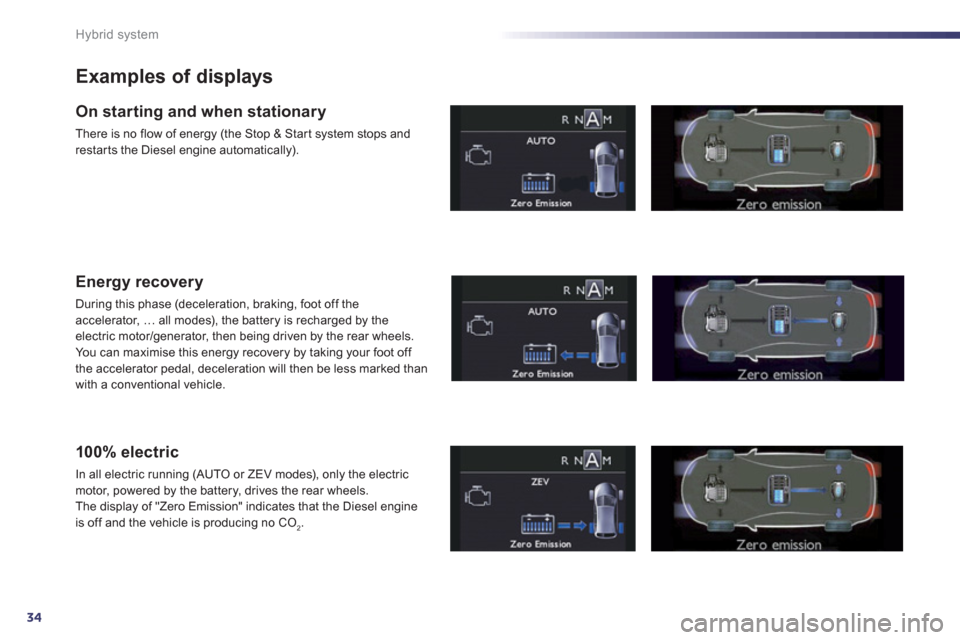
Examples of displays
On starting and when stationary
There is no flow of energy (the Stop & Star t system stops and restar ts the Diesel engine automatically).
Energy recovery
During this phase (deceleration, braking, foot off theaccelerator, … all modes), the battery is recharged by the electric motor/generator, then being driven by the rear wheels.
You can maximise this energy recovery by taking your foot off
the accelerator pedal, deceleration will then be less marked than
with
a conventional vehicle.
100% electric
In all electric running (AUTO or ZEV modes), only the electricmotor, powered by the battery, drives the rear wheels.
The display of "Zero Emission" indicates that the Diesel engine
is off and the vehicle is producing no CO2.
Page 40 of 308
38
Hybrid system
Air conditioning
QuestionAnswer
It
seems to me that the vehicle runs less on electricwhen the heating or air conditioning is operating, is
that right? The demand for heatin
g or air conditioning may require the star ting of the Diesel engine until
the desired level of comfort is attained.
Normal hybrid operation is simply put back. The period can be higher under low or very high
ambient temperatures.
It seems to me that when it is ver
y hot and the air conditioning is working, the vehicle runs on electric for shor ter periods. Is that right? When it is hot, the periods when the Diesel en
gine is put on standby and the vehicle runs on electric are necessarily restricted in order to limit the difference between the temperature in
the vehicle and the level of comfort selected.
In very hot weather, it is always possible to press the Eco OFF button (which brings the
vehicle out of ZEV mode and prevents electric running or the stopping of the engine) to give
preference to temperature control (keeps the air conditioning running).
Special HYbrid4 features
Question Answer
Can I tow with my hybrid vehicle and how much? A HYbrid4 vehicle can tow between 500 kg and 800 kg (see the "Towing" section).
This allows a jet ski or two-wheeler on a trailer to be towed, for example.
The "technical" reason for the limit is related to maintaining adequate cooling capacity for
the internal combustion engine as well as the hybrid components that are also cooled by theengine's cooling system.
Wh
y does engine braking seem so strong? When you take your foot off the accelerator, the engine braking results mainly from the energy recovery by the electric motor.
This leads to a higher level of deceleration than a conventional vehicle and so allows the recovery of free energy.
Page 43 of 308
.
41
Hybrid system
Limit the causes of excess
consumption
Spread loads throughout the vehicle; placethe heaviest items in the bottom of the boot,
as close as possible to the rear seats.Limit the loads carried in the vehicle and reduce wind resistance (roof bars, roof rack, bicycle carrier, trailer...). Use a roof box inpreference.Remove roof bars and roof racks after use.
At the end of winter, remove snow tyres and refit your summer tyres.
Observe the recommendations
on maintenance
Check the tyre pressures regularly, when cold, referring to the label in the door aper ture, driver's side.Carry out this check in par ticular:- before a long journey,- at each change of season,- after a long period out of use.
When refuelling, do not continue after the 3rdcut-off of the nozzle to avoid any overflow.
Have your vehicle ser viced regularly (engine oil, oil filter, air filter...) and obser ve the schedule of operations recommended by the
manufacturer.
At the wheel of your new vehicle, it is only after the first 1 800 miles (3 000 kilometres) that youwill see the fuel consumption settle down to aconsistent average.
Page 50 of 308
48
Hybrid system
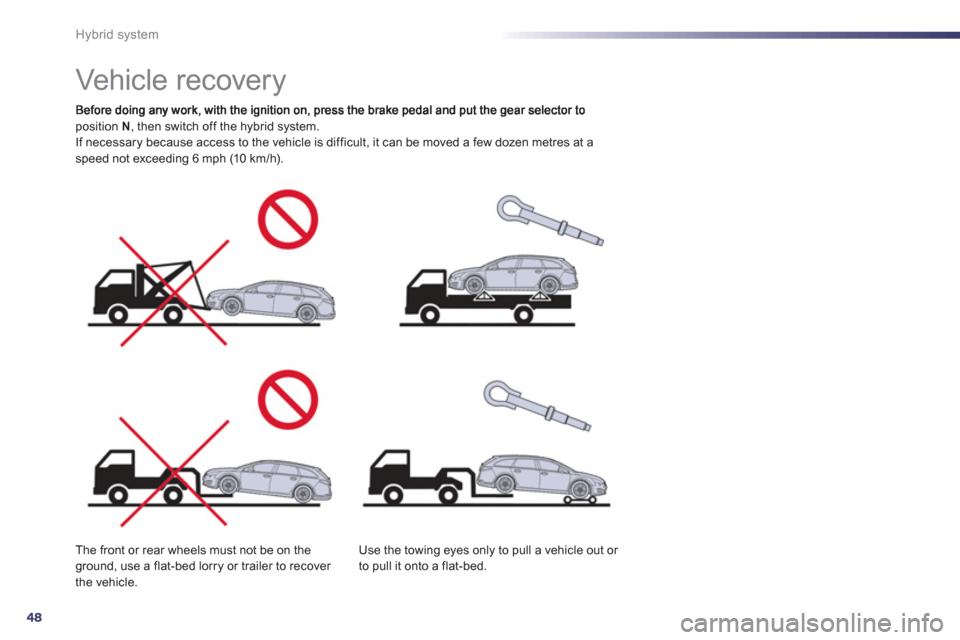
Vehicle recovery
position N
, then switch off the hybrid system.
If necessary because access to the vehicle is difficult, it can be moved a few dozen metres at a speed not exceeding 6 mph (10 km/h).
Th
e front or rear wheels must not be on theground, use a flat-bed lorry or trailer to recover
the vehicle.
Use the towin
g eyes only to pull a vehicle out or
to pull it onto a flat-bed.
Page 52 of 308
50
Instruments and controls
Indicator and warning
lamps
Visual indicators informing the driver that a system is in operation, switched off or has a
fault.
When the ignition is switched on
Certain warning lamps come on for a few seconds in the instrument panel and/or
instrument panel screen when the vehicle's
ignition is switched on.
When the engine is started, these same
warning lamps should go off.
If they remain on, before moving off, refer to the
information on the warning lamp concerned.
Associated warnings
The switching on of cer tain warning lamps maybe accompanied by an audible signal and a message in the instrument panel screen.
The warning lamps may come on continuously(fixed) or flash.
Certain warning lamps may come on inone of two modes. Only by relating thetype of lighting to the operating status
of the vehicle can it be ascertainedwhether the situation is normal or whether a fault has occurred.
1
2
2
2
3
3
3
2
3
3
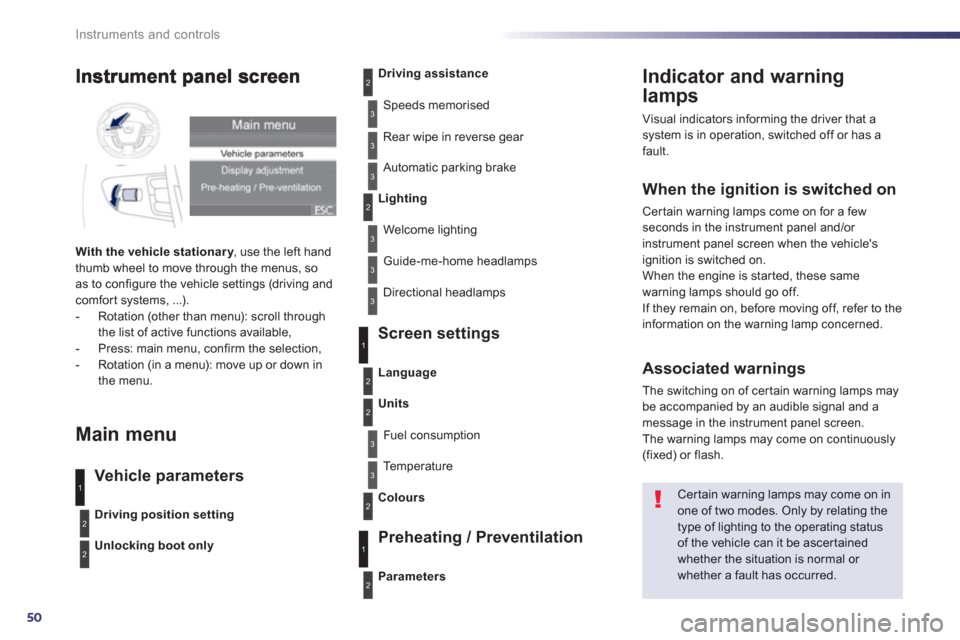
With the vehicle stationar y
, use the left handythumb wheel to move through the menus, so as to configure the vehicle settings (driving andcomfort systems, ...).
- Rotation (other than menu): scroll through
the list of active functions available,
- Press: main menu, confirm the selection,
- Rotation (in a menu): move up or down in
the menu.
Main menu
Vehicle parameters Screen settin
gs
Preheatin
g / Preventilation
Driving position setting
Unlocking boot only
Driving assistance
Speeds memorised
Rear wipe in reverse
gear
Automatic parkin
g brake
Lighting
Welcome lighting
Guide-me-home headlamps
Directional headlamps
Parameters
Language
Units
Fuel consumption
Te m p e r a t u r e
Colours
3
1
2
2
3
2
3
1
2
Page 57 of 308
1
55
Instruments and controls
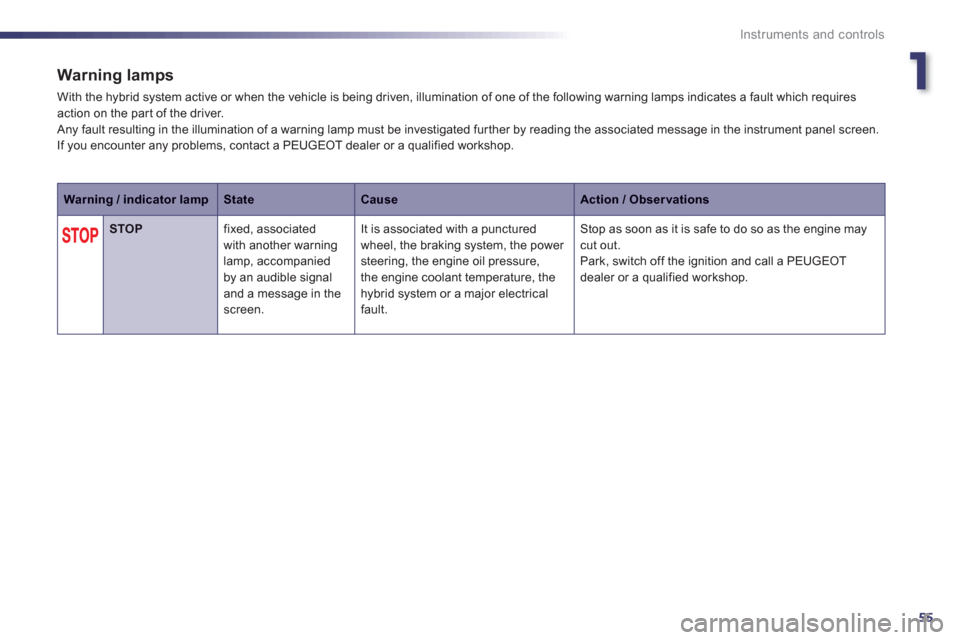
Warning lamps
With the hybrid system active or when the vehicle is being driven, illumination of one of the following warning lamps indicates a fault which requires
action on the par t of the driver.
Any fault resulting in the illumination of a warning lamp must be investigated fur ther by reading the associated message in the instrument panel screen.
If you encounter any problems, contact a PEUGEOT dealer or a qualified workshop.
Warning / indicator lampStateCauseAction / Observations
STOP
fixed, associated
with another warning
lamp, accompanied
b
y an audible signal
and a message in thescreen. It is associated with a punctured
wheel, the brakin
g system, the power steering, the engine oil pressure,
the engine coolant temperature, thehybrid system or a major electrical fault. Stop as soon as it is safe to do so as the en
gine maycut out.
Park, switch off the ignition and call a PEUGEOT
dealer or a qualified workshop.
Page 69 of 308
1
67
Instruments and controls
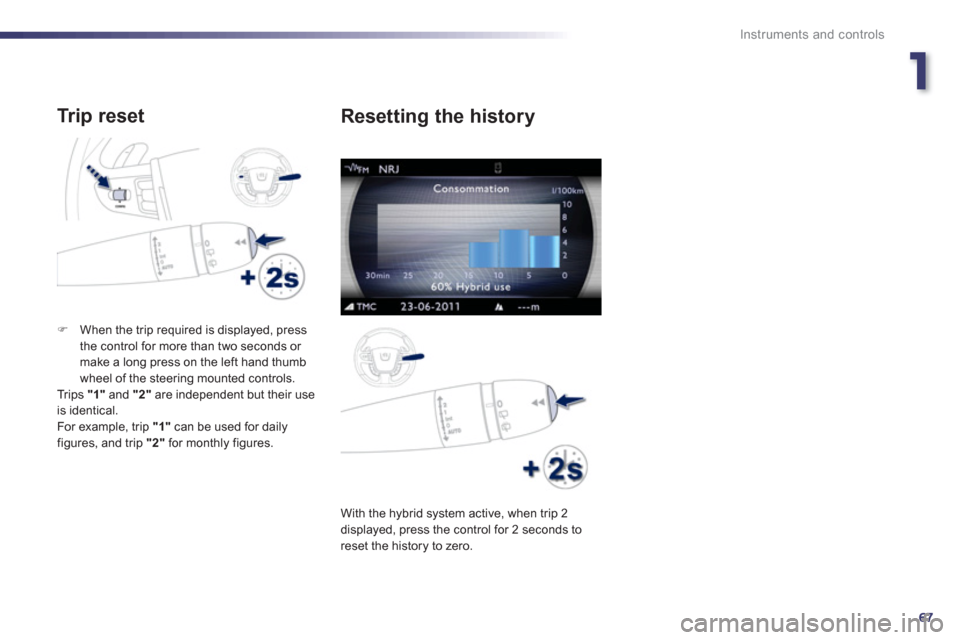
Tr ip reset
)When the trip required is displayed, press
the control for more than two seconds or make a long press on the left hand thumb
wheel of the steering mounted controls.
Trips "1"
and "2"are independent but their useis identical.
For example, trip "1"
can be used for daily figures, and trip "2"
for monthly figures.
With the h
ybrid system active, when trip 2
displayed, press the control for 2 seconds to reset the history to zero.
Resetting the history
Page 83 of 308
2
81
Access
Locking the vehicle
w
ith exterior perimeter
monitoring only
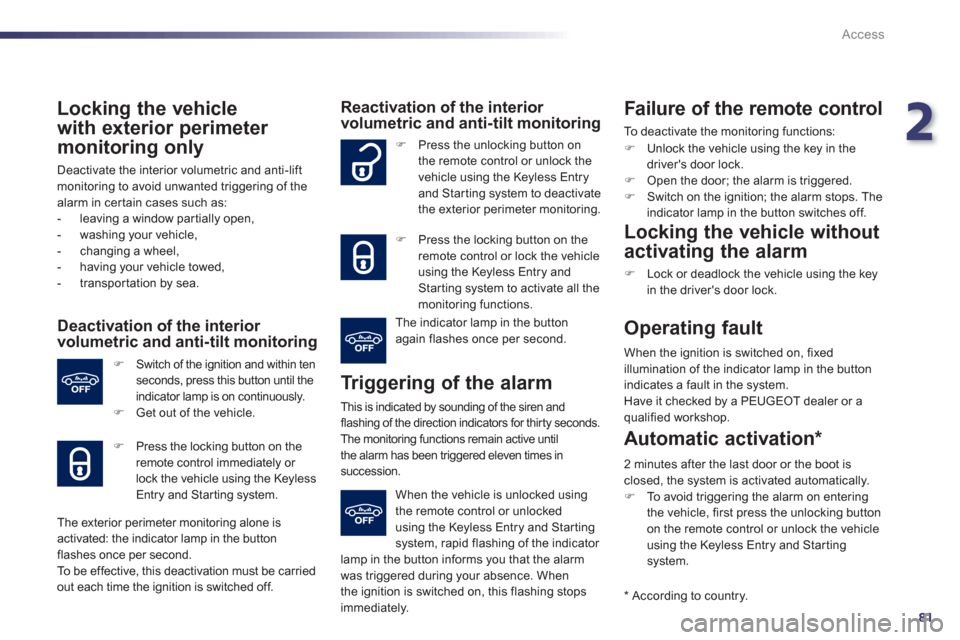
Deactivate the interior volumetric and anti-liftmonitoring to avoid unwanted triggering of the alarm in certain cases such as:
- leaving a window par tially open,
- washing your vehicle,
- changing a wheel,
- having your vehicle towed,
- transportation by sea.
Deactivation of the interior volumetric and anti-tilt monitoring
)
Switch of the ignition and within ten seconds, press this button until the
indicator lamp is on continuously.) Get out of the vehicle.
)
Press the locking button on the
remote control immediately or
lock the vehicle using the Keyless
Entry and Starting system.
The exterior perimeter monitorin
g alone is
activated: the indicator lamp in the button
flashes once per second.
To b e effective, this deactivation must be carried
out each time the ignition is switched off.
Reactivation of the interior volumetric and anti-tilt monitoring
Tr iggering of the alarm
This is indicated by sounding of the siren and flashing of the direction indicators for thirty seconds.
The monitoring functions remain active until
the alarm has been triggered eleven times in succession.
) Press the unlocking button on
the remote control or unlock thevehicle using the Keyless Entry
and Star ting system to deactivate
the exterior perimeter monitoring.
) Press the locking button on the
remote control or lock the vehicleusing the Keyless Entry and Starting system to activate all the monitoring functions.
The indicator lamp in the button
again flashes once per second.
When the vehicle is unlocked usingthe remote control or unlocked
using the Keyless Entry and Starting
system, rapid flashing of the indicator lamp in the button informs you that the alarmwas triggered during your absence. When
the ignition is switched on, this flashing stopsimmediately.
Failure of the remote control
To deactivate the monitoring functions:
)
Unlock the vehicle using the key in thedriver's door lock. )
Open the door; the alarm is triggered. )
Switch on the ignition; the alarm stops. The
indicator lamp in the button switches off.
Locking the vehicle without
activating the alarm
)
Lock or deadlock the vehicle using the key
in the driver's door lock.
Operating fault
When the ignition is switched on, fixed
illumination of the indicator lamp in the button
indicates a fault in the system.
Have it checked by a PEUGEOT dealer or a qualified workshop.
*
According to country.
Automatic activation *
2 minutes after the last door or the boot is closed, the system is activated automatically. )
To avoid triggering the alarm on enteringthe vehicle, first press the unlocking button on the remote control or unlock the vehicleusing the Keyless Entry and Star ting system.
Page 96 of 308
94
Comfort
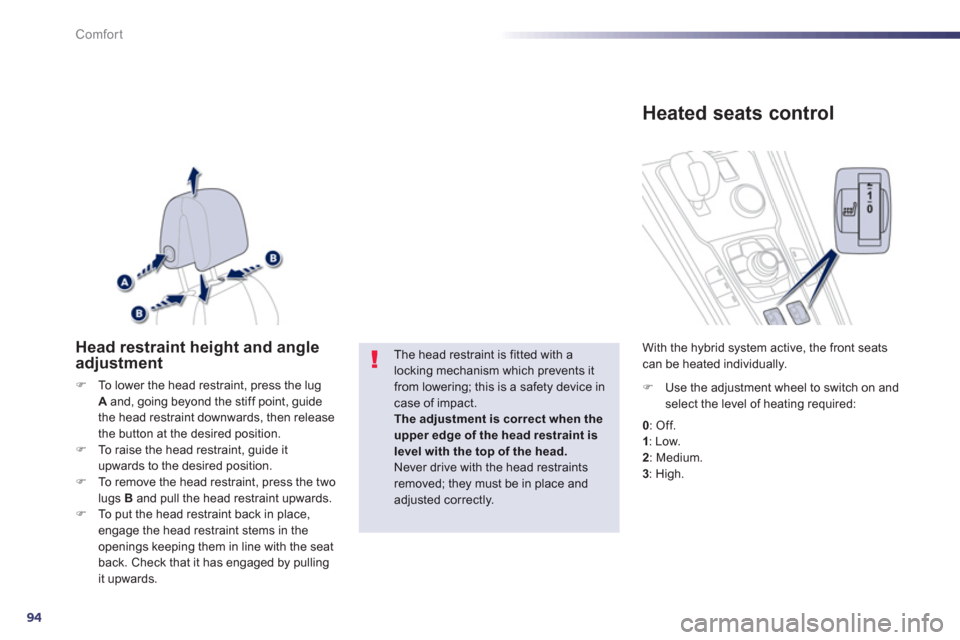
Head restraint height and angle adjustment
)To lower the head restraint, press the lugA and, going beyond the stiff point, guide
the head restraint downwards, then release
the button at the desired position.
)To raise the head restraint, guide it upwards to the desired position.)To remove the head restraint, press the two lugs B and pull the head restraint upwards. )To put the head restraint back in place,
engage the head restraint stems in the
openings keeping them in line with the seat
back. Check that it has engaged by pulling it upwards.
The head restraint is fitted with a locking mechanism which prevents itfrom lowering; this is a safety device incase of impact.The adjustment is correct when theupper edge of the head restraint is level with the top of the head.Never drive with the head restraintsremoved; they must be in place andadjusted correctly.
)Use the adjustment wheel to switch on and select the level of heating required:
With the h
ybrid system active, the front seatscan be heated individually.
0
:
Off.1:
Low.2
:
Medium. 3
:
High.
Heated seats control