charging Peugeot 508 RXH 2013 Owner's Manual
[x] Cancel search | Manufacturer: PEUGEOT, Model Year: 2013, Model line: 508 RXH, Model: Peugeot 508 RXH 2013Pages: 308, PDF Size: 8.95 MB
Page 25 of 308
.
23
Hybrid system
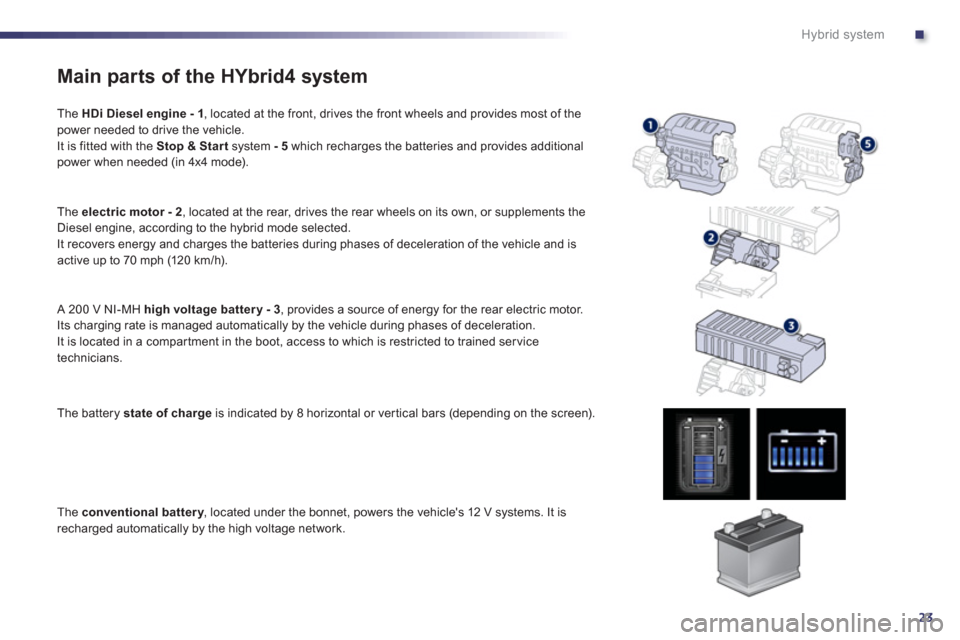
Main parts of the HYbrid4 system
The HDi Diesel engine - 1
, located at the front, drives the front wheels and provides most of the power needed to drive the vehicle.
It is fitted with the Stop & Start
system - 5
which recharges the batteries and provides additional
power when needed (in 4x4 mode).
Th
e electric motor - 2
, located at the rear, drives the rear wheels on its own, or supplements the
Diesel engine, according to the hybrid mode selected.
It recovers energy and charges the batteries during phases of deceleration of the vehicle and is
active up to 70 mph (120 km / h).
A 200 V NI-MH high voltage battery - 3
, provides a source of energy for the rear electric motor.
Its charging rate is managed automatically by the vehicle during phases of deceleration.
It is located in a compar tment in the boot, access to which is restricted to trained service
technicians.
The batter
y state of chargeis indicated by 8 horizontal or vertical bars (depending on the screen).
The conventional battery, located under the bonnet, powers the vehicle's 12 V systems. It is yrecharged automatically by the high voltage network.
Page 29 of 308
.
27
Hybrid system
the engine
(accessory position)
Anti-theft protection
Electronic engine immobiliser
The keys contain an electronic chip which hasa secret code. When the ignition is switched
on, this code must be recognised in order for
starting to be possible.
This electronic engine immobiliser locks the
en
gine management system a few minutes after the ignition is switched off and prevents
starting of the engine by anyone who does not have the key.
In the event of a malfunction, you are informed by a message in the instrument panel screen.In this case, your vehicle does not start; contacta PEUGEOT dealer as soon as possible.
Turn the key towards the dashboard to the
intermediate position or with the Keyless Entry
and
Starting key inside the vehicle, press the
"START/STOP" button, with no action on the pedal. This switches on the ignition and so
activates the ancillary equipment.
)Press the "STA R T/STOP" button,
the instrument panel comes on
but the en
gine does not star t. )Press the button again to switch
off the ignition and so allow the
vehicle to be locked.
If you use the accessories positionfor too long, the system automaticallychanges to economy mode to avoid discharging the battery.
Page 39 of 308
.
37
Hybrid system
Reducing consumption - Fuel
QuestionAnswer
How can I optimise m
y fuel consumption? Give preference to Auto mode as it selects in the best way the "driving energy source" to
use in order to reduce fuel consumption.
You should also adapt your driving style to the special features of hybrid vehicles to get the
best out of it, for example by taking your foot off the accelerator pedal rather than braking and by anticipating decelerations (entering a built-up area, stop at traffic lights, stop at halt
signs, ...).
Wh
y do I not manage to reduce my fuel consumptioneven though I often drive in ZEV (Zero EmissionsVehicle) mode? It is not ZEV mode but Auto mode that is the most appropriate for reducin
g fuelconsumption, as it selects the best "driving energy source".
ZEV mode (10 0% electric operation) can reduce fuel consumption in some cases. However,recharging the traction battery has an energy cost.
This is why we recommend using Auto mode more often.
Wh
y does the trip computer sometimes display the
bars for 28 mpg (10 litres) consumption in town?The current fuel consumption displayed may appear high when the distance covered is
very low, but this generally has very little impact and the true average fuel consumption willremain low.
In town, your hybrid retains very good fuel economy (of the order of 35% better than a non-hybrid vehicle).
Wh
y is my battery rarely fully charged? A par tly charged battery is normal operation (4 to 5 bars on average in Auto mode).
This allows some capacity to be left free for the recovery for energy when going downhill or
taking when your foot off the accelerator.
Wh
y are there so may fuel aler t messages whenstarting to use the reser ve?To e n c o u r age you to refuel as soon as possible and avoid the loss of hybrid functions.
Page 45 of 308
.
43
Hybrid system
200 V high voltage battery
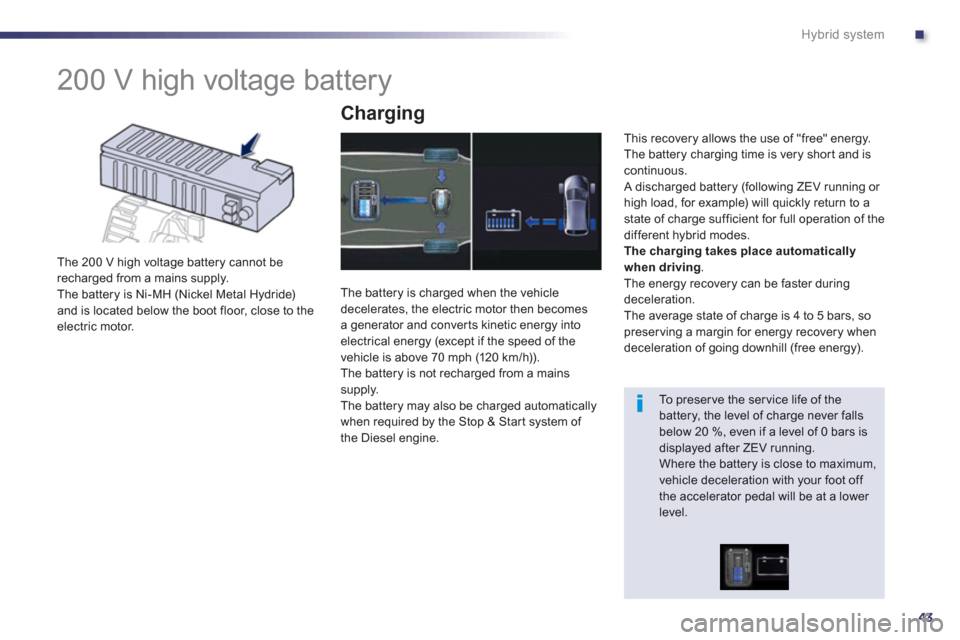
The 200 V high voltage battery cannot be
recharged from a mains supply.
The battery is Ni-MH (Nickel Metal Hydride)
and is located below the boot floor, close to the electric motor.
Charging
The battery is charged when the vehicledecelerates, the electric motor then becomesa generator and conver ts kinetic energy into
electrical energy (except if the speed of the
vehicle is above 70 mph (120 km / h)).
The battery is not recharged from a mains
supply.
The battery may also be charged automaticallywhen required by the Stop & Start system of
the Diesel engine.
This recover
y allows the use of "free" energy.
The battery charging time is very shor t and iscontinuous.
A discharged battery (following ZEV running or
high load, for example) will quickly return to astate of charge sufficient for full operation of the
different hybrid modes.
Thecharging takes place automatically
when driving.
The energy recovery can be faster during deceleration.
The average state of charge is 4 to 5 bars, so
preserving a margin for energy recovery when
deceleration of going downhill (free energy).
To preser ve the ser vice life of the battery, the level of charge never fallsbelow 20 %, even if a level of 0 bars isdisplayed after ZEV running. Where the battery is close to maximum,vehicle deceleration with your foot off the accelerator pedal will be at a lower level.
Page 61 of 308
1
59
Instruments and controls
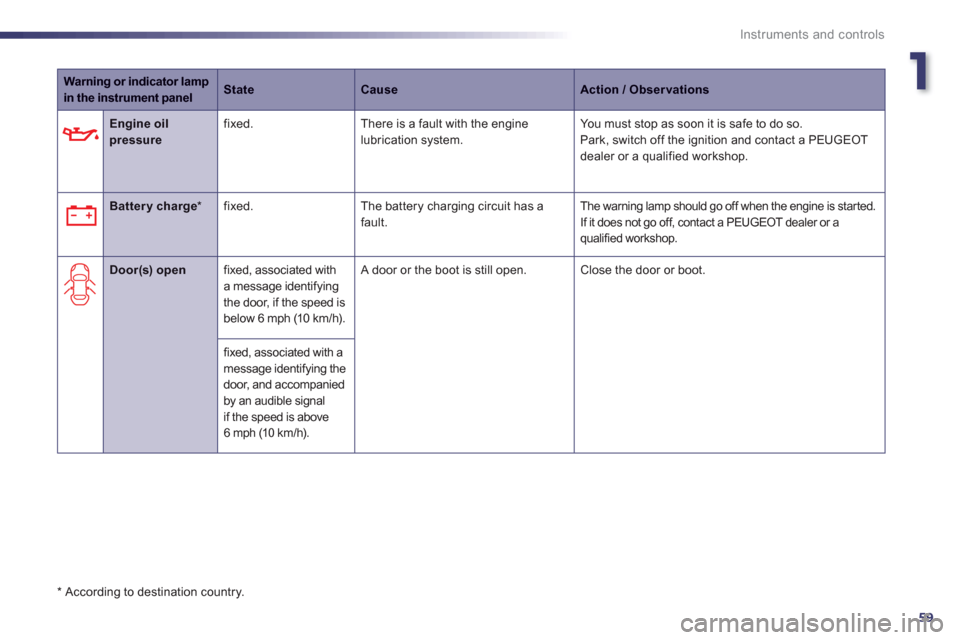
Warning or indicator lamp in the instrument panelStateCauseAction / Observations
Engine oilpressure
fixed. There is a fault with the engine
lubrication system. You must stop as soon it is safe to do so.
Park, switch off the ignition and contact a PEUGEOT
dealer or a qualified workshop.
Battery charge
*
fixed. The battery charging circuit has a
fault. The warning lamp should go off when the engine is started.
If it does not go off, contact a PEUGEOT dealer or a
quali
fied workshop.
Door(s) open
fixed, associated with
a message identifying
the door, if the speed is
below 6 mph (10 km/h).
A door or the boot is still open. Close the door or boot.
fixed, associated with a
message identifying the
door, and accompanied
b
y an audible signal
if the speed is above
6 mph (10 km/h).
*
According to destination country.
Page 151 of 308
5
149
Visibility
An audible signal when a front door is opened warns the driver that the vehicle's exterior lighting is on, with theignition off and in manual lighting mode. In this case, switching off the lighting stops the audible signal.
With the ignition off, if the dipped headlamps remain on, the vehicle goes into "ECO" mode to avoid discharging the battery.
In some weather conditions (e.g. low temperature or humidity), the presence of misting on the internal sur face of theglass of the headlamps and rear lampsis normal; it disappears after the lamps have been on for a few minutes.
Daytime lighting, compulsory in cer tain
countries, which comes on automatically when
the engine is star ted making the vehicle more
visible to other road users.
Daytime running lamps
This function is assured:
- in countries where it is imposed by
regulations, by illumination of the dippedbeam headlamps with the sidelamps and number plate lamps.
- for other countries where it is provided, by
the use of dedicated lamps.
This function can be activatedor deactivated via the vehicleconfiguration menu.
The lighting goes off when you switchoff the ignition, but you can always switch it on again using the lighting control stalk.
*
f
unction that can be set in the vehicle
configuration menu.
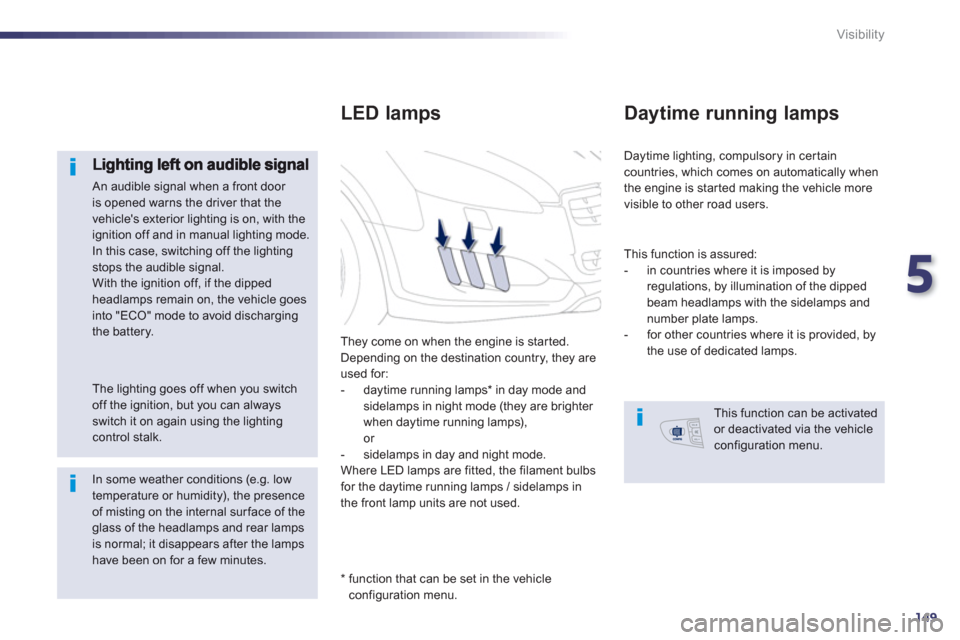
LED lamps
They come on when the engine is started.Depending on the destination country, they are used for:
- daytime running lamps *
in day mode andsidelamps in night mode (they are brighter
when daytime running lamps),
or
- sidelamps in day and night mode.
Where LED lamps are fitted, the filament bulbs
for the da
ytime running lamps / sidelamps in
the front lamp units are not used.
Page 185 of 308
7
183
Safety
Sit in a normal upright position. Wear a correctly adjusted seat belt.
Do not leave anything between theoccupants and the airbags (a child, pet, object...). This could hamper the operation of the airbags or injure the occupants. After an accident or if the vehicle has beenstolen or broken into, have the airbagsystems checked. All work on the airbag system must be carried out by a PEUGEOT dealer or a qualified workshop.
Even if all of the precautions mentionedare obser ved, a risk of injury or of minor burns to the head, chest or arms when an airbag is deployed cannot be ruled out. Thebag inflates almost instantly (within a fewmilliseconds) then deflates within the same
time discharging the hot gas via openings provided for this purpose.
Lateral airbags
Use only approved covers on the seats, compatible with the deployment the lateralairbags. For information on the range of seatcovers suitable for your vehicle, you can contact a PEUGEOT dealer. Refer to the "Accessories" section.Do not fix or attach anything to the seatbacks (clothing...). This could cause injuryto the chest or arms if the lateral airbag isdeployed.Do not sit with the upper par t of the body anynearer to the door than necessary.
Front airbags
Do not drive holding the steering wheel by itsspokes or resting your hands on the centre part of the wheel.
Passengers must not place their feet on thedashboard.
If possible, do not smoke as deployment of the airbags can cause burns or the risk of injury from a cigarette or pipe.
Never remove or pierce the steering wheel or hit it violently.
Curtain airbags
Do not fix or attach anything to the roof. This
could cause injury to the head if the cur tain airbag is deployed.If fitted on your vehicle, do not remove thegrab handles installed on the roof, they play a part in securing the cur tain airbags.
For the airbags to be fully effective, observe the following safety rules:
Page 209 of 308
8
207
Practical information
12 V battery
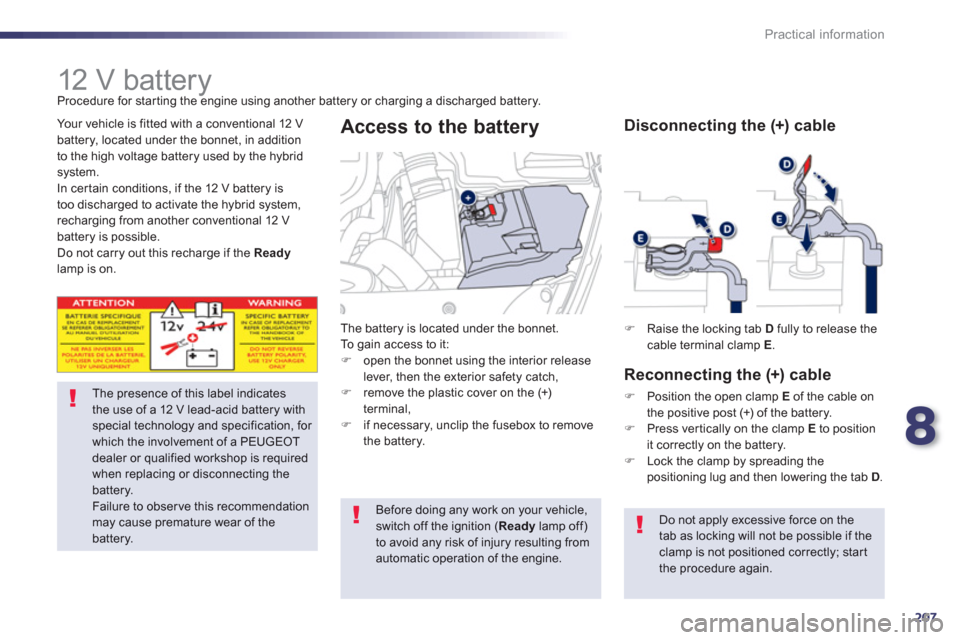
The presence of this label indicates the use of a 12 V lead-acid battery withspecial technology and specification, for which the involvement of a PEUGEOT dealer or qualified workshop is requiredwhen replacing or disconnecting the battery.
Failure to observe this recommendation may cause premature wear of the battery.
The battery is located under the bonnet.
To gain access to it:
) open the bonnet using the interior releaselever, then the exterior safety catch,)
remove the plastic cover on the (+)
terminal,) if necessary, unclip the fusebox to remove
the battery.
Access to the battery
Before doing any work on your vehicle, switch off the ignition ( Readylamp off)to avoid any risk of injury resulting from automatic operation of the engine. Y
our vehicle is fitted with a conventional 12 V
battery, located under the bonnet, in addition
to the high voltage battery used by the hybridsystem.
In cer tain conditions, if the 12 V battery is
too discharged to activate the hybrid system,
recharging from another conventional 12 V
battery is possible.
Do not carry out this recharge if the Readylamp is on.
Procedure for star tin
g the engine using another battery or charging a discharged battery.
)
Raise the locking tab D
fully to release thecable terminal clamp E.
Disconnecting the (+) cable
Reconnectin
g the (+) cable
)
Position the open clamp E
of the cable on
the positive post (+) of the battery. ) Press ver tically on the clamp E
to position
it correctly on the battery.) Lock the clamp by spreading thepositioning lug and then lowering the tab D.
Do not apply excessive force on the tab as locking will not be possible if the clamp is not positioned correctly; star tthe procedure again.
Page 211 of 308
8
209
Practical information
Following reconnection of the battery
Following reconnection of the battery, switch on
the ignition and wait 1 minute before star ting to
permit initialisation of the electronic systems.However, if problems remain following this operation, contact a PEUGEOT dealer or a qualified workshop.
Referring to the corresponding section, you
must yourself reinitialise (depending on
version):
- the remote control key,
- the electric blind(s),
- ...
Before disconnecting the battery
Wait 2 minutes after switching off the ignition
before disconnecting the battery.
Close the windows and the doors before
disconnecting the battery. Protect your eyes and face beforehandling the battery. All operations on the battery must be carried out in a well ventilated area and away from naked flames and sources of sparks, so as to avoid the risk of explosion or fire. Do not try to charge a frozen battery; the battery must first be thawed out toavoid the risk of explosion. If the battery has been frozen, before charging haveit checked by a PEUGEOT dealer or a qualified workshop who will check thatthe internal components have not been damaged and the casing is not cracked, which could cause a leak of toxic andcorrosive acid.
Do not push the vehicle to star t theengine.
It is advisable to disconnect the battery if the vehicle is to be left unused for more than one month.
The batteries contain harmful substances such as sulphuric acid and lead. Theymust be disposed of in accordancewith regulations and must not, in anycircumstances, be discarded with household
waste.
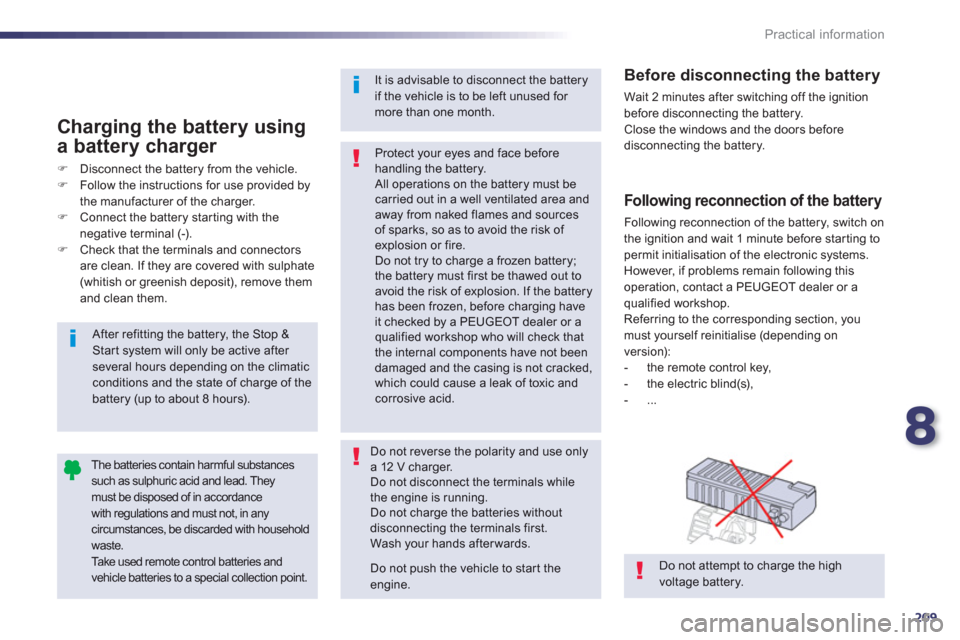
Take used remote control batteries and vehicle batteries to a special collection point. Do not attempt to charge the high voltage battery.
After refitting the battery, the Stop & Start system will only be active after several hours depending on the climaticconditions and the state of charge of the battery (up to about 8 hours).
Charging the battery using
a battery charger
)Disconnect the battery from the vehicle.)Follow the instructions for use provided by
the manufacturer of the charger.)Connect the battery starting with thenegative terminal (-).)Check that the terminals and connectorsare clean. If they are covered with sulphate (whitish or greenish deposit), remove themand clean them.
Do not reverse the polarity and use only a 12 V charger. Do not disconnect the terminals while the engine is running.Do not charge the batteries without disconnecting the terminals first. Wash your hands afterwards.
Page 241 of 308
239
The system is protected in such a way that it will onlyoperate in your vehicle.
Peugeot Connect Navigation (RT6)
01 First steps - Control panel
For safety reasons, the driver must carry out operations
which require prolonged attention while the vehicle is stationary.
When the en
gine is switched off and to prevent
discharging of the battery, the system switches off following the activation of the energy economy mode.
CONTENTS
02 Steering mounted controls
03 General operation
04 Navigation - Guidance
05 Traffic information
06 Using the telephone
07 Contacts - ADDR BOOK
08 Radio
09 Music media players
10 Audio settings
11 Configuration
12 Screen menu map p.
p.
p.
p.
p.
p.
p.
p.
p.
p.
p.
p.
240
2
42
243
245
2
58
261
269
272
275
2
81
282
283
Frequently asked questions p. 286
SATELLITE NAVIGATION SYSTEM
MULTIMEDIA BLUETOOTH TELEPHONE AUDIO
SYSTEM