glove box Peugeot 508 RXH 2013 Owner's Manual
[x] Cancel search | Manufacturer: PEUGEOT, Model Year: 2013, Model line: 508 RXH, Model: Peugeot 508 RXH 2013Pages: 308, PDF Size: 8.95 MB
Page 14 of 308
12
Familiarisation
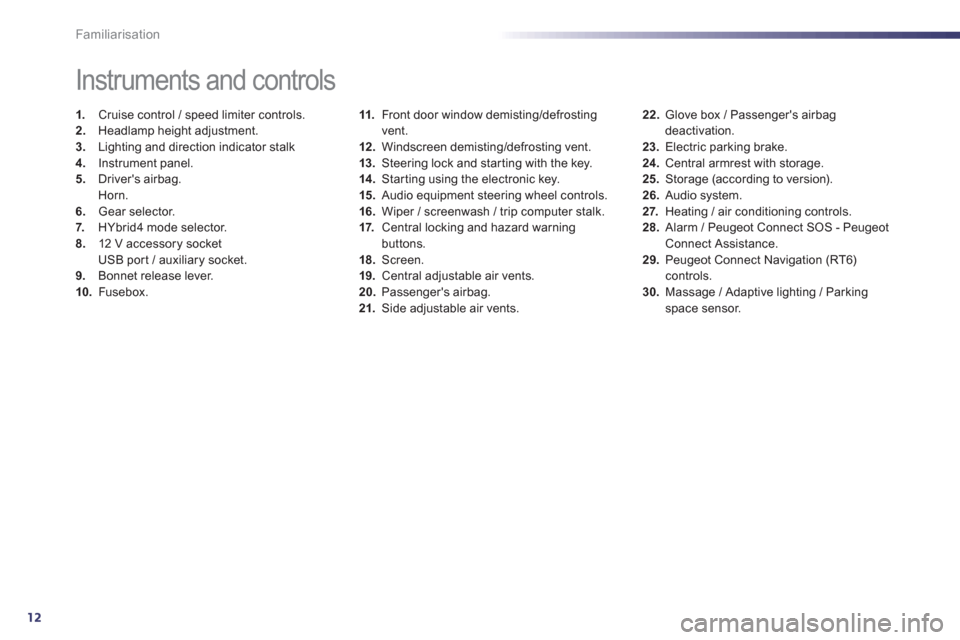
11.Front door window demisting/defrostingvent.
12.Windscreen demisting/defrosting vent.
13
. Steering lock and star ting with the key. 14 .
Starting using the electronic key.
15. Audio equipment steering wheel controls.
16.Wiper / screenwash / trip computer stalk.
17. Central locking and hazard warningbuttons.
18. Screen.
19.Central adjustable air vents.
20.Passenger's airbag. 21. Side adjustable air vents.
Instruments and controls
1.
Cruise control / speed limiter controls. 2.
Headlamp height adjustment. 3.
Lighting and direction indicator stalk
4.
Instrument panel. 5.
Driver's airbag.Horn.
6.Gear selector.
7. HYbrid4 mode selector. 8.12 V accessory socket
USB por t / auxiliary socket. 9. Bonnet release lever.10.Fusebox.
22.
Glove box / Passenger's airbag deactivation. 23.
Electric parking brake.
24.
Central armrest with storage. 25.Storage (according to version).26.Audio system. 27.
Heating / air conditioning controls.28.
Alarm / Peugeot Connect SOS - PeugeotConnect Assistance. 29.
Peugeot Connect Navigation (RT6)controls. 30.
Massage / Adaptive lighting / Parkingspace sensor.
Page 20 of 308
18
Familiarisation
Passenger safety
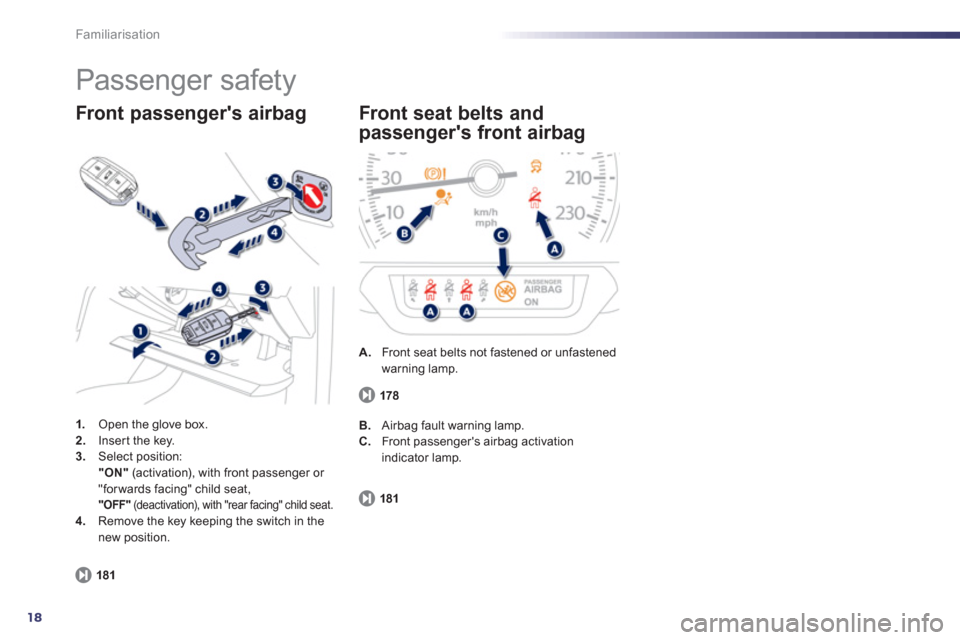
1.
Open the glove box.2.
Inser t the key.3.Select position:
"ON"
(activation), with front passenger or "forwards facing" child seat, "OFF"(deactivation), with "rear facing" child seat. 4.
Remove the key keeping the switch in the
new position.
Front passenger's airbag
181
A.
Front seat belts not fastened or unfastenedwarning lamp.
Front seat belts and
passenger's front airbag
181
B.
Airbag fault warning lamp.
C.
Front passenger's airbag activation indicator lamp.
178
Page 55 of 308
1
53
Instruments and controls
StateCauseAction / Observations
Automatic wiping
fixed. The wiper control is pushed downwards. Automatic front wiping is activated.
To deactivate automatic wiping, operate the controlstalk downwards or put the stalk into another position.
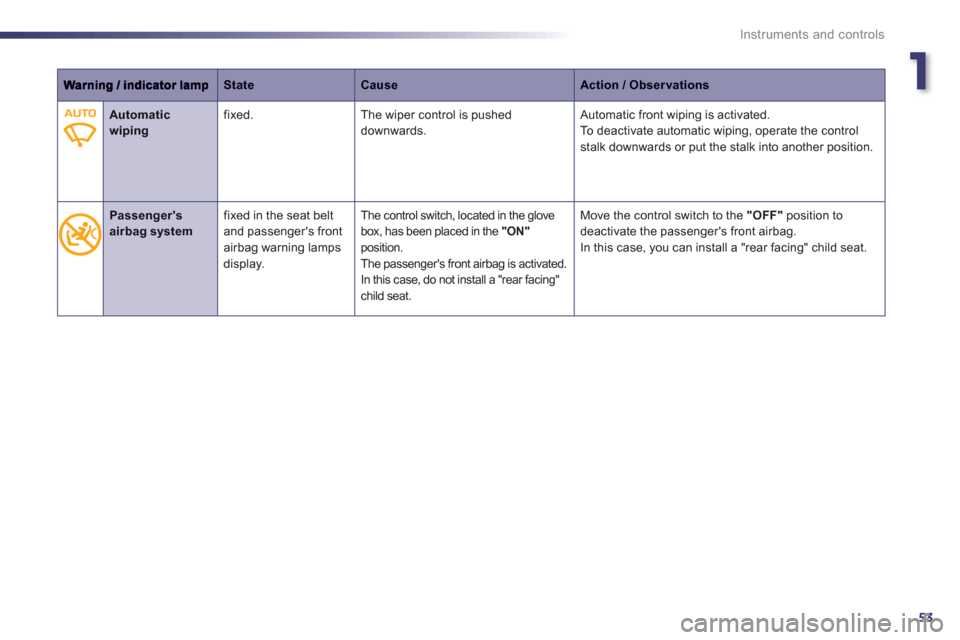
Passenger's airbag system fixed in the seat belt
and passenger's front
airbag warning lampsdisplay.
The control switch, located in the glove box, has been placed in the "ON" position.
The passenger's front airbag is activated. In this case, do not install a "rear facing"child seat.
Move the control switch to the "OFF"
position to
deactivate the passenger's front airbag.
In this case, you can install a "rear facing" child seat.
Page 56 of 308
54
Instruments and controls
Deactivation indicator lamps
If one of the following indicator lamps comes on, this confirms that the corresponding system has been switched off intentionally.This is may be accompanied by an audible signal and a message in the instrument panel screen.
Warning / indicator lampStateCauseAction / Observations
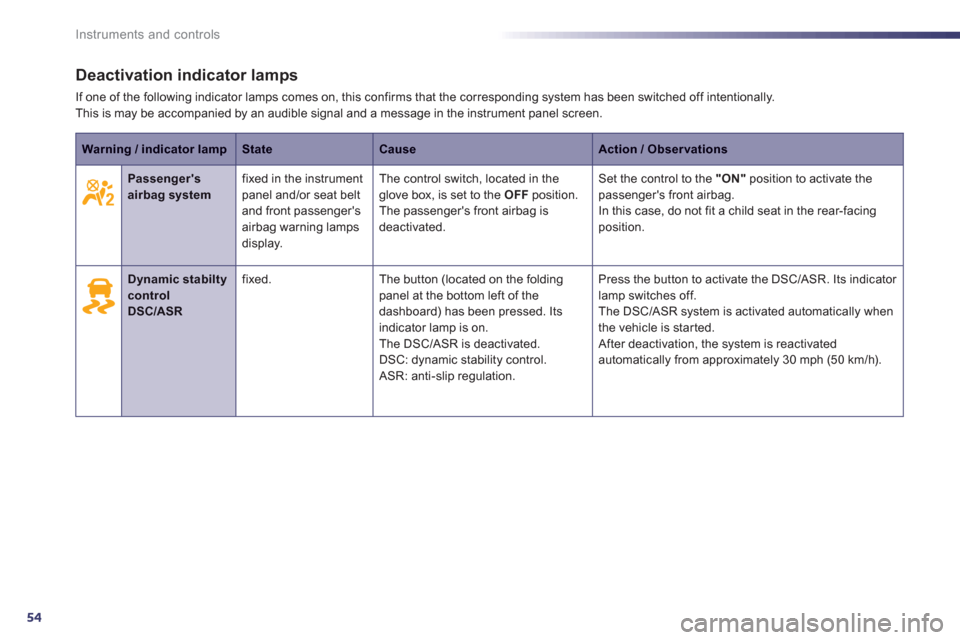
Passenger's airbag systemfixed in the instrumentpanel and/or seat beltand front passenger's airbag warning lamps
display.
The control switch, located in the glove box, is set to the OFF
position.
The passenger's front airbag is deactivated.
Set the control to the "ON"
position to activate the passenger's front airbag.
In this case, do not fit a child seat in the rear-facing position.
Dynamic stabilty controlDSC/ASR
fixed. The button (located on the foldingpanel at the bottom left of the
dashboard) has been pressed. Its
indicator lamp is on.
The DSC/ASR is deactivated.
DSC: d
ynamic stability control.
ASR: anti-slip regulation.Pr
ess the button to activate the DSC/ASR. Its indicator
lamp switches off.
The DSC/ASR system is activated automatically when
the vehicle is started.
After deactivation, the system is reactivated
automatically from approximately 30 mph (50 km/h).
Page 103 of 308
3
101
Comfort
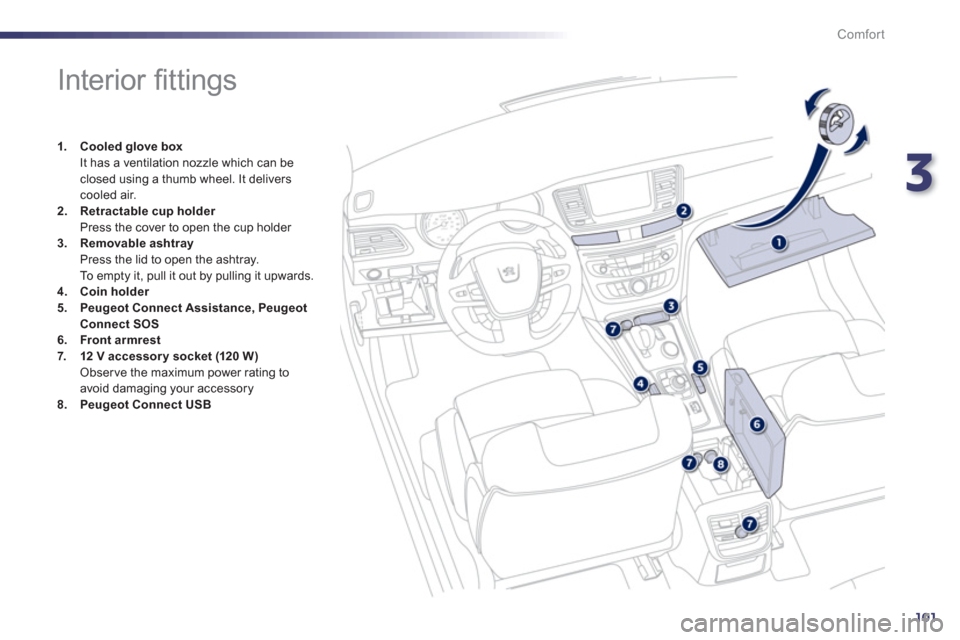
Interior fi ttings
1.Cooled glove box It has a ventilation nozzle which can be closed using a thumb wheel. It deliverscooled air. 2.Retractable cup holder
Press the cover to open the cup holder 3.Removable ashtray Press the lid to open the ashtray.
To empty it, pull it out by pulling it upwards. 4.Coin holder5.Peugeot Connect Assistance, Peugeot
Connect SOS6.Front armrest7.12 V accessory socket(120 W) Observe the maximum power rating toavoid damaging your accessory 8.Peugeot Connect USB
Page 182 of 308
180
Safety
Airbags
System designed to maximise the safety of the
occupants (with the exception of the rear centrepassenger) in the event of violent collisions.
The airbags supplement the action of the force-
limiting seat belts (with the exception of the centre rear passenger).
If a collision occurs, the electronic detectors record and analyse the front and side impacts sustained in the impact detection zones:
- in the case of a serious impact, the airbagsare deployed instantly and contribute
towards better protection of the occupants
of the vehicle
(with the exception of the rear centre passenger); immediately after theimpact, the airbags deflate rapidly so that
they do not hinder visibility or the exit of the
occupants,
- in the case of a minor or rear impact
or in cer tain roll-over conditions, the
airbags will not be deployed; the seat belt
alone contributes towards ensuring your protection in these situations.
The airbags do not operate when the ignition is switched off.
This equipment will only deploy once.
If a second impact occurs (during thesame or a subsequent accident), theairbag will not be deployed again.
Deployment of the airbag(s) is accompanied by a slight emission of smoke and a noise, due to theactivation of the pyrotechnic cartridgeincorporated in the system.This smoke is not harmful, but sensitiveindividuals may experience slight irritation.
The noise of the detonation may result in a slight loss of hearing for a shorttime.
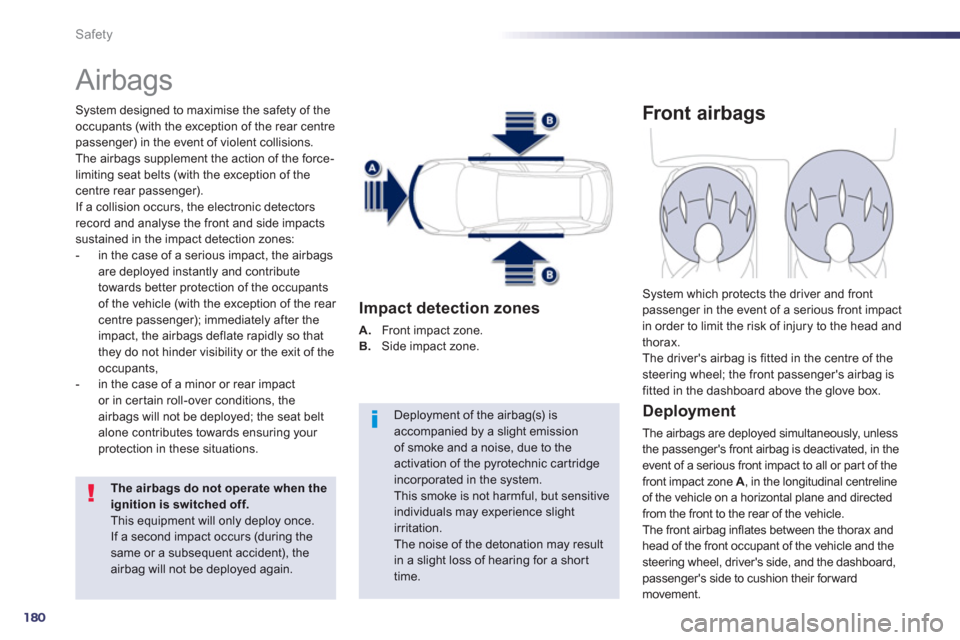
Impact detection zones
A.
Front impact zone. B.
Side impact zone.
Front airbags
Deployment
The airbags are deployed simultaneously, unless
the passenger's front airbag is deactivated, in the event of a serious front impact to all or part of thefront impact zone A, in the longitudinal centreline
of the vehicle on a horizontal plane and directedfrom the front to the rear of the vehicle.
The front airbag inflates between the thorax andhead of the front occupant of the vehicle and thesteering wheel, driver's side, and the dashboard,passenger's side to cushion their for ward movement.
System which protects the driver and frontpassenger in the event of a serious front impact
in order to limit the risk of injury to the head and
thorax.
The driver's airbag is fitted in the centre of the steering wheel; the front passenger's airbag isfitted in the dashboard above the glove box.
Page 192 of 308
190
Practical information
Changing a wheel Procedure for changing a faulty wheel for the spare wheel using the tools provided with the vehicle.
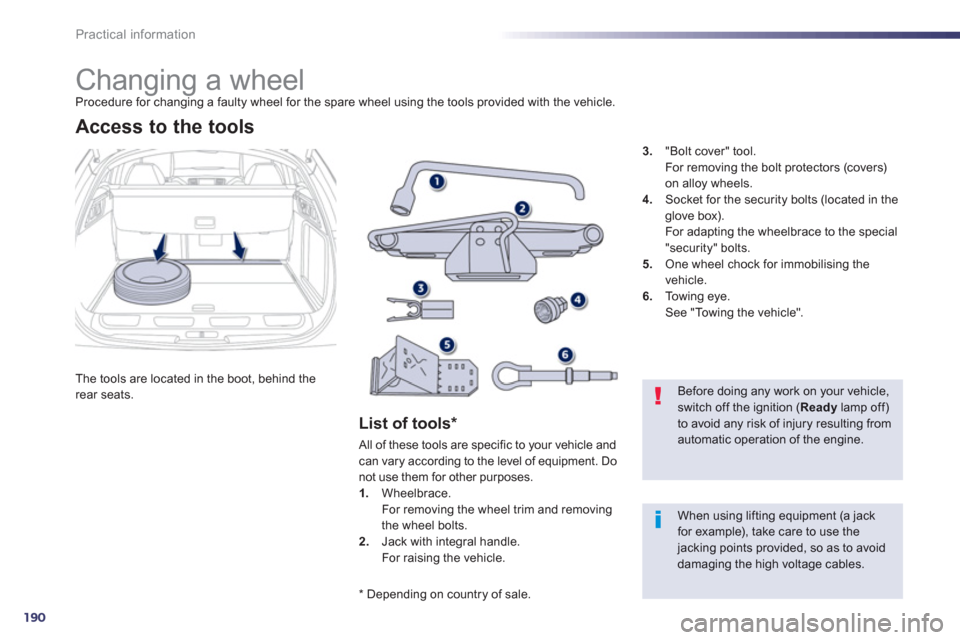
The tools are located in the boot, behind the
rear seats.
Access to the tools
List of tools *
3."Bolt cover" tool.
For removing the bolt protectors
(covers)
on alloy wheels.4. Socket for the security bolts (located in the glove box).
For adapting the wheelbrace to the special
"security" bolts.
5. One wheel chock for immobilising the
vehicle.
6.Towing eye.
See "Towing the vehicle".
Before doing any work on your vehicle, switch off the ignition (Readylamp off) to avoid any risk of injury resulting from automatic operation of the engine.
When using lifting equipment (a jackfor example), take care to use the
jacking points provided, so as to avoiddamaging the high voltage cables.
All o
f these tools are specific to your vehicle andcan vary according to the level of equipment. Do
not use them for other purposes.
1
.Wheelbrace.
For removing the wheel trim and removing
the wheel bolts.
2. Jack with integral handle.
For raising the vehicle.
*
Dependin
g on country of sale.
Page 205 of 308
8
203
Practical information
Changing a fuse
Procedure for replacing a failed fuse with a new fuse to rectify a failure of the corresponding function.
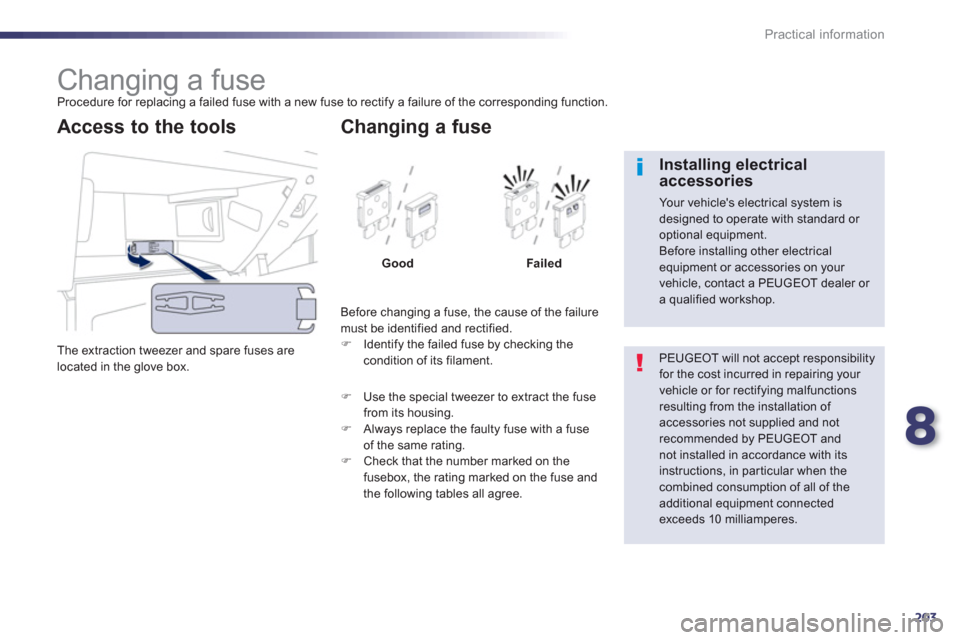
The extraction tweezer and s
pare fuses are
located in the glove box.
Access to the tools
Before changing a fuse, the cause of the failure
must be identified and rectified. ) Identify the failed fuse by checking thecondition of its filament.
Changing a fuse
Good Failed
)
Use the special tweezer to extract the fuse from its housing.)
Always replace the faulty fuse with a fuse
of the same rating. ) Check that the number marked on thefusebox, the rating marked on the fuse and
the following tables all agree.
PEUGEOT will not accept responsibilityfor the cost incurred in repairing your vehicle or for rectifying malfunctions resulting from the installation of accessories not supplied and not recommended by PEUGEOT andnot installed in accordance with itsinstructions, in par ticular when the combined consumption of all of the additional equipment connectedexceeds 10 milliamperes.
Installing electricalaccessories
Your vehicle's electrical system isdesigned to operate with standard or optional equipment.
Before installing other electrical equipment or accessories on your vehicle, contact a PEUGEOT dealer or a qualified workshop.
Page 207 of 308
8
205
Practical information
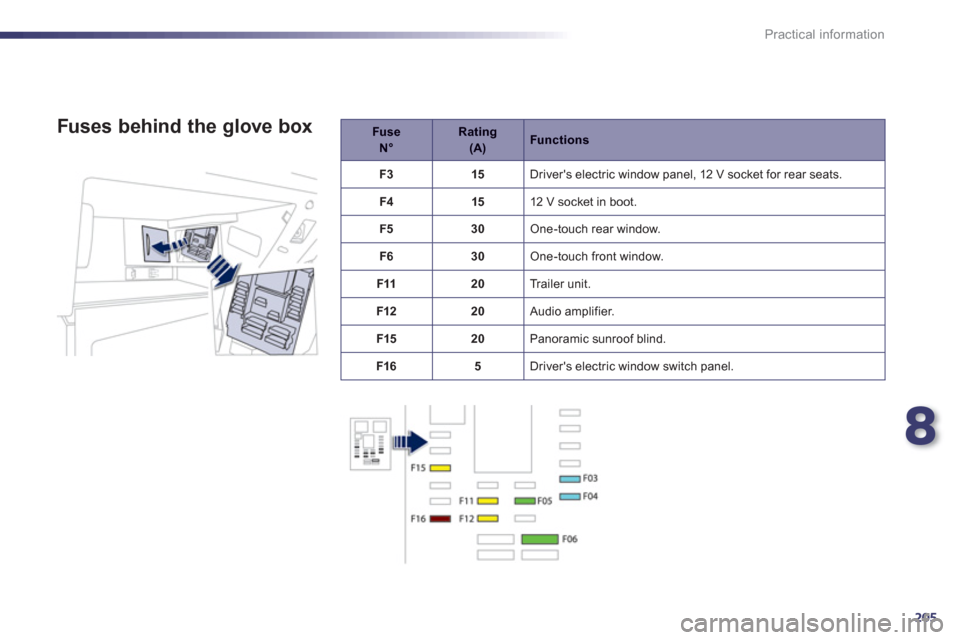
Fuse N°Rating (A)Functions
F3 15
Driver's electric window panel, 12 V socket for rear seats.
F
415
12 V socket in boot.
F530 One-touch rear window.
F
630 One-touch front window.
F1
120 Trailer unit.
F12 2
0 Audio amplifier.
F1
520 Panoramic sunroof blind.
F1
65 Driver's electric window switch panel.
Fuses behind the glove box
Page 300 of 308
298
Visual search
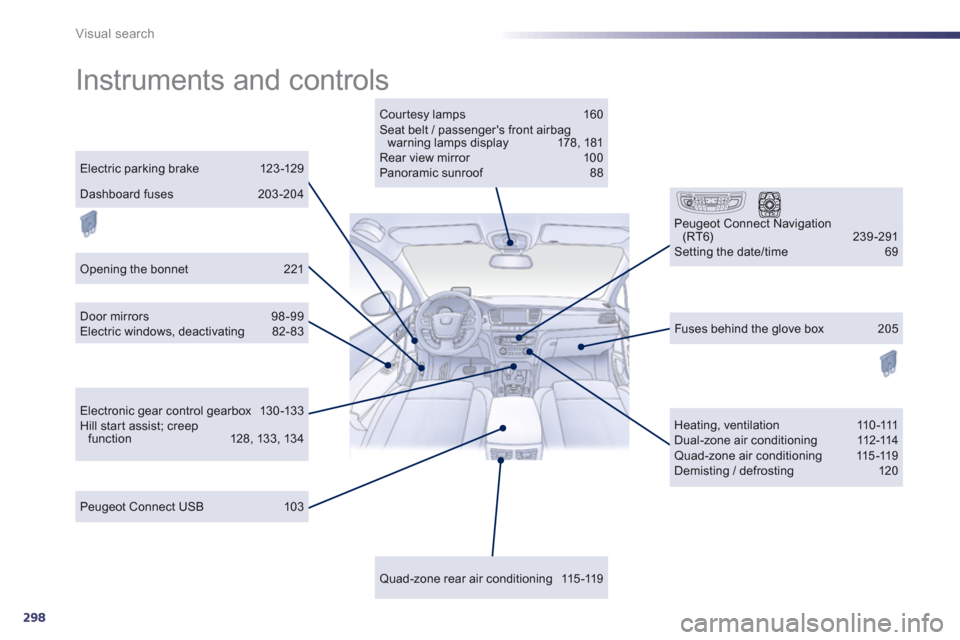
Instruments and controls
Courtesy lamps 160 Seat belt / passenger's front airbag warning lamps display 178, 181 Rear view mirror 10 0 Panoramic sunroof 88
Door mirrors 98-99 Electric windows, deactivating 82-83
Heating, ventilation 110 -111 Dual-zone air conditioning 112-114 Quad-zone air conditioning 115 -11 9 Demisting / defrosting 120
Peugeot Connect USB 103
Electric parking brake 123 -129
Electronic gear control gearbox 130-133 Hill star t assist; creep function 128, 133, 134
Fuses behind the glove box 205
Quad-zone rear air conditioning 115 -11 9
Peugeot Connect Navigation(RT6) 239-291 Setting the date/time 69
Opening the bonnet 221
Dashboard fuses 203-204