roof Peugeot 508 RXH 2013 Owner's Manual
[x] Cancel search | Manufacturer: PEUGEOT, Model Year: 2013, Model line: 508 RXH, Model: Peugeot 508 RXH 2013Pages: 308, PDF Size: 8.95 MB
Page 4 of 308
.
.
Contents
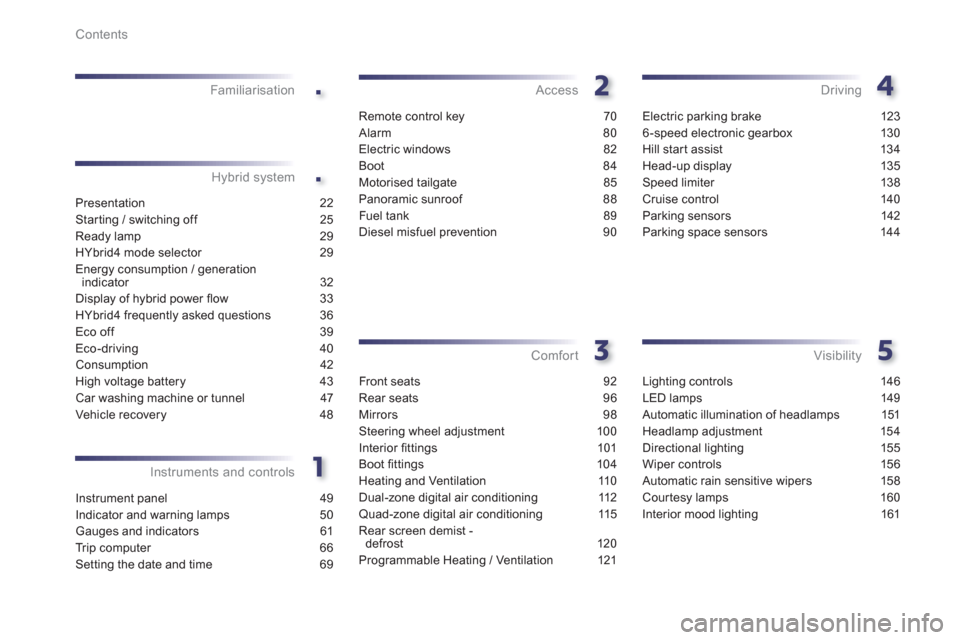
Instrument panel 49
Indicator and warning lamps 50
Gauges and indicators 61
Tr ip computer 66
Setting the date and time 69
Instruments and controlsFamiliarisation
Remote control key 70
Alarm 80
Electric windows 82
Boot 84
Motorised tailgate 85
Panoramic sunroof 88
Fuel tank 89
Diesel misfuel prevention 90
Access
Front seats 92
Rear seats 96
Mirrors 98
Steering wheel adjustment 100
Interior fi ttings 101
Boot fi ttings 104
Heating and Ventilation 110
Dual-zone digital air conditioning 112
Quad-zone digital air conditioning 115
Rear screen demist - defrost 120
Programmable Heating / Ventilation 121
Comfort
Electric parking brake 123
6-speed electronic gearbox 130
Hill star t assist 134
Head-up display 135
Speed limiter 138
Cruise control 140
Parking sensors 142
Parking space sensors 144
Driving
Lighting controls 146
LED lamps 149
Automatic illumination of headlamps 151
Headlamp adjustment 154
Directional lighting 155
Wiper controls 156
Automatic rain sensitive wipers 158
Cour tesy lamps 160
Interior mood lighting 161
Visibility Hybrid system
Presentation 22
Starting / switching off 25
Ready lamp 29
HYbrid4 mode selector 29
Energy consumption / generation
indicator 32
Display of hybrid power fl ow 33
HYbrid4 frequently asked questions 36
Eco off 39
Eco-driving 40
Consumption 42
High voltage battery 43
Car washing machine or tunnel 47
Vehicle recovery 48
Page 5 of 308
.
.
Contents
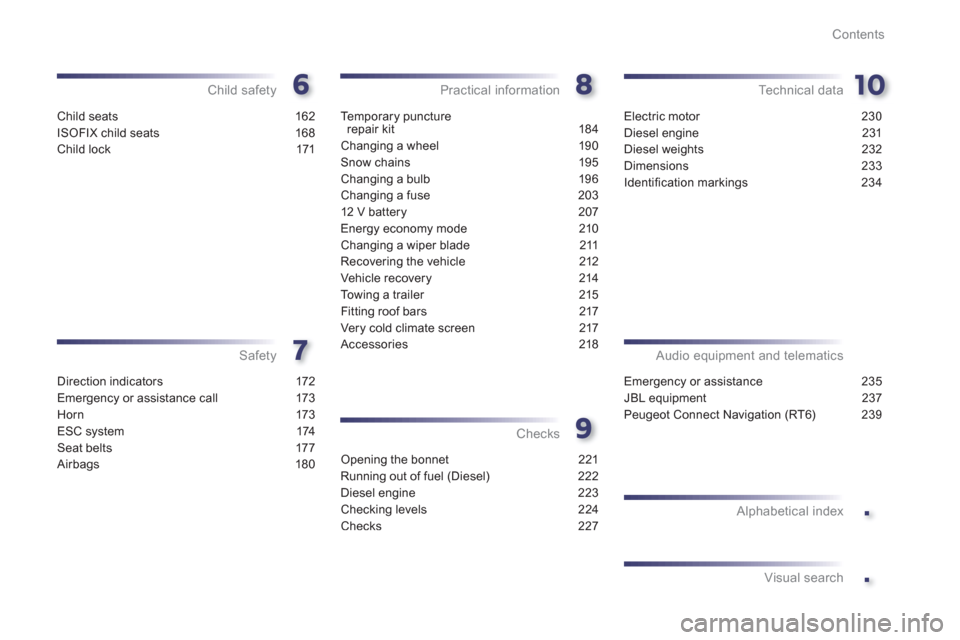
Child seats 162
ISOFIX child seats 168
Child lock 171
Child safety
Direction indicators 172
Emergency or assistance call 173
Horn 173
ESC system 174
Seat belts 177
Airbags 180
Safety
Te m p o r a ry puncture
repair kit 184
Changing a wheel 190
Snow chains 195
Changing a bulb 196
Changing a fuse 203
12 V battery 207
Energy economy mode 210
Changing a wiper blade 211
Recovering the vehicle 212
Vehicle recovery 214
Towing a trailer 215
Fitting roof bars 217
Very cold climate screen 217
Accessories 218
Practical information
Opening the bonnet 221
Running out of fuel (Diesel) 222
Diesel engine 223
Checking levels 224
Checks 227
Checks
Electric motor 230
Diesel engine 231
Diesel weights 232
Dimensions 233
Identifi cation markings 234
Technical data
Emergency or assistance 235
JBL equipment 237
Peugeot Connect Navigation (RT6) 239
Audio equipment and telematics
Alphabetical index
Visual search
Page 7 of 308
.
5
Familiarisation
For economical driving, caring for the environment
The fuel consumptionof a vehicle varies greatly:
- according to the driver's style of driving
(moderate, aggressive, fast, ...),
- according to the type of journeys
made (urban, main road, motorway, flowing, heavy traffic, …) and the speed.
Main recommendations for driving economically
Hybrid mode selector
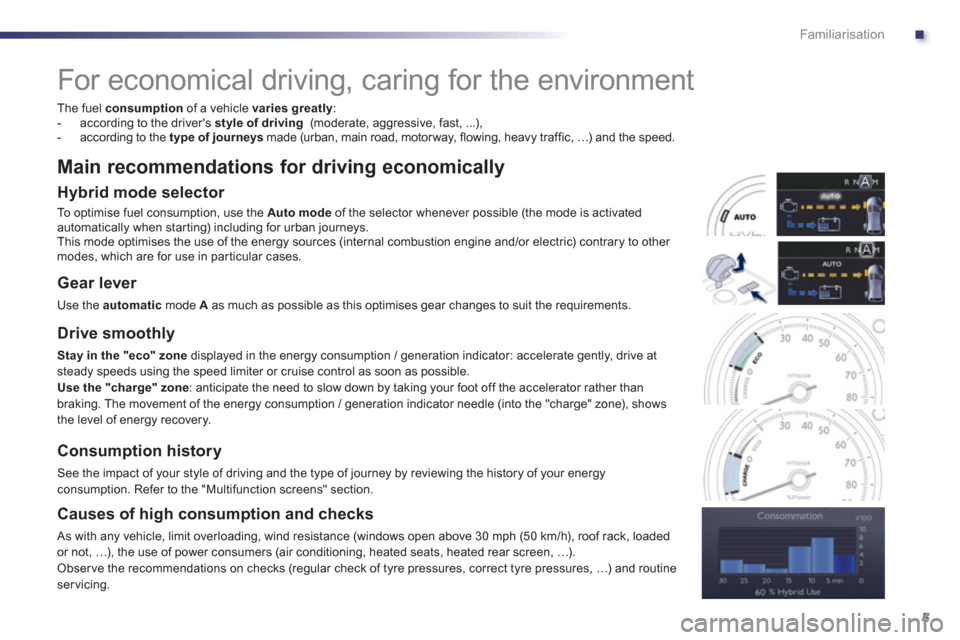
To optimise fuel consumption, use the Automodeof the selector whenever possible (the mode is activated
automatically when starting) including for urban journeys.
This mode optimises the use of the energy sources (internal combustion engine and/or electric) contrary to other modes, which are for use in par ticular cases.
Gear lever
Use the automatic
mode A
as much as possible as this optimises gear changes to suit the requirements.
Drive smoothly
Stay in the "eco" zone
displayed in the energy consumption / generation indicator: accelerate gently, drive atsteady speeds using the speed limiter or cruise control as soon as possible. Use the "charge" zone: anticipate the need to slow down by taking your foot off the accelerator rather than
braking. The movement of the energy consumption / generation indicator needle (into the "charge" zone), shows
the level of energy recovery.
Consumption history
See the impact of your style of driving and the type of journey by reviewing the history of your energyconsumption. Refer to the "Multifunction screens" section.
Causes of high consumption and checks
As with any vehicle, limit overloading, wind resistance (windows open above 30 mph (50 km/h), roof rack, loaded
or not, …), the use of power consumers (air conditioning, heated seats, heated rear screen, …).
Obser ve the recommendations on checks (regular check of tyre pressures, correct tyre pressures, …) and routine servicing.
Page 42 of 308
40
Hybrid system
Eco-driving
Eco-driving is a range of everyday practices that allow the motorist to optimise their fuel consumption and CO2emissions.
Eco-driving suited to your
HYbrid4 vehicle
Use gear selector position A , as thisoptimises gear changes to suit the
circumstances and the AUTOmode of theHYbrid4 mode selector. When moving off, accelerate normally up tothe desired speed (POWER
zone between 20and 40 %).
At steady speeds, drive gently with smallmovements of the accelerator pedal (ECO
or CHARGEzone), run in electric mode as oftenas possible when driving at low speed. Anticipate the need to slow down and use engine braking ( CHARGE
zone), so as to make use of free energy recovery while keeping light pressure on the accelerator pedal.
Control the use of your
electrical equipment
Before moving off, if the passenger compartment is too warm, ventilate it byopening the windows and air vents before using the air conditioning.
Above 30 mph (50 km/h), close the windows and leave the air vents open.
Remember to make use of equipment that canhelp keep the temperature in the passenger compartment down (sun roof and windowblinds...). Switch off the air conditioning, unless it has automatic digital regulation, as soon as thedesired temperature is attained. Switch off the demisting and defrostingcontrols, if not automatic.
Switch off the heated seat as soon as possible.
Switch off the headlamps and front foglampswhen the level of light does not require their use.
Avoid running the Diesel engine when stationary, par ticularly in winter; your vehicle will warm up much faster while driving.
As a passenger, if you avoid connecting your multimedia devices (film, music, videogame...), you will contribute towards limitingthe consumption of electrical energy, and soof fuel.
Disconnect your por table devices beforeleaving the vehicle.
Page 43 of 308
.
41
Hybrid system
Limit the causes of excess
consumption
Spread loads throughout the vehicle; placethe heaviest items in the bottom of the boot,
as close as possible to the rear seats.Limit the loads carried in the vehicle and reduce wind resistance (roof bars, roof rack, bicycle carrier, trailer...). Use a roof box inpreference.Remove roof bars and roof racks after use.
At the end of winter, remove snow tyres and refit your summer tyres.
Observe the recommendations
on maintenance
Check the tyre pressures regularly, when cold, referring to the label in the door aper ture, driver's side.Carry out this check in par ticular:- before a long journey,- at each change of season,- after a long period out of use.
When refuelling, do not continue after the 3rdcut-off of the nozzle to avoid any overflow.
Have your vehicle ser viced regularly (engine oil, oil filter, air filter...) and obser ve the schedule of operations recommended by the
manufacturer.
At the wheel of your new vehicle, it is only after the first 1 800 miles (3 000 kilometres) that youwill see the fuel consumption settle down to aconsistent average.
Page 76 of 308
74
Access
As a safety measure (children on board), never leave the vehicle without taking your key, even for a shor t period. Guard against theft when the electronic key isin the defined zone with the vehicle unlocked.
Locking is confirmed by fixedlighting of the direction indicators for approximately two seconds.
According to version, the door mirrors fold at the same time.
It is not possible to lock the vehicle if an electronic key is left inside the vehicleor if the ignition is on.
If one of the doors or the boot is stillopen or if an electronic key has been left inside the vehicle, the central
locking does not take place.
When the vehicle is locked, if it isunlocked inadver tently, it will relock automatically after about thir ty seconds unless a door is opened.
The folding and unfolding of the door mirrors by the remote control can be deactivated by a PEUGEOT dealer.
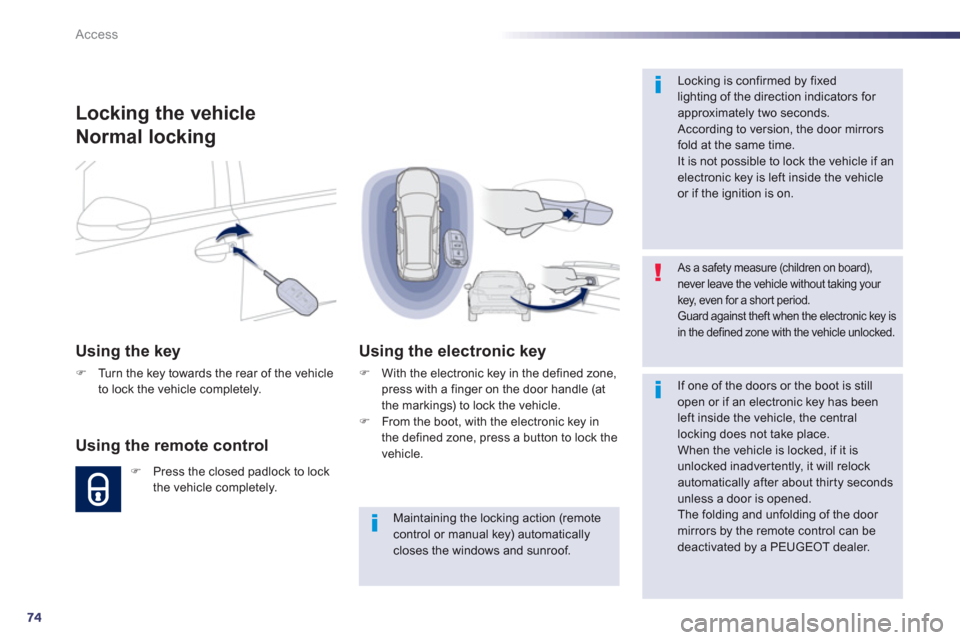
Locking the vehicle
Normal lockin
g
Using the key
)Turn the key towards the rear of the vehicle
to lock the vehicle completely.
Using the remote control
)Press the closed padlock to lockthe vehicle completely.
Using the electronic key
)
With the electronic key in the defined zone,
press with a finger on the door handle (at
the markings) to lock the vehicle. ) From the boot, with the electronic key in
the defined zone, press a button to lock the
vehicle.
Maintaining the locking action (remotecontrol or manual key) automaticallycloses the windows and sunroof.
Page 90 of 308
88
Access
Panoramic sunroof
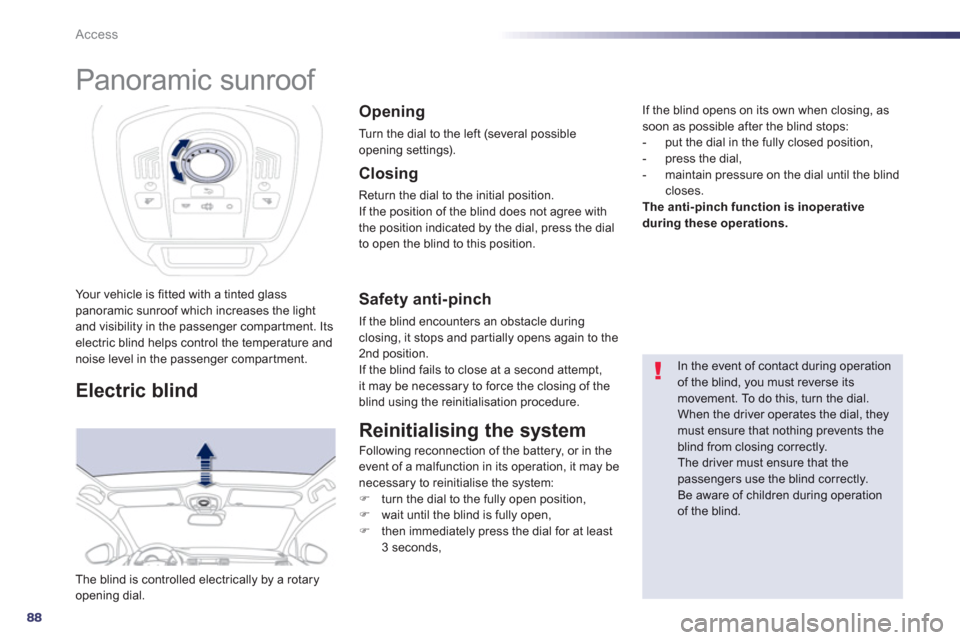
Your vehicle is fitted with a tinted glass panoramic sunroof which increases the lightand visibility in the passenger compartment. Itselectric blind helps control the temperature andnoise level in the passenger compartment.
Electric blind
The blind is controlled electrically by a rotaryopening dial.
Opening
Turn the dial to the left (several possible
opening settings).
In the event of contact during operationof the blind, you must reverse its movement. To do this, turn the dial.
When the driver operates the dial, theymust ensure that nothing prevents theblind from closing correctly. The driver must ensure that the passengers use the blind correctly.
Be aware of children during operationof the blind.
Closing
Return the dial to the initial position.
If the position of the blind does not agree with
t
he position indicated by the dial, press the dialto open the blind to this position.
Safety anti-pinch
If the blind encounters an obstacle duringclosing, it stops and par tially opens again to the 2nd position.
If the blind fails to close at a second attempt,
it may be necessary to force the closing of the blind using the reinitialisation procedure.
Reinitialising the system
Following reconnection of the battery, or in the event of a malfunction in its operation, it may be
necessary to reinitialise the system:
) turn the dial to the fully open position, )
wait until the blind is fully open,)
then immediately press the dial for at least
3 seconds,
If the blind opens on its own when closing, as soon as possible after the blind stops:
- put the dial in the fully closed position,
- press the dial,
- ma
intain pressure on the dial until the blindcloses. The anti-pinch function is inoperative
during these operations.
Page 110 of 308
108
Comfort
High load retaining net
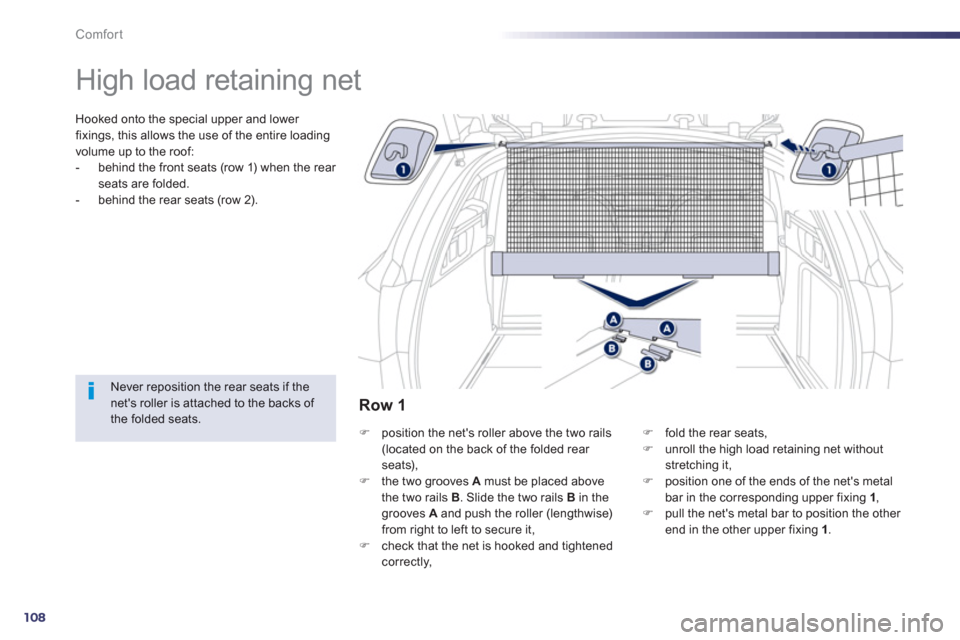
Hooked onto the special upper and lower
fixings, this allows the use of the entire loadingvolume up to the roof:
- behind the front seats (row 1) when the rear seats are folded.
- behind the rear seats (row 2).
Never reposition the rear seats if thenet's roller is attached to the backs of the folded seats. )
position the net's roller above the two rails (located on the back of the folded rear seats),)
the two grooves Amust be placed above
the two rails B
. Slide the two rails B
in the grooves A
and push the roller (lengthwise)from right to left to secure it,
)
check that the net is hooked and tightened correctly,
)fold the rear seats, )unroll the high load retaining net withoutstretching it, )position one of the ends of the net's metal
bar in the corresponding upper fixing 1,)pull the net's metal bar to position the other end in the other upper fixing 1 .
Row 1
Page 185 of 308
7
183
Safety
Sit in a normal upright position. Wear a correctly adjusted seat belt.
Do not leave anything between theoccupants and the airbags (a child, pet, object...). This could hamper the operation of the airbags or injure the occupants. After an accident or if the vehicle has beenstolen or broken into, have the airbagsystems checked. All work on the airbag system must be carried out by a PEUGEOT dealer or a qualified workshop.
Even if all of the precautions mentionedare obser ved, a risk of injury or of minor burns to the head, chest or arms when an airbag is deployed cannot be ruled out. Thebag inflates almost instantly (within a fewmilliseconds) then deflates within the same
time discharging the hot gas via openings provided for this purpose.
Lateral airbags
Use only approved covers on the seats, compatible with the deployment the lateralairbags. For information on the range of seatcovers suitable for your vehicle, you can contact a PEUGEOT dealer. Refer to the "Accessories" section.Do not fix or attach anything to the seatbacks (clothing...). This could cause injuryto the chest or arms if the lateral airbag isdeployed.Do not sit with the upper par t of the body anynearer to the door than necessary.
Front airbags
Do not drive holding the steering wheel by itsspokes or resting your hands on the centre part of the wheel.
Passengers must not place their feet on thedashboard.
If possible, do not smoke as deployment of the airbags can cause burns or the risk of injury from a cigarette or pipe.
Never remove or pierce the steering wheel or hit it violently.
Curtain airbags
Do not fix or attach anything to the roof. This
could cause injury to the head if the cur tain airbag is deployed.If fitted on your vehicle, do not remove thegrab handles installed on the roof, they play a part in securing the cur tain airbags.
For the airbags to be fully effective, observe the following safety rules:
Page 207 of 308
8
205
Practical information
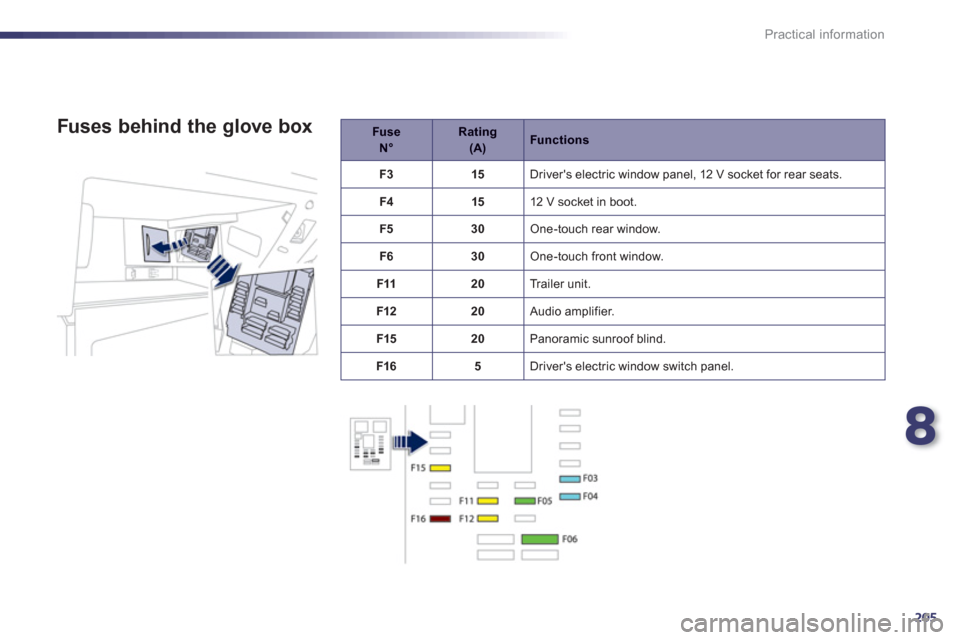
Fuse N°Rating (A)Functions
F3 15
Driver's electric window panel, 12 V socket for rear seats.
F
415
12 V socket in boot.
F530 One-touch rear window.
F
630 One-touch front window.
F1
120 Trailer unit.
F12 2
0 Audio amplifier.
F1
520 Panoramic sunroof blind.
F1
65 Driver's electric window switch panel.
Fuses behind the glove box