tow Peugeot 508 RXH 2014 Owner's Manual
[x] Cancel search | Manufacturer: PEUGEOT, Model Year: 2014, Model line: 508 RXH, Model: Peugeot 508 RXH 2014Pages: 338, PDF Size: 10.81 MB
Page 17 of 338
15
508RXH_en_Chap00c_systeme-hybride_ed01-2014
Starting - stopping the engine
Before startingStarting the HYbrid4
system
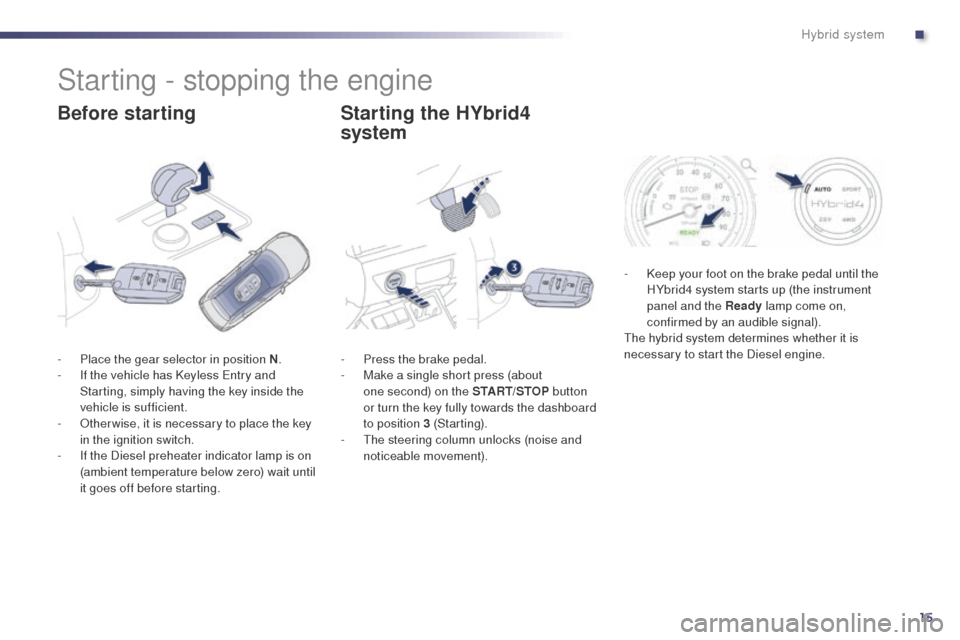
- Press the brake pedal.
-
M ake a single short press (about
one
second) on the START/STOP button
or turn the key fully towards the dashboard
to position 3 (Starting).
-
t
h
e steering column unlocks (noise and
noticeable movement).
-
P
lace the gear selector in position N
.
-
I
f the vehicle has Keyless
en
try and
Starting, simply having the key inside the
vehicle is sufficient.
-
O
ther wise, it is necessary to place the key
in the ignition switch.
-
I
f the Diesel preheater indicator lamp is on
(ambient temperature below zero) wait until
it goes off before starting. -
K
eep your foot on the brake pedal until the
HYbrid4 system starts up (the instrument
panel and the Ready lamp come on,
confirmed by an audible signal).
th
e hybrid system determines whether it is
necessary to start the Diesel engine.
.
Hybrid system
Page 19 of 338
17
508RXH_en_Chap00c_systeme-hybride_ed01-2014
Ignition on without starting
the engine
(accessory position)
Anti-theft protection
Electronic engine immobiliser
the keys contain an electronic chip which has
a secret code. When the ignition is switched
on, this code must be recognised in order for
starting to be possible.
th
is electronic engine immobiliser locks the
engine management system a few minutes
after the ignition is switched off and prevents
starting of the engine by anyone who does not
have the key.
In the event of a malfunction, you are informed
by a message in the instrument panel screen.
In this case, your vehicle does not start; contact
a P
e
uge
Ot
dealer as soon as possible.
tu
rn the key towards the dashboard to the
intermediate position or with the Keyless
e
n
try
and Starting key inside the vehicle, press the
"S
tA
R
t/
S
tO
P" button, with no action on the
pedal.
t
h
is switches on the ignition and so
activates the ancillary equipment.
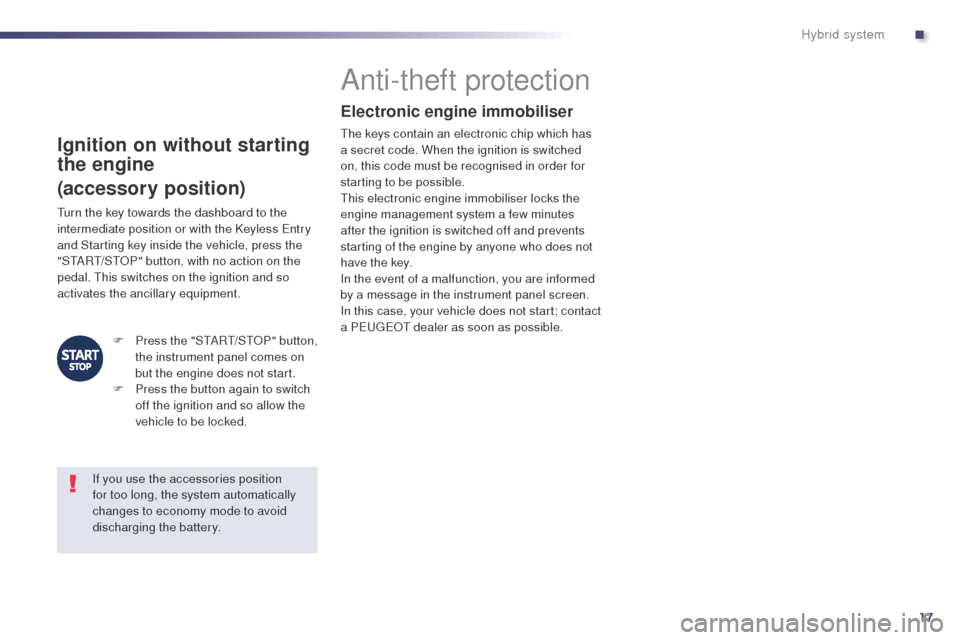
F
P
ress the "S
tA
R
t/
S
tO
P" button,
the instrument panel comes on
but the engine does not start.
F
P
ress the button again to switch
off the ignition and so allow the
vehicle to be locked.
If you use the accessories position
for too long, the system automatically
changes to economy mode to avoid
discharging the battery.
.
Hybrid system
Page 29 of 338
27
508RXH_en_Chap00c_systeme-hybride_ed01-2014
Reducing consumption - Fuel
QuestionAnswer
How can I optimise my fuel consumption?
gi
ve preference to Auto mode as it selects in the best way the "driving energy source" to
use in order to reduce fuel consumption.
You should also adapt your driving style to the characteristics of hybrid vehicles to get the
best out of it, for example by taking your foot off the accelerator pedal rather than braking
and by anticipating decelerations (entering a built-up area, stop at traffic lights, stop at halt
signs, ...).
Why do I not manage to reduce my fuel consumption
even though I often drive in Z
eV (
Zero e
m
issions
Vehicle) mode? It is not Z
eV m
ode but Auto mode that is the most appropriate for reducing fuel
consumption, as it selects the best "driving energy source".
Z
eV m
ode (100% electric operation) can reduce fuel consumption in some cases. However,
recharging the traction battery has an energy cost.
th
is is why we recommend using Auto mode more often.
Why does the trip computer sometimes display the
bars for 28 mpg (10 litres) consumption in town?
th
e current fuel consumption displayed may appear high when the distance covered is
very low, but this generally has very little impact and the true average fuel consumption will
remain low.
In town, your hybrid retains very good fuel economy (of the order of 35% better than a
non-hybrid vehicle).
Why is my battery rarely fully charged? A partly charged battery is normal operation (4 to 5 bars on average in Auto mode).
th
is allows some capacity to be left free for the recovery for energy when going downhill or
taking when your foot off the accelerator.
Why are there so may fuel alert messages when
starting to use the reserve?
to e
ncourage you to refuel as soon as possible and avoid the loss of hybrid functions.
.
Hybrid system
Page 30 of 338
28
508RXH_en_Chap00c_systeme-hybride_ed01-2014
Air conditioning
QuestionAnswer
It seems to me that the vehicle runs less on electric
when the heating or air conditioning is operating, is
that right?
the
demand for heating or air conditioning may require the starting of the Diesel engine
until the desired level of comfort is attained.
Normal hybrid operation is simply put back.
t
h
e period can be longer under low or very high
ambient temperatures.
It seems to me that when it is very hot and the air
conditioning is working, the vehicle runs on electric for
shorter periods. Is that right? When it is hot, the periods when the Diesel engine is put on standby and the vehicle runs on
electric are necessarily restricted in order to limit the difference between the temperature in
the vehicle and the level of comfort selected.
In very hot weather, it is always possible to press the
e
c
o OFF button (which brings the
vehicle out of Z
eV m
ode and prevents electric running or the stopping of the engine) to give
preference to temperature control (keeps the air conditioning running).
Special HYbrid4 features
Question Answer
Can I tow with my hybrid vehicle and how much? A HYbrid4 vehicle can tow between 500 kg and 800 kg (see the "
to
wing" section).
th
is allows a jet ski or two-wheeler on a trailer to be towed, for example.
th
e "technical" reason for the limit is related to maintaining adequate cooling capacity for
the internal combustion engine as well as the hybrid components that are also cooled by the
engine's cooling system.
Why does engine braking seem so strong? When you take your foot off the accelerator, the engine braking results mainly from the
energy recovery by the electric motor.
th
is leads to a higher level of deceleration than a conventional vehicle and so allows the
recovery of free energy.
Hybrid system
Page 32 of 338
30
508RXH_en_Chap00c_systeme-hybride_ed01-2014
eco-driving
eco-driving is a range of everyday practices that allow the motorist to optimise their fuel consumption and CO2 emissions.
Eco-driving suited to your
HYbrid4 vehicle
use gear selector position A, as this
optimises gear changes to suit the
circumstances, and the AUTO mode of the
HYbrid4 mode selector.
When moving off, accelerate normally
up to the desired speed ( POWER zone
between 20 and 40 %).
At steady speeds, drive gently with small
movements of the accelerator pedal ( ECO or
CHARGE zone), run in electric mode as often
as possible when driving at low speed.
Anticipate the need to slow down and use
engine braking ( CHARGE zone), so as to
make use of free energy recovery while
keeping light pressure on the accelerator
pedal.
Control the use of your
electrical equipment
Before moving off, if the passenger
compartment is too warm, ventilate it by
opening the windows and air vents before
using the air conditioning.
Above 30 mph (50 km/h), close the windows
and leave the air vents open.
Remember to make use of equipment that can
help keep the temperature in the passenger
compartment down (sun roof and window
blinds...).
Switch off the air conditioning, unless it has
automatic digital regulation, as soon as the
desired temperature is attained.
Switch off the demisting and defrosting
controls, if not automatic.
Switch off the heated seat as soon as possible.
Switch off the headlamps and front foglamps
when the level of light does not require
their
use. Avoid running the Diesel engine when
stationary, particularly in winter; your vehicle
will warm up much faster while driving.
As a passenger, if you avoid connecting
your multimedia devices (film, music, video
game...), you will contribute towards limiting
the consumption of electrical energy, and so
of fuel.
Disconnect your portable devices before
leaving the vehicle.
Hybrid system
Page 40 of 338
38
508RXH_en_Chap00c_systeme-hybride_ed01-2014
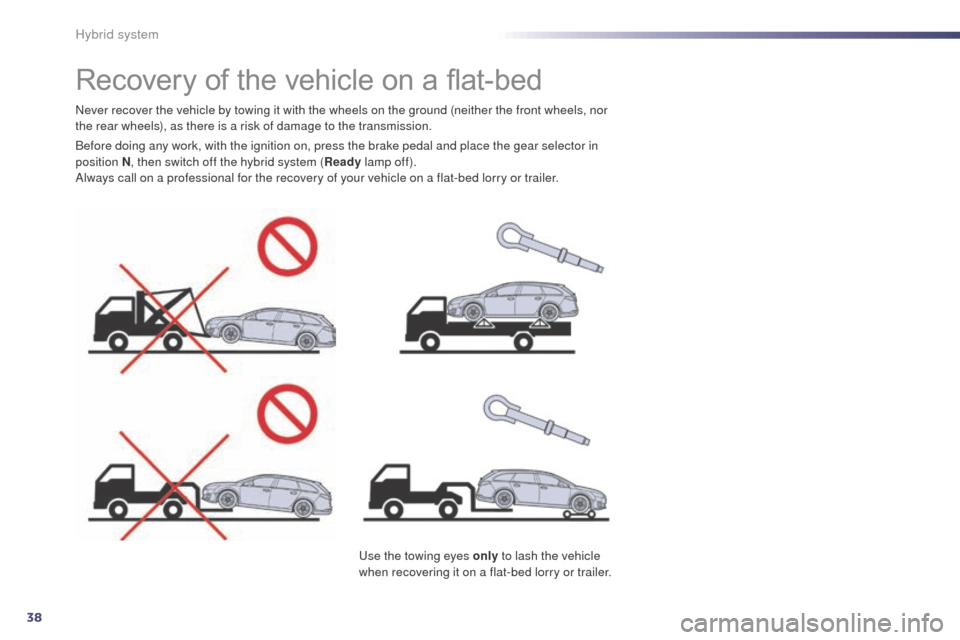
Recovery of the vehicle on a flat-bed
Before doing any work, with the ignition on, press the brake pedal and place the gear selector in
position N, then switch off the hybrid system ( Ready lamp off).
Always call on a professional for the recovery of your vehicle on a flat-bed lorry or trailer. Never recover the vehicle by towing it with the wheels on the ground (neither the front wheels, nor
the rear wheels), as there is a risk of damage to the transmission.
us
e the towing eyes only to lash the vehicle
when recovering it on a flat-bed lorry or trailer.
Hybrid system
Page 44 of 338
42
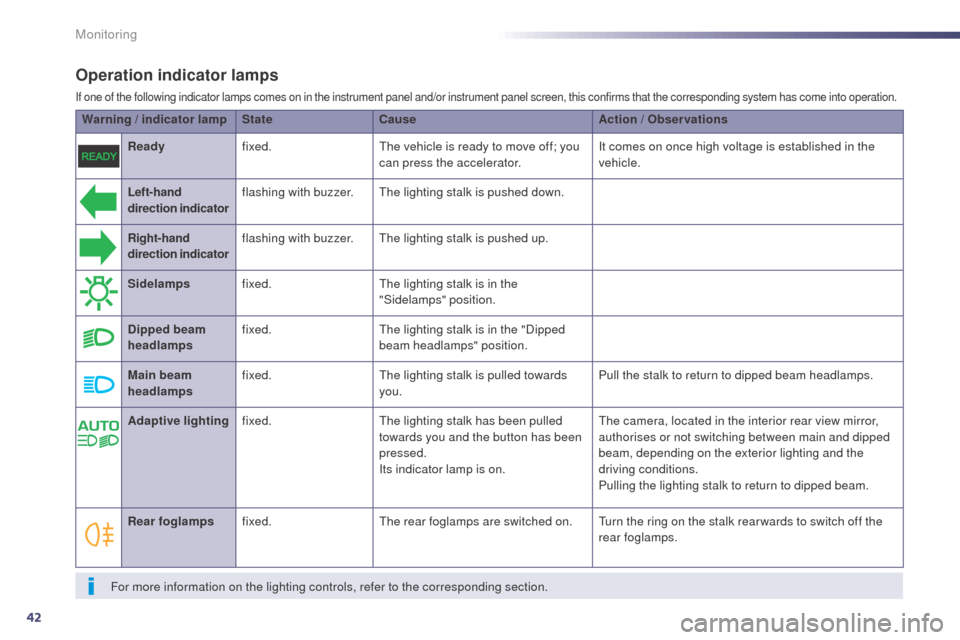
Operation indicator lamps
If one of the following indicator lamps comes on in the instrument panel and/or instrument panel screen, this confirms that the corresponding system has come into operation.
Warning / indicator lamp State Cause Action / Observations
Left-hand
direction indicato rflashing with buzzer.
th
e lighting stalk is pushed down.
Right-hand
direction indicator flashing with buzzer.
th
e lighting stalk is pushed up.
Sidelamps fixed.
th
e lighting stalk is in the
"Sidelamps" position.
Dipped beam
headlamps fixed.
th
e lighting stalk is in the "Dipped
beam headlamps" position.
Main beam
headlamps fixed.
th
e lighting stalk is pulled towards
you. Pull the stalk to return to dipped beam headlamps.
Ready
fixed.
th
e vehicle is ready to move off; you
can press the accelerator. It comes on once high voltage is established in the
vehicle.
Rear foglamps fixed.
th
e rear foglamps are switched on.
tu
rn the ring on the stalk rear wards to switch off the
rear foglamps.
For more information on the lighting controls, refer to the corresponding section. Adaptive lighting
fixed.
th
e lighting stalk has been pulled
towards you and the button has been
pressed.
Its indicator lamp is on.
th
e camera, located in the interior rear view mirror,
authorises or not switching between main and dipped
beam, depending on the exterior lighting and the
driving conditions.
Pulling the lighting stalk to return to dipped beam.
Monitoring
Page 70 of 338
68
508RXH_en_Chap02_ouvertures_ed01-2014
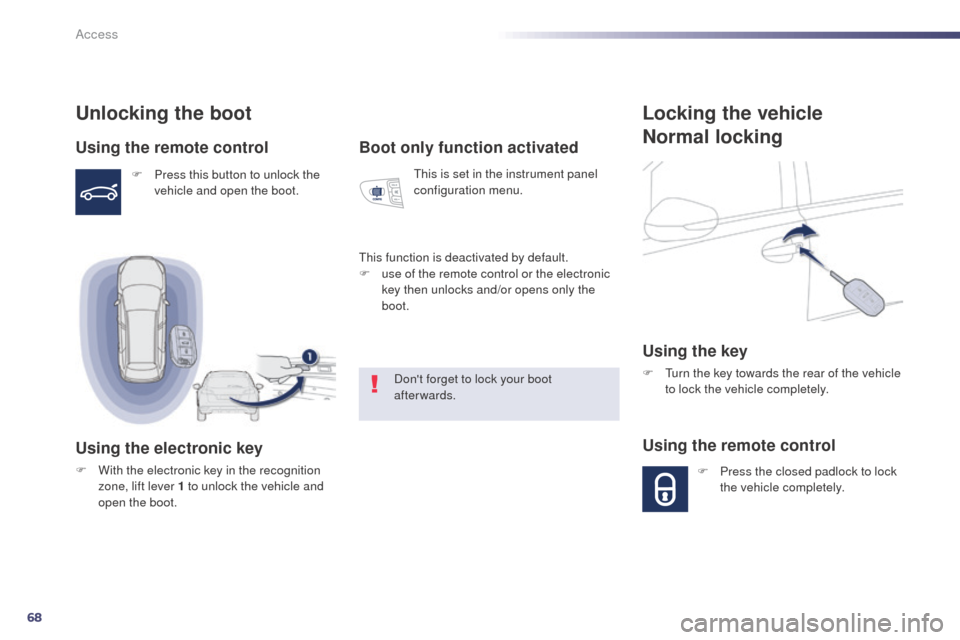
Locking the vehicle
Normal locking
Using the key
F turn the key towards the rear of the vehicle to lock the vehicle completely.
Using the remote control
F Press the closed padlock to lock the vehicle completely.
Unlocking the boot
Using the remote control
F Press this button to unlock the vehicle and open the boot.
Using the electronic key
F With the electronic key in the recognition zone, lift lever 1 to unlock the vehicle and
open the boot.
Boot only function activated
this is set in the instrument panel
configuration menu.
th
is function is deactivated by default.
F
u
se of the remote control or the electronic
key then unlocks and/or opens only the
boot.
Don't forget to lock your boot
afterwards.
Access
Page 74 of 338
72
508RXH_en_Chap02_ouvertures_ed01-2014
emergency procedure
Emergency unlocking/
locking
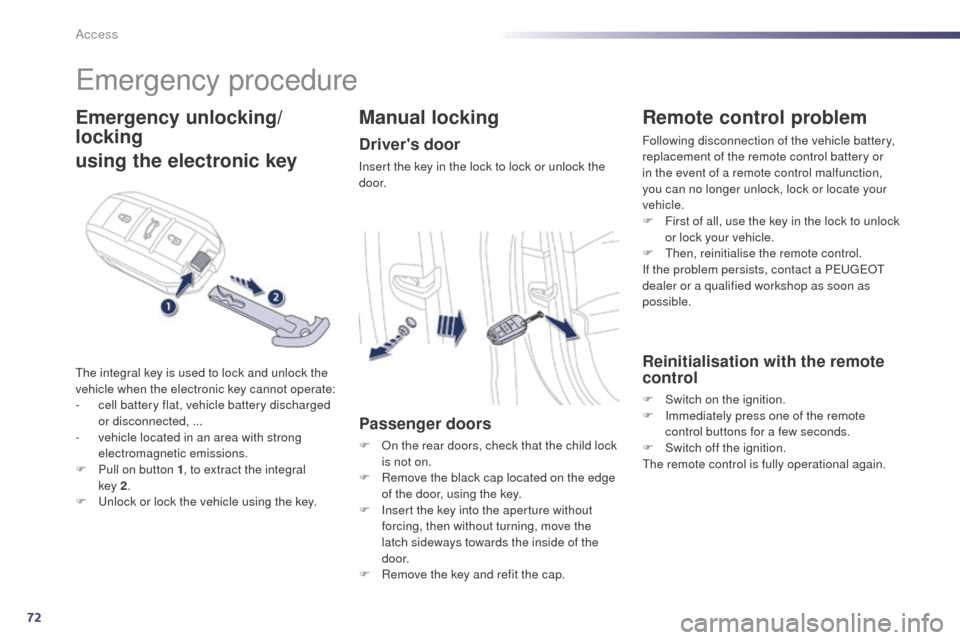
using the electronic key
the integral key is used to lock and unlock the
vehicle when the electronic key cannot operate:
-
c
ell battery flat, vehicle battery discharged
or disconnected, ...
-
v
ehicle located in an area with strong
electromagnetic emissions.
F
P
ull on button 1 , to extract the integral
key
2.
F
u
n
lock or lock the vehicle using the key.
Manual locking
Driver's door
Insert the key in the lock to lock or unlock the
d o o r.
Passenger doors
F On the rear doors, check that the child lock is not on.
F
R
emove the black cap located on the edge
of the door, using the key.
F
I
nsert the key into the aperture without
forcing, then without turning, move the
latch sideways towards the inside of the
d o o r.
F
R
emove the key and refit the cap.
Remote control problem
Following disconnection of the vehicle battery,
replacement of the remote control battery or
in the event of a remote control malfunction,
you can no longer unlock, lock or locate your
vehicle.
F
F
irst of all, use the key in the lock to unlock
or lock your vehicle.
F
t
hen
, reinitialise the remote control.
If the problem persists, contact a P
e
uge
Ot
dealer or a qualified workshop as soon as
possible.
Reinitialisation with the remote
control
F Switch on the ignition.
F I mmediately press one of the remote
control buttons for a few seconds.
F
S
witch off the ignition.
th
e remote control is fully operational again.
Access
Page 78 of 338
76
508RXH_en_Chap02_ouvertures_ed01-2014
Locking the vehicle
with exterior perimeter
monitoring only
Deactivate the interior volumetric and anti-lift
monitoring to avoid unwanted triggering of the
alarm in certain cases such as:
-
l
eaving a window partially open,
-
w
ashing your vehicle,
-
c
hanging a wheel,
-
h
aving your vehicle towed,
-
t
ransportation by sea.
Deactivation of the interior
volumetric and anti-tilt monitoring
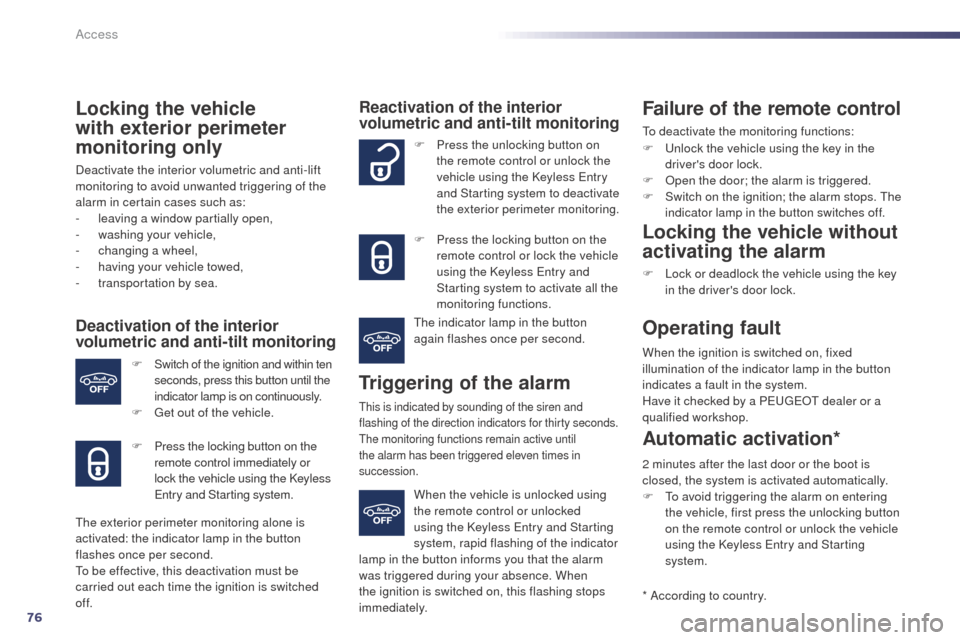
F Switch of the ignition and within ten seconds, press this button until the
indicator lamp is on continuously.
F
g
e
t out of the vehicle.
F
P
ress the locking button on the
remote control immediately or
lock the vehicle using the Keyless
en
try and Starting system.
th
e exterior perimeter monitoring alone is
activated: the indicator lamp in the button
flashes once per second.
to b
e effective, this deactivation must be
carried out each time the ignition is switched
of f.
Reactivation of the interior
volumetric and anti-tilt monitoring
Triggering of the alarm
this is indicated by sounding of the siren and
flashing of the direction indicators for thirty seconds.
th
e monitoring functions remain active until
the alarm has been triggered eleven times in
succession.
F Press the unlocking button on the remote control or unlock the
vehicle using the Keyless
e
n
try
and Starting system to deactivate
the exterior perimeter monitoring.
F
P
ress the locking button on the
remote control or lock the vehicle
using the Keyless
e
n
try and
Starting system to activate all the
monitoring functions.
th
e indicator lamp in the button
again flashes once per second.
When the vehicle is unlocked using
the remote control or unlocked
using the Keyless
e
n
try and Starting
system, rapid flashing of the indicator
lamp in the button informs you that the alarm
was triggered during your absence. When
the ignition is switched on, this flashing stops
immediately.
Failure of the remote control
to deactivate the monitoring functions:
F
u
n
lock the vehicle using the key in the
driver's door lock.
F
O
pen the door; the alarm is triggered.
F
S
witch on the ignition; the alarm stops. t
h
e
indicator lamp in the button switches off.
Locking the vehicle without
activating the alarm
F Lock or deadlock the vehicle using the key in the driver's door lock.
Operating fault
When the ignition is switched on, fixed
illumination of the indicator lamp in the button
indicates a fault in the system.
Have it checked by a P
e
uge
Ot
dealer or a
qualified workshop.
* According to country.
Automatic activation*
2 minutes after the last door or the boot is
closed, the system is activated automatically.
F
t
o a
void triggering the alarm on entering
the vehicle, first press the unlocking button
on the remote control or unlock the vehicle
using the Keyless
e
n
try and Starting
system.
Access