instrument panel Peugeot 807 2013 User Guide
[x] Cancel search | Manufacturer: PEUGEOT, Model Year: 2013, Model line: 807, Model: Peugeot 807 2013Pages: 234, PDF Size: 9.8 MB
Page 53 of 234
Steering wheel controls
EASE OF USE and COMFORT
3
51
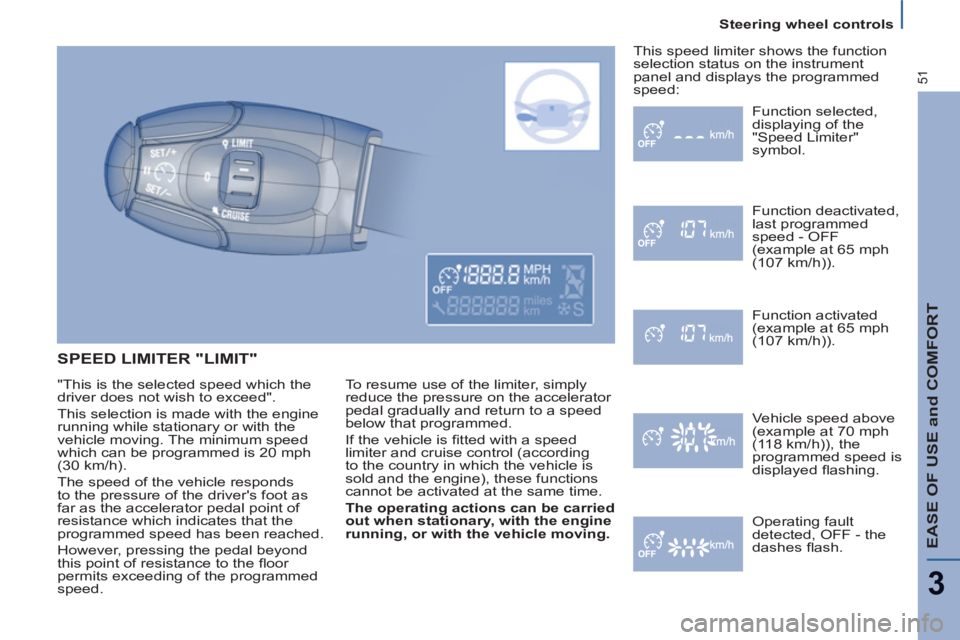
SPEED LIMITER "LIMIT"
To resume use of the limiter, simply
reduce the pressure on the accelerator
pedal gradually and return to a speed
below that programmed.
If the vehicle is fi tted with a speed
limiter and cruise control (according
to the country in which the vehicle is
sold and the engine), these functions
cannot be activated at the same time
.
The operating actions can be carried
out when stationary, with the engine
running, or with the vehicle moving.
Function selected,
displaying of the
"Speed Limiter"
symbol.
Function deactivated,
last programmed
speed - OFF
(example at 65 mph
(107 km/h)).
Function activated
(example at 65 mph
(107 km/h)).
Vehicle speed above
(example at 70 mph
(118 km/h)), the
programmed speed is
displayed fl ashing.
Operating fault
detected,
OFF - the
dashes fl ash. This speed limiter shows the function
selection status on the instrument
panel and displays the programmed
speed:
"This is the selected speed which the
driver does not wish to exceed".
This selection is made with the engine
running while stationary or with the
vehicle moving. The minimum speed
which can be programmed is 20 mph
(30 km/h).
The speed of the vehicle responds
to the pressure of the driver's foot as
far as the accelerator pedal point of
resistance which indicates that the
programmed speed has been reached.
However, pressing the pedal beyond
this point of resistance to the fl oor
permits exceeding of the programmed
speed.
Page 88 of 234
86
Driving safely
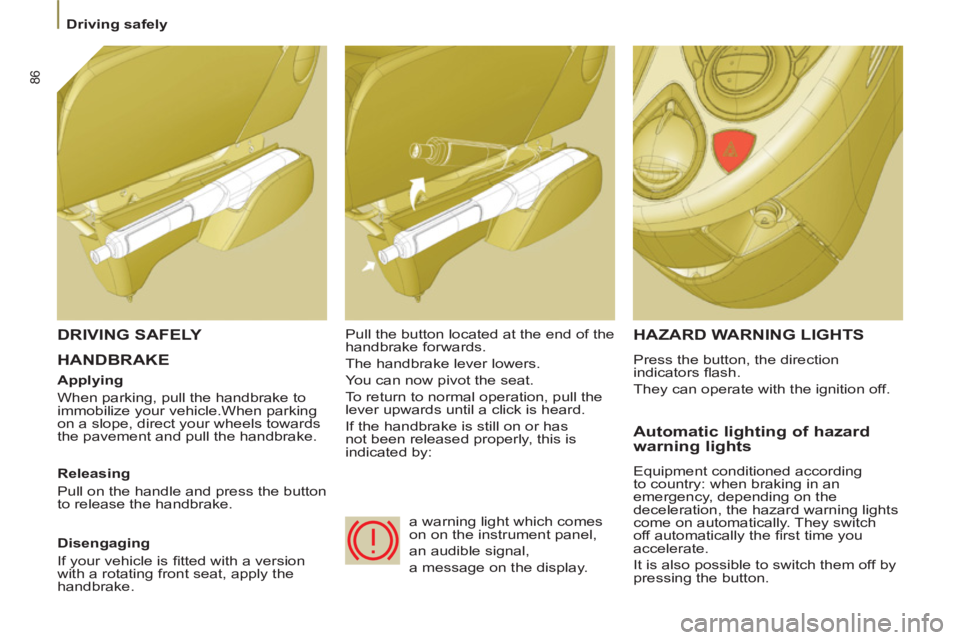
HANDBRAKE
HAZARD WARNING LIGHTS
Press the button, the direction
indicators fl ash.
They can operate with the ignition off.
Automatic lighting of hazard
warning lights
Equipment conditioned according
to country: when braking in an
emergency, depending on the
deceleration, the hazard warning lights
come on automatically. They switch
off automatically the fi rst time you
accelerate.
It is also possible to switch them off by
pressing the button.
DRIVING SAFELY
Applying
When parking, pull the handbrake to
immobilize your vehicle.When parking
on a slope, direct your wheels towards
the pavement and pull the handbrake.
Releasing
Pull on the handle and press the button
to release the handbrake. Pull the button located at the end of the
handbrake forwards.
The handbrake lever lowers.
You can now pivot the seat.
To return to normal operation, pull the
lever upwards until a click is heard.
If the handbrake is still on or has
not been released properly, this is
indicated by:
Disengaging
If your vehicle is fi tted with a version
with a rotating front seat, apply the
handbrake. a warning light which comes
on on the instrument panel,
an audible signal,
a message on the display.
Page 97 of 234
SAFETY
95
Airbags
4
Side air bags
If fi tted on your vehicle, this is a system
which protects the driver and front
passenger in the event of a serious
side impact in order to limit the risk of
injury to the chest.
Each side air bag is incorporated in the
front seat back frame, on the door side. The curtain air bag infl ates between
the front or rear occupant of the vehicle
and the windows.
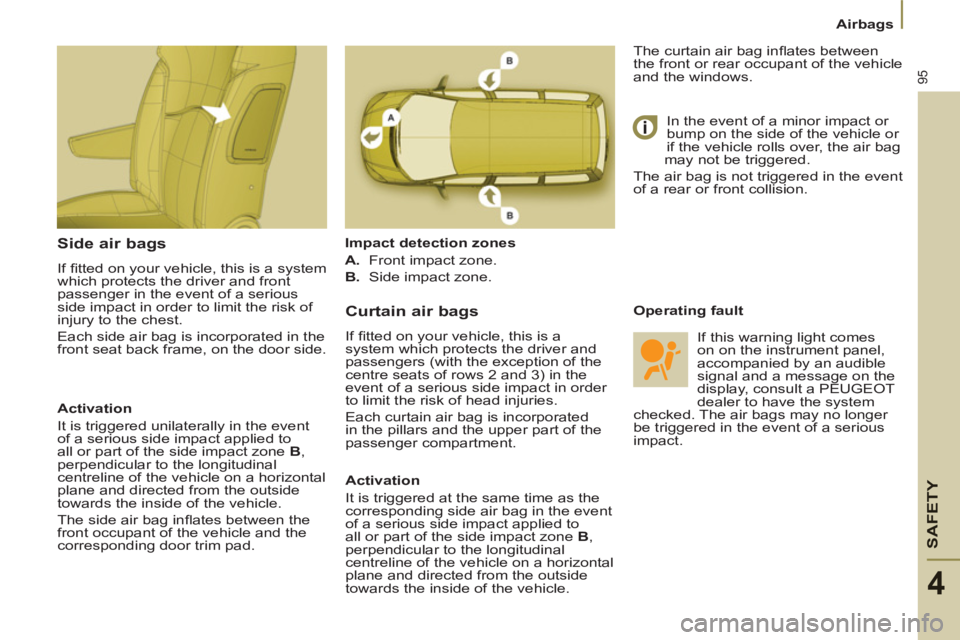
Impact detection zones
A.
Front impact zone.
B.
Side impact zone.
In the event of a minor impact or
bump on the side of the vehicle or
if the vehicle rolls over, the air bag
may not be triggered.
The air bag is not triggered in the event
of a rear or front collision.
Operating fault
Curtain air bags
If fi tted on your vehicle, this is a
system which protects the driver and
passengers (with the exception of the
centre seats of rows 2 and 3) in the
event of a serious side impact in order
to limit the risk of head injuries.
Each curtain air bag is incorporated
in the pillars and the upper part of the
passenger compartment.
Activation
It is triggered unilaterally in the event
of a serious side impact applied to
all or part of the side impact zone B
,
perpendicular to the longitudinal
centreline of the vehicle on a horizontal
plane and directed from the outside
towards the inside of the vehicle.
The side air bag infl ates between the
front occupant of the vehicle and the
corresponding door trim pad.
Activation
It is triggered at the same time as the
corresponding side air bag in the event
of a serious side impact applied to
all or part of the side impact zone B
,
perpendicular to the longitudinal
centreline of the vehicle on a horizontal
plane and directed from the outside
towards the inside of the vehicle. If this warning light comes
on on the instrument panel,
accompanied by an audible
signal and a message on the
display, consult a PEUGEOT
dealer to have the system
checked. The air bags may no longer
be triggered in the event of a serious
impact.
Page 98 of 234
96
Airbags
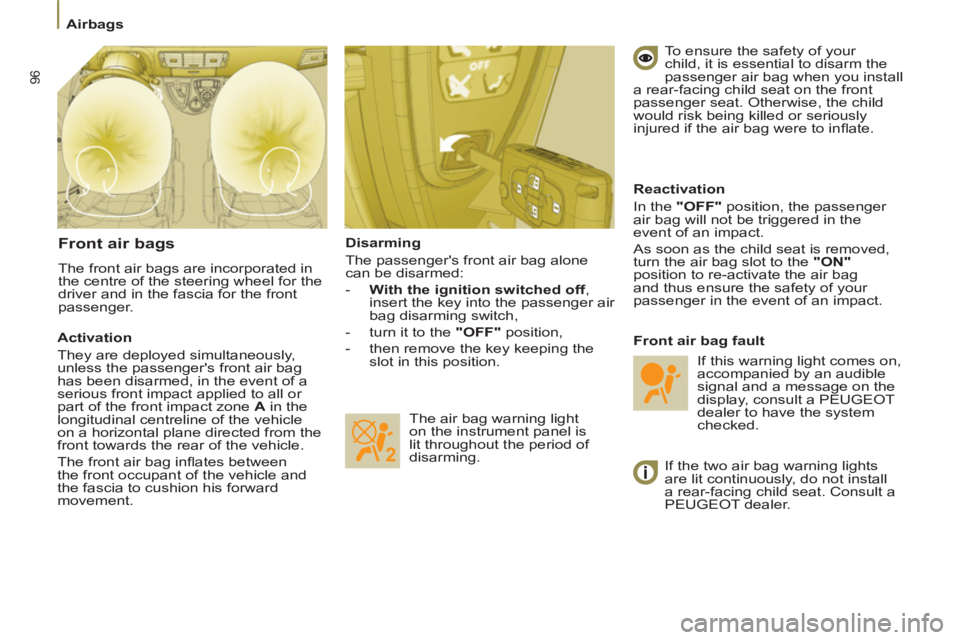
Disarming
The passenger's front air bag alone
can be disarmed:
- With
the
ignition
switched
off
,
insert the key into the passenger air
bag disarming switch,
- turn it to the "OFF"
position,
-
then remove the key keeping the
slot in this position.
Front air bags
The front air bags are incorporated in
the centre of the steering wheel for the
driver and in the fascia for the front
passenger.
Front air bag fault
Reactivation
In the "OFF"
position, the passenger
air bag will not be triggered in the
event of an impact.
As soon as the child seat is removed,
turn the air bag slot to the "ON"
position to re-activate the air bag
and thus ensure the safety of your
passenger in the event of an impact. To ensure the safety of your
child, it is essential to disarm the
passenger air bag when you install
a rear-facing child seat on the front
passenger seat. Otherwise, the child
would risk being killed or seriously
injured if the air bag were to infl ate.
The air bag warning light
on the instrument panel is
lit throughout the period of
disarming.
If the two air bag warning lights
are lit continuously, do not install
a rear-facing child seat. Consult a
PEUGEOT dealer.
Activation
They are deployed simultaneously,
unless the passenger's front air bag
has been disarmed, in the event of a
serious front impact applied to all or
part of the front impact zone A
in the
longitudinal centreline of the vehicle
on a horizontal plane directed from the
front towards the rear of the vehicle.
The front air bag infl ates between
the front occupant of the vehicle and
the fascia to cushion his forward
movement. If this warning light comes on,
accompanied by an audible
signal and a message on the
display, consult a PEUGEOT
dealer to have the system
checked.
Page 115 of 234
11 3
Levels
CHECKS
6
These regular maintenance
operations will keep your vehicle
in good running order. Consult the
instructions at PEUGEOT dealerships
or in the servicing booklet enclosed in
the handbook pack. To maintain the reliability of engines
and emission control systems, the use
of additives in engine oil is prohibited.
Oil change
It is imperative that this is carried out at
the intervals specifi ed and the viscosity
grade of the oil selected must fulfi l the
requirements in accordance with the
manufacturer’s servicing schedule.
Consult the instructions at PEUGEOT
dealerships.
Remove the dipstick before fi lling.
Check the level after fi lling (never
exceed the max mark).
Screw the cap back onto the sump
before closing the bonnet.
LEVELS
If you have to remove/refi t the
engine style cover, handle it with
care to avoid damaging the fi xing
clips.
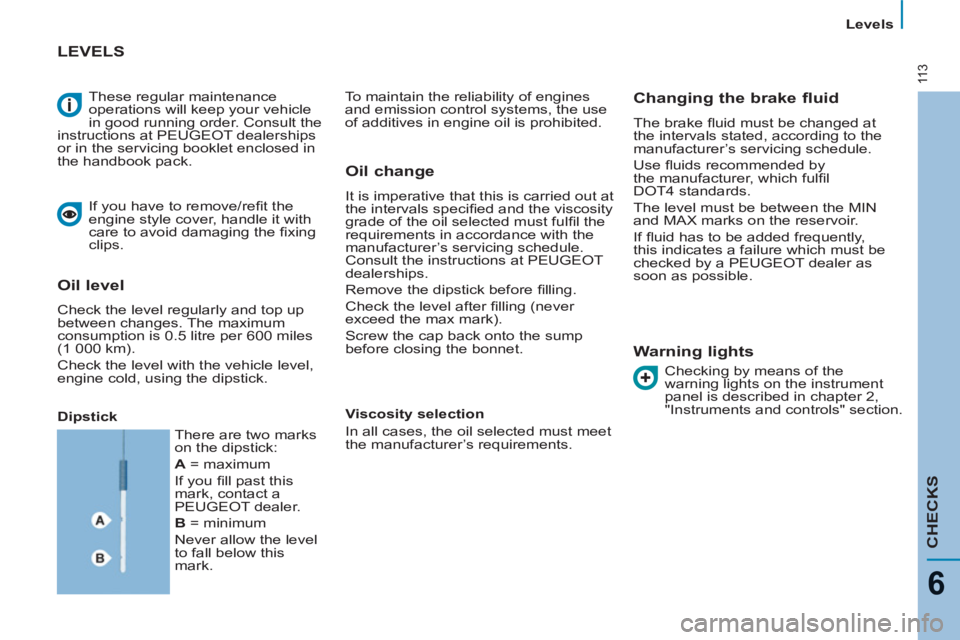
Dipstick
Warning lights
Oil level
Check the level regularly and top up
between changes. The maximum
consumption is 0.5 litre per 600 miles
(1 000 km).
Check the level with the vehicle level,
engine cold, using the dipstick.
Viscosity selection
In all cases, the oil selected must meet
the manufacturer’s requirements.
Checking by means of the
warning lights on the instrument
panel is described in chapter 2,
"Instruments and controls" section.
Changing the brake fluid
The brake fl uid must be changed at
the intervals stated, according to the
manufacturer’s servicing schedule.
Use fl uids recommended by
the manufacturer, which fulfi l
DOT4 standards.
The level must be between the MIN
and MAX marks on the reservoir.
If fl uid has to be added frequently,
this indicates a failure which must be
checked by a PEUGEOT dealer as
soon as possible.
There are two marks
on the dipstick:
A
= maximum
If you fi ll past this
mark, contact a
PEUGEOT dealer.
B
= minimum
Never allow the level
to fall below this
mark.
Page 126 of 234
124
Changing a fuse
CHANGING A FUSE
The fuse boxes are located in:
- the instrument panel lower glove
box (right-hand side),
- the battery compartment (right-
hand side fl oor),
- the engine compartment.
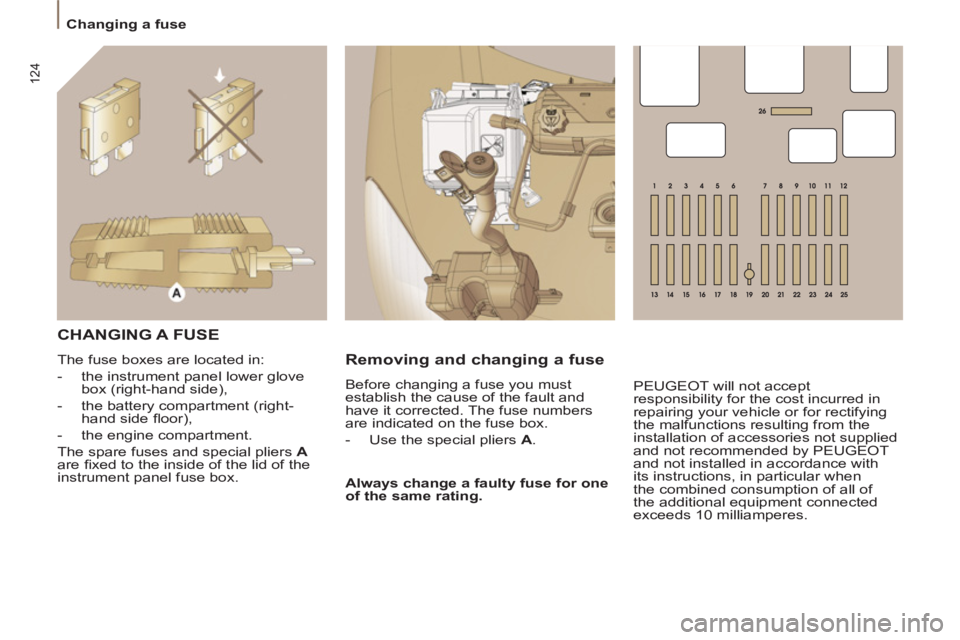
The spare fuses and special pliers A
are fi xed to the inside of the lid of the
instrument panel fuse box. Before changing a fuse you must
establish the cause of the fault and
have it corrected. The fuse numbers
are indicated on the fuse box.
- Use the special pliers A
.
Always change a faulty fuse for one
of the same rating.
Removing and changing a fuse
PEUGEOT will not accept
responsibility for the cost incurred in
repairing your vehicle or for rectifying
the malfunctions resulting from the
installation of accessories not supplied
and not recommended by PEUGEOT
and not installed in accordance with
its instructions, in particular when
the combined consumption of all of
the additional equipment connected
exceeds 10 milliamperes.
Page 127 of 234
125
QUICK HELP
7
Changing a fuse
INSTRUMENT PANEL FUSES
- Open the lower glove box on the right-hand side.
- Pull the handle to open the cover and access the fuses.
N°
Rating
(Amps)
Functions
1
15
Rear wiper.
2
- Not used.
3
5
Airbag control unit.
4
10
Steering wheel angle sensor, Diagnostic socket, ESP sensor, Manual air conditioning, Clutch
switch, Headlamp beam height, Particle emission fi lter pump, Electrochromatic interior mirror.
5
30
Electric mirrors, Passenger's electric window motor, Sunroof row 1.
6
30
Front electric windows supply.
7
5
Courtesy lights, Glove box light, Courtesy mirror lights, Entertainment screen lights row 2.
8
20
Multifunction display, Anti-theft alarm siren, Audio equipment, Compact disc changer, Audio/
telephone, Diesel additive control unit, Tyre under-infl ation detection control unit, Sliding doors
module control unit.
9
30
Lighter.
10
15
Steering wheel switching, Trailer fuse box.
11
15
Diagnostic socket, Ignition switch, Automatic gearbox (4-speed).
12
15
Driver's seat memory unit, Passenger's electric seat, Airbag control unit, Parking assistance
control unit, Sliding side door buttons, Hands-free kit, Automatic gearbox (6-speed).
13
5
Engine fuse box, Trailer fuse box.
14
15
Rain sensor, Automatic air conditioning, Instrument panel, Sunroofs, Odometer warning lights
unit, Audio-telematics control.
15
30
Passenger's lock locking.
16
30
Locking/unlocking of the accesses.
17
40
Heated rear screen.
Page 130 of 234
128
Changing a fuse
Fuse box
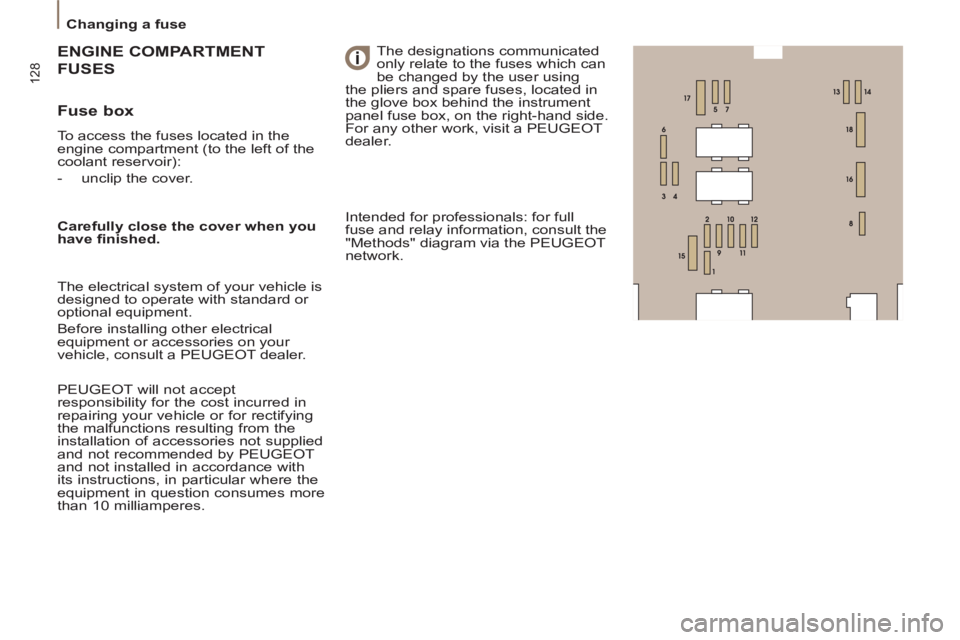
To access the fuses located in the
engine compartment (to the left of the
coolant reservoir):
- unclip the cover.
GINE COMPARTMENT
ENGIN
USES FUS
The designations communicated
only relate to the fuses which can
be changed by the user using
the pliers and spare fuses, located in
the glove box behind the instrument
panel fuse box, on the right-hand side.
For any other work, visit a PEUGEOT
dealer.
Carefully close the cover when you
have fi nished.
The electrical system of your vehicle is
designed to operate with standard or
optional equipment.
Before installing other electrical
equipment or accessories on your
vehicle, consult a PEUGEOT dealer.
PEUGEOT will not accept
responsibility for the cost incurred in
repairing your vehicle or for rectifying
the malfunctions resulting from the
installation of accessories not supplied
and not recommended by PEUGEOT
and not installed in accordance with
its instructions, in particular where the
equipment in question consumes more
than 10 milliamperes. Intended for professionals: for full
fuse and relay information, consult the
"Methods" diagram via the PEUGEOT
network.
Page 225 of 234
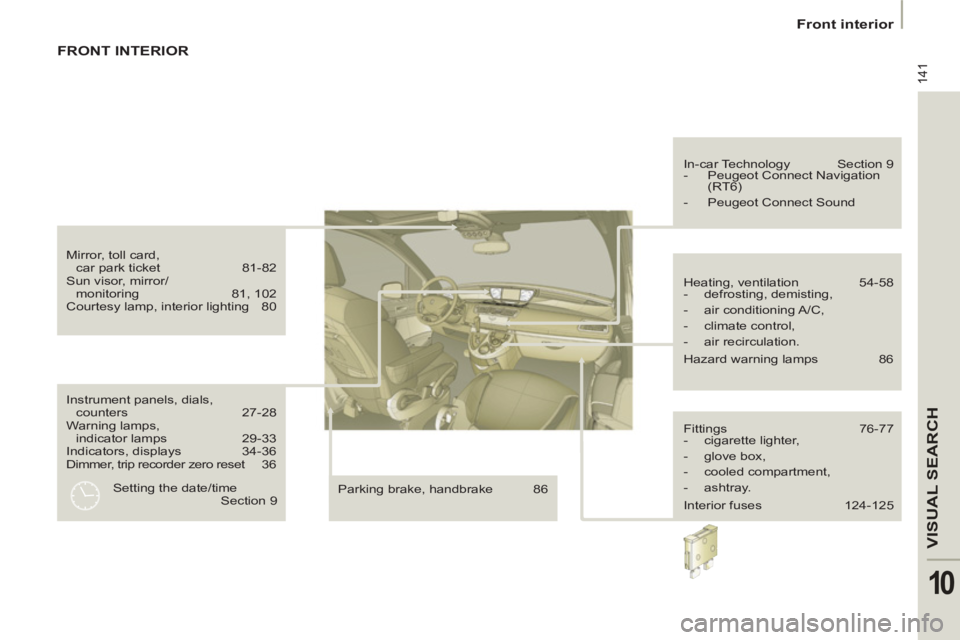
141
VISUAL SEARC
H
10
Front interior
Instrument panels, dials,
counters 27-28
Warning lamps,
indicator lamps 29-33
Indicators, displays 34-36
Dimmer, trip recorder zero reset 36
Parking brake, handbrake 86 Heating, ventilation 54-58
- defrosting, demisting,
- air conditioning A/C,
- climate control,
- air recirculation.
Hazard warning lamps 86 In-car Technology Section 9
- Peugeot Connect Navigation
(RT6)
- Peugeot Connect Sound
Fittings 76-77
- cigarette lighter,
- glove box,
- cooled compartment,
- ashtray.
Interior fuses 124-125
Mirror, toll card,
car park ticket 81-82
Sun visor, mirror/
monitoring 81, 102
Courtesy lamp, interior lighting 80
Setting the date/time
Section 9
FRONT INTERIOR
Page 228 of 234
144
Environment
ECO-DRIVING
Eco-driving is a range of everyday practices that allow the motorist to optimise their fuel consumption and CO2
emissions.
Optimise the use of your gearbox
With a manual gearbox, move off gently, change up without
waiting and drive by changing up quite soon. If your vehicle
has the system, the gear shift indicator invites you to
change up; it is displayed in the instrument panel, follow its
instructions.
With an automatic or electronic gearbox, stay in Drive "D"
or
Auto "A"
, according to the type of gearbox, without pressing
the accelerator pedal heavily or suddenly.
Drive smoothly
Maintain a safe distance between vehicles, use engine
braking rather than the brake pedal, and press the
accelerator progressively. These practices contribute
towards a reduction in fuel consumption and CO
2 emissions
and also helps reduce the background traffi c noise.
If your vehicle has cruise control, make use of the system at
speeds above 25 mph (40 km/h) when the traffi c is fl owing
well.
Control the use of your electrical equipment
Before moving off, if the passenger compartment is too
warm, ventilate it by opening the windows and air vents
before using the air conditioning.
Above 30 mph (50 km/h), close the windows and leave the
air vents open.
Remember to make use of equipment that can help keep the
temperature in the passenger compartment down (sunroof
and window blinds...).
Switch off the air conditioning, unless it has automatic digital
regulation, as soon as the desired temperature is attained.
Switch off the demisting and defrosting controls, if not
automatic.
Switch off the heated seat as soon as possible.
Switch off the headlamps and front foglamps when the level
of light does not require their use.
Avoid running the engine before moving off, particularly in
winter; your vehicle will warm up much faster while driving.
As a passenger, if you avoid connecting your multimedia
devices (fi lm, music, video game...), you will contribute
towards limiting the consumption of electrical energy, and
so of fuel.
Disconnect your portable devices before leaving the
vehicle.