Chapter 3 Peugeot Bipper 2011 User Guide
[x] Cancel search | Manufacturer: PEUGEOT, Model Year: 2011, Model line: Bipper, Model: Peugeot Bipper 2011Pages: 180, PDF Size: 5.14 MB
Page 122 of 180
12
0
Airbags
AIRBAGS
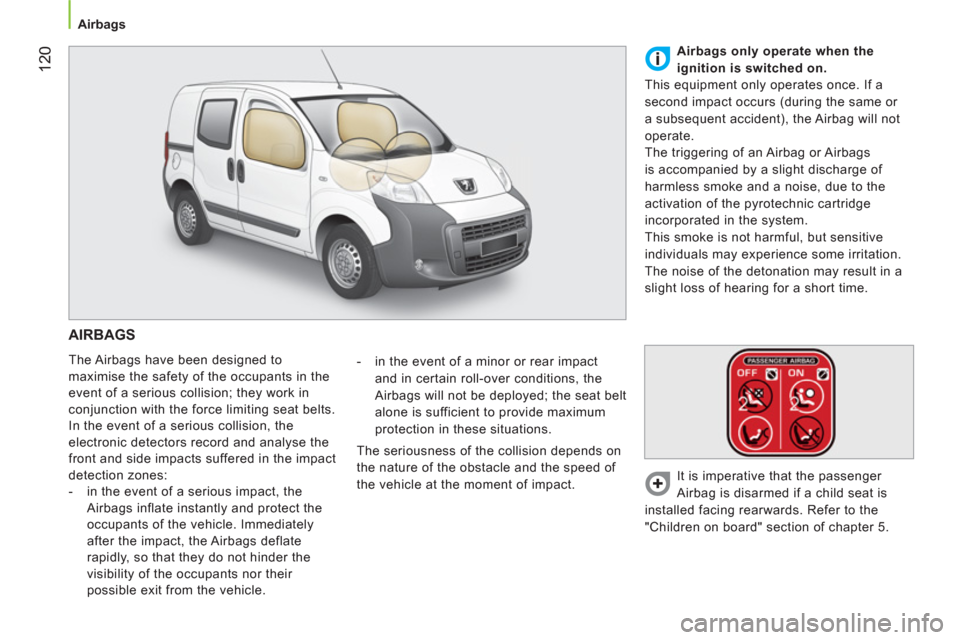
The Airbags have been designed to
maximise the safety of the occupants in the
event of a serious collision; they work in
conjunction with the force limiting seat belts.
In the event of a serious collision, the
electronic detectors record and analyse the
front and side impacts suffered in the impact
detection zones:
- in the event of a serious impact, the
Airbags inflate instantly and protect the
occupants of the vehicle. Immediately
after the impact, the Airbags deflate
rapidly, so that they do not hinder the
visibility of the occupants nor their
possible exit from the vehicle.
- in the event of a minor or rear impact
and in certain roll-over conditions, the
Airbags will not be deployed; the seat belt
alone is sufficient to provide maximum
protection in these situations.
The seriousness of the collision depends on
the nature of the obstacle and the speed of
the vehicle at the moment of impact.
Airbags only operate when the
ignition is switched on.
This equipment only operates once. If a
second impact occurs (during the same or
a subsequent accident), the Airbag will not
operate.
The triggering of an Airbag or Airbags
is accompanied by a slight discharge of
harmless smoke and a noise, due to the
activation of the pyrotechnic cartridge
incorporated in the system.
This smoke is not harmful, but sensitive
individuals may experience some irritation.
The noise of the detonation may result in a
slight loss of hearing for a short time.
It is imperative that the passenger
Airbag is disarmed if a child seat is
installed facing rearwards. Refer to the
"Children on board" section of chapter 5.
Page 124 of 180
122
Airbags
FRONT AIRBAGS
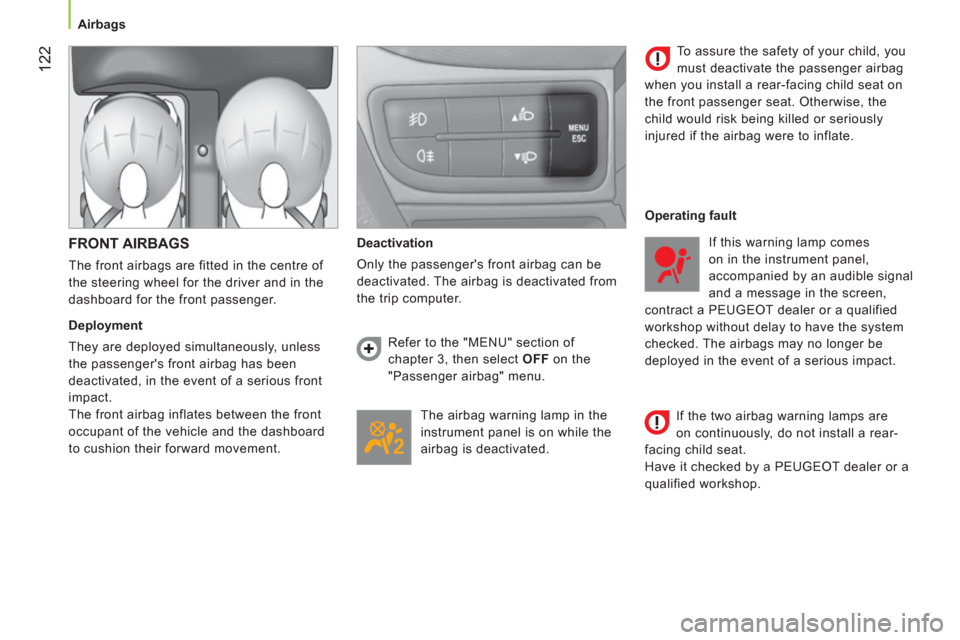
The front airbags are fitted in the centre of
the steering wheel for the driver and in the
dashboard for the front passenger.
Deployment
They are deployed simultaneously, unless
the passenger's front airbag has been
deactivated, in the event of a serious front
impact.
The front airbag inflates between the front
occupant of the vehicle and the dashboard
to cushion their forward movement.
Deactivation
Only the passenger's front airbag can be
deactivated. The airbag is deactivated from
the trip computer.
The airbag warning lamp in the
instrument panel is on while the
airbag is deactivated. To assure the safety of your child, you
must deactivate the passenger airbag
when you install a rear-facing child seat on
the front passenger seat. Otherwise, the
child would risk being killed or seriously
injured if the airbag were to inflate.
Refer to the "MENU" section of
chapter 3, then select OFF
on the
"Passenger airbag" menu.
Operating fault
If the two airbag warning lamps are
on continuously, do not install a rear-
facing child seat.
Have it checked by a PEUGEOT dealer or a
qualified workshop.
If this warning lamp comes
on in the instrument panel,
accompanied by an audible signal
and a message in the screen,
contract a PEUGEOT dealer or a qualified
workshop without delay to have the system
checked. The airbags may no longer be
deployed in the event of a serious impact.
Page 127 of 180
5
SAFETY
Child safety
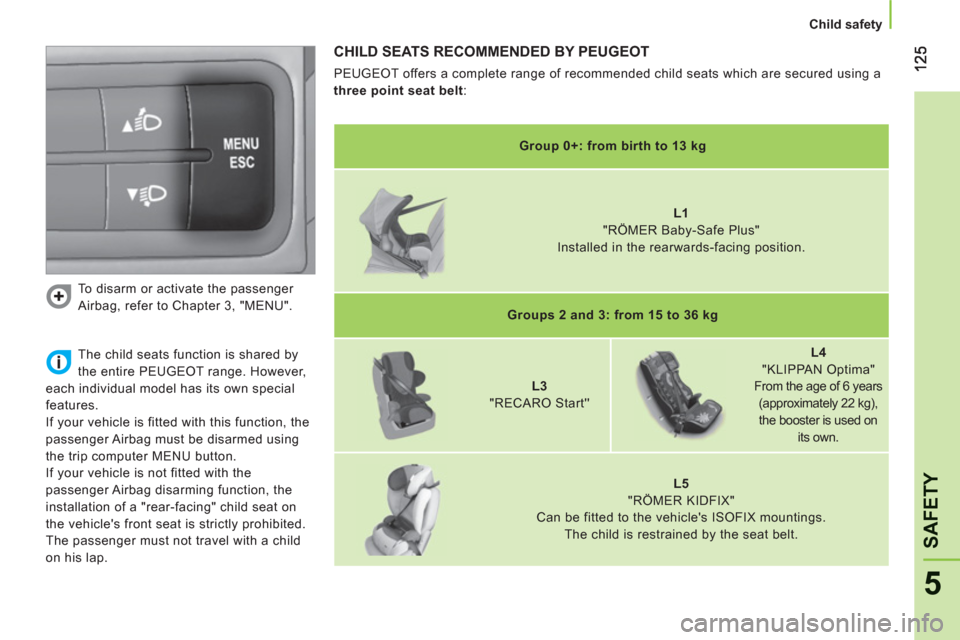
To disarm or activate the passenger
Airbag, refer to Chapter 3, "MENU".
CHILD SEATS RECOMMENDED BY PEUGEOT
PEUGEOT offers a complete range of recommended child seats which are secured using a
three point seat belt
:
The child seats function is shared by
the entire PEUGEOT range. However,
each individual model has its own special
features.
If your vehicle is fitted with this function, the
passenger Airbag must be disarmed using
the trip computer MENU button.
If your vehicle is not fitted with the
passenger Airbag disarming function, the
installation of a "rear-facing" child seat on
the vehicle's front seat is strictly prohibited.
The passenger must not travel with a child
on his lap.
Group 0+: from birth to 13 kg
L1
"RÖMER Baby-Safe Plus"
Installed in the rearwards-facing position.
Groups 2 and 3: from 15 to 36 kg
L3
"RECARO Start''
L4
"KLIPPAN Optima"
From the age of 6 years
(approximately 22 kg),
the booster is used on
its own.
L5
"RÖMER KIDFIX"
Can be fitted to the vehicle's ISOFIX mountings.
The child is restrained by the seat belt.
Page 134 of 180
132
Towing a trailer
In certain cases of particularly arduous
use (towing the maximum load up a steep
slope in high temperatures), the engine
automatically limits its power. In this case,
automatic cutting off of the air conditioning
allows the engine power to be saved.
If the coolant temperature
warning lamp comes on, stop the
vehicle and switch off the engine
as soon as possible.
See the "Levels" section of chapter 7.
Tyres:
check the tyre pressures of the
towing vehicle (see the "Identification
markings" section of chapter 7) and of
the trailer, observing the recommended
pressures.
Brakes:
towing increases the braking
distance. Drive at a moderate speed,
change down early and brake gradually.
Side wind:
sensitivity to side wind is
increased. Drive smoothly and at a
moderate speed.
ABS:
the system only controls the vehicle,
not the trailer.
Rear parking sensors:
the sensors
will be deactivated automatically when
an genuine PEUGEOT towbar is used
(see the "Rear parking sensors" section of
chapter 3).
Towbar
We recommend the use of original
PEUGEOT towbars and their harnesses,
which have been tested and approved from
the design stage of your vehicle, and that
the fitting of this equipment is entrusted to a
PEUGEOT dealer or a qualified workshop.
If this equipment is not fitted by a PEUGEOT
dealer, it is essential that it is fitted using
the electrical pre-equipment located at
the rear of the vehicle and following the
manufacturer's instructions.
The operation of the rear parking sensors is
deactivated automatically when the trailer
cable connector is inserted in the towbar
socket.
When the trailer cable is removed, the rear
parking sensors are re-activated.
Distribution of loads
Distribute the load in the trailer so that the
heaviest objects are as close as possible
to the axle and the nose weight is close to
the maximum authorised without, however,
exceeding it. The air density decreases with
altitude, so reducing the performance of
the engine. The maximum towed load must
be reduced by 10 % for each 1 000 metres
of altitude. Refer to the "Technical data"
chapter for details of the weights and towed
loads applicable to your vehicle and also to
the administrative documents
(V5 registration document, ...).
Page 142 of 180
14
0
Changing a wheel
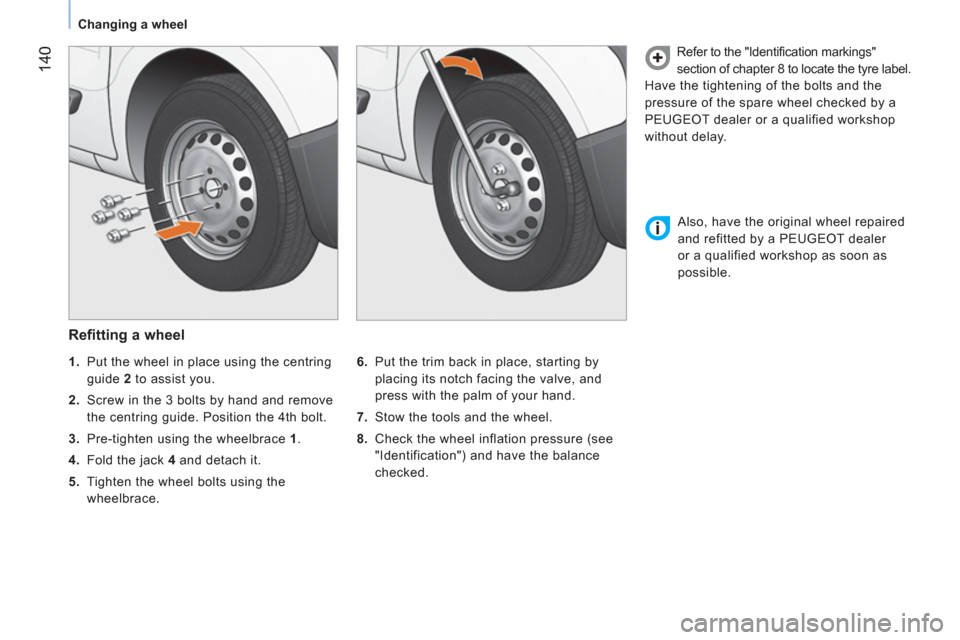
Refitting a wheel
6.
Put the trim back in place, starting by
placing its notch facing the valve, and
press with the palm of your hand.
7.
Stow the tools and the wheel.
8.
Check the wheel inflation pressure (see
"Identification") and have the balance
checked. Refer to the "Identifi cation markings"
section of chapter 8 to locate the tyre label.
Have the tightening of the bolts and the
pressure of the spare wheel checked by a
PEUGEOT dealer or a qualified workshop
without delay.
1.
Put the wheel in place using the centring
guide 2
to assist you.
2.
Screw in the 3 bolts by hand and remove
the centring guide. Position the 4th bolt.
3.
Pre-tighten using the wheelbrace 1
.
4.
Fold the jack 4
and detach it.
5.
Tighten the wheel bolts using the
wheelbrace. Also, have the original wheel repaired
and refitted by a PEUGEOT dealer
or a qualified workshop as soon as
possible.
Page 164 of 180
162
Levels
These regular maintenance operations
will keep your vehicle in good working
order. Ask for advice from a PEUGEOT
dealer or a qualified workshop or refer to the
servicing booklet provided in the handbook
pack.
LEVELS
Oil level
Check the level regularly and top up
between changes. The maximum oil
consumption is 0.5 litre per 600 miles
(1 000 km). Check the level with the vehicle
level, engine cold, using the dipstick.
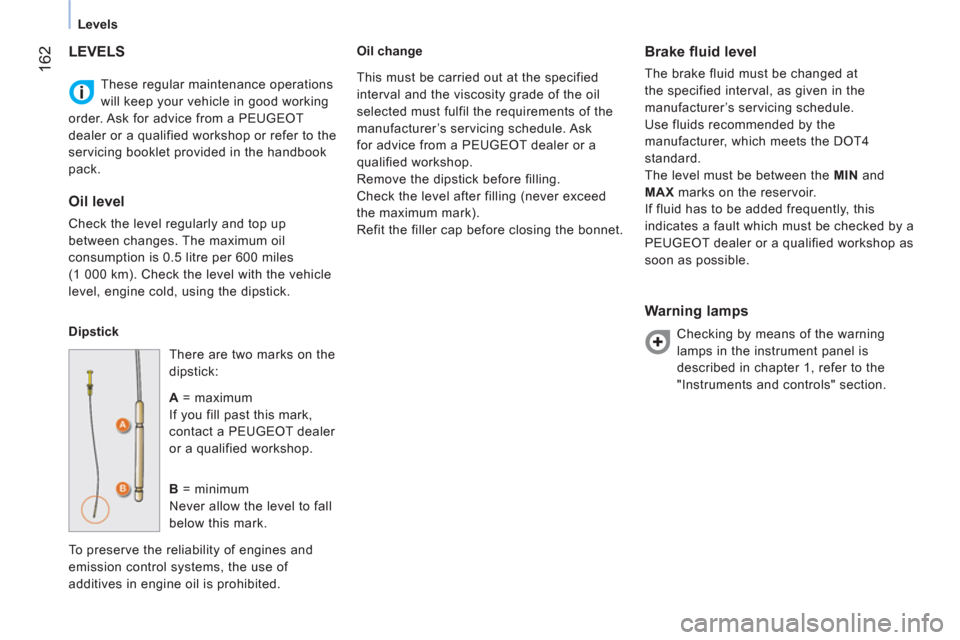
Dipstick
There are two marks on the
dipstick:
A
= maximum
If you fill past this mark,
contact a PEUGEOT dealer
or a qualified workshop.
B
= minimum
Never allow the level to fall
below this mark.
To preserve the reliability of engines and
emission control systems, the use of
additives in engine oil is prohibited.
Oil change
Brake fluid level
The brake fluid must be changed at
the specified interval, as given in the
manufacturer’s servicing schedule.
Use fluids recommended by the
manufacturer, which meets the DOT4
standard.
The level must be between the MIN
and
MAX
marks on the reservoir.
If fluid has to be added frequently, this
indicates a fault which must be checked by a
PEUGEOT dealer or a qualified workshop as
soon as possible.
Warning lamps
Checking by means of the warning
lamps in the instrument panel is
described in chapter 1, refer to the
"Instruments and controls" section. This must be carried out at the specified
interval and the viscosity grade of the oil
selected must fulfil the requirements of the
manufacturer’s servicing schedule. Ask
for advice from a PEUGEOT dealer or a
qualified workshop.
Remove the dipstick before filling.
Check the level after filling (never exceed
the maximum mark).
Refit the filler cap before closing the bonnet.
Page 166 of 180
164
Checks
CHECKS
Bleeding water from
the Diesel filter
If this warning lamp comes
on, you must bleed the filter;
otherwise bleed the filter
regularly, every time the engine is
changed.
To remove the water, unscrew the bleed
screw or the water in Diesel sensor, located
at the base of the filter. Operate until all of
the water has flowed out. Then tighten the
bleed screw or the water sensor.
HDi engines use advanced technology. All
work requires specialist knowledge, which
all PEUGEOT dealers have.
Battery
At the start of winter, have your battery
checked by a PEUGEOT dealer or a
qualified workshop.
Air filter and passenger compartment
filter
A blocked passenger compartment filter
may reduce the performance of the
air conditioning system and generate
undesirable odours. The replacement
intervals for these components are indicated
in the servicing booklet.
Depending on the environment (dusty
atmosphere...) and the use of the vehicle
(urban driving...), change them twice as
often if necessary, refer to the "Under the
bonnet" section of chapter 7.
Brake pads
Brake pad wear depends on the style of
driving, in particular for vehicles which are
used in town, over short distances. It may
be necessary to check the brake pad wear,
even between services.
Unless there is a leak on the system, a drop
in the brake fluid level indicates that the
brake pads are worn.
Brake disc/drum wear
For all information on checking the brake
disc/drum wear, contact a PEUGEOT dealer
or a qualified workshop.
Parking brake
Where the parking brake travel is too great
or there is a reduction in the performance
of the system, the parking brake should be
adjusted, even between services.
Have the system checked by a PEUGEOT
dealer or a qualified workshop.
Oil filter
Change the filter regularly, in accordance
with the servicing schedule.
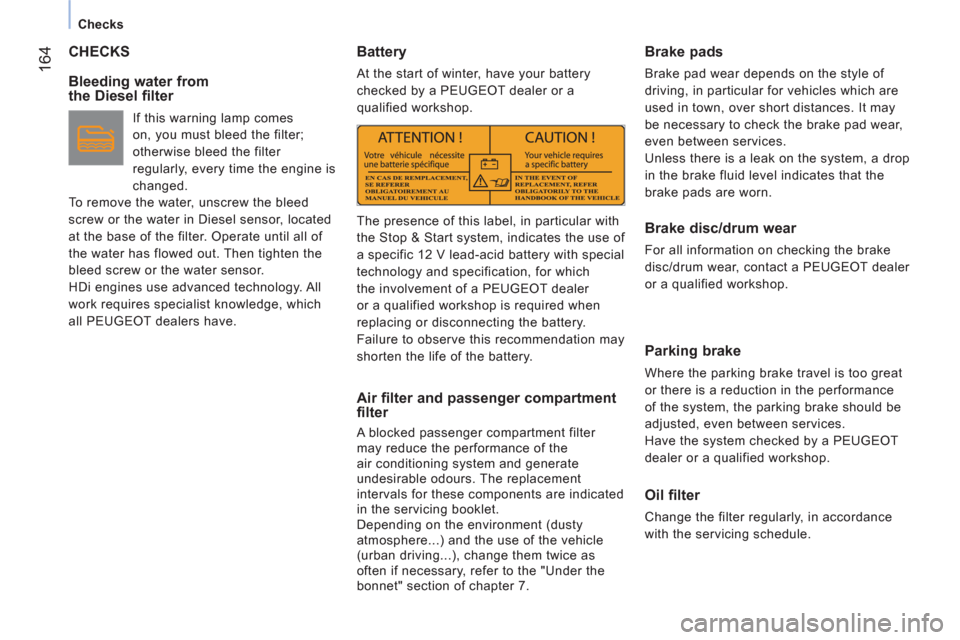
The presence of this label, in particular with
the Stop & Start system, indicates the use of
a specific 12 V lead-acid battery with special
technology and specification, for which
the involvement of a PEUGEOT dealer
or a qualified workshop is required when
replacing or disconnecting the battery.
Failure to observe this recommendation may
shorten the life of the battery.