light Peugeot Bipper 2015 Owner's Guide
[x] Cancel search | Manufacturer: PEUGEOT, Model Year: 2015, Model line: Bipper, Model: Peugeot Bipper 2015Pages: 192, PDF Size: 7.97 MB
Page 84 of 192
82
Bipper_en_Chap04_ergonomie_ed02-2014
INTERIOR LIGHTING
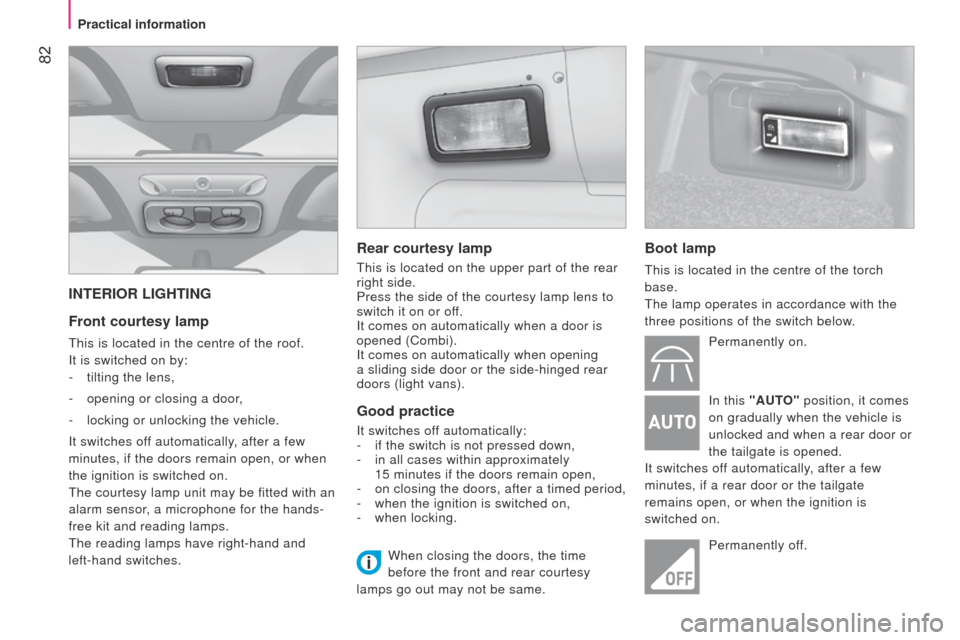
Front courtesy lamp
this is located in the centre of the roof.
It is switched on by:
-
tilting the lens,
-
opening or closing a door
,
-
locking or unlocking the vehicle.
It switches of
f automatically, after a few
minutes, if the doors remain open, or when
the ignition is switched on.
t
he courtesy lamp unit may be fitted with an
alarm sensor, a microphone for the hands-
free kit and reading lamps.
t
he reading lamps have right-hand and
left-hand switches.
Rear courtesy lamp
this is located on the upper part of the rear
right side.
Press the side of the courtesy lamp lens to
switch it on or off.
It comes on automatically when a door is
opened (Combi).
It comes on automatically when opening
a sliding side door or the side-hinged rear
doors (light vans).
Good practice
It switches off automatically:
- if the switch is not pressed down,
-
in all cases within approximately
15 minutes if the doors remain open,
-
on closing the doors, after a timed period,
-
when the ignition is switched on,
-
when locking.
Boot lamp
this is located in the centre of the torch
base.
t
he lamp operates in accordance with the
three positions of the switch below.
Permanently on.
In this "AUTO"
position, it comes
on gradually when the vehicle is
unlocked and when a rear door or
the tailgate is opened.
It switches off automatically, after a few
minutes, if a rear door or the tailgate
remains open, or when the ignition is
switched on.
Permanently off.
When closing the doors, the time
before the front and rear courtesy
lamps go out may not be same.
Practical information
Page 114 of 192
11 2
Bipper_en_Chap06_securite_ed02-2014
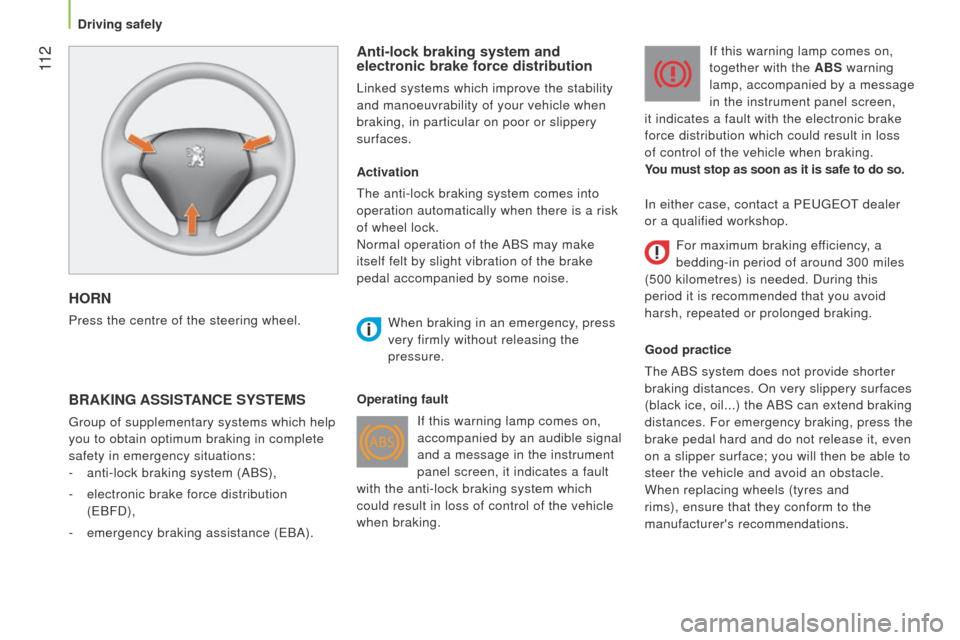
HORN
Press the centre of the steering wheel.
Anti-lock braking system and
electronic brake force distribution
linked systems which improve the stability
and manoeuvrability of your vehicle when
braking, in particular on poor or slippery
surfaces.
BRAKING ASSISTANCE SYSTEMS
group of supplementary systems which help
you to obtain optimum braking in complete
safety in emergency situations:
-
anti-lock braking system (ABS),
-
electronic brake force distribution
(
e BFD),
-
emergency braking assistance (
e BA).Activation
t
he anti-lock braking system comes into
operation automatically when there is a risk
of wheel lock.
Normal operation of the ABS may make
itself felt by slight vibration of the brake
pedal accompanied by some noise.
When braking in an emergency
, press
very firmly without releasing the
pressure.
Operating fault If this warning lamp comes on,
accompanied by an audible signal
and a message in the instrument
panel screen, it indicates a fault
with the anti-lock braking system which
could result in loss of control of the vehicle
when braking. If this warning lamp comes on,
together with the ABS warning
lamp, accompanied by a message
in the instrument panel screen,
it indicates a fault with the electronic brake
force distribution which could result in loss
of control of the vehicle when braking.
You must stop as soon as it is safe to do so.
Good practice
t
he ABS system does not provide shorter
braking distances. On very slippery surfaces
(black ice, oil...) the ABS can extend braking
distances. For emergency braking, press the
brake pedal hard and do not release it, even
on a slipper surface; you will then be able to
steer the vehicle and avoid an obstacle.
When replacing wheels (tyres and
rims), ensure that they conform to the
manufacturer's recommendations. In either case, contact a P euge O t
dealer
or a qualified workshop.
For maximum braking efficiency, a
bedding-in period of around 300 miles
(500 kilometres) is needed. During this
period it is recommended that you avoid
harsh, repeated or prolonged braking.
Driving safely
Page 121 of 192
11 9
Bipper_en_Chap06_securite_ed02-2014
Good practice
the driver must ensure that all passengers
fasten their seat belts correctly .
Wherever you are seated in the vehicle,
always fasten your seat belt, even for short
journeys.
t
he seat belts are fitted with an inertia reel
which automatically adjusts the length of the
strap to your size.
t
he seat belt is reeled in
automatically when not in use.
e
nsure that the seat belt has reeled in
correctly after use.
After folding or moving a seat, ensure that
the seat belt has reeled in correctly into its
compartment and that the buckle is ready to
accommodate the tongue.
t
he force limiter reduces the pressure of the
seat belt against the body of the occupants. t he equipment fitted to these seat belts is
operational when the ignition is switched on.
t
he inertia reels are fitted with a device
which automatically locks the strap in the
event of a collision or emergency braking or
if the vehicle rolls over.
t
he airbag warning lamp comes
on if the pretensioners are
deployed. Contact a P
euge O t
or a qualified workshop.
Depending on the nature and seriousness
of any impact, the pretensioning device may
be deployed before and independently of
inflation of the airbags. It instantly tightens
the seat belts against the body of the
occupants.
t
he deployment of the pretensioners is
accompanied by a slight discharge of
harmless smoke and a noise, due to the
activation of the pyrotechnic cartridge
incorporated in the system. In order to be effective, a seat belt must:
-
restrain one person only
,
-
must not be twisted, check by pulling in
front of you with an even movement,
-
be tightened as close to the body as
possible.
t
he upper part of the seat belt should be
positioned in the hollow of the shoulder.
t
he lap part should be placed as low as
possible on the pelvis.
Do not interchange the seat belt buckles as
they will not fulfil their role completely. If the
seats are fitted with armrests, the lap part of
the seat belt should always pass under the
armrest.
Check that the seat belt is fastened correctly
by pulling the strap firmly. Recommendations for children:
-
use a suitable child seat if the passenger
is less than 12 years old or less than one
and a half metres tall,
-
never allow a child to travel on your lap,
even with the seat belt fastened.
For more information on child seats,
refer to the "Safety - Children on
board" section.
In accordance with current safety
regulations, for all work on your vehicle,
refer to a qualified workshop that has the
skills an equipment needed, all of which can
be provided by a P
euge O t
dealer
.
Have the seat belts checked regularly (even
after a minor impact) by a P
euge O t
dealer
or a qualified workshop: they must not show
any signs of wear, cutting or fraying and they
must not be transformed or modified.
Clean the seat belt straps with soapy
water or a textile cleaning product,
available from P
euge O t
dealers.
6
SAFETY
Seat belts
Page 122 of 192
120
Bipper_en_Chap06_securite_ed02-2014
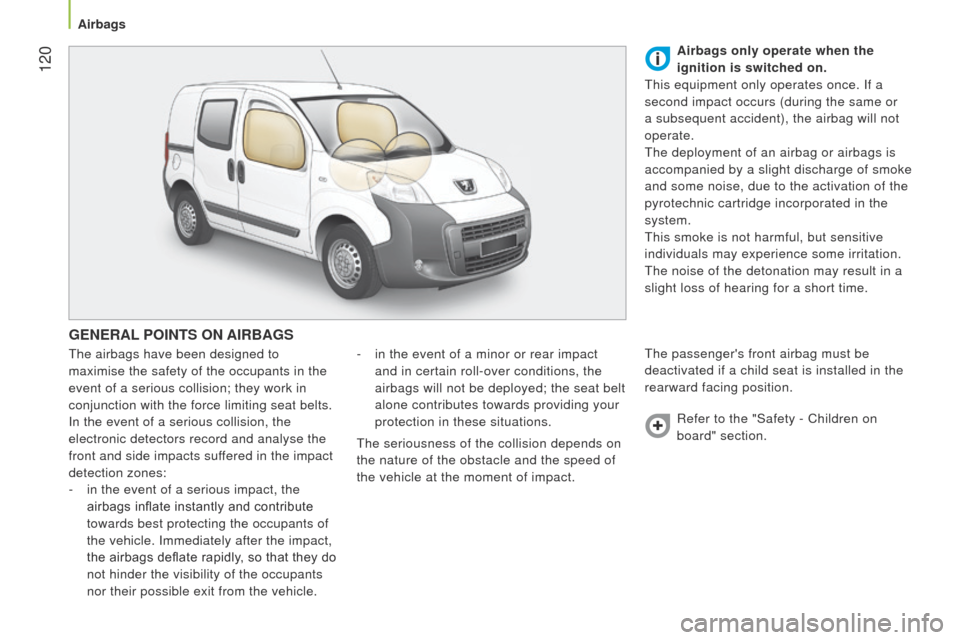
GENERAL POINTS ON AIRBAGS
the airbags have been designed to
maximise the safety of the occupants in the
event of a serious collision; they work in
conjunction with the force limiting seat belts.
In the event of a serious collision, the
electronic detectors record and analyse the
front and side impacts suffered in the impact
detection zones:
-
in the event of a serious impact, the
airbags inflate instantly and contribute
towards best protecting the occupants of
the vehicle. Immediately after the impact,
the airbags deflate rapidly, so that they do
not hinder the visibility of the occupants
nor their possible exit from the vehicle. -
in the event of a minor or rear impact
and in certain roll-over conditions, the
airbags will not be deployed; the seat belt
alone contributes towards providing your
protection in these situations.
t
he seriousness of the collision depends on
the nature of the obstacle and the speed of
the vehicle at the moment of impact. Airbags only operate when the
ignition is switched on.
t
his equipment only operates once. If a
second impact occurs (during the same or
a subsequent accident), the airbag will not
operate.
t
he deployment of an airbag or airbags is
accompanied by a slight discharge of smoke
and some noise, due to the activation of the
pyrotechnic cartridge incorporated in the
system.
t
his smoke is not harmful, but sensitive
individuals may experience some irritation.
t
he noise of the detonation may result in a
slight loss of hearing for a short time.t he passenger's front airbag must be
deactivated if a child seat is installed in the
rearward facing position.
Refer to the "Safety - Children on
board" section.
Airbags
Page 125 of 192
123
Bipper_en_Chap06_securite_ed02-2014
For the airbags to be fully effective,
observe the following safety rules:
Sit in a normal upright position.
Wear a correctly adjusted seat belt.
Do not leave anything between the
occupants and the airbags (a child, pet,
object...).
t
his could hamper the operation
of the airbags or injure the occupants.
After an accident or if the vehicle has been
stolen or broken into, have the airbag
systems checked.
All work on the airbag systems must be
carried out by a P
euge O t
dealer or a
qualified workshop.
e
ven if all of the precautions mentioned are
observed, a risk of injury or of slight burns
to the head, chest or arms when an airbag
is deployed cannot be ruled out. In fact,
the bag inflates almost instantly (within a
few milliseconds) then deflates within the
same time, discharging the hot gas through
openings provided for this purpose. Front airbags
Do not drive holding the steering wheel
by its spokes or resting your hands on the
centre part of the wheel.
Passengers must not place their feet on the
dashboard.
Smoke as little as possible as deployment
of the airbags can cause burns or the risk of
injury from a cigarette or pipe.
Never remove or pierce the steering wheel
or hit it violently.
Lateral airbags
Only put approved covers on the seats,
compatible with the deployment of lateral
airbags. For information on the range of seat
covers suitable for your vehicle, you can
contact a P
euge O t
dealer
. Refer to the
"Accessories" section.
Do not fix or attach anything to the seat
backs.
t
his could cause injury to the chest
or arms when the lateral airbag inflates.
Do not sit with the upper part of the body
any nearer to the door than necessary.
6
SAFETY
Airbags
Page 133 of 192

In accordance with european regulations, this table indicates the options for installing chi\
l")
131
Bipper_en_Chap06_securite_ed02-2014
INSTALLING CHILD SEATS ATTACHED USING THE SEAT BELT (LIGHT VAN)
In accordance with european regulations, this table indicates the options for installing chi\
ld seats secured using a seat belt and universally
approved in accordance with the weight of the child and the seat in the \
vehicle:
W
eight of the child and indicative age
Seat Under 13 kg
(groups 0 (a) and 0+)
u
p to approx 1 yearFrom 9 to 18 kg
(group 1)
1 to 3 years approx From 15 to 25 kg
(group 2)
3 to 6 years approx From 22 to 36 kg
(group 3)
6 to 10 years approx
Front passenger
seat (b) U
UUU
a :
g roup 0: from birth to 10 kg. Infant car seats and "car cots" cannot be i\
nstalled on the front passenger seat.
b : consult the legislation in force in your country before installing your\
child on this seat.
U:
seat suitable for the installation of a child seat secured using a seat \
belt and universally approved, "rearward facing" and/or
"forward
facing".
6
SAFETY
Child safety
Page 146 of 192
144
Bipper_en_Chap08_verifications_ed02-2014
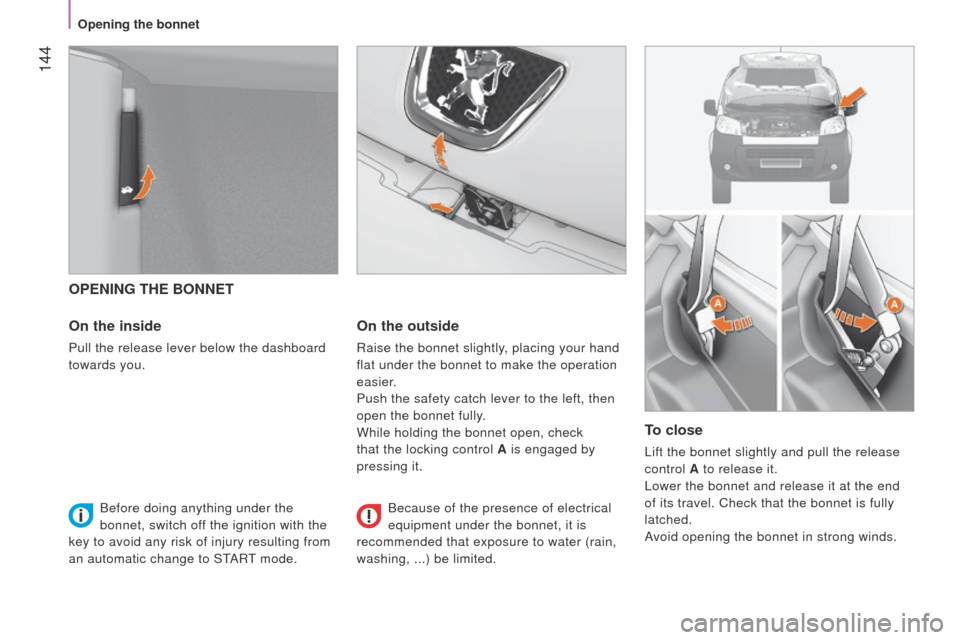
OPENING THE BONNET
On the inside
Pull the release lever below the dashboard
towards you.
On the outside
Raise the bonnet slightly, placing your hand
flat under the bonnet to make the operation
easier.
Push the safety catch lever to the left, then
open the bonnet fully.
While holding the bonnet open, check
that the locking control A is engaged by
pressing it.
To close
lift the bonnet slightly and pull the release
control A to release it.
l
ower the bonnet and release it at the end
of its travel. Check that the bonnet is fully
latched.
Avoid opening the bonnet in strong winds.
Before doing anything under the
bonnet, switch off the ignition with the
key to avoid any risk of injury resulting from
an automatic change to S
t
ARt mode. Because of the presence of electrical
equipment under the bonnet, it is
recommended that exposure to water (rain,
washing, ...) be limited.
Opening the bonnet
Page 152 of 192
150
Bipper_en_Chap08_verifications_ed02-2014
Manual gearbox
the gearbox does not require any
maintenance (no oil change).
Refer to the warranty and maintenance
record for the checking interval for this
component.
Good practice
to check the main levels and certain
components, in accordance with the
manufacturer's servicing schedule, refer to
the pages of the warranty and maintenance
record which correspond to your vehicle's
engine.
Electronic gearbox
the gearbox does not require any
maintenance (no oil change).
Refer to the warranty and maintenance
record for details of the checking interval
for this component.
Only use products recommended by
P
euge O t
or products of equivalent
quality and specification.
In order to optimise the operation of units as
important as the braking system, P
euge O t
selects and of
fers specific products.
In order to avoid damaging the electrical
units, high pressure washing to clean the
engine compartment is strictly prohibited.
After washing the vehicle dampness, or in
winter, ice may form on the brake discs and
pads: braking efficiency may be reduced.
Make some light brake applications to dry
and de-ice the brakes.
Checks
Page 164 of 192
162
Bipper_en_Chap09_aide-rapide_ed02-2014
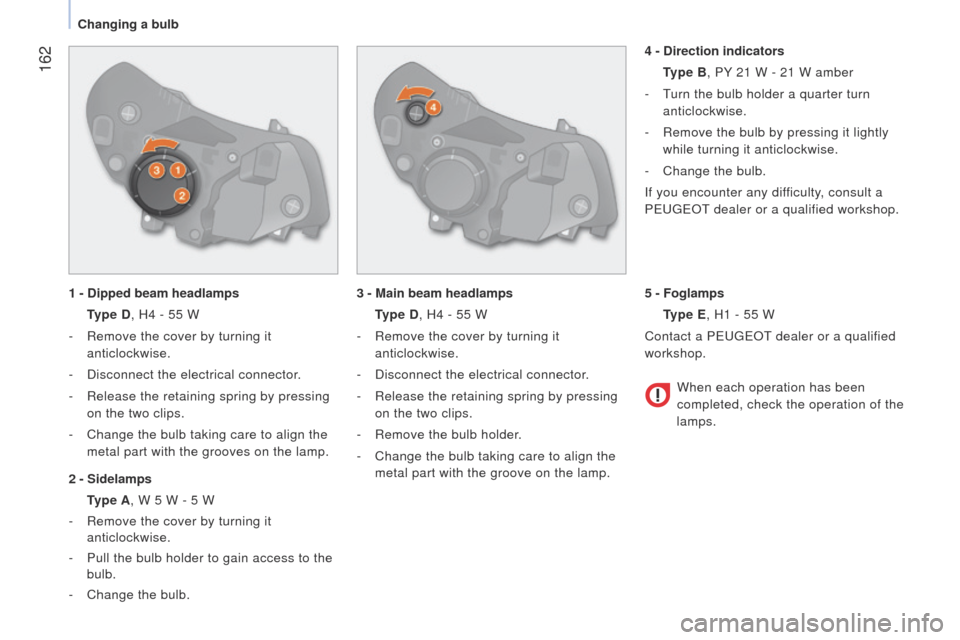
1 - Dipped beam headlamps
T
ype D, H4 - 55 W
-
Remove the cover by turning it
anticlockwise.
-
Disconnect the electrical connector
.
-
Release the retaining spring by pressing
on the two clips.
-
Change the bulb taking care to align the
metal part with the grooves on the lamp.
2 - Sidelamps
T
ype A, W 5 W - 5 W
-
Remove the cover by turning it
anticlockwise.
-
Pull the bulb holder to gain access to the
bulb.
-
Change the bulb. 3 - Main beam headlamps
T
ype D, H4 - 55 W
-
Remove the cover by turning it
anticlockwise.
-
Disconnect the electrical connector
.
-
Release the retaining spring by pressing
on the two clips.
-
Remove the bulb holder
.
-
Change the bulb taking care to align the
metal part with the groove on the lamp. 4 - Direction indicators
T
ype B, PY 21 W - 21 W amber
- t
urn the bulb holder a quarter turn
anticlockwise.
-
Remove the bulb by pressing it lightly
while turning it anticlockwise.
-
Change the bulb.
If you encounter any dif
ficulty, consult a
P euge O t
dealer or a qualified workshop.
When each operation has been
completed, check the operation of the
lamps.
5 - Foglamps
T
ype E, H1 - 55 W
Contact a P
euge O t
dealer or a qualified
workshop.
Changing a bulb
Page 170 of 192
168
Bipper_en_Chap09_aide-rapide_ed02-2014
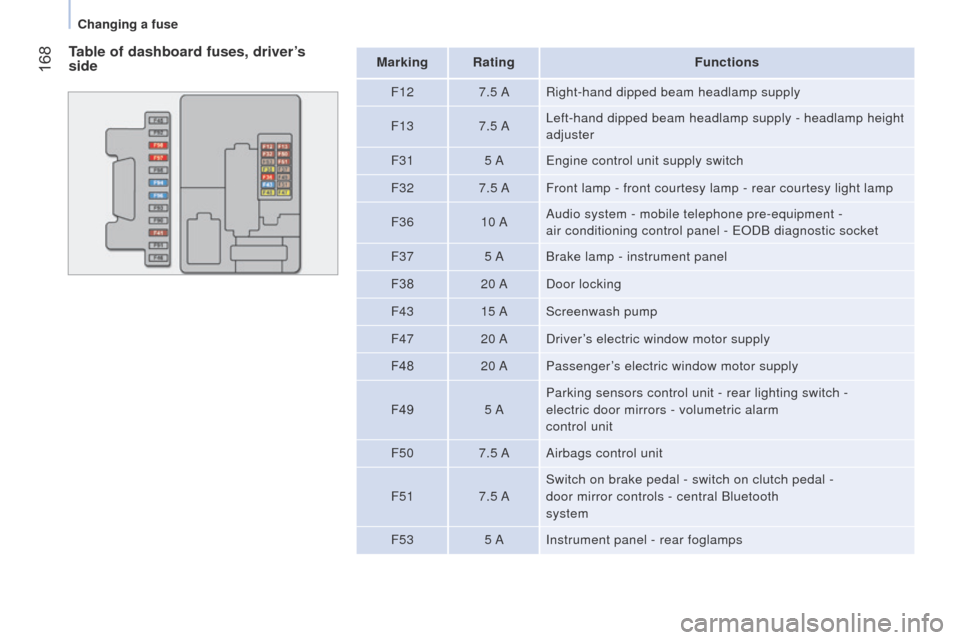
Table of dashboard fuses, driver’s
sideMarking RatingFunctions
F12 7.5 ARight-hand dipped beam headlamp supply
F13 7.5 A
l
eft-hand dipped beam headlamp supply - headlamp height
adjuster
F31 5 A
e
ngine control unit supply switch
F32 7.5 AFront lamp - front courtesy lamp - rear courtesy light lamp
F36 10 AAudio system - mobile telephone pre-equipment -
air conditioning control panel -
e ODB diagnostic socket
F37 5 ABrake lamp - instrument panel
F38 20 ADoor locking
F43 15 AScreenwash pump
F47 20 ADriver’s electric window motor supply
F48 20 APassenger’s electric window motor supply
F49 5 AParking sensors control unit - rear lighting switch -
electric door mirrors - volumetric alarm
control unit
F50 7.5 AAirbags control unit
F51 7.5 ASwitch on brake pedal - switch on clutch pedal -
door mirror controls - central Bluetooth
system
F53 5 AInstrument panel - rear foglamps
Changing a fuse