ight Peugeot Boxer 2013 Owner's Guide
[x] Cancel search | Manufacturer: PEUGEOT, Model Year: 2013, Model line: Boxer, Model: Peugeot Boxer 2013Pages: 184, PDF Size: 4.53 MB
Page 42 of 184
Gearbox and steering wheel
40
MANUAL
To change gear easily, always depress the
clutch pedal fully.
To prevent the mat from becoming caught
under the pedal:
- ensure that the mat is positioned
correctly,
- never fit one mat on top of another.
Avoid leaving your hand on the gear knob as
the force exerted, even if slight, may wear
the internal components of the gearbox over
time.
GEARBOX AND STEERING WHEEL STEERING WHEEL REACH
ADJUSTMENT
With the vehicle stationary, first adjust your
seat to the most suitable position.
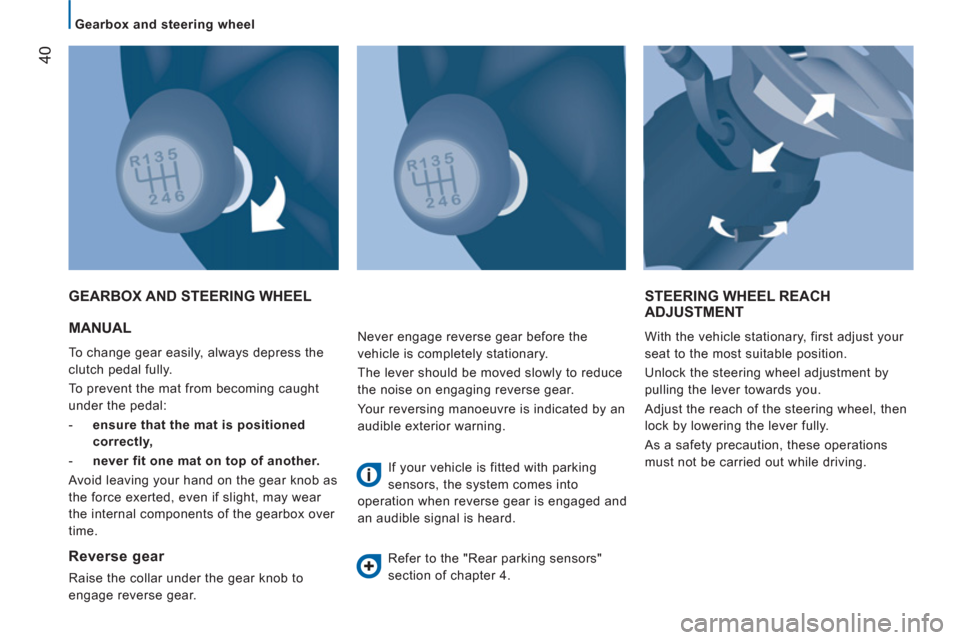
Unlock the steering wheel adjustment by
pulling the lever towards you.
Adjust the reach of the steering wheel, then
lock by lowering the lever fully.
As a safety precaution, these operations
must not be carried out while driving.
Reverse gear
Raise the collar under the gear knob to
engage reverse gear. Never engage reverse gear before the
vehicle is completely stationary.
The lever should be moved slowly to reduce
the noise on engaging reverse gear.
Your reversing manoeuvre is indicated by an
audible exterior warning.
If your vehicle is fitted with parking
sensors, the system comes into
operation when reverse gear is engaged and
an audible signal is heard.
Refer to the "Rear parking sensors"
section of chapter 4.
Page 45 of 184
Starting and stopping
READY TO SET OFF
43
2
The Stop & Start system puts the engine
temporarily into standby - STOP mode
- during stops in the traffic (red lights,
traffic jams, or other...). The engine restarts
automatically - START mode - as soon as
you want to move off. The restart takes
place instantly, quickly and silently.
Perfect for urban use, the Stop & Start
system reduces fuel consumption and
exhaust emissions and offers the comfort of
complete silence when stationary.
STOP & START
O
peration
Going into engine STOP mode
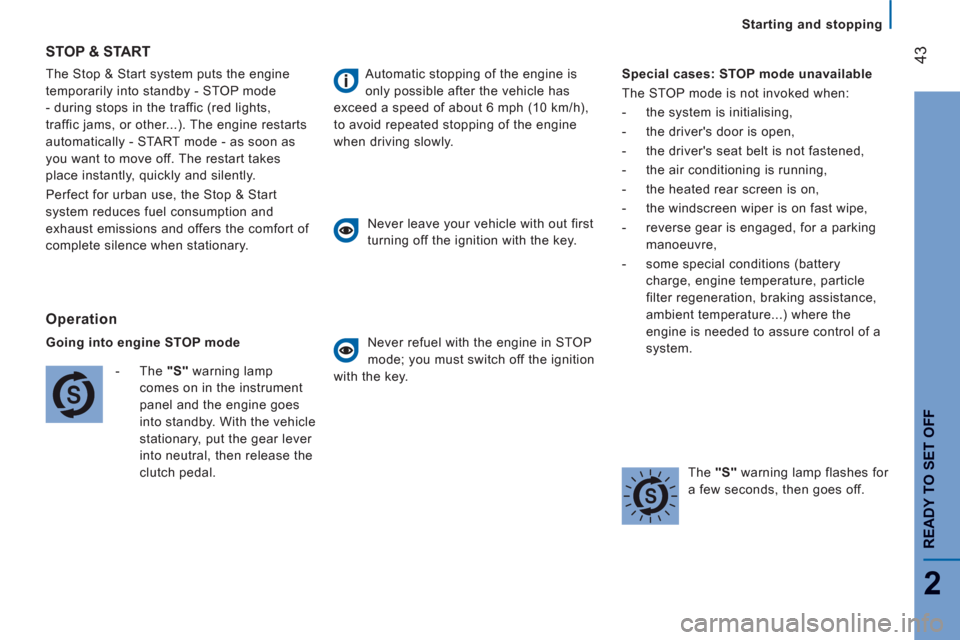
- The "S"
warning lamp
comes on in the instrument
panel and the engine goes
into standby. With the vehicle
stationary, put the gear lever
into neutral, then release the
clutch pedal.
Automatic stopping of the engine is
only possible after the vehicle has
exceed a speed of about 6 mph (10 km/h),
to avoid repeated stopping of the engine
when driving slowly.
Never leave your vehicle with out first
turning off the ignition with the key.
Never refuel with the engine in STOP
mode; you must switch off the ignition
with the key.
Special cases: STOP mode unavailable
The STOP mode is not invoked when:
- the system is initialising,
- the driver's door is open,
- the driver's seat belt is not fastened,
- the air conditioning is running,
- the heated rear screen is on,
- the windscreen wiper is on fast wipe,
- reverse gear is engaged, for a parking
manoeuvre,
- some special conditions (battery
charge, engine temperature, particle
filter regeneration, braking assistance,
ambient temperature...) where the
engine is needed to assure control of a
system.
The "S"
warning lamp flashes for
a few seconds, then goes off.
Page 49 of 184
47
3
EASE OF USE
and
COMFOR
T
Steering mounted controls
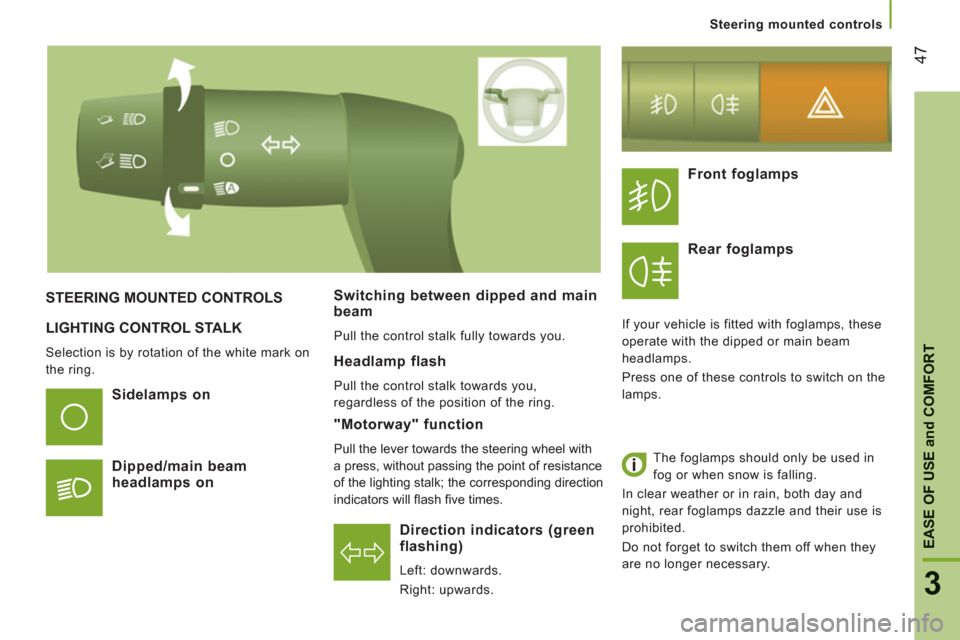
LIGHTING CONTROL STALK
Selection is by rotation of the white mark on
the ring.
Direction indicators (greenflashing)
Left: downwards.
Right: upwards.
STEERING MOUNTED CONTROLS
Sidelamps on
Di
pped/main beam headlamps on
Switchin
g between dipped and main beam
Pull the control stalk fully towards you.
Headlamp flash
Pull the control stalk towards you,
regardless of the position of the ring.
Front foglamps
Rear fo
glamps
If your vehicle is fitted with foglamps, these
operate with the dipped or main beam
headlamps.
Press one of these controls to switch on the
lamps.
The foglamps should only be used in
fog or when snow is falling.
In clear weather or in rain, both day and
night, rear foglamps dazzle and their use is
prohibited.
Do not forget to switch them off when they
are no longer necessary.
"Motorway" function
Pull the lever towards the steering wheel with
a press, without passing the point of resistance
of the lighting stalk; the corresponding direction
indicators will fl ash fi ve times.
Page 50 of 184
48
Steering mounted controls
AUTOMATIC ILLUMINATION OF HEADLAMPS
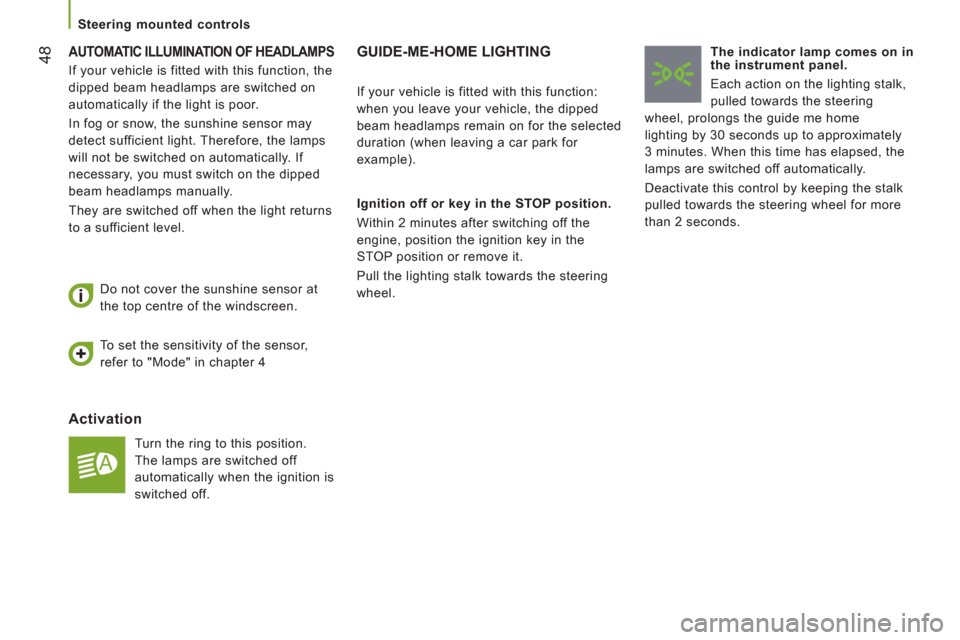
Activation
Turn the ring to this position.
The lamps are switched off
automatically when the ignition is
switched off.
Do not cover the sunshine sensor at
the top centre of the windscreen.
GUIDE-ME-HOME LIGHTING
Ignition off or key in the STOP position.
Within 2 minutes after switching off the
engine, position the ignition key in the
STOP position or remove it.
Pull the lighting stalk towards the steering
wheel.
The indicator lamp comes on in
the instrument panel.
Each action on the lighting stalk,
pulled towards the steering
wheel, prolongs the guide me home
lighting by 30 seconds up to approximately
3 minutes. When this time has elapsed, the
lamps are switched off automatically.
Deactivate this control by keeping the stalk
pulled towards the steering wheel for more
than 2 seconds.
If your vehicle is fitted with this function:
when you leave your vehicle, the dipped
beam headlamps remain on for the selected
duration (when leaving a car park for
example).
To set the sensitivity of the sensor,
refer to "Mode" in chapter 4
If your vehicle is fitted with this function, the
dipped beam headlamps are switched on
automatically if the light is poor.
In fog or snow, the sunshine sensor may
detect sufficient light. Therefore, the lamps
will not be switched on automatically. If
necessary, you must switch on the dipped
beam headlamps manually.
They are switched off when the light returns
to a sufficient level.
Page 51 of 184
49
3
EASE OF USE
and
COMFOR
T
Steering mounted controls
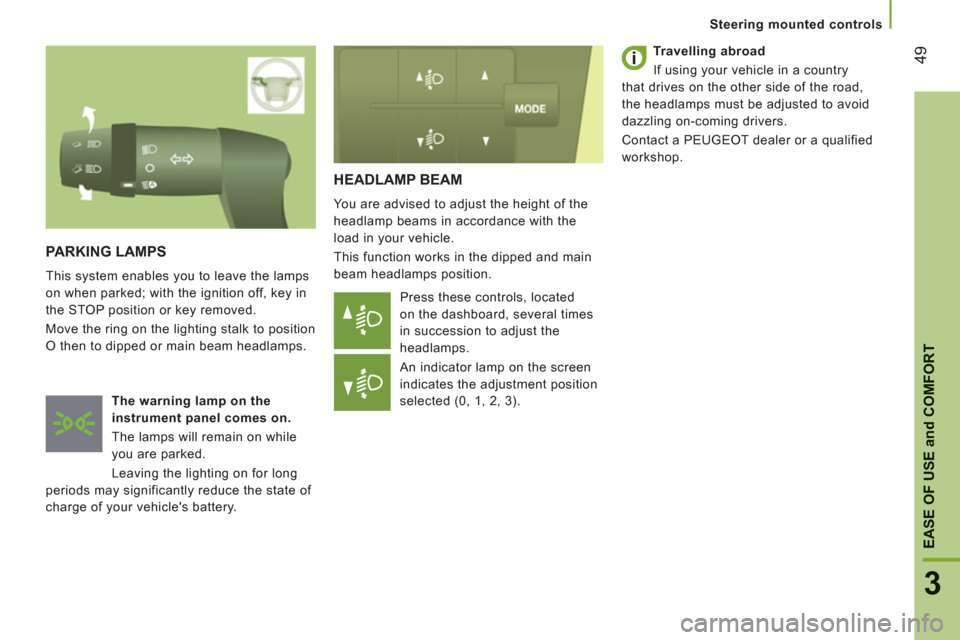
HEADLAMP BEAM
You are advised to adjust the height of the
headlamp beams in accordance with the
load in your vehicle.
This function works in the dipped and main
beam headlamps position.
Press these controls, located
on the dashboard, several times
in succession to adjust the
headlamps.
An indicator lamp on the screen
indicates the adjustment position
selected (0, 1, 2, 3).
PARKING LAMPS
This system enables you to leave the lamps
on when parked; with the ignition off, key in
the STOP position or key removed.
Move the ring on the lighting stalk to position
O then to dipped or main beam headlamps.
The warning lamp on the
instrument panel comes on.
The lamps will remain on while
you are parked.
Leaving the lighting on for long
periods may significantly reduce the state of
charge of your vehicle's battery.
Travelling abroad
If using your vehicle in a country
that drives on the other side of the road,
the headlamps must be adjusted to avoid
dazzling on-coming drivers.
Contact a PEUGEOT dealer or a qualified
workshop.
Page 57 of 184
Ventilation
55
EASE OF USE
and
COMFOR
T
3
CORRECT USE OF THE AIRCONDITIONING
In order to be effective, the air conditioning
should only be used with the windows
closed. However, if the interior temperature
remains high after a prolonged period
parked in the sun, first ventilate the
passenger compartment for a few minutes. For even air distribution, ensure that the
exterior air intake grille located at the base
of the windscreen is not obstructed and that
the side and central vents, the air outlets on
the floor and the air extractor at the rear are
open.
The air conditioning is useful in all seasons
as it eliminates condensation and air
humidity. Operate the air conditioning system for
5 to 10 minutes, once or twice a month,
to keep it in good working order.
Have the filter elements (air filter and
passenger compartment filter) replaced
regularly. If you drive in a dusty environment,
have them replaced twice as often.
It is normal that the condensation created by
the air conditioning system results in a flow
of water which may form a puddle under the
vehicle when parked.
If the system does not produce cold air, do
not use it and contact a PEUGEOT dealer.
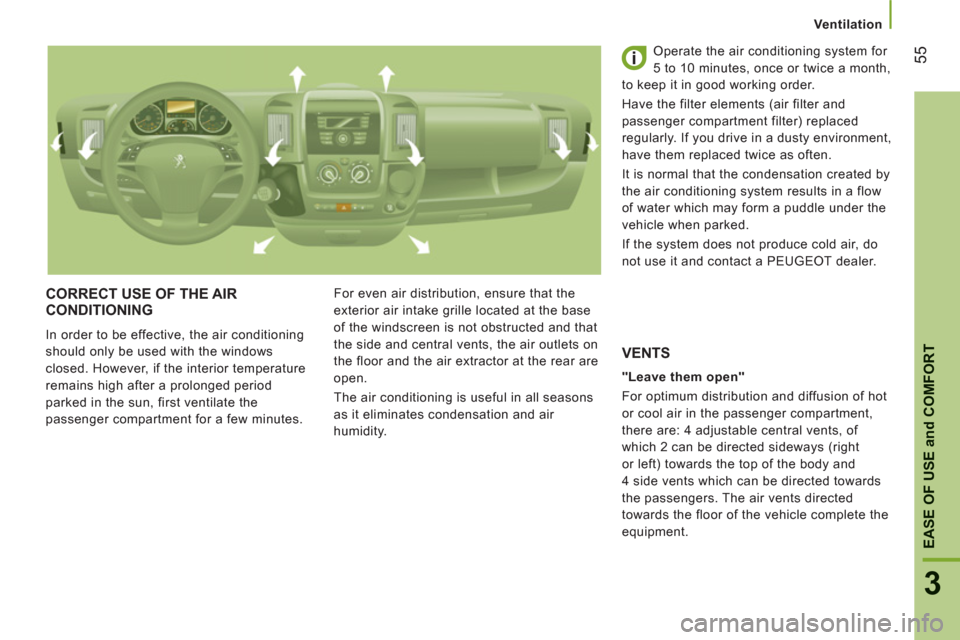
"Leave them open"
For optimum distribution and diffusion of hot
or cool air in the passenger compartment,
there are: 4 adjustable central vents, of
which 2 can be directed sideways (right
or left) towards the top of the body and
4 side vents which can be directed towards
the passengers. The air vents directed
towards the floor of the vehicle complete the
equipment.
VENTS
Page 65 of 184
Ventilation
63
EASE OF USE
and
COMFOR
T
3
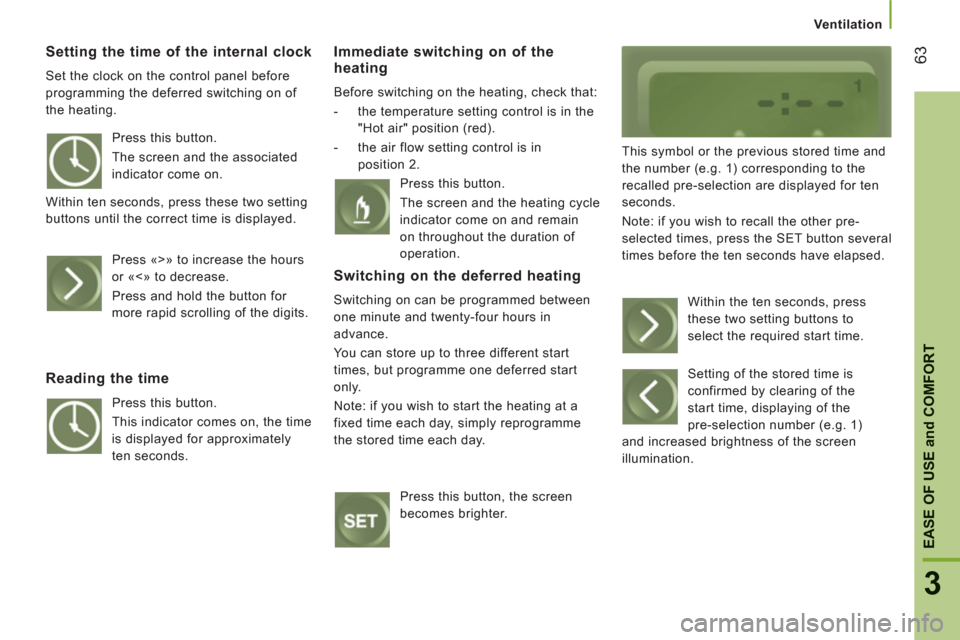
Setting the time of the internal clock
Set the clock on the control panel before
programming the deferred switching on of
the heating.
Immediate switching on of the heating
Before switching on the heating, check that:
- the temperature setting control is in the
"Hot air" position (red).
- the air flow setting control is in
position 2. This symbol or the previous stored time and
the number (e.g. 1) corresponding to the
recalled pre-selection are displayed for ten
seconds.
Note: if you wish to recall the other pre-
selected times, press the SET button several
times before the ten seconds have elapsed. Press this button.
The screen and the associated
indicator come on.
Within ten seconds, press these two setting
buttons until the correct time is displayed.
Press «>» to increase the hours
or «<» to decrease.
Press and hold the button for
more rapid scrolling of the digits.
Reading the time
Press this button.
This indicator comes on, the time
is displayed for approximately
ten seconds. Press this button.
The screen and the heating cycle
indicator come on and remain
on throughout the duration of
operation.
Switching on the deferred heating
Switching on can be programmed between
one minute and twenty-four hours in
advance.
You can store up to three different start
times, but programme one deferred start
only.
Note: if you wish to start the heating at a
fixed time each day, simply reprogramme
the stored time each day.
Press this button, the screen
becomes brighter. Within the ten seconds, press
these two setting buttons to
select the required start time.
Setting of the stored time is
confirmed by clearing of the
start time, displaying of the
pre-selection number (e.g. 1)
and increased brightness of the screen
illumination.
Page 67 of 184
Seats
65
3
EASE OF USE
and
COMFOR
T
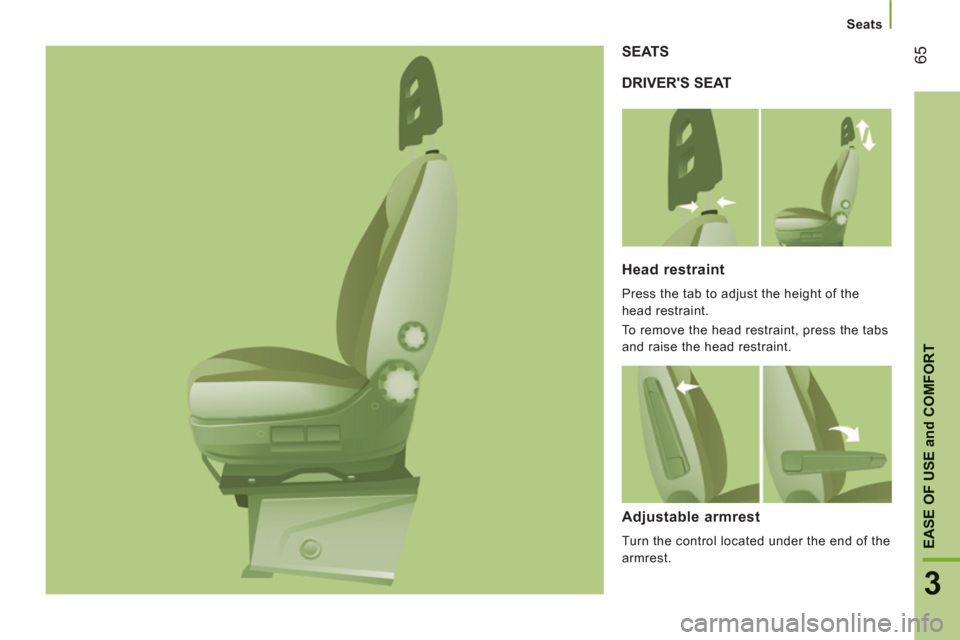
DRIVER'S SEAT SEATS
Head restraint
Press the tab to adjust the height of the
head restraint.
To remove the head restraint, press the tabs
and raise the head restraint.
Adjustable armrest
Turn the control located under the end of the
armrest.
Page 68 of 184
Seats
66
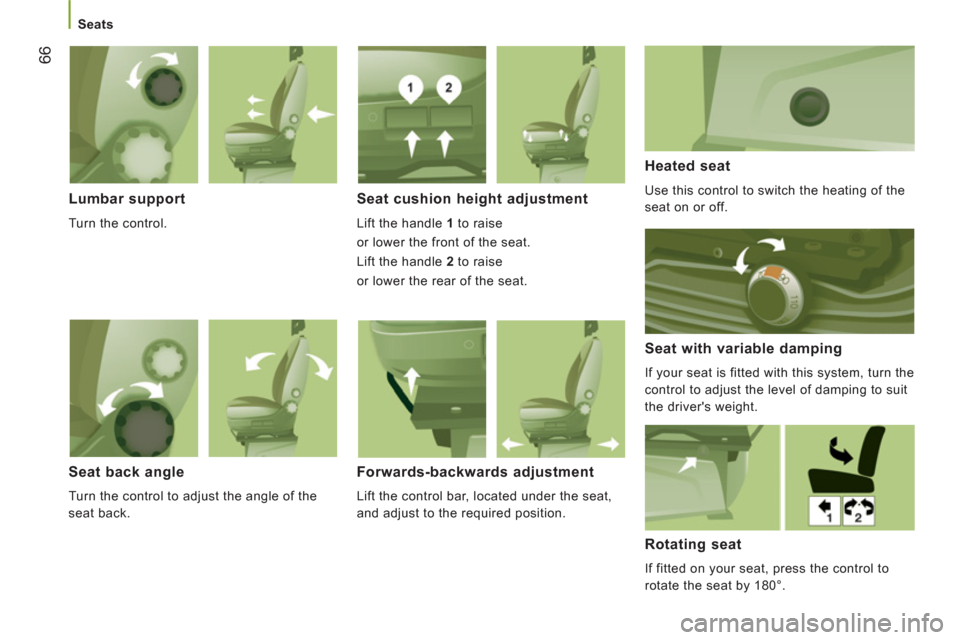
Lumbar support
Turn the control.
Seat cushion height adjustment
Lift the handle 1
to raise
or lower the front of the seat.
Lift the handle 2
to raise
or lower the rear of the seat.
Heated seat
Use this control to switch the heating of the
seat on or off.
Seat with variable damping
If your seat is fitted with this system, turn the
control to adjust the level of damping to suit
the driver's weight.
Seat back angle
Turn the control to adjust the angle of the
seat back.
Forwards-backwards adjustment
Lift the control bar, located under the seat,
and adjust to the required position.
Rotating seat
If fitted on your seat, press the control to
rotate the seat by 180°.
Page 71 of 184
Seats
69
3
EASE OF USE
and
COMFOR
T
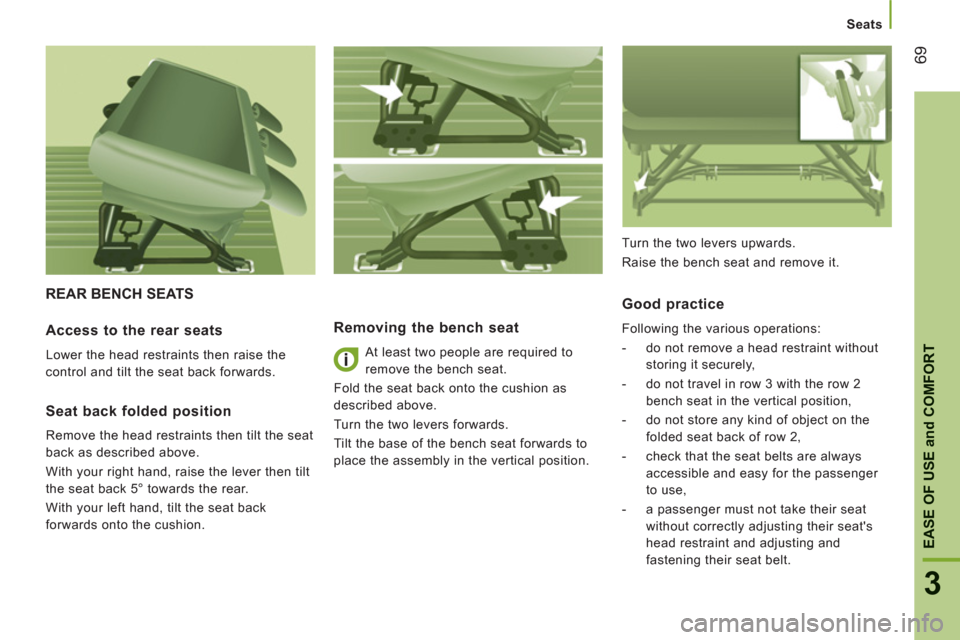
REAR BENCH SEATS
Removing the bench seat
At least two people are required to
remove the bench seat.
Fold the seat back onto the cushion as
described above.
Turn the two levers forwards.
Tilt the base of the bench seat forwards to
place the assembly in the vertical position.
Good practice
Following the various operations:
- do not remove a head restraint without
storing it securely,
- do not travel in row 3 with the row 2
bench seat in the vertical position,
- do not store any kind of object on the
folded seat back of row 2,
- check that the seat belts are always
accessible and easy for the passenger
to use,
- a passenger must not take their seat
without correctly adjusting their seat's
head restraint and adjusting and
fastening their seat belt.
Access to the rear seats
Lower the head restraints then raise the
control and tilt the seat back forwards.
Seat back folded position
Remove the head restraints then tilt the seat
back as described above.
With your right hand, raise the lever then tilt
the seat back 5° towards the rear.
With your left hand, tilt the seat back
forwards onto the cushion. Turn the two levers upwards.
Raise the bench seat and remove it.