Locking Peugeot Boxer 2018 User Guide
[x] Cancel search | Manufacturer: PEUGEOT, Model Year: 2018, Model line: Boxer, Model: Peugeot Boxer 2018Pages: 232, PDF Size: 9.09 MB
Page 75 of 232
73
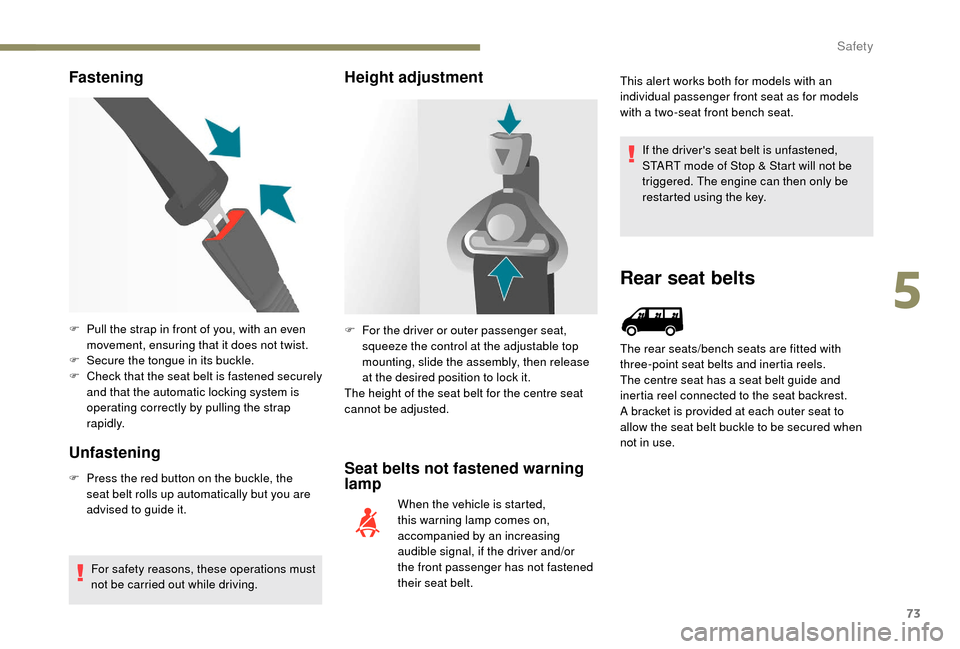
Fastening
Unfastening
F Press the red button on the buckle, the seat belt rolls up automatically but you are
advised to guide it.
For safety reasons, these operations must
not be carried out while driving.
Height adjustment
Seat belts not fastened warning
lamp
F Pull the strap in front of you, with an even movement, ensuring that it does not twist.
F
S
ecure the tongue in its buckle.
F
C
heck that the seat belt is fastened securely
and that the automatic locking system is
operating correctly by pulling the strap
rapidly. F
F or the driver or outer passenger seat,
squeeze the control at the adjustable top
mounting, slide the assembly, then release
at the desired position to lock it.
The height of the seat belt for the centre seat
cannot be adjusted.
When the vehicle is started,
this warning lamp comes on,
accompanied by an increasing
audible signal, if the driver and/or
the front passenger has not fastened
their seat belt. This alert works both for models with an
individual passenger front seat as for models
with a
two-seat front bench seat.
If the driver's seat belt is unfastened,
START mode of Stop & Start will not be
triggered. The engine can then only be
restarted using the key.
Rear seat belts
The rear seats/bench seats are fitted with
three-point seat belts and inertia reels.
The centre seat has a seat belt guide and
inertia reel connected to the seat backrest.
A bracket is provided at each outer seat to
allow the seat belt buckle to be secured when
not in use.
5
5
Safety
Page 76 of 232
74
The driver must ensure that passengers use
the seat belts correctly and that they are all
fastened before setting off.
Wherever you are seated in the vehicle,
always fasten your seat belt, even for short
journeys.
Do not interchange the seat belt buckles as
they will not fulfil their role fully.
The seat belts are fitted with an inertia reel
permitting automatic adjustment of the length
of the strap to your size. The seat belt is
stowed automatically when not in use.
Before and after use, ensure that the seat belt
is reeled in correctly.
The lower part of the strap must be positioned
as low as possible on the pelvis.
The upper part must be positioned in the
hollow of the shoulder.
The inertia reels have an automatic locking
device at the time of a collision, during
sudden braking or if the vehicle turns over.
You can release the device by pulling the
strap firmly and then releasing it so that it
reels in slightly.
Advice
In order to be effective, a seat belt must:
- b e tightened as close to the body as
possible,
-
b
e pulled in front of you with a smooth
movement, checking that it does not
twist,
-
b
e used to restrain only one person,
-
n
ot show any signs of cuts or fraying,
-
n
ot be converted or modified to avoid
affecting its performance.
In accordance with current safety
regulations, for all repairs on your vehicle's
seat belts, go to a
qualified workshop with
the skills and equipment needed, which
a
PEUGEOT dealer is able to provide.
Have your seat belts checked regularly by
a
PEUGEOT dealer or a qualified workshop,
particularly if the straps show signs of
damage.
Clean the seat belt straps with soapy
water or a
textile cleaning product, sold by
PEUGEOT dealers.
After folding or moving a
seat or rear bench
seat, ensure that the seat belt is positioned
and reeled in correctly. Recommendations for children
Use a
suitable child seat if the passenger is
less than 12
years old or shorter than one and
a
half metres.
Never use the same seat belt to secure more
than one person.
Never allow a
child to travel on your lap.
For more information on Child seats , refer to
the corresponding section.
In the event of an impact
Depending on the nature and seriousness
of the impact , the pyrotechnic device may
be deployed before and independently of the
airbags. Deployment of the pretensioners
is accompanied by a
slight discharge of
harmless smoke and a
noise, due to the
activation of the pyrotechnic cartridge
incorporated in the system.
In all cases, the airbag warning lamp comes
on.
Following an impact, have the seat belts
system checked and, if necessary, replaced,
by a
PEUGEOT dealer or a qualified
workshop.
Safety
Page 91 of 232
89
Cooling
Towing a trailer on a slope increases the
t emperature of the coolant.
As the fan is electrically controlled, its cooling
capacity is not dependent on the engine speed.
F
T
o lower the engine speed, reduce your
speed.
The maximum towable load on an incline
depends on the gradient and the exterior
temperature.
In all cases, keep a
check on the coolant
temperature.
F
I
f this warning lamp and the
STOP warning lamp come on,
stop the vehicle and switch off
the engine as soon as possible.
New vehicle
Do not pull a
trailer before having driven at
least 620
miles (1,000 kilometres).
Braking
Towing a trailer increases the braking distance.
T o avoid overheating of the brakes, the use of
engine braking is recommended.
Ty r e s
F Check the tyre pressures of the towing vehicle and of the trailer, observing the
recommended pressures.
Lighting
F Check the electrical lighting and signalling on the trailer and the headlamp beam height
of your vehicle.
For more information on Headlamp
beam height adjustment , refer to the
corresponding section.
The rear parking sensors will be
deactivated automatically to avoid the
audible signal if a
genuine PEUGEOT
towbar is used.
Anti-theft protection
Electronic immobiliser
The keys contain an electronic immobiliser
device.
This device locks the engine supply system.
It activates automatically when the key is
removed from the ignition.
This warning lamp goes off after the
key has been recognised, the ignition is
switched on and the engine can be started.
If the key is not recognised, the engine
cannot be started. Use another key
and have the faulty key checked by
a
PEUGEOT dealer.
Note the number of the keys carefully;
in case of loss, inter vention by the
PEUGEOT dealer will be more efficient
and quicker if you present this number and
the confidential card.
When the ignition switch is turned on, a
dialogue is set up between the key and the
electronic immobiliser.
Do not make any modifications to the
electronic immobiliser system.
Operating the remote control, even when it
is in your pocket, may result in involuntary
unlocking of the doors.
The simultaneous use of other high
frequency equipment (mobile telephones,
domestic alarms, etc.), may inter fere
with the operation of the remote control
temporarily.
The remote control does not operate
while the key is in the ignition, even if the
ignition is off, except for reinitialisation.
6
Driving
Page 93 of 232
91
In low temperatures
In mountainous and/or cold areas, it is
advisable to use a "winter" type fuel suited
to low or minus temperatures.
Battery standby system
If the vehicle is not to be used for a prolonged
p eriod, such as for winter storage, for example,
it is strongly recommended that the battery
be placed on standby in order to protect it and
optimise its ser vice life.
When the battery is on standby, access to
the vehicle is only possible by unlocking
the vehicle using the key in the lock barrel
in the driver's door.
After the battery is switched off, the
information (time, date, radio stations,
etc.) is stored.
To take the battery out of standby:
F
T
urn the key to the MAR position.
F
S
tart the engine normally (AV V position).
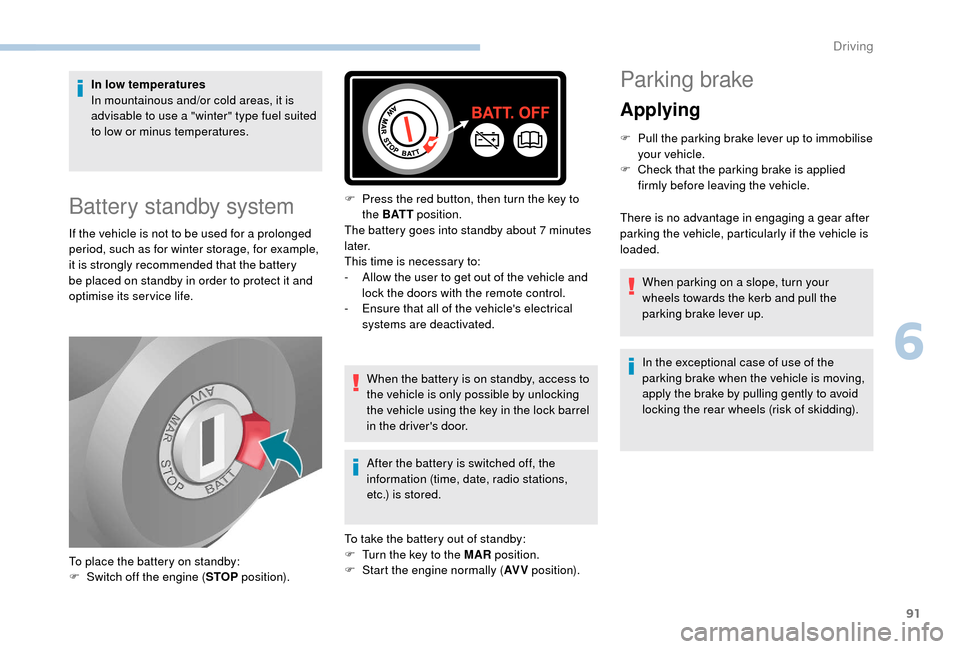
To place the battery on standby:
F
S
witch off the engine ( STOP position). F
P
ress the red button, then turn the key to
the B AT T position.
The battery goes into standby about 7 minutes
later.
This time is necessary to:
-
A
llow the user to get out of the vehicle and
lock the doors with the remote control.
-
E
nsure that all of the vehicle's electrical
systems are deactivated.
Parking brake
Applying
F Pull the parking brake lever up to immobilise your vehicle.
F
C
heck that the parking brake is applied
firmly before leaving the vehicle.
There is no advantage in engaging a
gear after
parking the vehicle, particularly if the vehicle is
loaded.
When parking on a
slope, turn your
wheels towards the kerb and pull the
parking brake lever up.
In the exceptional case of use of the
parking brake when the vehicle is moving,
apply the brake by pulling gently to avoid
locking the rear wheels (risk of skidding).
6
Driving
Page 118 of 232
116
Fuel
The capacity of the tank is about 90 litres.
F uel tanks of different capacities may be fitted,
60
and 120 litres, depending on the engine.
Low fuel level
When the E (Empty) level is
reached, this warning lamp lights up.
You then have around 10
to 12 litres in
reser ve, depending on the capacity of the tank
and the engine.
Refuel without delay to avoid running out of
fuel.
Refilling
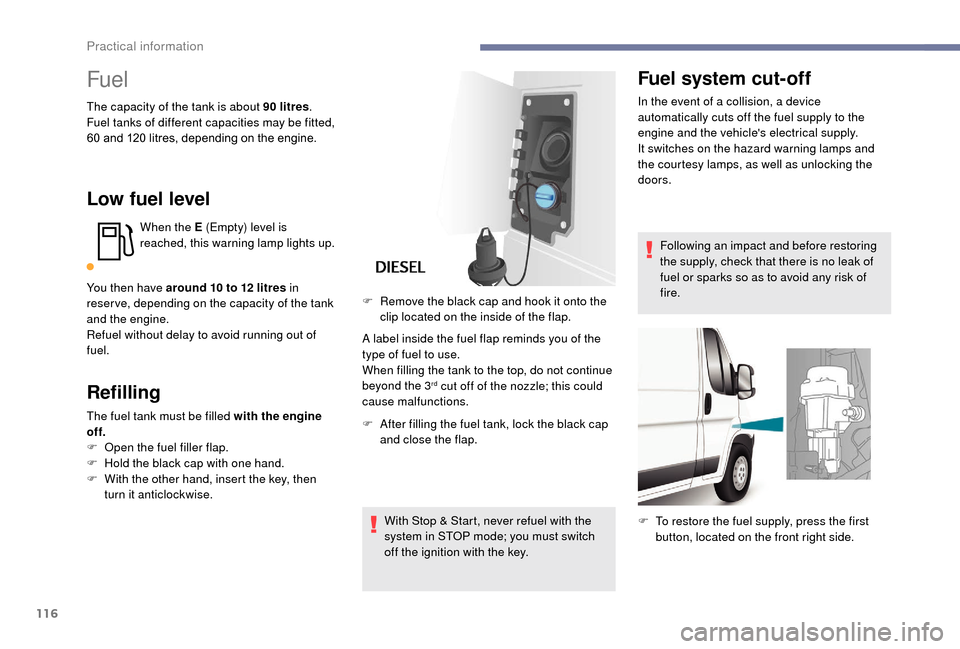
The fuel tank must be filled with the engine
off.
F
O
pen the fuel filler flap.
F
H
old the black cap with one hand.
F
W
ith the other hand, insert the key, then
turn it anticlockwise. A label inside the fuel flap reminds you of the
type of fuel to use.
When filling the tank to the top, do not continue
beyond the 3
rd cut off of the nozzle; this could
cause malfunctions.
F
A
fter filling the fuel tank, lock the black cap
and close the flap.
With Stop & Start, never refuel with the
system in STOP mode; you must switch
off the ignition with the key.
F
R
emove the black cap and hook it onto the
clip located on the inside of the flap.
Fuel system cut-off
In the event of a collision, a device
a utomatically cuts off the fuel supply to the
engine and the vehicle's electrical supply.
It switches on the hazard warning lamps and
the courtesy lamps, as well as unlocking the
doors.
Following an impact and before restoring
the supply, check that there is no leak of
fuel or sparks so as to avoid any risk of
fire.
F
T
o restore the fuel supply, press the first
button, located on the front right side.
Practical information
Page 122 of 232
120
For more information on the Technical
data of the vehicle and particularly on
weights and towable loads, refer to the
corresponding section.
You will then have information on your vehicle's
ability to tow a
trailer, a caravan, a boat, etc.
We recommend the use of genuine
PEUGEOT towbars and their harnesses
that have been tested and approved from
the design stage of your vehicle, and
that the fitting of the towbar is entrusted
to a
member of the PEUGEOT dealer
network.
These genuine towbars are compatible
with the operation of the rear parking
sensors and the reversing camera, if your
vehicle is so equipped.
If the towbar is not fitted by a
PEUGEOT
dealer, it must still be fitted in accordance
with the vehicle manufacturer's
instructions.Towbar with quickly
detachable towball
Presentation
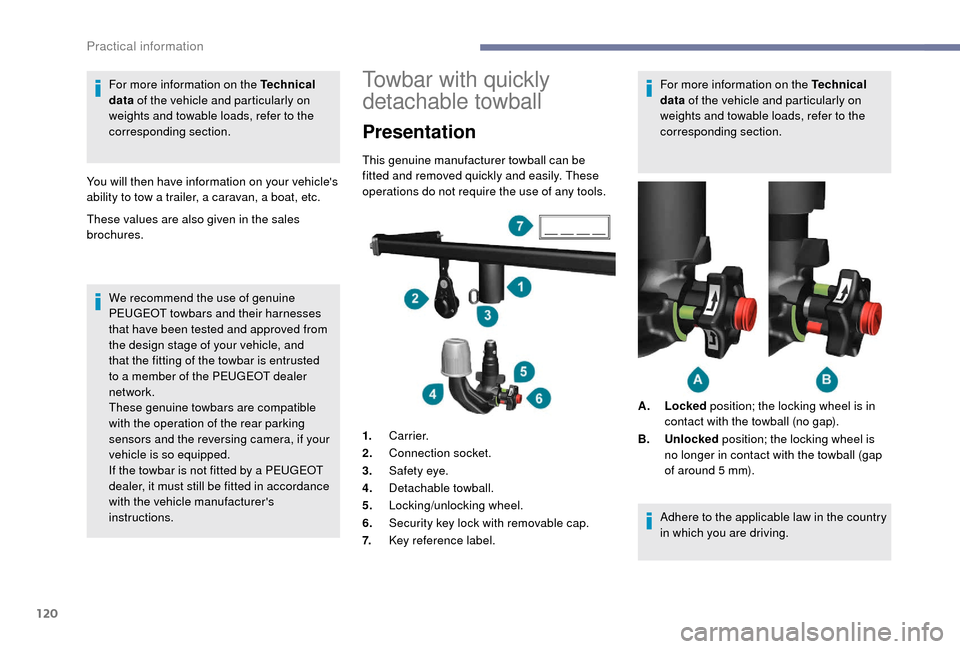
This genuine manufacturer towball can be
fitted and removed quickly and easily. These
operations do not require the use of any tools.
1. Carrier.
2. Connection socket.
3. Safety eye.
4. Detachable towball.
5. Locking/unlocking wheel.
6. Security key lock with removable cap.
7. Key reference label. For more information on the Technical
data
of the vehicle and particularly on
weights and towable loads, refer to the
corresponding section.
A. Locked position; the locking wheel is in
contact with the towball (no gap).
B. Unlocked position; the locking wheel is
no longer in contact with the towball (gap
of around 5
mm).
Adhere to the applicable law in the country
in which you are driving.
These values are also given in the sales
brochures.
Practical information
Page 123 of 232
121
Before each use
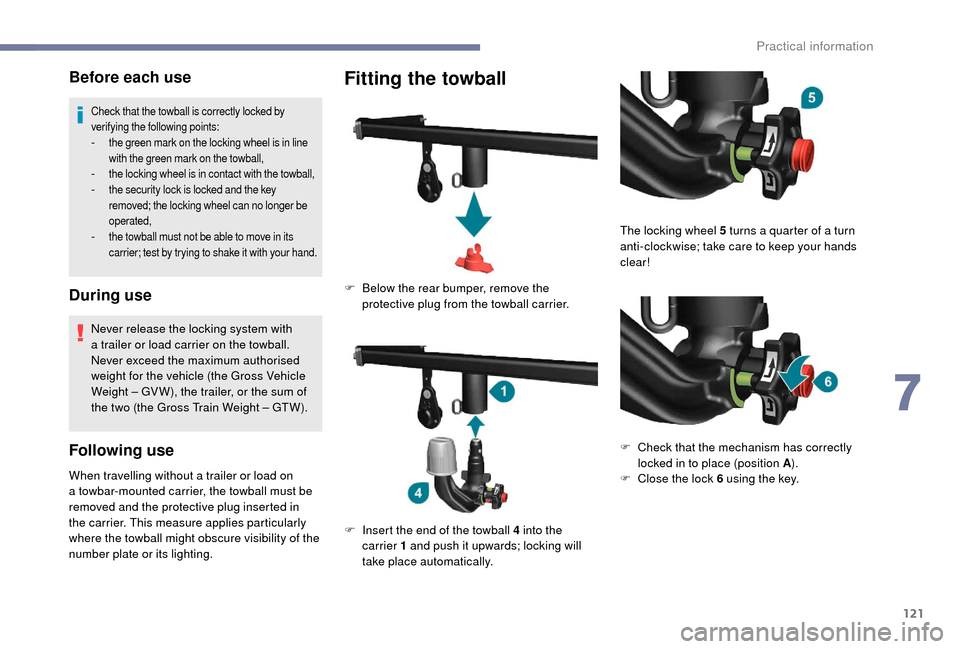
Check that the towball is correctly locked by
verifying the following points:
- the green mark on the locking wheel is in line with the green mark on the towball,
- the locking wheel is in contact with the towball,- the security lock is locked and the key removed; the locking wheel can no longer be
operated,
- the towball must not be able to move in its carrier; test by trying to shake it with your hand.
During use
Never release the locking system with
a trailer or load carrier on the towball.
Never exceed the maximum authorised
weight for the vehicle (the Gross Vehicle
Weight – GV W), the trailer, or the sum of
the two (the Gross Train Weight – GTW).
Following use
When travelling without a trailer or load on
a towbar-mounted carrier, the towball must be
removed and the protective plug inserted in
the carrier. This measure applies particularly
where the towball might obscure visibility of the
number plate or its lighting.
Fitting the towball
F Below the rear bumper, remove the protective plug from the towball carrier.
F
I
nsert the end of the towball 4 into the
carrier 1
and push it upwards; locking will
take place automatically. The locking wheel 5
turns a quarter of a turn
anti-clockwise; take care to keep your hands
clear!
F
C
heck that the mechanism has correctly
locked in to place (position A ).
F
C
lose the lock 6 using the key.
7
Practical information
Page 124 of 232
122
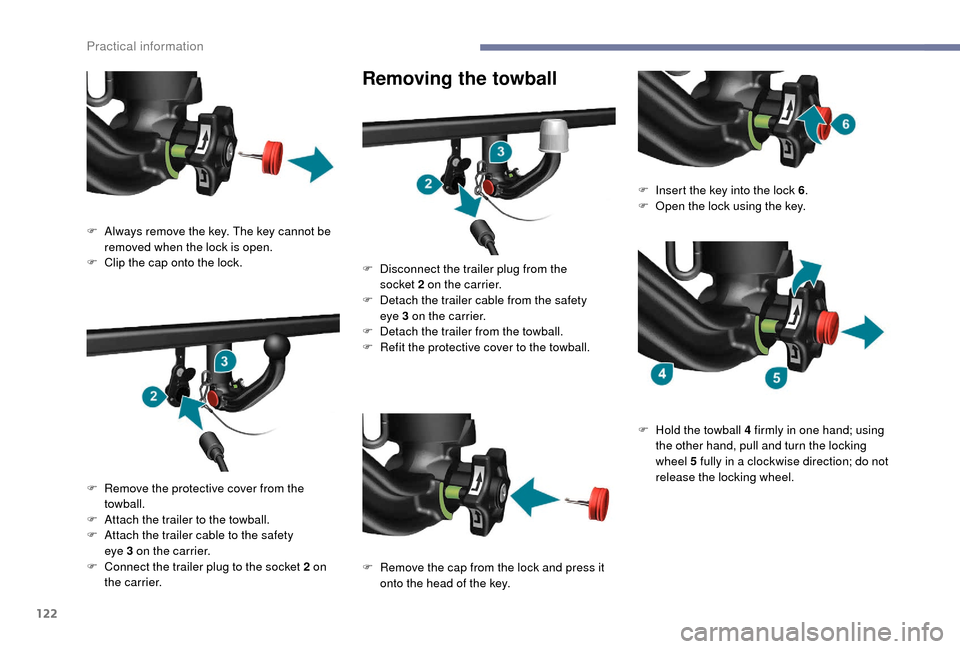
Removing the towball
F Always remove the key. The key cannot be removed when the lock is open.
F
C
lip the cap onto the lock.
F
R
emove the protective cover from the
towball.
F
A
ttach the trailer to the towball.
F
A
ttach the trailer cable to the safety
eye 3
on the carrier.
F
C
onnect the trailer plug to the socket 2 on
the carrier. F
D
isconnect the trailer plug from the
socket 2
on the carrier.
F
D
etach the trailer cable from the safety
eye 3
on the carrier.
F
D
etach the trailer from the towball.
F
R
efit the protective cover to the towball.
F
R
emove the cap from the lock and press it
onto the head of the key. F
I
nsert the key into the lock 6
.
F
O
pen the lock using the key.
F
H
old the towball 4 firmly in one hand; using
the other hand, pull and turn the locking
wheel 5
fully in a clockwise direction; do not
release the locking wheel.
Practical information
Page 125 of 232
123
Maintenance
Correct operation is only possible if the towball
and its carrier are kept clean.
Before cleaning the vehicle with a high-
pressure jet wash, the towball must be removed
and the protective plug fitted to the carrier.
Apply the label provided to a
clearly visible
area, close to the carrier or in the boot.
Go to a
PEUGEOT dealer or a qualified
workshop for any work on the towbar
system.
Roof carrying systems
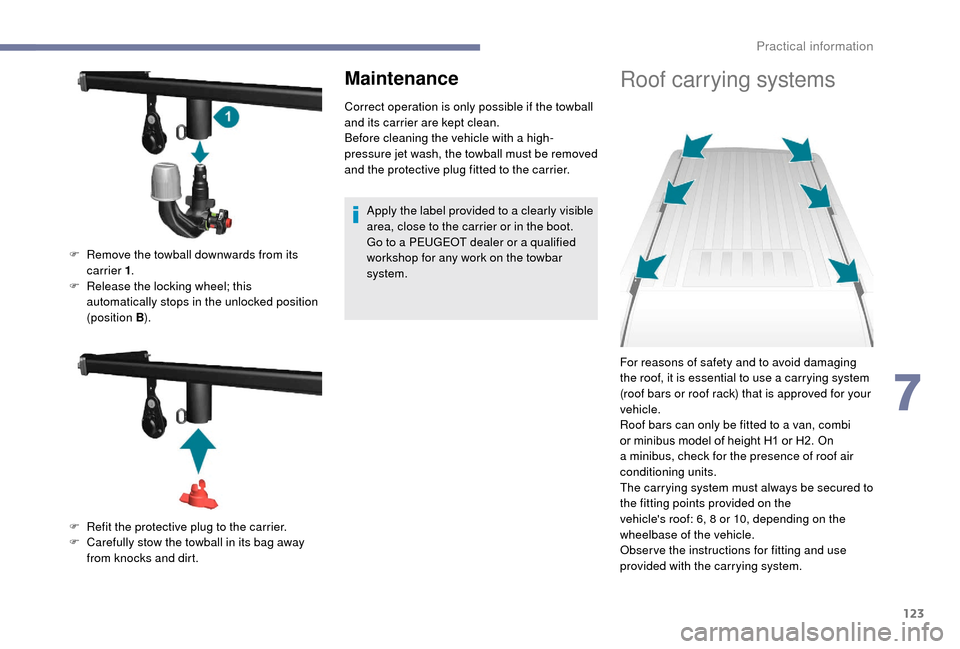
F Remove the towball downwards from its carrier 1 .
F
R
elease the locking wheel; this
automatically stops in the unlocked position
(position B ).
F
R
efit the protective plug to the carrier.
F
C
arefully stow the towball in its bag away
from knocks and dirt. For reasons of safety and to avoid damaging
the roof, it is essential to use a
carrying system
(roof bars or roof rack) that is approved for your
vehicle.
Roof bars can only be fitted to a
van, combi
or minibus model of height H1
or H2. On
a
minibus, check for the presence of roof air
conditioning units.
The carrying system must always be secured to
the fitting points provided on the
vehicle's roof: 6, 8
or 10, depending on the
wheelbase of the vehicle.
Obser ve the instructions for fitting and use
provided with the carrying system.
7
Practical information
Page 136 of 232
134
Refilling
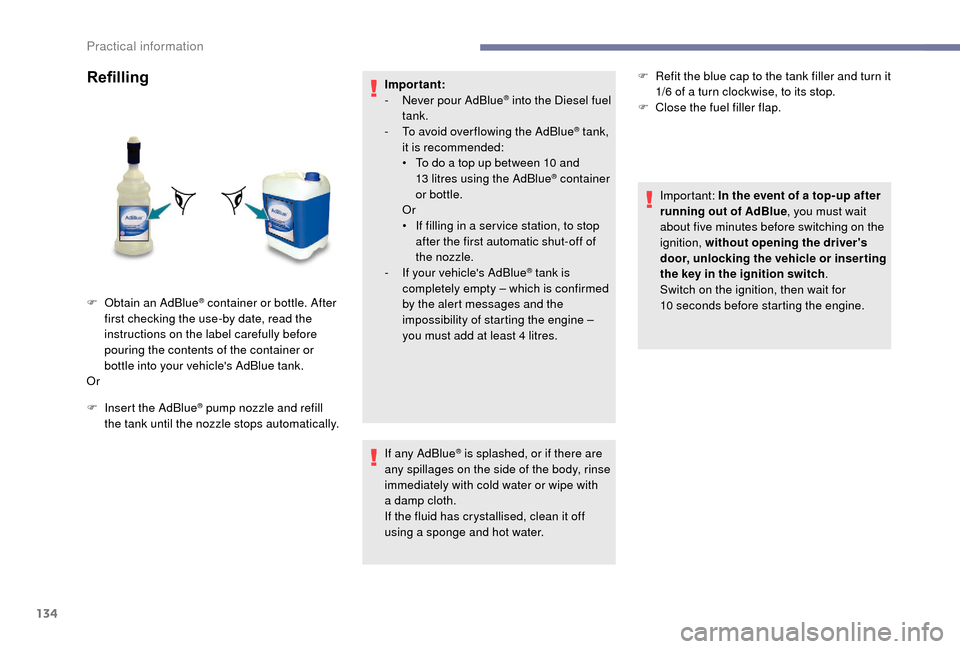
F Insert the AdBlue® pump nozzle and refill
the tank until the nozzle stops automatically. Important:
-
N
ever pour AdBlue
® into the Diesel fuel
tank.
-
T
o avoid over flowing the AdBlue
® tank,
it is recommended:
•
T
o do a
top up between 10
and
13
litres using the AdBlue
® container
or bottle.
Or
•
I
f filling in a
ser vice station, to stop
after the first automatic shut-off of
the nozzle.
-
I
f your vehicle's AdBlue
® tank is
completely empty – which is confirmed
by the alert messages and the
impossibility of starting the engine –
you must add at least 4
litres.
If any AdBlue
® is splashed, or if there are
any spillages on the side of the body, rinse
immediately with cold water or wipe with
a
damp cloth.
If the fluid has crystallised, clean it off
using a
sponge and hot water.
F
O
btain an
AdBlue
® container or bottle. After
first checking the use-by date, read the
instructions on the label carefully before
pouring the contents of the container or
bottle into your vehicle's AdBlue tank.
Or F
R
efit the blue cap to the tank filler and turn it
1/6 of a turn clockwise, to its stop.
F
C
lose the fuel filler flap.
Important: In the event of a top-up after
running out of AdBlue , you must wait
about five minutes before switching on the
ignition, without opening the driver's
door, unlocking the vehicle or inser ting
the key in the ignition switch .
Switch on the ignition, then wait for
10 seconds before starting the engine.
Practical information