ser Peugeot Boxer 2018 Service Manual
[x] Cancel search | Manufacturer: PEUGEOT, Model Year: 2018, Model line: Boxer, Model: Peugeot Boxer 2018Pages: 232, PDF Size: 9.09 MB
Page 101 of 232
99
Speed limiter
The system prevents the vehicle
from exceeding the speed setting
programmed by the driver.
Speed selection is made with the vehicle
stationary and the engine running or with
the vehicle moving and 2nd gear or higher
engaged.
The minimum speed that can be programmed
is 19
mph (30 km/h).
The vehicle responds to the driver's foot
pressure on the accelerator until resistance is
felt in the pedal, which signifies that the vehicle
has reached the programmed speed.
However, pressing the pedal beyond this point
of resistance to the floor permits exceeding
the programmed speed. To resume use of
the limiter, simply reduce the pressure on
the accelerator pedal gradually and return to
a
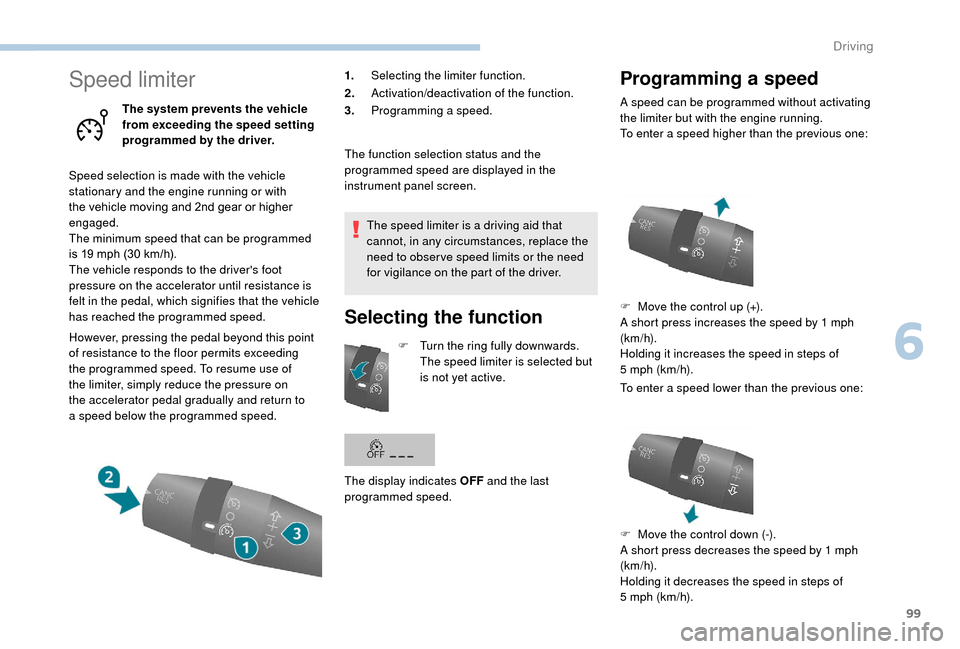
speed below the programmed speed. 1.
Selecting the limiter function.
2. Activation/deactivation of the function.
3. Programming a
speed.
The function selection status and the
programmed speed are displayed in the
instrument panel screen. The speed limiter is a
driving aid that
cannot, in any circumstances, replace the
need to obser ve speed limits or the need
for vigilance on the part of the driver.
Selecting the function
F Turn the ring fully downwards. The speed limiter is selected but
is not yet active.
The display indicates OFF and the last
programmed speed.
Programming a speed
A speed can be programmed without activating
the limiter but with the engine running.
To enter a
speed higher than the previous one:
F
M
ove the control up (+).
A short press increases the speed by 1
mph
(km/h).
Holding it increases the speed in steps of
5
mph (km/h).
To enter a
speed lower than the previous one:
F
M
ove the control down (-).
A short press decreases the speed by 1
mph
(km/h).
Holding it decreases the speed in steps of
5
mph (km/h).
6
Driving
Page 108 of 232
106
If the windscreen is damaged, it is strongly
recommended that you go to a PEUGEOT
dealer or a
qualified workshop for any
replacement and calibration of the camera.
Operation
The system starts automatically when moving
of f.
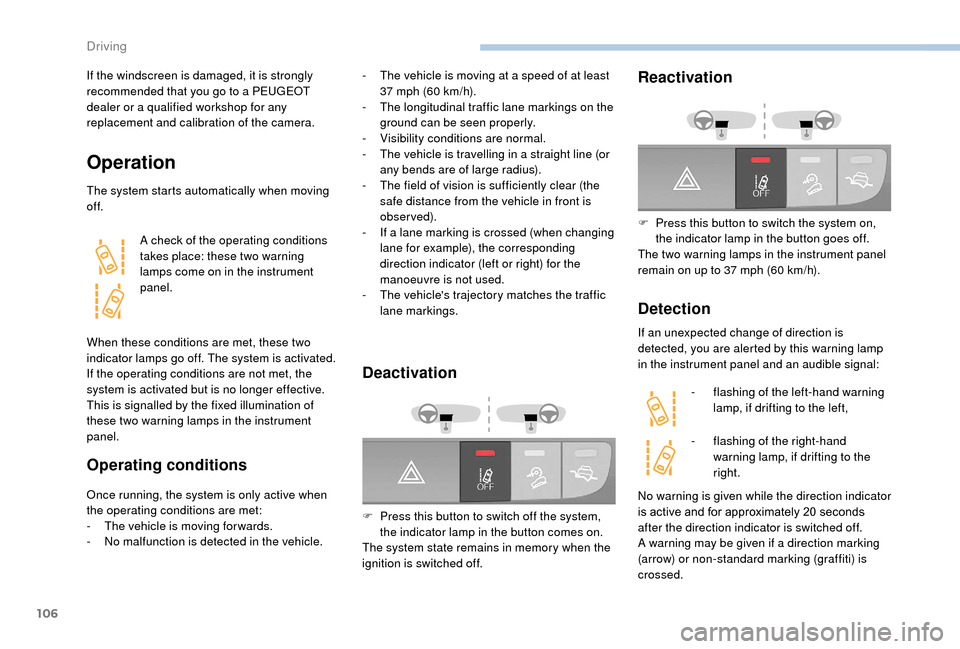
A check of the operating conditions
takes place: these two warning
lamps come on in the instrument
panel.
When these conditions are met, these two
indicator lamps go off. The system is activated.
If the operating conditions are not met, the
system is activated but is no longer effective.
This is signalled by the fixed illumination of
these two warning lamps in the instrument
panel.
Operating conditions
Once running, the system is only active when
the operating conditions are met:
-
T
he vehicle is moving for wards.
-
N
o malfunction is detected in the vehicle.
Deactivation
F Press this button to switch off the system, the indicator lamp in the button comes on.
The system state remains in memory when the
ignition is switched off.
Reactivation
F Press this button to switch the system on, the indicator lamp in the button goes off.
The two warning lamps in the instrument panel
remain on up to 37
mph (60 km/h).
Detection
If an unexpected change of direction is
detected, you are alerted by this warning lamp
in the instrument panel and an audible signal:-
f
lashing of the left-hand warning
lamp, if drifting to the left,
-
f
lashing of the right-hand
warning lamp, if drifting to the
right.
-
T
he vehicle is moving at a
speed of at least
37
mph (60
km/h).
-
T
he longitudinal traffic lane markings on the
ground can be seen properly.
-
V
isibility conditions are normal.
-
T
he vehicle is travelling in a
straight line (or
any bends are of large radius).
-
T
he field of vision is sufficiently clear (the
safe distance from the vehicle in front is
observed).
-
I
f a
lane marking is crossed (when changing
lane for example), the corresponding
direction indicator (left or right) for the
manoeuvre is not used.
-
T
he vehicle's trajectory matches the traffic
lane markings.
No warning is given while the direction indicator
is active and for approximately 20 seconds
after the direction indicator is switched off.
A warning may be given if a
direction marking
(arrow) or non-standard marking (graffiti) is
crossed.
Driving
Page 109 of 232
107
The system is automatically deactivated
if the Stop & Start system is active.
The system will restart and check the
operating conditions again when the
vehicle moves off. Detection may be impeded:
-
i
f the markings on the road are worn,
-
i
f there is little contrast between the
markings on the road and the road
sur face.
The system may suffer inter ference or not
work correctly:
-
w
hen the vehicle is carrying a very
heavy load (even more so if the load is
not evenly spread),
-
w
hen the conditions of visibility are
poor (rain, fog, snow, etc.),
-
w
hen the lighting conditions are poor
(dazzling sun, shade, etc.),
-
i
f the windscreen is dirty or damaged
near the camera,
-
i
f any of the ABS, DSC, ASR or
Intelligent Traction Control systems are
out of service.
Malfunction
If a malfunction occurs, this warning
l amp comes on, accompanied by
an audible signal and confirmed by
a
message in the screen.
Have the system checked by a
PEUGEOT
dealer or a
qualified workshop.
6
Driving
Page 113 of 232
111
• if it is not possible to check the tyre pressures at the time, drive carefully at
reduced speed and go to the nearest
PEUGEOT dealer or a
qualified
workshop.
The loss of pressure detected does not
always cause visible bulging of the tyre.
Do not rely on just a
visual check.
The alert continues until the tyre or tyres
concerned is reinflated, repaired or
replaced.
Malfunction
The flashing and then fixed
illumination of this warning lamp
accompanied by the illumination
of the ser vice warning lamp, and
depending on equipment, the display
of a message indicates a fault with
the system.
In this case, monitoring of the tyre pressures is
not assured. This alert is also displayed when one or
more wheels is not fitted with a
sensor.
Go to a PEUGEOT dealer or a qualified
workshop to have the system checked or,
following a puncture, to have the original wheel,
equipped with a sensor, refitted with a tyre.
Rear parking sensors,
audible assistance
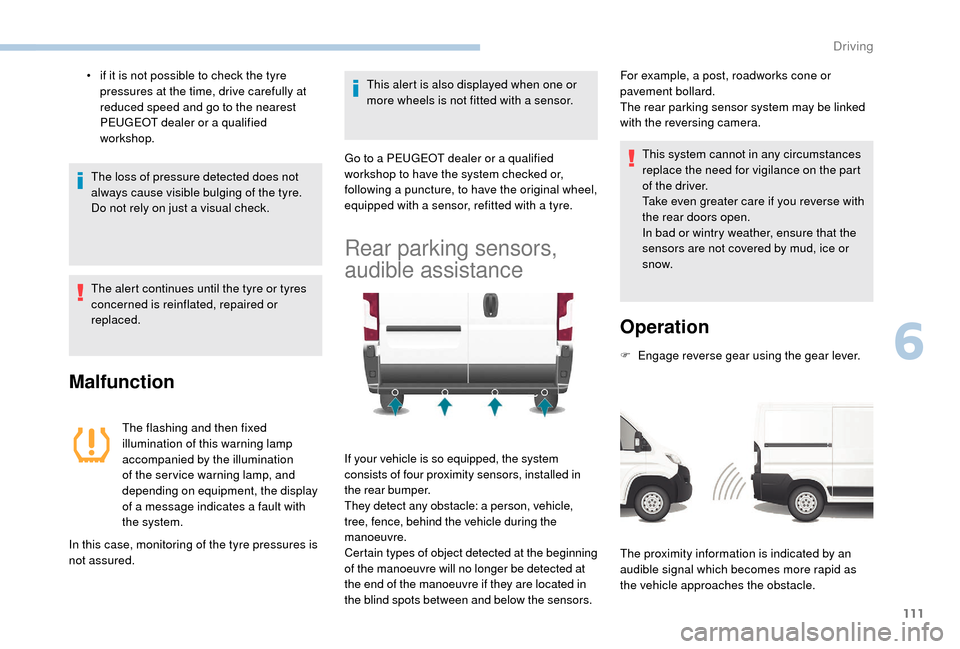
If your vehicle is so equipped, the system
consists of four proximity sensors, installed in
the rear bumper.
They detect any obstacle: a person, vehicle,
tree, fence, behind the vehicle during the
manoeuvre.
Certain types of object detected at the beginning
of the manoeuvre will no longer be detected at
the end of the manoeuvre if they are located in
the blind spots between and below the sensors. For example, a post, roadworks cone or
pavement bollard.
The rear parking sensor system may be linked
with the reversing camera.
This system cannot in any circumstances
replace the need for vigilance on the part
of the driver.
Take even greater care if you reverse with
the rear doors open.
In bad or wintry weather, ensure that the
sensors are not covered by mud, ice or
snow.
Operation
F Engage reverse gear using the gear lever.
The proximity information is indicated by an
audible signal which becomes more rapid as
the vehicle approaches the obstacle.
6
Driving
Page 118 of 232
116
Fuel
The capacity of the tank is about 90 litres.
F uel tanks of different capacities may be fitted,
60
and 120 litres, depending on the engine.
Low fuel level
When the E (Empty) level is
reached, this warning lamp lights up.
You then have around 10
to 12 litres in
reser ve, depending on the capacity of the tank
and the engine.
Refuel without delay to avoid running out of
fuel.
Refilling
The fuel tank must be filled with the engine
off.
F
O
pen the fuel filler flap.
F
H
old the black cap with one hand.
F
W
ith the other hand, insert the key, then
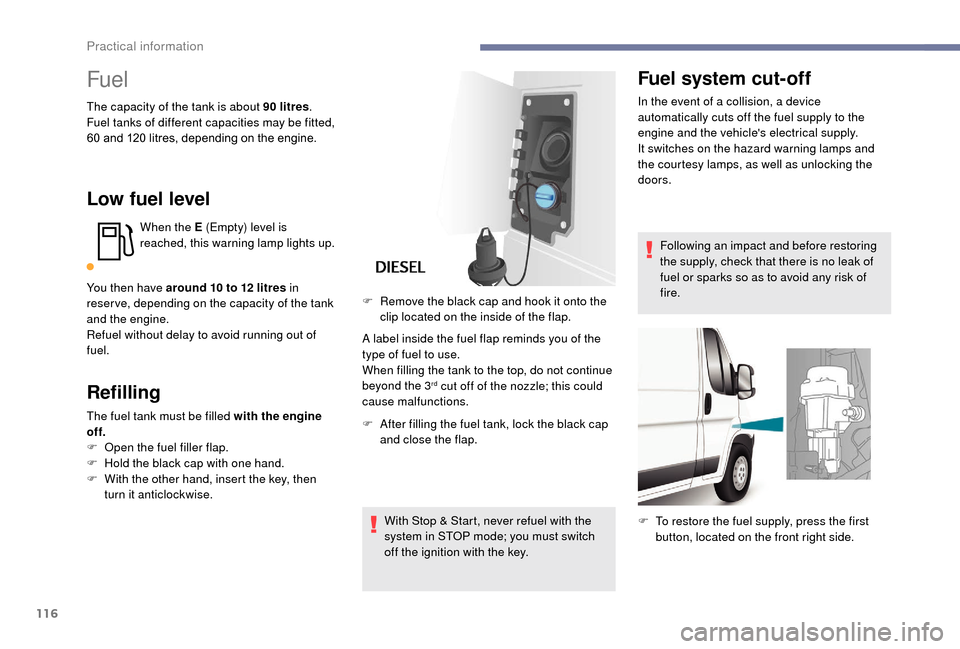
turn it anticlockwise. A label inside the fuel flap reminds you of the
type of fuel to use.
When filling the tank to the top, do not continue
beyond the 3
rd cut off of the nozzle; this could
cause malfunctions.
F
A
fter filling the fuel tank, lock the black cap
and close the flap.
With Stop & Start, never refuel with the
system in STOP mode; you must switch
off the ignition with the key.
F
R
emove the black cap and hook it onto the
clip located on the inside of the flap.
Fuel system cut-off
In the event of a collision, a device
a utomatically cuts off the fuel supply to the
engine and the vehicle's electrical supply.
It switches on the hazard warning lamps and
the courtesy lamps, as well as unlocking the
doors.
Following an impact and before restoring
the supply, check that there is no leak of
fuel or sparks so as to avoid any risk of
fire.
F
T
o restore the fuel supply, press the first
button, located on the front right side.
Practical information
Page 120 of 232
118
Compatibility of fuels
Fuel used for Diesel
engines
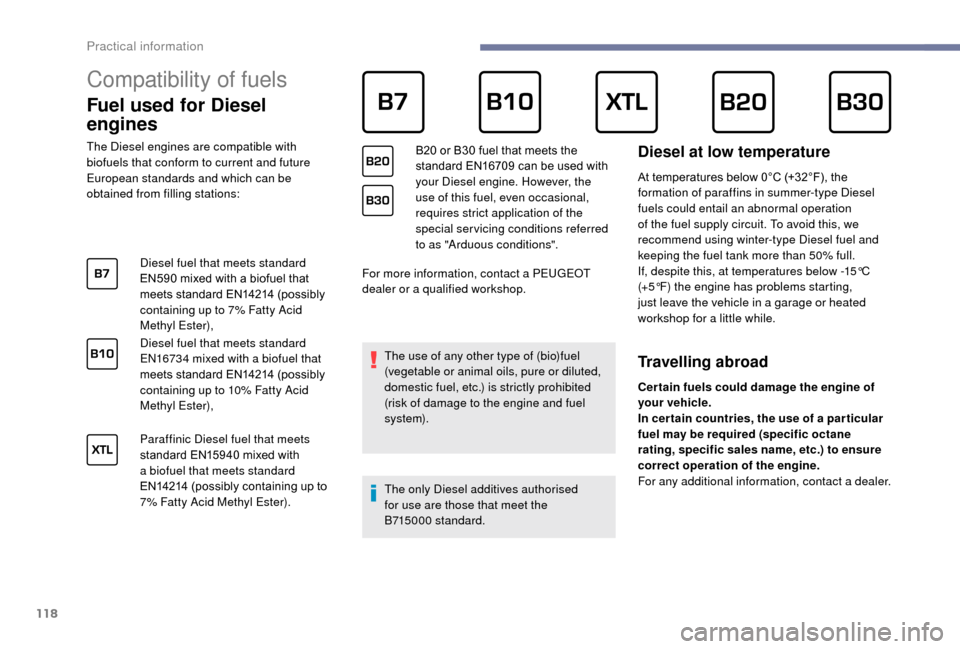
The Diesel engines are compatible with
biofuels that conform to current and future
European standards and which can be
obtained from filling stations:Diesel fuel that meets standard
EN590
mixed with a biofuel that
meets standard EN14214 (possibly
containing up to 7% Fatty Acid
Methyl Ester),
Diesel fuel that meets standard
EN16734
mixed with a biofuel that
meets standard EN14214 (possibly
containing up to 10% Fatty Acid
Methyl Ester),
Paraffinic Diesel fuel that meets
standard EN15940
mixed with
a
biofuel that meets standard
EN14214 (possibly containing up to
7% Fatty Acid Methyl Ester). For more information, contact a
PEUGEOT
dealer or a
qualified workshop.
The use of any other type of (bio)fuel
(vegetable or animal oils, pure or diluted,
domestic fuel, etc.) is strictly prohibited
(risk of damage to the engine and fuel
syste m).
The only Diesel additives authorised
for use are those that meet the
B715000
standard.Diesel at low temperature
At temperatures below 0°C (+32°F), the
formation of paraffins in summer-type Diesel
fuels could entail an abnormal operation
of the fuel supply circuit. To avoid this, we
recommend using winter-type Diesel fuel and
keeping the fuel tank more than 50% full.
If, despite this, at temperatures below -15°C
(+5°F) the engine has problems starting,
just leave the vehicle in a garage or heated
workshop for a
little while.
B20
or B30
fuel that meets the
standard EN16709
can be used with
your Diesel engine. However, the
use of this fuel, even occasional,
requires strict application of the
special servicing conditions referred
to as "Arduous conditions".
Travelling abroad
Cer tain fuels could damage the engine of
your vehicle.
In cer tain countries, the use of a
par ticular
fuel may be required (specific octane
rating, specific sales name, etc.) to ensure
correct operation of the engine.
For any additional information, contact a dealer.
Practical information
Page 123 of 232
121
Before each use
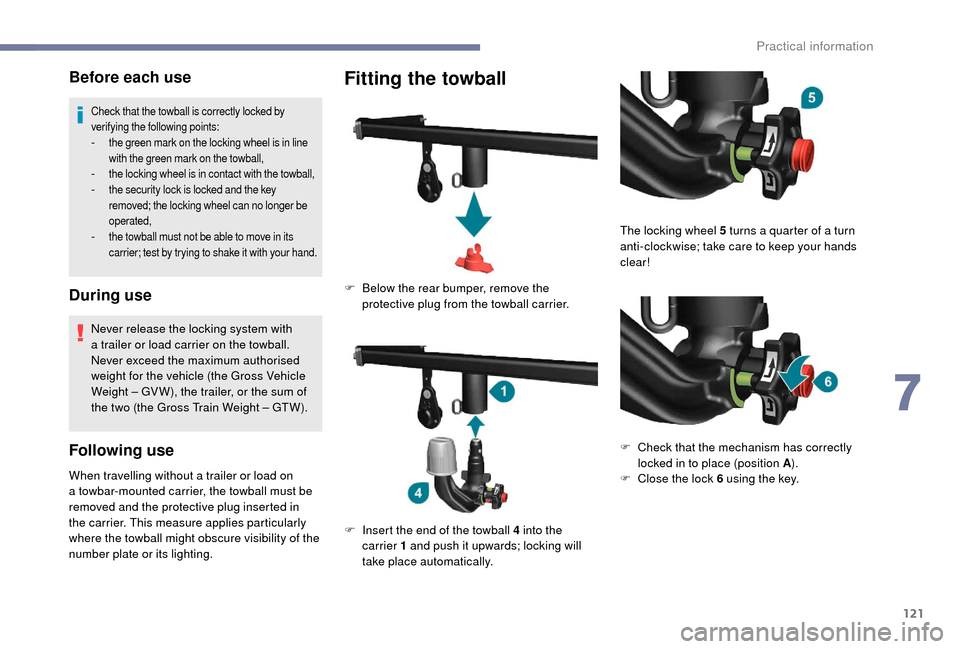
Check that the towball is correctly locked by
verifying the following points:
- the green mark on the locking wheel is in line with the green mark on the towball,
- the locking wheel is in contact with the towball,- the security lock is locked and the key removed; the locking wheel can no longer be
operated,
- the towball must not be able to move in its carrier; test by trying to shake it with your hand.
During use
Never release the locking system with
a trailer or load carrier on the towball.
Never exceed the maximum authorised
weight for the vehicle (the Gross Vehicle
Weight – GV W), the trailer, or the sum of
the two (the Gross Train Weight – GTW).
Following use
When travelling without a trailer or load on
a towbar-mounted carrier, the towball must be
removed and the protective plug inserted in
the carrier. This measure applies particularly
where the towball might obscure visibility of the
number plate or its lighting.
Fitting the towball
F Below the rear bumper, remove the protective plug from the towball carrier.
F
I
nsert the end of the towball 4 into the
carrier 1
and push it upwards; locking will
take place automatically. The locking wheel 5
turns a quarter of a turn
anti-clockwise; take care to keep your hands
clear!
F
C
heck that the mechanism has correctly
locked in to place (position A ).
F
C
lose the lock 6 using the key.
7
Practical information
Page 124 of 232
122
Removing the towball
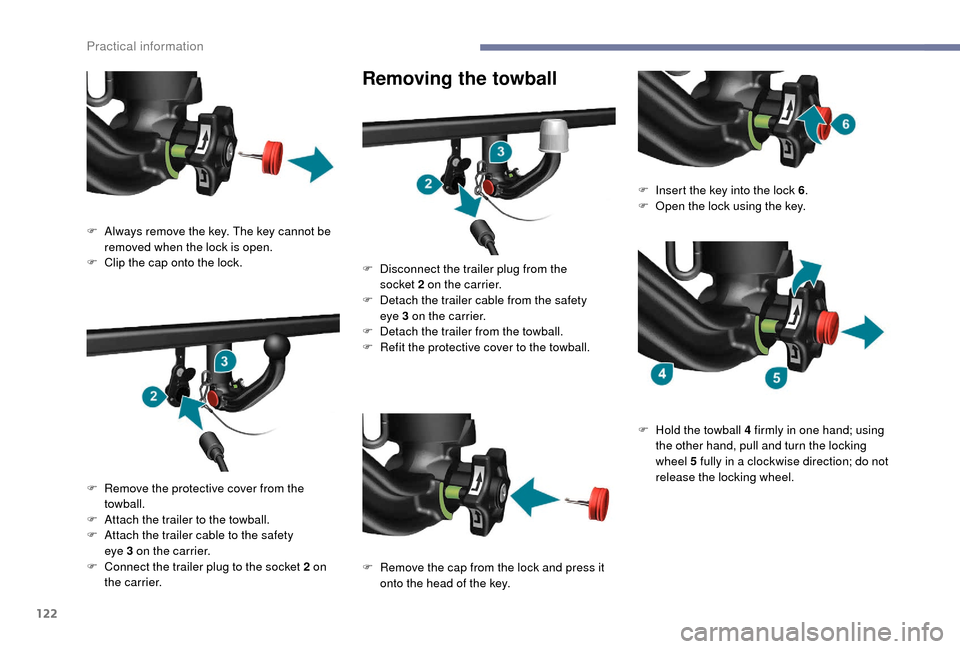
F Always remove the key. The key cannot be removed when the lock is open.
F
C
lip the cap onto the lock.
F
R
emove the protective cover from the
towball.
F
A
ttach the trailer to the towball.
F
A
ttach the trailer cable to the safety
eye 3
on the carrier.
F
C
onnect the trailer plug to the socket 2 on
the carrier. F
D
isconnect the trailer plug from the
socket 2
on the carrier.
F
D
etach the trailer cable from the safety
eye 3
on the carrier.
F
D
etach the trailer from the towball.
F
R
efit the protective cover to the towball.
F
R
emove the cap from the lock and press it
onto the head of the key. F
I
nsert the key into the lock 6
.
F
O
pen the lock using the key.
F
H
old the towball 4 firmly in one hand; using
the other hand, pull and turn the locking
wheel 5
fully in a clockwise direction; do not
release the locking wheel.
Practical information
Page 125 of 232
123
Maintenance
Correct operation is only possible if the towball
and its carrier are kept clean.
Before cleaning the vehicle with a high-
pressure jet wash, the towball must be removed
and the protective plug fitted to the carrier.
Apply the label provided to a
clearly visible
area, close to the carrier or in the boot.
Go to a
PEUGEOT dealer or a qualified
workshop for any work on the towbar
system.
Roof carrying systems
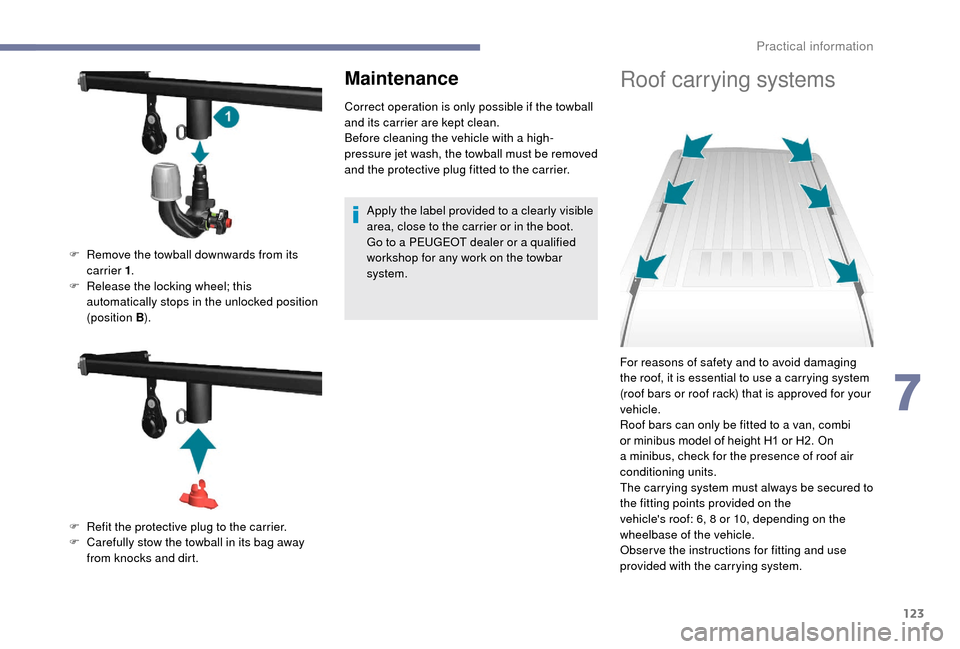
F Remove the towball downwards from its carrier 1 .
F
R
elease the locking wheel; this
automatically stops in the unlocked position
(position B ).
F
R
efit the protective plug to the carrier.
F
C
arefully stow the towball in its bag away
from knocks and dirt. For reasons of safety and to avoid damaging
the roof, it is essential to use a
carrying system
(roof bars or roof rack) that is approved for your
vehicle.
Roof bars can only be fitted to a
van, combi
or minibus model of height H1
or H2. On
a
minibus, check for the presence of roof air
conditioning units.
The carrying system must always be secured to
the fitting points provided on the
vehicle's roof: 6, 8
or 10, depending on the
wheelbase of the vehicle.
Obser ve the instructions for fitting and use
provided with the carrying system.
7
Practical information
Page 127 of 232
125
Bonnet
Opening
Before doing anything under the bonnet,
deactivate the Stop & Start system to
avoid the risk of injury related to an
automatic change to START mode.
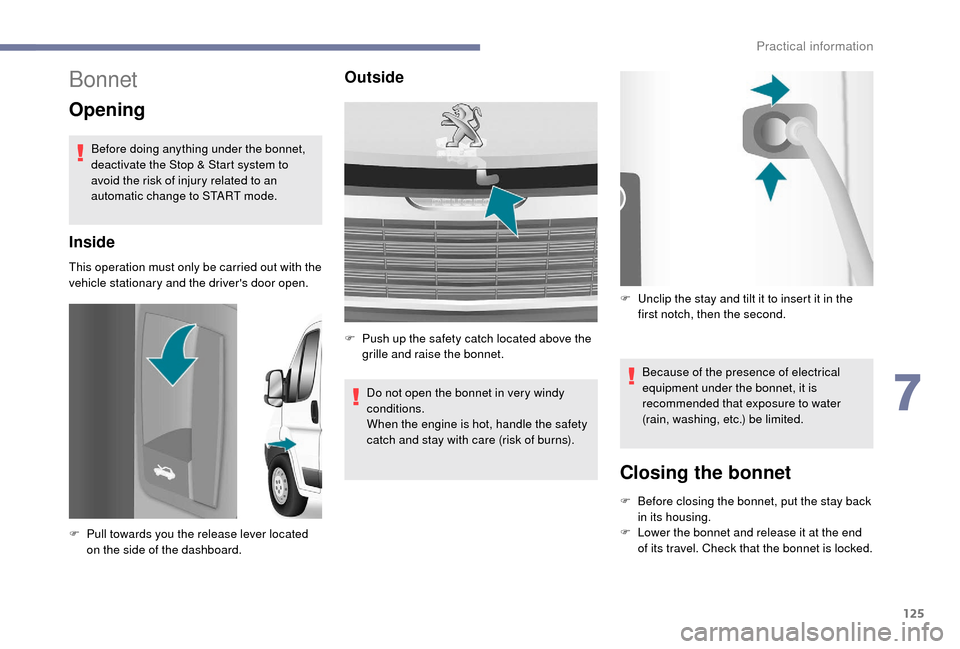
Inside
This operation must only be carried out with the
vehicle stationary and the driver's door open.
Outside
Do not open the bonnet in very windy
conditions.
When the engine is hot, handle the safety
catch and stay with care (risk of burns).Because of the presence of electrical
equipment under the bonnet, it is
recommended that exposure to water
(rain, washing, etc.) be limited.
Closing the bonnet
F Pull towards you the release lever located
on the side of the dashboard. F
P
ush up the safety catch located above the
grille and raise the bonnet. F
U
nclip the stay and tilt it to insert it in the
first notch, then the second.
F
B
efore closing the bonnet, put the stay back
in its housing.
F L ower the bonnet and release it at the end
of its travel. Check that the bonnet is locked.
7
Practical information