ser Peugeot Boxer 2018 Repair Manual
[x] Cancel search | Manufacturer: PEUGEOT, Model Year: 2018, Model line: Boxer, Model: Peugeot Boxer 2018Pages: 232, PDF Size: 9.09 MB
Page 145 of 232
143
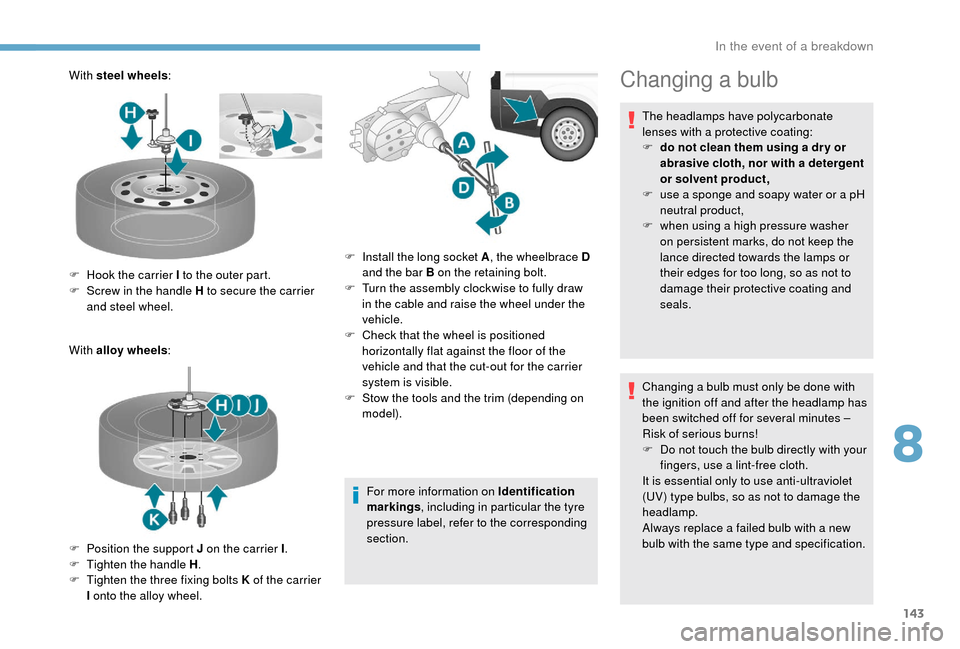
With steel wheels:
With alloy wheels :
For more information on Identification
markings, including in particular the tyre
pressure label, refer to the corresponding
section.
F
H
ook the carrier I to the outer part.
F
S
crew in the handle H to secure the carrier
and steel wheel.
F
P
osition the support J on the carrier I .
F
T
ighten the handle H .
F
T
ighten the three fixing bolts K of the carrier
I onto the alloy wheel. F
I
nstall the long socket A, the wheelbrace D
and the bar B on the retaining bolt.
F
T
urn the assembly clockwise to fully draw
in the cable and raise the wheel under the
vehicle.
F
C
heck that the wheel is positioned
horizontally flat against the floor of the
vehicle and that the cut-out for the carrier
system is visible.
F
S
tow the tools and the trim (depending on
model).Changing a bulb
The headlamps have polycarbonate
lenses with a
protective coating:
F
d
o not clean them using a dr y or
abrasive cloth, nor with a
detergent
or solvent product,
F
u
se a sponge and soapy water or a pH
neutral product,
F
w
hen using a high pressure washer
on persistent marks, do not keep the
lance directed towards the lamps or
their edges for too long, so as not to
damage their protective coating and
seals.
Changing a
bulb must only be done with
the ignition off and after the headlamp has
been switched off for several minutes –
Risk of serious burns!
F
D
o not touch the bulb directly with your
fingers, use a
lint-free cloth.
It is essential only to use anti-ultraviolet
(UV) type bulbs, so as not to damage the
headlamp.
Always replace a
failed bulb with a new
bulb with the same type and specification.
8
In the event of a breakdown
Page 151 of 232
149
Third brake lamp
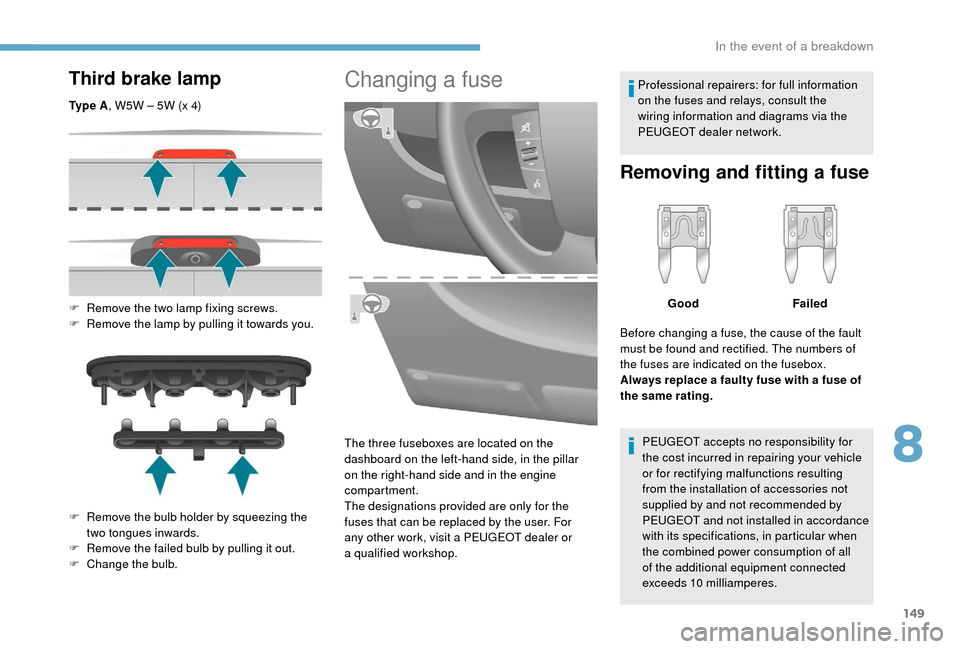
Ty p e A, W5W – 5W (x 4)
F
R
emove the two lamp fixing screws.
F
R
emove the lamp by pulling it towards you.
F
R
emove the bulb holder by squeezing the
two tongues inwards.
F
R
emove the failed bulb by pulling it out.
F
C
hange the bulb.
Changing a fuse
The three fuseboxes are located on the
dashboard on the left-hand side, in the pillar
on the right-hand side and in the engine
compartment.
The designations provided are only for the
fuses that can be replaced by the user. For
any other work, visit a
PEUGEOT dealer or
a
qualified workshop. Professional repairers: for full information
on the fuses and relays, consult the
wiring information and diagrams via the
PEUGEOT dealer network.
Removing and fitting a fuse
PEUGEOT accepts no responsibility for
the cost incurred in repairing your vehicle
or for rectifying malfunctions resulting
from the installation of accessories not
supplied by and not recommended by
PEUGEOT and not installed in accordance
with its specifications, in particular when
the combined power consumption of all
of the additional equipment connected
exceeds 10
milliamperes.
Good
Failed
Before changing a fuse, the cause of the fault
must be found and rectified. The numbers of
the fuses are indicated on the fusebox.
Always replace a faulty fuse with a fuse of
the same rating.
8
In the event of a breakdown
Page 157 of 232
155
To w i n g
General recommendations
Obser ve the legislation in force in your
c o u nt r y.
Ensure that the weight of the towing
vehicle is higher than that of the towed
vehicle.
The driver must remain at the wheel of
the towed vehicle and must have a valid
driving licence.
When towing a
vehicle with all four wheels
on the ground, always use an approved
towbar; rope and straps are prohibited.
The towing vehicle must move off gently.
When the vehicle is towed with its engine
off, there is no longer braking and steering
assistance.
In the following cases, you must always
call on a
professional recovery ser vice:
-
v
ehicle broken down on a motor way or
main road,
-
f
our-wheel drive vehicle,
-
w
hen it is not possible to put the
gearbox into neutral, unlock the
steering, or release the parking brake,
-
t
owing with only two wheels on the
ground,
-
w
here there is no approved towbar
available.
The charging operation must be carried
out in a
ventilated area away from naked
flames or any possible sources of sparks
to eliminate the risk of explosion and fire.
Do not try to charge a
frozen battery: it
must first be thawed out to avoid the risk
of explosion. If the battery has frozen,
before charging it have it checked by
a
specialist who will verify that the internal
components have not been damaged and
that the case is not cracked, which could
mean that there is a
risk of a
leak of toxic
and corrosive acid.
Proceed with a
slow charge at low current
for a
maximum of about 24
hours to avoid
damaging the battery.
Charging the battery using
a battery charger
F Go to the battery located in the front left
f l o o r.
F
D
isconnect the battery.
F
F
ollow the instructions for use provided by
the manufacturer of the charger.
F
R
econnect starting with the negative (-)
terminal.
F
C
heck the condition of the terminals and
clamps. If they are covered with sulphate
(whitish or greenish deposits), disconnect
them and clean them all.
After refitting of the battery by
a
PEUGEOT dealer or a qualified
workshop, the Stop & Start system will
only be active after a
continuous period
of immobilisation of the vehicle, a period
which depends on the climatic conditions
and the state of charge of the battery (up
to about 8
hours).
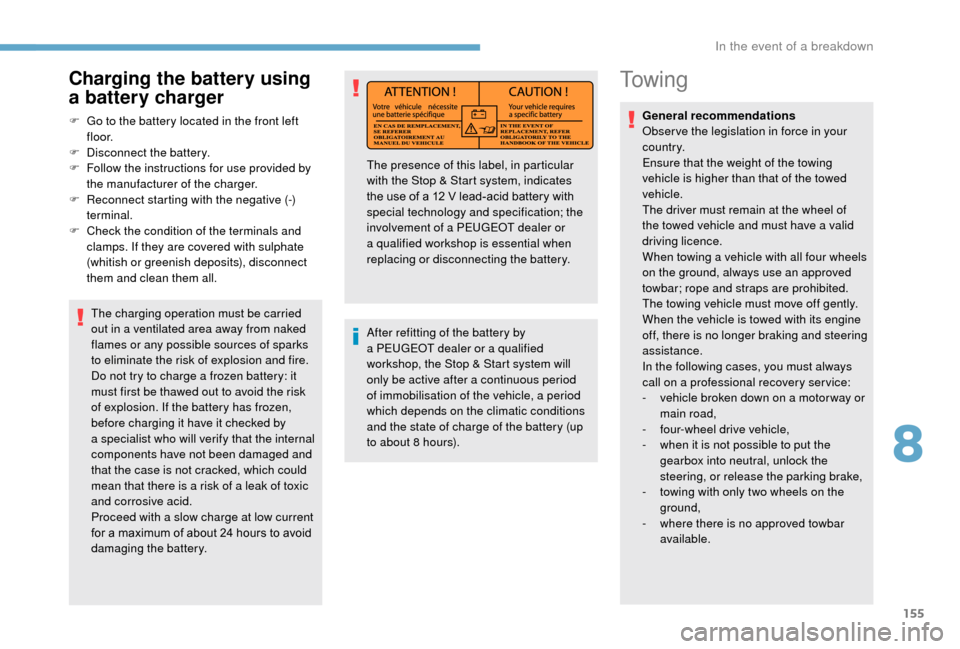
The presence of this label, in particular
with the Stop & Start system, indicates
the use of a
12 V lead-acid battery with
special technology and specification; the
involvement of a
PEUGEOT dealer or
a
qualified workshop is essential when
replacing or disconnecting the battery.
8
In the event of a breakdown
Page 159 of 232
157
Engine technical data and
towed loads
Engines
The engine characteristics are given in the
vehicle's registration document, as well as in
sales brochures.The maximum power corresponds to the
value type-approved on a
test bed, under
conditions defined in European legislation
(Directive 1999/99/EC).
For more information, contact a
PEUGEOT
dealer or a
qualified workshop.
Weights and towed loads
The maximum weights and towed loads for
your vehicle are given in the registration
document, as well as in sales brochures.
These values are also given on the
manufacturer's plate or label.
For more information, contact a PEUGEOT
dealer or a
qualified workshop. The GTW and towed load values indicated are
valid up to a
maximum altitude of 1,000 metres.
The towed load value must be reduced by 10%
for each additional 1,000 metres of altitude.
The maximum authorised nose weight
corresponds to the weight permitted on the
towbar (which can be dismantled with or
without a tool).
GT W: Gross train weight.
High exterior temperatures may result
in a reduction in the per formance of
the vehicle to protect the engine. If the
exterior temperature is above 37°C, limit
the towed load.
Towing with a towing vehicle which is only
slightly laden may negatively affect its
handling.
Towing a
trailer increases the braking
distance.
When towing, never exceed the speed
of 62
mph (100 km/h) (obser ve the local
legislation in force). If the exterior temperature is high, it is
recommended that the engine be allowed
to idle for 1
to 2 minutes after the vehicle
comes to a stop, to facilitate its cooling.
9
Technical data
Page 169 of 232
167
Identification markings
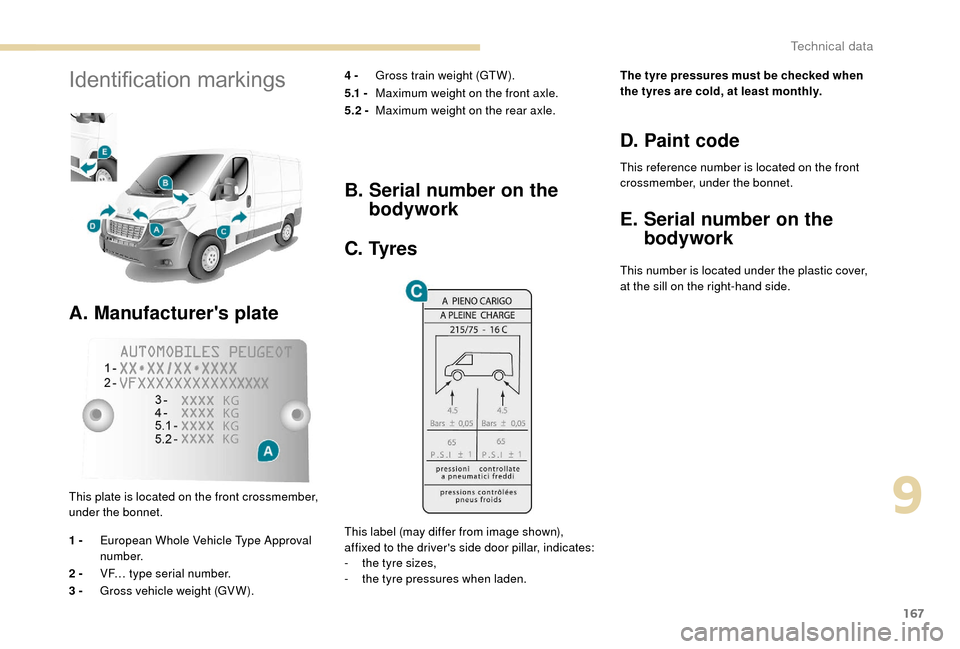
A. Manufacturer's plate
4 - Gross train weight (GTW).
5.1 - Maximum weight on the front axle.
5.2 - Maximum weight on the rear axle.
This plate is located on the front crossmember,
under the bonnet.
1 - European Whole Vehicle Type Approval
number.
2 - VF… type serial number.
3 - Gross vehicle weight (GV W).
B. Serial number on the
bodywork
C. Tyres
This label (may differ from image shown),
affixed to the driver's side door pillar, indicates:
-
t
he tyre sizes,
-
t
he tyre pressures when laden. The tyre pressures must be checked when
the tyres are cold, at least monthly.
D. Paint code
This reference number is located on the front
crossmember, under the bonnet.
E. Serial number on the
bodywork
This number is located under the plastic cover,
at the sill on the right-hand side.
9
Technical data
Page 182 of 232
180
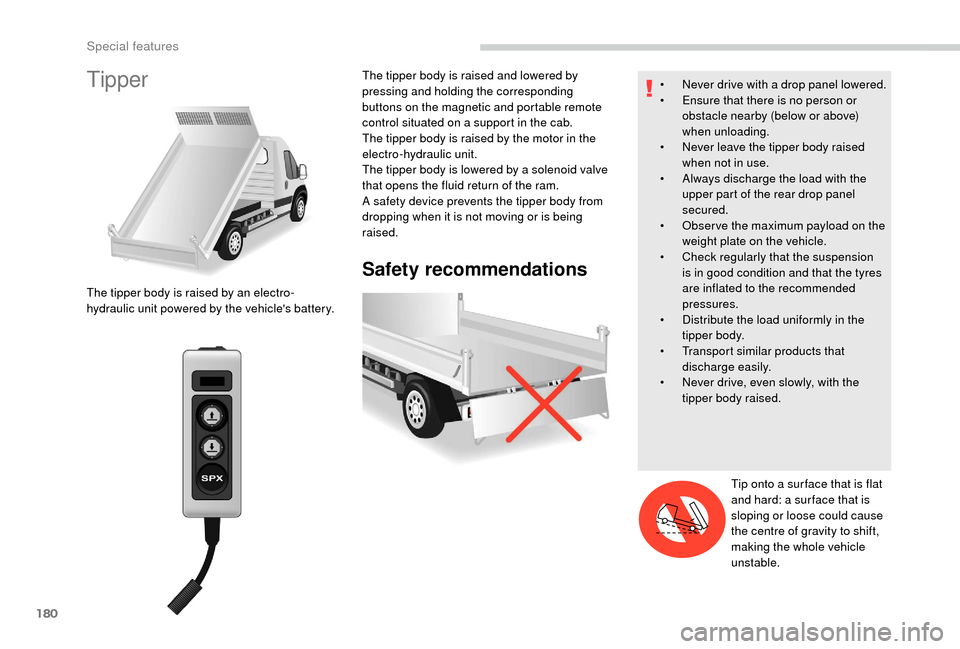
Tipper
Safety recommendations
The tipper body is raised by an electro-
hydraulic unit powered by the vehicle's battery.The tipper body is raised and lowered by
pressing and holding the corresponding
buttons on the magnetic and portable remote
control situated on a
support in the cab.
The tipper body is raised by the motor in the
electro-hydraulic unit.
The tipper body is lowered by a solenoid valve
that opens the fluid return of the ram.
A safety device prevents the tipper body from
dropping when it is not moving or is being
raised. •
N
ever drive with a drop panel lowered.
•
E
nsure that there is no person or
obstacle nearby (below or above)
when unloading.
•
N
ever leave the tipper body raised
when not in use.
•
A
lways discharge the load with the
upper part of the rear drop panel
secured.
•
O
bser ve the maximum payload on the
weight plate on the vehicle.
•
C
heck regularly that the suspension
is in good condition and that the tyres
are inflated to the recommended
pressures.
•
D
istribute the load uniformly in the
tipper body.
•
T
ransport similar products that
discharge easily.
•
N
ever drive, even slowly, with the
tipper body raised.
Tip onto a
sur face that is flat
and hard: a sur face that is
sloping or loose could cause
the centre of gravity to shift,
making the whole vehicle
unstable.
Special features
Page 183 of 232
181
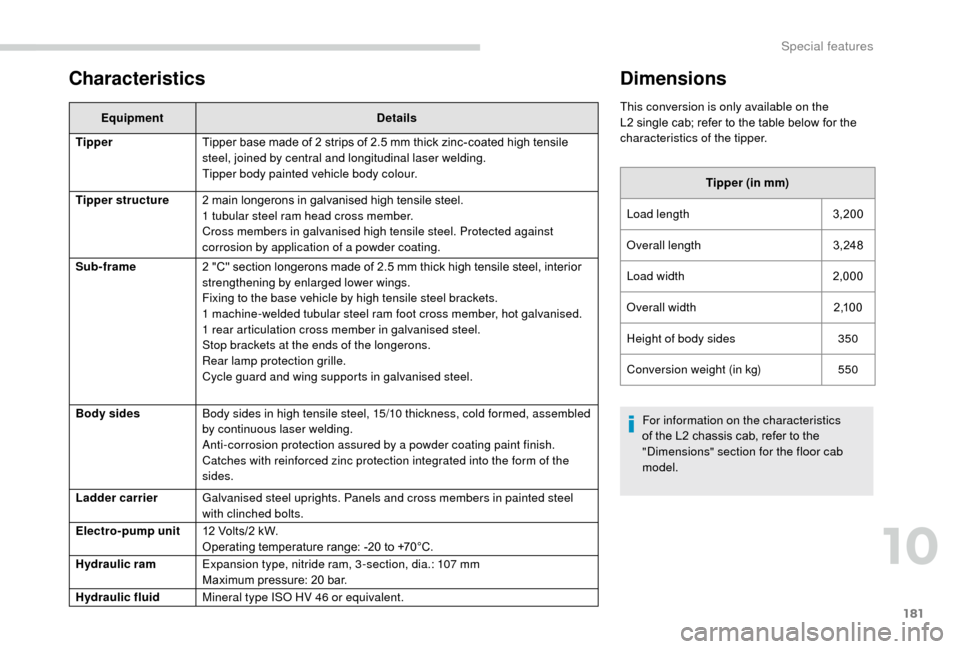
Characteristics
EquipmentDetails
Tipper Tipper base made of 2
strips of 2.5 mm thick zinc-coated high tensile
steel, joined by central and longitudinal laser welding.
Tipper body painted vehicle body colour.
Tipper structure 2
main longerons in galvanised high tensile steel.
1
tubular steel ram head cross member.
Cross members in galvanised high tensile steel. Protected against
corrosion by application of a
powder coating.
Sub-frame 2 "C" section longerons made of 2.5
mm thick high tensile steel, interior
strengthening by enlarged lower wings.
Fixing to the base vehicle by high tensile steel brackets.
1
machine-welded tubular steel ram foot cross member, hot galvanised.
1
rear articulation cross member in galvanised steel.
Stop brackets at the ends of the longerons.
Rear lamp protection grille.
Cycle guard and wing supports in galvanised steel.
Body sides Body sides in high tensile steel, 15/10
thickness, cold formed, assembled
by continuous laser welding.
Anti-corrosion protection assured by a
powder coating paint finish.
Catches with reinforced zinc protection integrated into the form of the
sides.
Ladder carrier Galvanised steel uprights. Panels and cross members in painted steel
with clinched bolts.
Electro-pump unit 12
Volts/2 kW.
Operating temperature range: -20
to +70°C.
Hydraulic ram Expansion type, nitride ram, 3 -section, dia.: 107
mm
Maximum pressure: 20
bar.
Hydraulic fluid Mineral type ISO HV 46
or equivalent.
Dimensions
This conversion is only available on the
L2 single cab; refer to the table below for the
characteristics of the tipper.
Tipper (in mm)
Load length 3,200
Overall length 3,248
Load width 2,000
Overall width 2 ,1 0 0
Height of body sides 350
Conversion weight (in kg) 550
For information on the characteristics
of the L2
chassis cab, refer to the
"Dimensions" section for the floor cab
model.
10
Special features
Page 185 of 232
183
Check and top up the fluid level regularly.
Replace the fluid annually. Replace the fluid if it
contains water.
Check the condition of the hydraulic hose and
the sealing of the hydraulic system regularly.
Pump and motor
Requires no ser vicing; the ball bearings are
lubricated for life and the pump bearings by the
pumped fluid.
Lubrication
The tipper body and ram pivots do not have
grease nipples. Lubricate the hinges and
retainers for the tipper body sides regularly,
as well as the catches for the rear tipper body
side.
Sub-chassis and tipper body
For maximum life, we recommend that you
clean your tipper body by washing it down
regularly with a hose.
Touch up paint chips quickly to avoid rust
spreading.After 8
months of use, check the
tightening torque of the fixings of the
underbody to the chassis (following the
recommendations of the body converter).
Cleaning the valve slider
F Loosen the cap 244A paying attention to
the ball and retrieving it.
F
U
sing a wide screwdriver, unscrew the
bore/piston bolt assembly.
F
C
heck that the piston slides smoothly and
remove any impurities. Pass a
magnet over
if there is any swar f present.
F
R
efit the assembly and ensure that the
piston slides smoothly. Retain the ball with
some grease on the plug for reassembly.
F
B
leed the hydraulic unit.
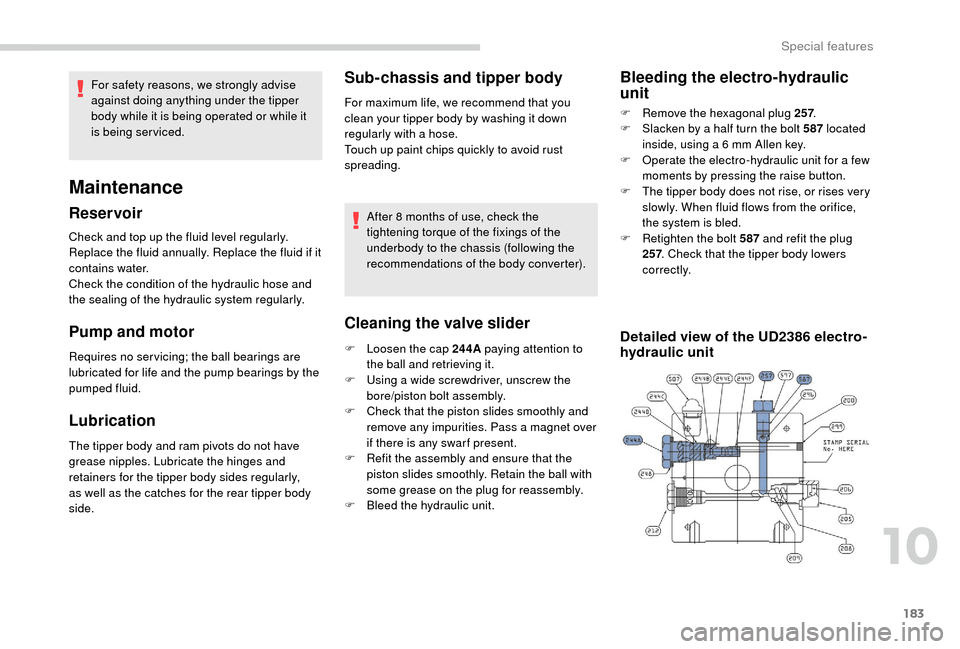
Bleeding the electro-hydraulic
unit
F Remove the hexagonal plug 257 .
F S lacken by a half turn the bolt 587 located
inside, using a
6 mm Allen key.
F
O
perate the electro-hydraulic unit for a few
moments by pressing the raise button.
F
T
he tipper body does not rise, or rises very
slowly. When fluid flows from the orifice,
the system is bled.
F
R
etighten the bolt 587
and refit the plug
257 . Check that the tipper body lowers
c o r r e c t l y.
Detailed view of the UD2386 electro-
h ydraulic unit
Maintenance
Reser voir
For safety reasons, we strongly advise
against doing anything under the tipper
body while it is being operated or while it
is being serviced.
10
Special features
Page 186 of 232
184
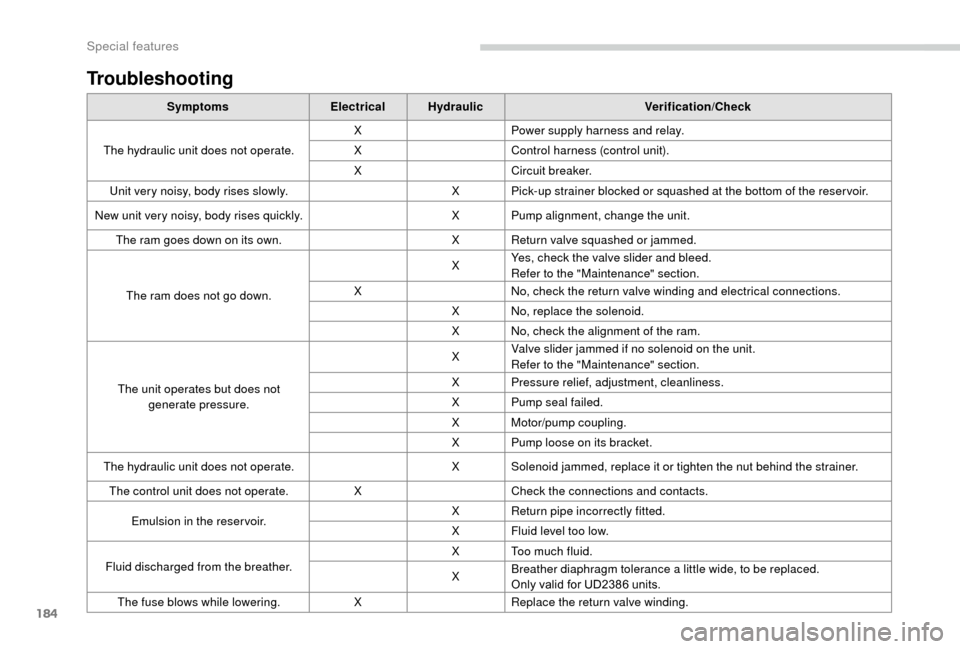
Troubleshooting
SymptomsElectricalHydraulic Verification/Check
The hydraulic unit does not operate. X
Power supply harness and relay.
X Control harness (control unit).
X Circuit breaker.
Unit very noisy, body rises slowly. X Pick-up strainer blocked or squashed at the bottom of the reser voir.
New unit very noisy, body rises quickly. X Pump alignment, change the unit.
The ram goes down on its own. X Return valve squashed or jammed.
The ram does not go down. X
Yes, check the valve slider and bleed.
Refer to the "Maintenance" section.
X No, check the return valve winding and electrical connections.
X No, replace the solenoid.
X No, check the alignment of the ram.
The unit operates but does not generate pressure. X
Valve slider jammed if no solenoid on the unit.
Refer to the "Maintenance" section.
X Pressure relief, adjustment, cleanliness.
X Pump seal failed.
X Motor/pump coupling.
X Pump loose on its bracket.
The hydraulic unit does not operate. X Solenoid jammed, replace it or tighten the nut behind the strainer.
The control unit does not operate. XCheck the connections and contacts.
Emulsion in the reser voir. X
Return pipe incorrectly fitted.
X Fluid level too low.
Fluid discharged from the breather. X Too much fluid.
X
Breather diaphragm tolerance a
little wide, to be replaced.
Only valid for UD2386
units.
The fuse blows while lowering. XReplace the return valve winding.
Special features
Page 191 of 232
5
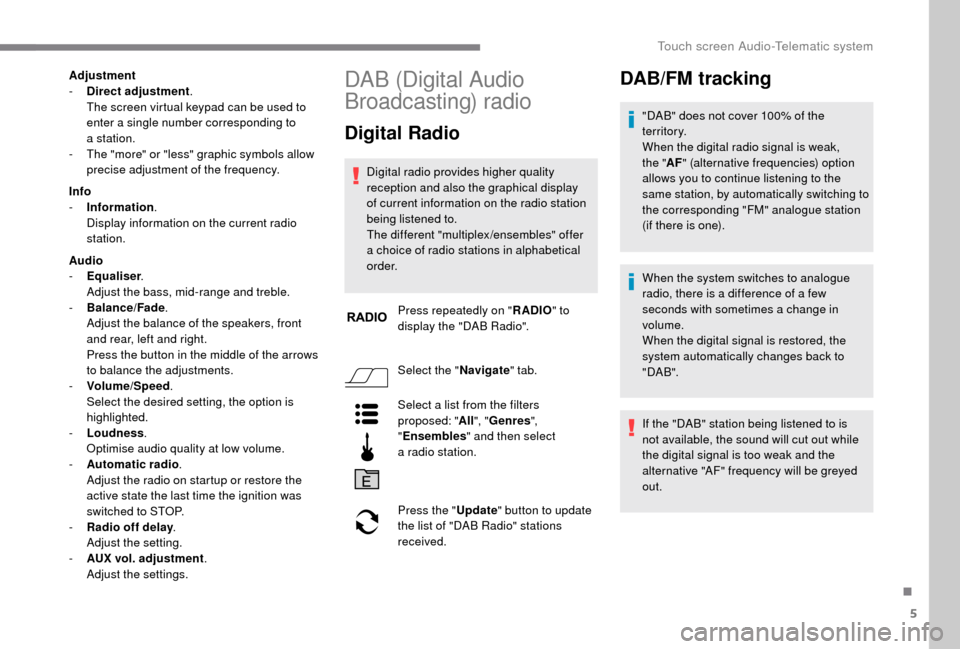
Adjustment
- D irect adjustment .
The screen virtual keypad can be used to
enter a
single number corresponding to
a
station.
-
T
he "more" or "less" graphic symbols allow
precise adjustment of the frequency.
Info
-
I
nformation .
Display information on the current radio
station.
Audio
-
E
qualiser .
Adjust the bass, mid-range and treble.
-
B
alance/Fade .
Adjust the balance of the speakers, front
and rear, left and right.
Press the button in the middle of the arrows
to balance the adjustments.
-
V
olume/Speed .
Select the desired setting, the option is
highlighted.
-
L
oudness .
Optimise audio quality at low volume.
-
A
utomatic radio .
Adjust the radio on startup or restore the
active state the last time the ignition was
switched to STOP.
-
R
adio off delay .
Adjust the setting.
-
A
UX vol. adjustment .
Adjust the settings.DAB (Digital Audio
Broadcasting) radio
Digital Radio
Digital radio provides higher quality
reception and also the graphical display
of current information on the radio station
being listened to.
The different "multiplex/ensembles" offer
a
choice of radio stations in alphabetical
o r d e r.
Press repeatedly on " RADIO" to
display the "DAB Radio".
Select the " Navigate" tab.
Select a
list from the filters
proposed: " All", "Genres ",
" Ensembles " and then select
a
radio station.
Press the " Update" button to update
the list of "DAB Radio" stations
received.
DAB/FM tracking
"DAB" does not cover 100% of the
te r r i to r y.
When the digital radio signal is weak,
the " AF" (alternative frequencies) option
allows you to continue listening to the
same station, by automatically switching to
the corresponding "FM" analogue station
(if there is one).
When the system switches to analogue
radio, there is a
difference of a few
seconds with sometimes a
change in
volume.
When the digital signal is restored, the
system automatically changes back to
" DA B ".
If the "DAB" station being listened to is
not available, the sound will cut out while
the digital signal is too weak and the
alternative "AF" frequency will be greyed
out.
.
Touch screen Audio-Telematic system