ESP PEUGEOT EXPERT 2023 Owner's Manual
[x] Cancel search | Manufacturer: PEUGEOT, Model Year: 2023, Model line: EXPERT, Model: PEUGEOT EXPERT 2023Pages: 348, PDF Size: 12 MB
Page 52 of 348
50
Ease of use and comfort
► To put it back in place, engage the head
restraint rods in the openings keeping them in
line with the seat backrest.
►
T
o lower it, press the lug A and push down on
the head restraint at the same time.
The head restraint has a frame with notches which prevents it from lowering;
this is a safety device in case of impact.
The adjustment is correct when the upper
edge of the head restraint is level with the
top of the head.
Never drive with the head restraints removed;
they must be fitted and correctly adjusted.
2-seat front bench seat
If fitted in the vehicle, this is fixed and has a seat
belt built into the backrest for the seat next to the
driver’s seat.
For more information on the Seat belts,
refer to the corresponding section.
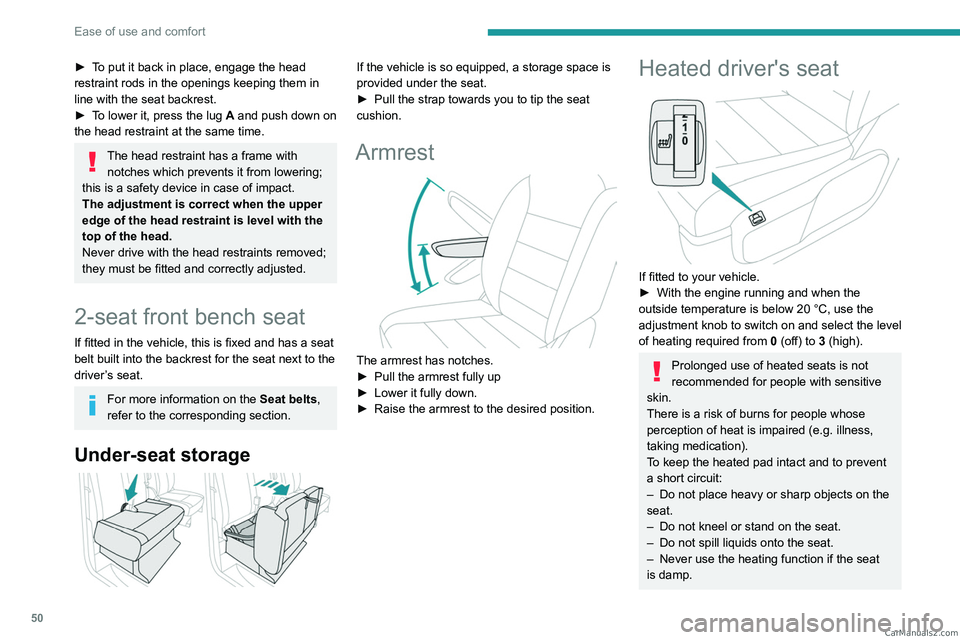
Under-seat storage
If the vehicle is so equipped, a storage space is
provided under the seat.
►
Pull the strap towards you to tip the seat
cushion.
Armrest
The armrest has notches.
► Pull the armrest fully up
►
Lower it fully down.
►
Raise the armrest to the desired position.
Heated driver's seat
If fitted to your vehicle.
► With the engine running and when the
outside temperature is below 20
°C, use the
adjustment knob to switch on and select the level
of heating required from
0
(off) to 3 (high).
Prolonged use of heated seats is not
recommended for people with sensitive
skin.
There is a risk of burns for people whose
perception of heat is impaired (e.g.
illness,
taking medication).
To keep the heated pad intact and to prevent
a short circuit:
–
Do not place heavy or sharp objects on the
seat.
–
Do not kneel or stand on the seat.
–
Do not spill liquids onto the seat.
–
Never use the heating function if the seat
is damp. CarM an uals 2 .c o m
Page 54 of 348
52
Ease of use and comfort
► When stationary, lower the control lever to
release the steering wheel.
►
Adjust the height and reach.
►
Pull the control lever to lock the steering
wheel.
As a safety precaution, these operations must only be carried out while the vehicle
is stationary.
Mirrors
Door mirrors
As a safety measure, the mirrors should be adjusted to reduce the "blind spots".
The objects that you see in the mirrors are
in fact closer than they appear. Take this
into account in order to correctly judge the
distance of vehicles approaching from behind.
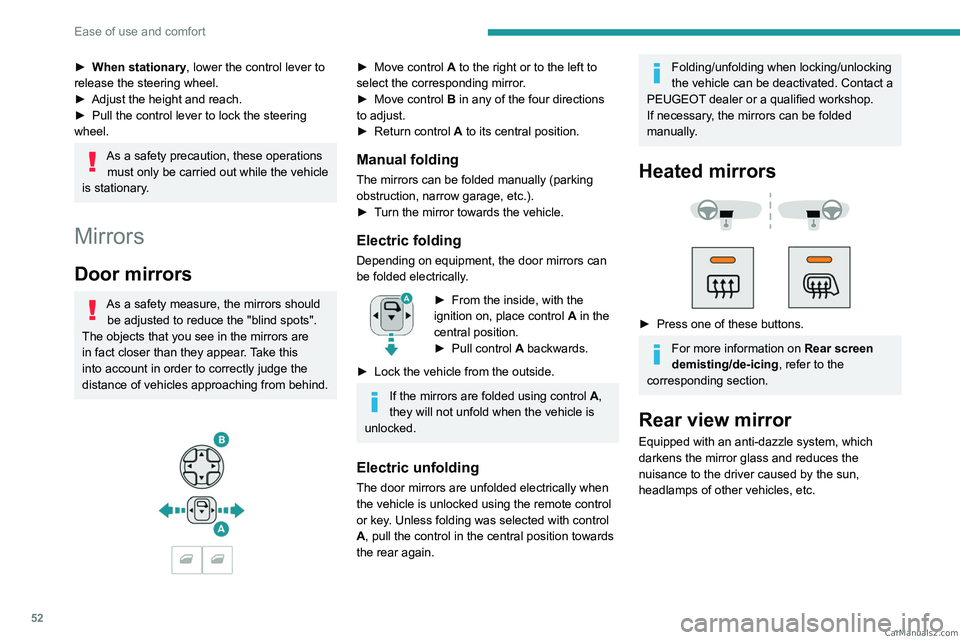
► Move control A to the right or to the left to
select the corresponding mirror.
►
Move control
B in any of the four directions
to adjust.
►
Return control A
to its central position.
Manual folding
The mirrors can be folded manually (parking
obstruction, narrow garage, etc.).
►
T
urn the mirror towards the vehicle.
Electric folding
Depending on equipment, the door mirrors can
be folded electrically.
► From the inside, with the
ignition on, place control A
in the
central position.
►
Pull control A
backwards.
►
Lock the vehicle from the outside.
If the mirrors are folded using control A,
they will not unfold when the vehicle is
unlocked.
Electric unfolding
The door mirrors are unfolded electrically when
the vehicle is unlocked using the remote control
or key. Unless folding was selected with control
A, pull the control in the central position towards
the rear again.
Folding/unfolding when locking/unlocking
the vehicle can be deactivated. Contact a
PEUGEOT dealer or a qualified workshop.
If necessary, the mirrors can be folded
manually.
Heated mirrors
► Press one of these buttons.
For more information on Rear screen
demisting/de-icing , refer to the
corresponding section.
Rear view mirror
Equipped with an anti-dazzle system, which
darkens the mirror glass and reduces the
nuisance to the driver caused by the sun,
headlamps of other vehicles, etc. CarM an uals 2 .c o m
Page 59 of 348
57
Ease of use and comfort
3introducing any foreign bodies into the
mechanisms.
The seats and bench seats are not designed for any other use than in the
vehicle. They are equipped with mechanisms
and features that may be damaged if used
improperly or if dropped.
Loading luggage or objects
behind the row 3 seat and
bench seat
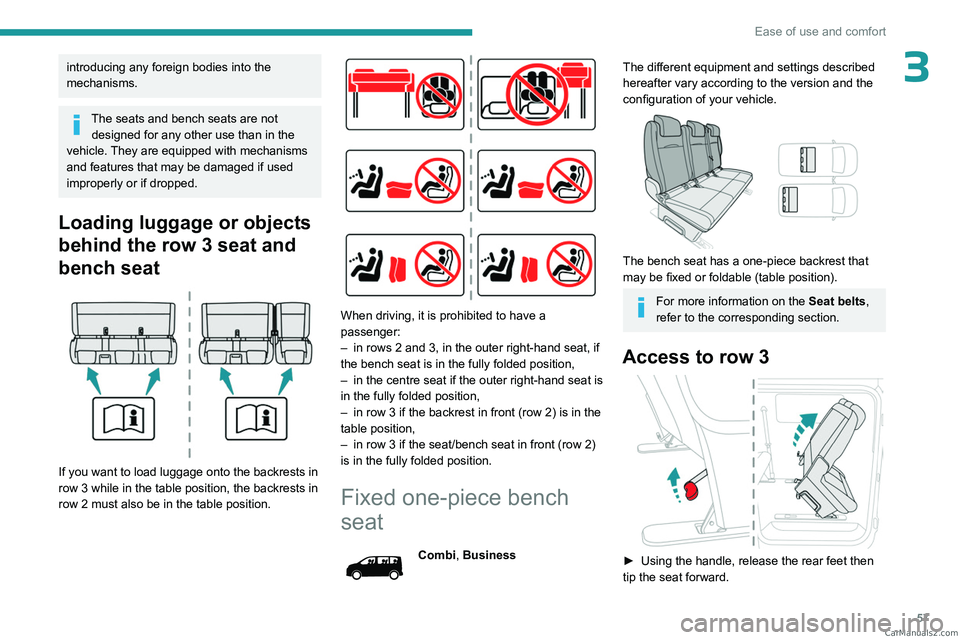
If you want to load luggage onto the backrests in
row
3 while in the table position, the backrests in
row
2 must also be in the table position.
When driving, it is prohibited to have a
passenger:
–
in rows 2 and 3, in the outer right-hand seat, if
the bench seat is in the fully folded position,
–
in the centre seat if the outer right-hand seat is
in the fully folded position,
–
in row 3 if the backrest in front (row 2) is in the
table position,
–
in row 3 if the seat/bench seat in front (row 2)
is in the fully folded position.
Fixed one-piece bench
seat
Combi, Business
The different equipment and settings described
hereafter vary according to the version and the
configuration of your vehicle.
The bench seat has a one-piece backrest that
may be fixed or foldable (table position).
For more information on the Seat belts,
refer to the corresponding section.
Access to row 3
► Using the handle, release the rear feet then
tip the seat forward. CarM an uals 2 .c o m
Page 61 of 348
59
Ease of use and comfort
3
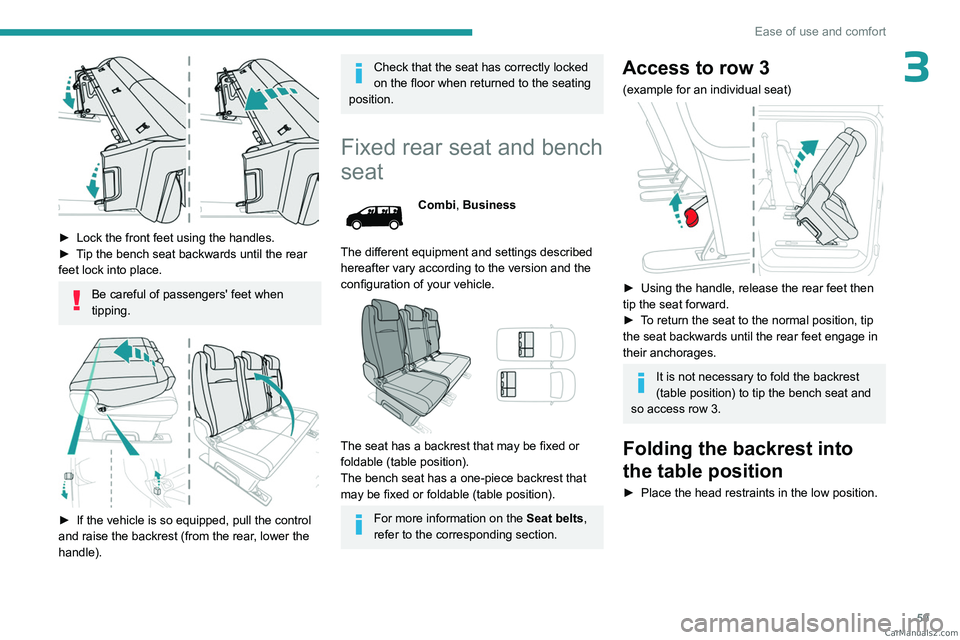
► Lock the front feet using the handles.
► T ip the bench seat backwards until the rear
feet lock into place.
Be careful of passengers' feet when
tipping.
► If the vehicle is so equipped, pull the control
and raise the backrest (from the rear , lower the
handle).
Check that the seat has correctly locked
on the floor when returned to the seating
position.
Fixed rear seat and bench
seat
Combi, Business
The different equipment and settings described
hereafter vary according to the version and the
configuration of your vehicle.
The seat has a backrest that may be fixed or
foldable (table position).
The bench seat has a one-piece backrest that
may be fixed or foldable (table position).
For more information on the Seat belts,
refer to the corresponding section.
Access to row 3
(example for an individual seat)
► Using the handle, release the rear feet then
tip the seat forward.
►
T
o return the seat to the normal position, tip
the seat backwards until the rear feet engage in
their anchorages.
It is not necessary to fold the backrest
(table position) to tip the bench seat and
so access row 3.
Folding the backrest into
the table position
► Place the head restraints in the low position. CarM an uals 2 .c o m
Page 63 of 348
61
Ease of use and comfort
3
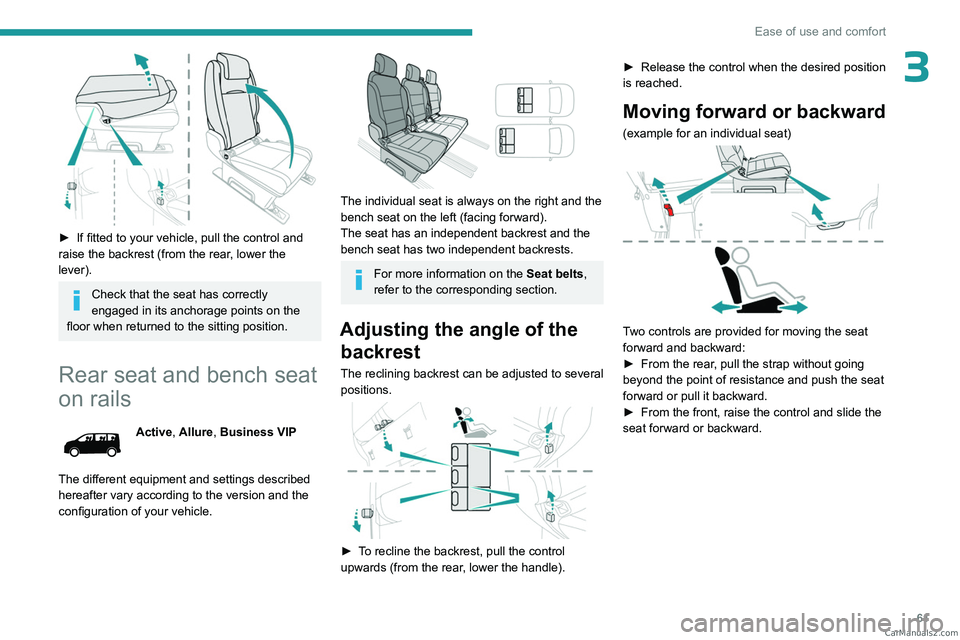
► If fitted to your vehicle, pull the control and
raise the backrest (from the rear , lower the
lever).
Check that the seat has correctly
engaged in its anchorage points on the
floor when returned to the sitting position.
Rear seat and bench seat
on rails
Active, Allure, Business VIP
The different equipment and settings described
hereafter vary according to the version and the
configuration of your vehicle.
The individual seat is always on the right and the
bench seat on the left (facing forward).
The seat has an independent backrest and the
bench seat has two independent backrests.
For more information on the Seat belts,
refer to the corresponding section.
Adjusting the angle of the backrest
The reclining backrest can be adjusted to several
positions.
► To recline the backrest, pull the control
upwards (from the rear, lower the handle). ►
Release the control when the desired position
is reached.
Moving forward or backward
(example for an individual seat)
Two controls are provided for moving the seat
forward and backward:
►
From the rear
, pull the strap without going
beyond the point of resistance and push the seat
forward or pull it backward.
►
From the front, raise the control and slide the
seat forward or backward. CarM an uals 2 .c o m
Page 65 of 348
63
Ease of use and comfort
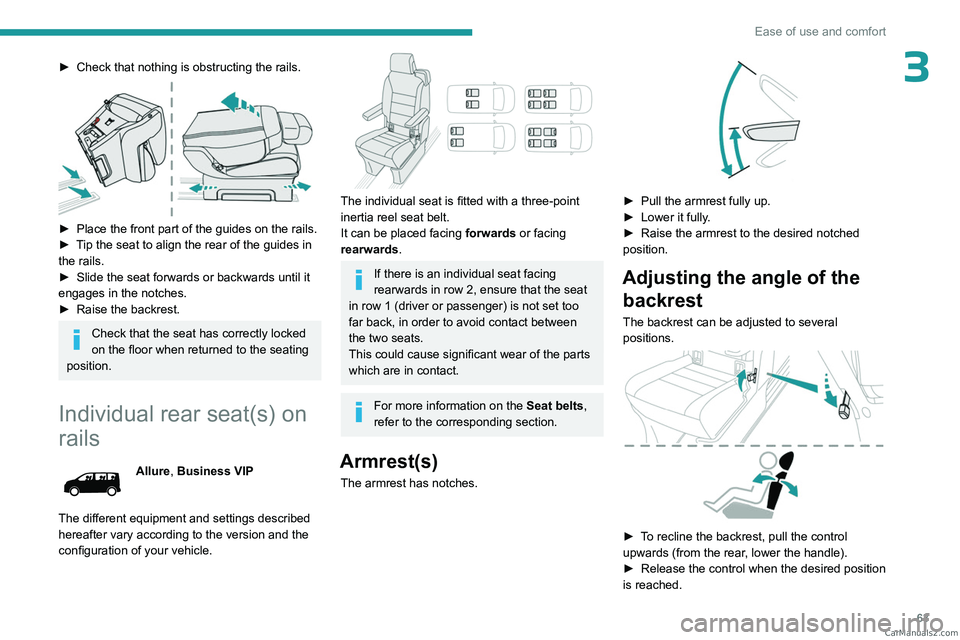
3► Check that nothing is obstructing the rails.
► Place the front part of the guides on the rails.
► T ip the seat to align the rear of the guides in
the rails.
►
Slide the seat forwards or backwards until it
engages in the notches.
►
Raise the backrest.
Check that the seat has correctly locked
on the floor when returned to the seating
position.
Individual rear seat(s) on
rails
Allure, Business VIP
The different equipment and settings described
hereafter vary according to the version and the
configuration of your vehicle.
The individual seat is fitted with a three-point
inertia reel seat belt.
It can be placed facing forwards or facing
rearwards .
If there is an individual seat facing
rearwards in row 2, ensure that the seat
in row 1 (driver or passenger) is not set too
far back, in order to avoid contact between
the two seats.
This could cause significant wear of the parts
which are in contact.
For more information on the Seat belts,
refer to the corresponding section.
Armrest(s)
The armrest has notches.
► Pull the armrest fully up.
► Lower it fully .
►
Raise the armrest to the desired notched
position.
Adjusting the angle of the backrest
The backrest can be adjusted to several
positions.
► To recline the backrest, pull the control
upwards (from the rear, lower the handle).
►
Release the control when the desired position
is reached. CarM an uals 2 .c o m
Page 67 of 348
65
Ease of use and comfort
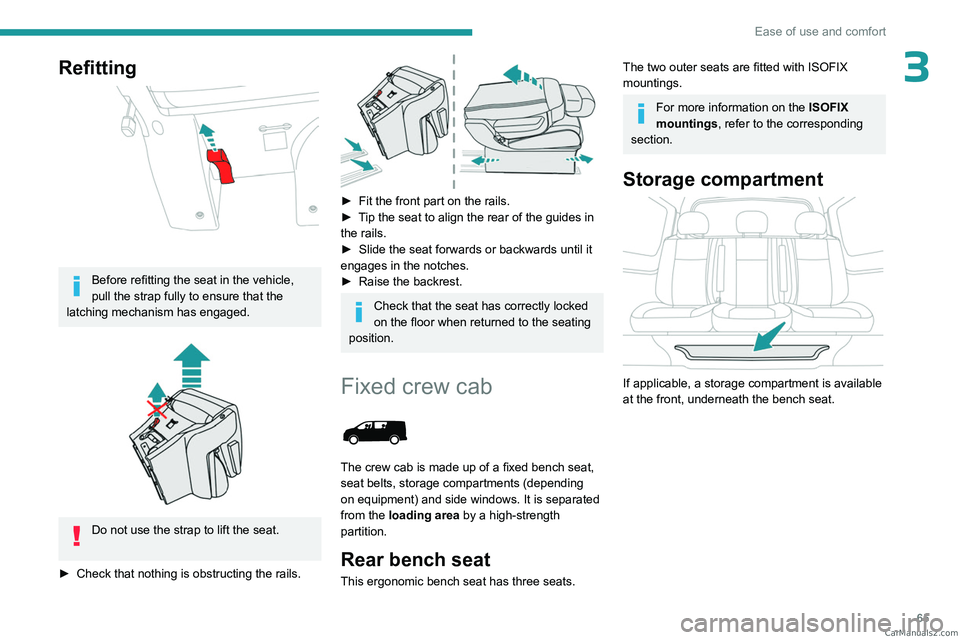
3Refitting
Before refitting the seat in the vehicle,
pull the strap fully to ensure that the
latching mechanism has engaged.
Do not use the strap to lift the seat.
►
Check that nothing is obstructing the rails.
► Fit the front part on the rails.
► T ip the seat to align the rear of the guides in
the rails.
►
Slide the seat forwards or backwards until it
engages in the notches.
►
Raise the backrest.
Check that the seat has correctly locked
on the floor when returned to the seating
position.
Fixed crew cab
The crew cab is made up of a fixed bench seat,
seat belts, storage compartments (depending
on equipment) and side windows. It is separated
from the loading area by a high-strength
partition.
Rear bench seat
This ergonomic bench seat has three seats.
The two outer seats are fitted with ISOFIX
mountings.
For more information on the ISOFIX
mountings , refer to the corresponding
section.
Storage compartment
If applicable, a storage compartment is available
at the front, underneath the bench seat. CarM an uals 2 .c o m
Page 71 of 348
69
Ease of use and comfort
3Any liquid which could spill risks causing an electrical short circuit and therefore a
potential fire.
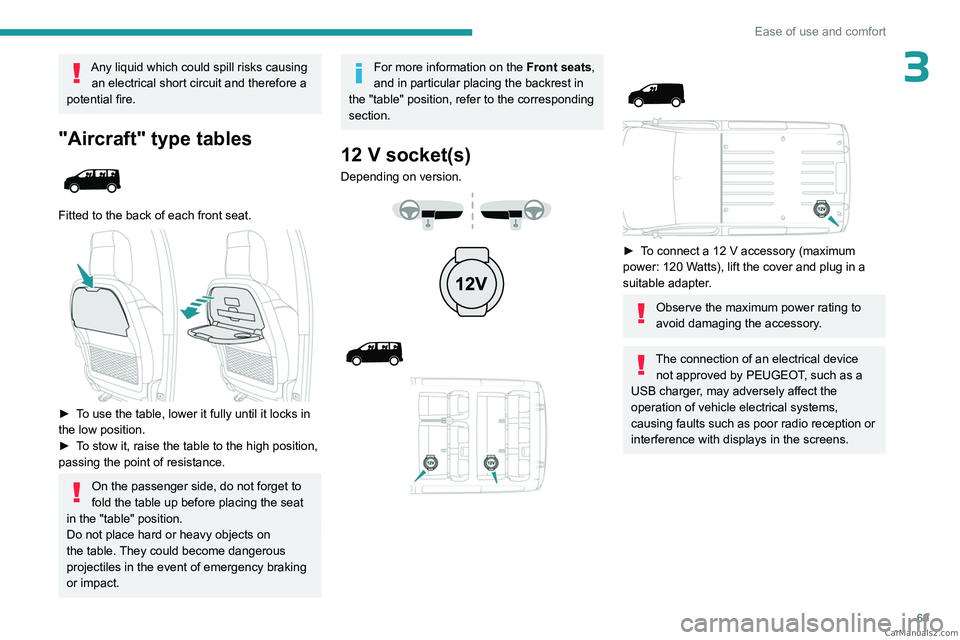
"Aircraft" type tables
Fitted to the back of each front seat.
► To use the table, lower it fully until it locks in
the low position.
►
T
o stow it, raise the table to the high position,
passing the point of resistance.
On the passenger side, do not forget to
fold the table up before placing the seat
in the "table" position.
Do not place hard or heavy objects on
the table. They could become dangerous
projectiles in the event of emergency braking
or impact.
For more information on the Front seats,
and in particular placing the backrest in
the "table" position, refer to the corresponding
section.
12 V socket(s)
Depending on version.
► To connect a 12 V accessory (maximum
power: 120 Watts), lift the cover and plug in a
suitable adapter.
Observe the maximum power rating to
avoid damaging the accessory.
The connection of an electrical device not approved by PEUGEOT, such as a
USB charger, may adversely affect the
operation of vehicle electrical systems,
causing faults such as poor radio reception or
interference with displays in the screens. CarM an uals 2 .c o m
Page 74 of 348
72
Ease of use and comfort
Recommendations on
loading
The weight of the load must comply with the Gross Train Weight (GTW).
For more information on Engine technical
data and towed loads , refer to the
corresponding section.
If you are using a carrying system (roof
bars/roof rack), comply with the
maximum loads associated with this system.
For more information on Roof bars/Roof
rack , refer to the corresponding section.
Make sure that the size, shape and
volume of the loads carried are
compatible with the highway code and safety
regulations and do not impair the driver’s field
of vision.
The load must be evenly distributed in the loading area so as not to interfere
with driving the vehicle.
Place the load close to the side wall panels,
or push it against the side wall panels
between the wheel arches.
However, it is recommended that heavy
objects are placed as close to the cab as
possible as a precaution in case of sharp
braking.
Firmly secure all parts of the load using
the stowing rings on the floor of the
loading area.
For more information on the Interior fittings
and in particular on the stowing rings, refer to
the corresponding section.
To avoid the risk of injury or accident, the load must be made stable so that it
cannot slide, tip over, fall or be projected. To
do this, use only retaining straps that conform
to current standards (DIN, for example).
For more information on putting straps in
place, refer to the manufacturer’s user guide.
To prevent the load from sliding, there must
not be any empty spaces between the load
items and the vehicle wall panels.
As well as the straps, optimise the stability
of the load with stable handling equipment
(wedges, rigid blocks of wood or padding).
When washing your vehicle, never clean
the inside directly using a water jet.
Seating area fittings
High load retaining net
This allows the use of the entire loading capacity,
up to the roof:
–
behind the front seats in row 1, when the rear
seats (and bench seats) in rows 2 and 3 are
folded or removed,
–
behind the rear seats (and bench seats) in row
2, when the rear seats (and bench seats) in row
3 are folded or removed.
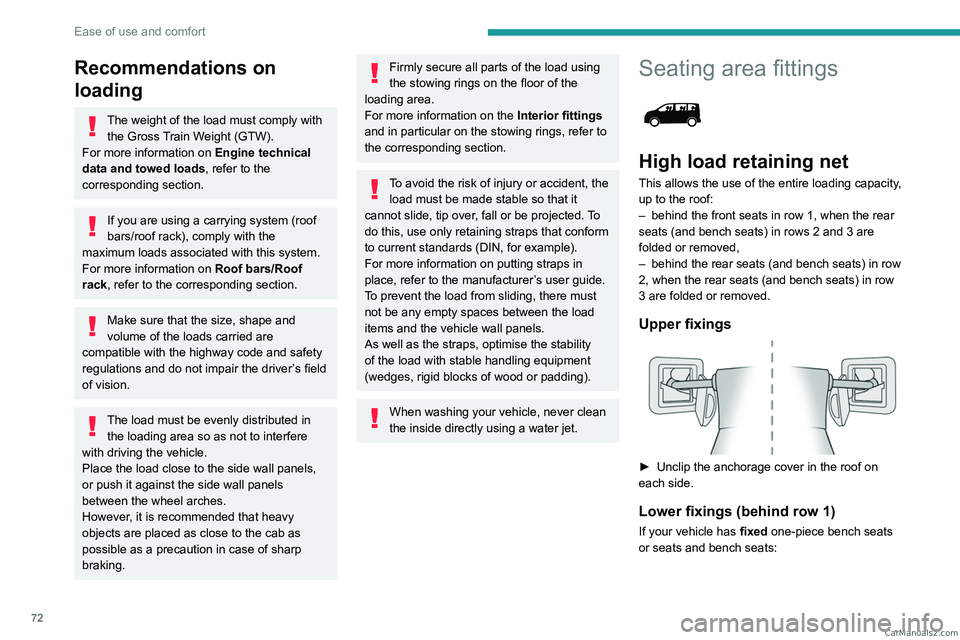
Upper fixings
► Unclip the anchorage cover in the roof on
each side.
Lower fixings (behind row 1)
If your vehicle has fixed one-piece bench seats
or seats and bench seats:
CarM an uals 2 .c o m
Page 75 of 348
73
Ease of use and comfort
3
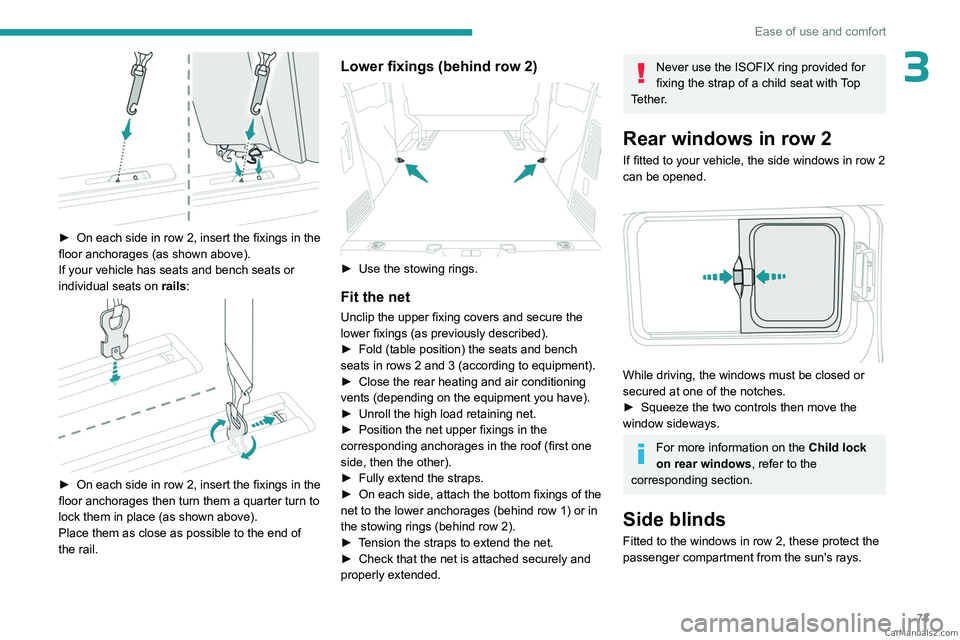
► On each side in row 2, insert the fixings in the
floor anchorages (as shown above).
If your vehicle has seats and bench seats or
individual seats on rails:
► On each side in row 2, insert the fixings in the
floor anchorages then turn them a quarter turn to
lock them in place (as shown above).
Place them as close as possible to the end of
the rail.
Lower fixings (behind row 2)
► Use the stowing rings.
Fit the net
Unclip the upper fixing covers and secure the
lower fixings (as previously described).
►
Fold (table position) the seats and bench
seats in rows 2 and 3 (according to equipment).
►
Close the rear heating and air conditioning
vents (depending on the equipment you have).
►
Unroll the high load retaining net.
►
Position the net upper fixings in the
corresponding anchorages in the roof (first one
side, then the other).
►
Fully extend the straps.
►
On each side, attach the bottom fixings of the
net to the lower anchorages (behind row 1) or in
the stowing rings (behind row 2).
►
T
ension the straps to extend the net.
►
Check that the net is attached securely and
properly extended.
Never use the ISOFIX ring provided for
fixing the strap of a child seat with Top
Tether.
Rear windows in row 2
If fitted to your vehicle, the side windows in row 2
can be opened.
While driving, the windows must be closed or
secured at one of the notches.
►
Squeeze the two controls then move the
window sideways.
For more information on the Child lock
on rear windows , refer to the
corresponding section.
Side blinds
Fitted to the windows in row 2, these protect the
passenger compartment from the sun's rays.
CarM an uals 2 .c o m