brake PEUGEOT PARTNER TEPEE ELECTRIC 2017 Owners Manual
[x] Cancel search | Manufacturer: PEUGEOT, Model Year: 2017, Model line: PARTNER TEPEE ELECTRIC, Model: PEUGEOT PARTNER TEPEE ELECTRIC 2017Pages: 252, PDF Size: 9.89 MB
Page 10 of 252
8
Starting procedure
Starting the vehicle
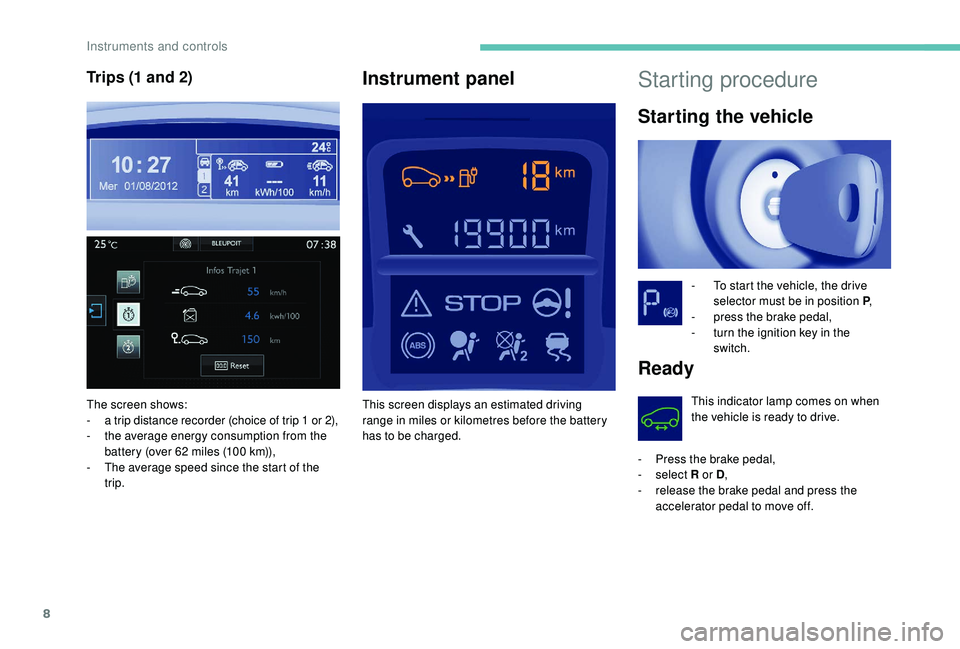
- To start the vehicle, the drive selector must be in position P ,
-
p
ress the brake pedal,
-
t
urn the ignition key in the
switch.
Ready
This indicator lamp comes on when
the vehicle is ready to drive.
-
P
ress the brake pedal,
-
select R or D,
-
r
elease the brake pedal and press the
accelerator pedal to move off.
Instrument panel
The screen shows:
- a t rip distance recorder (choice of trip 1 or 2),
-
t
he average energy consumption from the
battery (over 62
miles (100 km)),
-
T
he average speed since the start of the
trip. This screen displays an estimated driving
range in miles or kilometres before the battery
has to be charged.
Trips (1 and 2)
Instruments and controls
Page 11 of 252
9
Parking the vehicle
When leaving the vehicle, it is strongly
recommended that you apply the parking
brake, place the drive selector in position P,
then switch off the ignition.
There is an audible signal on opening the
driver's door if:
-
t
he ignition is still on (" Ready" lamp on),
-
t
he vehicle has not been correctly
immobilised (drive selector not in
position P ).
An alert message is displayed in the screen.
Drive selector
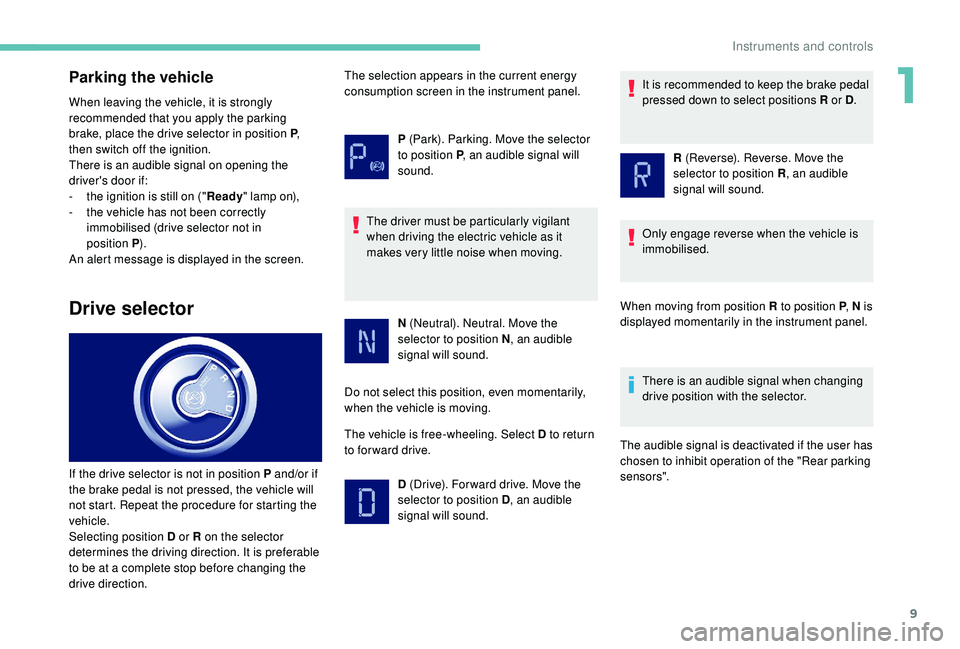
P (Park). Parking. Move the selector
to position P , an audible signal will
sound.
If the drive selector is not in position P and/or if
the brake pedal is not pressed, the vehicle will
not start. Repeat the procedure for starting the
vehicle.
Selecting position D or R on the selector
determines the driving direction. It is preferable
to be at a complete stop before changing the
drive direction. The selection appears in the current energy
consumption screen in the instrument panel.
The driver must be particularly vigilant
when driving the electric vehicle as it
makes very little noise when moving. N (Neutral). Neutral. Move the
selector to position N , an audible
signal will sound.
Do not select this position, even momentarily,
when the vehicle is moving.
The vehicle is free-wheeling. Select D to return
to for ward drive. D (Drive). For ward drive. Move the
selector to position D , an audible
signal will sound. It is recommended to keep the brake pedal
pressed down to select positions R or D
.
R (Reverse). Reverse. Move the
selector to position R , an audible
signal will sound.
Only engage reverse when the vehicle is
immobilised.
When moving from position R to position P , N is
displayed momentarily in the instrument panel.
There is an audible signal when changing
drive position with the selector.
The audible signal is deactivated if the user has
chosen to inhibit operation of the "Rear parking
sensors".
1
Instruments and controls
Page 27 of 252
25
In the event of an accident or
impact under the vehicle or on
one of the charging flaps
In the event of an accident or an impact to the
underbody of the vehicle (for example: contact
with a pole, a raised kerb or other urban
roadside fixture) or in the event of an impact,
even slight, to one of the charging flaps, these
circumstances may have serious repercussions
for your vehicle's electrical system or traction
battery and cause damage to them. Have
your vehicle checked as soon as possible by a
franchised dealer or a qualified workshop.
Never touch the 300 Volt components or the
orange cables exposed and visible inside or
outside of the vehicle.
In the case of serious damage to the traction
battery:
-
d
o not try to do anything to the vehicle
yourself,
-
n
ever touch liquids coming from the traction
battery and in the event of skin contact with
these products, wash abundantly with water
and contact a doctor as soon as possible. In the event of exposure to a fire
In the event of exposure to a fire, you and
your passengers should exit the vehicle
immediately. Never intervene yourself (risk
of electrocution). Contact the emergency
ser vices immediately. Warn them that your
vehicle is electric.
Washing precautions
Never wash the vehicle while the battery is on
charge.
Before washing the vehicle, check that the
access flaps are closed and the cover on each
charging socket is correctly closed.
In order to avoid damaging the electric units,
the use of a high pressure jet wash is strictly
forbidden:
-
u
nder the bonnet,
-
u
nder the vehicle, around the battery packs.
Do not use a pressure greater than 80
bar
when washing the bodywork.
Audible environment
On the outside
The driver must be particularly vigilant when
driving the electric vehicle as it makes very little
noise when moving.
On the inside
While in operation, you may hear noises that
are specific to an electric vehicle, such as:
-
t
he traction battery relays when starting,
-
t
he vacuum pump when braking,
-
t
yre or wind noise from the vehicle when
driving.
When parking on a slope, it is recommended
that you apply the parking brake before putting
the drive selector in P . When moving off, a
knock and a clicking sound may be heard,
which is normal.
3
Charging the traction battery
Page 41 of 252
3
.
.
Driving recommendations 103
Starting and stopping 1 04
Electronic engine immobiliser
1
05
Parking brake
1
05
Manual gearbox
1
05
6-speed electronic gearbox
1
06
Gear shift indicator
1
08
Stop & Start
1
08
Hill start assist
1
11
Tyre under-inflation detection
1
12
Tyre under-inflation detection with
reinitialisation
113
Speed limiter
1
15
Cruise control
1
17
Active City Brake
1
20
Parking sensors
1
22
Reversing camera
1
24Fuel 1
26
Fuel system cut-off 1 27
Compatibility of fuels
1
28
Snow chains
1
29
Removable snow shield
1
30
Changing a wiper blade
1
30
Towing device
1
31
Towbar with a swan neck towball
1
31
Roof bars
1
33
Zenith roof bars
1
33
Maximum weights on bars
1
34
Other accessories
1
34
Bonnet
13 5
Engines
1
36
Checking levels
1
36
Chec ks
13 8
AdBlue
® (BlueHDi engines) 1 40
Temporary puncture repair kit
1
43
Changing a wheel
1
43
Fitting the wheel trim on the rim
1
47
Changing a bulb
1
49
Changing a fuse
1
54
Battery
158
Economy mode
1
59
Towing your vehicle
1
59
Running out of fuel (Diesel)
1
60
Characteristics of engines and towed loads 1 61Petrol engines/weights 162
Diesel engines/weights 1 63
Dimensions
165
Identification markings
1
74
DrivingPractical information
In the event of a breakdown Technical data
Alphabetical index
Audio and Telematics
7-inch touch screen
Peugeot Connect Sound (RD5)
.
Contents
Page 43 of 252
5
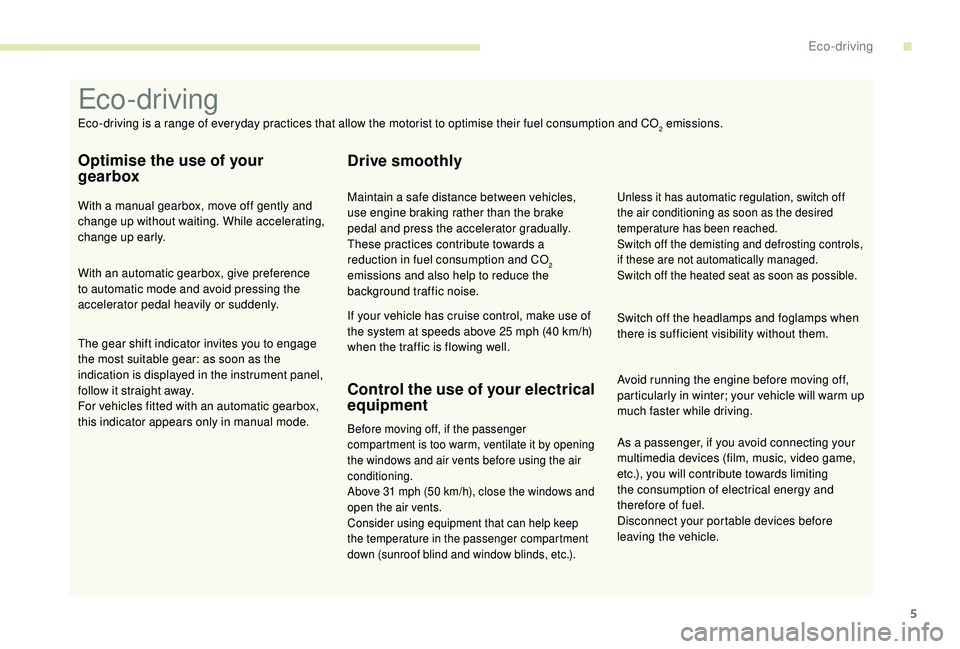
As a passenger, if you avoid connecting your
multimedia devices (film, music, video game,
etc.), you will contribute towards limiting
the consumption of electrical energy and
therefore of fuel.
Disconnect your portable devices before
leaving the vehicle.
Eco- driving
Eco-driving is a range of everyday practices that allow the motorist to optimise their fuel consumption and CO2 emissions.
Optimise the use of your
gearbox
With a manual gearbox, move off gently and
change up without waiting. While accelerating,
change up early.
With an automatic gearbox, give preference
to automatic mode and avoid pressing the
accelerator pedal heavily or suddenly.
The gear shift indicator invites you to engage
the most suitable gear: as soon as the
indication is displayed in the instrument panel,
follow it straight away.
For vehicles fitted with an automatic gearbox,
this indicator appears only in manual mode.
Drive smoothly
Maintain a safe distance between vehicles,
use engine braking rather than the brake
pedal and press the accelerator gradually.
These practices contribute towards a
reduction in fuel consumption and CO
2
emissions and also help to reduce the
background traffic noise.
If your vehicle has cruise control, make use of
the system at speeds above 25
mph (40 km/h)
when the traffic is flowing well.
Control the use of your electrical
equipment
Before moving off, if the passenger
compartment is too warm, ventilate it by opening
the windows and air vents before using the air
conditioning.
Above 31
mph (50 km/h), close the windows and
open the air vents.
Consider using equipment that can help keep
the temperature in the passenger compartment
down (sunroof blind and window blinds, etc.).
Switch off the headlamps and foglamps when
there is sufficient visibility without them.
Avoid running the engine before moving off,
particularly in winter; your vehicle will warm up
much faster while driving.
Unless it has automatic regulation, switch off
the air conditioning as soon as the desired
temperature has been reached.
Switch off the demisting and defrosting controls,
if these are not automatically managed.
Switch off the heated seat as soon as possible.
.
.
Eco-drivingsommaire
Page 47 of 252

9
Warning/indicator lampStateCause Action/Observations
Red warning/indicator lamps
STOPFixed, associated with
another warning lamp
and accompanied
by a message in the
screen. Major faults linked with the "Brake
fluid level", "Engine oil pressure
and temperature", "Engine
coolant temperature", "Electronic
brake force distribution" and
"Power steering" warning lamps. You must stop as soon as it is safe to do so.
Park, switch off the ignition and call a PEUGEOT
dealer or qualified workshop.
Engine coolant
temperature and
level Fixed, with the needle
in the red zone.
An abnormal increase in
temperature.
Park and switch off the ignition, then allow to cool down.
Check the level visually.
Flashing.
A drop in the engine coolant level. Contact a PEUGEOT dealer or a qualified workshop.
Engine oil pressure
and temperature Fixed while driving. Insufficient pressure or excessive
temperature.
Park and switch off the ignition, then allow to cool down.
Check the level visually. For more information on
Checking levels, refer to the corresponding section.
Fixed, even though the
level is correct. A major fault.
Have it checked by a PEUGEOT dealer or a qualified
workshop.
Battery charge Fixed. A fault in the charging circuit. Check the battery terminals. For more information on
the Battery, refer to the corresponding section.
Flashing. Active functions set to standby
(economy mode). For more information on the Battery
, refer to the
corresponding section.
Fixed, despite the
checks. A fault with the ignition or
injection system. Have it checked by a PEUGEOT dealer or a qualified
workshop.
1
Instruments
Page 48 of 252
10
Warning/indicator lampStateCause Action/Observations
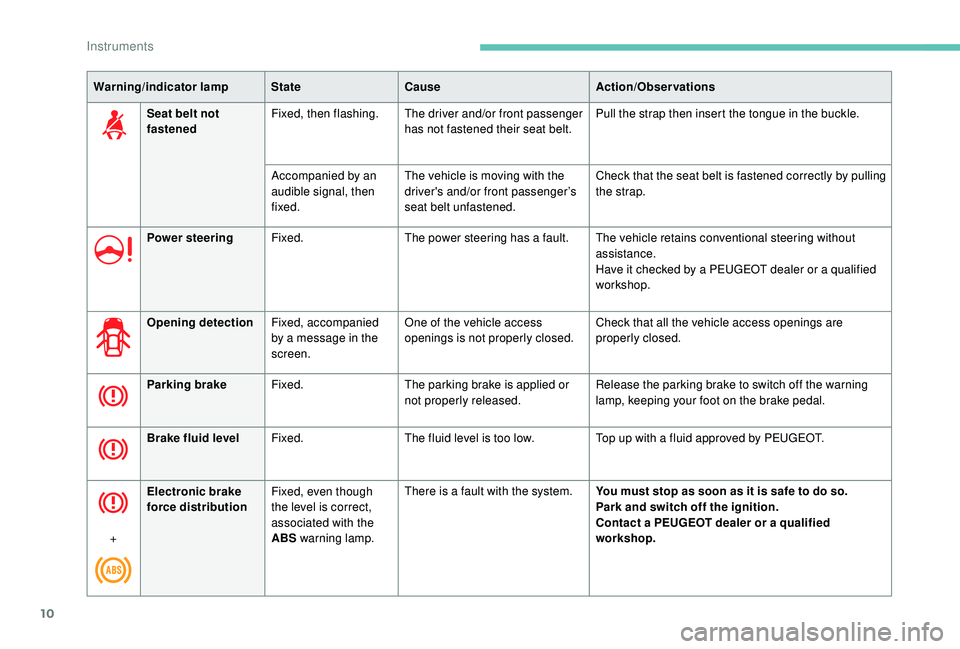
Seat belt not
fastened Fixed, then flashing.
The driver and/or front passenger
has not fastened their seat belt. Pull the strap then insert the tongue in the buckle.
Accompanied by an
audible signal, then
fixed. The vehicle is moving with the
driver's and/or front passenger’s
seat belt unfastened. Check that the seat belt is fastened correctly by pulling
the strap.
Power steering Fixed. The power steering has a fault. The vehicle retains conventional steering without
assistance.
Have it checked by a PEUGEOT dealer or a qualified
workshop.
Opening detection Fixed, accompanied
by a message in the
screen. One of the vehicle access
openings is not properly closed.
Check that all the vehicle access openings are
properly closed.
Parking brake Fixed. The parking brake is applied or
not properly released. Release the parking brake to switch off the warning
lamp, keeping your foot on the brake pedal.
Brake fluid level Fixed. The fluid level is too low. Top up with a fluid approved by PEUGEOT.
+ Electronic brake
force distribution
Fixed, even though
the level is correct,
associated with the
ABS
warning lamp. There is a fault with the system.
You must stop as soon as it is safe to do so.
Park and switch off the ignition.
Contact a PEUGEOT dealer or a qualified
workshop.
Instruments
Page 117 of 252
79
Anti-lock braking system
(ABS/EBFD)
The ABS and EBFD (electronic brake force
distribution) systems improve the stability and
manoeuvrability of your vehicle when braking,
in particular on poor or slippery sur faces.
The ABS prevents the wheels from locking,
and the EBFD provides control of the braking
pressure wheel by wheel.
The anti-lock braking system comes into
operation automatically when there is a risk
of wheel lock. It does not reduce the braking
distance.
On very slippery sur faces (ice, oil, etc.), the
ABS may increase the braking distance. When
braking in an emergency, do not hesitate to
press the brake pedal firmly without releasing
the pressure, even on a slippery sur face; you
will then be able to continue to manoeuvre the
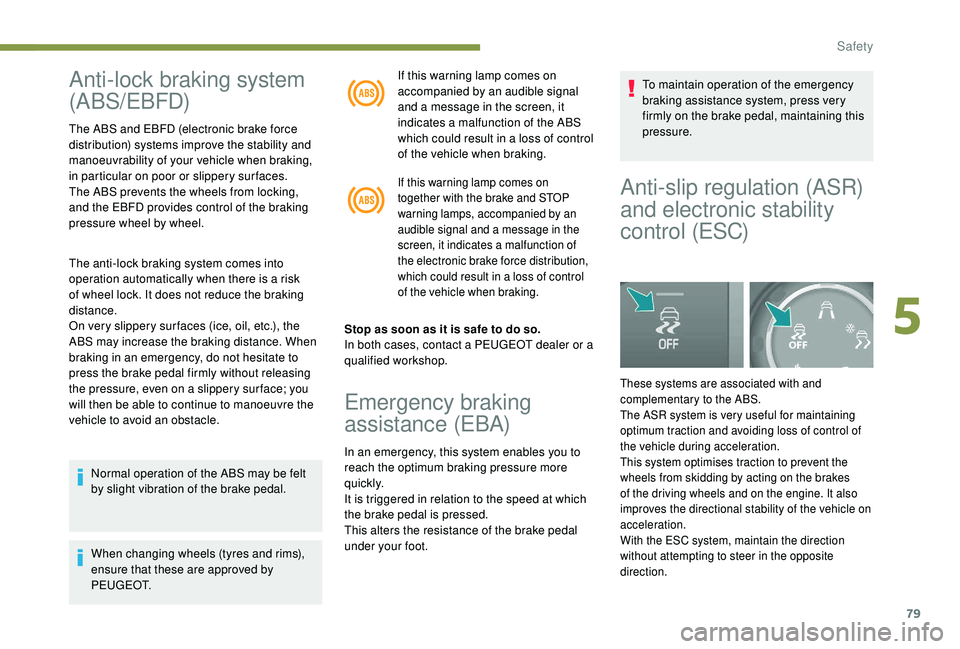
vehicle to avoid an obstacle.If this warning lamp comes on
accompanied by an audible signal
and a message in the screen, it
indicates a malfunction of the ABS
which could result in a loss of control
of the vehicle when braking.
If this warning lamp comes on
together with the brake and STOP
warning lamps, accompanied by an
audible signal and a message in the
screen, it indicates a malfunction of
the electronic brake force distribution,
which could result in a loss of control
of the vehicle when braking.
Stop as soon as it is safe to do so.
In both cases, contact a PEUGEOT dealer or a
qualified workshop.
Emergency braking
assistance (EBA)
In an emergency, this system enables you to
reach the optimum braking pressure more
quickly.
It is triggered in relation to the speed at which
the brake pedal is pressed.
This alters the resistance of the brake pedal
under your foot.To maintain operation of the emergency
braking assistance system, press very
firmly on the brake pedal, maintaining this
pressure.
Normal operation of the ABS may be felt
by slight vibration of the brake pedal.
When changing wheels (tyres and rims),
ensure that these are approved by
P E U G E O T.
Anti-slip regulation (ASR)
and electronic stability
c ont rol (ESC)
These systems are associated with and
complementary to the ABS.
The ASR system is very useful for maintaining
optimum traction and avoiding loss of control of
the vehicle during acceleration.
This system optimises traction to prevent the
wheels from skidding by acting on the brakes
of the driving wheels and on the engine. It also
improves the directional stability of the vehicle on
acceleration.
With the ESC system, maintain the direction
without attempting to steer in the opposite
direction.
5
Safety
Page 118 of 252
80
Operation
The warning lamp flashes when the
ASR or ESC is triggered.
Deactivation
In exceptional conditions (moving a vehicle that
is bogged down in mud, stuck in snow, on loose
soil, etc.), it may prove useful to deactivate the
ASR and ESC systems, so that the wheels can
spin and regain grip.F
P
ress the button or turn the
knob to the ESC OFF position
(depending on version).
The LED lights up: the ASR and ESC systems
are deactivated.
They reactivate again:
-
a
utomatically above 31 mph (50 km/h),
If there is a difference between the path followed
by the vehicle and that required by the driver, the
ESC system automatically acts on the brake of
one or more wheels and on the engine to return
the vehicle to the required path.
- manually when you press the button again or turn the knob
to this position (depending on
ve r s i o n).
Operating fault
In the event of a malfunction of the
systems, the warning lamp and the
LED come on, accompanied by an
audible signal and a message on the
screen.
Contact a PEUGEOT dealer or a qualified
workshop to have the system checked.
The warning lamp may also come on if the
tyres are under-inflated. Check the pressure of
each tyre.
Although the ASR /ESC systems help to
improve safety in normal driving, they
should not encourage the driver to take
extra risks or drive at high speed.
The correct operation of these systems
is ensured if the recommendations of the
manufacturer regarding the wheels (tyres
and rims), the braking components, the
electronic components and the fitting and
repair procedures are observed.
After an impact, have these systems
checked by a PEUGEOT dealer or a
qualified workshop.
Grip control
Special patented traction control system which
improves traction on snow, mud and sand.
This system, the operation of which has been
optimised for each situation, allows you to
manoeuvre in most conditions of poor grip
(encountered during passenger car use).
The accelerator pedal should be pressed
sufficiently to allow the system to use the power
of the engine. Operation at high engine speeds
is completely normal.
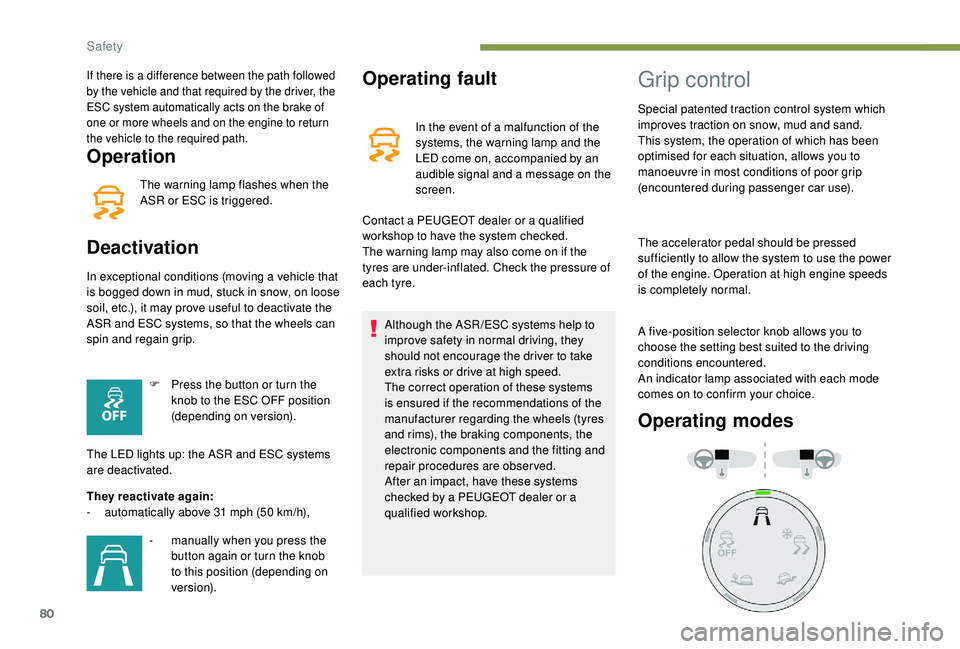
A five-position selector knob allows you to
choose the setting best suited to the driving
conditions encountered.
An indicator lamp associated with each mode
comes on to confirm your choice.
Operating modes
Safety
Page 141 of 252
103
Driving recommendations
Obser ve the Highway Code and remain vigilant
whatever the traffic conditions.
Pay close attention to the traffic and keep your
hands on the wheel so that you are ready to
react at any time to any eventuality.
As a safety measure, the driver should only
carry out any operations that require close
attention when the vehicle is stationary.
On a long journey, a break every two hours is
strongly recommended.
In bad weather, drive smoothly, anticipate the
need to brake and increase the safety distance.
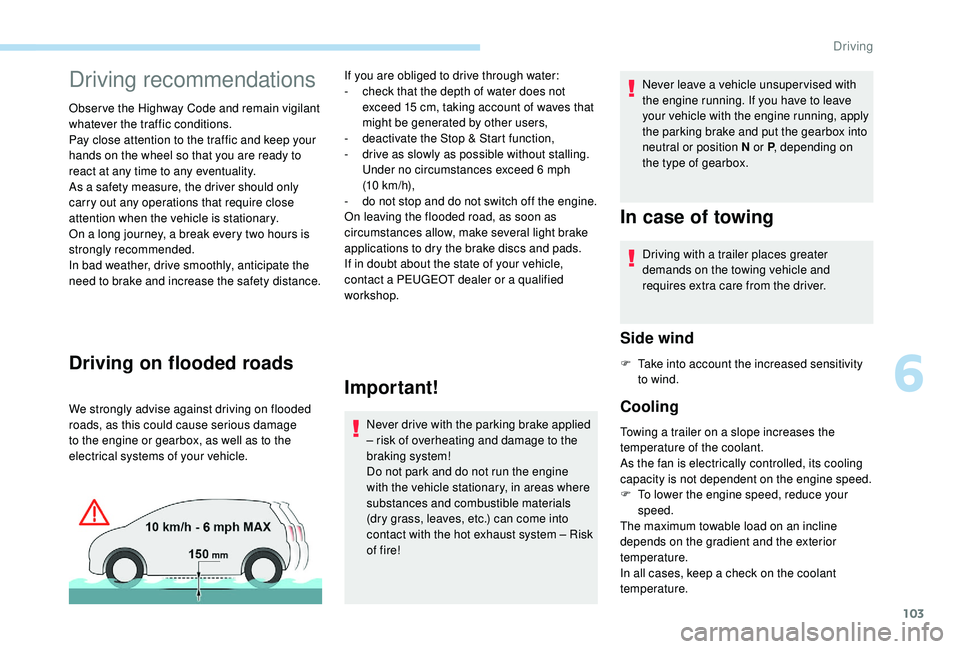
Driving on flooded roads
We strongly advise against driving on flooded
roads, as this could cause serious damage
to the engine or gearbox, as well as to the
electrical systems of your vehicle.
Important!
Never drive with the parking brake applied
– risk of overheating and damage to the
braking system!
Do not park and do not run the engine
with the vehicle stationary, in areas where
substances and combustible materials
(dry grass, leaves, etc.) can come into
contact with the hot exhaust system – Risk
of fire!Never leave a vehicle unsuper vised with
the engine running. If you have to leave
your vehicle with the engine running, apply
the parking brake and put the gearbox into
neutral or position N or P
, depending on
the type of gearbox.
In case of towing
If you are obliged to drive through water:
- c heck that the depth of water does not
exceed 15
cm, taking account of waves that
might be generated by other users,
-
d
eactivate the Stop & Start function,
-
d
rive as slowly as possible without stalling.
Under no circumstances exceed 6
mph
(10
km/h),
-
d
o not stop and do not switch off the engine.
On leaving the flooded road, as soon as
circumstances allow, make several light brake
applications to dry the brake discs and pads.
If in doubt about the state of your vehicle,
contact a PEUGEOT dealer or a qualified
workshop. Driving with a trailer places greater
demands on the towing vehicle and
requires extra care from the driver.
Side wind
F Take into account the increased sensitivity
to wind.
Cooling
Towing a trailer on a slope increases the
temperature of the coolant.
As the fan is electrically controlled, its cooling
capacity is not dependent on the engine speed.
F
T
o lower the engine speed, reduce your
speed.
The maximum towable load on an incline
depends on the gradient and the exterior
temperature.
In all cases, keep a check on the coolant
temperature.
6
Driving