wheel PEUGEOT PARTNER TEPEE ELECTRIC 2017 Owners Manual
[x] Cancel search | Manufacturer: PEUGEOT, Model Year: 2017, Model line: PARTNER TEPEE ELECTRIC, Model: PEUGEOT PARTNER TEPEE ELECTRIC 2017Pages: 252, PDF Size: 9.89 MB
Page 11 of 252
9
Parking the vehicle
When leaving the vehicle, it is strongly
recommended that you apply the parking
brake, place the drive selector in position P,
then switch off the ignition.
There is an audible signal on opening the
driver's door if:
-
t
he ignition is still on (" Ready" lamp on),
-
t
he vehicle has not been correctly
immobilised (drive selector not in
position P ).
An alert message is displayed in the screen.
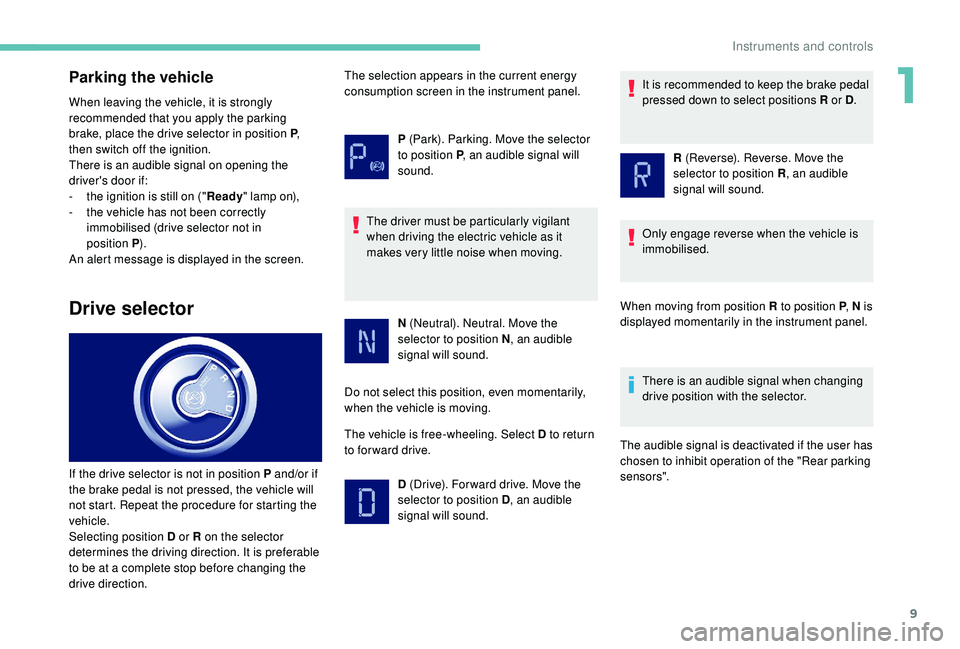
Drive selector
P (Park). Parking. Move the selector
to position P , an audible signal will
sound.
If the drive selector is not in position P and/or if
the brake pedal is not pressed, the vehicle will
not start. Repeat the procedure for starting the
vehicle.
Selecting position D or R on the selector
determines the driving direction. It is preferable
to be at a complete stop before changing the
drive direction. The selection appears in the current energy
consumption screen in the instrument panel.
The driver must be particularly vigilant
when driving the electric vehicle as it
makes very little noise when moving. N (Neutral). Neutral. Move the
selector to position N , an audible
signal will sound.
Do not select this position, even momentarily,
when the vehicle is moving.
The vehicle is free-wheeling. Select D to return
to for ward drive. D (Drive). For ward drive. Move the
selector to position D , an audible
signal will sound. It is recommended to keep the brake pedal
pressed down to select positions R or D
.
R (Reverse). Reverse. Move the
selector to position R , an audible
signal will sound.
Only engage reverse when the vehicle is
immobilised.
When moving from position R to position P , N is
displayed momentarily in the instrument panel.
There is an audible signal when changing
drive position with the selector.
The audible signal is deactivated if the user has
chosen to inhibit operation of the "Rear parking
sensors".
1
Instruments and controls
Page 26 of 252
24
Other information
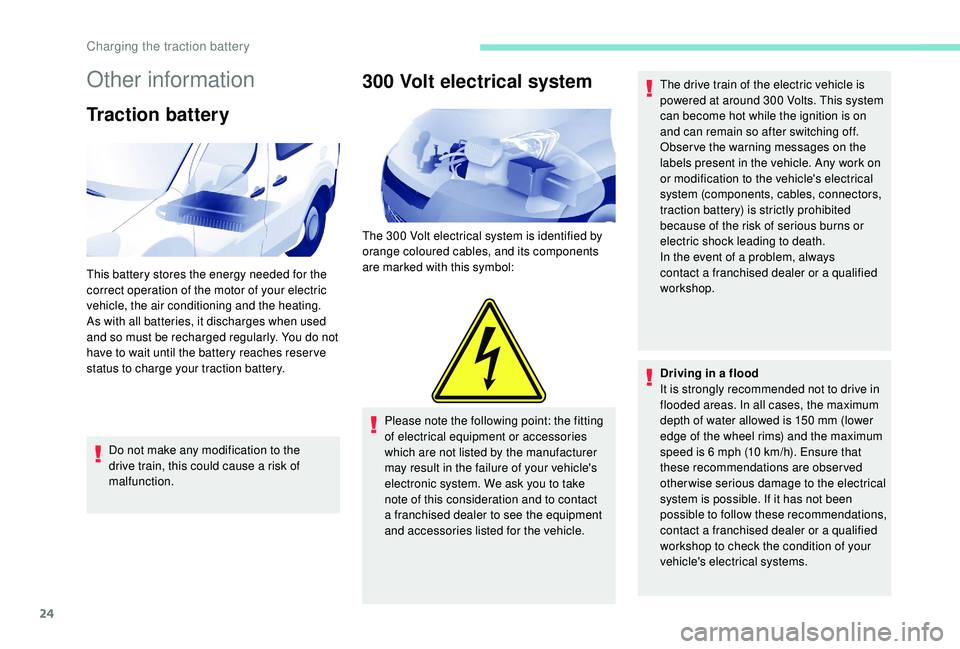
Traction battery
Do not make any modification to the
drive train, this could cause a risk of
malfunction.
300 Volt electrical system
The 300 Volt electrical system is identified by
o range coloured cables, and its components
are marked with this symbol:
Please note the following point: the fitting
of electrical equipment or accessories
which are not listed by the manufacturer
may result in the failure of your vehicle's
electronic system. We ask you to take
note of this consideration and to contact
a franchised dealer to see the equipment
and accessories listed for the vehicle. The drive train of the electric vehicle is
powered at around 300
Volts. This system
can become hot while the ignition is on
and can remain so after switching off.
Obser ve the warning messages on the
labels present in the vehicle. Any work on
or modification to the vehicle's electrical
system (components, cables, connectors,
traction battery) is strictly prohibited
because of the risk of serious burns or
electric shock leading to death.
In the event of a problem, always
contact a franchised dealer or a qualified
workshop.
Driving in a flood
It is strongly recommended not to drive in
flooded areas. In all cases, the maximum
depth of water allowed is 150
mm (lower
edge of the wheel rims) and the maximum
speed is 6
mph (10 km/h). Ensure that
these recommendations are observed
otherwise serious damage to the electrical
system is possible. If it has not been
possible to follow these recommendations,
contact a franchised dealer or a qualified
workshop to check the condition of your
vehicle's electrical systems.
This battery stores the energy needed for the
correct operation of the motor of your electric
vehicle, the air conditioning and the heating.
As with all batteries, it discharges when used
and so must be recharged regularly. You do not
have to wait until the battery reaches reser ve
status to charge your traction battery.
Charging the traction battery
Page 32 of 252
30
Fuses
The fusebox is placed in the lower dashboard (left-hand side).
The designations provided are for the fuses that can be replaced by the user. For any other work,
contact a franchised dealer or a qualified workshop.Fuse no. Rating Functions
1 15
ARear wiper.
3 5
AAirbags.
4 10
ADiagnostic socket, mirror control, headlamp beams.
5 30
AWindow controls.
6 30
ASide-hinged door lock.
7 5
A Rear courtesy lamp, roof, glove box.
8 20
A Audio system, screen, alarm and siren.
11 15
AAnti-theft.
12 15
AAir conditioning control panel, front and rear parking sensors.
13 5
AInstrument panel.
14 15
ARain and sunshine sensor, airbags.
15 5
AOther locks.
17 40
ARear screen / mirrors demisting.
Towing the vehicle
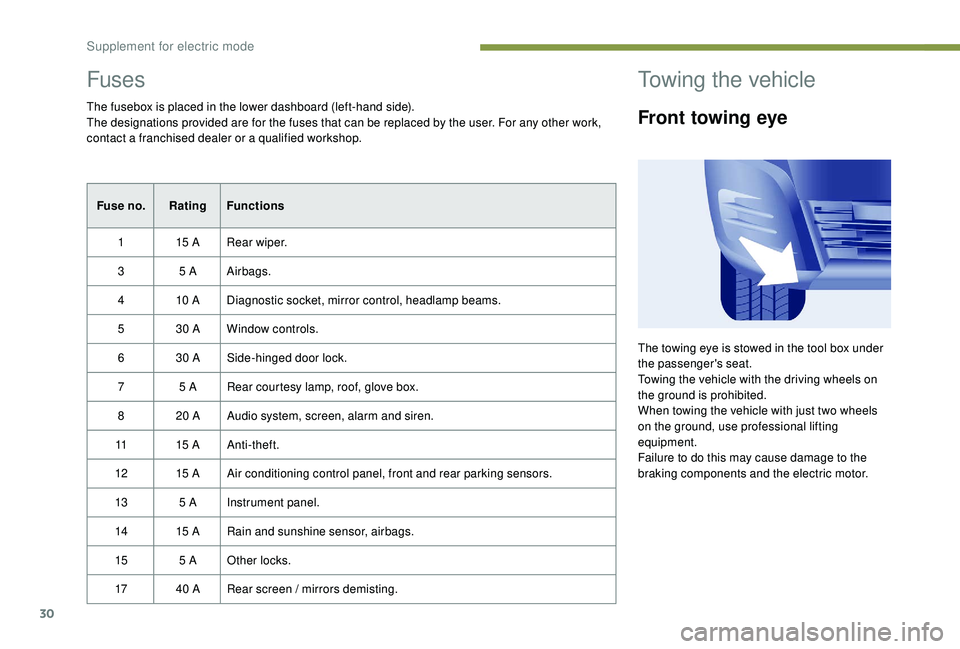
Front towing eye
The towing eye is stowed in the tool box under
the passenger's seat.
Towing the vehicle with the driving wheels on
the ground is prohibited.
When towing the vehicle with just two wheels
on the ground, use professional lifting
equipment.
Failure to do this may cause damage to the
braking components and the electric motor.
Supplement for electric mode
Page 34 of 252
32
The range of the vehicle, approved on
the NEDC cycle, is 105 miles (170 km).
This range may vary according to various
factors, the main ones being the use of
the heating and air conditioning, the style
of driving, the type of route taken and the
ageing of the traction battery.
Ageing of the traction battery also depends
on various factors, such as the ambient
temperature, the mileage of the vehicle, the
frequency of fast charges, etc.Identification markings
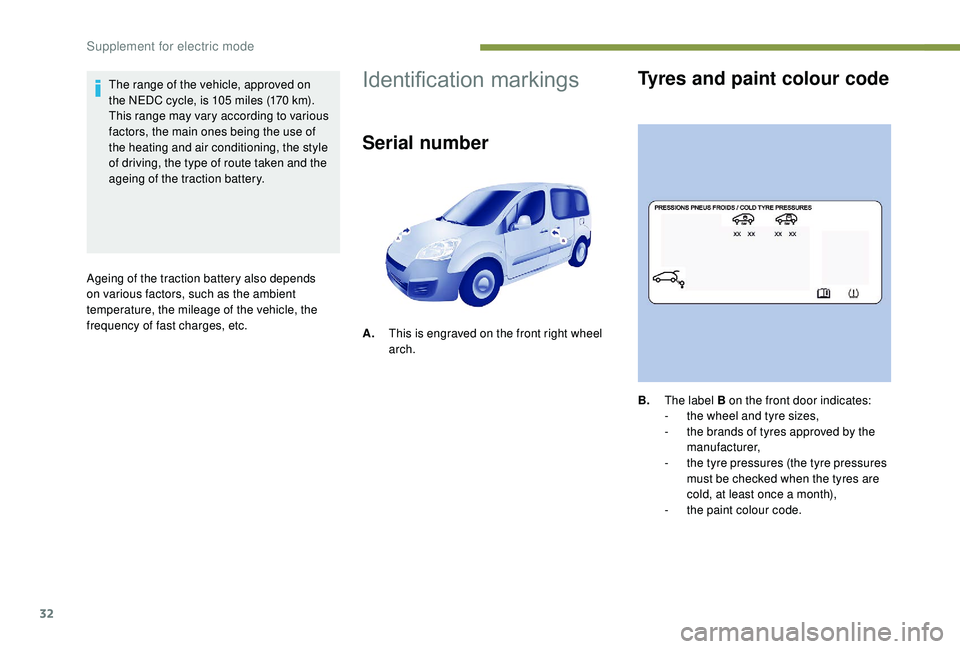
Serial number
A. This is engraved on the front right wheel
arch.
Tyres and paint colour code
B.The label B on the front door indicates:
-
t he wheel and tyre sizes,
-
t
he brands of tyres approved by the
manufacturer,
-
t
he tyre pressures (the tyre pressures
must be checked when the tyres are
cold, at least once a month),
-
t
he paint colour code.
Supplement for electric mode
Page 40 of 252

2
.
.
Instrument panel 7
W arning and indicator lamps 8
I
ndic ators
18
Lighting dimmer
2
2
Trip computer
2
2
Date and time setting
2
3
Instruments and controls
4
K
ey
25
Remote control
2
5
Front doors
2
8
Sliding side door(s)
2
8
Operation in the event of a battery failure
2
9
Tailgate
29
Side-hinged rear doors
3
0
Rear roof flap
3
2
Central locking
3
3
Alarm
34
Rear windows
3
5
Electric windows
3
5Steering wheel adjustment
3
7
Mirrors
37
Surveillance mirror
3
8
Front seats
3
8
Individual passenger seat
4
0
Multi-Flex bench seat
4
0
Rear bench seat
4
2
Rear seats (5 seats) 4 3
Rear seats (7 seats) 4 6
Crew cab
5
0
Seat modularity and configurations
5
2
Front fittings
5
4
Seating area fittings
5
5
Zenith
56
Fragrance diffuser
5
7
Courtesy lamps
5
9
Rear fittings (5 seats)
6
0
Rear fittings (7 seats)
6
1
Load space layout
6
4
Heating/Manual air conditioning
6
6
Dual-zone automatic air conditioning
6
7
Recommendations for ventilation
and air conditioning
6
9
Demisting and defrosting
7
0Lighting control stalk
7
1
Automatic illumination of headlamps
7
2
LED daytime running lamps
7
2
Guide-me-home lighting
7
2
Cornering lighting
7
3
Direction indicators
7
3
Headlamp beam
7
3
Wiper control stalk 7 3
General safety recommendations
7
6
Hazard warning lamps
7
7
Horn
77
Emergency or assistance call
7
7
Anti-lock braking system (ABS/EBFD)
7
9
Emergency braking assistance (EBA)
7
9
Anti-slip regulation (ASR) and electronic
stability control (ESC)
7
9
Grip control
8
0
Seat belts
8
2
Airbags
85
Child seats
8
9
Deactivating the passenger's front airbag
9
0
Reactivating the passenger's front airbag
9
1
Recommended child seats
9
4
Locations for child seats secured using
a seat belt
9
5
ISOFIX mountings and child seats
9
8
Instructions for child seats
1
01
Child lock
1
02
Over view
Instruments
Access Ease of use and comfort
Safety
Lighting and visibility
Eco-driving
Contents
Page 41 of 252
3
.
.
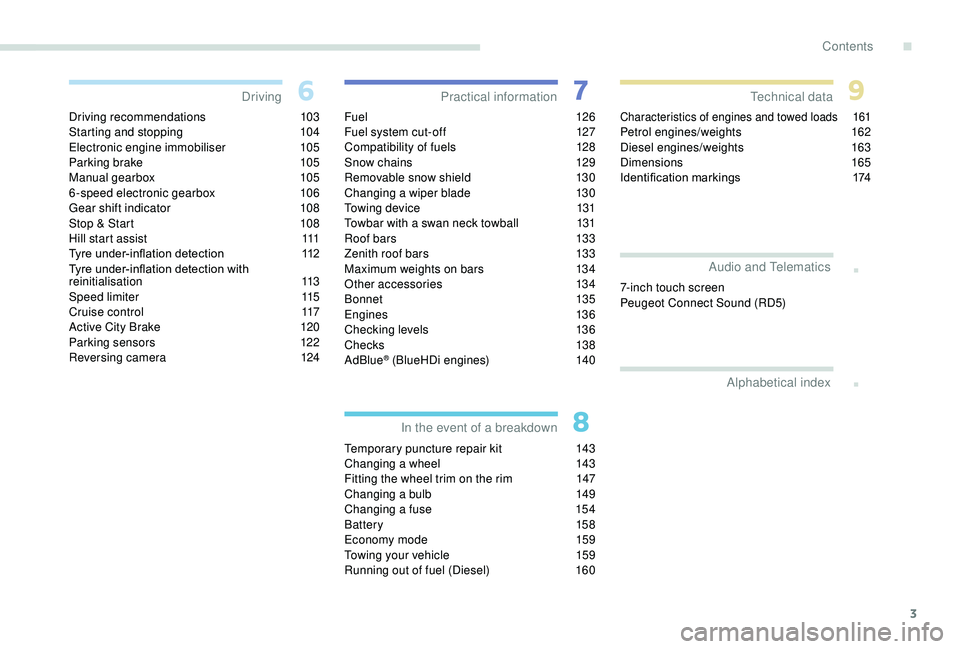
Driving recommendations 103
Starting and stopping 1 04
Electronic engine immobiliser
1
05
Parking brake
1
05
Manual gearbox
1
05
6-speed electronic gearbox
1
06
Gear shift indicator
1
08
Stop & Start
1
08
Hill start assist
1
11
Tyre under-inflation detection
1
12
Tyre under-inflation detection with
reinitialisation
113
Speed limiter
1
15
Cruise control
1
17
Active City Brake
1
20
Parking sensors
1
22
Reversing camera
1
24Fuel 1
26
Fuel system cut-off 1 27
Compatibility of fuels
1
28
Snow chains
1
29
Removable snow shield
1
30
Changing a wiper blade
1
30
Towing device
1
31
Towbar with a swan neck towball
1
31
Roof bars
1
33
Zenith roof bars
1
33
Maximum weights on bars
1
34
Other accessories
1
34
Bonnet
13 5
Engines
1
36
Checking levels
1
36
Chec ks
13 8
AdBlue
® (BlueHDi engines) 1 40
Temporary puncture repair kit
1
43
Changing a wheel
1
43
Fitting the wheel trim on the rim
1
47
Changing a bulb
1
49
Changing a fuse
1
54
Battery
158
Economy mode
1
59
Towing your vehicle
1
59
Running out of fuel (Diesel)
1
60
Characteristics of engines and towed loads 1 61Petrol engines/weights 162
Diesel engines/weights 1 63
Dimensions
165
Identification markings
1
74
DrivingPractical information
In the event of a breakdown Technical data
Alphabetical index
Audio and Telematics
7-inch touch screen
Peugeot Connect Sound (RD5)
.
Contents
Page 42 of 252

4
Instruments and controls1.Lighting and direction indicator control
stalk.
2. Instrument panel with display.
3. Wiper/screenwash/trip computer control
stalk.
4. Ignition.
5. Audio system controls.
6. Driver's front airbag/horn.
7. Steering wheel height and reach
adjustment.
8. Cruise control/speed limiter controls.
9. Control panel: parking sensors, headlamp
beam adjustment, ESC, Stop & Start,
alarm (depending on country of sale).
10. Bonnet release.
11. Electric door mirror adjustment controls.
12 . Front window controls.
13. Switch panel: hazard warning lamps,
central locking, child lock (depending on
ve r s i o n).
14 . Cigarette lighter.
15. Heating/ventilation controls.
16. Electronic gearbox or Grip control
control.
17. Touch screen.
18. USB port (with electronic gearbox).
19. USB port (with manual gearbox).
Over view
Page 44 of 252
6
Limit the causes of excess
consumption
Spread loads throughout the vehicle; place
the heaviest items in the bottom of the boot,
as close as possible to the rear seats.
Limit the loads carried in the vehicle and
reduce wind resistance (roof bars, roof rack,
bicycle carrier, trailer, etc.). Preferably, use a
roof box.
Remove roof bars and the roof rack after use.
At the end of winter, remove snow tyres and
refit your summer tyres.
Observe the recommendations
on maintenance
Check the tyre pressures regularly, when cold,
referring to the label in the door aperture,
driver's side.
Carry out this check in particular:
-
b
efore a long journey,
-
a
t each change of season,
-
a
fter a long period out of use.
Do not forget the spare wheel and the tyres on
any trailer or caravan. Have your vehicle ser viced regularly (engine
oil, oil filter, air filter, passenger compartment
filter, etc.) and obser ve the schedule of
operations in the manufacturer's service
schedule.
When filling the tank, do not continue after the
3
rd cut-off of the nozzle to avoid over flow.
At the wheel of your new vehicle, it is only
after the first 1,900
miles (3,000 kilometres)
that you will see the fuel consumption settle
down to a consistent average. With a BlueHDi Diesel engine, if the SCR
system is faulty, your vehicle becomes
polluting. Visit a PEUGEOT dealer or a
qualified workshop as soon as possible to
bring your vehicle’s nitrogen oxide emissions
back in line with the regulations.
Eco-driving
Page 50 of 252
12
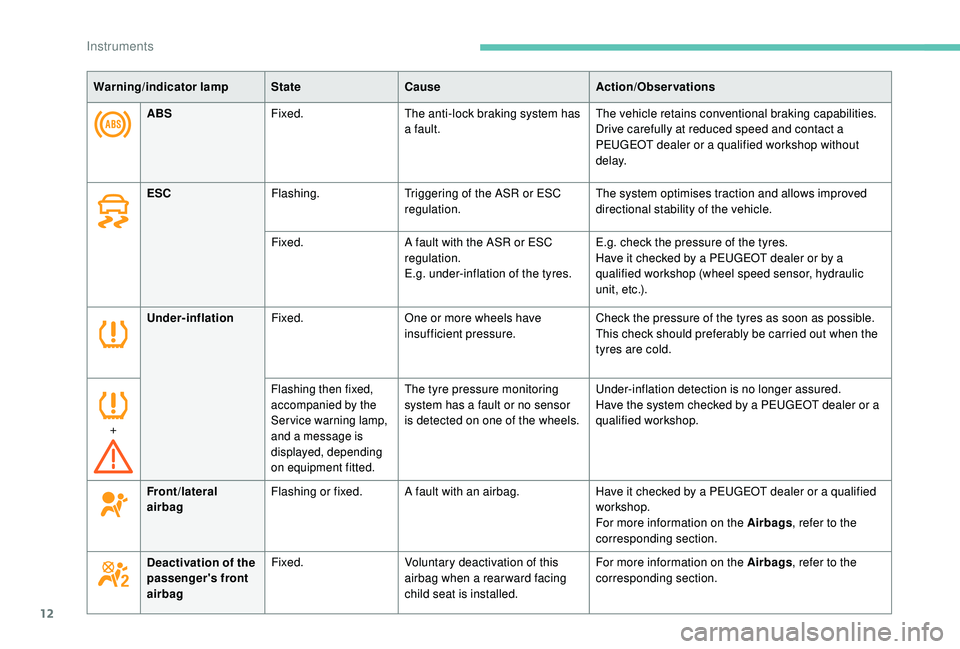
ABSFixed. The anti-lock braking system has
a fault. The vehicle retains conventional braking capabilities.
Drive carefully at reduced speed and contact a
PEUGEOT dealer or a qualified workshop without
d e l ay.
Warning/indicator lamp
StateCause Action/Observations
ESC Flashing. Triggering of the ASR or ESC
regulation. The system optimises traction and allows improved
directional stability of the vehicle.
Fixed. A fault with the ASR or ESC
regulation.
E.g. under-inflation of the tyres. E.g. check the pressure of the tyres.
Have it checked by a PEUGEOT dealer or by a
qualified workshop (wheel speed sensor, hydraulic
unit, etc.).
Under-inflation Fixed. One or more wheels have
insufficient pressure. Check the pressure of the tyres as soon as possible.
This check should preferably be carried out when the
tyres are cold.
+
Flashing then fixed,
accompanied by the
Service warning lamp,
and a message is
displayed, depending
on equipment fitted.The tyre pressure monitoring
system has a fault or no sensor
is detected on one of the wheels. Under-inflation detection is no longer assured.
Have the system checked by a PEUGEOT dealer or a
qualified workshop.
Front/lateral
airbag Flashing or fixed.
A fault with an airbag. Have it checked by a PEUGEOT dealer or a qualified
workshop.
For more information on the Airbags , refer to the
corresponding section.
Deactivation of the
passenger's front
airbag Fixed.
Voluntary deactivation of this
airbag when a rear ward facing
child seat is installed. For more information on the Airbags
, refer to the
corresponding section.
Instruments
Page 65 of 252
27
Lost keys, remote control
Go to a PEUGEOT dealer, taking with you the
vehicle's registration certificate, your personal
identification documents and if possible, the
label bearing the key code.
The PEUGEOT dealer will be able to retrieve
the key code and the transponder code
required to order a new key.
F
I
nsert the key into the ignition switch with
the remote control buttons (padlocks) facing
you.
F
S
witch on the ignition.
F
W
ithin ten seconds, press the locking
padlock for at least five seconds.
F
S
witch off the ignition.
F
W
ait at least one minute before using the
remote control.
The remote control is now working again. Anti-theft protection
Do not make any modifications to the
electronic engine immobiliser system; this
could cause malfunctions.
For vehicles with an ignition switch, do not
forget to remove the key and turn the steering
wheel to engage the steering lock.
Remote control
The high frequency remote control is a
sensitive system; do not operate it while it is
in your pocket as there is a possibility that
it may unlock the vehicle, without you being
aware of it.
Do not repeatedly press the buttons of your
remote control out of range and out of sight
of your vehicle. You may stop it from working
and the remote control would have to be
reinitialised.
The remote control does not operate when
the key is in the ignition, even when the
ignition is switched off.
Locking the vehicle
Driving with the doors locked may make
access to the passenger compartment by
the emergency ser vices more difficult in an
emergency.
As a safety precaution (with children on
board), remove the key from the ignition or
take the electronic key when you leave the
vehicle, even for a short time. When purchasing a second-hand vehicle
Have the key codes memorised by a
PEUGEOT dealer, to ensure that the keys in
your possession are the only ones which can
start the vehicle.
2
Access