ECU PONTIAC G8 2009 Owner's Manual
[x] Cancel search | Manufacturer: PONTIAC, Model Year: 2009, Model line: G8, Model: PONTIAC G8 2009Pages: 356, PDF Size: 1.83 MB
Page 52 of 356
Securing Child Restraints
(Rear Seat)
When securing a child restraint in a
rear seating position, study the
instructions that came with your child
restraint to make sure it is compatible
with this vehicle.
If the child restraint has the LATCH
system, seeLower Anchors and
Tethers for Children (LATCH)
on page 1-42for how and where to
install your child restraint using
LATCH. If a child restraint is secured
in the vehicle using a safety belt
and it uses a top tether, seeLower
Anchors and Tethers for Children
(LATCH) on page 1-42for top tether
anchor locations.Do not secure a child restraint in a
position without a top tether
anchor if a national or local law
requires that the top tether be
anchored, or if the instructions that
come with the child restraint say
that the top strap must be anchored.
In Canada, the law requires that
forward-facing child restraints have
a top tether, and that the tether
be attached.
If the child restraint does not have
the LATCH system, you will be using
the safety belt to secure the child
restraint in this position. Be sure to
follow the instructions that came
with the child restraint. Secure the
child in the child restraint when
and as the instructions say.If more than one child restraint
needs to be installed in the
rear seat, be sure to readWhere to
Put the Restraint on page 1-40.
1. Put the child restraint on the seat.
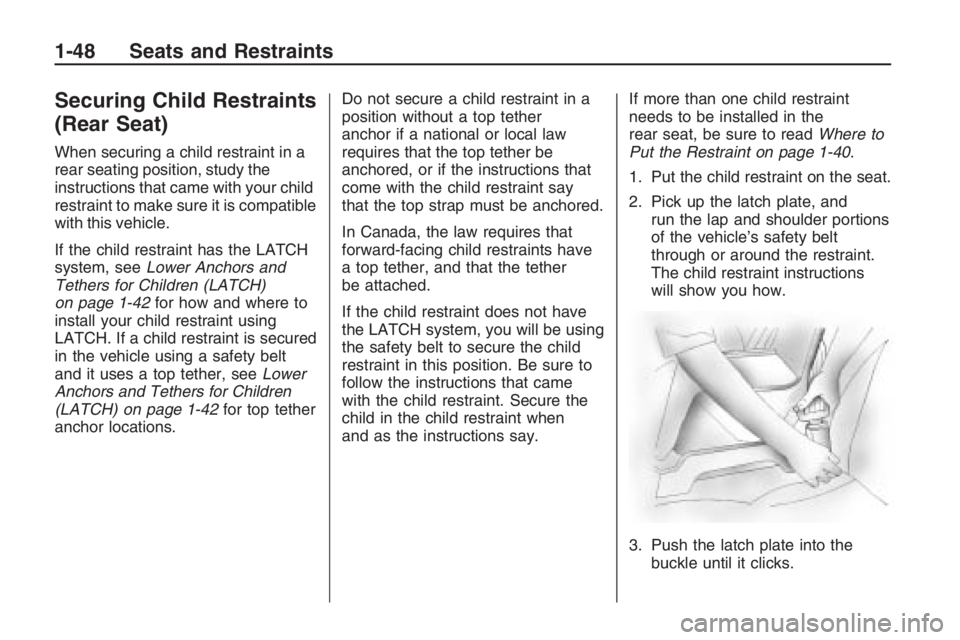
2. Pick up the latch plate, and
run the lap and shoulder portions
of the vehicle’s safety belt
through or around the restraint.
The child restraint instructions
will show you how.
3. Push the latch plate into the
buckle until it clicks.
1-48 Seats and Restraints
Page 53 of 356
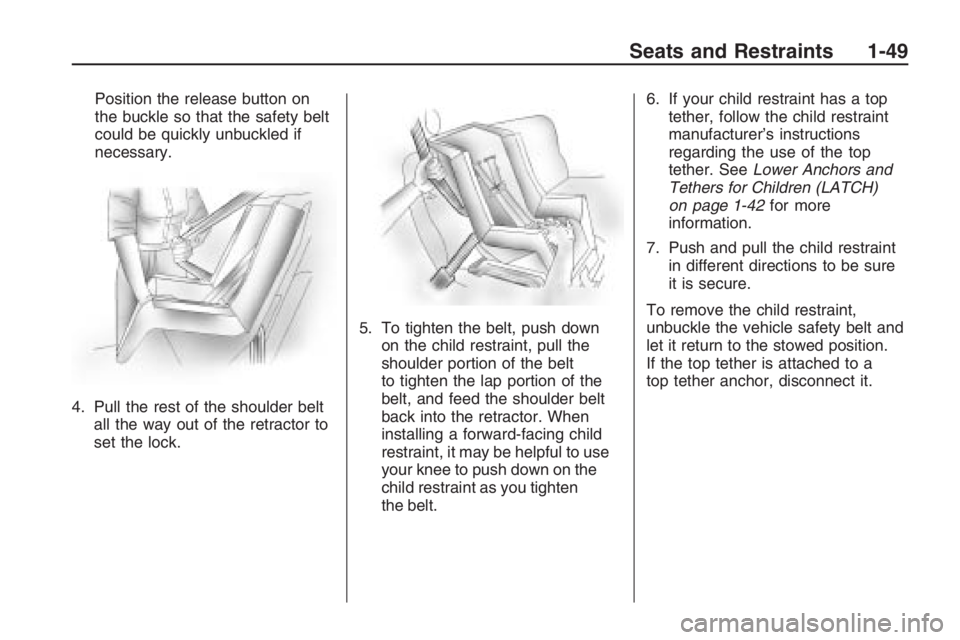
Position the release button on
the buckle so that the safety belt
could be quickly unbuckled if
necessary.
4. Pull the rest of the shoulder belt
all the way out of the retractor to
set the lock.5. To tighten the belt, push down
on the child restraint, pull the
shoulder portion of the belt
to tighten the lap portion of the
belt, and feed the shoulder belt
back into the retractor. When
installing a forward-facing child
restraint, it may be helpful to use
your knee to push down on the
child restraint as you tighten
the belt.6. If your child restraint has a top
tether, follow the child restraint
manufacturer’s instructions
regarding the use of the top
tether. SeeLower Anchors and
Tethers for Children (LATCH)
on page 1-42for more
information.
7. Push and pull the child restraint
in different directions to be sure
it is secure.
To remove the child restraint,
unbuckle the vehicle safety belt and
let it return to the stowed position.
If the top tether is attached to a
top tether anchor, disconnect it.
Seats and Restraints 1-49
Page 54 of 356
Securing Child Restraints
(Right Front Seat)
This vehicle has airbags. A rear
seat is a safer place to secure
a forward-facing child restraint.
SeeWhere to Put the Restraint
on page 1-40.
In addition, the vehicle has a
passenger sensing system which
is designed to turn off the right front
passenger frontal airbag under
certain conditions. SeePassenger
Sensing System on page 1-27
andPassenger Airbag Status
Indicator on page 4-14for more
information, including important
safety information.A label on the sun visor says,
“Never put a rear-facing child seat
in the front.” This is because the risk
to the rear-facing child is so great,
if the airbag deploys.
{CAUTION
A child in a rear-facing child
restraint can be seriously injured or
killed if the right front passenger
airbag inates. This is because
the back of the rear-facing child
restraint would be very close to
the inating airbag. A child in a
forward-facing child restraint can
be seriously injured or killed if the
right front passenger airbag
inates and the passenger seat
is in a forward position.
(Continued)
CAUTION (Continued)
Even if the passenger sensing
system has turned off the right
front passenger frontal airbag, no
system is fail-safe. No one can
guarantee that an airbag will not
deploy under some unusual
circumstance, even though it is
turned off.
Secure rear-facing child restraints
in a rear seat, even if the airbag is
off. If you secure a forward-facing
child restraint in the right front seat,
always move the front passenger
seat as far back as it will go. It is
better to secure the child restraint
in a rear seat.
SeePassenger Sensing System
on page 1-27for additional
information.
1-50 Seats and Restraints
Page 55 of 356
If the child restraint has the LATCH
system, seeLower Anchors and
Tethers for Children (LATCH)
on page 1-42for how and where to
install the child restraint using
LATCH. If a child restraint is secured
using a safety belt and it uses a
top tether, seeLower Anchors and
Tethers for Children (LATCH)
on page 1-42for top tether anchor
locations.
Do not secure a child seat in a
position without a top tether anchor
if a national or local law requires
that the top tether be anchored, or if
the instructions that come with
the child restraint say that the top
strap must be anchored.
In Canada, the law requires that
forward-facing child restraints have a
top tether, and that the tether be
attached.You will be using the lap-shoulder
belt to secure the child restraint in
this position. Follow the instructions
that came with the child restraint.
1. Move the seat as far back as it
will go before securing the
forward-facing child restraint.
When the passenger sensing
system has turned off the
right front passenger frontal
airbag, the off indicator on
the passenger airbag status
indicator should light and stay lit
when the vehicle is started.
SeePassenger Airbag Status
Indicator on page 4-14.
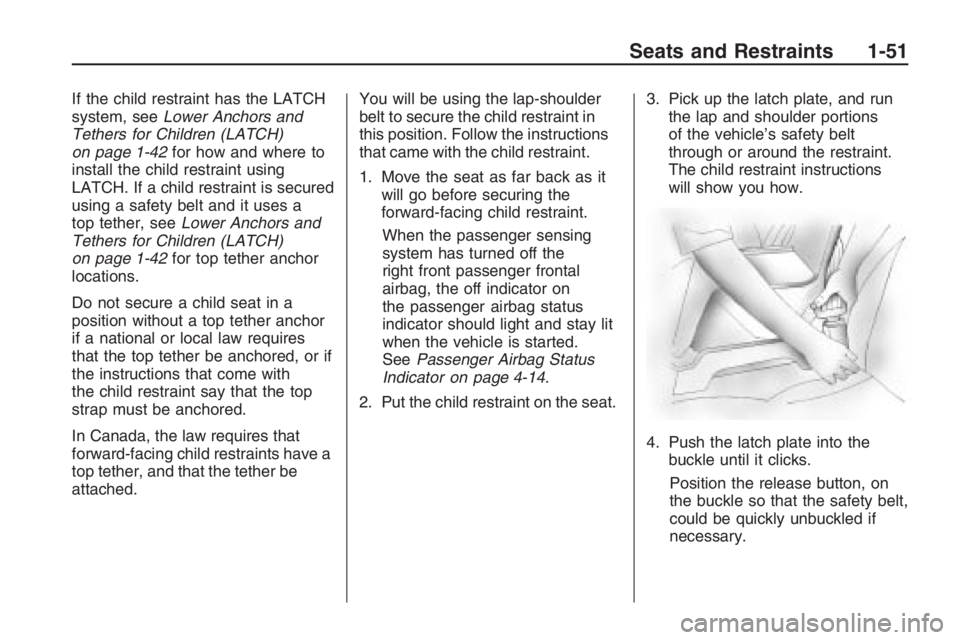
2. Put the child restraint on the seat.3. Pick up the latch plate, and run
the lap and shoulder portions
of the vehicle’s safety belt
through or around the restraint.
The child restraint instructions
will show you how.
4. Push the latch plate into the
buckle until it clicks.
Position the release button, on
the buckle so that the safety belt,
could be quickly unbuckled if
necessary.
Seats and Restraints 1-51
Page 56 of 356
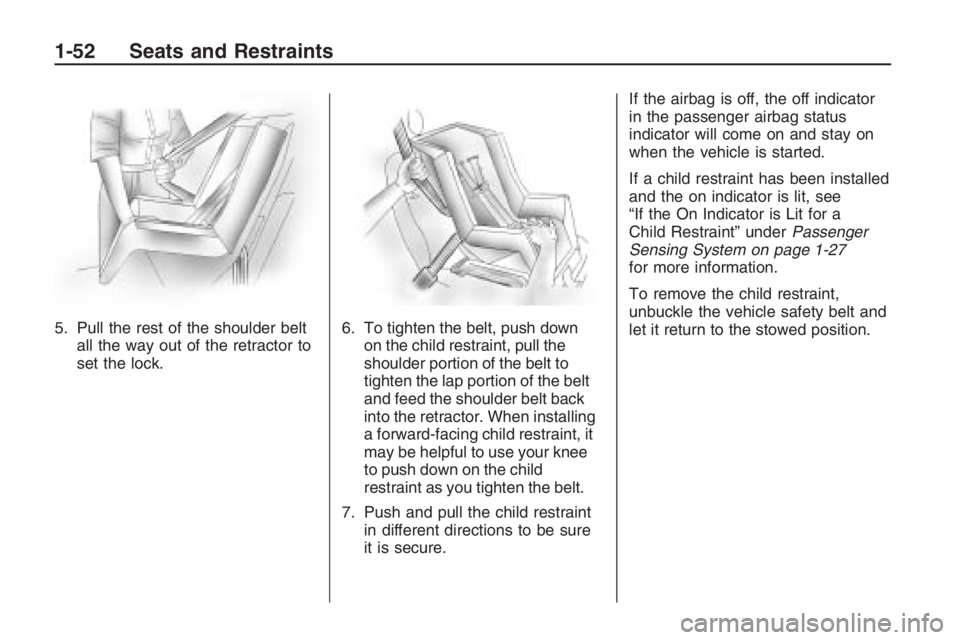
5. Pull the rest of the shoulder belt
all the way out of the retractor to
set the lock.6. To tighten the belt, push down
on the child restraint, pull the
shoulder portion of the belt to
tighten the lap portion of the belt
and feed the shoulder belt back
into the retractor. When installing
a forward-facing child restraint, it
may be helpful to use your knee
to push down on the child
restraint as you tighten the belt.
7. Push and pull the child restraint
in different directions to be sure
it is secure.If the airbag is off, the off indicator
in the passenger airbag status
indicator will come on and stay on
when the vehicle is started.
If a child restraint has been installed
and the on indicator is lit, see
“If the On Indicator is Lit for a
Child Restraint” underPassenger
Sensing System on page 1-27
for more information.
To remove the child restraint,
unbuckle the vehicle safety belt and
let it return to the stowed position.
1-52 Seats and Restraints
Page 57 of 356
Keys, Doors and
Windows
Keys
Keys...................................2-2
Remote Keyless Entry
(RKE) System...................2-3
Remote Keyless Entry
(RKE) System
Operation
..........................2-4
Remote Vehicle Start..........2-6
Doors and Locks
Door Locks.........................2-8
Power Door Locks..............2-9
Rear Door Security
Locks................................2-9
Trunk................................2-10
Theft-Deterrent Systems
Theft-Deterrent Systems. . . .2-11
Immobilizer.......................2-11
Immobilizer Operation.......2-12
Content Theft-Deterrent.....2-13
Windows
Windows...........................2-14
Power Windows................2-15
Sun Visors........................2-15
Mirrors
Manual Rearview Mirror. . . .2-16
Compass..........................2-16
Outside Power Mirror(s). . . .2-17
Outside Convex Mirror......2-18
Sunroof
Sunroof.............................2-18
Keys, Doors and Windows 2-1
Page 65 of 356
The door lock cylinder turns freely
when either the wrong key is
used, or the correct key is not fully
inserted. The free turning door
lock feature prevents the lock from
being forced open.
To reset the lock, turn it to the
vertical position with the correct
key fully inserted. Remove the key
and insert it again.
If this does not reset the lock,
turn the key half-way around in
the cylinder and repeat the reset
procedure.Power Door Locks
The power door lock switch is
located on the center console.
K(Unlock):Press to unlock the
doors.
Q(Lock):Remove the key from
the ignition and press to lock
the doors.
Rear Door Security Locks
Your vehicle has rear door security
locks to prevent passengers
from opening the rear doors from
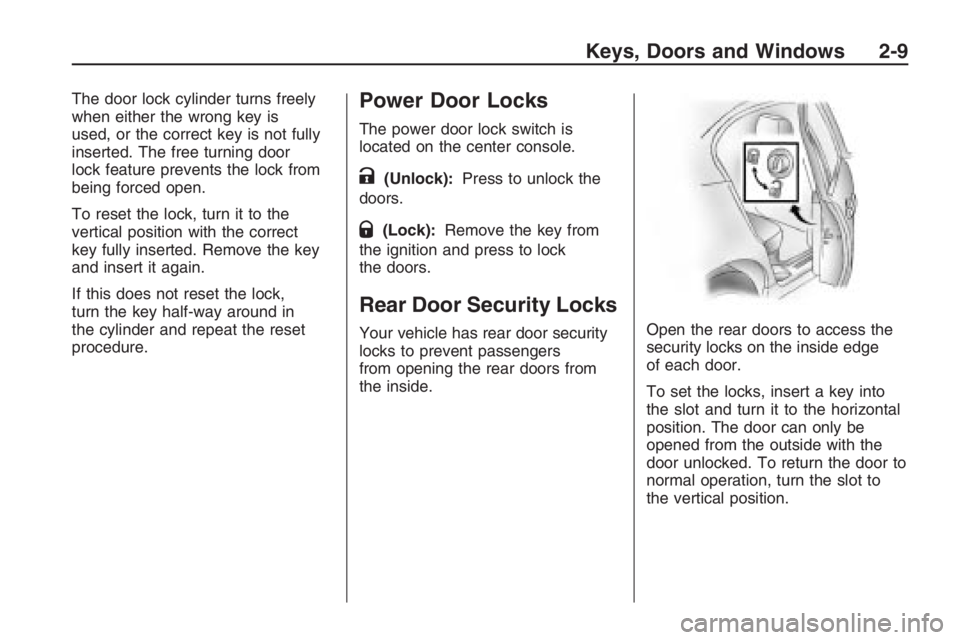
the inside.Open the rear doors to access the
security locks on the inside edge
of each door.
To set the locks, insert a key into
the slot and turn it to the horizontal
position. The door can only be
opened from the outside with the
door unlocked. To return the door to
normal operation, turn the slot to
the vertical position.
Keys, Doors and Windows 2-9
Page 66 of 356
Trunk
{CAUTION
It can be dangerous to drive
with the trunk lid open because
carbon monoxide (CO) gas
can come into your vehicle.
You cannot see or smell CO.
It can cause unconsciousness
and even death. If you must
drive with the trunk lid open or
if electrical wiring or other
(Continued)
CAUTION (Continued)
cable connections must pass
through the seal between the
body and the trunk lid:
Make sure all other windows
are shut.
Turn the fan on your heating
or cooling system to its
highest speed and select the
control setting that will force
outside air into your vehicle.
See Climate Control System.
If you have air outlets on or
under the instrument panel,
open them all the way.
SeeEngine Exhaust on page 8-14.
Remote Trunk Release
To open the trunk from the outside
the vehicle, press the
Vbutton
on the Remote Keyless Entry (RKE)
transmitter.
From inside the vehicle, press the
Vbutton located in the glove box.
The trunk can only be opened
while the vehicle is in PARK (P),
and when the doors are unlocked.
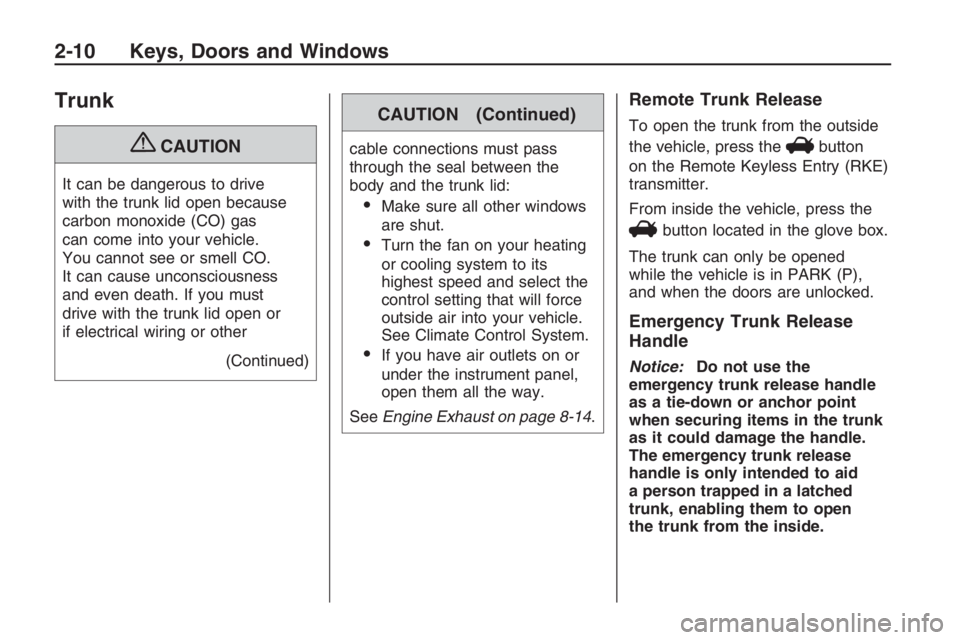
Emergency Trunk Release
Handle
Notice:Do not use the
emergency trunk release handle
as a tie-down or anchor point
when securing items in the trunk
as it could damage the handle.
The emergency trunk release
handle is only intended to aid
a person trapped in a latched
trunk, enabling them to open
the trunk from the inside.
2-10 Keys, Doors and Windows
Page 69 of 356
3. Insert and turn the new
section (A) to ON/RUN within
ve seconds of removing
the original key.
4. Turn the new section (A) to
LOCK/OFF. Section (A) is
now programmed.
To program a new section (B):
1. Turn the ignition to ON/RUN with
the new section (A).
The vehicle must be in P (Park).
2. Select Remote Key from
the personalization menu.
3. Select Program.
4. Press
QandWon the new
section (B), at the same time,
until you hear two beeps.
5. Repeat Step 4 for all other keys,
including keys that require
programming or ones previously
programmed to the vehicle.
Any key not reprogrammed will
be erased.6. Turn the ignition to LOCK/OFF.
7. Join sections (A) and (B)
until they click.
Do not join the two key sections
until programming is complete.
Do not leave the key or device that
disarms or deactivates the theft
deterrent system in the vehicle.
Content Theft-Deterrent
This vehicle has a content
theft-deterrent alarm system.
Arming the System
To arm the system, either:
PressQon the RKE transmitter.
Or, lock the vehicle using the
key in the driver door.
The alarm automatically arms after
about 30 seconds. The security
light, located on the instrument
panel, ashes.Press
Von the RKE transmitter
to open the trunk without setting
off the alarm. The system rearms
when the trunk is closed.
Disarming the System
To disarm the system, do one of the
following:
PressKon the RKE transmitter.
Turn the ignition to ON/RUN.
Allow the alarm to time out after
about 30 seconds and reset
itself.
The alarm automatically disarms.
If the system is armed and any door
is unlocked without pressing
K
on the RKE transmitter the alarm
sounds.
Keys, Doors and Windows 2-13
Page 76 of 356
Convenience Net
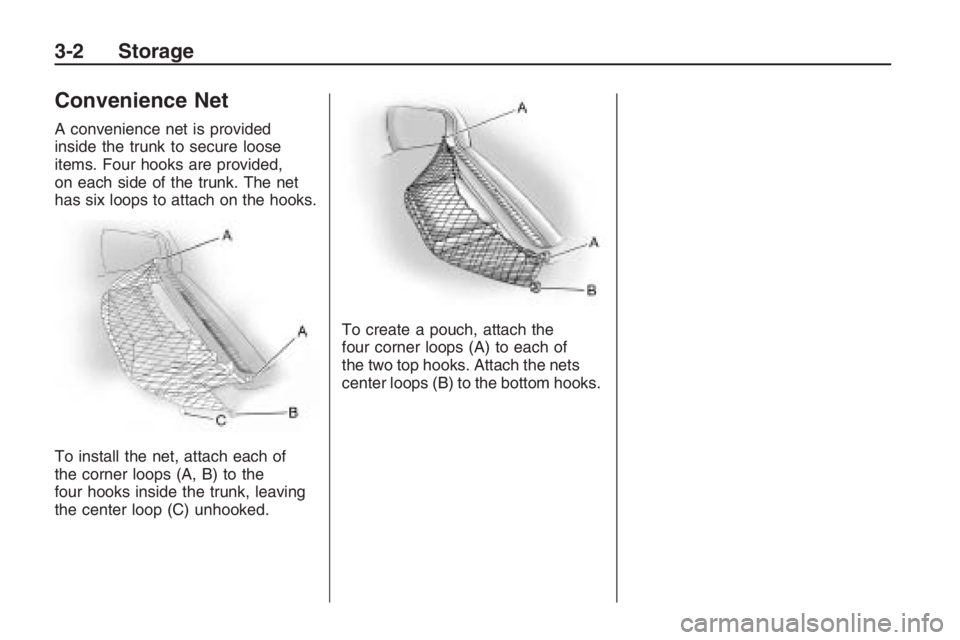
A convenience net is provided
inside the trunk to secure loose
items. Four hooks are provided,
on each side of the trunk. The net
has six loops to attach on the hooks.
To install the net, attach each of
the corner loops (A, B) to the
four hooks inside the trunk, leaving
the center loop (C) unhooked.To create a pouch, attach the
four corner loops (A) to each of
the two top hooks. Attach the nets
center loops (B) to the bottom hooks.
3-2 Storage