ECU PONTIAC G8 2009 Service Manual
[x] Cancel search | Manufacturer: PONTIAC, Model Year: 2009, Model line: G8, Model: PONTIAC G8 2009Pages: 356, PDF Size: 1.83 MB
Page 239 of 356
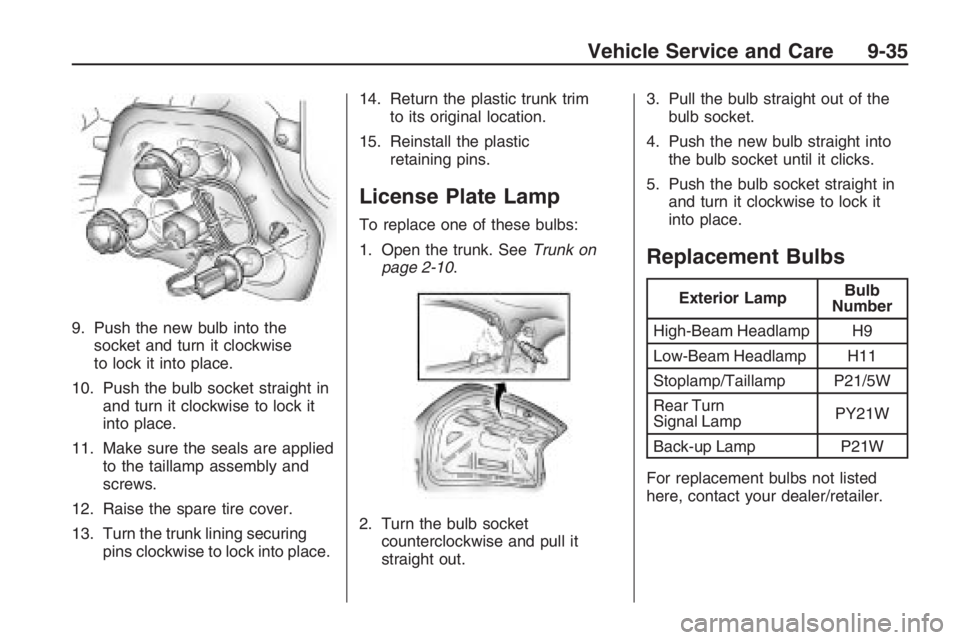
9. Push the new bulb into the
socket and turn it clockwise
to lock it into place.
10. Push the bulb socket straight in
and turn it clockwise to lock it
into place.
11. Make sure the seals are applied
to the taillamp assembly and
screws.
12. Raise the spare tire cover.
13. Turn the trunk lining securing
pins clockwise to lock into place.14. Return the plastic trunk trim
to its original location.
15. Reinstall the plastic
retaining pins.
License Plate Lamp
To replace one of these bulbs:
1. Open the trunk. SeeTrunk on
page 2-10.
2. Turn the bulb socket
counterclockwise and pull it
straight out.3. Pull the bulb straight out of the
bulb socket.
4. Push the new bulb straight into
the bulb socket until it clicks.
5. Push the bulb socket straight in
and turn it clockwise to lock it
into place.
Replacement Bulbs
Exterior LampBulb
Number
High-Beam Headlamp H9
Low-Beam Headlamp H11
Stoplamp/Taillamp P21/5W
Rear Turn
Signal LampPY21W
Back-up Lamp P21W
For replacement bulbs not listed
here, contact your dealer/retailer.
Vehicle Service and Care 9-35
Page 276 of 356
19. Wipe off any sealant from the
wheel, tire or vehicle.
20. Dispose of the used sealant
canister at a local dealer/retailer
or in accordance with local
state codes and practices.
After using the sealant canister,
replace it with a new canister
available from your
dealer/retailer.
This is a temporary repair. Take
the vehicle to your
dealer/retailer to have the tire
repaired or replaced as soon as
possible.Using the Air Compressor
without Sealant to Inate an
Underinated Tire
To use the air compressor to inate
a tire with air only and not sealant:
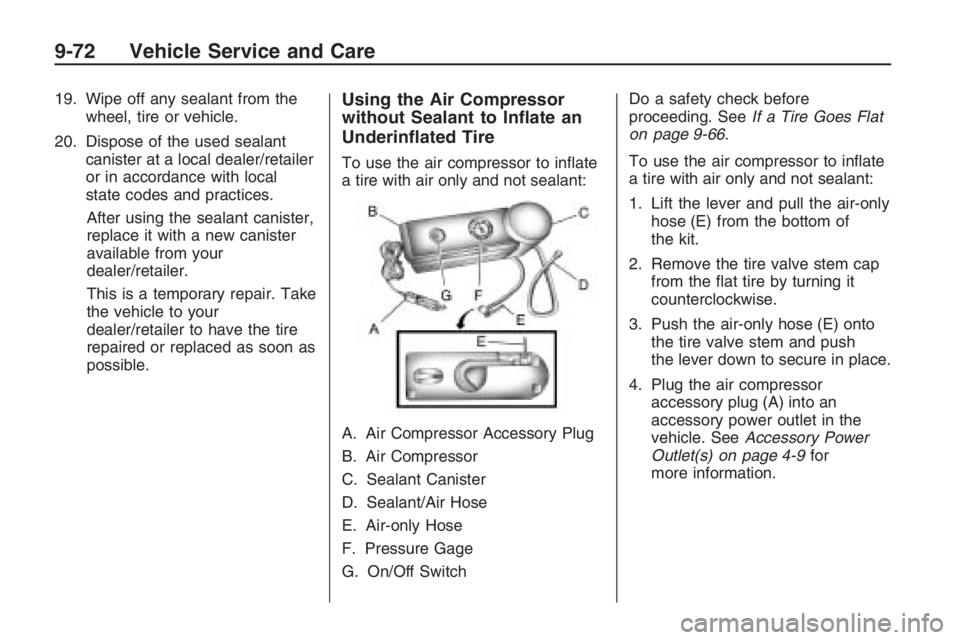
A. Air Compressor Accessory Plug
B. Air Compressor
C. Sealant Canister
D. Sealant/Air Hose
E. Air-only Hose
F. Pressure Gage
G. On/Off SwitchDo a safety check before
proceeding. SeeIf a Tire Goes Flat
on page 9-66.
To use the air compressor to inate
a tire with air only and not sealant:
1. Lift the lever and pull the air-only
hose (E) from the bottom of
the kit.
2. Remove the tire valve stem cap
from the at tire by turning it
counterclockwise.
3. Push the air-only hose (E) onto
the tire valve stem and push
the lever down to secure in place.
4. Plug the air compressor
accessory plug (A) into an
accessory power outlet in the
vehicle. SeeAccessory Power
Outlet(s) on page 4-9for
more information.
9-72 Vehicle Service and Care
Page 280 of 356
Removing the Spare Tire
and Tools
Spare Tire
The equipment you will need is
located in the rear storage area.
1. Open the trunk. SeeTrunk
on page 2-10.
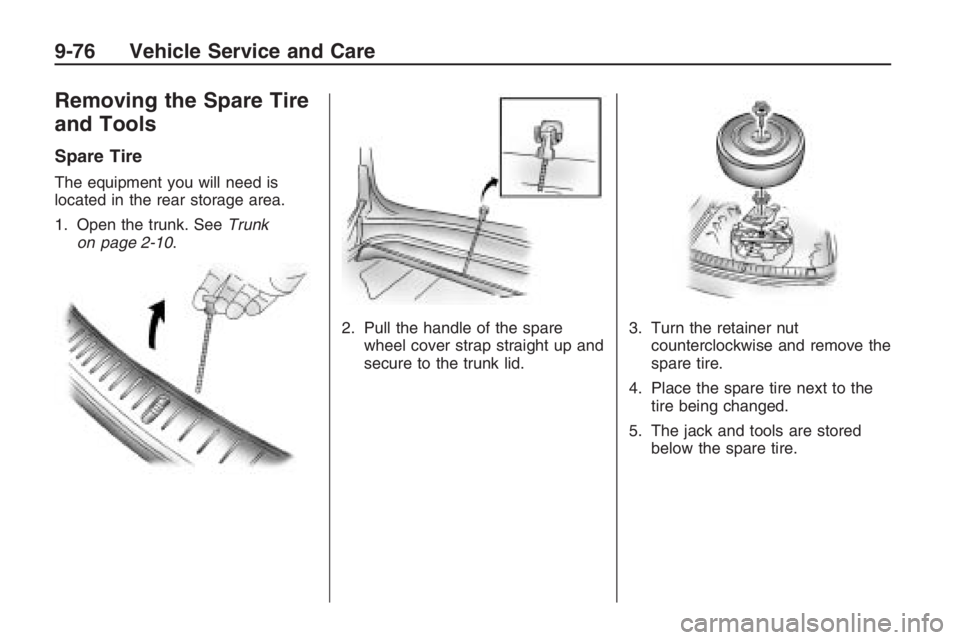
2. Pull the handle of the spare
wheel cover strap straight up and
secure to the trunk lid.3. Turn the retainer nut
counterclockwise and remove the
spare tire.
4. Place the spare tire next to the
tire being changed.
5. The jack and tools are stored
below the spare tire.
9-76 Vehicle Service and Care
Page 286 of 356
Storing a Flat or Spare
Tire and Tools
{CAUTION
Storing a jack, a tire, or other
equipment in the passenger
compartment of the vehicle could
cause injury. In a sudden stop or
collision, loose equipment could
strike someone. Store all these in
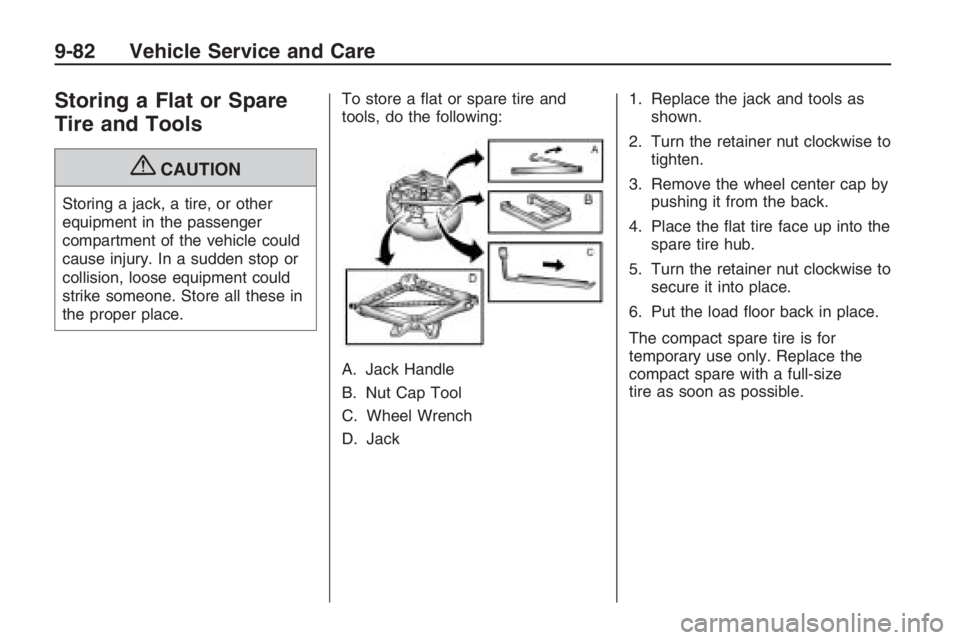
the proper place.To store a at or spare tire and
tools, do the following:
A. Jack Handle
B. Nut Cap Tool
C. Wheel Wrench
D. Jack1. Replace the jack and tools as
shown.
2. Turn the retainer nut clockwise to
tighten.
3. Remove the wheel center cap by
pushing it from the back.
4. Place the at tire face up into the
spare tire hub.
5. Turn the retainer nut clockwise to
secure it into place.
6. Put the load oor back in place.
The compact spare tire is for
temporary use only. Replace the
compact spare with a full-size
tire as soon as possible.
9-82 Vehicle Service and Care
Page 295 of 356
Weight of the Trailer
How heavy can a trailer safely be?
It should never weigh more than
2,000 lbs (907 kg). But even
that can be too heavy.
It depends on how you plan to use
your rig. For example, speed,
altitude, road grades, outside
temperature and how much your
vehicle is used to pull a trailer are all
important. It can also depend on
any special equipment that you have
on your vehicle, and the amount
of tongue weight the vehicle
can carry. See “Weight of the Trailer
Tongue” later in this section for
more information.
Maximum trailer weight is calculated
assuming only the driver is in the tow
vehicle and it has all the required
trailering equipment. The weight of
additional optional equipment,
passengers and cargo in the tow
vehicle must be subtracted form the
maximum trailer weight.You can ask your dealer/retailer for
our trailering information or
advice, or you can write us at our
Customer Assistance Offices.
SeeCustomer Assistance Offices
on page 12-4for more information.
Weight of the Trailer Tongue
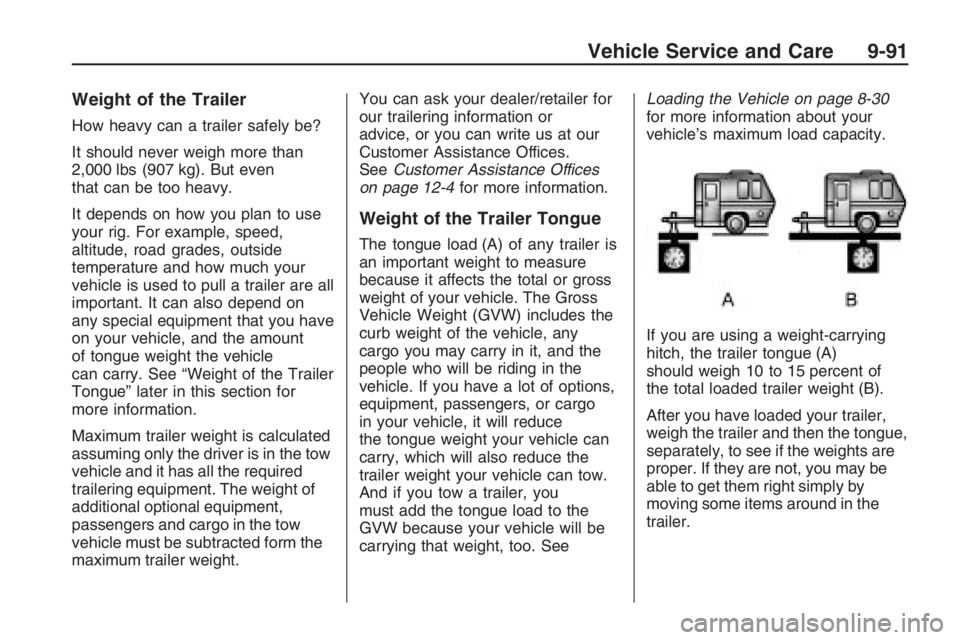
The tongue load (A) of any trailer is
an important weight to measure
because it affects the total or gross
weight of your vehicle. The Gross
Vehicle Weight (GVW) includes the
curb weight of the vehicle, any
cargo you may carry in it, and the
people who will be riding in the
vehicle. If you have a lot of options,
equipment, passengers, or cargo
in your vehicle, it will reduce
the tongue weight your vehicle can
carry, which will also reduce the
trailer weight your vehicle can tow.
And if you tow a trailer, you
must add the tongue load to the
GVW because your vehicle will be
carrying that weight, too. SeeLoading the Vehicle on page 8-30
for more information about your
vehicle’s maximum load capacity.
If you are using a weight-carrying
hitch, the trailer tongue (A)
should weigh 10 to 15 percent of
the total loaded trailer weight (B).
After you have loaded your trailer,
weigh the trailer and then the tongue,
separately, to see if the weights are
proper. If they are not, you may be
able to get them right simply by
moving some items around in the
trailer.
Vehicle Service and Care 9-91
Page 297 of 356
Driving with a Trailer
Towing a trailer requires a certain
amount of experience. Before setting
out for the open road, you will want to
get to know your rig. Acquaint
yourself with the feel of handling and
braking with the added weight of the
trailer. And always keep in mind that
the vehicle you are driving is now a
good deal longer and not nearly as
responsive as your vehicle is by
itself.
Before you start, check all trailer
hitch parts and attachments, safety
chains, electrical connector,
lamps, tires and mirror adjustment.
If the trailer has electric brakes,
start your vehicle and trailer moving
and then apply the trailer brake
controller by hand to be sure
the brakes are working. This lets
you check your electrical connection
at the same time.
During your trip, check occasionally
to be sure that the load is secure,
and that the lamps and any
trailer brakes are still working.
Towing with the Electronic
Stability Program (ESP®)
When towing, the sound of the ESP
modulator might be heard. The ESP
is reacting to the vehicle movement
caused by the trailer, which mainly
occurs during cornering. This is
normal when towing heavier trailers.
Following Distance
Stay at least twice as far behind the
vehicle ahead as when driving
your vehicle without a trailer. This
can help avoid situations that require
heavy braking and sudden turns.
Passing
More passing distance is needed up
ahead when you are towing a trailer.
And, because the vehicle is longer, it
is necessary to go much farther
beyond the passed vehicle before
returning to the lane.
Backing Up
Hold the bottom of the steering
wheel with one hand. Then, to move
the trailer to the left, just move that
hand to the left. To move the trailer to
the right, move the hand to the right.
Always back up slowly and, if
possible, have someone guide you.
Making Turns
Notice:Making very sharp turns
while trailering could cause the
trailer to come in contact with the
vehicle. The vehicle could be
damaged. Avoid making very
sharp turns while trailering.
When you are turning with a trailer,
make wider turns than normal. Do
this so your trailer will not strike soft
shoulders, curbs, road signs, trees or
other objects. Avoid jerky or sudden
maneuvers. Signal well in advance.
Vehicle Service and Care 9-93
Page 319 of 356
Owner Checks and
Services
These owner checks and services
should be performed at the intervals
specied to help ensure vehicle
safety, dependability, and emission
control performance. Your dealer/
retailer can assist with these checks
and services.
Be sure any necessary repairs are
completed at once. Whenever
any uids or lubricants are added to
the vehicle, make sure they are
the proper ones, as shown in
Recommended Fluids and
Lubricants on page 11-12.
At Each Fuel Fill
It is important to perform these
underhood checks at each fuel fill.
Engine Oil Level Check
Notice:It is important to check
the engine oil regularly and keep it
at the proper level. Failure to keep
the engine oil at the proper level
can cause damage to the engine
not covered by the vehicle
warranty.
Check the engine oil level and
add the proper oil if necessary.
SeeEngine Oil on page 9-8.
Engine Coolant Level Check
Check the engine coolant level
and add DEX-COOL®coolant
mixture if necessary. SeeEngine
Coolant on page 9-15.
Windshield Washer Fluid
Level Check
Check the windshield washer uid
level in the windshield washer
uid reservoir and add the proper
uid if necessary.
At Least Once a Month
Tire Ination Check
Inspect the vehicle’s tires and make
sure they are inated to the correct
pressures. Do not forget to check
the spare tire, if the vehicle has one.
SeeInflation - Tire Pressure on
page 9-49. If the vehicle has a spare
tire, check to make sure it is stored
securely. SeeChanging a Flat Tire
on page 9-75.
Tire Wear Inspection
Tire rotation may be required for
high mileage highway drivers prior to
the Engine Oil Life System service
notication. Check the tires for
wear and, if necessary, rotate the
tires. SeeTire Inspection and
Rotation on page 9-57.
Service and Maintenance 11-9
Page 335 of 356
Services Provided
Emergency Fuel Delivery:
Delivery of enough fuel for
the vehicle to get to the nearest
service station.
Lock-Out Service:Service is
provided to unlock the vehicle
if you are locked out. A remote
unlock may be available if
you have OnStar
®. For security
reasons, the driver must
present identication before this
service is given.
Emergency Tow From a Public
Road or Highway:Tow to the
nearest Pontiac dealer for
warranty service, or if the vehicle
was in a crash and cannot be
driven. Assistance is also given
when the vehicle is stuck in
sand, mud, or snow.
Flat Tire Change:Service is
provided to change a at tire
with the spare tire. The spare tire,
if equipped, must be in good
condition and properly inated.
It is the owner’s responsibility
for the repair or replacement of
the tire if it is not covered by
the warranty.
Battery Jump Start:Service is
provided to jump start a dead
battery.
Trip Interruption Benets
and Assistance:If your trip is
interrupted due to a warranty
failure, incidental expenses may
be reimbursed during the 5 years/
100,000 miles (160 000 km)
Powertrain warranty period. Items
considered are hotel, meals, and
rental car.
Services Not Included in
Roadside Assistance
Impound towing caused by
violation of any laws.
Legal nes.
Mounting, dismounting or
changing of snow tires, chains,
or other traction devices.
Towing or services for vehicles
driven on a non-public road or
highway.
Customer Information 12-7
Page 345 of 356
GM will not access this data or
share it with others except: with the
consent of the vehicle owner or, if the
vehicle is leased, with the consent
of the lessee; in response to an
official request of police or similar
government office; as part of GM’s
defense of litigation through the
discovery process; or, as required
by law. Data that GM collects or
receives may also be used for GM
research needs or may be made
available to others for research
purposes, where a need is shown
and the data is not tied to a specic
vehicle or vehicle owner.
OnStar®
If your vehicle has OnStar and you
subscribe to the OnStar services,
please refer to the OnStar Terms and
Conditions for information on data
collection and use. See alsoOnStar
®
System on page 4-35in this manual
for more information.
Navigation System
If your vehicle has a navigation
system, use of the system may result
in the storage of destinations,
addresses, telephone numbers, and
other trip information. Refer to the
navigation system operating manual
for information on stored data and for
deletion instructions.
Radio Frequency
Identication (RFID)
RFID technology is used in some
vehicles for functions such as
tire pressure monitoring and ignition
system security, as well as in
connection with conveniences
such as key fobs for remote door
locking/unlocking and starting, and
in-vehicle transmitters for garage
door openers. RFID technology in
GM vehicles does not use or record
personal information or link with
any other GM system containing
personal information.
Customer Information 12-17
Page 348 of 356
B
Battery...............................9-28
Run-Down Protection.......... 5-4
Bluetooth
®..........................6-25
Brake Fluid.........................9-25
Brakes...............................9-25
System Warning Light.......4-15
Braking...............................8-17
Break-In, New Vehicle............ 8-2
Bulb Replacement................9-31
Front Turn Signal Lamps . . . 9-33
Halogen Bulbs..................9-31
Headlamp Aiming..............9-28
Headlamps and Parking
Lamps .........................9-31
License Plate Lamps.........9-35
Replacement Bulbs...........9-35
Taillamps.........................9-34
Buying New Tires.................9-59
C
Calibration..........................2-16
California Fuel.....................8-35
California Perchlorate
Materials Requirements....... 9-3California Proposition 65
Warning............................ 9-3
Canadian Owners..................... ii
Capacities and
Specications...................10-2
Carbon
Monoxide........2-10, 8-14, 8-27
Care, Safety Belts................1-19
Cautions and Notices............... iii
CD, MP3 ............................6-20
Center Console
Storage Area..................... 3-1
Chains, Tire........................9-65
Charging System Light..........4-15
Check
Engine Lamp...................4-18
Chemical Paint Spotting......9-102
Child Restraints
Child Restraint Systems.....1-39
Infants and Young
Children.......................1-36
Lower Anchors and
Tethers for Children.......1-42
Older Children..................1-34
Securing..................1-48, 1-50
Where to Put the
Restraint......................1-40Cleaning
Exterior...........................9-98
Interior............................9-95
Underbody Maintenance . . . 9-102
Climate Control System.......... 7-1
Automatic.......................... 7-4
Outlet Adjustment............... 7-9
Clock, Setting........................ 6-2
Collision Damage Repair.....12-10
Compact Spare Tire.............9-83
Compass............................2-16
Compressor Kit, Tire
Sealant...........................9-67
Content Theft-Deterrent.........2-13
Control of a Vehicle..............8-17
Convenience Net................... 3-2
Coolant
Engine............................9-15
Engine Temperature Gage . . . 4-17
Cooling System...................9-13
Cruise Control....................... 4-5
Cupholders........................... 3-1
i-2 INDEX