service PONTIAC VIBE 2010 Workshop Manual
[x] Cancel search | Manufacturer: PONTIAC, Model Year: 2010, Model line: VIBE, Model: PONTIAC VIBE 2010Pages: 318, PDF Size: 1.7 MB
Page 243 of 318
Treadwear
The treadwear grade is a
comparative rating based on the
wear rate of the tire when tested
under controlled conditions on
a specified government test
course. For example, a tire
graded 150 would wear one
and a half (1.5) times as well
on the government course as
a tire graded 100. The relative
performance of tires depends
upon the actual conditions of
their use, however, and may
depart significantly from the
norm due to variations in driving
habits, service practices,
and differences in road
characteristics and climate.Traction – AA, A, B, C
The traction grades, from
highest to lowest, are AA, A, B,
and C. Those grades represent
the tire’s ability to stop on wet
pavement as measured under
controlled conditions on specified
government test surfaces of
asphalt and concrete. A tire
marked C may have poor traction
performance.
Temperature – A, B, C
The temperature grades
are A (the highest), B, and C,
representing the tire’s resistance
to the generation of heat and
its ability to dissipate heat
when tested under controlled
conditions on a specified indoor
laboratory test wheel. Sustained
high temperature can cause thematerial of the tire to degenerate
and reduce tire life, and
excessive temperature can
lead to sudden tire failure.
The grade C corresponds to a
level of performance which all
passenger car tires must meet
under the Federal Motor Vehicle
Safety Standard No. 109.
Grades B and A represent
higher levels of performance
on the laboratory test wheel than
the minimum required by law.
It should be noted that the
temperature grade for this tire
is established for a tire that
is properly inflated and not
overloaded. Excessive speed,
underinflation, or excessive
loading, either separately or in
combination, can cause heat
buildup and possible tire failure.
Vehicle Care 9-59
Page 256 of 318
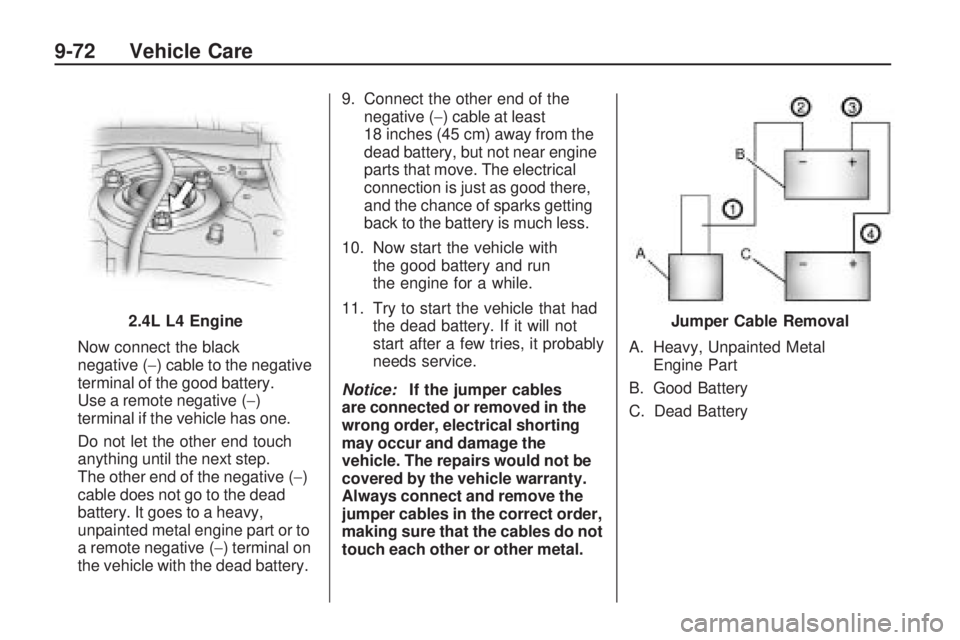
Now connect the black
negative (−) cable to the negative
terminal of the good battery.
Use a remote negative (−)
terminal if the vehicle has one.
Do not let the other end touch
anything until the next step.
The other end of the negative ( −)
cable does not go to the dead
battery. It goes to a heavy,
unpainted metal engine part or to
a remote negative (−) terminal on
the vehicle with the dead battery. 9. Connect the other end of the
negative (−) cable at least
18 inches (45 cm) away from the
dead battery, but not near engine
parts that move. The electrical
connection is just as good there,
and the chance of sparks getting
back to the battery is much less.
10. Now start the vehicle with the good battery and run
the engine for a while.
11. Try to start the vehicle that had the dead battery. If it will not
start after a few tries, it probably
needs service.
Notice: If the jumper cables
are connected or removed in the
wrong order, electrical shorting
may occur and damage the
vehicle. The repairs would not be
covered by the vehicle warranty.
Always connect and remove the
jumper cables in the correct order,
making sure that the cables do not
touch each other or other metal. A. Heavy, Unpainted Metal
Engine Part
B. Good Battery
C. Dead Battery
2.4L L4 Engine
Jumper Cable Removal
9-72 Vehicle Care
Page 257 of 318
To disconnect the jumper cables
from both vehicles, do the following:
1. Disconnect the black negative (−)
cable from the vehicle that had
the dead battery.
2. Disconnect the black negative ( −)
cable from the vehicle with the
good battery.
3. Disconnect the red positive (+) cable from the vehicle with the
good battery.
4. Disconnect the red positive (+) cable from the other vehicle.Towing
Towing the Vehicle
To avoid damage, the disabled
vehicle should be towed with all
four wheels off the ground. Consult
your dealer/retailer or a professional
towing service if the disabled vehicle
must be towed. See Roadside
Assistance Program on page 12-6 .
To tow the vehicle behind
another vehicle for recreational
purposes — such as behind
a motorhome, see Recreational
Vehicle Towing following.
Recreational Vehicle
Towing
Recreational vehicle towing means
towing the vehicle behind another
vehicle – such as behind a
motorhome. The two most common
types of recreational vehicle towing
are known as dinghy towing and
dolly towing. Dinghy towing is towing
the vehicle with all four wheels on
the ground. Dolly towing is towing
the vehicle with two wheels on the
ground and two wheels up on a
device known as a dolly.
Vehicle Care 9-73
Page 269 of 318
Service and
Maintenance
General InformationGeneral Information.............10-1
Scheduled MaintenanceScheduled Maintenance ........10-3
Recommended Fluids,
Lubricants, and Parts
Recommended Fluids and
Lubricants ......................
.10-15
Maintenance Replacement Parts .............................
.10-17
Maintenance RecordsMaintenance Records .........10-18
General Information
Important: Keep engine oil at the
proper level and change as
recommended.
Have you purchased the GM
Protection Plan? The Plan
supplements the vehicle warranties.
See the Warranty and Owner
Assistance booklet or your dealer/
retailer for details.
Notice:
Maintenance intervals,
checks, inspections, replacement
parts, and recommended uids
and lubricants as prescribed in
this manual are necessary to
keep this vehicle in good working
condition. Any damage caused
by failure to follow scheduled
maintenance might not be covered
by the vehicle warranty. Proper vehicle maintenance not only
helps to keep the vehicle in good
working condition, but also helps the
environment. All recommended
maintenance is important. Improper
vehicle maintenance can even affect
the quality of the air we breathe.
Improper fluid levels or the wrong tire
inflation can increase the level of
emissions from the vehicle. To help
protect the environment, and to keep
the vehicle in good condition, be sure
to maintain the vehicle properly.
Using the Maintenance
Schedule
We want to help keep this vehicle in
good working condition. But we do
not know exactly how you will drive it.
You might drive very short distances
only a few times a week. Or you
might drive long distances all the
time in very hot, dusty weather.
You might use the vehicle in making
deliveries. Or you might drive it to
work, to do errands, or in many
other ways.
Service and Maintenance 10-1
Page 270 of 318
Because of all the different
ways people use their vehicles,
maintenance needs vary. You might
need more frequent checks and
replacements. So please read the
following and note how you drive.
If you have any questions on how to
keep the vehicle in good condition,
see your dealer/retailer.
This schedule is for vehicles that:
•carry passengers and cargo
within recommended limits on
the Tire and Loading Information
label. SeeVehicle Load Limits on
page 8-12.
•are driven on reasonable road
surfaces within legal driving limits.
•use the recommended fuel.
See Recommended Fuel on
page 8-39.
The services in Scheduled
Maintenance on page 10-3 should
be performed when indicated.
{CAUTION
Performing maintenance work
on a vehicle can be dangerous.
In trying to do some jobs, you can
be seriously injured. Do your own
maintenance work only if you
have the required know-how and
the proper tools and equipment
for the job. If you have any doubt,
see your dealer/retailer to have a
qualified technician do the work.
See Doing Your Own Service
Work on page 9-4.
Some maintenance services can
be complex. So, unless you are
technically qualified and have the
necessary equipment, have your
dealer/retailer do these jobs. When you go to your dealer/retailer
for service, trained and supported
service technicians will perform
the work using genuine parts.
To purchase service information,
see
Service Publications Ordering
Information on page 12-12 .
The proper replacement parts,
fluids, and lubricants to use are
listed in Recommended Fluids and
Lubricants on page 10-15 and
Maintenance Replacement Parts on
page 10-17. When the vehicle is
serviced, make sure these are used.
All parts should be replaced and all
necessary repairs done before you
or anyone else drives the vehicle.
We recommend the use of genuine
parts from your dealer/retailer.
10-2 Service and Maintenance
Page 271 of 318
Scheduled
Maintenance
The services shown in this schedule
up to 192 000 km (120,000 miles)
should be repeated after 192 000 km
(120,000 miles) at the same intervals
for the life of this vehicle.
Footnotes
†The U.S. Environmental Protection
Agency or the California Air
Resources Board has determined
that the failure to perform this
maintenance item will not nullify the
emissions warranty or limit recall
liability prior to the completion of the
vehicle’s useful life. We, however,
urge that all recommended
maintenance services be performed
at the indicated intervals and the
maintenance be recorded.
+ A good time to check your brakes
is during tire rotation. See Tire
Rotation on page 9-55 .
8 000 km (5,000 Miles)
❑Change engine oil and filter
(or every 3 months, whichever
occurs first). An Emission Control
Service.
❑ Rotate tires. See Tire Rotation on
page 9-55 for proper rotation
pattern and additional information.
(See footnote +.)
❑ Inspect engine air cleaner filter
if vehicle is driven in dusty
conditions. Replace filter if
necessary.
16 000 km (10,000 Miles)
❑ Change engine oil and filter
(or every 3 months, whichever
occurs first). An Emission Control
Service.
❑ Rotate tires. See Tire Rotation
on page 9-55 for proper rotation
pattern and additional information.
(See footnote +.)
❑ Inspect engine air cleaner filter
if vehicle is driven in dusty
conditions. Replace filter if
necessary.
24 000 km (15,000 Miles)
❑ Change engine oil and filter
(or every 3 months, whichever
occurs first). An Emission Control
Service.
❑ Rotate tires. See Tire Rotation
on page 9-55 for proper rotation
pattern and additional information.
(See footnote +.)
❑ Inspect engine air cleaner filter
if vehicle is driven in dusty
conditions. Replace filter if
necessary.
❑ Inspect passenger compartment
air filter.
❑ Change transfer case fluid when
doing frequent trailer towing.
❑ Change rear differential fluid when
doing frequent trailer towing.
Service and Maintenance 10-3
Page 272 of 318
32 000 km (20,000 Miles)
❑Change engine oil and filter
(or every 3 months, whichever
occurs first). An Emission Control
Service.
❑ Rotate tires. See Tire Rotation
on page 9-55 for proper rotation
pattern and additional information.
(See footnote +.)
❑ Inspect engine air cleaner filter
if vehicle is driven in dusty
conditions. Replace filter if
necessary.
40 000 km (25,000 Miles)
❑ Change engine oil and filter
(or every 3 months, whichever
occurs first). An Emission Control
Service.
❑ Rotate tires. See Tire Rotation
on page 9-55 for proper rotation
pattern and additional information.
(See footnote +.)
❑ Inspect engine air cleaner filter
if vehicle is driven in dusty
conditions. Replace filter if
necessary.
48 000 km (30,000 Miles)
❑ Change engine oil and filter
(or every 3 months, whichever
occurs first). An Emission Control
Service.
❑ Rotate tires. See Tire Rotation
on page 9-55 for proper rotation
pattern and additional information.
(See footnote +.)
❑ Replace engine air cleaner filter
(or every 24 months, whichever
occurs first). See Engine Air
Cleaner/Filter on page 9-16 for
more information.
❑ Check restraint system. Make
sure the safety belt reminder light
and safety belt assemblies are
working properly. Look for any
other loose or damaged safety
belt system parts. If you see
anything that might keep a safety
belt system from doing its job,
have it repaired. Have any torn
or frayed safety belts replaced.
Also see Safety System Check
on page 2-21. ❑
Replace passenger compartment
air filter.
❑ Change transfer case fluid when
doing frequent trailer towing.
❑ Change rear differential fluid when
doing frequent trailer towing.
❑ Inspect fuel tank, cap, cap gasket,
and lines for damage or leaks
(or every 24 months, whichever
occurs first). Replace parts as
needed. An Emission Control
Service. (See footnote †.)
❑ Change manual transmission fluid
every 48 000 km (30,000 miles)
only if your vehicle is used to tow
a trailer.
10-4 Service and Maintenance
Page 273 of 318
56 000 km (35,000 Miles)
❑Change engine oil and filter
(or every 3 months, whichever
occurs first). An Emission Control
Service.
❑ Rotate tires. See Tire Rotation
on page 9-55 for proper rotation
pattern and additional information.
(See footnote +.)
❑ Inspect engine air cleaner filter
if vehicle is driven in dusty
conditions. Replace filter if
necessary.
64 000 km (40,000 Miles)
❑ Change engine oil and filter
(or every 3 months, whichever
occurs first). An Emission Control
Service.
❑ Rotate tires. See Tire Rotation
on page 9-55 for proper rotation
pattern and additional information.
(See footnote +.)
❑ Inspect engine air cleaner filter
if vehicle is driven in dusty
conditions. Replace filter if
necessary.
72 000 km (45,000 Miles)
❑ Change engine oil and filter
(or every 3 months, whichever
occurs first). An Emission Control
Service.
❑ Rotate tires. See Tire Rotation
on page 9-55 for proper rotation
pattern and additional
information. (See footnote +.)
❑ Inspect engine air cleaner filter
if vehicle is driven in dusty
conditions. Replace filter if
necessary.
❑ Inspect passenger compartment
air filter.
❑ Change transfer case fluid when
doing frequent trailer towing.
❑ Change rear differential fluid
when doing frequent trailer
towing.
80 000 km (50,000 Miles)
❑ Change engine oil and filter
(or every 3 months, whichever
occurs first). An Emission Control
Service.
❑ Rotate tires. See Tire Rotation
on page 9-55 for proper rotation
pattern and additional information.
(See footnote +.)
❑ Inspect engine air cleaner filter
if vehicle is driven in dusty
conditions. Replace filter if
necessary.
88 000 km (55,000 Miles)
❑ Change engine oil and filter
(or every 3 months, whichever
occurs first). An Emission Control
Service.
❑ Rotate tires. See Tire Rotation
on page 9-55 for proper rotation
pattern and additional information.
(See footnote +.)
❑ Inspect engine air cleaner filter
if vehicle is driven in dusty
conditions. Replace filter if
necessary.
Service and Maintenance 10-5
Page 274 of 318
96 000 km (60,000 Miles)
❑Change engine oil and filter
(or every 3 months, whichever
occurs first). An Emission Control
Service.
❑ Rotate tires. See Tire Rotation
on page 9-55 for proper rotation
pattern and additional
information. (See footnote +.)
❑ Replace engine air cleaner filter
(or every 24 months, whichever
occurs first). See Engine Air
Cleaner/Filter on page 9-16 for
more information.
❑ Check restraint system. Make
sure the safety belt reminder light
and safety belt assemblies are
working properly. Look for any
other loose or damaged safety
belt system parts. If you see
anything that might keep a safety
belt system from doing its job,
have it repaired. Have any torn
or frayed safety belts replaced.
Also see Safety System Check
on page 2-21. ❑
Replace passenger compartment
air filter.
❑ Change transfer case fluid when
doing frequent trailer towing.
❑ Change rear differential fluid when
doing frequent trailer towing.
❑ Inspect engine accessory drive
belts (or every 48 months,
whichever occurs first). Visually
inspect belt for fraying, excessive
cracks, or obvious damage.
Replace belt if necessary.
An Emission Control Service.
❑ Inspect for tappet noise and
engine vibration. Adjust valve
clearance to factory specifications
if necessary (or every 48 months,
whichever occurs first). An
Emission Control Service.
❑ Inspect fuel tank, cap, cap gasket,
and lines for damage or leaks
(or every 24 months, whichever
occurs first). Replace parts as
needed. An Emission Control
Service. (See footnote †.) ❑
Change manual transmission fluid
every 48 000 km (30,000 miles)
only if your vehicle is used to tow
a trailer.
❑ Change automatic
transmission fluid every
96 000 km (60,000 miles) if the
vehicle is mainly driven under one
or more of these conditions:
- In heavy city traffic where the outside temperature regularly
reaches 32°C (90°F) or higher.
- In hilly or mountainous terrain.
- When doing frequent trailer towing.
- Uses such as found in taxi, police, or delivery service.
If you do not use your vehicle under
any of these conditions, the uid
does not require changing.
See Recommended Fluids and
Lubricants on page 10-15 for
the proper uid to use.
10-6 Service and Maintenance
Page 275 of 318
104 000 km (65,000 Miles)
❑Change engine oil and filter
(or every 3 months, whichever
occurs first). An Emission Control
Service.
❑ Rotate tires. See Tire Rotation
on page 9-55 for proper rotation
pattern and additional
information. (See footnote +.)
❑ Inspect engine air cleaner filter
if vehicle is driven in dusty
conditions. Replace filter if
necessary.
112 000 km (70,000 Miles)
❑ Change engine oil and filter
(or every 3 months, whichever
occurs first). An Emission Control
Service.
❑ Rotate tires. See Tire Rotation
on page 9-55 for proper rotation
pattern and additional
information. (See footnote +.)
❑ Inspect engine air cleaner filter
if vehicle is driven in dusty
conditions. Replace filter if
necessary.
120 000 km (75,000 Miles)
❑ Change engine oil and filter
(or every 3 months, whichever
occurs first). An Emission Control
Service.
❑ Rotate tires. See Tire Rotation
on page 9-55 for proper rotation
pattern and additional information.
(See footnote +.)
❑ Inspect engine air cleaner filter
if vehicle is driven in dusty
conditions. Replace filter if
necessary.
❑ Inspect passenger compartment
air filter.
❑ Change transfer case fluid when
doing frequent trailer towing.
❑ Change rear differential fluid when
doing frequent trailer towing.
❑ Inspect engine accessory drive
belts (or 12 months since last
inspection). An Emission Control
Service.
128 000 km (80,000 Miles)
❑ Change engine oil and filter
(or every 3 months, whichever
occurs first). An Emission Control
Service.
❑ Rotate tires. See Tire Rotation
on page 9-55 for proper rotation
pattern and additional
information. (See footnote +.)
❑ Inspect engine air cleaner filter
if vehicle is driven in dusty
conditions. Replace filter if
necessary.
136 000 km (85,000 Miles)
❑ Change engine oil and filter
(or every 3 months, whichever
occurs first). An Emission Control
Service.
❑ Rotate tires. See Tire Rotation
on page 9-55 for proper rotation
pattern and additional information.
(See footnote +.)
❑ Inspect engine air cleaner filter
if vehicle is driven in dusty
conditions. Replace filter if
necessary.
Service and Maintenance 10-7