lock PORSCHE 911 GT3 2010 5.G Repair Manual
[x] Cancel search | Manufacturer: PORSCHE, Model Year: 2010, Model line: 911 GT3, Model: PORSCHE 911 GT3 2010 5.GPages: 251, PDF Size: 14.33 MB
Page 209 of 251

208
Practical Tips, Emergency Service
Alarm system, central lockingThe status of the central locking and alarm system
is not changed by disconnecting the battery.
When the battery is disconnected, the alarm
system ceases to function.Central locking overload protectionIf the central locking system is operated more
than ten times within a minute, further operation is
blocked for 30 seconds.
Load switch-off after 2 hours or 7 daysIf the ignition key is removed, loads which are
switched on or are in standby mode (such as the
luggage compartment light, interior light and
radio) are automatically switched off after approx.
2hours.
If the vehicle is not started or unlocked with the
remote control within 7days, the remote control
standby function is switched off (to save the
vehicle battery).
1. In this case, unlock the driver’s door with the
key at the door lock.
Leave the door closed in order to prevent the
alarm system from being triggered.
2. Press button 1 on the remote control.
The remote control is now activated again.
10_GT3_21.book Seite 208 Donnerstag, 4. Juni 2009 12:48 12
Page 210 of 251
Practical Tips, Emergency Service
209
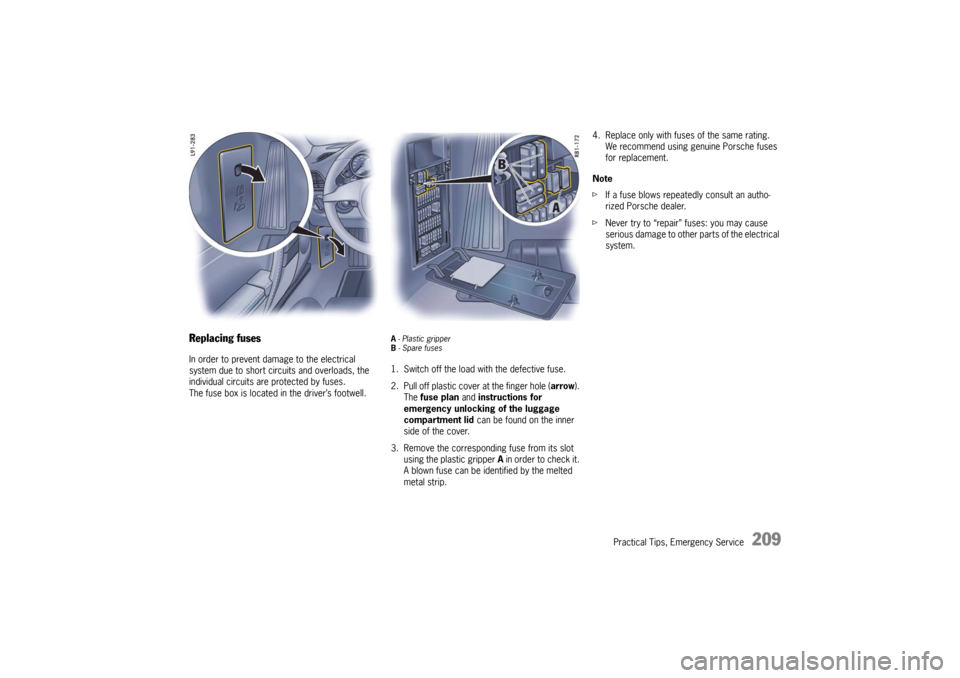
Replacing fuses In order to prevent damage to the electrical
system due to short circuits and overloads, the
individual circuits are protected by fuses.
The fuse box is located in the driver’s footwell.
A - Plastic gripper
B - Spare fuses 1. Switch off the load with the defective fuse.
2. Pull off plastic cover at the finger hole (arrow).
The fuse plan and instructions for
emergency unlocking of the luggage
compartment lid can be found on the inner
side of the cover.
3. Remove the corresponding fuse from its slot
using the plastic gripper A in order to check it.
A blown fuse can be identified by the melted
metal strip.4. Replace only with fuses of the same rating.
We recommend using genuine Porsche fuses
for replacement.
Note
fIf a fuse blows repeatedly consult an autho-
rized Porsche dealer.
fNever try to “repair” fuses: you may cause
serious damage to other parts of the electrical
system.
10_GT3_21.book Seite 209 Donnerstag, 4. Juni 2009 12:48 12
Page 211 of 251
210
Practical Tips, Emergency Service
Emergency unlocking of the luggage
compartment lidIf the battery is discharged, the luggage compart-
ment lid can be opened only with the aid of a donor
battery.
Note
The engine cannot be started with this method.
fPlease see the chapter “EMERGENCY
STARTING WITH JUMPER CABLES” on
Page 217.
Unlocking lid
1. Use the key to unlock the vehicle at the door
lock.
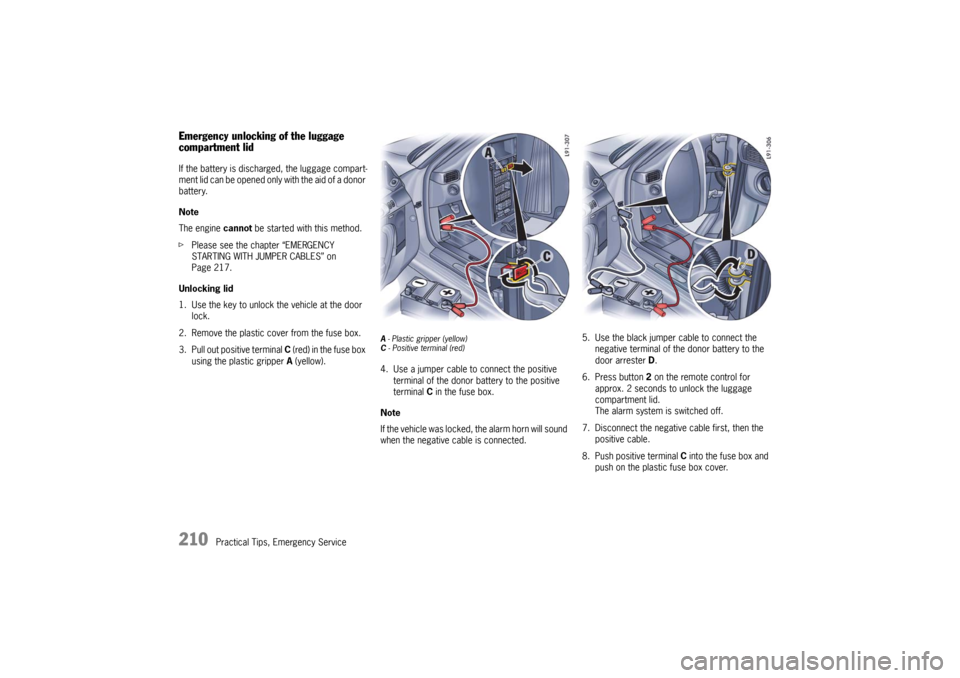
2. Remove the plastic cover from the fuse box.
3. Pull out positive terminal C (red) in the fuse box
using the plastic gripper A (yellow).
A - Plastic gripper (yellow)
C - Positive terminal (red)4. Use a jumper cable to connect the positive
terminal of the donor battery to the positive
terminal C in the fuse box.
Note
If the vehicle was locked, the alarm horn will sound
when the negative cable is connected.5. Use the black jumper cable to connect the
negative terminal of the donor battery to the
door arrester D.
6. Press button 2 on the remote control for
approx. 2 seconds to unlock the luggage
compartment lid.
The alarm system is switched off.
7. Disconnect the negative cable first, then the
positive cable.
8. Push positive terminal C into the fuse box and
push on the plastic fuse box cover.
10_GT3_21.book Seite 210 Donnerstag, 4. Juni 2009 12:48 12
Page 212 of 251

Practical Tips, Emergency Service
211
Battery fPlease see the chapter “EMERGENCY OPERA-
TION – PULLING OUT THE IGNITION KEY” on
Page 69.
fPlease see the chapter “EMERGENCY
UNLOCKING OF THE LUGGAGE COMPART-
MENT LID” on Page 210.
Warning!
Risk of short circuit and fire, resulting in
serious personal injury or death.
fObserve all warning notes on the battery.
fDisconnect the negative terminal on the
battery during all work on the electrical
system.
fDo not lay tools or other metal objects on the
battery as they could cause a short circuit
across the battery terminal.
Hydrogen gas generated by the battery
could cause an explosion, resulting in
serious personal injury or death.
fDo not expose the battery to an open flame,
electrical spark or a lit cigarette.
fDo not wipe battery with a dry cloth.
Risk of serious personal injury or death and
damage to the fabric, metal or paint.
fWear eye protection. fDo not allow battery acid to come in contact
with your skin, eyes, fabric or painted
surfaces.
fIf you get electrolyte, which is an acid, in your
eyes or on your skin, immediately rinse with
cold water for several minutes and call a
doctor.
fSpilled electrolyte must be rinsed off at once
with a solution of baking soda and water to
neutralize the acid.
Battery posts, terminals and related acces-
sories contain lead and lead compounds,
chemicals known to the State of California to
cause cancer and reproductive harm.
fAlways protect your skin by washing
thoroughly with soap and water.
Risk of explosion as a result of static charge,
resulting in serious personal injury or death.
fDo not wipe the battery with a dry cloth.
fEliminate potential electrostatic charge by
touching the vehicle before touching the
battery.
Charge state A well charged battery will not only prevent
starting problems but will also last longer.
In order to avoid discharging the battery
unintentionally:
fSwitch off unnecessary electrical loads in city
traffic, on short trips or in a line or traffic.
fAlways remove the ignition key from the
ignition switch when leaving the car.
fAvoid frequent operation of the convertible top
and operation of the Porsche Communication
Management system when the engine is not
running.
In the cold season in particular or if the vehicle is
used primarily for short trips, it may be necessary
to recharge the battery from time to time.
Porsche recommends the use of a charger, partic-
ularly during extended immobilization periods.
Please see your authorized Porsche dealer
for relevant information.
10_GT3_21.book Seite 211 Donnerstag, 4. Juni 2009 12:48 12
Page 215 of 251
214
Practical Tips, Emergency Service
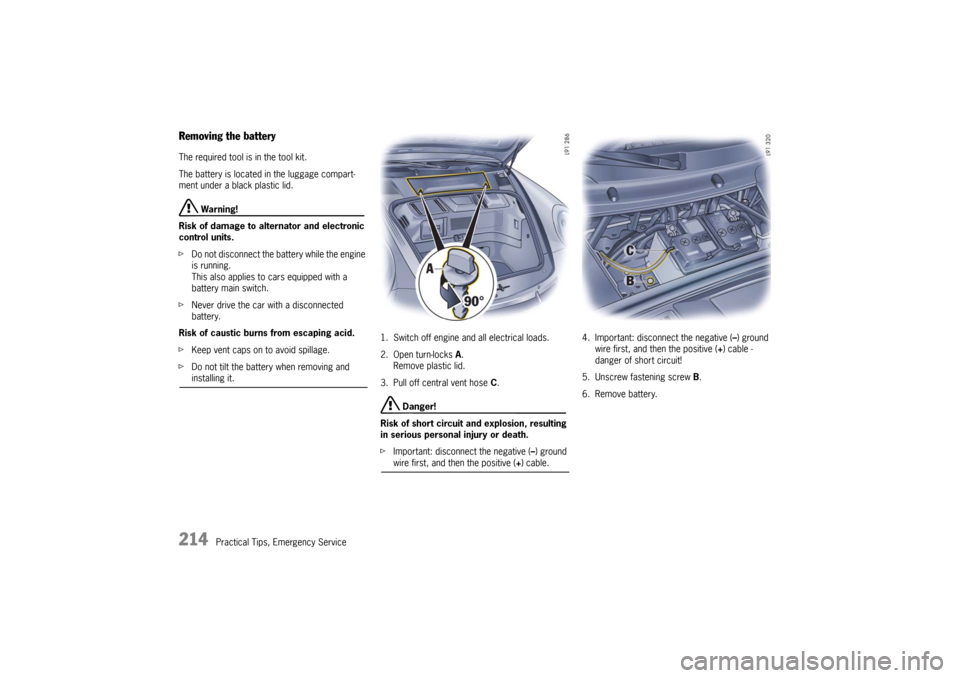
Removing the battery The required tool is in the tool kit.
The battery is located in the luggage compart-
ment under a black plastic lid.
Warning!
Risk of damage to alternator and electronic
control units.
fDo not disconnect the battery while the engine
is running.
This also applies to cars equipped with a
battery main switch.
fNever drive the car with a disconnected
battery.
Risk of caustic burns from escaping acid.
fKeep vent caps on to avoid spillage.
fDo not tilt the battery when removing and installing it. 1. Switch off engine and all electrical loads.
2. Open turn-locks A.
Remove plastic lid.
3. Pull off central vent hose C.
Danger!
Risk of short circuit and explosion, resulting
in serious personal injury or death.
fImportant: disconnect the negative (–) ground wire first, and then the positive (+) cable.4. Important: disconnect the negative (–) ground
wire first, and then the positive (+) cable -
danger of short circuit!
5. Unscrew fastening screw B.
6. Remove battery.
10_GT3_21.book Seite 214 Donnerstag, 4. Juni 2009 12:48 12
Page 216 of 251
Practical Tips, Emergency Service
215
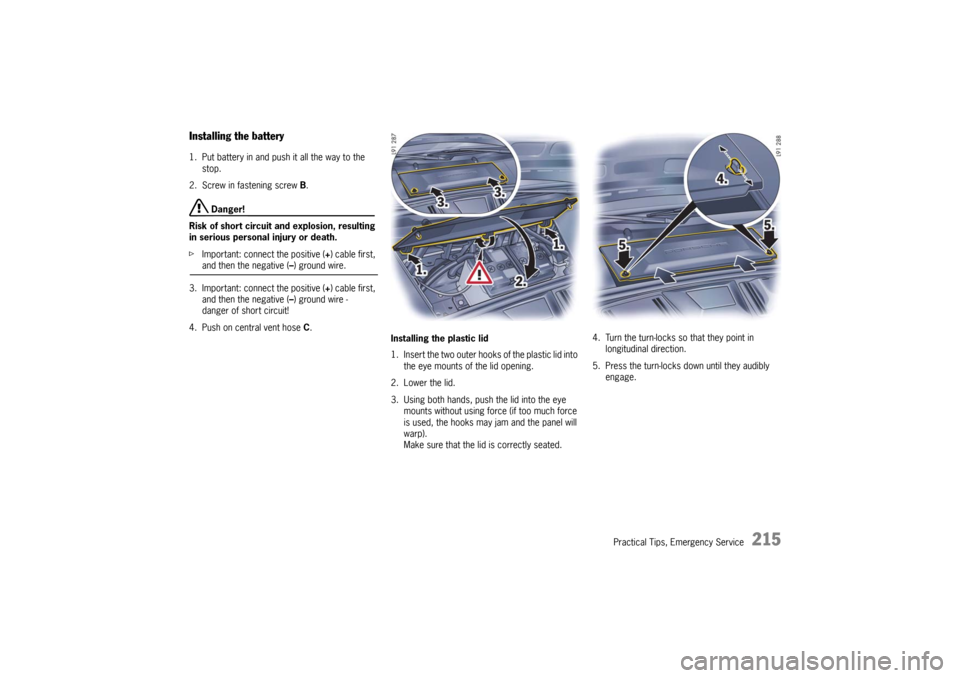
Installing the battery 1. Put battery in and push it all the way to the
stop.
2. Screw in fastening screw B.
Danger!
Risk of short circuit and explosion, resulting
in serious personal injury or death.
fImportant: connect the positive (+) cable first, and then the negative (–) ground wire.
3. Important: connect the positive (+) cable first,
and then the negative (–) ground wire -
danger of short circuit!
4. Push on central vent hose C.
Installing the plastic lid
1. Insert the two outer hooks of the plastic lid into
the eye mounts of the lid opening.
2. Lower the lid.
3. Using both hands, push the lid into the eye
mounts without using force (if too much force
is used, the hooks may jam and the panel will
warp).
Make sure that the lid is correctly seated.4. Turn the turn-locks so that they point in
longitudinal direction.
5. Press the turn-locks down until they audibly
engage.
10_GT3_21.book Seite 215 Donnerstag, 4. Juni 2009 12:48 12
Page 218 of 251

Practical Tips, Emergency Service
217
Emergency Starting with Jumper
Cables If the battery is discharged, e.g. in winter or after
the car has been parked for a long time, the
battery of another car can be used for starting
with the help of jumper cables.
Make sure the voltage of both batteries is the
same. Both batteries must be 12 volt types.
The capacity (Ampere hours, Ah) of the booster
battery must not be substantially less than that of
the discharged battery.
The discharged battery must be correctly
connected to the vehicle’s electrical system.
fPlease see the chapter “BATTERY” on
Page 211.
fPlease see the chapter “EMERGENCY
UNLOCKING OF THE LUGGAGE COMPART-
MENT LID” on Page 210.
Note
fDo not try to start the car by pushing or
towing. Damage to the catalytic converters
and other components of the car may result.
Warning!
Risk of short circuit, damage and explosion,
resulting in serious personal injury or death.
fUse only jumper cables of adequate diameter
cross-section and fitted with completely
insulated alligator clips.
fFollow all warnings and instructions of the
jumper cable manufacturer.
fWhen connecting jumper cables, make sure
that they cannot get caught in any moving
parts in the engine compartment.
The jumper cables must be long enough so
that neither vehicles nor cables touch another.
fThe vehicles must not be in contact, otherwise
current might flow as soon as the positive
terminals are connected.
fThe cable clamps must not be allowed to
contact each other when one end of the
jumper cables are connected to a battery.
fEnsure that tools or conductive jewelery (rings,
chains, watch straps) do not come into contact
with the positive jumper cable or the positive
battery post.
fImproper hook-up of jumper cables can ruin
the alternator. Danger of caustic burns.
fDo not lean over the battery.
Danger of gas explosion.
fImproper use of booster battery to start a
vehicle may cause an explosion, resulting in
serious personal injury or death.
fKeep sources of ignition away from the
battery, e.g. open flame, burning cigarettes or
sparking due to cable contact or welding work.
fA discharged battery can freeze even at 23 °F/
–5 °C.
Before connecting jumper cables, a frozen
battery must be thawed out.
10_GT3_21.book Seite 217 Donnerstag, 4. Juni 2009 12:48 12
Page 219 of 251

218
Practical Tips, Emergency Service
Connect jumper cables in the following
sequence: Always observe the sequence below:
1. Connect the positive lead (red) to the
positive terminal of the discharged battery
first, then connect it to the positive terminal of
the donor battery.
2. First connect the negative cable (black) to
the negative terminal of the donor battery, then
connect it to a suitable grounding point on the
vehicle with the discharged battery.
This grounding point must lie as far as possible
from the battery.
For example, a solid metal part or the engine
block are suitable grounding points.
If no suitable grounding points are to be found
on either vehicle, the negative cable must
carefully be connected directly to the negative
terminal of the battery.
If a suitable grounding point is to be found only
on the donor vehicle, the negative cable must
first be connected to the terminal of the
discharged battery, then to the grounding point
of the donor vehicle.
3. Run the engine of the donor car at a higher
speed.4. Start the engine.
An attempted start using jumper cables should
not last more than 15 seconds. Then allow a
waiting period of at least one minute.
fNote
Before disconnecting the jumper cables,
electrical loads such as the heated rear
window and the heating fan blower should be
switched on (the vehicle’s lights must not be
switched on). This reduces voltage peaks
which may occur when disconnecting the
jumper cables.
With the engine running, remove both jumper
cables in reverse order.10_GT3_21.book Seite 218 Donnerstag, 4. Juni 2009 12:48 12
Page 221 of 251
220
Practical Tips, Emergency Service
Headlights
Caution!
Risk of damage to headlights due to exces-
sive temperatures and abrasion.
fTo ensure optimum ventilation, do not cover
the gap between headlight and body
(e.g. “stone guards” or films).
fOnly use soapy water to clean light lenses and
plastic headlight lenses.
In no case may chemical cleaners or other
volatile cleaning fluids be used.
fTo prevent scratches, do not rub with a dry or merely moist cloth, tissue or insect sponges.
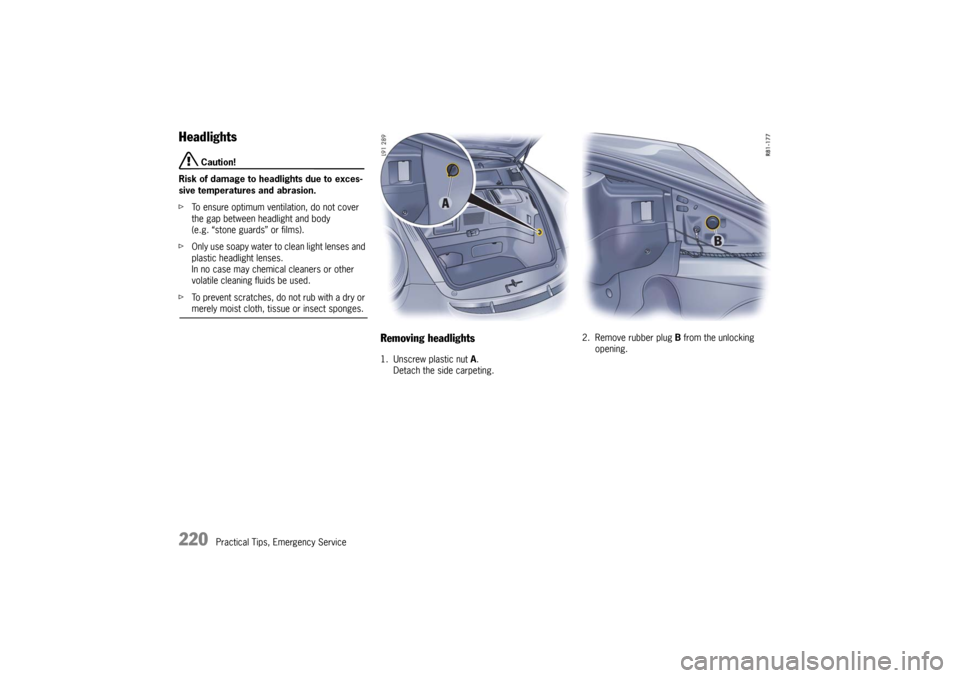
Removing headlights1. Unscrew plastic nut A.
Detach the side carpeting.2. Remove rubber plug B from the unlocking
opening.
10_GT3_21.book Seite 220 Donnerstag, 4. Juni 2009 12:48 12
Page 222 of 251
Practical Tips, Emergency Service
221
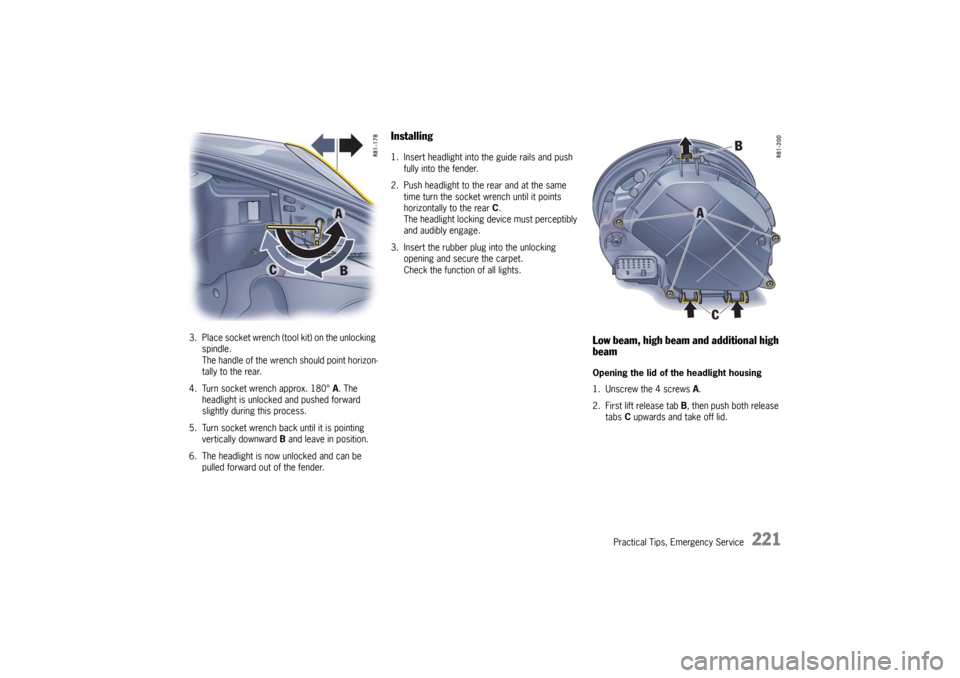
3. Place socket wrench (tool kit) on the unlocking
spindle.
The handle of the wrench should point horizon-
tally to the rear.
4. Turn socket wrench approx. 180° A. The
headlight is unlocked and pushed forward
slightly during this process.
5. Turn socket wrench back until it is pointing
vertically downward B and leave in position.
6. The headlight is now unlocked and can be
pulled forward out of the fender.
Installing1. Insert headlight into the guide rails and push
fully into the fender.
2. Push headlight to the rear and at the same
time turn the socket wrench until it points
horizontally to the rear C.
The headlight locking device must perceptibly
and audibly engage.
3. Insert the rubber plug into the unlocking
opening and secure the carpet.
Check the function of all lights.
Low beam, high beam and additional high
beamOpening the lid of the headlight housing
1. Unscrew the 4 screws A.
2. First lift release tab B, then push both release
tabs C upwards and take off lid.
10_GT3_21.book Seite 221 Donnerstag, 4. Juni 2009 12:48 12