lock PORSCHE 911 GT3 2010 5.G Owner's Guide
[x] Cancel search | Manufacturer: PORSCHE, Model Year: 2010, Model line: 911 GT3, Model: PORSCHE 911 GT3 2010 5.GPages: 251, PDF Size: 14.33 MB
Page 68 of 251
Operation, Safety
67
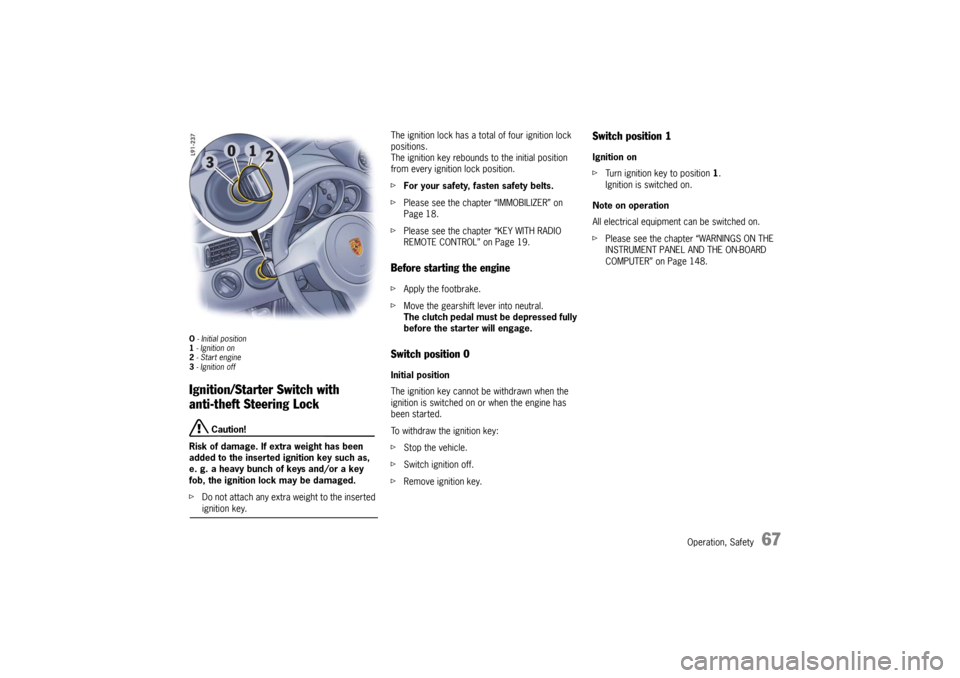
O - Initial position
1 - Ignition on
2 - Start engine
3 - Ignition offIgnition/Starter Switch with
anti-theft Steering Lock
Caution!
Risk of damage. If extra weight has been
added to the inserted ignition key such as,
e. g. a heavy bunch of keys and/or a key
fob, the ignition lock may be damaged.
fDo not attach any extra weight to the inserted ignition key.The ignition lock has a total of four ignition lock
positions.
The ignition key rebounds to the initial position
from every ignition lock position.
fFor your safety, fasten safety belts.
fPlease see the chapter “IMMOBILIZER” on
Page 18.
fPlease see the chapter “KEY WITH RADIO
REMOTE CONTROL” on Page 19.
Before starting the enginefApply the footbrake.
fMove the gearshift lever into neutral.
The clutch pedal must be depressed fully
before the starter will engage.Switch position 0 Initial position
The ignition key cannot be withdrawn when the
ignition is switched on or when the engine has
been started.
To withdraw the ignition key:
fStop the vehicle.
fSwitch ignition off.
fRemove ignition key.
Switch position 1 Ignition on
fTurn ignition key to position 1.
Ignition is switched on.
Note on operation
All electrical equipment can be switched on.
fPlease see the chapter “WARNINGS ON THE
INSTRUMENT PANEL AND THE ON-BOARD
COMPUTER” on Page 148.
10_GT3_21.book Seite 67 Donnerstag, 4. Juni 2009 12:48 12
Page 69 of 251

68
Operation, Safety
Switch position 2Start engine
fTurn ignition key to ignition lock position 2.
fPlease see the chapter “STARTING PROCE-
DURES” on Page 70.Switch position 3Ignition off
fTurn ignition key to ignition lock position 3.
Note on operation
The vehicle battery discharges if the ignition key is
left inserted.
If the vehicle battery is dead, the key can only be
pulled out of the ignition lock if the emergency
operation is performed:
fPlease see the chapter “EMERGENCY OPERA-
TION – PULLING OUT THE IGNITION KEY” on
Page 69.
Locking the steering columnAutomatic locking
The steering column is automatically locked when
the ignition key is withdrawn from the ignition lock.
Warning!
Risk of an accident, resulting in serious
personal injury or death.
The steering wheel will lock and will cause
loss of steering.
fNever remove key from the ignition lock or turn
the key off while the vehicle is moving.
fAlways withdraw the ignition key when leaving the vehicle.Automatic unlocking
The steering column is unlocked when the vehicle
is unlocked with the radio remote control.
Note
fTo avoid discharging the battery, always
remove the ignition key from the ignition lock.
Please see the chapter “BATTERY” on
Page 211.
Gong If you leave the key in the ignition/steering lock, a
gong will sound when the driver’s door is opened.
This is a reminder to remove the key.
10_GT3_21.book Seite 68 Donnerstag, 4. Juni 2009 12:48 12
Page 70 of 251
Operation, Safety
69
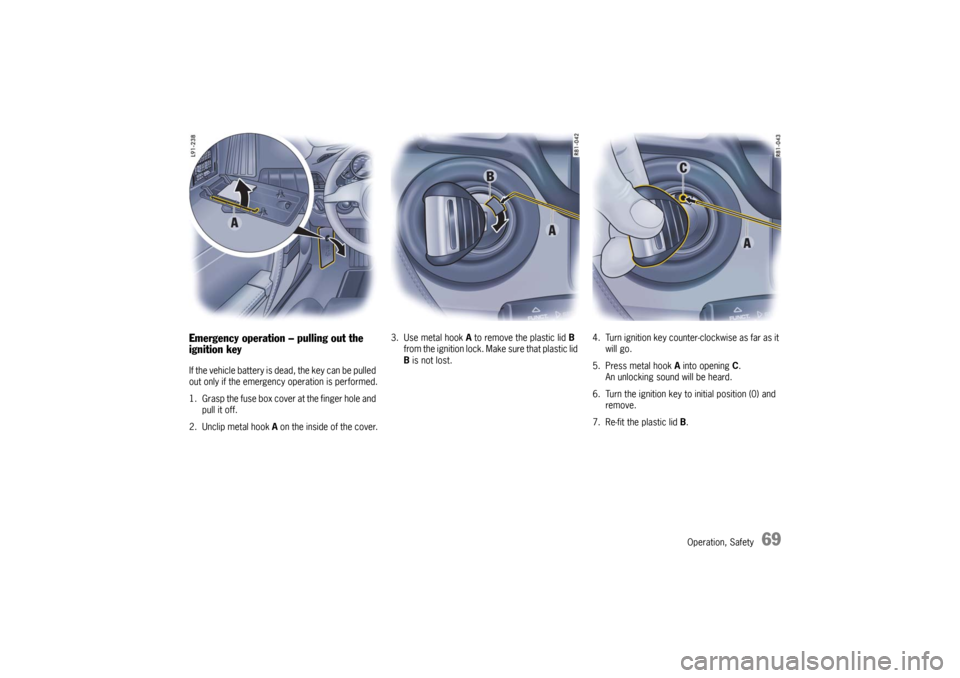
Emergency operation – pulling out the
ignition keyIf the vehicle battery is dead, the key can be pulled
out only if the emergency operation is performed.
1. Grasp the fuse box cover at the finger hole and
pull it off.
2. Unclip metal hook A on the inside of the cover.3. Use metal hook A to remove the plastic lid B
from the ignition lock. Make sure that plastic lid
B is not lost.4. Turn ignition key counter-clockwise as far as it
will go.
5. Press metal hook A into opening C.
An unlocking sound will be heard.
6. Turn the ignition key to initial position (0) and
remove.
7. Re-fit the plastic lid B.
10_GT3_21.book Seite 69 Donnerstag, 4. Juni 2009 12:48 12
Page 71 of 251

70
Operation, Safety
Starting Procedures fPlease see the chapter “IMMOBILIZER” on
Page 18.
fPlease see the chapter “EMISSION CONTROL
SYSTEM” on Page 168.
Warning!
Serious injury or death may result if you are
involved in a collision without having
fastened the safety belts.
fFasten safety belts before driving away. Before starting the engine fApply the footbrake.
fMove the gearshift lever into neutral.
The clutch pedal must be depressed fully
before the starter will engage.
Temperature sensors on the engine automatically
provide the correct fuel/air mixture required for
starting.
Therefore, it is not necessary to depress the
accelerator pedal while starting a cold or a
warm engine.
Starting the enginefTurn ignition key to ignition lock position 2.
fAs soon as the engine starts, release the
ignition key.
The first operation of the starter is ended
automatically when the engine starts.
If the engine does not start, subsequent starter
operations will not be ended automatically.
If the engine fails to start after 10 or 15 seconds
of cranking:
fWait about 10 seconds before engaging the
starter again.
fWhen starting the engine, be ready to drive
immediately.
Drive vehicle at moderate speeds and avoid
engine speeds above 4,200 rpm during the
first 5 minutes.
fDo not let the engine idle to warm up.
Danger!
Engine exhaust fumes have many compon-
ents which you can smell. They also contain
carbon monoxide (CO), which is a colorless
and odorless gas.
Carbon monoxide can cause unconscious-
ness and even death if inhaled.
fNever start or let the engine run in an
enclosed, unventilated area.
It is not recommended to sit in your car for
prolonged periods with the engine on and the
car not moving.
An unattended vehicle with a running engine
is potentially hazardous.
If warning lights should come on to indicate
improper operation, they would go
unnoticed.
fNever leave the engine idling unattended.
Risk of fire due to hot exhaust system.
fDo not park or operate the vehicle in areas
where the hot exhaust system may come in
contact with dry grass, brush, fuel spill or
other flammable material.
fIf your car catches on fire for any reason, call
the fire department.
Do not endanger your life by attempting to put out the fire.
10_GT3_21.book Seite 70 Donnerstag, 4. Juni 2009 12:48 12
Page 72 of 251

Operation, Safety
71
Stopping Engine fTurn key back to position 3.
fDo not stop engine immediately after hard or
extended driving.
Keep engine running at increased idle for
about two minutes to prevent excessive heat
build-up before turning off engine.
fTo avoid discharging the battery, always
remove the ignition key from the ignition lock.
fWhen leaving the vehicle always remove the
ignition key, apply the parking brake and
engage the 1st gear or reverse gear.
fEngage the steering lock by moving the
steering wheel to the left or right.
Turn the steering wheel to the locking position
before you switch off the engine so that you
don’t have to exert yourself when locking or
unlocking the steering.
Warning!
Danger of injury. Hot engine compartment
components can burn skin on contact.
fBefore working on any part in the engine
compartment, turn the engine off and let it cool down sufficiently.
Engine-compartment blower,
radiator fan The radiator and radiator fan are in the front of the
car.
The engine-compartment blower is mounted on
the engine compartment lid.
Warning!
Risk of injury.
After the engine is switched off, the engine-
compartment temperature is monitored for
approx. 30 minutes.
During this period, and depending on tempe-
rature, the engine-compartment blower may
continue to run or start to run.
fCarry out work in these areas only with the
engine off, the ignition off, and exercise
extreme caution.
Risk of injury. The radiator fan in the front
end of the car may be operating or unexpec-
tedly start operating when the engine is
switched on.
fCarry out work in these areas only with the engine switched off.
Automatic garage door The ignition system in your Porsche may interfere
with your electronically operated garage door.
fTo check this, drive your Porsche close to the
garage door. Make sure not to interfere with
the operating range of the door.
fRun the engine at different speeds.
fIf the garage door opens or closes without you
operating the garage door unit in your car,
contact the dealer who installed the automatic
garage door to have the frequency and/or
coding of the garage door signal changed or
modified.
10_GT3_21.book Seite 71 Donnerstag, 4. Juni 2009 12:48 12
Page 73 of 251
72
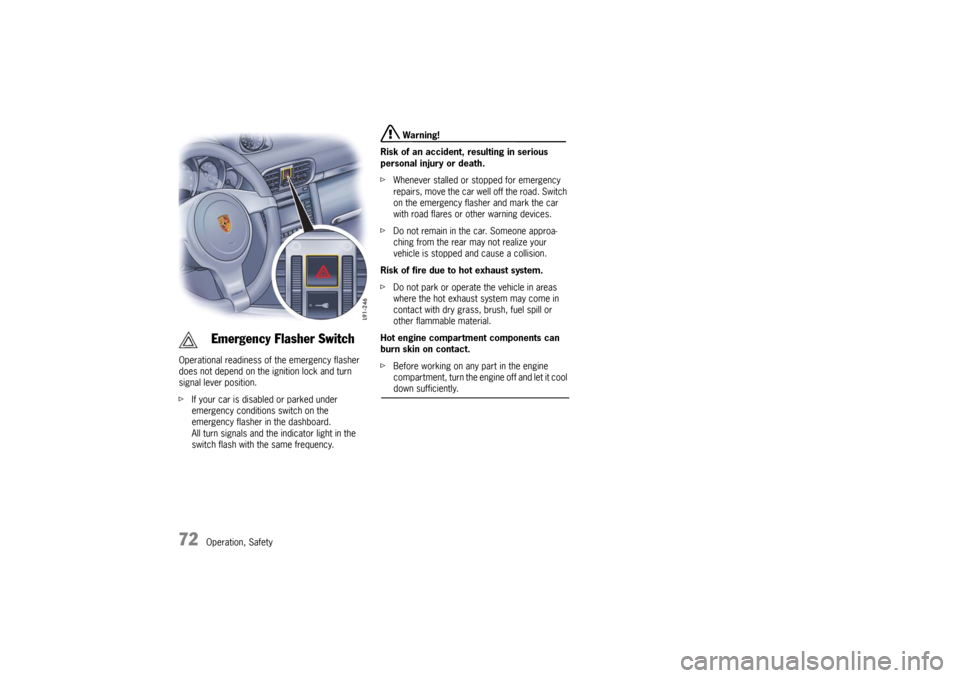
Operation, Safety Operational readiness of the emergency flasher
does not depend on the ignition lock and turn
signal lever position.
fIf your car is disabled or parked under
emergency conditions switch on the
emergency flasher in the dashboard.
All turn signals and the indicator light in the
switch flash with the same frequency.
Warning!
Risk of an accident, resulting in serious
personal injury or death.
fWhenever stalled or stopped for emergency
repairs, move the car well off the road. Switch
on the emergency flasher and mark the car
with road flares or other warning devices.
fDo not remain in the car. Someone approa-
ching from the rear may not realize your
vehicle is stopped and cause a collision.
Risk of fire due to hot exhaust system.
fDo not park or operate the vehicle in areas
where the hot exhaust system may come in
contact with dry grass, brush, fuel spill or
other flammable material.
Hot engine compartment components can
burn skin on contact.
fBefore working on any part in the engine
compartment, turn the engine off and let it cool down sufficiently.
Emergency Flasher Switch
10_GT3_21.book Seite 72 Donnerstag, 4. Juni 2009 12:48 12
Page 75 of 251

74
Operation, Safety
Dynamic Cornering LightAbove a speed of 6 mph (10 km/h) the low beam
is swivelled into the direction of the bend for better
illumination of the road.
If the dynamic cornering light malfunctions, the
blue high beam indicator light in the tachometer
starts to flash.Individual Light FunctionsFurther individual light functions are available in
vehicles equipped with the Sport Chrono Package
Plus.
fPlease see the chapter “Individual Memory” in
the separate PCM Owner’s Manual.
Welcome Home LightingSwitching onfMove light switch to the HOME position.
For improved visibility and security when you get
in and out of the car, the daytime running lights
and the tail lights remain on for a certain period of
time:
–When you get out of the car, the lights are
turned on for approx. 30 seconds after the
door is opened. The off-delay time resumes
when the vehicle is locked.
On vehicles with the Sport Chrono Package
Plus, the PCM can be used to set the off-delay
time. This setting also changes the lighting
period for unlocking the vehicle.
Please see the chapter “Individual Memory” in
the separate PCM Owner’s Manual.
– The lights are turned on for approx.
30 seconds when the vehicle is unlocked.
The lights go out if the ignition is switched on
or when leaving the Welcome Home lighting.
Automatic Headlight Beam
Adjustment Vehicles with Bi-Xenon headlights feature
dynamic headlight beam adjustment.
When the ignition is switched on, the level of the
headlight beam automatically changes in accor-
dance with the vehicle load.
The level of the headlight beam is automatically
kept constant during acceleration and braking. Checking operation 1. Switch the low beam on.
2. Insert ignition key and switch ignition on.
The light beam first dips all the way down and
is then adapted to the vehicle load.
If this test item is not met, the headlight beam
adjustment system must be checked by an autho-
rized Porsche dealer.
10_GT3_21.book Seite 74 Donnerstag, 4. Juni 2009 12:48 12
Page 83 of 251
82
Operation, Safety
Emptying fOpen ashtray and carefully pull out ash insert.
fLeave ashtray lid open.
Push in ash insert.
Warning!
Danger of fire.
fNever use ashtray for waste paper disposal, as it could pose a fire hazard.
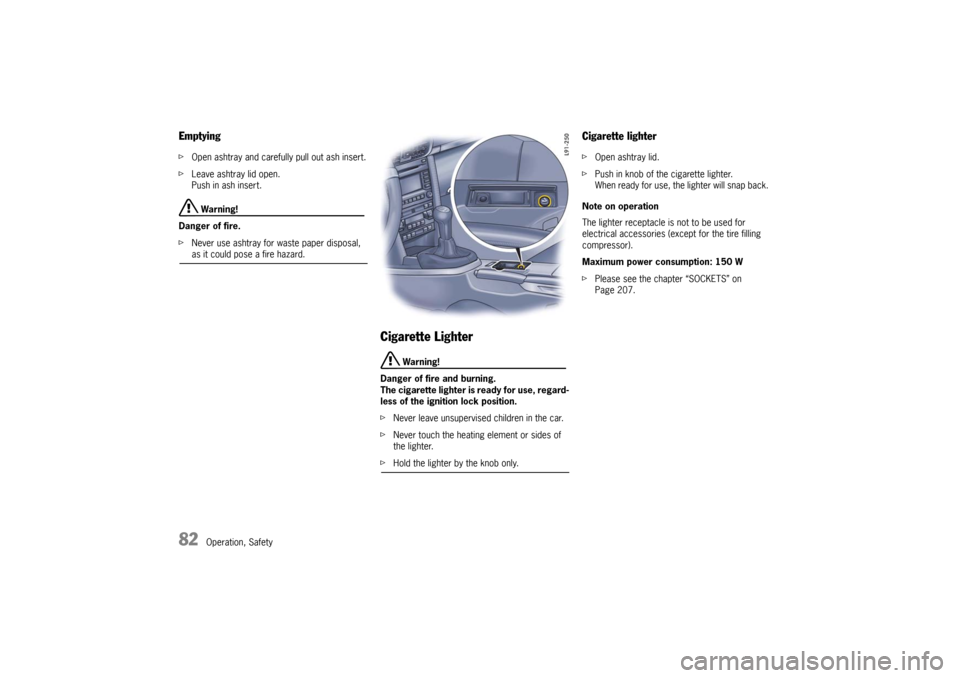
Cigarette Lighter
Warning!
Danger of fire and burning.
The cigarette lighter is ready for use, regard-
less of the ignition lock position.
fNever leave unsupervised children in the car.
fNever touch the heating element or sides of
the lighter.
fHold the lighter by the knob only.
Cigarette lighter fOpen ashtray lid.
fPush in knob of the cigarette lighter.
When ready for use, the lighter will snap back.
Note on operation
The lighter receptacle is not to be used for
electrical accessories (except for the tire filling
compressor).
Maximum power consumption: 150 W
fPlease see the chapter “SOCKETS” on
Page 207.
10_GT3_21.book Seite 82 Donnerstag, 4. Juni 2009 12:48 12
Page 85 of 251
84
Operation, Safety
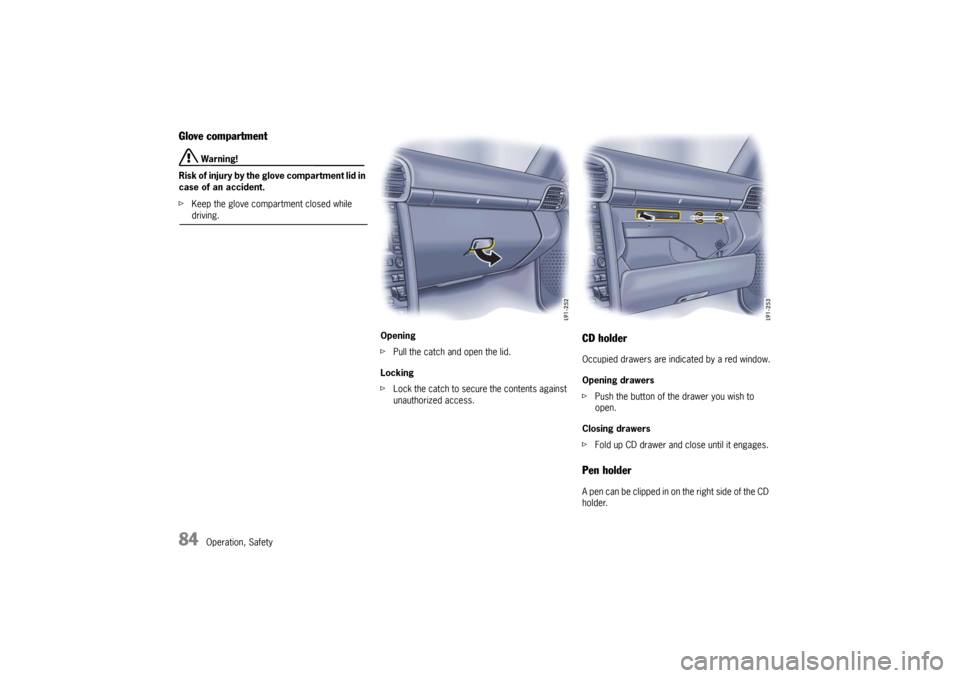
Glove compartment
Warning!
Risk of injury by the glove compartment lid in
case of an accident.
fKeep the glove compartment closed while driving.
Opening
fPull the catch and open the lid.
Locking
fLock the catch to secure the contents against
unauthorized access.
CD holderOccupied drawers are indicated by a red window.
Opening drawers
fPush the button of the drawer you wish to
open.
Closing drawers
fFold up CD drawer and close until it engages.Pen holderA pen can be clipped in on the right side of the CD
holder.
10_GT3_21.book Seite 84 Donnerstag, 4. Juni 2009 12:48 12
Page 86 of 251
Operation, Safety
85
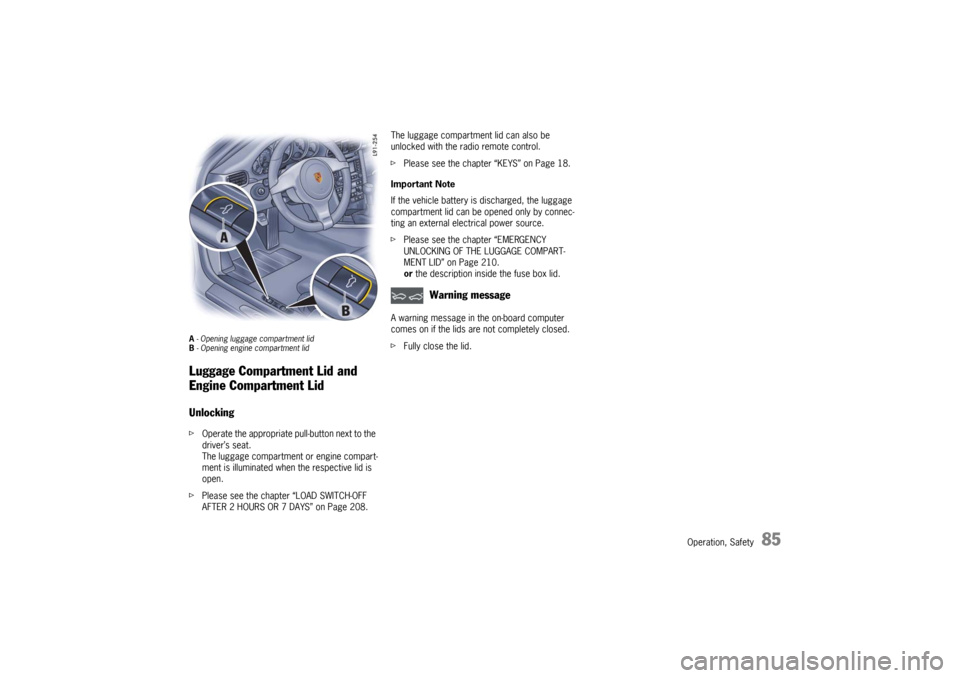
A - Opening luggage compartment lid
B - Opening engine compartment lid Luggage Compartment Lid and
Engine Compartment LidUnlocking fOperate the appropriate pull-button next to the
driver’s seat.
The luggage compartment or engine compart-
ment is illuminated when the respective lid is
open.
fPlease see the chapter “LOAD SWITCH-OFF
AFTER 2 HOURS OR 7 DAYS” on Page 208.The luggage compartment lid can also be
unlocked with the radio remote control.
fPlease see the chapter “KEYS” on Page 18.
Important Note
If the vehicle battery is discharged, the luggage
compartment lid can be opened only by connec-
ting an external electrical power source.
fPlease see the chapter “EMERGENCY
UNLOCKING OF THE LUGGAGE COMPART-
MENT LID” on Page 210.
or the description inside the fuse box lid.
A warning message in the on-board computer
comes on if the lids are not completely closed.
fFully close the lid.
Warning message
10_GT3_21.book Seite 85 Donnerstag, 4. Juni 2009 12:48 12