lock PORSCHE 911 GT3 2010 5.G Workshop Manual
[x] Cancel search | Manufacturer: PORSCHE, Model Year: 2010, Model line: 911 GT3, Model: PORSCHE 911 GT3 2010 5.GPages: 251, PDF Size: 14.33 MB
Page 166 of 251
Maintenance, Car Care
165
Fuel
Warning!
Fuel is highly flammable and harmful to
health.
fFire, open flame and smoking are prohibited
when handling fuel.
fAvoid contact with skin or clothing.
fDo not inhale fuel vapors.
To prevent damage to the emission control
system and engine:
fNever drive the tank completely out of fuel.
fAvoid high cornering speeds after the warning lights have come on.
fPlease see the chapter “FUEL ECONOMY” on
Page 164.
Please see the chapter “EMISSION CONTROL
SYSTEM” on Page 168.
Please see the chapter “LEVEL GAUGE” on
Page 113.
Check engine warning light If the warning lights in the instrument panel and on-
board computer come on and remain on while
driving, it suggests:
– a potential engine control problem and the
need for system service or
– an improperly fastened tank cap or – refueling with engine running.
Opening the filler flapThe filler opening is under the filler flap in the front
right fender.
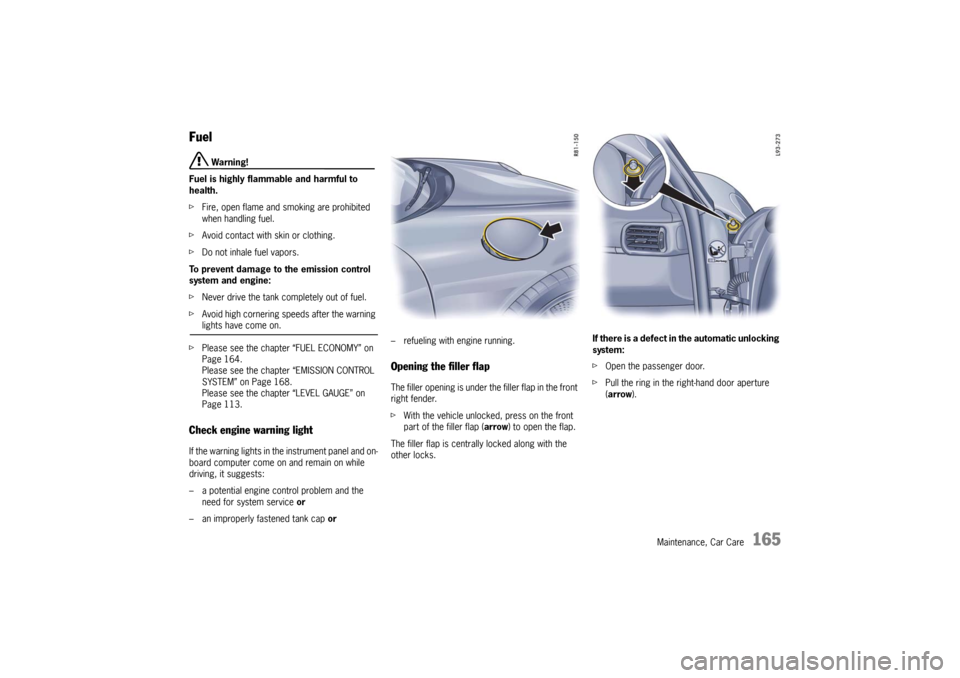
fWith the vehicle unlocked, press on the front
part of the filler flap (arrow) to open the flap.
The filler flap is centrally locked along with the
other locks. If there is a defect in the automatic unlocking
system:
fOpen the passenger door.
fPull the ring in the right-hand door aperture
(arrow).
10_GT3_21.book Seite 165 Donnerstag, 4. Juni 2009 12:48 12
Page 168 of 251

Maintenance, Car Care
167
Unleaded fuels may not be available outside the
continental U.S. and Canada. Therefore, we
recommend you do not take your car to areas or
countries where unleaded fuel may not be
available. Octane ratings Octane rating indicates a fuel’s ability to resist
detonation. Therefore, buying the correct octane
gas is important to prevent engine “damage”.
The RON octane rating is based on the research
method. The CLC (U.S. Cost of Living Council
octane rating) or AKI (antiknock index) octane
rating usually displayed on U.S. fuel pumps is
calculated as research octane number plus motor
octane number, divided by 2, that is written as:
The CLC or AKI octane rating is usually lower than
the RON rating:
For example: 95 RON equals 90 CLC or AKI
Fuels containing ethanolDo not use any fuels containing more than 10
percent ethanol by volume.
We recommend, however, to change to a different
fuel or station if any of the following problems
occur with your vehicle:
– Deterioration of driveability and performance.
– Substantially reduced fuel economy.
– Vapor lock and non-start problems, especially
at high altitude or at high temperature.
– Engine malfunction or stalling. Portable Fuel Containers
Danger!
Portable fuel containers, full or partially
empty, may leak causing an explosion, or
result in fire in case of an accident.
fNever carry additional fuel in portable contai-ners in your vehicle.
Fuel Evaporation Control Fuel tank venting The evaporation chamber and the carbon canister
prevent fuel from escaping to the atmosphere at
extreme high outside temperatures, when driving
abruptly around curves and when the car is parked
at an incline or in any other nonlevel position. Vapor control system and storage When the fuel tank is filled, vapors are collected in
the evaporation chamber by a vent line leading the
vapors to the carbon canister where they are
stored as long as the engine does not run. Purge system When the engine is running, the fuel vapors from
the canister will be mixed with fresh air from the
ambient air of the canister. This mixture will be
directed to the intake air housing by the tank vent
line, mixed with the intake air and burned during
normal combustion. RON+MON
2R+M
2 or
10_GT3_21.book Seite 167 Donnerstag, 4. Juni 2009 12:48 12
Page 172 of 251
Maintenance, Car Care
171
Power Steering Power steering is assisted by hydraulic auxiliary
forces.
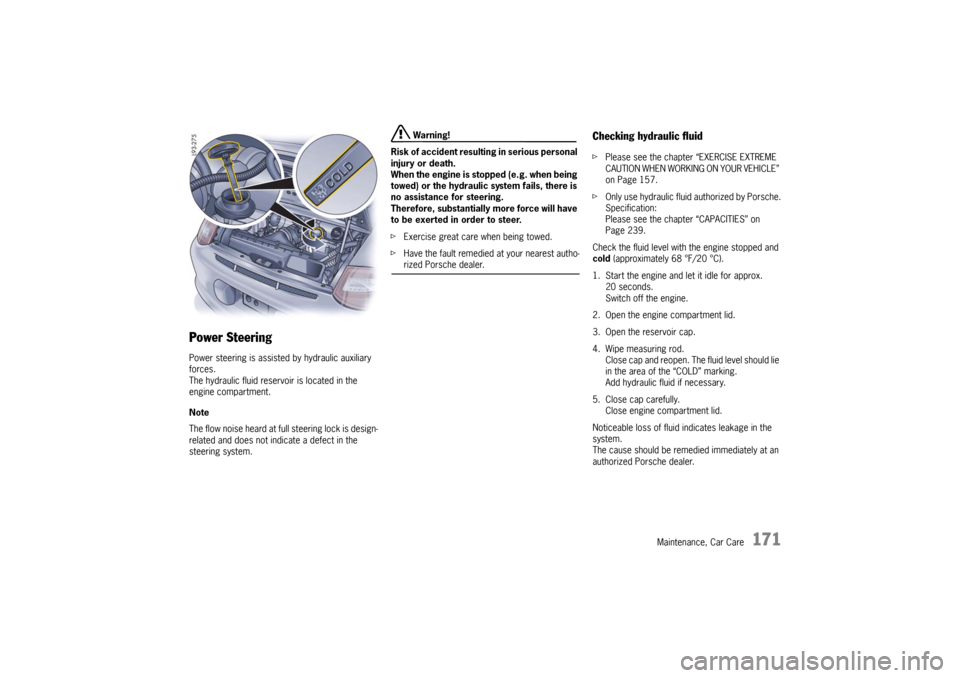
The hydraulic fluid reservoir is located in the
engine compartment.
Note
The flow noise heard at full steering lock is design-
related and does not indicate a defect in the
steering system.
Warning!
Risk of accident resulting in serious personal
injury or death.
When the engine is stopped (e.g. when being
towed) or the hydraulic system fails, there is
no assistance for steering.
Therefore, substantially more force will have
to be exerted in order to steer.
fExercise great care when being towed.
fHave the fault remedied at your nearest autho-rized Porsche dealer.
Checking hydraulic fluid fPlease see the chapter “EXERCISE EXTREME
CAUTION WHEN WORKING ON YOUR VEHICLE”
on Page 157.
fOnly use hydraulic fluid authorized by Porsche.
Specification:
Please see the chapter “CAPACITIES” on
Page 239.
Check the fluid level with the engine stopped and
cold (approximately 68 °F/20 °C).
1. Start the engine and let it idle for approx.
20 seconds.
Switch off the engine.
2. Open the engine compartment lid.
3. Open the reservoir cap.
4. Wipe measuring rod.
Close cap and reopen. The fluid level should lie
in the area of the “COLD” marking.
Add hydraulic fluid if necessary.
5. Close cap carefully.
Close engine compartment lid.
Noticeable loss of fluid indicates leakage in the
system.
The cause should be remedied immediately at an
authorized Porsche dealer.
10_GT3_21.book Seite 171 Donnerstag, 4. Juni 2009 12:48 12
Page 177 of 251

176
Maintenance, Car Care Note
Automatic car washes spray water at odd angles
and high pressures, which are not seen in normal
driving. Therefore, water can sometimes find its
way into the passengers compartment during or
shortly after the car wash.
Door lock fTo prevent the door lock from freezing during
the cold season, the lock cylinder should be
covered during a wash.
fShould the lock freeze, use an ordinary de-icer.
In many cases, a well warmed key can help.
Never use excessive force.Paint fNever rub a dusty car with a dry cloth since
dust particles are abrasive and could dull and
damage the surface finish.
The paintwork of your car is exposed to all types
of mechanical and chemical conditions, particu-
larly climatic ones such as bright sunlight, rain,
frost and snow. Ultraviolet light, rapid changes in
temperature, rain, snow, industrial dust and
chemical deposits constantly attack the paint
which is only able to withstand such exposure in
the long term if it is given regular care and atten-
tion.
fDo not apply silicone polishes to the windshield
or windows. fDo not treat matt-painted components with
preservatives or polishes as this will spoil the
matte effect.
Preservation
The paint surface becomes dull over time due to
weathering. It is therefore necessary to preserve
the paint regularly.
This keeps the paint shiny and elastic. Dirt is
prevented from adhering to the paint surface and
industrial dust is prevented from penetrating the
paint.
Provided it is washed and treated with preserva-
tive regularly, the brand new finish of your car will
be retained for years to come.
fApply paint preservative after the car wash and
polish it dry to obtain a bright finish.
Polishing
Do not resort to using Porsche polish until it
becomes evident that the normal preservatives no
longer produce the desired finish.
Spots and stains
fRemove tar stains, grease, oil spots and dead
insects as soon as possible with Insect
Remover. They can cause discoloration if
allowed to remain on the paintwork.
fWash the affected area immediately after
treating it.Minor paint damage
fHave minor paint damage, such as scratches,
scores or chips caused by flying stones,
repaired immediately by your authorized
Porsche dealer before corrosion sets in.
However, if there are already traces of corrosion,
they must first be removed carefully and
thoroughly. Coat the area with a rust-proofing
primer and finish off with a top coat. The paint
code and color number are found on the data bank
in the Maintenance booklet. 10_GT3_21.book Seite 176 Donnerstag, 4. Juni 2009 12:48 12
Page 183 of 251
182
Practical Tips, Emergency Service
Practical Tips, Emergency ServiceExercise Extreme Caution when Working
on your Vehicle ........................................... 183
Tires/Wheels .............................................. 184
Loading Information .................................... 195
Wheels with Central Locking ........................ 197
Central Bolts .............................................. 197
Changing a Wheel ....................................... 198
Checking Tire Pressure with a
Pressure Gauge .......................................... 203
Flat Tire ..................................................... 203
Lifting the Vehicle with a Lifting Platform or
Garage Lift ................................................. 206
Electrical System ........................................ 207
Battery....................................................... 211
Replacing the remote-control battery ............ 216
Emergency Starting with Jumper Cables ....... 217
Bulb chart .................................................. 219
Lights, Replacing Bulbs ............................... 219
Headlights .................................................. 220
License Plate Light...................................... 227
Front Side Lights, Front Turn Signal Lights,
Daytime Running Lights, Tail Lights and
Additional Brake Light ................................. 227
Adjusting Headlights.................................... 228
Towing ....................................................... 230
10_GT3_21.book Seite 182 Donnerstag, 4. Juni 2009 12:48 12
Page 184 of 251

Practical Tips, Emergency Service
183
Exercise Extreme Caution when
Working on your Vehicle
Danger!
Ignoring the following instructions may
cause serious personal injury or death.
fThe engine compartment of any motor vehicle
is a potentially hazardous area. If you are not
fully familiar with proper repair procedures, do
not attempt the adjustments described on the
following pages.
This caution also applies to the entire vehicle.
fO n l y w o r k o n y o u r v e h i c l e o u t d o o r s o r i n a w e l l
ventilated area.
fEnsure that there are no open flames in the
area of your vehicle at any time when fuel
fumes might be present. Be especially
cautious of such devices such as hot water
heaters which ignite a flame intermittently.
fBefore working on any part in the engine
compartment, turn the engine off and let it cool
down sufficiently. Hot engine compartment
components can burn skin on contact.
fBe alert and cautious around engine at all
times while the engine is running.
If work has to be performed with the engine
running, always set the parking brake, and
make sure the shift lever is in neutral position.fIn particular, be very careful to ensure that
items of clothing (ties, shirt, sleeves etc.),
jewelry, long hair, hand or fingers cannot get
caught in the engine-compartment blower, fan,
belts or other moving parts.
The radiator and radiator fan are in the front of
the car.
The engine-compartment blower is mounted
on the engine-compartment lid.
The engine-compartment blower can start or
continue running as a function of temperature,
even with the engine switched off.
Carry out work in these areas only with the
engine off, the ignition switched off, and
exercise extreme caution.
fYour Porsche is equipped with an electronic
ignition system. When the ignition is on, high
voltage is present in all wires connected with
the ignition system; therefore, exercise
extreme caution when working on any part of
the engine while the ignition is on or the engine
is running.
fAlways support your car with safety stands if it
is necessary to work under the car.
Jacks are not suitable for this kind of work.
fWhen working under the car without safety
stands but with the wheels on the ground,
make sure the car is on level ground, the
wheels are blocked, and that the engine
cannot be started.
Remove the ignition key.fDo not smoke or allow an open flame around
the battery or fuel.
Keep a fire extinguisher in close reach.
fIncomplete or improper servicing may cause
problems in the operation o f t h e c a r. I f i n d o u b t
about any servicing, have it done by your
authorized Porsche dealer.
Improper maintenance during the warranty
period may affect your Porsche warranty
coverage.
fSupplies of fluids, e.g. engine oil, brake fluid or
coolant, are hazardous to your health.
Keep these fluids out of children’s reach and
dispose of them in accordance with the appro-
priate regulations.
fSome countries require additional tools and
special spare parts to be carried.
Please make enquiries before driving abroad.
10_GT3_21.book Seite 183 Donnerstag, 4. Juni 2009 12:48 12
Page 198 of 251

Practical Tips, Emergency Service
197
Wheels with Central LockingWheels with central locking are perfectly normal in
motor sport, but on normal roads they are not
common. Your GT3 is fitted with central locking
wheels as standard.
Instead of the central lock nuts conventionally
used in motor sport, the GT3 wheel has a central
bolt, with which it is fastened to the wheel carrier.
Its anti-rotation device consists of an element
inserted into the wheel hub with spring-mounted
locking bolt.
Central BoltsThe central bolt and the lock are safety-related
components. Therefore, always check them for
signs of damage.
fThe conical surface, trapezoidal thread and
internal toothing of the central bolt must not
exhibit any scratches or cracks.
fReplace damaged central bolts.
Only use the genuine Porsche central bolts
allocated specifically to this vehicle model.
fThe conical surface and trapezoidal thread
on the central bolt must be free of any
contamination.
fThe central bolt must not contain any grease
except on the trapezoidal thread.Tightening torque6. Tightening torque for central bolts: 370 ftlb.
(500 Nm).
10_GT3_21.book Seite 197 Donnerstag, 4. Juni 2009 12:48 12
Page 200 of 251
Practical Tips, Emergency Service
199
Caution!
Risk of damage due to scratches.
fBe careful when removing the wheel-hub cap.
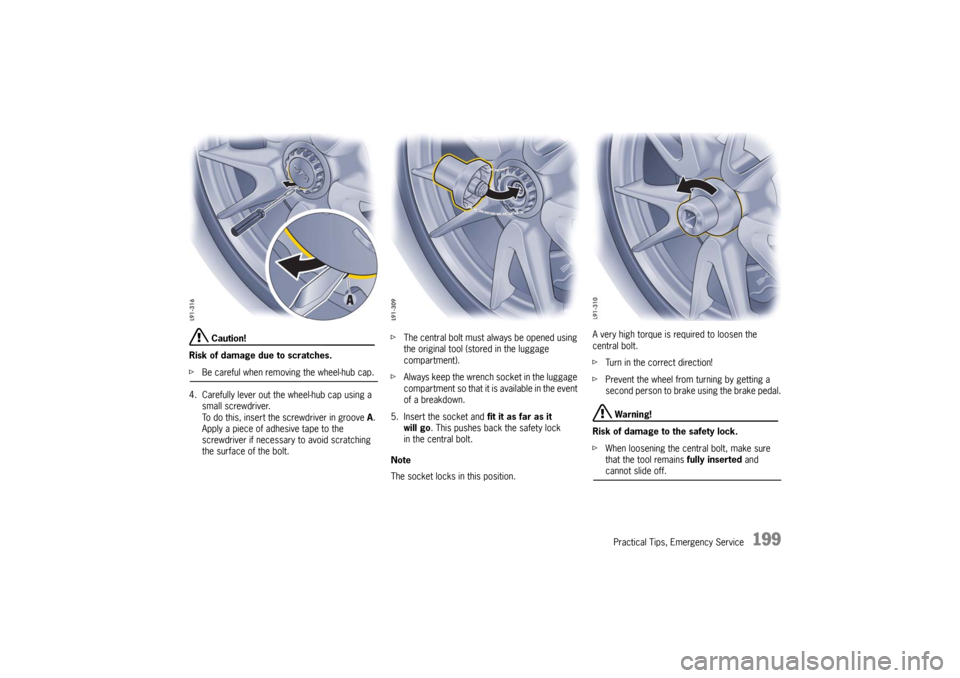
4. Carefully lever out the wheel-hub cap using a
small screwdriver.
To do this, insert the screwdriver in groove A.
Apply a piece of adhesive tape to the
screwdriver if necessary to avoid scratching
the surface of the bolt.fThe central bolt must always be opened using
the original tool (stored in the luggage
compartment).
fAlways keep the wrench socket in the luggage
compartment so that it is available in the event
of a breakdown.
5. Insert the socket and fit it as far as it
will go. This pushes back the safety lock
in the central bolt.
Note
The socket locks in this position.A very high torque is required to loosen the
central bolt.
fTurn in the correct direction!
fPrevent the wheel from turning by getting a
second person to brake using the brake pedal.
Warning!
Risk of damage to the safety lock.
fWhen loosening the central bolt, make sure
that the tool remains fully inserted and cannot slide off.
10_GT3_21.book Seite 199 Donnerstag, 4. Juni 2009 12:48 12
Page 201 of 251
200
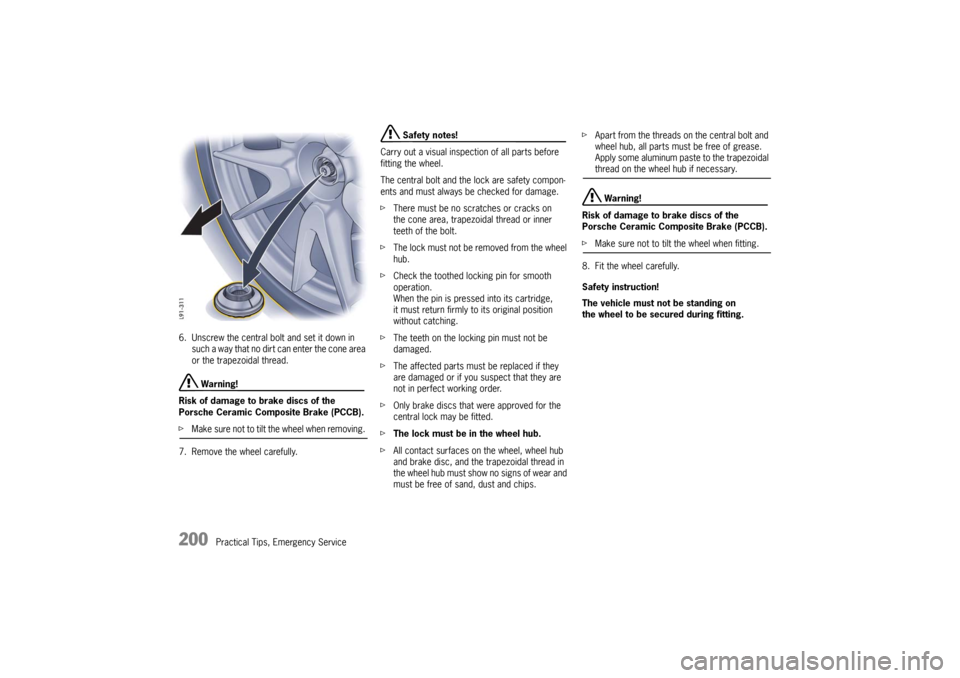
Practical Tips, Emergency Service 6. Unscrew the central bolt and set it down in
such a way that no dirt can enter the cone area
or the trapezoidal thread.
Warning!
Risk of damage to brake discs of the
Porsche Ceramic Composite Brake (PCCB).
fMake sure not to tilt the wheel when removing.
7. Remove the wheel carefully.
Safety notes!
Carry out a visual inspection of all parts before
fitting the wheel.
The central bolt and the lock are safety compon-
ents and must always be checked for damage.
fThere must be no scratches or cracks on
the cone area, trapezoidal thread or inner
teeth of the bolt.
fThe lock must not be removed from the wheel
hub.
fCheck the toothed locking pin for smooth
operation.
When the pin is pressed into its cartridge,
it must return firmly to its original position
without catching.
fThe teeth on the locking pin must not be
damaged.
fThe affected parts must be replaced if they
are damaged or if you suspect that they are
not in perfect working order.
fOnly brake discs that were approved for the
central lock may be fitted.
fThe lock must be in the wheel hub.
fAll contact surfaces on the wheel, wheel hub
and brake disc, and the trapezoidal thread in
the wheel hub must show no signs of wear and
must be free of sand, dust and chips. fApart from the threads on the central bolt and
wheel hub, all parts must be free of grease.
Apply some aluminum paste to the trapezoidal
thread on the wheel hub if necessary. Warning!
Risk of damage to brake discs of the
Porsche Ceramic Composite Brake (PCCB).
fMake sure not to tilt the wheel when fitting.
8. Fit the wheel carefully.
Safety instruction!
The vehicle must not be standing on
the wheel to be secured during fitting.
10_GT3_21.book Seite 200 Donnerstag, 4. Juni 2009 12:48 12
Page 202 of 251
Practical Tips, Emergency Service
201
9. Insert the central bolt into the socket (until it
engages), fit the central bolt at right angles to
the wheel hub and screw it on without tilting.
10.Tighten the central bolt once to at least
370 ftlb. (500 Nm) using a suitable torque
wrench and then loosen again slightly (by
approx. 1/4 turn).
11.Tighten the central bolt to 370 ftlb.
(500 Nm).
Prevent the wheel from turning by getting
a second person to press the brake pedal.
If you do not have a suitable torque wrench
in a breakdown situation, the emergency
procedure for securing the central bolt must
be performed.
Please see the chapter “EMERGENCY PROCE-
DURE FOR SECURING CENTRAL BOLT” on
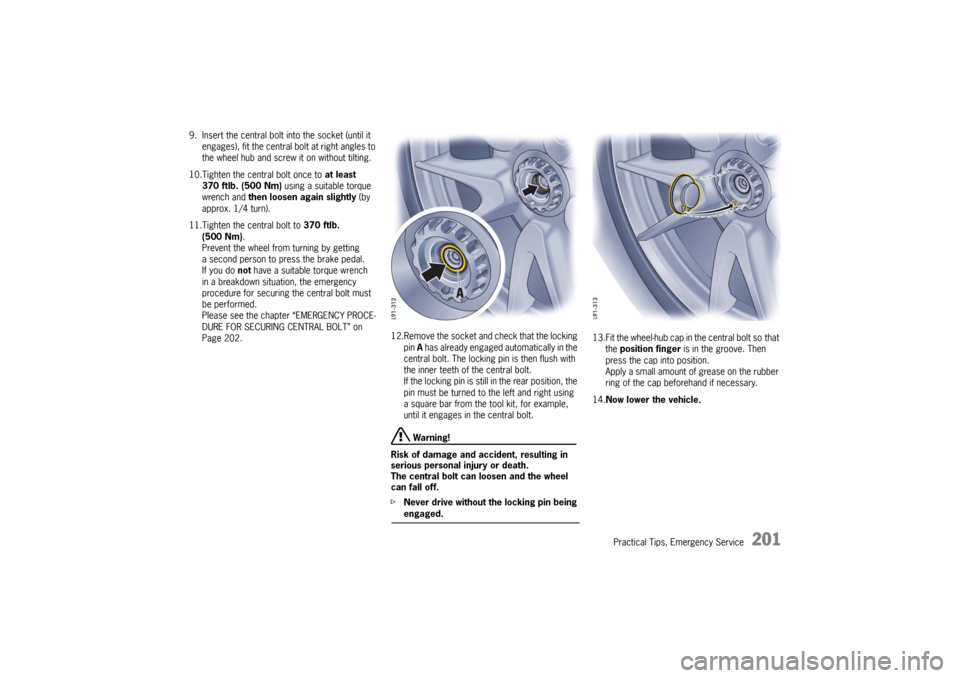
Page 202.12.Remove the socket and check that the locking
pin A has already engaged automatically in the
central bolt. The locking pin is then flush with
the inner teeth of the central bolt.
If the locking pin is still in the rear position, the
pin must be turned to the left and right using
a square bar from the tool kit, for example,
until it engages in the central bolt.
Warning!
Risk of damage and accident, resulting in
serious personal injury or death.
The central bolt can loosen and the wheel
can fall off.
fNever drive without the locking pin being engaged. 13.Fit the wheel-hub cap in the central bolt so that
the position finger is in the groove. Then
press the cap into position.
Apply a small amount of grease on the rubber
ring of the cap beforehand if necessary.
14.Now lower the vehicle.
10_GT3_21.book Seite 201 Donnerstag, 4. Juni 2009 12:48 12