light PORSCHE 911 TURBO 2014 6.G Owner's Manual
[x] Cancel search | Manufacturer: PORSCHE, Model Year: 2014, Model line: 911 TURBO, Model: PORSCHE 911 TURBO 2014 6.GPages: 300, PDF Size: 10.61 MB
Page 45 of 300
Seats, Mirrors and Steering Wheel 43
A statement by the seat manufacturer of compliance with this federal standard can be found on the instruction label on the restraint and in the instruction manual provided with the restraint.
The use of a child restraint system in the front passenger’s seat can result in serious personal injury or death to the child from an airbag deployment.
To reduce risk of injury from an inflating airbag in an accident, Porsche strongly recommends:fPlease see the chapter “PASS AIR BAG OFF INDICATOR LAMP DOES NOT LIGHT UP” on page 42.
fFollow all child restraint instructions and warnings in this manual.
fWhen using an infant or child restraint system, be sure to follow all manufacturer's instructions on installation and use.fInfants and small children should neither be held on the lap, nor should they share a safety belt with another occupant while the vehicle is in motion.fChildren too big for child restraint systems must use regular safety belts. A shoulder belt can be used providing it does not cross the face or the neck of the child.fChoose a child restraint system according to the weight of the child.fChild restraint systems that are damaged or have been heavily stressed in an accident must be replaced immediately.fChildren could be endangered in a crash if their child restraints are not properly secured in vehicle.fDo not affix objects to child restraint systems or cover them with other materials.fFor maximum safety and protection, do not use a child restraint system in the front passenger seat.
Direction of installation for child restraint systems
According to accident statistics, children are safer when properly restrained in the rear seating positions than in the front seating positions.
Under all normal circumstances, the forward facing child seat must be placed in the rear. fDo not use a child restraint system in the front passenger seat.
Group 0 and 0+: Children up to 29 lbs (13 kg)
Children of this weight must be transported in a restraint system which is installed on the passenger‘s seat facing rearward.
Group I: Children in between 20 lbs (9 kg) and 40 lbs (18 kg)
Children of this weight are transported in child restraint systems facing forward. Whenever possible, these child restraint systems should be installed on the rear seats.
Group II: Children in between 33 lbs (15 kg) and 55 lbs (25 kg)
Children of this weight are transported in child restraint systems facing forward. Whenever possible, these child restraint systems should be installed on the rear seats.
Group III: Children in between 49 lbs (22 kg) and 80 lbs (36 kg)
Children of this weight are transported in child restraint systems facing forward. Whenever possible, these child restraint systems should be installed on the rear seats.If a child restraint system must be fastened to the passenger’s seat, the passenger’s seat must be adjusted to the upper rear position.
Child Restraint in Front SeatDANGER h
Improper Use of Child Restraint
DANGERh
14_991_Turbo_21.book Seite 43 Mittwoch, 9. April 2014 2:19 14
Page 46 of 300
44 Seats, Mirrors and Steering Wheel
Information
If a child seat with top tether is adapted for use on the front seat, do not use Toptether in the rear.
Using child restraint systems in the front passenger seat
The use of a child restraint system in the front passenger seat can result in serious personal injury or death to the child from an airbag deployment.To reduce risk of injury from an inflating airbag in an accident, Porsche strongly recommends:fPlease see the chapter “PASS AIR BAG OFF INDICATOR LAMP DOES NOT LIGHT UP” on page 42.
However, there may be serious situations where it might be necessary to place a child in the front seat so that he/she can be kept under direct observation to prevent an immediate risk to the child (for example, while driving to the doctor or hospital). The following instructions are provided to you solely for that purpose.fSeek appropriate advice from your authorized Porsche dealer about the possible installation of a Porsche child restraint system.fIf a child restraint system must be fastened to the passenger's seat, adjust the passenger's seat as far away from the airbag as possible.fIf emergency or other serious conditions require a child to be placed in the front seat, exercise extreme caution and defensive driving of your vehicle.
Child restraint system for up to one-year old children
If the child restraint system must be fastened to the passenger’s seat in exceptional cases:– When an up to one-year old child is seated in the child restraint system, the front airbag is automatically deactivated on the passenger side.fMake sure that the “PASS AIR BAG OFF” indicator lamp lights up.fAdjust the passenger’s seat as far away from the airbag as possible.
When the ignition is on and the up to one-year old child is seated in the child restraint system on the passenger seat the indicator lamp “PASS AIR BAG OFF” must be on.
If the “PASS AIR BAG OFF” indicator lamp does not light up, it could indicate a fault in the system, and the airbag could inflate in a collision, placing the child at risk of death or severe injury from the inflating airbag.In this case:fChild restraint systems facing forwards: Install on the rear seats.fChild restraint systems facing rearwards: Do not drive with a rearward facing child restraint system.fHave the fault remedied at your nearest authorized Porsche dealer.
Child Restraint in Front Seat
DANGERh
Child Seat Detection Fault
DANGERh
14_991_Turbo_21.book Seite 44 Mittwoch, 9. April 2014 2:19 14
Page 47 of 300
Seats, Mirrors and Steering Wheel 45
Child restraint system for children older than one year
Your vehicle is equipped with occupant sensing for the passenger's seat in accordance with U.S. Federal Motor Vehicle Safety Standard 208. Depending on the weight, body positioning and shape acting on the passenger's seat, the passenger's airbag will automatically be switched on or off.fIn case of doubt, fasten the child restraint system on the rear bench.
Small adult passengers
fMake sure that the PASS AIR BAG OFF indicator lamp does not light up.
When the ignition is on and the small adult passenger is seated on the passenger seat, the indicator lamp “PASS AIR BAG OFF” must be off.
If the “PASS AIR BAG OFF” indicator lamp lights up, it could indicate a fault in the system.In this case:fHave the fault remedied at your nearest authorized Porsche dealer.
Automatic locking retractor
The safety belts for the front passenger and rear seats are equipped with an automatic locking retractor for securing the child restraint system. When activated, this retractor allows you to securely fasten the child restraint system in place so that inadvertent movements will not occur.
The use of a child restraint system on the front passenger seat can result in serious personal injury or death to the child from an airbag deployment.To reduce risk of injury from an inflating airbag in an accident, Porsche strongly recommends:fUnder all normal circumstances, the child seat must be placed in the rear. Do not use a child restraint system on the front passenger seat.
If there are emergency reasons for transporting a child in the front passenger seat, use a child restraint seat and the automatic locking retractor function. Follow the other safety instructions on the previous pages in this section.
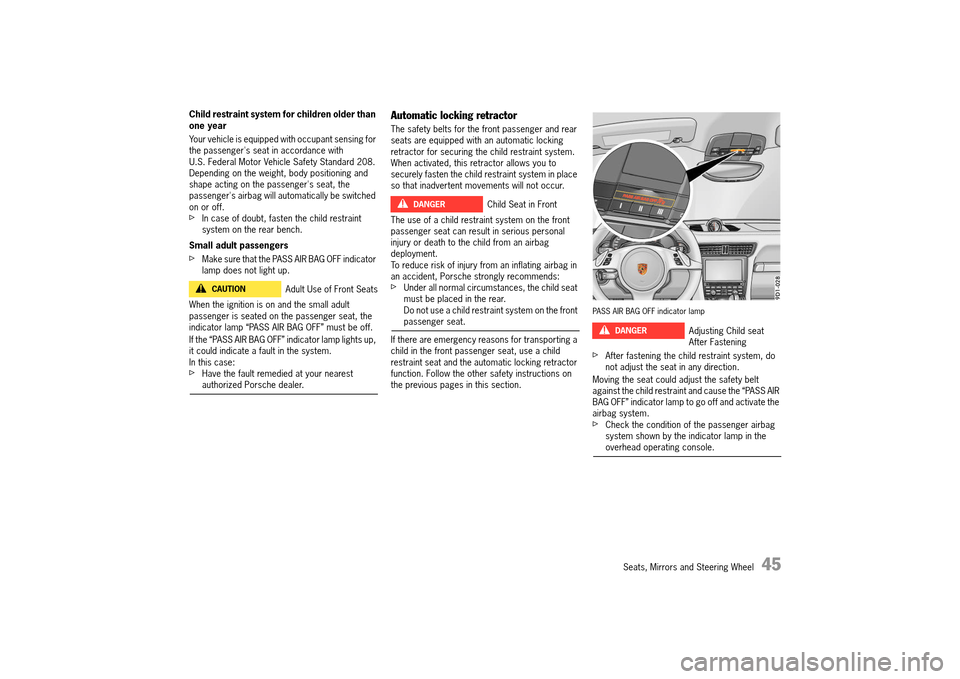
PASS AIR BAG OFF indicator lamp
fAfter fastening the child restraint system, do not adjust the seat in any direction.
Moving the seat could adjust the safety belt against the child restraint and cause the “PASS AIR BAG OFF” indicator lamp to go off and activate the airbag system.fCheck the condition of the passenger airbag system shown by the indicator lamp in the overhead operating console.
Adult Use of Front SeatsCAUTIONh
Child Seat in FrontDANGERh
Adjusting Child seat After Fastening
DANGERh
14_991_Turbo_21.book Seite 45 Mittwoch, 9. April 2014 2:19 14
Page 50 of 300
48 Seats, Mirrors and Steering Wheel
Roll-Over Protection
On the Cabriolet, a roll-over protection system installed behind the rear seats is extended within fractions of a second in the event of an accident. This generates a loud noise. If necessary, the seat-belt tensioners for the front seats will be activated.fPlease see the chapter “SAFETY-BELT PRETENSIONER” on page 37.
The roll-over protection system consists of two extendable assemblies which, together with the windshield frame, ensure sufficient headroom for all occupants if the vehicle rolls over.
Risk of damage to the convertible top and roll-over protection when opening and closing the convertible top.
Extended roll-over protection will obstruct the movement of the convertible top.fDo not open or close the convertible top with the roll-over protection extended.
A roll-over protection system that has been tampered with or obstructed in its movement may malfunction, resulting in serious or fatal injury.
A roll-over protection system that has been tampered with does not offer any protection. It may be triggered inadvertently, or not respond when needed. fDo not modify the wiring or components of the roll-over protection system.fKeep body parts and objects out of the area of movement of the extendable assemblies.fDo not open the covers of the extendable assemblies.fMake sure that no water or cleaning agents get into the roll-over protection system when cleaning the vehicle.
fIf the roll-over protection system is in any way faulty, please contact an authorized Porsche dealer to do this work.
Information
If the roll-over protection is triggered when the convertible top is closed, the rear window is destroyed.
Airbag Warning light
If the roll-over protection system is faulty, the airbag warning light on the instrument cluster will light up. Extension of the extendable assemblies is not ensured.fHave the fault repaired immediately at an authorized Porsche dealer.
Triggered roll-over protection system
fNever press the extendable assemblies back into the original position.fPlease contact an authorized Porsche dealer.
NOTICE
DANGERh
14_991_Turbo_21.book Seite 48 Mittwoch, 9. April 2014 2:19 14
Page 51 of 300
Seats, Mirrors and Steering Wheel 49
Exterior Mirrors
The convex mirror on the passenger’s side and the aspherical mirror on the driver’s side provide a larger field of view.
Vehicles or objects appear smaller in convex mirrors and further away than they are in reality.fBear this distortion in mind when estimating the distance of vehicles behind you and when reversing into a parking space.fAlso make use of the interior mirror for judging distance.
Risk of damage to the exterior mirrors when washing the vehicle in a car wash.fFold in exterior mirrors before using the car wash.
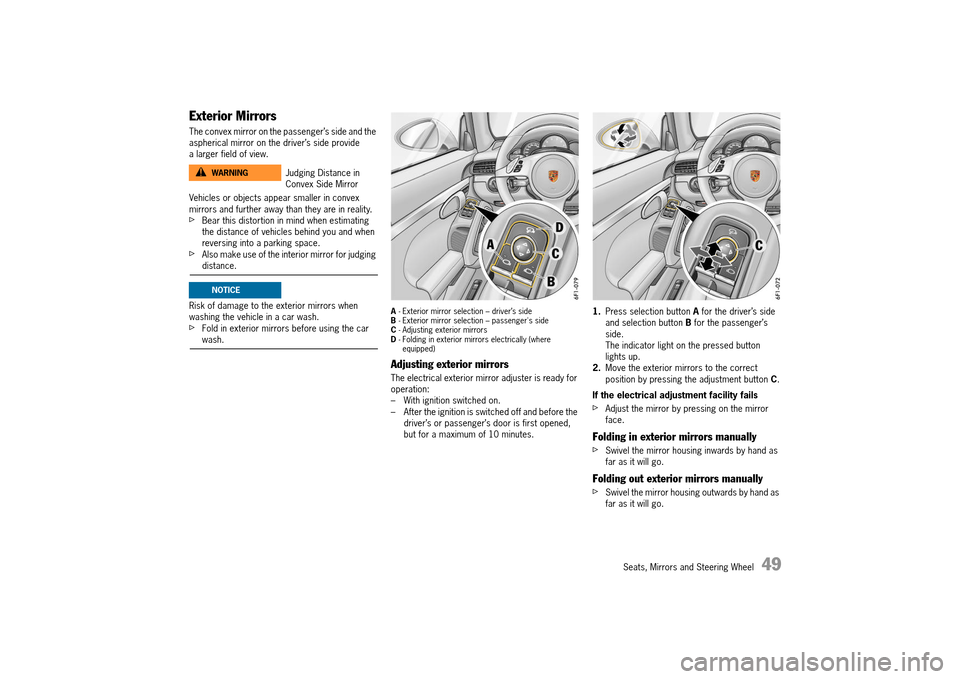
A - Exterior mirror selection – driver’s side B - Exterior mirror selection – passenger's side C - Adjusting exterior mirrors D - Folding in exterior mirrors electrically (where equipped)
Adjusting exterior mirrors
The electrical exterior mirror adjuster is ready for operation:– With ignition switched on.– After the ignition is switched off and before the driver’s or passenger’s door is first opened, but for a maximum of 10 minutes.
1. Press selection button A for the driver’s side and selection button B for the passenger’s side.The indicator light on the pressed button lights up.2. Move the exterior mirrors to the correct position by pressing the adjustment button C.
If the electrical adjustment facility fails
fAdjust the mirror by pressing on the mirror face.
Folding in exterior mirrors manually
fSwivel the mirror housing inwards by hand as far as it will go.
Folding out exterior mirrors manually
fSwivel the mirror housing outwards by hand as far as it will go.
Judging Distance in Convex Side Mirror
WARNINGh
NOTICE
14_991_Turbo_21.book Seite 49 Mittwoch, 9. April 2014 2:19 14
Page 52 of 300
50 Seats, Mirrors and Steering Wheel
Folding exterior mirrors in and out electrically
fPress button D. Both exterior mirrors fold in and out automatically.
If the electrical adjustment facility fails
fFold mirror in or out manually.
Information
At speeds greater than approx. 30 mph (50 km/h), the exterior mirrors can no longer be folded in.
Folding exterior mirrors in and out automatically
The exterior mirrors are folded in automatically after the vehicle is locked.
Prerequisite: – The function is activated on the multi-function display.
Folding exterior mirrors out automatically
fSwitch on ignition. The exterior mirrors fold out.
Information
The exterior mirrors do not fold out automatically after the ignition is switched on if they were folded in manually using the button D.
If the electrical adjustment facility fails
fFold the mirror outwards by hand as far as it will go.
Storing exterior mirror settings
On vehicles with memory, individual exterior mirror settings can be stored on the person buttons on the driver’s side and on the car key.
For further information on retrieving and storing vehicle settings:fPLEASE SEE THE CHAPTER “COMFORT ENTRY FUNCTION” on page 34.
Exterior mirror heating
The exterior mirror heating is activated automatically when the heated rear window is switched on while the engine is running.
For information on switching on the heated rear window:fPlease see the chapter “HEATED REAR WINDOW/ EXTERIOR MIRROR HEATING” on page 60.
If the charging condition of the battery is critical, the exterior mirror heating function is restricted initially and then switched off.
Swivelling down mirror glass as parking aid
When reverse gear is engaged, the mirror on the passenger’s side swivels down slightly to show the curb area.fPlease see the chapter “SWIVELLING DOWN MIRROR GLASS AS PARKING AID” on page 210.
Automatic Anti-Dazzle Interior and
Exterior Mirrors
The interior mirror’s reflection is undistorted.
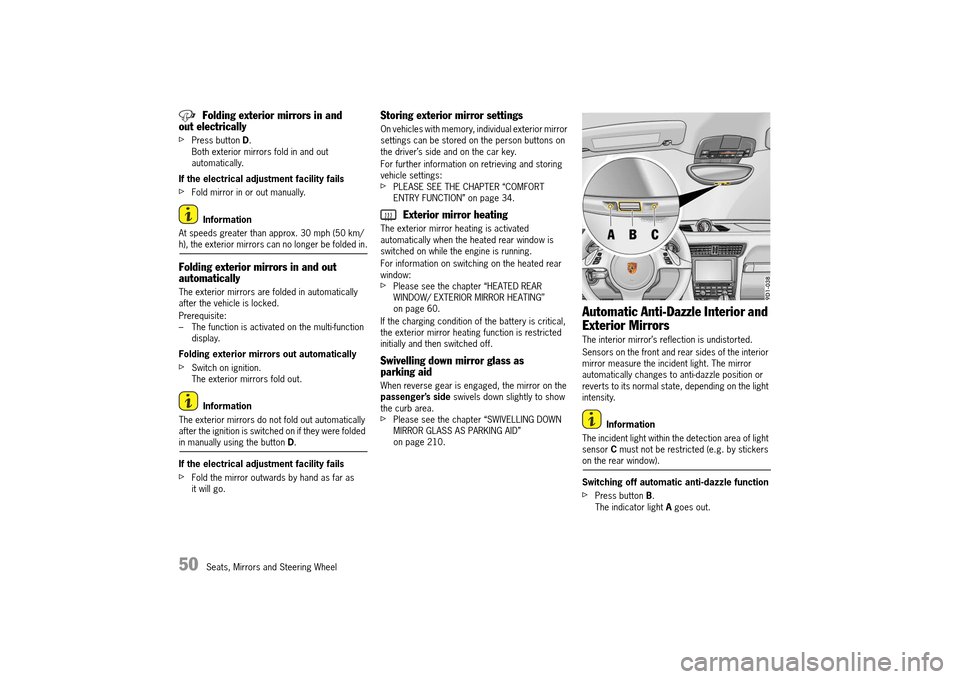
Sensors on the front and rear sides of the interior mirror measure the incident light. The mirror automatically changes to anti-dazzle position or reverts to its normal state, depending on the light intensity.
Information
The incident light within the detection area of light sensor C must not be restricted (e.g. by stickers on the rear window).
Switching off automatic anti-dazzle function
fPress button B. The indicator light A goes out.
14_991_Turbo_21.book Seite 50 Mittwoch, 9. April 2014 2:19 14
Page 53 of 300
Seats, Mirrors and Steering Wheel 51
Information
The anti-dazzle function switches off automatically if:– Reverse gear is engaged or– Interior lighting is switched on.
Switching on automatic anti-dazzle function
fPress button B. The indicator light A lights up.
Electrolyte fluid may escape from broken mirror glass. This fluid irritates the skin and eyes.fIf the electrolyte fluid should come into contact with the skin or eyes, rinse it off immediately with clean water.Seek medical attention if necessary.
Risk of damage to paintwork, leather, plastic parts and clothing.
Electrolyte fluid can be removed only while it is still wet.fClean the affected parts with water.
Automatic anti-dazzle exterior mirror
The exterior mirrors change to anti-dazzle position automatically in synchronization with the interior mirror.
Steering Wheel Heating
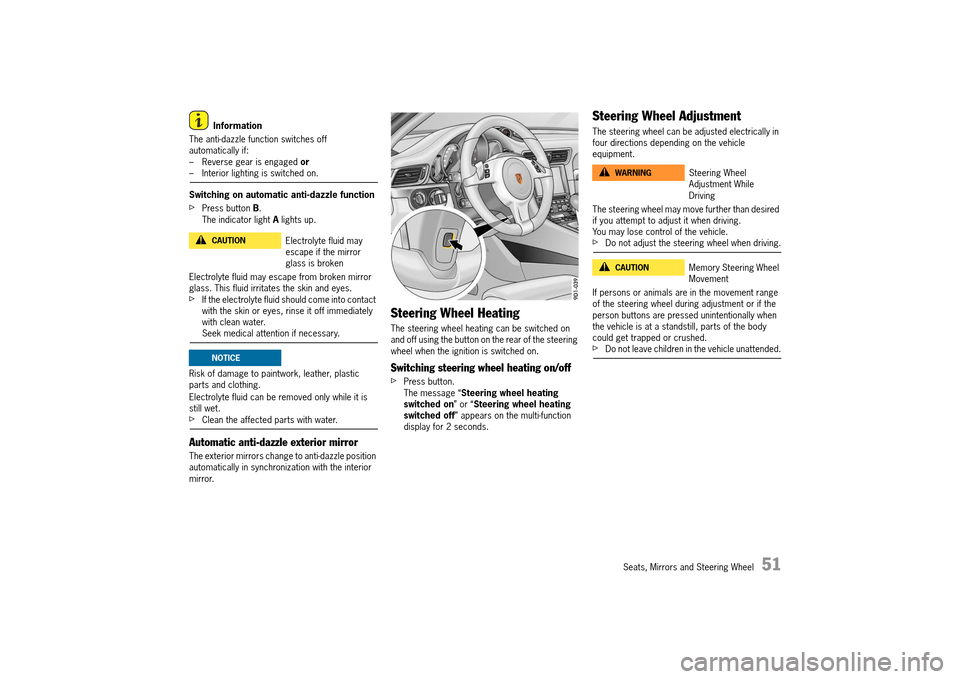
The steering wheel heating can be switched on and off using the button on the rear of the steering wheel when the ignition is switched on.
Switching steering wheel heating on/off
fPress button.The message “ Steering wheel heating switched on ” or “Steering wheel heating switched off ” appears on the multi-function display for 2 seconds.
Steering Wheel Adjustment
The steering wheel can be adjusted electrically in four directions depending on the vehicle equipment.
The steering wheel may move further than desired if you attempt to adjust it when driving.You may lose control of the vehicle.fDo not adjust the steering wheel when driving.
If persons or animals are in the movement range of the steering wheel during adjustment or if the person buttons are pressed unintentionally when the vehicle is at a standstill, parts of the body could get trapped or crushed.fDo not leave children in the vehicle unattended.
Electrolyte fluid may escape if the mirror glass is broken
CAUTIONh
NOTICE
Steering Wheel Adjustment While Driving
Memory Steering Wheel Movement
WARNINGh
CAUTIONh
14_991_Turbo_21.book Seite 51 Mittwoch, 9. April 2014 2:19 14
Page 55 of 300
Seats, Mirrors and Steering Wheel 53
Function buttons on the multi-function steering wheel
Information
The rotary buttons at the top left and right of the steering wheel can also be pressed.
Sun Visors
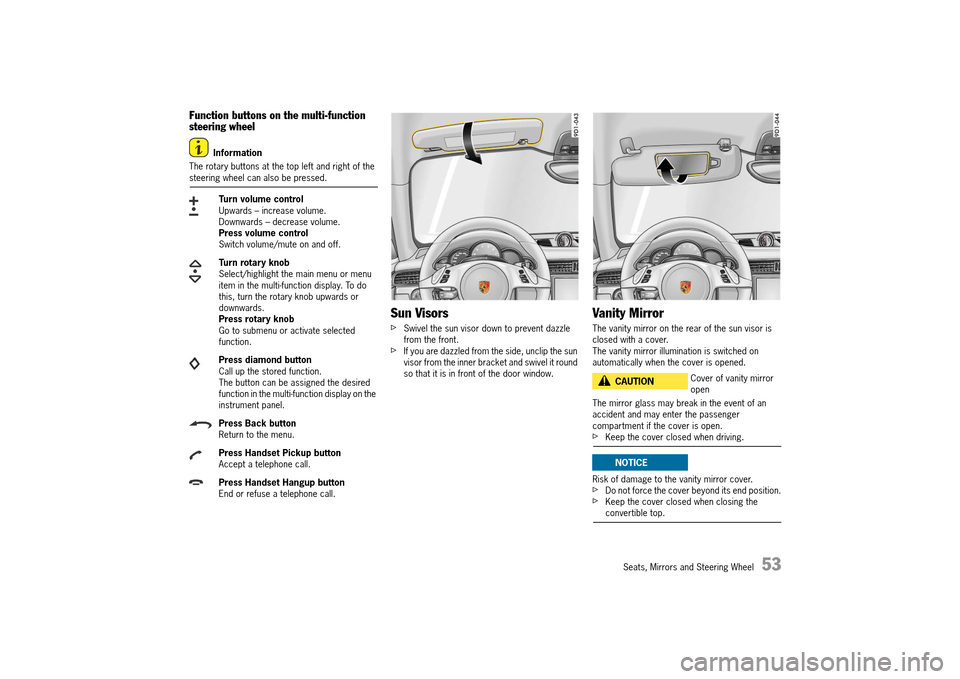
fSwivel the sun visor down to prevent dazzle from the front.fIf you are dazzled from the side, unclip the sun visor from the inner bracket and swivel it round so that it is in front of the door window.
Vanity Mirror
The vanity mirror on the rear of the sun visor is closed with a cover. The vanity mirror illumination is switched on automatically when the cover is opened.
The mirror glass may break in the event of an accident and may enter the passenger compartment if the cover is open.fKeep the cover closed when driving.
Risk of damage to the vanity mirror cover.fDo not force the cover beyond its end position.fKeep the cover closed when closing the convertible top.
Turn volume control Upwards – increase volume.Downwards – decrease volume.Press volume controlSwitch volume/mute on and off.
Turn rotary knob Select/highlight the main menu or menu item in the multi-function display. To do this, turn the rotary knob upwards or downwards.Press rotary knobGo to submenu or activate selected function.
Press diamond button Call up the stored function.The button can be assigned the desired function in the multi-function display on the instrument panel.
Press Back button Return to the menu.
Press Handset Pickup button Accept a telephone call.
Press Handset Hangup button End or refuse a telephone call.
Cover of vanity mirror openCAUTIONh
NOTICE
14_991_Turbo_21.book Seite 53 Mittwoch, 9. April 2014 2:19 14
Page 57 of 300
Air Conditioning 55
Automatically Controlled 2-zone
Air Conditioning
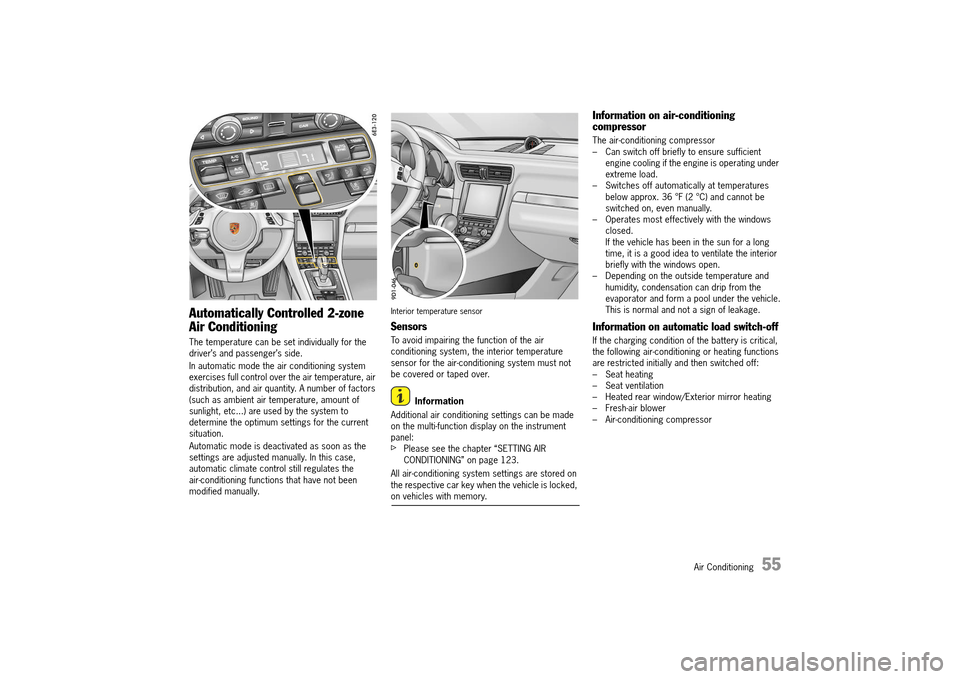
The temperature can be set individually for the driver’s and passenger’s side.
In automatic mode the air conditioning system exercises full control over the air temperature, air distribution, and air quantity. A number of factors (such as ambient air temperature, amount of sunlight, etc...) are used by the system to determine the optimum settings for the current situation.
Automatic mode is deactivated as soon as the settings are adjusted manually. In this case, automatic climate control still regulates the air-conditioning functions that have not been modified manually.
Interior temperature sensor
Sensors
To avoid impairing the function of the air conditioning system, the interior temperature sensor for the air-conditioning system must not be covered or taped over.
Information
Additional air conditioning settings can be made on the multi-function display on the instrument panel:fPlease see the chapter “SETTING AIR CONDITIONING” on page 123.
All air-conditioning system settings are stored on the respective car key when the vehicle is locked, on vehicles with memory.
Information on air-conditioning compressor
The air-conditioning compressor – Can switch off briefly to ensure sufficient engine cooling if the engine is operating under extreme load.– Switches off automatically at temperatures below approx. 36 °F (2 °C) and cannot be switched on, even manually.– Operates most effectively with the windows closed.If the vehicle has been in the sun for a long time, it is a good idea to ventilate the interior briefly with the windows open.– Depending on the outside temperature and humidity, condensation can drip from the evaporator and form a pool under the vehicle.This is normal and not a sign of leakage.
Information on automatic load switch-off
If the charging condition of the battery is critical, the following air-conditioning or heating functions are restricted initially and then switched off:– Seat heating– Seat ventilation– Heated rear window/Exterior mirror heating– Fresh-air blower– Air-conditioning compressor
14_991_Turbo_21.book Seite 55 Mittwoch, 9. April 2014 2:19 14
Page 58 of 300
56 Air Conditioning
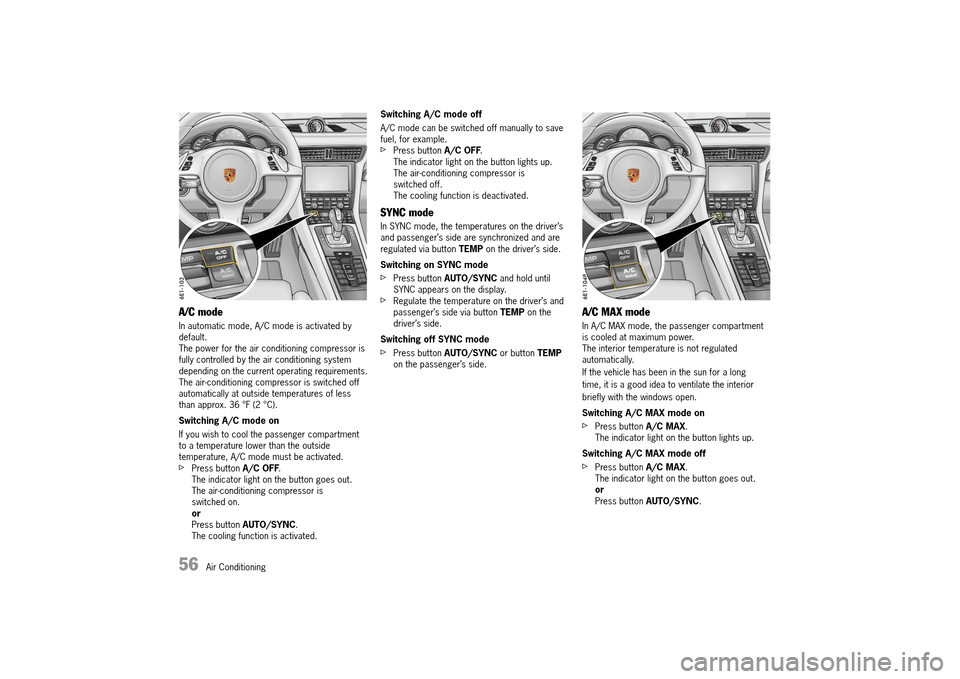
A/C mode
In automatic mode, A/C mode is activated by default.The power for the air conditioning compressor is fully controlled by the air conditioning system depending on the current operating requirements.The air-conditioning compressor is switched off automatically at outside temperatures of less than approx. 36 °F (2 °C).
Switching A/C mode on
If you wish to cool the passenger compartment to a temperature lower than the outside temperature, A/C mode must be activated.fPress button A/C OFF. The indicator light on the button goes out.The air-conditioning compressor is switched on.orPress button AUTO/SYNC. The cooling function is activated.
Switching A/C mode off
A/C mode can be switched off manually to save fuel, for example.fPress button A/C OFF. The indicator light on the button lights up.The air-conditioning compressor is switched off.The cooling function is deactivated.
SYNC mode
In SYNC mode, the temperatures on the driver’s and passenger’s side are synchronized and are regulated via button TEMP on the driver’s side.
Switching on SYNC mode
fPress button AUTO/SYNC and hold until SYNC appears on the display.fRegulate the temperature on the driver’s and passenger’s side via button TEMP on the driver’s side.
Switching off SYNC mode
fPress button AUTO/SYNC or button TEMP on the passenger’s side.
A/C MAX mode
In A/C MAX mode, the passenger compartment is cooled at maximum power.The interior temperature is not regulated automatically.
If the vehicle has been in the sun for a long
time, it is a good idea to ventilate the interior
briefly with the windows open.
Switching A/C MAX mode on
fPress button A/C MAX. The indicator light on the button lights up.
Switching A/C MAX mode off
fPress button A/C MAX. The indicator light on the button goes out.orPress button AUTO/SYNC.
14_991_Turbo_21.book Seite 56 Mittwoch, 9. April 2014 2:19 14