spare tire RAM 1500 2021 User Guide
[x] Cancel search | Manufacturer: RAM, Model Year: 2021, Model line: 1500, Model: RAM 1500 2021Pages: 496, PDF Size: 20.89 MB
Page 373 of 496

SAFETY371
PERIODIC SAFETY CHECKS YOU SHOULD
M
AKE OUTSIDE THE VEHICLE
Tires
Examine tires for excessive tread wear and
uneven wear patterns. Check for stones, nails,
glass, or other objects lodged in the tread or
sidewall. Inspect the tread for cuts and cracks.
Inspect sidewalls for cuts, cracks, and bulges.
Check the lug nut/bolt torque for tightness.
Check the tires (including spare) for proper cold
inflation pressure.
Lights
Have someone observe the operation of brake
lights and exterior lights while you work the
controls. Check turn signal and high beam
indicator lights on the instrument panel.
Door Latches
Check for proper closing, latching, and locking.
Fluid Leaks
Check area under the vehicle after overnight
parking for fuel, coolant, oil, or other fluid leaks.
Also, if gasoline fumes are detected or if fuel or
brake fluid leaks are suspected, the cause
should be located and corrected immediately.
EXHAUST GAS The best protection against carbon monoxide
entry into the vehicle body is a properly
maintained engine exhaust system.
Whenever a change is noticed in the sound of
the exhaust system, when exhaust fumes can
be detected inside the vehicle, or when the
underside or rear of the vehicle is damaged,
have an authorized dealer inspect the complete
exhaust system and adjacent body areas for
broken, damaged, deteriorated, or
mispositioned parts. Open seams or loose
connections could permit exhaust fumes to
seep into the passenger compartment. In
addition, inspect the exhaust system each time
the vehicle is raised for lubrication or oil
change. Replace as required.
WARNING!
Exhaust gases can injure or kill. They contain
carbon monoxide (CO), which is colorless and
odorless. Breathing it can make you
unconscious and can eventually poison you.
To avoid breathing (CO), follow these safety
tips:
Do not run the engine in a closed garage or
in confined areas any longer than needed
to move your vehicle in or out of the area.
If you are required to drive with the trunk/
liftgate/rear doors open, make sure that all
windows are closed and the climate control
BLOWER switch is set at high speed. DO
NOT use the recirculation mode.
If it is necessary to sit in a parked vehicle
with the engine running, adjust your
heating or cooling controls to force outside
air into the vehicle. Set the blower at high
speed.
6
21_DT_OM_EN_USC_t.book Page 371
Page 381 of 496
IN CASE OF EMERGENCY379
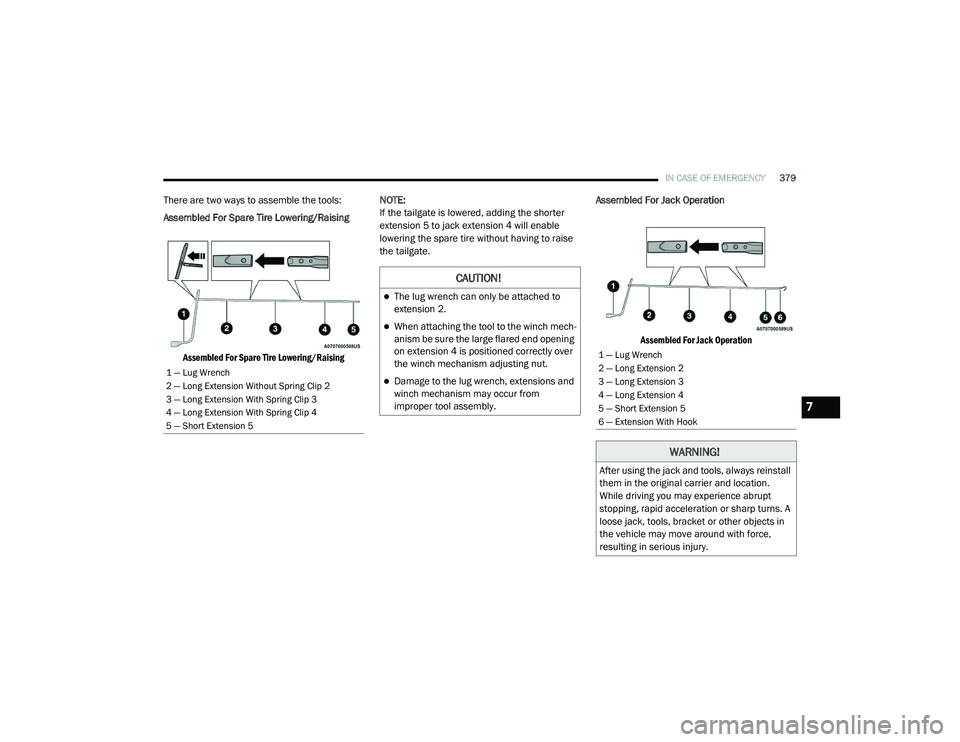
There are two ways to assemble the tools:
Assembled For Spare Tire Lowering/Raising
Assembled For Spare Tire Lowering/Raising
NOTE:
If the tailgate is lowered, adding the shorter
extension 5 to jack extension 4 will enable
lowering the spare tire without having to raise
the tailgate.
Assembled For Jack Operation
Assembled For Jack Operation
1 — Lug Wrench
2 — Long Extension Without Spring Clip 2
3 — Long Extension With Spring Clip 3
4 — Long Extension With Spring Clip 4
5 — Short Extension 5
CAUTION!
The lug wrench can only be attached to
extension 2.
When attaching the tool to the winch mech -
anism be sure the large flared end opening
on extension 4 is positioned correctly over
the winch mechanism adjusting nut.
Damage to the lug wrench, extensions and
winch mechanism may occur from
improper tool assembly.
1 — Lug Wrench
2 — Long Extension 2
3 — Long Extension 3
4 — Long Extension 4
5 — Short Extension 5
6 — Extension With Hook
WARNING!
After using the jack and tools, always reinstall
them in the original carrier and location.
While driving you may experience abrupt
stopping, rapid acceleration or sharp turns. A
loose jack, tools, bracket or other objects in
the vehicle may move around with force,
resulting in serious injury.
7
21_DT_OM_EN_USC_t.book Page 379
Page 382 of 496
380IN CASE OF EMERGENCY
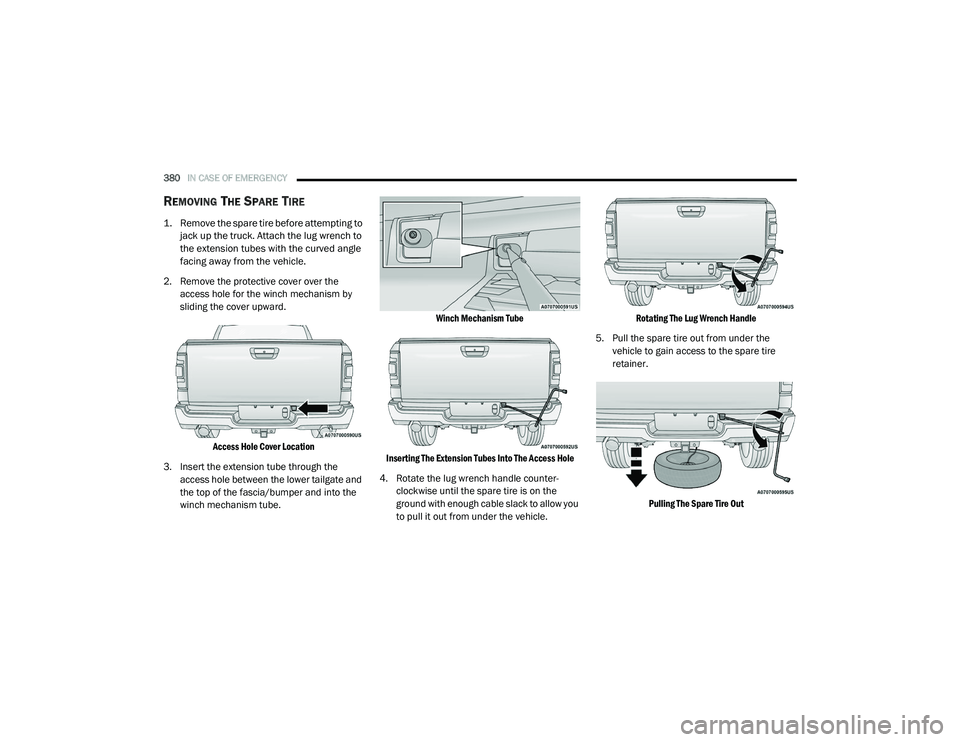
REMOVING THE SPARE TIRE
1. Remove the spare tire before attempting to
jack up the truck. Attach the lug wrench to
the extension tubes with the curved angle
facing away from the vehicle.
2. Remove the protective cover over the access hole for the winch mechanism by
sliding the cover upward.
Access Hole Cover Location
3. Insert the extension tube through the access hole between the lower tailgate and
the top of the fascia/bumper and into the
winch mechanism tube.
Winch Mechanism Tube
Inserting The Extension Tubes Into The Access Hole
4. Rotate the lug wrench handle counter -
clockwise until the spare tire is on the
ground with enough cable slack to allow you
to pull it out from under the vehicle.
Rotating The Lug Wrench Handle
5. Pull the spare tire out from under the vehicle to gain access to the spare tire
retainer.
Pulling The Spare Tire Out
21_DT_OM_EN_USC_t.book Page 380
Page 383 of 496

IN CASE OF EMERGENCY381
(Continued)
6. Lift the spare tire with one hand to give clearance to tilt the retainer at the end of
the cable.
Tilting The Retainer Through The Center Of The Wheel
7. Pull the retainer through the center of the wheel.
Pulling The Retainer Through The Center Of The Wheel
NOTE:
The winch mechanism is designed for use with
the extension tubes only. Use of an air wrench
or other power tools is not recommended and
can damage the winch.
JACKING INSTRUCTIONS
Jack Warning Label
WARNING!
Carefully follow these tire changing warnings
to help prevent personal injury or damage to
your vehicle:
Always park on a firm, level surface as far
from the edge of the roadway as possible
before raising the vehicle.
Turn on the Hazard Warning Flashers.
Apply the parking brake firmly and set the
transmission in PARK.
Block the wheel diagonally opposite the
wheel to be raised.
Never start or run the engine with the
vehicle on a jack.
Do not let anyone sit in the vehicle when it
is on a jack.
Do not get under the vehicle when it is on a
jack. If you need to get under a raised
vehicle, take it to a service center where it
can be raised on a lift.
Only use the jack in the positions indicated
and for lifting this vehicle during a tire
change.
If working on or near a roadway, be
extremely careful of motor traffic.
To assure that spare tires, flat or inflated,
are securely stowed, spares must be
stowed with the valve stem facing the
ground.
WARNING!
(Continued)
7
21_DT_OM_EN_USC_t.book Page 381
Page 384 of 496

382IN CASE OF EMERGENCY
1. Remove the spare tire, jack, and tools from
the stored location.
2. Using the lug wrench, loosen the wheel nuts (but do not remove), by turning them
counterclockwise one turn while the wheel
is still on the ground.
3. Assemble the jack and jacking tools. Connect the jack handle driver to the
extension, then to the lug wrench.
Assembled Jack And Tools
4. Placement for the front and rear jacking
locations are critical. See below images for
proper jacking locations.
Jack / Extensions Placement
Front Jacking Location
When changing a front wheel, place the
scissor jack under the rear portion of the
lower control arm as shown. Access the
front jacking location from behind the front
tire.
Front Lifting Point
Front Jacking Location
Rear Jacking Location
Operate the jack using the extension with
jack hook and the lug wrench. The exten -
sion tubes may be used but is not required.
CAUTION!
Do not attempt to raise the vehicle by jacking
on locations other than those indicated in the
Jacking Instructions for this vehicle.
21_DT_OM_EN_USC_t.book Page 382
Page 385 of 496

IN CASE OF EMERGENCY383
When changing a rear wheel, assemble the
extension with jack hook to the jack and
connect the extension tubes. Access the
rear jacking location from behind the rear
tire. Place the jack under the Jack Lifting
Point located on the rear axle lower control
arm bracket. Then locate the slot in the jack
lift plate onto the rear axle Jack Lifting Point.
Attach the extension with jack hook extend -
ing to the rear of the vehicle.
Rear Lifting Point Rear Jacking Location
Connect the long extensions to the lug
wrench.
5. By rotating the lug wrench clockwise, raise the vehicle until the wheel just clears the
ground surface. 6. Remove the lug nuts and pull the wheel off.
Install the spare wheel and lug nuts with the
cone shaped end of the lug nuts toward the
wheel. Hand tighten the lug nuts with the
vehicle lifted. To avoid the risk of forcing the
vehicle off the jack, do not fully tighten the
lug nuts until the vehicle has been
completely lowered.
7. Finish tightening the lug nuts. Push down on the wrench handle for increased leverage.
Tighten the lug nuts in a star pattern until
each lug nut has been tightened twice
Úpage 467. If in doubt about the correct
tightness, have them checked with a torque
wrench by an authorized dealer or at a
service station.
CAUTION!
Before raising the wheel off the ground, make
sure that the jack will not damage
surrounding truck parts and adjust the jack
position as required.
WARNING!
Raising the vehicle higher than necessary can
make the vehicle less stable. It could slip off
the jack and hurt someone near it. Raise the
vehicle only enough to remove the tire.
7
21_DT_OM_EN_USC_t.book Page 383
Page 386 of 496
384IN CASE OF EMERGENCY
8. If your vehicle is equipped with a wheel
center cap, install the cap and remove the
wheel blocks. Do not install chrome or
aluminum wheel center caps on the spare
wheel. This may result in cap damage.
9. Lower the jack to its fully closed position. Stow the replaced tire, and secure the jack
and tools in the proper location.
10. Adjust the tire pressure when possible.
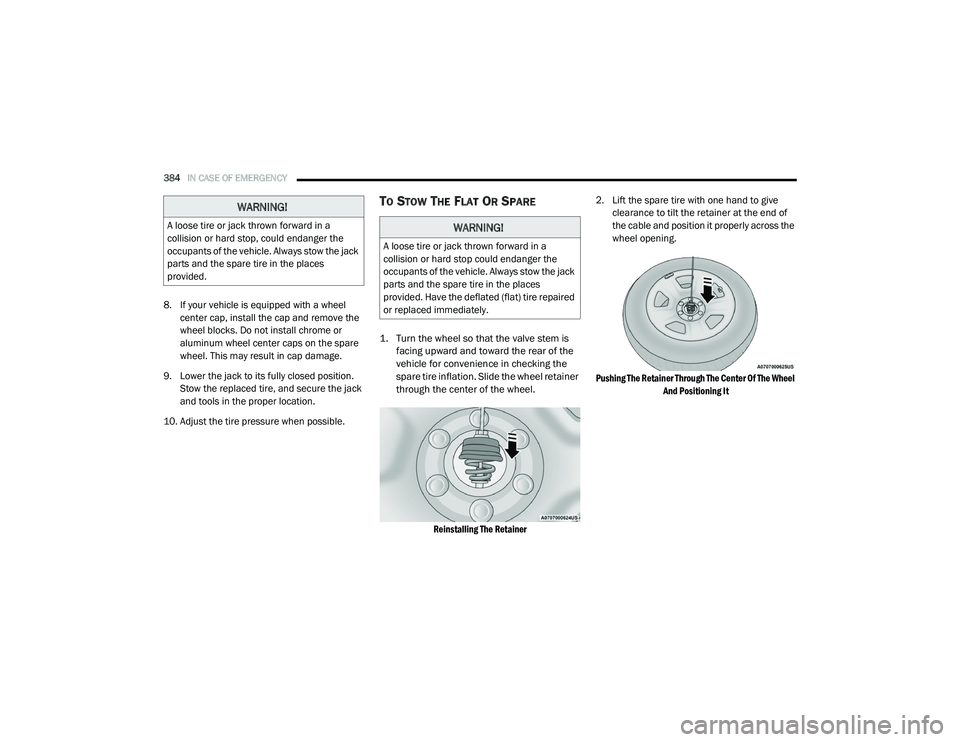
TO STOW THE FLAT OR SPARE
1. Turn the wheel so that the valve stem is facing upward and toward the rear of the
vehicle for convenience in checking the
spare tire inflation. Slide the wheel retainer
through the center of the wheel.
Reinstalling The Retainer
2. Lift the spare tire with one hand to give
clearance to tilt the retainer at the end of
the cable and position it properly across the
wheel opening.
Pushing The Retainer Through The Center Of The Wheel And Positioning It
WARNING!
A loose tire or jack thrown forward in a
collision or hard stop, could endanger the
occupants of the vehicle. Always stow the jack
parts and the spare tire in the places
provided.WARNING!
A loose tire or jack thrown forward in a
collision or hard stop could endanger the
occupants of the vehicle. Always stow the jack
parts and the spare tire in the places
provided. Have the deflated (flat) tire repaired
or replaced immediately.
21_DT_OM_EN_USC_t.book Page 384
Page 387 of 496
IN CASE OF EMERGENCY385
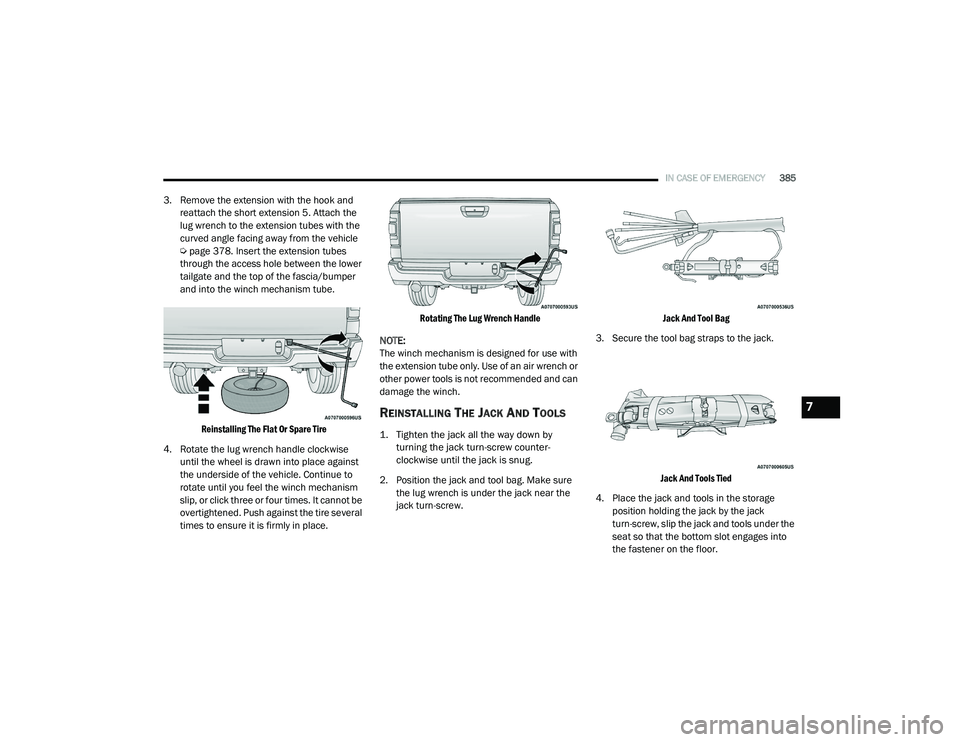
3. Remove the extension with the hook and
reattach the short extension 5. Attach the
lug wrench to the extension tubes with the
curved angle facing away from the vehicle
Úpage 378. Insert the extension tubes
through the access hole between the lower
tailgate and the top of the fascia/bumper
and into the winch mechanism tube.
Reinstalling The Flat Or Spare Tire
4. Rotate the lug wrench handle clockwise until the wheel is drawn into place against
the underside of the vehicle. Continue to
rotate until you feel the winch mechanism
slip, or click three or four times. It cannot be
overtightened. Push against the tire several
times to ensure it is firmly in place.
Rotating The Lug Wrench Handle
NOTE:
The winch mechanism is designed for use with
the extension tube only. Use of an air wrench or
other power tools is not recommended and can
damage the winch.
REINSTALLING THE JACK AND TOOLS
1. Tighten the jack all the way down by turning the jack turn-screw counter -
clockwise until the jack is snug.
2. Position the jack and tool bag. Make sure the lug wrench is under the jack near the
jack turn-screw.
Jack And Tool Bag
3. Secure the tool bag straps to the jack.
Jack And Tools Tied
4. Place the jack and tools in the storage position holding the jack by the jack
turn-screw, slip the jack and tools under the
seat so that the bottom slot engages into
the fastener on the floor.
7
21_DT_OM_EN_USC_t.book Page 385
Page 436 of 496
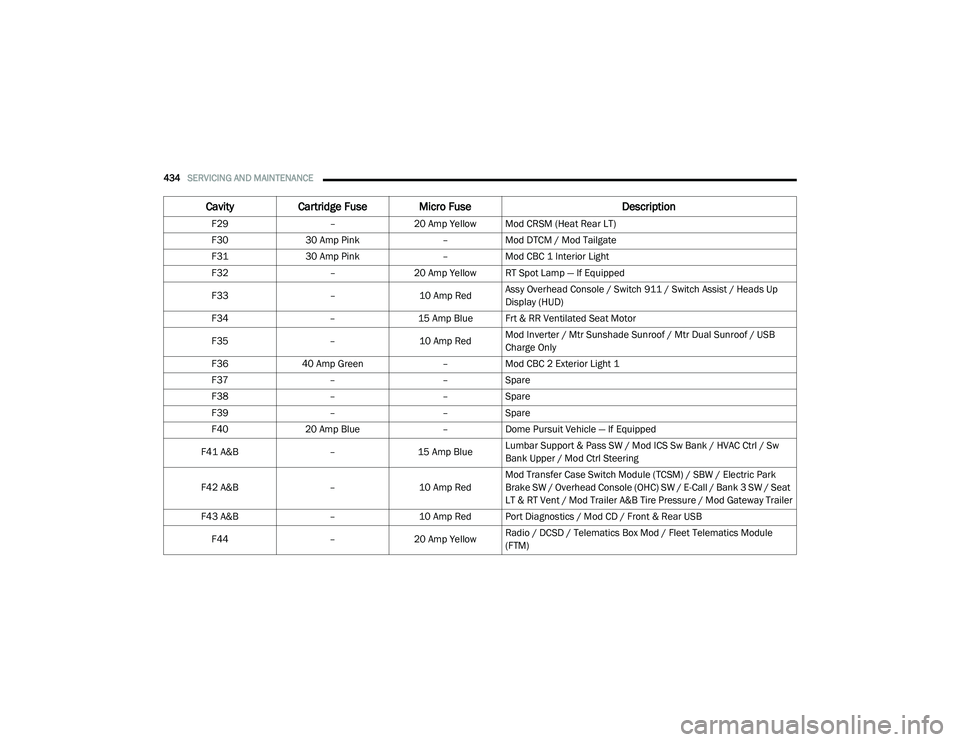
434SERVICING AND MAINTENANCE
F29–20 Amp Yellow Mod CRSM (Heat Rear LT)
F30 30 Amp Pink –Mod DTCM / Mod Tailgate
F31 30 Amp Pink –Mod CBC 1 Interior Light
F32 –20 Amp Yellow RT Spot Lamp — If Equipped
F33 –10 Amp RedAssy Overhead Console / Switch 911 / Switch Assist / Heads Up
Display (HUD)
F34 –15 Amp Blue Frt & RR Ventilated Seat Motor
F35 –10 Amp RedMod Inverter / Mtr Sunshade Sunroof / Mtr Dual Sunroof / USB
Charge Only
F36 40 Amp Green –Mod CBC 2 Exterior Light 1
F37 ––Spare
F38 ––Spare
F39 ––Spare
F40 20 Amp Blue –Dome Pursuit Vehicle — If Equipped
F41 A&B –15 Amp BlueLumbar Support & Pass SW / Mod ICS Sw Bank / HVAC Ctrl / Sw
Bank Upper / Mod Ctrl Steering
F42 A&B –10 Amp RedMod Transfer Case Switch Module (TCSM) / SBW / Electric Park
Brake SW / Overhead Console (OHC) SW / E-Call / Bank 3 SW / Seat
LT & RT Vent / Mod Trailer A&B Tire Pressure / Mod Gateway Trailer
F43 A&B –10 Amp Red Port Diagnostics / Mod CD / Front & Rear USB
F44 –20 Amp Yellow Radio / DCSD / Telematics Box Mod / Fleet Telematics Module
(FTM)
Cavity
Cartridge Fuse Micro Fuse Description
21_DT_OM_EN_USC_t.book Page 434
Page 445 of 496

SERVICING AND MAINTENANCE443
3. Turn the desired bulb socket a quarter turn
counterclockwise and remove the socket
and bulb from housing.
4. Pull the desired bulb straight from the socket.
Outside Bulbs: Cargo Lamps
Inside Bulb: Center High Mounted Stop
Lamp
5. Reverse the procedure for installation of bulbs and housing.
TIRES
TIRE SAFETY INFORMATION
Tire safety information will cover aspects of the
following information: Tire Markings, Tire
Identification Numbers, Tire Terminology and
Definitions, Tire Pressures, and Tire Loading.
Tire Markings
Tire Markings
NOTE:
P (Passenger) — Metric tire sizing is based on
US design standards. P-Metric tires have the
letter “P” molded into the sidewall preceding
the size designation. Example: P215/65R15
95H.
European — Metric tire sizing is based on
European design standards. Tires designed
to this standard have the tire size molded
into the sidewall beginning with the section
width. The letter "P" is absent from this tire
size designation. Example: 215/65R15 96H.
LT (Light Truck) — Metric tire sizing is based
on US design standards. The size designation
for LT-Metric tires is the same as for P-Metric
tires except for the letters “LT” that are
molded into the sidewall preceding the size
designation. Example: LT235/85R16.
Temporary spare tires are designed for
temporary emergency use only. Temporary
high pressure compact spare tires have the
letter “T” or “S” molded into the sidewall
preceding the size designation. Example:
T145/80D18 103M.
High flotation tire sizing is based on US
design standards and it begins with the tire
diameter molded into the sidewall. Example:
31x10.5 R15 LT.
CAUTION!
Do not contaminate the bulb glass by
touching it with your fingers or by allowing it
to contract other oily surfaces. Shortened
bulb life will result.
1 — US DOT Safety Standards Code (TIN)
2 — Size Designation
3 — Service Description
4 — Maximum Load
5 — Maximum Pressure
6 — Treadwear, Traction and Tempera -
ture Grades
8
21_DT_OM_EN_USC_t.book Page 443