service interval RAM 1500 2021 Owners Manual
[x] Cancel search | Manufacturer: RAM, Model Year: 2021, Model line: 1500, Model: RAM 1500 2021Pages: 496, PDF Size: 20.89 MB
Page 345 of 496
SAFETY343
(Continued)
The Air Bag Warning Light does not come on
during the four to eight seconds when the
ignition switch is first in the ON/RUN position.
The Air Bag Warning Light remains on after
the four to eight-second interval.
The Air Bag Warning Light comes on intermit -
tently or remains on while driving.
NOTE:
If the speedometer, tachometer, or any engine
related gauges are not working, the Occupant
Restraint Controller (ORC) may also be
disabled. In this condition the air bags may not
be ready to inflate for your protection. Have an
authorized dealer service the air bag system
immediately.
Redundant Air Bag Warning Light
If a fault with the Air Bag Warning
Light is detected, which could affect
the Supplemental Restraint System
(SRS), the Redundant Air Bag Warning
Light will illuminate on the instrument panel.
The Redundant Air Bag Warning Light will stay
on until the fault is cleared. In addition, a single
chime will sound to alert you that the
Redundant Air Bag Warning Light has come on
and a fault has been detected. If the Redundant
Air Bag Warning Light comes on intermittently or
remains on while driving have an authorized
dealer service the vehicle immediately
Ú page 126.
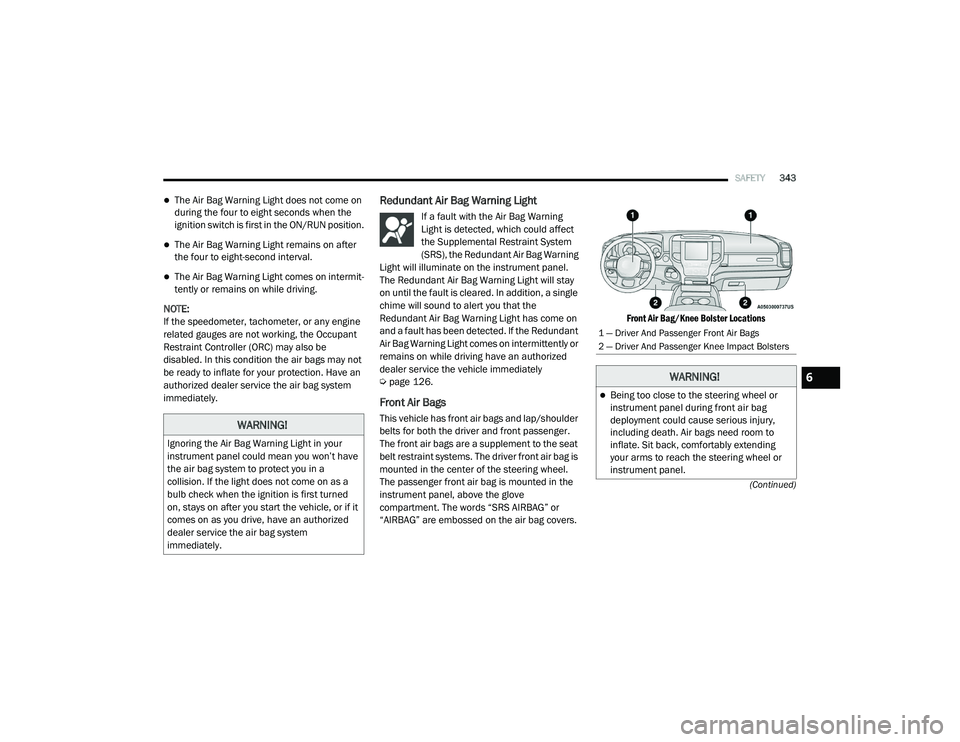
Front Air Bags
This vehicle has front air bags and lap/shoulder
belts for both the driver and front passenger.
The front air bags are a supplement to the seat
belt restraint systems. The driver front air bag is
mounted in the center of the steering wheel.
The passenger front air bag is mounted in the
instrument panel, above the glove
compartment. The words “SRS AIRBAG” or
“AIRBAG” are embossed on the air bag covers.
Front Air Bag/Knee Bolster Locations
WARNING!
Ignoring the Air Bag Warning Light in your
instrument panel could mean you won’t have
the air bag system to protect you in a
collision. If the light does not come on as a
bulb check when the ignition is first turned
on, stays on after you start the vehicle, or if it
comes on as you drive, have an authorized
dealer service the air bag system
immediately.
1 — Driver And Passenger Front Air Bags
2 — Driver And Passenger Knee Impact Bolsters
WARNING!
Being too close to the steering wheel or
instrument panel during front air bag
deployment could cause serious injury,
including death. Air bags need room to
inflate. Sit back, comfortably extending
your arms to reach the steering wheel or
instrument panel.
6
21_DT_OM_EN_USC_t.book Page 343
Page 397 of 496
395
SERVICING AND MAINTENANCE
SCHEDULED SERVICING — GASOLINE
ENGINE
Your vehicle is equipped with an automatic oil
change indicator system. The oil change
indicator system will remind you that it is time to
take your vehicle in for scheduled maintenance.
Based on engine operation conditions, the oil
change indicator message will illuminate. This
means that service is required for your vehicle.
Operating conditions such as frequent
short-trips, trailer tow, and extremely hot or cold
ambient temperatures will influence when the
“Oil Change Required” message is displayed.
Severe operating conditions can cause the
change oil message to illuminate as early as
3,500 miles (5,600 km) since last reset. Have
your vehicle serviced as soon as possible,
within the next 500 miles (805 km).
An authorized dealer will reset the oil change
indicator message after completing the
scheduled oil change. If a scheduled oil change
is performed by someone other than an authorized dealer, the message can be reset by
referring to the steps described under
Instrument Cluster Display Ú
page 114.
NOTE:
Under no circumstances should oil change
intervals exceed 10,000 miles (16,000 km),
12 months or 350 hours of engine run time,
whichever comes first. The 350 hours of engine
run or idle time is generally only a concern for
fleet customers.
Severe Duty All Models
NOTE:
Vehicles that are operated in a dusty and
off-road environment, or predominately at idle
or very low engine RPM are known as Severe
Duty vehicles. It is recommended that you
change the engine oil at 4,000 miles
(6,500 km) or 350 hours of engine run time.
Once A Month Or Before A Long Trip:
Check engine oil level.
Check windshield washer fluid level.
Check tire pressure and look for unusual
wear or damage. Rotate tires at the first sign
of irregular wear, even if it occurs before the
oil indicator system turns on.
Check the fluid levels of the coolant reservoir,
brake master cylinder, and fill as needed.
Check function of all interior and exterior
lights.
MAINTENANCE PLAN
Refer to the Maintenance Plan for required
maintenance. More frequent maintenance may
be needed in severe conditions, such as dusty
areas and very short trip driving. In some
extreme conditions, additional maintenance
not specified in the maintenance schedule may
be required.
8
21_DT_OM_EN_USC_t.book Page 395
Page 401 of 496
SERVICING AND MAINTENANCE399
SCHEDULED SERVICING — DIESEL ENGINE
Your vehicle is equipped with an automatic oil
change indicator system. The oil change
indicator system will remind you that it is time to
take your vehicle in for scheduled maintenance. Based on engine operation conditions, the oil
change indicator message will illuminate. This
means that service is required for your vehicle.
Operating conditions such as frequent
short-trips, trailer tow, extremely hot or cold
ambient temperatures will influence when the
“Oil Change Required” message is displayed.
Severe Operating Conditions will cause the
change oil message to illuminate more
frequently. Have your vehicle serviced as soon
as possible, within the next 500 miles
(805 km).
An authorized dealer will reset the oil change
indicator message after completing the
scheduled oil change. If a scheduled oil change
is performed by someone other than an
authorized dealer, the message can be reset by
referring to the steps described under
Instrument Cluster Display Ú
page 114.NOTE:
Under no circumstances should oil change
intervals exceed 10,000 miles (16,000 km) or
12 months, whichever comes first.
Once A Month Or Before A Long Trip:
Check engine oil level
Check windshield washer fluid level
Check the tire inflation pressures and look
for unusual wear or damage
Check the fluid levels of the coolant reservoir,
brake master cylinder, and power steering,
and fill as needed
Check function of all interior and exterior
lights
WARNING!
You can be badly injured working on or
around a motor vehicle. Do only service
work for which you have the knowledge and
the right equipment. If you have any doubt
about your ability to perform a service job,
take your vehicle to a competent mechanic.
Failure to properly inspect and maintain
your vehicle could result in a component
malfunction and effect vehicle handling
and performance. This could cause an acci
-
dent.
8
21_DT_OM_EN_USC_t.book Page 399
Page 405 of 496
SERVICING AND MAINTENANCE403
ADDITIONAL MAINTENANCE — B6 TO
B20 B
IODIESEL
NOTE:
Under no circumstances should oil change
intervals exceed 8,000 miles (12,875 km) or
six months, whichever comes first when
using biodiesel blends greater than 5% (B5).
The owner is required to monitor mileage for
B6-B20 biodiesel, the automatic oil change
indicator system does not reflect the use of
biofuels.
Fuel filter change interval is maintained at
every second oil change. This is especially
important with biodiesel usage.
For more information on using biodiesel
Ú page 472.
WARNING!
You can be badly injured working on or
around a motor vehicle. Do only service
work for which you have the knowledge and
the right equipment. If you have any doubt
about your ability to perform a service job,
take your vehicle to a competent mechanic.
Failure to properly inspect and maintain
your vehicle could result in a component
malfunction and effect vehicle handling
and performance. This could cause an acci -
dent.
8
21_DT_OM_EN_USC_t.book Page 403
Page 412 of 496
410SERVICING AND MAINTENANCE
ENGINE OIL — GAS ENGINE
Engine Oil Selection — Gasoline Engine
For best performance and maximum protection
under all types of operating conditions, FCA only
recommends engine oils that are API Certified
and meet the requirements of FCA Material
Standard MS-6395.
NOTE:
Hemi engines (5.7L) at times can tick right after
startup and then quiet down after approxi -
mately 30 seconds. This is normal and will not
harm the engine. This characteristic can be
caused by short drive cycles. For example, if the
vehicle is started then shut off after driving a
short distance. Upon restarting, you may experi -
ence a ticking sound. Other causes could be if
the vehicle is unused for an extended period of
time, incorrect oil, extended oil changes or
extended idling. If the engine continues to tick
or if the Malfunction Indicator Light (MIL) comes
on, see the nearest authorized dealer.
Engine Oil Selection — Diesel Engine
For best performance and maximum protection
under all types of operating conditions, FCA
recommends engine oils that meet the
requirements of FCA Material Standard MS-12991, and that are API SN certified and
meet the requirements of FCA LLC.
American Petroleum Institute (API) Engine
Oil Identification Symbol
This symbol means that the oil has
been certified by the American
Petroleum Institute (API). The
manufacturer only recommends API
Certified engine oils.
This symbol certifies 0W-20, 5W-20, 0W-30,
5W-30 and 10W-30 engine oils.
Synthetic Engine Oils
You may use synthetic engine oils provided the
recommended oil quality requirements are met,
and the recommended maintenance intervals
for oil and filter changes are followed.
Synthetic engine oils which do not have both the
engine oil certification mark and the correct SAE
viscosity grade number should not be used.
Materials Added To Engine Oil
FCA strongly recommends against the addition
of any additives (other than leak detection dyes)
to the engine oil. Engine oil is an engineered
product and its performance may be impaired
by supplemental additives.
Disposing Of Used Engine Oil And Oil
Filters
Care should be taken in disposing of used
engine oil and oil filters from your vehicle. Used
oil and oil filters, indiscriminately discarded, can
present a problem to the environment. Contact
an authorized dealer, service station or
governmental agency for advice on how and
where used oil and oil filters can be safely
discarded in your area.
ENGINE OIL FILTER
The engine oil filter should be replaced with a
new filter at every engine oil change.
Engine Oil Filter Selection
A full-flow type disposable oil filter should be
used for replacement. The quality of
replacement filters varies considerably. Only
high quality Mopar certified filters should be
used.
CAUTION!
Do not use chemical flushes in your engine oil
as the chemicals can damage your engine.
Such damage is not covered by the New
Vehicle Limited Warranty.
21_DT_OM_EN_USC_t.book Page 410
Page 417 of 496
SERVICING AND MAINTENANCE415
DIESEL EXHAUST FLUID
Diesel Exhaust Fluid (DEF) sometimes known
simply by the name of its active component,
UREA—is a key component of Selective Catalytic
Reduction (SCR) systems, which help diesel
vehicles meet stringent emission regulations.
DEF is a liquid reducing agent that reacts with
engine exhaust in the presence of a catalyst to
convert smog-forming nitrogen oxides (NOx)
into harmless nitrogen and water vapor.
Refer to Engine Fluids And Lubricants
Úpage 475 for further information.
AIR CONDITIONER MAINTENANCE
For best possible performance, your air
conditioner should be checked and serviced by
an authorized dealer at the start of each warm
season. This service should include cleaning of
the condenser fins and a performance test.
Drive belt tension should also be checked at
this time.
Refrigerant Recovery And Recycling —
R–1234yf
R–1234yf Air Conditioning Refrigerant is a
hydrofluoroolefin (HFO) that is endorsed by the
Environmental Protection Agency and is an
ozone-friendly substance with a low
global-warming potential. It is recommended
that air conditioning service be performed by an
authorized dealer using recovery and recycling
equipment.
NOTE:
Use only FCA approved A/C system PAG
compressor oil, and refrigerants.
Cabin Filter Replacement (A/C Air Filter)
For the proper maintenance intervals
Úpage 395.
WARNING!
Use only refrigerants and compressor lubri -
cants approved by FCA for your air condi -
tioning system. Some unapproved
refrigerants are flammable and can
explode, injuring you. Other unapproved
refrigerants or lubricants can cause the
system to fail, requiring costly repairs.
Refer to Warranty Information Book, for
further warranty information.
The air conditioning system contains refrig -
erant under high pressure. To avoid risk of
personal injury or damage to the system,
adding refrigerant or any repair requiring
lines to be disconnected should be done by
an experienced technician.
CAUTION!
Do not use chemical flushes in your air
conditioning system as the chemicals can
damage your air conditioning components.
Such damage is not covered by the New
Vehicle Limited Warranty.
WARNING!
Do not remove the cabin air filter while the
vehicle is running, or while the ignition is in
the ACC or ON/RUN mode. With the cabin air
filter removed and the blower operating, the
blower can contact hands and may propel dirt
and debris into your eyes, resulting in
personal injury.
8
21_DT_OM_EN_USC_t.book Page 415
Page 429 of 496
SERVICING AND MAINTENANCE427
Drain And Refill
For the proper maintenance intervals
Úpage 395.
Lubricant Selection
For further information Ú page 478.
NOTE:
The presence of water in the gear lubricant will
result in corrosion and possible failure of differ -
ential components. Operation of the vehicle in
water, as may be encountered in some
off-highway types of service, will require
draining and refilling the axle to avoid damage.
Limited-Slip Differentials
Rear axles equipped with a Limited Slip
Differential require that 5 oz. (148 ml) Mopar
Limited Slip Additive be added to the gear
lubricant Ú page 478. The Mopar Limited Slip
Additive should be added to the gear lubricant
whenever a fluid change is made to an axle
equipped with a Limited Slip Differential. NOTE:
When refilling a limited slip differential axle
which requires a friction modification additive,
the additive should be added before the gear
lubricant to ensure proper additive fill.TRANSFER CASE
Fluid Level Check
This fluid level can be checked by removing the
filler plug. The fluid level should be to the
bottom edge of the filler plug hole (or within
1/8 inch of the bottom) with the vehicle in a
level position.
Drain And Refill
For the proper maintenance intervals
Ú
page 395.
Selection Of Lubricant
Use only the recommended fluid Ú page 478.
FUSES
General Information
WARNING!
When replacing a blown fuse, always use
an appropriate replacement fuse with the
same amp rating as the original fuse. Never
replace a fuse with another fuse of higher
amp rating. Never replace a blown fuse with
metal wires or any other material. Do not
place a fuse inside a circuit breaker cavity
or vice versa. Failure to use proper fuses
may result in serious personal injury, fire
and/or property damage.
Before replacing a fuse, make sure that the
ignition is off and that all the other services
are switched off and/or disengaged.
If the replaced fuse blows again, contact an
authorized dealer.
If a general protection fuse for safety
systems (air bag system, braking system),
power unit systems (engine system, trans -
mission system) or steering system blows,
contact an authorized dealer.
8
21_DT_OM_EN_USC_t.book Page 427
Page 462 of 496
460SERVICING AND MAINTENANCE
TIRE ROTATION RECOMMENDATIONS
Tires on the front and rear axles of vehicles
operate at different loads and perform different
steering, driving, and braking functions. For
these reasons, they wear at unequal rates.
These effects can be reduced by timely rotation
of tires. The benefits of rotation are especially
worthwhile with aggressive tread designs such
as those on all season type tires. Rotation will
increase tread life, help to maintain mud, snow
and wet traction levels and contribute to a
smooth, quiet ride.
For the proper maintenance intervals
Úpage 395. More frequent rotation is
permissible if desired. The reasons for any rapid or unusual wear should be corrected prior to
rotation being performed.
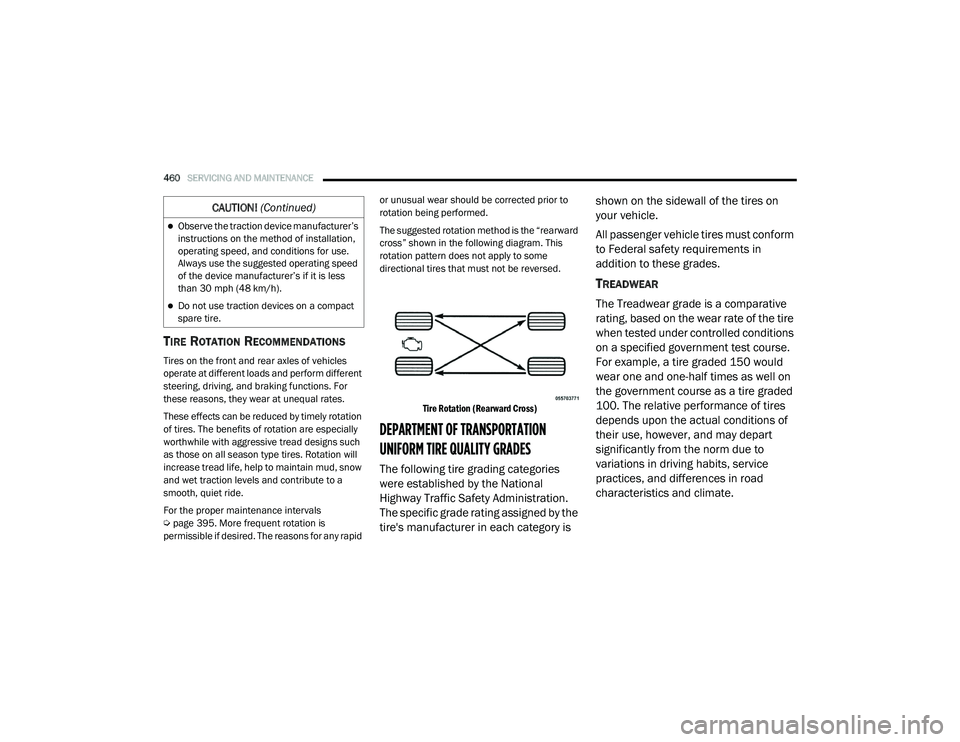
The suggested rotation method is the “rearward
cross” shown in the following diagram. This
rotation pattern does not apply to some
directional tires that must not be reversed.
Tire Rotation (Rearward Cross)
DEPARTMENT OF TRANSPORTATION
UNIFORM TIRE QUALITY GRADES
The following tire grading categories
were established by the National
Highway Traffic Safety Administration.
The specific grade rating assigned by the
tire's manufacturer in each category is shown on the sidewall of the tires on
your vehicle.
All passenger vehicle tires must conform
to Federal safety requirements in
addition to these grades.
TREADWEAR
The Treadwear grade is a comparative
rating, based on the wear rate of the tire
when tested under controlled conditions
on a specified government test course.
For example, a tire graded 150 would
wear one and one-half times as well on
the government course as a tire graded
100. The relative performance of tires
depends upon the actual conditions of
their use, however, and may depart
significantly from the norm due to
variations in driving habits, service
practices, and differences in road
characteristics and climate.
Observe the traction device manufacturer’s
instructions on the method of installation,
operating speed, and conditions for use.
Always use the suggested operating speed
of the device manufacturer’s if it is less
than 30 mph (48 km/h).
Do not use traction devices on a compact
spare tire.
CAUTION!
(Continued)
21_DT_OM_EN_USC_t.book Page 460
Page 478 of 496
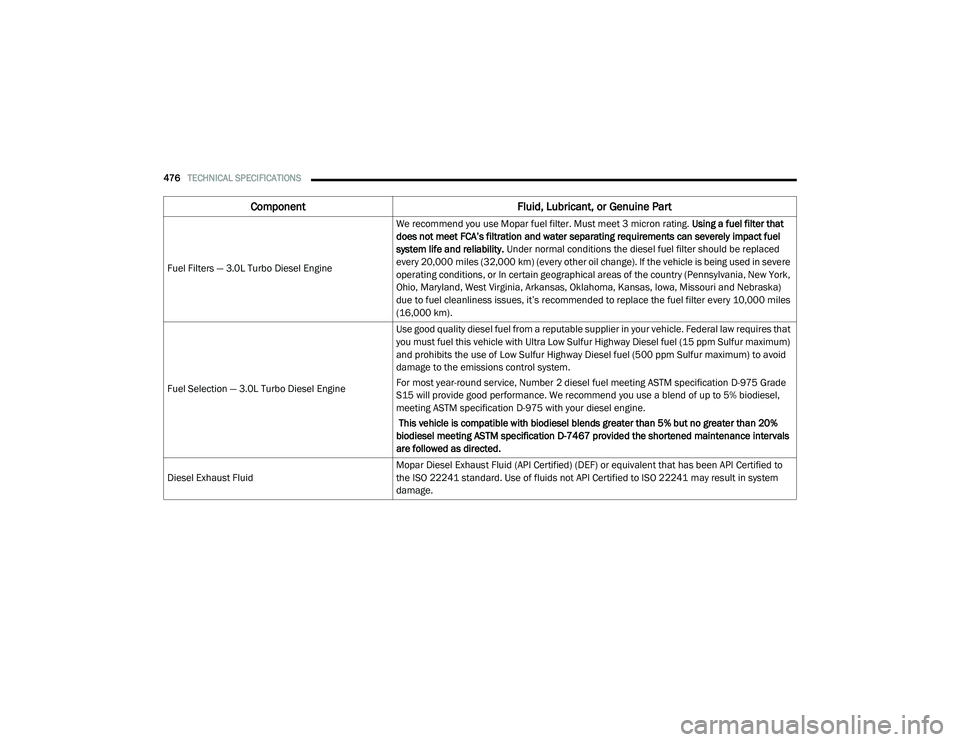
476TECHNICAL SPECIFICATIONS
Fuel Filters — 3.0L Turbo Diesel Engine We recommend you use Mopar fuel filter. Must meet 3 micron rating. Using a fuel filter that
does not meet FCA’s filtration and water separating requirements can severely impact fuel
system life and reliability.
Under normal conditions the diesel fuel filter should be replaced
every 20,000 miles (32,000 km) (every other oil change). If the vehicle is being used in severe
operating conditions, or In certain geographical areas of the country (Pennsylvania, New York,
Ohio, Maryland, West Virginia, Arkansas, Oklahoma, Kansas, Iowa, Missouri and Nebraska)
due to fuel cleanliness issues, it’s recommended to replace the fuel filter every 10,000 miles
(16,000 km).
Fuel Selection — 3.0L Turbo Diesel Engine Use good quality diesel fuel from a reputable supplier in your vehicle. Federal law requires that
you must fuel this vehicle with Ultra Low Sulfur Highway Diesel fuel (15 ppm Sulfur maximum)
and prohibits the use of Low Sulfur Highway Diesel fuel (500 ppm Sulfur maximum) to avoid
damage to the emissions control system.
For most year-round service, Number 2 diesel fuel meeting ASTM specification D-975 Grade
S15 will provide good performance. We recommend you use a blend of up to 5% biodiesel,
meeting ASTM specification D-975 with your diesel engine.
This vehicle is compatible with biodiesel blends greater than 5% but no greater than 20%
biodiesel meeting ASTM specification D-7467 provided the shortened maintenance intervals
are followed as directed.
Diesel Exhaust Fluid Mopar Diesel Exhaust Fluid (API Certified) (DEF) or equivalent that has been API Certified to
the ISO 22241 standard. Use of fluids not API Certified to ISO 22241 may result in system
damage.
Component
Fluid, Lubricant, or Genuine Part
21_DT_OM_EN_USC_t.book Page 476