suspension RAM 1500 2022 Owners Manual
[x] Cancel search | Manufacturer: RAM, Model Year: 2022, Model line: 1500, Model: RAM 1500 2022Pages: 496, PDF Size: 18.03 MB
Page 7 of 496
5
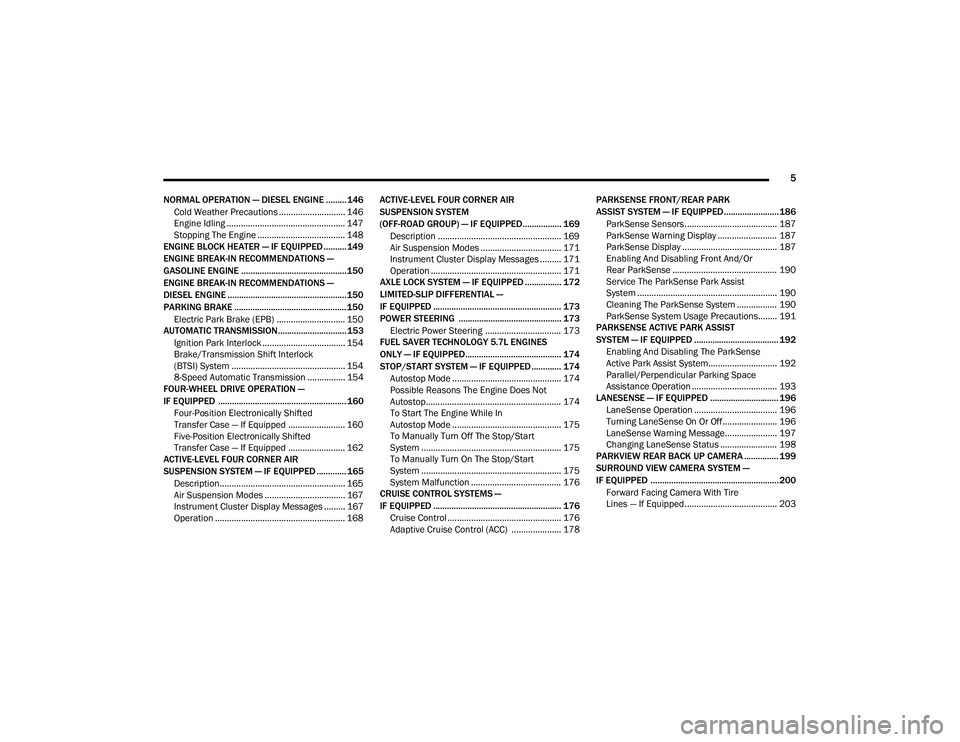
NORMAL OPERATION — DIESEL ENGINE ......... 146 Cold Weather Precautions ............................ 146
Engine Idling .................................................. 147
Stopping The Engine ..................................... 148
ENGINE BLOCK HEATER — IF EQUIPPED .......... 149
ENGINE BREAK-IN RECOMMENDATIONS —
GASOLINE ENGINE .............................................. 150
ENGINE BREAK-IN RECOMMENDATIONS —
DIESEL ENGINE .................................................... 150
PARKING BRAKE ................................................. 150
Electric Park Brake (EPB) ............................. 150
AUTOMATIC TRANSMISSION.............................. 153
Ignition Park Interlock ................................... 154Brake/Transmission Shift Interlock
(BTSI) System ................................................ 154
8-Speed Automatic Transmission ................ 154
FOUR-WHEEL DRIVE OPERATION —
IF EQUIPPED ........................................................ 160
Four-Position Electronically Shifted
Transfer Case — If Equipped ........................ 160
Five-Position Electronically Shifted
Transfer Case — If Equipped ........................ 162
ACTIVE-LEVEL FOUR CORNER AIR
SUSPENSION SYSTEM — IF EQUIPPED ............. 165
Description..................................................... 165
Air Suspension Modes .................................. 167
Instrument Cluster Display Messages ......... 167Operation ....................................................... 168 ACTIVE-LEVEL FOUR CORNER AIR
SUSPENSION SYSTEM
(OFF-ROAD GROUP) — IF EQUIPPED................. 169
Description .................................................... 169
Air Suspension Modes .................................. 171
Instrument Cluster Display Messages ......... 171Operation ....................................................... 171
AXLE LOCK SYSTEM — IF EQUIPPED ................ 172
LIMITED-SLIP DIFFERENTIAL —
IF EQUIPPED ........................................................ 173
POWER STEERING ............................................. 173
Electric Power Steering ................................ 173
FUEL SAVER TECHNOLOGY 5.7L ENGINES
ONLY — IF EQUIPPED.......................................... 174
STOP/START SYSTEM — IF EQUIPPED ............. 174 Autostop Mode .............................................. 174
Possible Reasons The Engine Does Not
Autostop......................................................... 174
To Start The Engine While In
Autostop Mode .............................................. 175
To Manually Turn Off The Stop/Start
System ........................................................... 175
To Manually Turn On The Stop/Start
System ........................................................... 175
System Malfunction ...................................... 176
CRUISE CONTROL SYSTEMS —
IF EQUIPPED ........................................................ 176
Cruise Control ................................................ 176Adaptive Cruise Control (ACC) ..................... 178 PARKSENSE FRONT/REAR PARK
ASSIST SYSTEM — IF EQUIPPED........................ 186
ParkSense Sensors ....................................... 187
ParkSense Warning Display ......................... 187
ParkSense Display ........................................ 187
Enabling And Disabling Front And/Or
Rear ParkSense ............................................ 190
Service The ParkSense Park Assist
System ........................................................... 190
Cleaning The ParkSense System ................. 190
ParkSense System Usage Precautions........ 191
PARKSENSE ACTIVE PARK ASSIST
SYSTEM — IF EQUIPPED ..................................... 192
Enabling And Disabling The ParkSense
Active Park Assist System............................. 192Parallel/Perpendicular Parking Space
Assistance Operation .................................... 193
LANESENSE — IF EQUIPPED .............................. 196
LaneSense Operation ................................... 196
Turning LaneSense On Or Off....................... 196
LaneSense Warning Message...................... 197
Changing LaneSense Status ........................ 198
PARKVIEW REAR BACK UP CAMERA ............... 199
SURROUND VIEW CAMERA SYSTEM —
IF EQUIPPED ........................................................ 200 Forward Facing Camera With Tire
Lines — If Equipped....................................... 203
22_DT_OM_EN_USC_t.book Page 5
Page 9 of 496
7
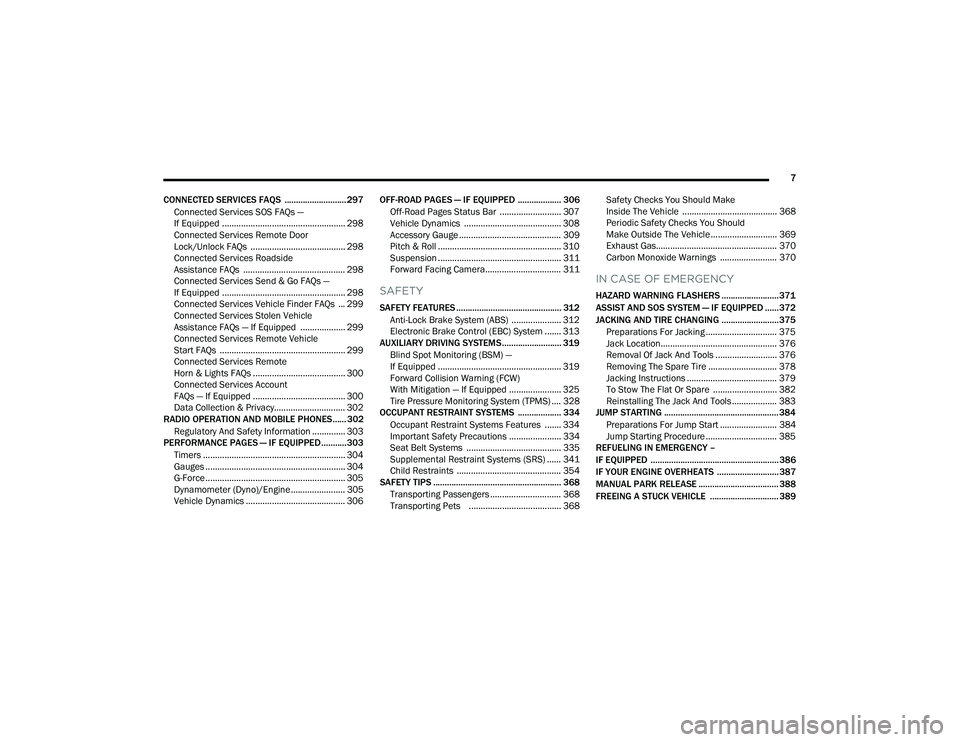
CONNECTED SERVICES FAQS ........................... 297 Connected Services SOS FAQs —
If Equipped .................................................... 298
Connected Services Remote Door
Lock/Unlock FAQs ........................................ 298
Connected Services Roadside
Assistance FAQs ........................................... 298Connected Services Send & Go FAQs —
If Equipped .................................................... 298
Connected Services Vehicle Finder FAQs ... 299
Connected Services Stolen Vehicle
Assistance FAQs — If Equipped ................... 299
Connected Services Remote Vehicle
Start FAQs ..................................................... 299
Connected Services Remote
Horn & Lights FAQs ....................................... 300
Connected Services Account
FAQs — If Equipped ....................................... 300
Data Collection & Privacy.............................. 302
RADIO OPERATION AND MOBILE PHONES...... 302
Regulatory And Safety Information .............. 303
PERFORMANCE PAGES — IF EQUIPPED...........303
Timers ............................................................ 304
Gauges ........................................................... 304G-Force ........................................................... 305Dynamometer (Dyno)/Engine ....................... 305
Vehicle Dynamics .......................................... 306 OFF-ROAD PAGES — IF EQUIPPED ................... 306
Off-Road Pages Status Bar .......................... 307
Vehicle Dynamics ......................................... 308
Accessory Gauge ........................................... 309Pitch & Roll .................................................... 310
Suspension .................................................... 311
Forward Facing Camera................................ 311
SAFETY
SAFETY FEATURES .............................................. 312
Anti-Lock Brake System (ABS) ..................... 312
Electronic Brake Control (EBC) System ....... 313
AUXILIARY DRIVING SYSTEMS.......................... 319
Blind Spot Monitoring (BSM) —
If Equipped .................................................... 319
Forward Collision Warning (FCW)
With Mitigation — If Equipped ...................... 325Tire Pressure Monitoring System (TPMS) .... 328
OCCUPANT RESTRAINT SYSTEMS ................... 334
Occupant Restraint Systems Features ....... 334
Important Safety Precautions ...................... 334Seat Belt Systems ........................................ 335Supplemental Restraint Systems (SRS) ...... 341Child Restraints ............................................ 354
SAFETY TIPS ........................................................ 368
Transporting Passengers .............................. 368Transporting Pets ....................................... 368 Safety Checks You Should Make
Inside The Vehicle ........................................ 368
Periodic Safety Checks You Should
Make Outside The Vehicle ............................ 369
Exhaust Gas................................................... 370
Carbon Monoxide Warnings ........................ 370
IN CASE OF EMERGENCY
HAZARD WARNING FLASHERS ......................... 371
ASSIST AND SOS SYSTEM — IF EQUIPPED ...... 372
JACKING AND TIRE CHANGING ......................... 375 Preparations For Jacking .............................. 375
Jack Location................................................. 376
Removal Of Jack And Tools .......................... 376
Removing The Spare Tire ............................. 378Jacking Instructions ...................................... 379
To Stow The Flat Or Spare ........................... 382
Reinstalling The Jack And Tools ................... 383
JUMP STARTING .................................................. 384
Preparations For Jump Start ........................ 384Jump Starting Procedure .............................. 385
REFUELING IN EMERGENCY –
IF EQUIPPED ........................................................ 386
IF YOUR ENGINE OVERHEATS ........................... 387
MANUAL PARK RELEASE ................................... 388
FREEING A STUCK VEHICLE .............................. 389
22_DT_OM_EN_USC_t.book Page 7
Page 16 of 496

14 Electronic Throttle Control (ETC) Warning Light Úpage 129
Electric Power Steering (EPS) Fault Warning Light Úpage 130
Engine Coolant Temperature Warning Light Úpage 130
Hood Open Warning Light Úpage 130
Oil Pressure Warning Light Úpage 130
Oil Temperature Warning Light Úpage 130
Seat Belt Reminder Warning Light Úpage 130
Tailgate Open Warning Light Úpage 130
Red Warning Lights
Trailer Brake Disconnected Warning Light
Úpage 131
Transmission Temperature Warning Light Úpage 131
Vehicle Security Warning Light Úpage 131
Yellow Warning Lights
Adaptive Cruise Control (ACC) Fault Warning Light
Úpage 131
Air Suspension Fault Warning Light Úpage 131
Anti-Lock Brake System (ABS) Warning Light Úpage 131
Cruise Control Fault Warning Light Úpage 133
Red Warning Lights
22_DT_OM_EN_USC_t.book Page 14
Page 17 of 496

15
Electronic Park Brake Warning Light Úpage 131
Electronic Stability Control (ESC) Active Warning Light Úpage 131
Electronic Stability Control (ESC) OFF Warning Light Úpage 132
Engine Check/Malfunction Indicator Warning Light (MIL) Úpage 132
Low Washer Fluid Warning Light Úpage 132
Low Fuel Warning Light Úpage 132
Rear Axle Locker Fault Indicator Light Úpage 133
Service Forward Collision Warning (FCW) Light Úpage 133
Yellow Warning Lights
Service Stop/Start System Warning Light
Úpage 133
Service 4WD Warning Light Úpage 133
Service LaneSense Warning Light Úpage 132
Tire Pressure Monitoring System (TPMS) Warning Light Úpage 133
Yellow Indicator Lights
Air Suspension Payload Protection Indicator Light
Úpage 134
Air Suspension Off-Road 1 Indicator Light Úpage 134
Air Suspension Off-Road 2 Indicator Light Úpage 134
Yellow Warning Lights
1
22_DT_OM_EN_USC_t.book Page 15
Page 18 of 496
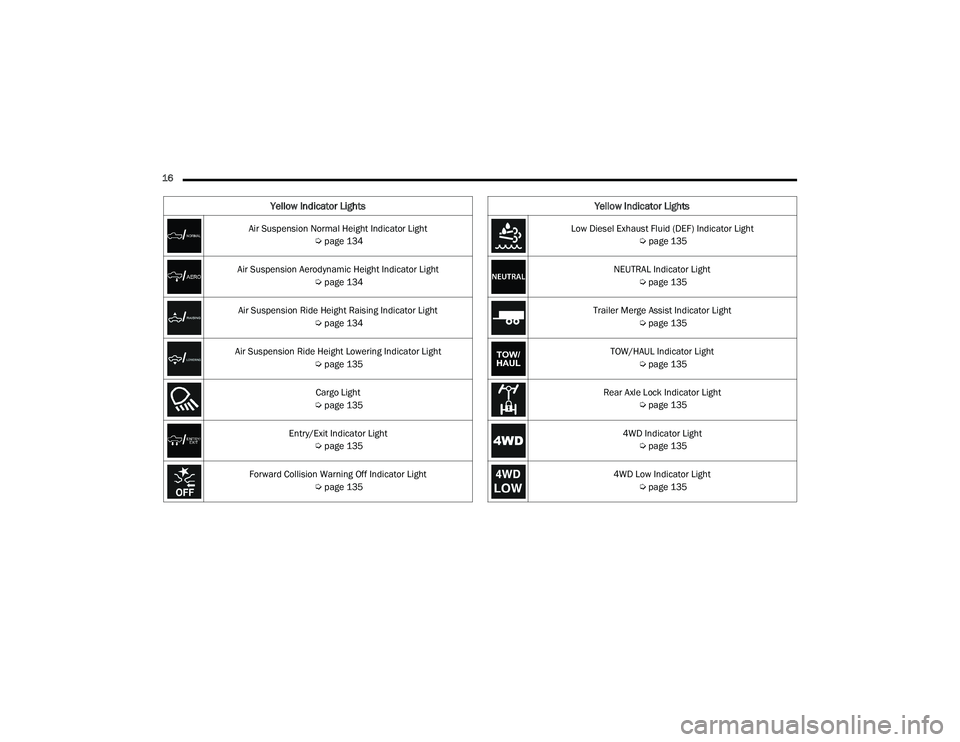
16 Air Suspension Normal Height Indicator Light Úpage 134
Air Suspension Aerodynamic Height Indicator Light Úpage 134
Air Suspension Ride Height Raising Indicator Light Úpage 134
Air Suspension Ride Height Lowering Indicator Light Úpage 135
Cargo Light
Ú page 135
Entry/Exit Indicator Light Úpage 135
Forward Collision Warning Off Indicator Light Úpage 135
Yellow Indicator Lights
Low Diesel Exhaust Fluid (DEF) Indicator Light
Úpage 135
NEUTRAL Indicator Light Úpage 135
Trailer Merge Assist Indicator Light Úpage 135
TOW/HAUL Indicator Light Úpage 135
Rear Axle Lock Indicator Light Úpage 135
4WD Indicator Light Úpage 135
4WD Low Indicator Light Úpage 135
Yellow Indicator Lights
22_DT_OM_EN_USC_t.book Page 16
Page 21 of 496
19
GETTING TO KNOW YOUR VEHICLE
KEYS
KEY FOB
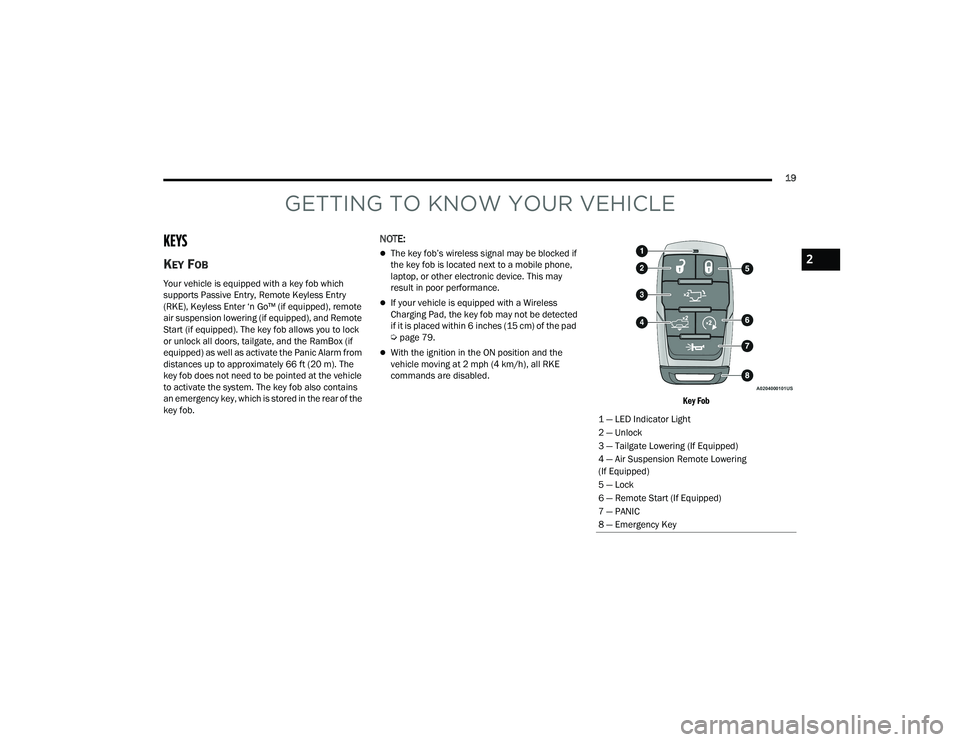
Your vehicle is equipped with a key fob which
supports Passive Entry, Remote Keyless Entry
(RKE), Keyless Enter ‘n Go™ (if equipped), remote
air suspension lowering (if equipped), and Remote
Start (if equipped). The key fob allows you to lock
or unlock all doors, tailgate, and the RamBox (if
equipped) as well as activate the Panic Alarm from
distances up to approximately 66 ft (20 m). The
key fob does not need to be pointed at the vehicle
to activate the system. The key fob also contains
an emergency key, which is stored in the rear of the
key fob.
NOTE:
The key fob’s wireless signal may be blocked if
the key fob is located next to a mobile phone,
laptop, or other electronic device. This may
result in poor performance.
If your vehicle is equipped with a Wireless
Charging Pad, the key fob may not be detected
if it is placed within 6 inches (15 cm) of the pad
Úpage 79.
With the ignition in the ON position and the
vehicle moving at 2 mph (4 km/h), all RKE
commands are disabled.
Key Fob
1 — LED Indicator Light
2 — Unlock
3 — Tailgate Lowering (If Equipped)
4 — Air Suspension Remote Lowering
(If Equipped)
5 — Lock
6 — Remote Start (If Equipped)
7 — PANIC
8 — Emergency Key
2
22_DT_OM_EN_USC_t.book Page 19
Page 22 of 496
20GETTING TO KNOW YOUR VEHICLE
In case the ignition switch does not change with
the push of a button, the key fob may have a low or
fully depleted battery. A low key fob battery can be
verified by referring to the instrument cluster
display, which will display directions to follow.
NOTE:A low key fob battery condition may be indicated by
a message in the instrument cluster display, or by
the LED light on the key fob. If the LED key fob light
no longer illuminates from key fob button pushes,
then the key fob battery requires replacement
Ú page 480.
To Lock/Unlock The Doors And Tailgate
Push and release the unlock button on the key fob
once to unlock the driver’s door, or, twice within
five seconds to unlock all doors, the tailgate and
the RamBox (if equipped). To lock all the doors and
the tailgate, push the lock button once.
When the doors are unlocked, the turn signals will
flash and the illuminated entry system will be
activated. When the doors are locked, the turn
signals will flash and the horn will chirp.
All doors can be programmed to unlock on the first
push of the unlock button. The horn chirp when the
lock button is pushed can be programmed on/off
within Uconnect Settings Ú page 234.
Key Left Vehicle Feature
If a valid key fob is no longer detected inside the
vehicle while the vehicle’s ignition system is in the
ON/RUN or START position, the message “Key Left
Vehicle” will be shown in the instrument cluster
display along with an interior chime. An exterior
audible and visual alert will also be activated to
warn the driver.
The vehicle’s horn will rapidly chirp three times
along with a single flash of the vehicle’s exterior
lights.
NOTE:
The doors have to be open and then closed in
order for the vehicle to check for the presence of
a key fob; the Key Left Vehicle feature will not
activate until all of the doors are closed.
These alerts will not be activated in situations
where the vehicle’s engine is left running with
the key fob inside.
Air Suspension (Remote Lowering Of The
Vehicle) — If Equipped
For easy entry and loading, your vehicle
can be lowered by pushing the key fob air
suspension lowering button two times.
When air suspension lowering is
requested using the key fob, the vehicle will send a
series of chirps and flashes to alert the customer
that the operation has begun and will continue
these alerts until it successfully lowers. The following conditions must be met for the
vehicle to lower remotely:
The vehicle must not already be in Entry/Exit
ride height.
The vehicle battery must be fully charged.
All doors must be closed.
The key fob must be out of the vehicle.
Gear selector must be in PARK.
NOTE:Ensure the vehicle is clear of all objects, pets, and
people prior to remote lowering.
Canceling Remote Lowering
Vehicle lowering can be canceled at anytime.
When vehicle lowering is canceled, the vehicle will
raise to the next defined level and lock out the
remote lowering feature for five seconds until a
new request is made.
To cancel vehicle lowering, push the key fob air
suspension lowering button one time during the
lowering process. When vehicle lowering is
canceled, the horn will chirp two times and the turn
signal lamps will flash four times. Once raising is
completed, the horn will chirp one time.
NOTE:More information on air suspension is provided
later in this manual, see Ú
page 165.
22_DT_OM_EN_USC_t.book Page 20
Page 118 of 496
116GETTING TO KNOW YOUR INSTRUMENT PANEL
OIL LIFE RESET
Your vehicle is equipped with an engine oil change
indicator system. The “Oil Change Required”
message will display in the instrument cluster
display for five seconds after a single chime has
sounded, to indicate the next scheduled oil change
interval. The engine oil change indicator system is
duty cycle based, which means the engine oil
change interval may fluctuate, dependent upon
your personal driving style.
Unless reset, this message will continue to display
each time you place the ignition in the ON/RUN
position. To turn off the message temporarily, push
and release the OK or arrow buttons. To reset the
oil change indicator system (after performing the
scheduled maintenance), refer to the following
procedure:
1. Without pressing the brake pedal, push the ENGINE START/STOP button and place the
ignition in the ON/RUN position (do not start
the engine).
2. Push and release the down arrow button to
scroll downward through the main menu to
“Vehicle Info.”
3. Push and release the right arrow button to
access the ”Oil Life” screen. 4. Push and hold the
OK button to reset oil life. If
conditions are met, the gauge and numeric
display will update to show 100%. If conditions
are not met a pop-up message of “To reset oil
life engine must be off with ignition in run” will
be displayed (for five seconds), and the user
will remain at the Oil Life screen.
5. Push and release the up or down arrow
button to exit the submenu screen.
NOTE:If the indicator message illuminates when you start
the vehicle, the oil change indicator system did not
reset. If necessary, repeat this procedure.
DISPLAY MENU ITEMS
Push and release the up or down arrow
button until the desired selectable menu icon is
highlighted in the instrument cluster display.
Speedometer
Push and release the up or down arrow
button until the speedometer menu item is
highlighted in the instrument cluster display. Push
and release the OK button to cycle the display
between mph and km/h.
Vehicle Info
Push and release the up or down arrow
button until the Vehicle Info menu icon is displayed
in the instrument cluster display. Push and release
the left or right arrow button to scroll through
the information submenus and push and release
the OK button to select or reset the resettable
submenus.
Tire Pressure Monitor System
Air Suspension — If Equipped
Coolant Temperature — If Equipped
Trans Temperature (Automatic only)
Oil Temperature
Oil Pressure — If Equipped
Oil Life
Battery Voltage — If Equipped
Gauge Summary — If Equipped
Coolant Temp
Trans Temp
Oil Temp
Oil Pressure
Engine Hours
22_DT_OM_EN_USC_t.book Page 116
Page 133 of 496

GETTING TO KNOW YOUR INSTRUMENT PANEL131
Trailer Brake Disconnected Warning Light
This warning light will illuminate when the
Trailer Brake has been disconnected.
Transmission Temperature Warning Light —
If Equipped
This warning light will illuminate to warn
of a high transmission fluid temperature.
This may occur with strenuous usage
such as trailer towing. If this light turns
on, stop the vehicle and run the engine at idle or
slightly faster, with the transmission in PARK or
NEUTRAL, until the light turns off. Once the light
turns off, you may continue to drive normally.
Vehicle Security Warning Light —
If Equipped
This light will flash at a fast rate for
approximately 15 seconds when the
vehicle security system is arming, and
then will flash slowly until the vehicle
is disarmed.
YELLOW WARNING LIGHTS
Adaptive Cruise Control (ACC) Fault
Warning Light — If Equipped
This warning light will illuminate to
indicate a fault in the ACC system.
Contact an authorized dealer for service
Ú page 178.
Air Suspension Fault Warning Light —
If Equipped
This light will illuminate when a fault is
detected with the air suspension system.
Anti-Lock Brake System (ABS) Warning
Light
This warning light monitors the ABS.
The light will turn on when the ignition is
placed in the ON/RUN or ACC/ON/RUN
position and may stay on for as long as
four seconds. If the ABS light remains on or turns on while
driving, then the Anti-Lock portion of the brake
system is not functioning and service is required as
soon as possible. However, the conventional brake
system will continue to operate normally,
assuming the Brake Warning Light is not also on.
If the ABS light does not turn on when the ignition
is placed in the ON/RUN or ACC/ON/RUN position,
have the brake system inspected by an authorized
dealer.
Electronic Park Brake Warning Light
This warning light will illuminate to
indicate the Electronic Park Brake is not
functioning properly and service is
required. Contact an authorized dealer.
Electronic Stability Control (ESC) Active
Warning Light — If Equipped
This warning light will indicate when the
ESC system is Active. The ESC Indicator
Light in the instrument cluster will come
on when the ignition is placed in the
ON/RUN or ACC/ON/RUN position, and when ESC
is activated. It should go out with the engine
running. If the ESC Indicator Light comes on
continuously with the engine running, a
malfunction has been detected in the ESC system.
If this warning light remains on after several
ignition cycles, and the vehicle has been driven
WARNING!
If you continue operating the vehicle when the
Transmission Temperature Warning Light is
illuminated you could cause the fluid to boil over,
come in contact with hot engine or exhaust
components and cause a fire.
CAUTION!
Continuous driving with the Transmission
Temperature Warning Light illuminated will
eventually cause severe transmission damage
or transmission failure.
3
22_DT_OM_EN_USC_t.book Page 131
Page 136 of 496

134GETTING TO KNOW YOUR INSTRUMENT PANEL
Your vehicle has also been equipped with a TPMS
malfunction indicator to indicate when the system
is not operating properly. The TPMS malfunction
indicator is combined with the low tire pressure
telltale. When the system detects a malfunction,
the telltale will flash for approximately one minute
and then remain continuously illuminated. This
sequence will continue upon subsequent vehicle
start-ups as long as the malfunction exists. When
the malfunction indicator is illuminated, the
system may not be able to detect or signal low tire
pressure as intended. TPMS malfunctions may
occur for a variety of reasons, including the
installation of replacement or alternate tires or
wheels on the vehicle that prevent the TPMS from
functioning properly. Always check the TPMS
malfunction telltale after replacing one or more
tires or wheels on your vehicle to ensure that the
replacement or alternate tires and wheels allow
the TPMS to continue to function properly.
YELLOW INDICATOR LIGHTS
Air Suspension Payload Protection
Indicator Light — If Equipped
This indicator light will illuminate to
indicate that the maximum payload may
have been exceeded or load leveling
cannot be achieved at its current ride
height. Protection Mode will automatically be
selected to “protect” the air suspension system, air
suspension adjustment is limited due to payload.
Air Suspension Off-Road 1 Indicator Light —
If Equipped
This light will illuminate when the air
suspension system is set to the Off-Road
1 setting Ú page 165.
Air Suspension Off-Road 2 Indicator Light —
If Equipped
This light will illuminate when the air
suspension system is set to the Off-Road
2 setting Úpage 165.
Air Suspension Normal Height Indicator
Light— If Equipped
This light will illuminate when the air
suspension system is set to the Normal
setting Úpage 165.
Air Suspension Aerodynamic Height
Indicator Light— If Equipped
This light will illuminate when the air
suspension system is set to the
Aerodynamic setting.
Air Suspension Ride Height Raising
Indicator Light— If Equipped
This light will blink and alert the driver
that the vehicle is changing to a higher
ride height.
CAUTION!
The TPMS has been optimized for the original
equipment tires and wheels. TPMS pressures
and warning have been established for the tire
size equipped on your vehicle. Undesirable
system operation or sensor damage may result
when using replacement equipment that is not
of the same size, type, and/or style. Aftermarket
wheels can cause sensor damage. Using
aftermarket tire sealants may cause the Tire
Pressure Monitoring System (TPMS) sensor to
become inoperable. After using an aftermarket
tire sealant it is recommended that you take
your vehicle to an authorized dealer to have your
sensor function checked.
22_DT_OM_EN_USC_t.book Page 134