lock RAM 1500 2023 Owners Manual
[x] Cancel search | Manufacturer: RAM, Model Year: 2023, Model line: 1500, Model: RAM 1500 2023Pages: 416, PDF Size: 20.59 MB
Page 308 of 416
306SAFETY
Installing Child Restraints Using The
Vehicle Seat Belt
Child restraint systems are designed to be secured in
vehicle seats by lap belts or the lap belt portion of a lap/
shoulder belt. The seat belts in the passenger seating positions are
equipped with a Switchable Automatic Locking Retractor
(ALR) that is designed to keep the lap portion of the seat
belt tight around the child restraint so that it is not
necessary to use a locking clip. The ALR retractor can be
“switched” into a locked mode by pulling all of the webbing
out of the retractor and then letting the webbing retract
back into the retractor. If it is locked, the ALR will make a
clicking noise while the webbing is pulled back into the
retractor.
See the “Automatic Locking Mode” description
Úpage 287 for additional information on ALR.
Please see the table below and the following sections for
more information.
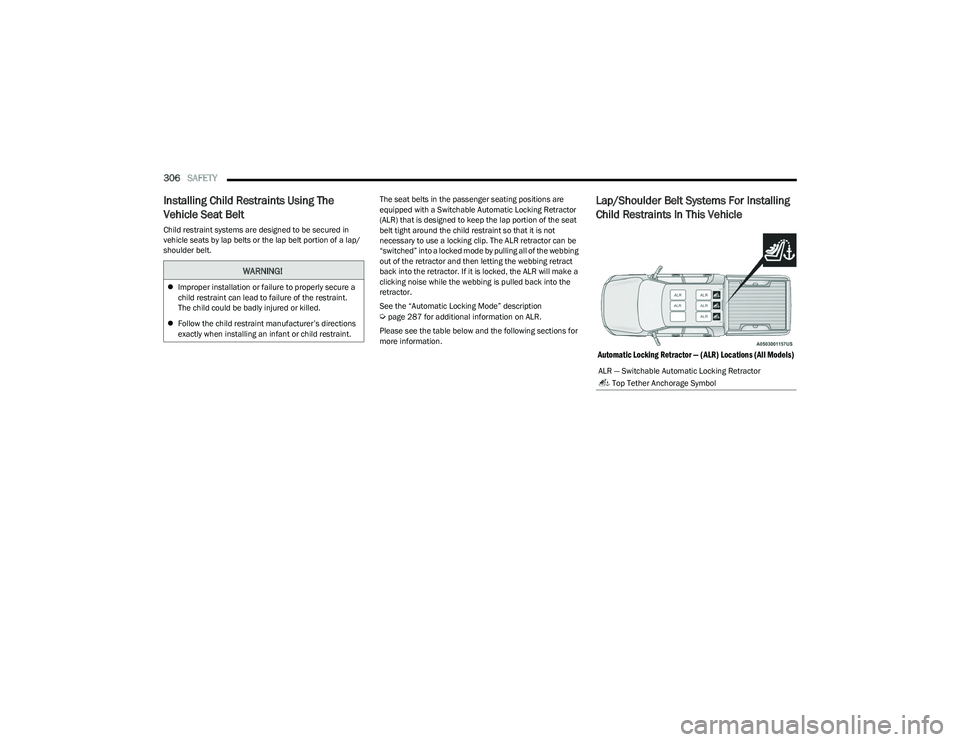
Lap/Shoulder Belt Systems For Installing
Child Restraints In This Vehicle
Automatic Locking Retractor — (ALR) Locations (All Models)
WARNING!
Improper installation or failure to properly secure a
child restraint can lead to failure of the restraint.
The child could be badly injured or killed.
Follow the child restraint manufacturer’s directions
exactly when installing an infant or child restraint.
ALR — Switchable Automatic Locking Retractor
Top Tether Anchorage Symbol
23_DT_OM_EN_USC_t.book Page 306
Page 310 of 416

308SAFETY
Installing A Child Restraint With A
Switchable Automatic Locking Retractor
(ALR):
Child restraint systems are designed to be secured in
vehicle seats by lap belts or the lap belt portion of a lap/
shoulder belt.
1. Place the child seat in the center of the seating
position. If the second row seat can be reclined, you
may recline the seat and/or raise the head restraint
(if adjustable) to get a better fit. If the rear seat can
be moved forward and rearward in the vehicle, you
may wish to move it to its rear-most position to make
room for the child seat. You may also move the front
seat forward to allow more room for the child seat.
2. Pull enough of the seat belt webbing from the retractor to pass it through the belt path of the
child restraint. Do not twist the belt webbing in
the belt path. 3. Slide the latch plate into the buckle until you hear a
“click.”
4. Pull on the webbing to make the lap portion tight against the child seat.
5. To lock the seat belt, pull down on the shoulder part of the belt until you have pulled all the seat belt
webbing out of the retractor. Then, allow the webbing
to retract back into the retractor. As the webbing
retracts, you will hear a clicking sound. This means
the seat belt is now in the Automatic Locking mode.
6. Try to pull the webbing out of the retractor. If it is locked, you should not be able to pull out any
webbing. If the retractor is not
locked, repeat step 5.
7. Finally, pull up on any excess webbing to tighten the lap portion around the child restraint while you push
the child restraint rearward and downward into the
vehicle seat.
8. If the child restraint has a top tether strap and the seating position has a top tether anchorage, connect
the tether strap to the anchorage and tighten the
tether strap
Úpage 308.
9. Test that the child restraint is installed tightly by pulling back and forth on the child seat at the belt
path. It should not move more than 1 inch (25.4 mm) in any direction.
Any seat belt system will loosen with time, so check the
belt occasionally, and pull it tight if necessary.
Installing Child Restraints Using The Top
Tether Anchorage
WARNING!
Improper installation or failure to properly secure a
child restraint can lead to failure of the restraint.
The child could be badly injured or killed.
Follow the child restraint manufacturer’s directions
exactly when installing an infant or child restraint.
WARNING!
Do not attach a tether strap for a rear-facing car seat to
any location in front of the car seat, including the seat
frame or a tether anchorage. Only attach the tether
strap of a rear-facing car seat to the tether anchorage
that is approved for that seating position, located
behind the top of the vehicle seat. For the location of
approved tether anchorages in your vehicle, see
Úpage 302.
WARNING!
Never place a rear-facing child restraint in front of an air
bag. A deploying Passenger Front Air Bag can cause
death or serious injury to a child 12 years or younger,
including a child in a rear-facing child restraint.
23_DT_OM_EN_USC_t.book Page 308
Page 315 of 416

SAFETY313
(Continued)
Lights
Have someone observe the operation of brake lights and
exterior lights while you work the controls. Check turn
signal and high beam indicator lights on the instrument
panel.
Door Latches
Check for proper closing, latching, and locking.
Fluid Leaks
Check area under the vehicle after overnight parking for
fuel, coolant, oil, or other fluid leaks. Also, if gasoline
fumes are detected or if fuel or brake fluid leaks are
suspected, the cause should be located and corrected
immediately.
EXHAUST GAS
The best protection against carbon monoxide entry into
the vehicle body is a properly maintained engine exhaust
system.
Whenever a change is noticed in the sound of the exhaust
system, when exhaust fumes can be detected inside the
vehicle, or when the underside or rear of the vehicle is
damaged, have an authorized dealer inspect the complete
exhaust system and adjacent body areas for broken,
damaged, deteriorated, or mispositioned parts. Open
seams or loose connections could permit exhaust fumes
to seep into the passenger compartment. In addition,
inspect the exhaust system each time the vehicle is raised
for lubrication or oil change. Replace as required.
CARBON MONOXIDE WARNINGS
WARNING!
Exhaust gases can injure or kill. They contain carbon
monoxide (CO), which is colorless and odorless.
Breathing it can make you unconscious and can
eventually poison you. To avoid breathing (CO), follow
these safety tips:
Do not run the engine in a closed garage or in
confined areas any longer than needed to move your
vehicle in or out of the area.
If you are required to drive with the trunk/liftgate/
rear doors open, make sure that all windows are
closed and the climate control BLOWER switch is set
at high speed. DO NOT use the recirculation mode.
If it is necessary to sit in a parked vehicle with the
engine running, adjust your heating or cooling
controls to force outside air into the vehicle. Set the
blower at high speed.
WARNING!
WARNING!
Carbon monoxide (CO) in exhaust gases is deadly.
Follow the precautions below to prevent carbon
monoxide poisoning:
Do not inhale exhaust gases. They contain carbon
monoxide, a colorless and odorless gas, which can
kill. Never run the engine in a closed area, such as a
garage, and never sit in a parked vehicle with the
engine running for an extended period. If the vehicle
is stopped in an open area with the engine running
for more than a short period, adjust the ventilation
system to force fresh, outside air into the vehicle.
Guard against carbon monoxide with proper mainte -
nance. Have the exhaust system inspected every
time the vehicle is raised. Have any abnormal condi -
tions repaired promptly. Until repaired, drive with all
side windows fully open.
6
23_DT_OM_EN_USC_t.book Page 313
Page 320 of 416
318IN CASE OF EMERGENCY
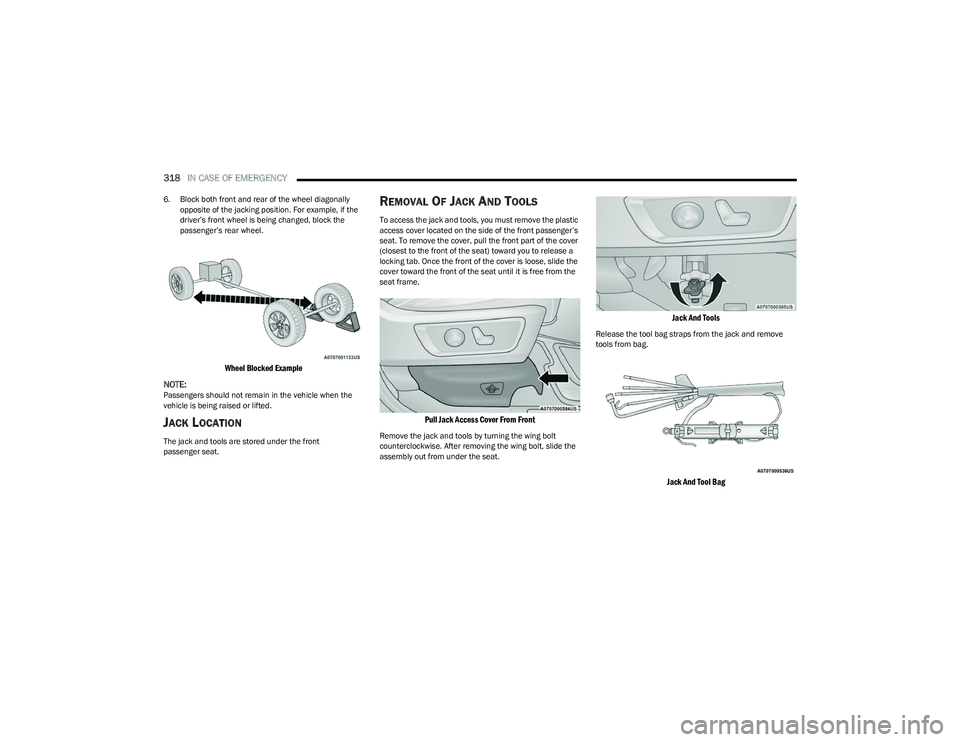
6. Block both front and rear of the wheel diagonally
opposite of the jacking position. For example, if the
driver’s front wheel is being changed, block the
passenger’s rear wheel.
Wheel Blocked Example
NOTE:
Passengers should not remain in the vehicle when the
vehicle is being raised or lifted.
JACK LOCATION
The jack and tools are stored under the front
passenger seat.
REMOVAL OF JACK AND TOOLS
To access the jack and tools, you must remove the plastic
access cover located on the side of the front passenger’s
seat. To remove the cover, pull the front part of the cover
(closest to the front of the seat) toward you to release a
locking tab. Once the front of the cover is loose, slide the
cover toward the front of the seat until it is free from the
seat frame.
Pull Jack Access Cover From Front
Remove the jack and tools by turning the wing bolt
counterclockwise. After removing the wing bolt, slide the
assembly out from under the seat.
Jack And Tools
Release the tool bag straps from the jack and remove
tools from bag.
Jack And Tool Bag
23_DT_OM_EN_USC_t.book Page 318
Page 322 of 416
320IN CASE OF EMERGENCY
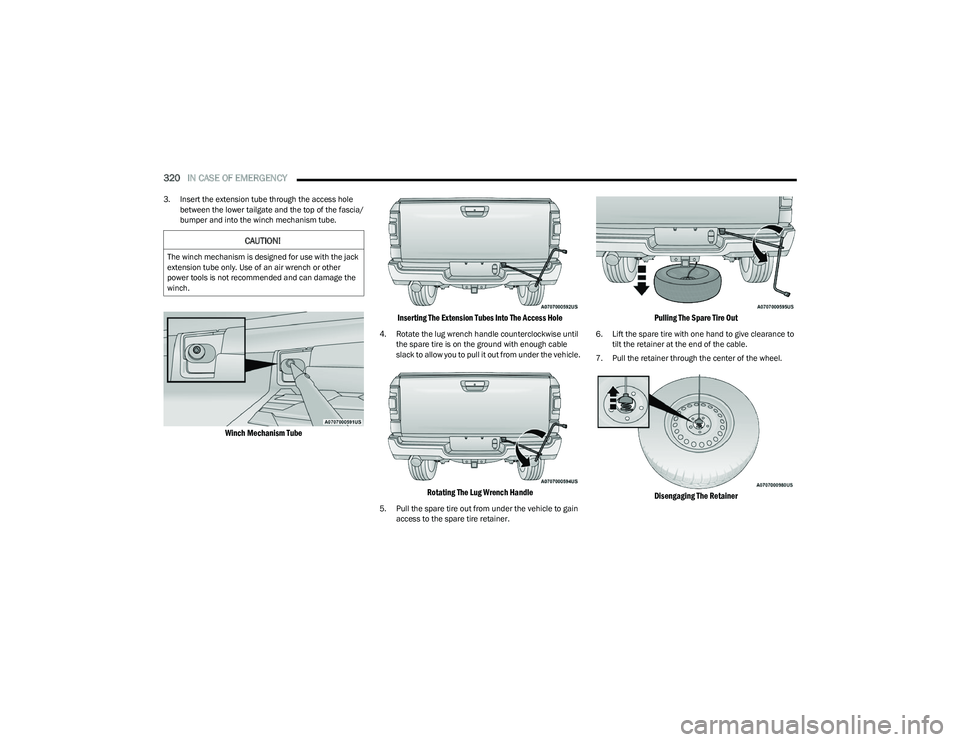
3. Insert the extension tube through the access hole
between the lower tailgate and the top of the fascia/
bumper and into the winch mechanism tube.
Winch Mechanism Tube Inserting The Extension Tubes Into The Access Hole
4. Rotate the lug wrench handle counterclockwise until
the spare tire is on the ground with enough cable
slack to allow you to pull it out from under the vehicle.
Rotating The Lug Wrench Handle
5. Pull the spare tire out from under the vehicle to gain access to the spare tire retainer.
Pulling The Spare Tire Out
6. Lift the spare tire with one hand to give clearance to tilt the retainer at the end of the cable.
7. Pull the retainer through the center of the wheel.
Disengaging The Retainer
CAUTION!
The winch mechanism is designed for use with the jack
extension tube only. Use of an air wrench or other
power tools is not recommended and can damage the
winch.
23_DT_OM_EN_USC_t.book Page 320
Page 323 of 416
IN CASE OF EMERGENCY321
JACKING INSTRUCTIONS
Jack Warning Label
1. Remove the spare tire, jack, and tools from the
stored location.
2. Using the lug wrench, loosen the wheel nuts (but do not remove), by turning them counterclockwise one
turn while the wheel is still on the ground.
3. Assemble the jack and jacking tools. Connect the jack handle driver to the extension, then to the lug wrench.
Assembled Jack And Tools
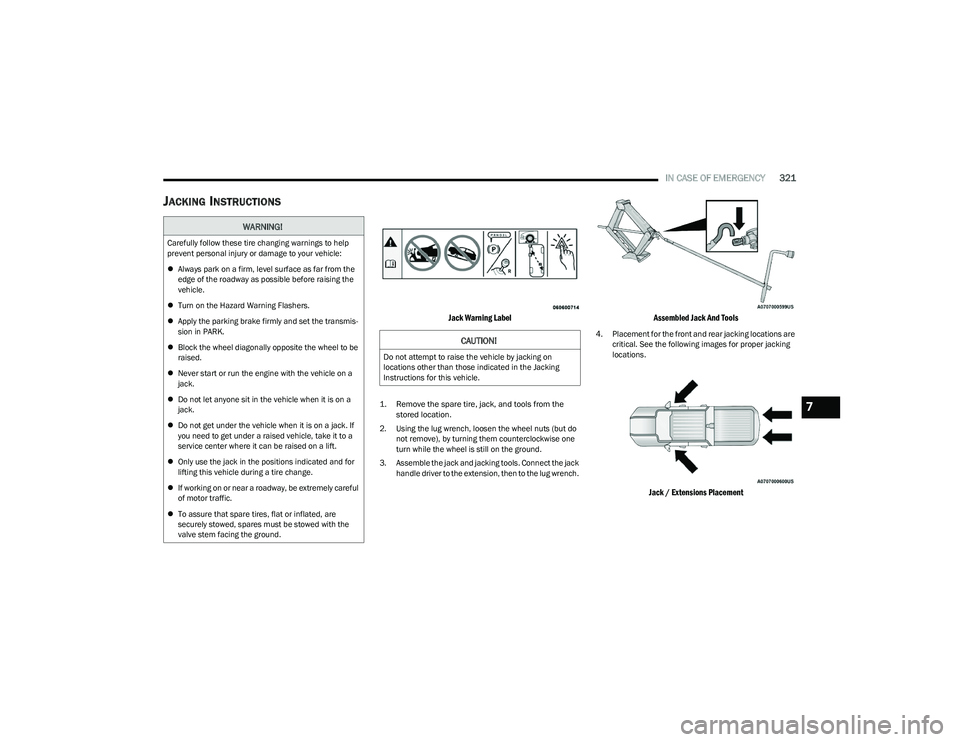
4. Placement for the front and rear jacking locations are critical. See the following images for proper jacking
locations.
Jack / Extensions Placement
WARNING!
Carefully follow these tire changing warnings to help
prevent personal injury or damage to your vehicle:
Always park on a firm, level surface as far from the
edge of the roadway as possible before raising the
vehicle.
Turn on the Hazard Warning Flashers.
Apply the parking brake firmly and set the transmis -
sion in PARK.
Block the wheel diagonally opposite the wheel to be
raised.
Never start or run the engine with the vehicle on a
jack.
Do not let anyone sit in the vehicle when it is on a
jack.
Do not get under the vehicle when it is on a jack. If
you need to get under a raised vehicle, take it to a
service center where it can be raised on a lift.
Only use the jack in the positions indicated and for
lifting this vehicle during a tire change.
If working on or near a roadway, be extremely careful
of motor traffic.
To assure that spare tires, flat or inflated, are
securely stowed, spares must be stowed with the
valve stem facing the ground.
CAUTION!
Do not attempt to raise the vehicle by jacking on
locations other than those indicated in the Jacking
Instructions for this vehicle.
7
23_DT_OM_EN_USC_t.book Page 321
Page 324 of 416
322IN CASE OF EMERGENCY
Front Jacking Location
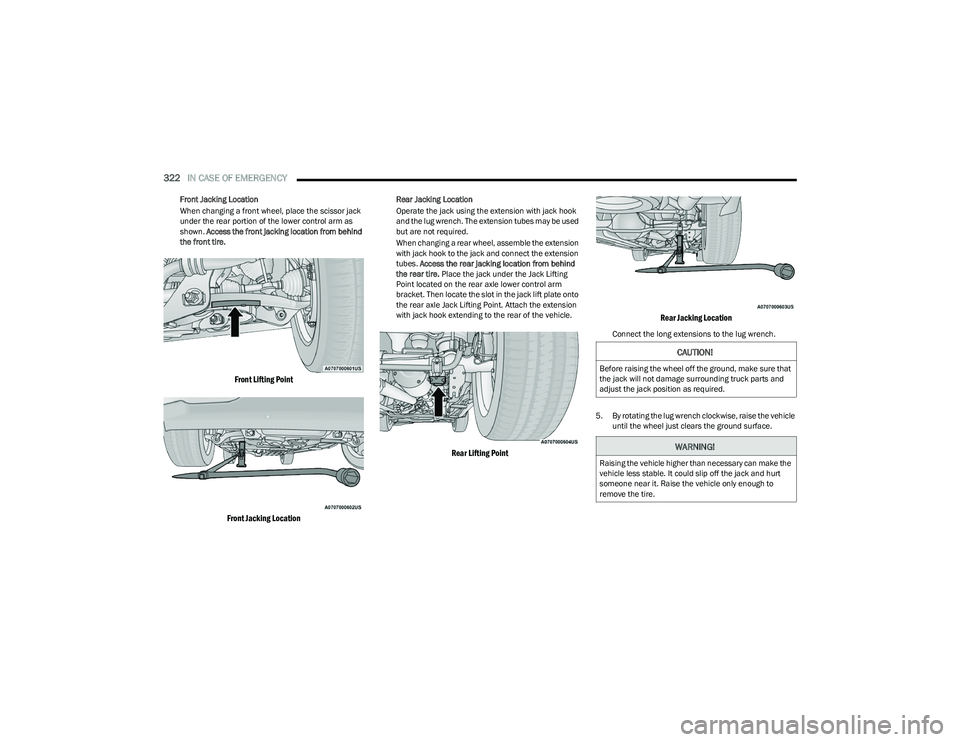
When changing a front wheel, place the scissor jack
under the rear portion of the lower control arm as
shown. Access the front jacking location from behind
the front tire.
Front Lifting Point
Front Jacking Location
Rear Jacking Location
Operate the jack using the extension with jack hook
and the lug wrench. The extension tubes may be used
but are not required.
When changing a rear wheel, assemble the extension
with jack hook to the jack and connect the extension
tubes. Access the rear jacking location from behind
the rear tire. Place the jack under the Jack Lifting
Point located on the rear axle lower control arm
bracket. Then locate the slot in the jack lift plate onto
the rear axle Jack Lifting Point. Attach the extension
with jack hook extending to the rear of the vehicle.
Rear Lifting Point Rear Jacking Location
Connect the long extensions to the lug wrench.
5. By rotating the lug wrench clockwise, raise the vehicle until the wheel just clears the ground surface.
CAUTION!
Before raising the wheel off the ground, make sure that
the jack will not damage surrounding truck parts and
adjust the jack position as required.
WARNING!
Raising the vehicle higher than necessary can make the
vehicle less stable. It could slip off the jack and hurt
someone near it. Raise the vehicle only enough to
remove the tire.
23_DT_OM_EN_USC_t.book Page 322
Page 325 of 416

IN CASE OF EMERGENCY323
6. Remove the lug nuts and pull the wheel off. Install the
spare wheel and lug nuts with the cone shaped end
of the lug nuts toward the wheel. Hand tighten the lug
nuts with the vehicle lifted. To avoid the risk of forcing
the vehicle off the jack, do not fully tighten the lug
nuts until the vehicle has been completely lowered.
7. Lower the vehicle to the ground and finish tightening the lug nuts. Push down on the wrench handle for
increased leverage. Tighten the lug nuts in a star
pattern until each lug nut has been tightened twice
Úpage 392. If in doubt about the correct tightness,
have them checked with a torque wrench by an
authorized dealer or at a service station.
8. If your vehicle is equipped with a wheel center cap, install the cap and remove the wheel blocks. Do not
install chrome or aluminum wheel center caps on the
spare wheel. This may result in cap damage.
9. Lower the jack to its fully closed position. Stow the replaced tire, and secure the jack and tools in the
proper location.
10. Adjust the tire pressure when possible.
TO STOW THE FLAT OR SPARE
1. Lift the spare tire with one hand to give clearance to tilt the retainer at the end of the cable.
2. Position the wheel behind the rear fascia/bumper facing outward. Push the end of the winch’s cable,
spring and steel sleeve through the back of the road
wheel. Making sure the valve stem is facing the
ground when the wheel is stowed.
Reinstalling The Retainer
3. Remove the extension with the hook and reattach the
short extension #5 Úpage 318. Attach the lug
wrench to the extension tubes with the curved angle
facing away from the vehicle. Insert the extension
tubes through the access hole between the lower
tailgate and the top of the fascia/bumper and into the
winch mechanism tube.
Reinstalling The Flat Or Spare Tire
WARNING!
A loose tire or jack thrown forward in a collision or hard
stop, could endanger the occupants of the vehicle.
Always stow the jack parts and the spare tire in the
places provided.
CAUTION!
The winch mechanism is designed for use with the jack
extension tube only. Use of an air wrench or other
power tools is not recommended and can damage the
winch.
7
23_DT_OM_EN_USC_t.book Page 323
Page 326 of 416
324IN CASE OF EMERGENCY
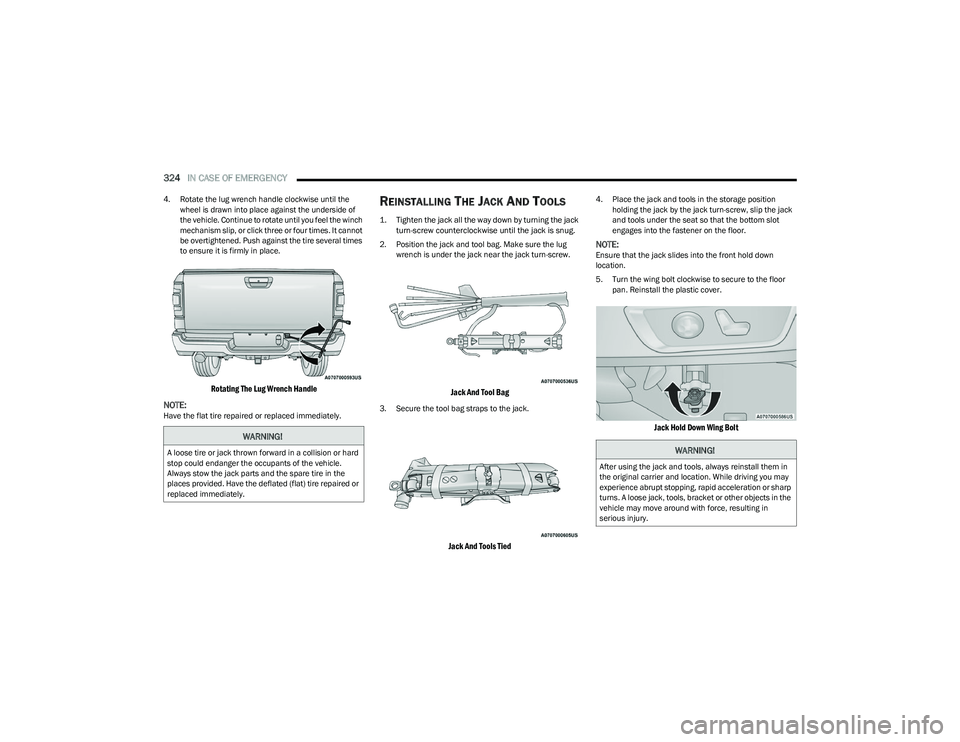
4. Rotate the lug wrench handle clockwise until the
wheel is drawn into place against the underside of
the vehicle. Continue to rotate until you feel the winch
mechanism slip, or click three or four times. It cannot
be overtightened. Push against the tire several times
to ensure it is firmly in place.
Rotating The Lug Wrench Handle
NOTE:
Have the flat tire repaired or replaced immediately.
REINSTALLING THE JACK AND TOOLS
1. Tighten the jack all the way down by turning the jack turn-screw counterclockwise until the jack is snug.
2. Position the jack and tool bag. Make sure the lug wrench is under the jack near the jack turn-screw.
Jack And Tool Bag
3. Secure the tool bag straps to the jack.
Jack And Tools Tied
4. Place the jack and tools in the storage position holding the jack by the jack turn-screw, slip the jack
and tools under the seat so that the bottom slot
engages into the fastener on the floor.
NOTE:Ensure that the jack slides into the front hold down
location.
5. Turn the wing bolt clockwise to secure to the floor pan. Reinstall the plastic cover.
Jack Hold Down Wing Bolt
WARNING!
A loose tire or jack thrown forward in a collision or hard
stop could endanger the occupants of the vehicle.
Always stow the jack parts and the spare tire in the
places provided. Have the deflated (flat) tire repaired or
replaced immediately.WARNING!
After using the jack and tools, always reinstall them in
the original carrier and location. While driving you may
experience abrupt stopping, rapid acceleration or sharp
turns. A loose jack, tools, bracket or other objects in the
vehicle may move around with force, resulting in
serious injury.
23_DT_OM_EN_USC_t.book Page 324
Page 331 of 416
IN CASE OF EMERGENCY329
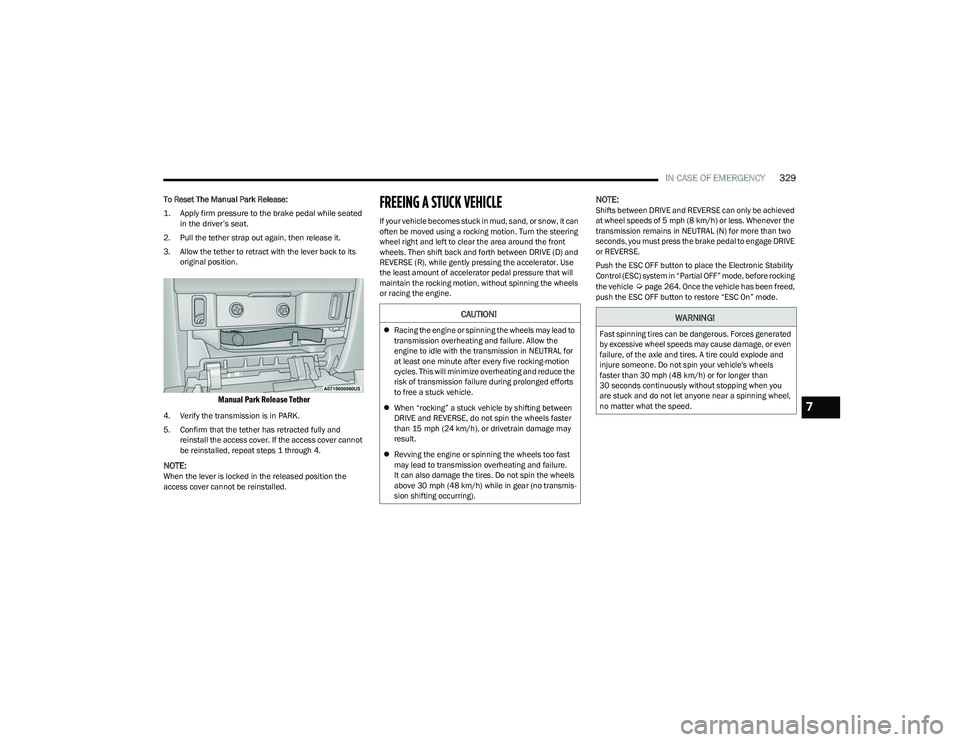
To Reset The Manual Park Release:
1. Apply firm pressure to the brake pedal while seated
in the driver’s seat.
2. Pull the tether strap out again, then release it.
3. Allow the tether to retract with the lever back to its original position.
Manual Park Release Tether
4. Verify the transmission is in PARK.
5. Confirm that the tether has retracted fully and reinstall the access cover. If the access cover cannot
be reinstalled, repeat steps 1 through 4.
NOTE:When the lever is locked in the released position the
access cover cannot be reinstalled.
FREEING A STUCK VEHICLE
If your vehicle becomes stuck in mud, sand, or snow, it can
often be moved using a rocking motion. Turn the steering
wheel right and left to clear the area around the front
wheels. Then shift back and forth between DRIVE (D) and
REVERSE (R), while gently pressing the accelerator. Use
the least amount of accelerator pedal pressure that will
maintain the rocking motion, without spinning the wheels
or racing the engine.
NOTE:Shifts between DRIVE and REVERSE can only be achieved
at wheel speeds of 5 mph (8 km/h) or less. Whenever the
transmission remains in NEUTRAL (N) for more than two
seconds, you must press the brake pedal to engage DRIVE
or REVERSE.
Push the ESC OFF button to place the Electronic Stability
Control (ESC) system in “Partial OFF” mode, before rocking
the vehicle
Úpage 264. Once the vehicle has been freed,
push the ESC OFF button to restore “ESC On” mode.
CAUTION!
Racing the engine or spinning the wheels may lead to
transmission overheating and failure. Allow the
engine to idle with the transmission in NEUTRAL for
at least one minute after every five rocking-motion
cycles. This will minimize overheating and reduce the
risk of transmission failure during prolonged efforts
to free a stuck vehicle.
When “rocking” a stuck vehicle by shifting between
DRIVE and REVERSE, do not spin the wheels faster
than 15 mph (24 km/h), or drivetrain damage may
result.
Revving the engine or spinning the wheels too fast
may lead to transmission overheating and failure.
It can also damage the tires. Do not spin the wheels
above 30 mph (48 km/h) while in gear (no transmis -
sion shifting occurring).
WARNING!
Fast spinning tires can be dangerous. Forces generated
by excessive wheel speeds may cause damage, or even
failure, of the axle and tires. A tire could explode and
injure someone. Do not spin your vehicle's wheels
faster than 30 mph (48 km/h) or for longer than
30 seconds continuously without stopping when you
are stuck and do not let anyone near a spinning wheel,
no matter what the speed.
7
23_DT_OM_EN_USC_t.book Page 329