wheel Ram 3500 Chassis Cab 2019 Owner's Manual
[x] Cancel search | Manufacturer: RAM, Model Year: 2019, Model line: 3500 Chassis Cab, Model: Ram 3500 Chassis Cab 2019Pages: 607, PDF Size: 10.72 MB
Page 398 of 607

396 IN CASE OF EMERGENCY
Dual Rear Wheels
Slots in the wheels will assist in properly orienting the inner
and outer wheels. Align these slots when assembling the
wheels for best access to the tire valve on the inner wheel.
The tires of both dual wheels must be completely off the
ground when tightening to insure wheel centering and
maximum wheel clamping.
Dual wheel models require a special heavy-duty lug nut
tightening adapter (included with the vehicle) to correctly
tighten the lug nuts. Also, when it is necessary to remove and
install dual rear wheels, use a proper vehicle lifting device.
NOTE:
When installing a spare tire (if equipped) as part of a dual
rear wheel end combination, the tire diameter of the two
individual tires must be compared. If there is a significant
difference, the larger tire should be installed in a front loca-
tion. The correct direction of rotation for dual tire installa -
tions must also be observed
It is recommended that wheel stud nuts be kept torqued to
specifications at all times. Torque wheel stud nuts to specifi -
cations at each lubrication interval.
Refer to “Wheel And Tire Torque Specifications” in “Tech -
nical Specifications” for further information. Wheel Nuts
All wheel nuts should be tightened occasionally to eliminate
the possibility of wheel studs being sheared or the bolt holes
in the wheels becoming elongated. This is especially
important during the first few hundred miles/kilometers of
operation to allow the wheel nuts to become properly set. All
wheel nuts should first be firmly seated against the wheel.
The wheel nuts should then be tightened to recommended
torque. Tighten the wheel nuts to final torque in increments.
Progress around the bolt circle, tightening the wheel nut
opposite to the wheel nut just previously tightened until
final torque is achieved.
Refer to “Wheel And Tire Torque Specifications” in “Tech
-
nical Specifications” for further information.
To Stow The Flat Or Spare — If Equipped
Refer to Upfitters Body Builder’s Guide for information on
stowing your spare tire (if equipped).
Page 399 of 607
IN CASE OF EMERGENCY 397
Hub Caps/Wheel Covers — If Equipped
The hub caps must be removed before raising the vehicle off
the ground.
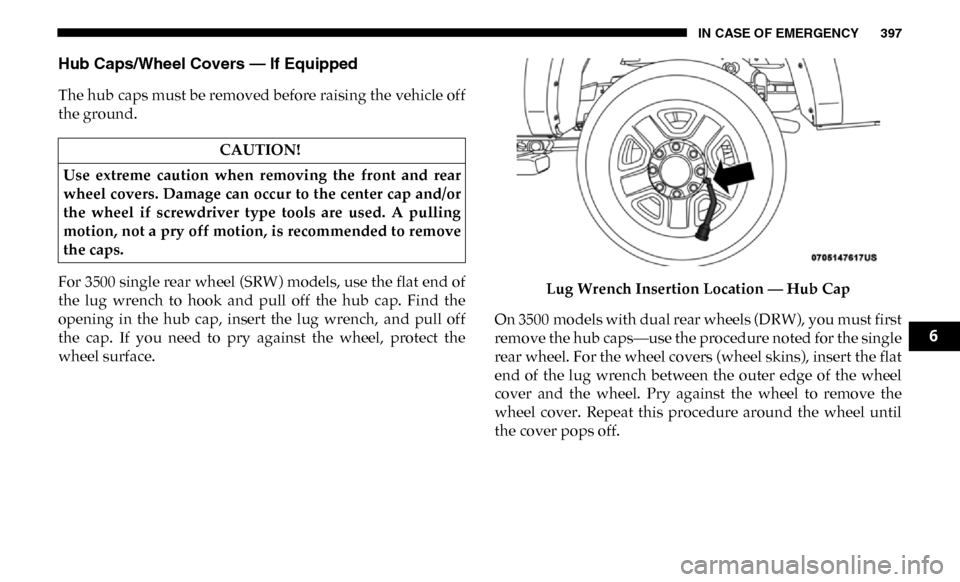
For 3500 single rear wheel (SRW) models, use the flat end of
the lug wrench to hook and pull off the hub cap. Find the
opening in the hub cap, insert the lug wrench, and pull off
the cap. If you need to pry against the wheel, protect the
wheel surface.Lug Wrench Insertion Location — Hub Cap
On 3500 models with dual rear wheels (DRW), you must first
remove the hub caps—use the procedure noted for the single
rear wheel. For the wheel covers (wheel skins), insert the flat
end of the lug wrench between the outer edge of the wheel
cover and the wheel. Pry against the wheel to remove the
wheel cover. Repeat this procedure around the wheel until
the cover pops off.
CAUTION!
Use extreme caution when removing the front and rear
wheel covers. Damage can occur to the center cap and/or
the wheel if screwdriver type tools are used. A pulling
motion, not a pry off motion, is recommended to remove
the caps.
6
Page 400 of 607

398 IN CASE OF EMERGENCY
Lug Wrench Insertion Location — Wheel Cover
Replace the wheel covers using a rubber mallet to ease the
installation. Align the wheel cover vent holes to the wheel
vent holes. Tap on the wheel cover as needed to firmly seat it
evenly around the wheel.
JUMP STARTING
If your vehicle has a discharged battery, it can be jump
started using a set of jumper cables and a battery in another
vehicle, or by using a portable battery booster pack. Jump
starting can be dangerous if done improperly, so please
follow the procedures in this section carefully.
NOTE:
When using a portable battery booster pack, follow the
manufacturer's operating instructions and precautions.
CAUTION!
• Use a pulling motion to remove the hub cap. Do not use a twisting motion when removing the hub cap, damage
to the hub cap; finish may occur.
• The rear hub caps on the dual rear wheel has two pull off notches. Make sure that the hook of the jack handle
driver is located squarely in the cap notch before
attempting to pull off.
WARNING!
Do not attempt jump starting if the battery is frozen. It
could rupture or explode and cause personal injury.
CAUTION!
Do not use a portable battery booster pack or any other
booster source with a system voltage greater than 12 Volts or
damage to the battery, starter motor, alternator or electrical
system may occur.
Page 404 of 607

402 IN CASE OF EMERGENCY
• You can also turn the temperature control to maximumheat, the mode control to floor and the blower control to
high. This allows the heater core to act as a supplement to
the radiator and aids in removing heat from the engine
cooling system.GEAR SELECTOR OVERRIDE — 6–SPEED
TRANSMISSION
If a malfunction occurs and the gear selector cannot be
moved out of the PARK (P) position, you can use the
following procedure to temporarily move the gear selector:
1. Turn the engine OFF.
2. Firmly apply the parking brake.
3. Tilt the steering wheel to the full up position.
4. Press and maintain firm pressure on the brake pedal.
5. Insert a screwdriver or similar tool into the access port (ringed circle) on the bottom of the steering column, and
push and hold the override release lever up.
WARNING!
You or others can be badly burned by hot engine coolant
(antifreeze) or steam from your radiator. If you see or
hear steam coming from under the hood, do not open the
hood until the radiator has had time to cool. Never try to
open a cooling system pressure cap when the radiator or
coolant bottle is hot.
CAUTION!
Driving with a hot cooling system could damage your
vehicle. If the temperature gauge reads HOT (H), pull
over and stop the vehicle. Idle the vehicle with the air
conditioner turned off until the pointer drops back into
the normal range. If the pointer remains on HOT (H),
and you hear continuous chimes, turn the engine off
immediately and call for service.
Page 407 of 607
IN CASE OF EMERGENCY 405
(Continued)
FREEING A STUCK VEHICLE
If your vehicle becomes stuck in mud, sand, or snow, it can
often be moved using a rocking motion. Turn the steering
wheel right and left to clear the area around the front wheels.
Then shift back and forth between DRIVE and REVERSE,
while gently pressing the accelerator. Use the least amount of
accelerator pedal pressure that will maintain the rocking
motion, without spinning the wheels or racing the engine.
NOTE:
• For trucks equipped with an 8–speed transmission, shiftsbetween DRIVE and REVERSE can only be achieved at
wheel speeds of 5 mph (8 km/h) or less. Whenever the
transmission remains in NEUTRAL for more than two
seconds, you must press the brake pedal to engage DRIVE
or REVERSE.
• Push the "ESC Off" switch, to place the Electronic Stability Control (ESC) system in "Partial Off" mode, before rocking
the vehicle. Refer to “Electronic Brake Control” in “Safety”
for further information. Once the vehicle has been freed,
push the "ESC Off" switch again to restore "ESC On" mode.
WARNING!
Fast spinning tires can be dangerous. Forces generated
by excessive wheel speeds may cause damage, or even
failure, of the axle and tires. A tire could explode and
injure someone. Do not spin your vehicle's wheels faster
than 30 mph (48 km/h) or for longer than 30 seconds
continuously without stopping when you are stuck and
do not let anyone near a spinning wheel, no matter what
the speed.
CAUTION!
• Racing the engine or spinning the wheels may lead to transmission overheating and failure. Allow the engine
to idle with the transmission in NEUTRAL for at least
one minute after every five rocking-motion cycles. This
will minimize overheating and reduce the risk of trans -
mission failure during prolonged efforts to free a stuck
vehicle.
• When “rocking” a stuck vehicle by shifting between DRIVE and REVERSE, do not spin the wheels faster
than 15 mph (24 km/h), or drivetrain damage may
result.
6
Page 408 of 607

406 IN CASE OF EMERGENCY
TOWING A DISABLED VEHICLE
This section describes procedures for towing a disabled
vehicle using a commercial towing service. If the transmis-
sion and drivetrain are operable, disabled vehicles may also
be towed as described under “Recreational Towing” in the
“Starting And Operating” section.
• Revving the engine or spinning the wheels too fast may lead
to transmission overheating and failure. It can also damage
the tires. Do not spin the wheels above 30 mph (48 km/h)
while in gear (no transmission shifting occurring).
CAUTION!
(Continued)
Towing
Condition Wheels OFF
The Ground 2WD Models
4WD Models
Flat Tow NONE If transmission is operable:
• Transmission in NEUTRAL
• 30 mph (48 km/h) max speed
• 15 miles (24 km) max distance (6–speed
transmission)
• 30 miles (48 km) max distance (8–speed
transmission) See instructions in “Recreational Towing”
under “Starting And Operating”
• Auto Transmission in PARK
• Transfer Case in NEUTRAL
• Tow in forward direction
Wheel Lift Or Dolly Tow Front
NOT ALLOWED
Rear OK NOT ALLOWED
Flatbed ALL
BEST METHOD BEST METHOD
Page 409 of 607

IN CASE OF EMERGENCY 407
Proper towing or lifting equipment is required to prevent
damage to your vehicle. Use only tow bars and other equip-
ment designed for this purpose, following equipment manu-
facturer’s instructions. Use of safety chains is mandatory.
Attach a tow bar or other towing device to main structural
members of the vehicle, not to bumpers or associated
brackets. State and local laws regarding vehicles under tow
must be observed.
If you must use the accessories (wipers, defrosters, etc.)
while being towed, the ignition must be in the ON/RUN
mode, not the ACC mode.
If the key fob is unavailable or the vehicle's battery is
discharged, refer to “Manual Park Release” or “Gear Selector
Override” in this section for instructions on shifting the auto -
matic transmission out of PARK for towing.Two-Wheel Drive Models
The manufacturer recommends towing your vehicle with all
four wheels OFF the ground using a flatbed.
If flatbed equipment is not available, and the transmission is
operable, the vehicle may be towed (with the rear wheels on
the ground) under the following conditions:
• The transmission must be in NEUTRAL. Refer to “Manual Park Release” in this section for instructions on shifting the
8–speed transmission to NEUTRAL when the engine is off.
• The towing speed must not exceed 30 mph (48 km/h).
• The towing distance must not exceed 15 miles (24 km) for 6–speed transmission, or 30 miles (48 km) for 8–speed
transmission.
If the transmission is not operable, or the vehicle must be
towed faster than 30 mph (48 km/h) or farther than 15 miles (24 km) for 6–speed transmission, or 30 miles (48 km) for
8–speed transmission, tow with the rear wheels OFF the
ground. Acceptable methods are to tow the vehicle on a
flatbed, or with the front wheels raised and the rear wheels
on a towing dolly, or (when using a suitable steering wheel
stabilizer to hold the front wheels in the straight position)
with rear wheels raised and the front wheels on the ground.
CAUTION!
• Do not use sling type equipment when towing. Vehicle damage may occur.
• When securing the vehicle to a flat bed truck, do not attach to front or rear suspension components. Damage
to your vehicle may result from improper towing.
6
Page 410 of 607

408 IN CASE OF EMERGENCY
Four-Wheel Drive Models
The manufacturer recommends towing with all wheels OFF
the ground. Acceptable methods are to tow the vehicle on a
flatbed or with one end of vehicle raised and the opposite
end on a towing dolly.
If flatbed equipment is not available, and the transfer case is
operable, the vehicle may be towed (in the forward direction,
with ALL wheels on the ground), IF the transfer case is in
NEUTRAL and the transmission is in PARK (P). Refer to
“Recreational Towing” in “Starting And Operating” for
further information and detailed instructions.
Emergency Tow Hooks — If Equipped
Your vehicle may be equipped with emergency tow hooks.
NOTE:
For off-road recovery, it is recommended to use both of the
front tow hooks to minimize the risk of damage to the
vehicle.
CAUTION!
Towing this vehicle in violation of the above
requirements can cause severe engine and/or
transmission damage. Damage from improper towing is
not covered under the New Vehicle Limited Warranty.
CAUTION!
• Front or rear wheel lifts must not be used (if the remaining wheels are on the ground). Internal damage
to the transmission or transfer case will occur if a front
or rear wheel lift is used when towing.
• Towing this vehicle in violation of the above require -
ments can cause severe transmission and/or transfer
case damage. Damage from improper towing is not
covered under the New Vehicle Limited Warranty.
Page 459 of 607

SERVICING AND MAINTENANCE 457
Run Flat Tires — If Equipped
Run Flat tires allow you the capability to drive 50 miles
(80 km) at 50 mph (80 km/h) after a rapid loss of inflation
pressure. This rapid loss of inflation is referred to as the Run
Flat mode. A Run Flat mode occurs when the tire inflation
pressure is of/or below 14 psi (96 kPa). Once a Run Flat tire
reaches the run flat mode it has limited driving capabilities
and needs to be replaced immediately. A Run Flat tire is not
repairable. When a run flat tire is changed after driving with
underinflated tire condition, please replace the TPM sensor
as it is not designed to be reused when driven under run flat
mode (14 psi (96 kPa)) condition.
NOTE:
TPM Sensor must be replaced after driving the vehicle on a
flat tire condition.
It is not recommended driving a vehicle loaded at full
capacity or to tow a trailer while a tire is in the run flat mode.
See the tire pressure monitoring section for more informa-
tion. Tire Spinning
When stuck in mud, sand, snow, or ice conditions, do not
spin your vehicle's wheels above 30 mph (48 km/h) or for
longer than 30 seconds continuously without stopping.
Refer to “Freeing A Stuck Vehicle” in “In Case Of Emer
-
gency” for further information.
WARNING!
Fast spinning tires can be dangerous. Forces generated
by excessive wheel speeds may cause tire damage or
failure. A tire could explode and injure someone. Do not
spin your vehicle's wheels faster than 30 mph (48 km/h)
for more than 30 seconds continuously when you are
stuck, and do not let anyone near a spinning wheel, no
matter what the speed.
7
Page 461 of 607

SERVICING AND MAINTENANCE 459
(Continued)
NOTE:
Wheel Valve Stem must be replaced as well when installing
new tires due to wear and tear in existing tires.
Keep dismounted tires in a cool, dry place with as little expo-
sure to light as possible. Protect tires from contact with oil,
grease, and gasoline.
Replacement Tires
The tires on your new vehicle provide a balance of many
characteristics. They should be inspected regularly for wear
and correct cold tire inflation pressures. The manufacturer
strongly recommends that you use tires equivalent to the
originals in size, quality and performance when replacement
is needed. Refer to the paragraph on “Tread Wear Indica -
tors” in this section. Refer to the Tire and Loading Informa -
tion placard or the Vehicle Certification Label for the size
designation of your tire. The Load Index and Speed Symbol
for your tire will be found on the original equipment tire
sidewall.
See the Tire Sizing Chart example found in the “Tire Safety
Information” section of this manual for more information
relating to the Load Index and Speed Symbol of a tire. It is recommended to replace the two front tires or two rear
tires as a pair. Replacing just one tire can seriously affect
your vehicle’s handling. If you ever replace a wheel, make
sure that the wheel’s specifications match those of the orig
-
inal wheels.
It is recommended you contact an authorized tire dealer or
original equipment dealer with any questions you may have
on tire specifications or capability. Failure to use equivalent
replacement tires may adversely affect the safety, handling,
and ride of your vehicle.
WARNING!
• Do not use a tire, wheel size, load rating, or speed rating other than that specified for your vehicle. Some combi -
nations of unapproved tires and wheels may change
suspension dimensions and performance characteris -
tics, resulting in changes to steering, handling, and
braking of your vehicle. This can cause unpredictable
handling and stress to steering and suspension compo -
nents. You could lose control and have a collision
resulting in serious injury or death. Use only the tire
and wheel sizes with load ratings approved for your
vehicle.
7