wheel Ram 3500 Chassis Cab 2019 Owner's Manual
[x] Cancel search | Manufacturer: RAM, Model Year: 2019, Model line: 3500 Chassis Cab, Model: Ram 3500 Chassis Cab 2019Pages: 607, PDF Size: 10.72 MB
Page 463 of 607
SERVICING AND MAINTENANCE 461
Snow Tires
Some areas of the country require the use of snow tires
during the Winter. Snow tires can be identified by a “moun-
tain/snowflake” symbol on the tire sidewall.
If you need snow tires, select tires equivalent in size
and type to the original equipment tires. Use snow
tires only in sets of four; failure to do so may
adversely affect the safety and handling of your vehicle.
Snow tires generally have lower speed ratings than what was
originally equipped with your vehicle and should not be
operated at sustained speeds over 75 mph (120 km/h). For speeds above 75 mph (120 km/h) refer to original equipment
or an authorized tire dealer for recommended safe operating
speeds, loading and cold tire inflation pressures.
While studded tires improve performance on ice, skid and
traction capability on wet or dry surfaces may be poorer than
that of non-studded tires. Some states prohibit studded tires;
therefore, local laws should be checked before using these
tire types.Spare Tires — If Equipped
NOTE:
For vehicles equipped with Tire Service Kit instead of a spare
tire, please refer to “Tire Service Kit” in “In Case Of Emer -
gency” for further information.
Refer to the “Towing Requirements - Tires” in “Starting And
Operating” for restrictions when towing with a spare tire
designated for temporary emergency use.
Spare Tire Matching Original Equipped Tire And Wheel
— If Equipped
Your vehicle may be equipped with a spare tire and wheel
equivalent in look and function to the original equipment
tire and wheel found on the front or rear axle of your vehicle.
This spare tire may be used in the tire rotation for your
vehicle. If your vehicle has this option, refer to an authorized
tire dealer for the recommended tire rotation pattern.
CAUTION!
Because of the reduced ground clearance, do not take
your vehicle through an automatic car wash with a
compact or limited use temporary spare installed.
Damage to the vehicle may result.
7
Page 464 of 607

462 SERVICING AND MAINTENANCE
Compact Spare Tire — If Equipped
The compact spare is for temporary emergency use only.
You can identify if your vehicle is equipped with a compact
spare by looking at the spare tire description on the Tire and
Loading Information Placard located on the driver’s side
door opening or on the sidewall of the tire. Compact spare
tire descriptions begin with the letter “T” or “S” preceding
the size designation. Example: T145/80D18 103M.
T, S = Temporary Spare Tire
Since this tire has limited tread life, the original equipment
tire should be repaired (or replaced) and reinstalled on your
vehicle at the first opportunity.
Do not install a wheel cover or attempt to mount a conven-
tional tire on the compact spare wheel, since the wheel is
designed specifically for the compact spare tire. Do not
install more than one compact spare tire and wheel on the
vehicle at any given time. Collapsible Spare Tire — If Equipped
The collapsible spare is for temporary emergency use only.
You can identify if your vehicle is equipped with a collaps
-
ible spare by looking at the spare tire description on the Tire
and Loading Information Placard located on the driver’s side
door opening or on the sidewall of the tire.
Collapsible spare tire description example: 165/80-17 101P.
Since this tire has limited tread life, the original equipment
tire should be repaired (or replaced) and reinstalled on your
vehicle at the first opportunity.
Inflate collapsible tire only after the wheel is properly
installed to the vehicle. Inflate the collapsible tire using the
electric air pump before lowering the vehicle.WARNING!
Compact and collapsible spares are for temporary
emergency use only. With these spares, do not drive
more than 50 mph (80 km/h). Temporary use spares have
limited tread life. When the tread is worn to the tread
wear indicators, the temporary use spare tire needs to be
replaced. Be sure to follow the warnings, which apply to
your spare. Failure to do so could result in spare tire
failure and loss of vehicle control.
Page 465 of 607
SERVICING AND MAINTENANCE 463
Do not install a wheel cover or attempt to mount a conven-
tional tire on the collapsible spare wheel, since the wheel is
designed specifically for the collapsible spare tire.
Full Size Spare — If Equipped
The full size spare is for temporary emergency use only. This
tire may look like the originally equipped tire on the front or
rear axle of your vehicle, but it is not. This spare tire may
have limited tread life. When the tread is worn to the tread
wear indicators, the temporary use full size spare tire needs
to be replaced. Since it is not the same as your original equip -
ment tire, replace (or repair) the original equipment tire and
reinstall on the vehicle at the first opportunity. Limited Use Spare — If Equipped
The limited use spare tire is for temporary emergency use
only. This tire is identified by a label located on the limited
use spare wheel. This label contains the driving limitations
for this spare. This tire may look like the original equipped
tire on the front or rear axle of your vehicle, but it is not.
Installation of this limited use spare tire affects vehicle
handling. Since it is not the same as your original equipment
tire, replace (or repair) the original equipment tire and rein
-
stall on the vehicle at the first opportunity.
WARNING!
Compact and Collapsible spares are for temporary
emergency use only. With these spares, do not drive
more than 50 mph (80 km/h). Temporary use spares have
limited tread life. When the tread is worn to the tread
wear indicators, the temporary use spare tire needs to be
replaced. Be sure to follow the warnings, which apply to
your spare. Failure to do so could result in spare tire
failure and loss of vehicle control.
WARNING!
Limited use spares are for emergency use only.
Installation of this limited use spare tire affects vehicle
handling. With this tire, do not drive more than the
speed listed on the limited use spare wheel. Keep
inflated to the cold tire inflation pressures listed on your
Tire and Loading Information Placard located on the
driver’s side B-Pillar or the rear edge of the driver’s side
door. Replace (or repair) the original equipment tire at
the first opportunity and reinstall it on your vehicle.
Failure to do so could result in loss of vehicle control.
7
Page 466 of 607

464 SERVICING AND MAINTENANCE
Wheel And Wheel Trim Care
All wheels and wheel trim, especially aluminum and chrome
plated wheels, should be cleaned regularly using mild
(neutral Ph) soap and water to maintain their luster and to
prevent corrosion. Wash wheels with the same soap solution
recommended for the body of the vehicle and remember to
always wash when the surfaces are not hot to the touch.
Your wheels are susceptible to deterioration caused by salt,
sodium chloride, magnesium chloride, calcium chloride, etc.,
and other road chemicals used to melt ice or control dust on
dirt roads. Use a soft cloth or sponge and mild soap to wipe
away promptly. Do not use harsh chemicals or a stiff brush.
They can damage the wheel’s protective coating that helps
keep them from corroding and tarnishing.When cleaning extremely dirty wheels including excessive
brake dust, care must be taken in the selection of tire and
wheel cleaning chemicals and equipment to prevent damage
to the wheels. Mopar Wheel Treatment or Mopar Chrome
Cleaner or their equivalent is recommended or select a
non-abrasive, non-acidic cleaner for aluminum or chrome
wheels.
NOTE:
If you intend parking or storing your vehicle for an extended
period after cleaning the wheels with wheel cleaner, drive
your vehicle and apply the brakes to remove the water drop-
lets from the brake components. This activity will remove the
red rust on the brake rotors and prevent vehicle vibration
when braking.
CAUTION!
Avoid products or automatic car washes that use acidic
solutions or strong alkaline additives or harsh brushes.
Many aftermarket wheel cleaners and automatic car
washes may damage the wheel's protective finish. Such
damage is not covered by the New Vehicle Limited
Warranty. Only car wash soap, Mopar Wheel Cleaner or
equivalent is recommended.
CAUTION!
Do not use scouring pads, steel wool, a bristle brush,
metal polishes or oven cleaner. These products may
damage the wheel's protective finish. Such damage is not
covered by the New Vehicle Limited Warranty. Only car
wash soap, Mopar Wheel Cleaner or equivalent is
recommended.
Page 467 of 607

SERVICING AND MAINTENANCE 465
Dark Vapor Chrome, Black Satin Chrome, or Low Gloss
Clear Coat WheelsTire Chains (Traction Devices)
Use of traction devices require sufficient tire-to-body clear-
ance. Follow these recommendations to guard against
damage.
• Traction device must be of proper size for the tire, as recommended by the traction device manufacturer.
Please follow the table below for proper tire size, chain type,
and axle recommendations:
CAUTION!
If your vehicle is equipped with these specialty wheels,
DO NOT USE wheel cleaners, abrasives, or polishing
compounds. They will permanently damage this finish
and such damage is not covered by the New Vehicle
Limited Warranty. HAND WASH ONLY USING MILD
SOAP AND WATER WITH A SOFT CLOTH. Used on a
regular basis; this is all that is required to maintain this
finish.
Vehicle Axle Recommendations Tire Sizes Chain Class
Chassis Cab 3500 (Single Rear
Wheel) Models Rear Only
LT275/70R18E U Class
Chassis Cab 3500 (Dual Rear
Wheel) 4X2 Models Rear Only
LT235/80R17E U Class
Chassis Cab 3500 (Dual Rear
Wheel) 4X4 Models Front/Rear
LT235/80R17E U Class
Chassis Cab 4500/5500 Models Rear Only 225/70R19.5G U Class
7
Page 469 of 607
SERVICING AND MAINTENANCE 467
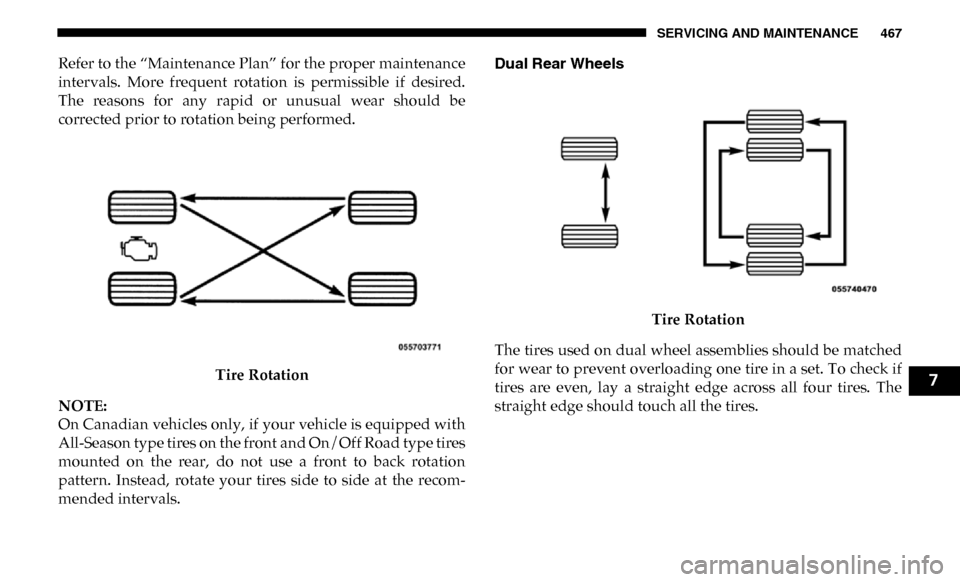
Refer to the “Maintenance Plan” for the proper maintenance
intervals. More frequent rotation is permissible if desired.
The reasons for any rapid or unusual wear should be
corrected prior to rotation being performed.Tire Rotation
NOTE:
On Canadian vehicles only, if your vehicle is equipped with
All-Season type tires on the front and On/Off Road type tires
mounted on the rear, do not use a front to back rotation
pattern. Instead, rotate your tires side to side at the recom -
mended intervals. Dual Rear Wheels
Tire Rotation
The tires used on dual wheel assemblies should be matched
for wear to prevent overloading one tire in a set. To check if
tires are even, lay a straight edge across all four tires. The
straight edge should touch all the tires.
7
Page 470 of 607

468 SERVICING AND MAINTENANCE
(Continued)
NOTE:
If your vehicle is equipped with a Tire Pressure Information
System (TPIS):
• The Tire Pressure Information System (TPIS) uses uniquesensors in the inner rear wheels to help identify them from
the outer rear wheels, because of this, the inner and outer
wheel locations can’t be switched.
• After a tire rotation is completed, as shown below, the system can auto learn the locations of each sensor ID. Auto
learning/localization occurs when the vehicle ignition
status is changed from Off to On and speeds of greater
than 5 mph (8km/h) are obtained and remain over 5mph
(8km/h) for at about a 15 minute period. You may need to
drive for 20 minutes to account slower speeds and stops.
• If the tires are rotated incorrectly, the Auto localization of the TPIS sensors will fail to locate correctly resulting in
incorrect locations for the pressure values displayed in the
Instrument Cluster.
DEPARTMENT OF TRANSPORTATION UNIFORM
TIRE QUALITY GRADES
The following tire grading categories were established by
the National Highway Traffic Safety Administration. The
specific grade rating assigned by the tire's manufacturer
in each category is shown on the sidewall of the tires on
your vehicle.
All passenger vehicle tires must conform to Federal safety
requirements in addition to these grades.
CAUTION!
• 4500/5500 Dual Rear Tires may only have one approved direction of rotation. This is to accommodate the asym -
metrical design (tread pattern) of the On/Off road tire.
• When replacing a flat, the spare tire may have to be remounted on the rim or installed at a different location
to maintain the correct placement of the tire on the
wheel relative to the tire/wheel position on the vehicle.
For example, if the spare is used to replace an outer rear
tire it will have to be remounted on the rim so that the
wheel is dished inward. That way the tread design of
asymmetrical tires will maintain proper position. CAUTION!
(Continued)
Page 471 of 607

SERVICING AND MAINTENANCE 469
Treadwear
The Treadwear grade is a comparative rating, based on
the wear rate of the tire when tested under controlled
conditions on a specified government test course. For
example, a tire graded 150 would wear one and one-half
times as well on the government course as a tire graded
100. The relative performance of tires depends upon the
actual conditions of their use, however, and may depart
significantly from the norm due to variations in driving
habits, service practices, and differences in road charac-
teristics and climate.
Traction Grades
The Traction grades, from highest to lowest, are AA, A, B,
and C. These grades represent the tire's ability to stop on
wet pavement, as measured under controlled conditions
on specified government test surfaces of asphalt and
concrete. A tire marked C may have poor traction perfor -
mance. Temperature Grades
The Temperature grades are A (the highest), B, and C,
representing the tire's resistance to the generation of heat
and its ability to dissipate heat, when tested under
controlled conditions on a specified indoor laboratory test
wheel.
Sustained high temperature can cause the material of the
tire to degenerate and reduce tire life, and excessive
temperature can lead to sudden tire failure. The grade C
corresponds to a level of performance, which all
passenger vehicle tires must meet under the Federal
Motor Vehicle Safety Standard No. 109. Grades B and A
represent higher levels of performance on the laboratory
test wheel, than the minimum required by law.WARNING!
The traction grade assigned to this tire is based on
straight-ahead braking traction tests, and does not
include acceleration, cornering, hydroplaning, or peak
traction characteristics.
7
Page 474 of 607

472 SERVICING AND MAINTENANCE
Special Care
• If you drive on salted or dusty roads or if you drive nearthe ocean, hose off the undercarriage at least once a month.
• It is important that the drain holes in the lower edges of the doors, rocker panels, and trunk be kept clear and open.
• If you detect any stone chips or scratches in the paint, touch them up immediately. The cost of such repairs is
considered the responsibility of the owner.
• If your vehicle is damaged due to a collision or similar cause that destroys the paint and protective coating, have
your vehicle repaired as soon as possible. The cost of such
repairs is considered the responsibility of the owner.
• If you carry special cargo such as chemicals, fertilizers, de-icer salt, etc., be sure that such materials are well pack -
aged and sealed.
• If a lot of driving is done on gravel roads, consider mud or stone shields behind each wheel.
• Use Mopar Touch Up Paint on scratches as soon as possible. An authorized dealer has touch up paint to
match the color of your vehicle.INTERIORS
Seats And Fabric Parts
Use Mopar Total Clean to clean fabric upholstery and carpeting.
Stain Repel Fabric Cleaning Procedure — If Equipped
Stain Repel seats may be cleaned in the following manner:
• Remove as much of the stain as possible by blotting with aclean, dry towel.
• Blot any remaining stain with a clean, damp towel.
• For tough stains, apply Mopar Total Clean, or a mild soap solution to a clean, damp cloth and remove stain. Use a
fresh, damp towel to remove soap residue.
• For grease stains, apply Mopar Multi-Purpose Cleaner to a clean, damp cloth and remove stain. Use a fresh, damp
towel to remove soap residue.
• Do not use any harsh solvents or any other form of protectants on Stain Repel products.
WARNING!
Do not use volatile solvents for cleaning purposes. Many
are potentially flammable, and if used in closed areas
they may cause respiratory harm.
Page 478 of 607

476 TECHNICAL SPECIFICATIONS
BRAKE SYSTEM
If power assist is lost for any reason (for example, repeated
brake applications with the engine off), the brakes will still
function. However, you will experience a substantial
increase in braking effort to stop the vehicle.
If either the front or rear hydraulic system loses normal
braking capability, the remaining system will still function
with some loss of overall braking effectiveness. This will be
evident by increased pedal travel during application, greater
pedal force required to slow or stop, and activation of the
“Brake Warning Light” and the “ABS Warning Light” (if
equipped) during brake use.
The brake system power assist is provided by a hydro-boost
unit which shares fluid with the power steering system. You
may experience some clicking or hissing noises from the
hydro-boost system during hard braking conditions.
NOTE:
Under cold temperatures, pedal effort will be higher than
normal until the power steering fluid reaches operating
temperature.
Hydraulic Brake Assist
The brake system power assist is provided by a hydro-boost
unit which shares fluid with the power steering system. You
may experience some clicking or hissing noises from the
hydro-boost system during hard braking conditions.
NOTE:
Under cold temperatures, pedal effort will be higher than
normal until the power steering fluid reaches operating
temperature.
WHEEL AND TIRE TORQUE SPECIFICATIONS
Proper lug nut/bolt torque is very important to ensure that
the wheel is properly mounted to the vehicle. Any time a
wheel has been removed and reinstalled on the vehicle, the
lug nuts/bolts should be torqued using a properly calibrated
torque wrench using a high quality six sided (hex) deep wall
socket.