coolant temperature RAM CHASSIS CAB 2021 Owner's Manual
[x] Cancel search | Manufacturer: RAM, Model Year: 2021, Model line: CHASSIS CAB, Model: RAM CHASSIS CAB 2021Pages: 463, PDF Size: 21.5 MB
Page 153 of 463
STARTING AND OPERATING151
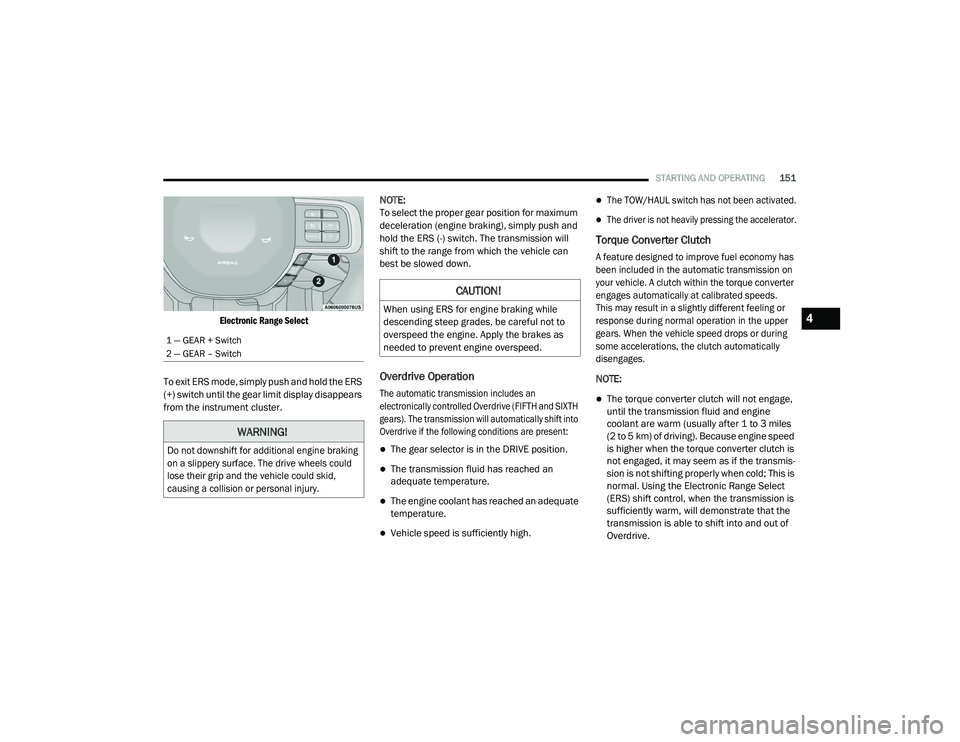
Electronic Range Select
To exit ERS mode, simply push and hold the ERS
(+) switch until the gear limit display disappears
from the instrument cluster. NOTE:
To select the proper gear position for maximum
deceleration (engine braking), simply push and
hold the ERS (-) switch. The transmission will
shift to the range from which the vehicle can
best be slowed down.
Overdrive Operation
The automatic transmission includes an
electronically controlled Overdrive (FIFTH and SIXTH
gears). The transmission will automatically shift into
Overdrive if the following conditions are present:
The gear selector is in the DRIVE position.
The transmission fluid has reached an
adequate temperature.
The engine coolant has reached an adequate
temperature.
Vehicle speed is sufficiently high.
The TOW/HAUL switch has not been activated.
The driver is not heavily pressing the accelerator.
Torque Converter Clutch
A feature designed to improve fuel economy has
been included in the automatic transmission on
your vehicle. A clutch within the torque converter
engages automatically at calibrated speeds.
This may result in a slightly different feeling or
response during normal operation in the upper
gears. When the vehicle speed drops or during
some accelerations, the clutch automatically
disengages.
NOTE:
The torque converter clutch will not engage,
until the transmission fluid and engine
coolant are warm (usually after 1 to 3 miles
(2 to 5 km) of driving). Because engine speed
is higher when the torque converter clutch is
not engaged, it may seem as if the transmis
-
sion is not shifting properly when cold; This is
normal. Using the Electronic Range Select
(ERS) shift control, when the transmission is
sufficiently warm, will demonstrate that the
transmission is able to shift into and out of
Overdrive.
1 — GEAR + Switch
2 — GEAR – Switch
WARNING!
Do not downshift for additional engine braking
on a slippery surface. The drive wheels could
lose their grip and the vehicle could skid,
causing a collision or personal injury.
CAUTION!
When using ERS for engine braking while
descending steep grades, be careful not to
overspeed the engine. Apply the brakes as
needed to prevent engine overspeed.4
21_DPF_OM_EN_USC_t.book Page 151
Page 273 of 463

MULTIMEDIA271
VEHICLE DYNAMICS
The Vehicle Dynamics page displays
information concerning the vehicle’s transfer
case and steering angle.
The following information is displayed:
1. Status of Transfer Case
2. Status of Front Axles — If Equipped
3. Status of the Rear Axles
4. Steering angle in degrees
Drivetrain Menu 2WD/4WD
ACCESSORY GAUGE
The Accessory Gauge page displays the current
status of the vehicle’s Coolant Temperature, Oil
Temperature, Oil Pressure, Transmission
Temperature, and Battery Voltage.
Accessory Gauge Menu 2WD/4WD
1 — Transfer Case Status
2 — Front Axle Locker Status
3 — Steering Angle
4 — Rear Axle Locker Status
1 — Coolant Temperature
2 — Oil Temperature
3 — Oil Pressure
4 — Transmission Temperature
5 — Battery Voltage
5
21_DPF_OM_EN_USC_t.book Page 271
Page 348 of 463

346IN CASE OF EMERGENCY
6. Once the engine is started, follow the
disconnecting procedure below.
Disconnecting The Jumper Cables
1. Disconnect the negative
(-)
end of the
jumper cable from the engine ground of
the vehicle with the discharged battery.
2. Disconnect the opposite end of the negative (-) jumper cable from the
negative (-) post of the booster battery.
3. Disconnect the positive (+) end of the
jumper cable from the positive (+) post of
the booster battery.
4. Disconnect the opposite end of the positive (+) jumper cable from the
positive (+) post of the vehicle with the
discharged battery.
If frequent jump starting is required to start your
vehicle you should have the battery and charging
system inspected at an authorized dealer.
IF YOUR ENGINE OVERHEATS
In any of the following situations, you can
reduce the potential for overheating by taking
the appropriate action.
On the highways — slow down.
In city traffic — while stopped, place the trans
-
mission in NEUTRAL, but do not increase the
engine idle speed while preventing vehicle
motion with the brakes. NOTE:
There are steps that you can take to slow down
an impending overheat condition:
If your Air Conditioner (A/C) is on, turn it off.
The A/C system adds heat to the engine
cooling system and turning the A/C off can
help remove this heat.
You can also turn the temperature control to
maximum heat, the mode control to floor and
the blower control to high. This allows the
heater core to act as a supplement to the
radiator and aids in removing heat from the
engine cooling system.
CAUTION!
Do not connect jumper cable to any of the
fuses on the positive battery terminal. The
resulting electrical current will blow the fuse.
CAUTION!
Accessories plugged into the vehicle power
outlets draw power from the vehicle’s battery,
even when not in use (i.e., cellular devices,
etc.). Eventually, if plugged in long enough
without engine operation, the vehicle’s battery
will discharge sufficiently to degrade battery
life and/or prevent the engine from starting.
WARNING!
You or others can be badly burned by hot
engine coolant (antifreeze) or steam from
your radiator. If you see or hear steam coming
from under the hood, do not open the hood
until the radiator has had time to cool. Never
try to open a cooling system pressure cap
when the radiator or coolant bottle is hot.
21_DPF_OM_EN_USC_t.book Page 346
Page 355 of 463
353
SERVICING AND MAINTENANCE
SCHEDULED SERVICING — GASOLINE
ENGINE
Your vehicle is equipped with an automatic
oil change indicator system. The oil change
indicator system will remind you that it is time to
take your vehicle in for scheduled maintenance.
Based on engine operation conditions, the
oil change indicator message will illuminate.
This means that service is required for your
vehicle. Operating conditions such as frequent
short-trips, trailer tow, extremely hot or cold
ambient temperatures, and E85 fuel usage will
influence when the “Oil Change Required”
message is displayed. Have your vehicle serviced
as soon as possible, within the next 500 miles
(805 km).
An authorized dealer will reset the oil change
indicator message after completing the
scheduled oil change.
Under no circumstances should oil change
intervals exceed 8,000 miles (13,000 km),
12 months or 350 hours of engine run time,
whichever comes first. The 350 hours of engine
run or idle time is generally only a concern for
fleet customers.
Once A Month Or Before A Long Trip:
Check engine oil level.
Check windshield washer fluid level.
Check the tire inflation pressures and look
for unusual wear or damage. Rotate at the
first sign of irregular wear.
Check the fluid levels of the coolant reservoir,
brake master cylinder, power steering and
automatic transmission (six-speed only), and
fill as needed.
Check function of all interior and exterior lights.
8
21_DPF_OM_EN_USC_t.book Page 353
Page 385 of 463

SERVICING AND MAINTENANCE383
Under normal operating conditions, the catalytic
converter will not require maintenance. However,
it is important to keep the engine properly tuned
to ensure proper catalyst operation and prevent
possible catalyst damage.
NOTE:
Intentional tampering with emissions control
systems can result in civil penalties being
assessed against you.
In unusual situations involving grossly
malfunctioning engine operation, a scorching
odor may suggest severe and abnormal catalyst
overheating. If this occurs, stop the vehicle, turn off
the engine and allow it to cool. Service, including a
tune-up to manufacturer's specifications, should be
obtained immediately.
To minimize the possibility of catalytic converter
damage:
Do not interrupt the ignition when the trans
-
mission is in gear and the vehicle is in
motion.
Do not try to start the vehicle by pushing or
towing the vehicle.
Do not idle the engine with any ignition
components disconnected or removed, such
as when diagnostic testing, or for prolonged
periods during very rough idle or malfunc -
tioning operating conditions.
COOLING SYSTEM CAUTION!
The catalytic converter requires the use of
unleaded fuel only. Leaded gasoline will
destroy the effectiveness of the catalyst as
an emissions control device and may seri -
ously reduce engine performance and
cause serious damage to the engine.
Damage to the catalytic converter can result
if your vehicle is not kept in proper operating
condition. In the event of engine malfunc -
tion, particularly involving engine misfire or
other apparent loss of performance, have
your vehicle serviced promptly. Continued
operation of your vehicle with a severe
malfunction could cause the converter to
overheat, resulting in possible damage to
the converter and vehicle.
WARNING!
You or others can be badly burned by hot
engine coolant (antifreeze) or steam from your
radiator. If you see or hear steam coming from
under the hood, do not open the hood until the
radiator has had time to cool. Never open a
cooling system pressure cap when the radiator
or coolant bottle is hot.
Keep hands, tools, clothing, and jewelry
away from the radiator cooling fan when
the hood is raised. The fan starts automati -
cally and may start at any time, whether the
engine is running or not.
When working near the radiator cooling fan,
disconnect the fan motor lead or turn the
ignition to the OFF mode. The fan is
temperature controlled and can start at any
time the ignition is in the ON mode.
8
21_DPF_OM_EN_USC_t.book Page 383
Page 387 of 463

SERVICING AND MAINTENANCE385
Please review these recommendations for
using Organic Additive Technology (OAT) engine
coolant that meets the requirements of FCA
Material Standard MS.90032. When adding
engine coolant:
We recommend using Mopar Antifreeze/
Coolant 10 Year/150,000 Mile (240,000 km)
Formula OAT that meets the requirements of
FCA Material Standard MS.90032.
Mix a minimum solution of 50% OAT engine
coolant that meets the requirements of FCA
Material Standard MS.90032 and distilled
water. Use higher concentrations (not to
exceed 70%) if temperatures below −34°F
(−37°C) are anticipated. Please contact an
authorized dealer for assistance.
Use only high purity water such as distilled or
deionized water when mixing the water/
engine coolant solution. The use of lower
quality water will reduce the amount of corro -
sion protection in the engine cooling system.
NOTE:
It is the owner's responsibility to maintain the
proper level of protection against freezing
according to the temperatures occurring in
the area where the vehicle is operated.
Some vehicles require special tools to add
coolant properly. Failure to fill these systems
properly could lead to severe internal engine
damage. If any coolant is needed to be added
to the system, please contact a local autho -
rized dealer.
Mixing engine coolant types is not recom -
mended and can result in cooling system
damage. If HOAT and OAT coolant are mixed
in an emergency, have an authorized dealer
drain, flush, and refill with OAT coolant
(conforming to MS.90032) as soon as
possible.
Cooling System Pressure Cap
The cap must be fully tightened to prevent loss
of engine coolant (antifreeze), and to ensure
that engine coolant will return to the radiator
from the coolant expansion bottle/recovery
tank (if equipped).
The cap should be inspected and cleaned if
there is any accumulation of foreign material on
the sealing surfaces.Disposal Of Used Coolant
Used ethylene glycol-based coolant (antifreeze)
is a regulated substance requiring proper
disposal. Check with your local authorities
to determine the disposal rules for your
community. To prevent ingestion by animals or
children, do not store ethylene glycol-based
coolant in open containers or allow it to remain
in puddles on the ground, clean up any ground
spills immediately. If ingested by a child or pet,
seek emergency assistance immediately.
WARNING!
Do not open hot engine cooling system.
Never add engine coolant (antifreeze) when
the engine is overheated. Do not loosen or
remove the cap to cool an overheated
engine. Heat causes pressure to build up in
the cooling system. To prevent scalding or
injury, do not remove the pressure cap
while the system is hot or under pressure.
Do not use a pressure cap other than the
one specified for your vehicle. Personal
injury or engine damage may result.
8
21_DPF_OM_EN_USC_t.book Page 385
Page 388 of 463

386SERVICING AND MAINTENANCE
Checking Coolant Level — 6.4L Engine
The level of the coolant in the pressurized
coolant bottle should be between the “MIN” and
“MAX” range on the bottle when the engine is
cold.
The radiator normally remains completely full,
so there is no need to remove the cap unless
checking for coolant freeze point or replacing
engine coolant (antifreeze). Advise your service
attendant of this. As long as the engine operating
temperature is satisfactory, the coolant bottle
need only be checked once a month. When
additional engine coolant is needed to maintain
the proper level, it should be added to the coolant
bottle. Do not overfill.
Cooling System Notes
NOTE:
When the vehicle is stopped after a few miles/
kilometers of operation, you may observe vapor
coming from the front of the engine compart -
ment. This is normally a result of moisture from
rain, snow, or high humidity accumulating on
the radiator and being vaporized when the ther -
mostat opens, allowing hot engine coolant (anti -
freeze) to enter the radiator. If an examination of your engine compartment
shows no evidence of radiator or hose leaks,
the vehicle may be safely driven. The vapor will
soon dissipate.
Do not overfill the coolant expansion bottle.
Check the coolant freeze point in the radiator
and in the coolant expansion bottle. If engine
coolant (antifreeze) needs to be added, the
contents of the coolant expansion bottle
must also be protected against freezing.
If frequent engine coolant additions are
required, the cooling system should be pres
-
sure tested for leaks.
Maintain engine coolant concentration at a
minimum of 50% OAT coolant (conforming to
MS.90032) and distilled water for proper
corrosion protection of your engine which
contains aluminum components.
Make sure that the coolant expansion bottle
overflow hoses are not kinked or obstructed.
Keep the front of the radiator clean. If your
vehicle is equipped with air conditioning,
keep the front of the condenser clean.
Do not change the thermostat for Summer or
Winter operation. If replacement is ever
necessary, install ONLY the correct type ther -
mostat. Other designs may result in unsatis -
factory engine cooling performance, poor gas
mileage, and increased emissions.
CHARGE AIR COOLER — INTER-COOLER
The charge air cooler is positioned below the
radiator and the air conditioner condenser. Air
enters the engine through the air cleaner and
passes through the turbocharger, where it is
pressurized. This pressurized air rapidly reaches
high temperature. The air is then directed
through a hose to the charge air cooler and
through another hose to the intake manifold of
the engine. The air entering the engine has been
cooled by about 50° to 100°F (10° to 38°C).
This cooling process enables more efficient
burning of fuel resulting in fewer emissions.
To guarantee optimum performance of the
system, keep the surfaces of the charge air
cooler, condenser and radiator clean and free
of debris. Periodically check the hoses leading
to and from the charge air cooler for cracks or
loose clamps resulting in loss of pressure and
reduced engine performance.
21_DPF_OM_EN_USC_t.book Page 386
Page 442 of 463

440TECHNICAL SPECIFICATIONS
ENGINE FLUIDS AND LUBRICANTS
6.4L GASOLINE ENGINE
Cooling System
6.7L Engine Chassis Cab 3500/4500 with AS69RC 22.3 Quarts21.1 Liters
6.7L Engine Chassis Cab 5500 with AS69RC 22.8 Quarts21.6 Liters
USMetric
Component Fluid, Lubricant, or Genuine Part
Engine CoolantWe recommend you use Mopar Antifreeze/Coolant 10–Year/150,000 Mile (240,000 km)
Formula OAT (Organic Additive Technology).
Engine Oil – 6.4L Engine For best performance and maximum protection under all types of operating conditions, the
manufacturer only recommends full synthetic engine oils that meet the American Petroleum
Institute (API) categories of SN. The manufacturer recommends the use of Pennzoil Ultra
0W-40 or equivalent Mopar engine oil meeting the requirements of FCA Material Standard
MS-12633 for use in all operating temperatures.
Engine Oil Filter – 6.4L Engine We recommend you use a Mopar Engine Oil Filter. If a Mopar Engine Oil Filter is unavailable
only use filters that meet or exceed SAE/USCAR-36 Filter Performance Requirements.
Fuel Selection – 6.4L Engine 87 Octane (R+M)/2 Method, 0-15% Ethanol (Do not use E-85).
21_DPF_OM_EN_USC_t.book Page 440
Page 443 of 463

TECHNICAL SPECIFICATIONS441
6.7L DIESEL ENGINE
Component Fluid, Lubricant, or Genuine Part
Engine CoolantWe recommend you use Mopar Antifreeze/Coolant 10 Year/150,000 Mile (240,000 km)
Formula OAT (Organic Additive Technology).
Engine Oil In ambient temperatures above 0°F (-18°C), we recommend you use 10W-30 engine oil such
as Mopar, Shell Rotella and Shell Rimula that meets FCA Material Standard MS-10902 and the
API CK-4 engine oil category is required. Products meeting Cummins CES 20081 may also be
used. The identification of these engine oils is typically located on the back of the oil container.
In ambient temperatures below 0°F (-18°C), we recommend you use 5W-40
synthetic engine
oil such as Mopar, Shell Rotella and Shell Rimula that meets FCA Material Standard MS-10902
and the API CK-4 engine oil category is required.
Engine Oil Filter We recommend you use a Mopar Engine Oil Filter. If a Mopar Engine Oil Filter is unavailable
only use filters that meet or exceed SAE/USCAR-36 Filter Performance Requirements.
Fuel Filters We recommend you use Mopar Fuel Filter. Must meet 3 micron rating (engine mounted filter).
Must meet 5 micron rating (chassis mounted filter).
Using a fuel filter that does not meet the
manufacturer’s filtration and water separating requirements can severely impact fuel system
life and reliability.
Crankcase Ventilation Filter We recommend you use Mopar CCV Filter.
9
21_DPF_OM_EN_USC_t.book Page 441
Page 452 of 463
450
INDEX
Pair (Link) Uconnect Phone To A Mobile
Phone............................................................ 260 WARRANTY INFORMATION...................... 447
A
Adaptive Cruise Control (ACC)
(Cruise Control)
.................................... 164, 166Adding Engine Coolant (Antifreeze)............... 384Adding Fuel.................................................... 196Additives, Fuel............................................... 434Adjust Down........................................................... 35Forward....................................................... 35Rearward..................................................... 35Up................................................................ 35Adjustable Pedals............................................ 40Advance Phone Connectivity......................... 266Air BagAir Bag Operation...................................... 305Air Bag Warning Light................................ 303Enhanced Accident Response......... 310, 352Event Data Recorder (EDR)....................... 352If Deployment Occurs................................ 309Knee Impact Bolsters................................ 305Maintaining Your Air Bag System.............. 311Maintenance............................................. 311
Redundant Air Bag Warning Light............. 303Transporting Pets..................................... 330Air Bag Light................................ 107, 303, 331Air Cleaner, Engine (Engine Air Cleaner
Filter)................................................... 369, 391Air Conditioner Maintenance........................ 371Air Conditioner Refrigerant.................. 371, 372Air Conditioner System................................. 371Air Conditioning................................................ 62Air Conditioning Filter....................................... 65Air Conditioning System................................... 64Air Conditioning, Operating Tips....................... 65Air Filter........................................................ 369Air PressureTires......................................................... 415AlarmSecurity Alarm....................................23, 108Alterations/ModificationsVehicle......................................................... 10Antifreeze (Engine Coolant).......................... 384Capacities................................................. 439Disposal................................................... 385Anti-Lock Brake System (ABS)...................... 273Anti-Lock Warning Light................................ 113Assist, Hill Start............................................. 280Audio Settings............................................... 253Audio Systems (Radio).................................. 220
Auto Down Power Windows..............................77Automatic Door Locks......................................28Automatic Headlights.......................................52Automatic Temperature Control (ATC)..............64Automatic Transmission....................... 141, 389Adding Fluid.............................................. 389Fluid And Filter Change............................. 389Fluid Change............................................. 389Fluid Level Check............................. 387, 388Fluid Type........................................ 390, 444Shifting..................................................... 146Special Additives...................................... 387Automatic Transmission Limp Home Mode... 145AutoPark....................................................... 120AUX Camera......................................... 188, 194Auxiliary Driving Systems.............................. 281Axle Fluid.....................................390, 391, 444Axle Lubrication................................... 390, 391
B
Back-Up......................................................... 186Back-Up Camera........................................... 186Battery................................................. 108, 366Blanket..................................................... 130Charging System Light.............................. 108Keyless Key Fob Replacement....................16Battery Saver Feature......................................54
21_DPF_OM_EN_USC_t.book Page 450