oil pressure RAM CHASSIS CAB 2021 Owner's Manual
[x] Cancel search | Manufacturer: RAM, Model Year: 2021, Model line: CHASSIS CAB, Model: RAM CHASSIS CAB 2021Pages: 463, PDF Size: 21.5 MB
Page 273 of 463

MULTIMEDIA271
VEHICLE DYNAMICS
The Vehicle Dynamics page displays
information concerning the vehicle’s transfer
case and steering angle.
The following information is displayed:
1. Status of Transfer Case
2. Status of Front Axles — If Equipped
3. Status of the Rear Axles
4. Steering angle in degrees
Drivetrain Menu 2WD/4WD
ACCESSORY GAUGE
The Accessory Gauge page displays the current
status of the vehicle’s Coolant Temperature, Oil
Temperature, Oil Pressure, Transmission
Temperature, and Battery Voltage.
Accessory Gauge Menu 2WD/4WD
1 — Transfer Case Status
2 — Front Axle Locker Status
3 — Steering Angle
4 — Rear Axle Locker Status
1 — Coolant Temperature
2 — Oil Temperature
3 — Oil Pressure
4 — Transmission Temperature
5 — Battery Voltage
5
21_DPF_OM_EN_USC_t.book Page 271
Page 334 of 463
332SAFETY
(Continued)
PERIODIC SAFETY CHECKS YOU SHOULD
M
AKE OUTSIDE THE VEHICLE
Tires
Examine tires for excessive tread wear and
uneven wear patterns. Check for stones, nails,
glass, or other objects lodged in the tread or
sidewall. Inspect the tread for cuts and cracks.
Inspect sidewalls for cuts, cracks, and bulges.
Check the lug nuts/bolt torque for tightness.
Check the tires (including spare) for proper cold
inflation pressure.
Lights
Have someone observe the operation of brake
lights and exterior lights while you work the
controls. Check turn signal and high beam
indicator lights on the instrument panel.
Door Latches
Check for proper closing, latching, and locking.
Fluid Leaks
Check area under the vehicle after overnight
parking for fuel, coolant, oil, or other fluid leaks.
Also, if gasoline fumes are detected or if fuel or
brake fluid leaks are suspected, the cause
should be located and corrected immediately.
ONLY use the passenger’s side floor mat on
the passenger’s side floor area.
ALWAYS make sure objects cannot fall or
slide into the driver’s side floor area when the
vehicle is moving. Objects can become trapped
under accelerator, brake, or clutch pedals and
could cause a loss of vehicle control.
NEVER place any objects under the floor
mat (e.g., towels, keys, etc.). These objects
could change the position of the floor mat
and may cause interference with the accel -
erator, brake, or clutch pedals.
If the vehicle carpet has been removed and
re-installed, always properly attach carpet to
the floor and check the floor mat fasteners
are secure to the vehicle carpet. Fully
depress each pedal to check for interference
with the accelerator, brake, or clutch pedals
then re-install the floor mats.
WARNING! (Continued)
It is recommended to only use mild soap
and water to clean your floor mats. After
cleaning, always check your floor mat has
been properly installed and is secured to
your vehicle using the floor mat fasteners
by lightly pulling mat.
WARNING! (Continued)
21_DPF_OM_EN_USC_t.book Page 332
Page 355 of 463
353
SERVICING AND MAINTENANCE
SCHEDULED SERVICING — GASOLINE
ENGINE
Your vehicle is equipped with an automatic
oil change indicator system. The oil change
indicator system will remind you that it is time to
take your vehicle in for scheduled maintenance.
Based on engine operation conditions, the
oil change indicator message will illuminate.
This means that service is required for your
vehicle. Operating conditions such as frequent
short-trips, trailer tow, extremely hot or cold
ambient temperatures, and E85 fuel usage will
influence when the “Oil Change Required”
message is displayed. Have your vehicle serviced
as soon as possible, within the next 500 miles
(805 km).
An authorized dealer will reset the oil change
indicator message after completing the
scheduled oil change.
Under no circumstances should oil change
intervals exceed 8,000 miles (13,000 km),
12 months or 350 hours of engine run time,
whichever comes first. The 350 hours of engine
run or idle time is generally only a concern for
fleet customers.
Once A Month Or Before A Long Trip:
Check engine oil level.
Check windshield washer fluid level.
Check the tire inflation pressures and look
for unusual wear or damage. Rotate at the
first sign of irregular wear.
Check the fluid levels of the coolant reservoir,
brake master cylinder, power steering and
automatic transmission (six-speed only), and
fill as needed.
Check function of all interior and exterior lights.
8
21_DPF_OM_EN_USC_t.book Page 353
Page 366 of 463

364SERVICING AND MAINTENANCE
ENGINE COMPARTMENT
6.4L ENGINE
1 — Engine Coolant Pressure Cap 6 — Battery
2 — Engine Coolant Pressure Reservoir 7 — Engine Air Cleaner Filter
3 — Engine Oil Fill 8 — Power Steering Reservoir Cap
4 — Engine Oil Dipstick 9 — Power Distribution Center (Fuses)
5 — Brake Fluid Reservoir Cap 10 — Washer Fluid Reservoir Cap
21_DPF_OM_EN_USC_t.book Page 364
Page 367 of 463
SERVICING AND MAINTENANCE365
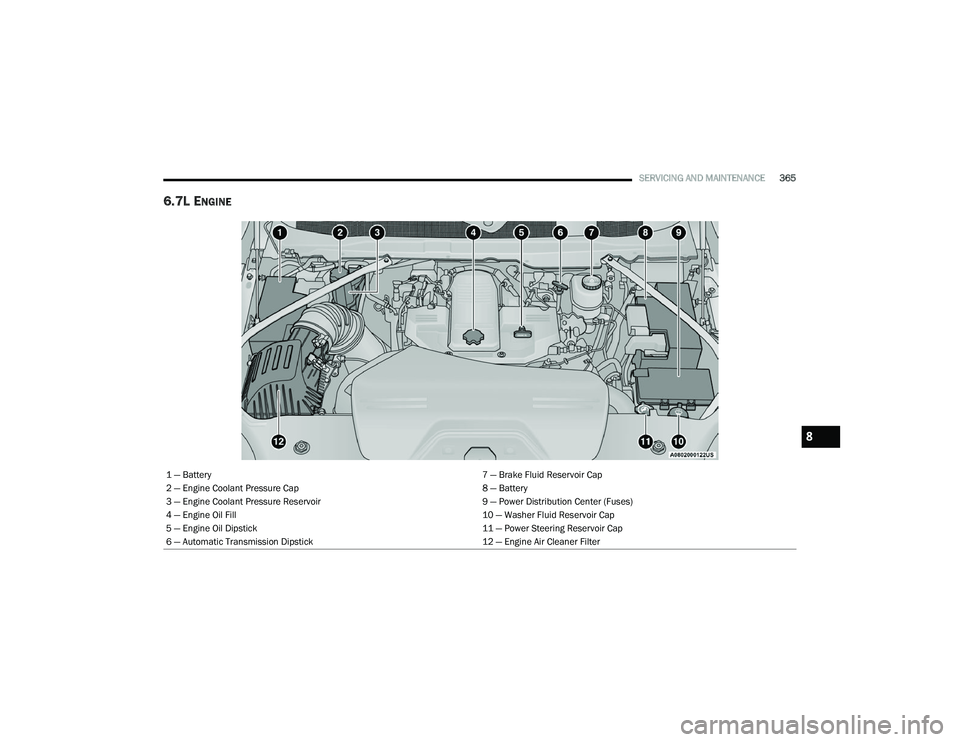
6.7L ENGINE
1 — Battery 7 — Brake Fluid Reservoir Cap
2 — Engine Coolant Pressure Cap 8 — Battery
3 — Engine Coolant Pressure Reservoir 9 — Power Distribution Center (Fuses)
4 — Engine Oil Fill 10 — Washer Fluid Reservoir Cap
5 — Engine Oil Dipstick 11 — Power Steering Reservoir Cap
6 — Automatic Transmission Dipstick 12 — Engine Air Cleaner Filter
8
21_DPF_OM_EN_USC_t.book Page 365
Page 368 of 463

366SERVICING AND MAINTENANCE
CHECKING OIL LEVEL
To ensure proper engine lubrication, the engine
oil must be maintained at the correct level.
Check the oil level at regular intervals, such as
every fuel stop. The best time to check the
engine oil level is about five minutes after a fully
warmed up engine is shut off.
Checking the oil while the vehicle is on level
ground will improve the accuracy of the oil level
readings.
There are four possible dipstick types:
Crosshatched zone.
Crosshatched zone marked SAFE.
Crosshatched zone marked with MIN at the
low end of the range and MAX at the high end
of the range.
Crosshatched zone marked with dimples at
the MIN and the MAX ends of the range.
NOTE:
Always maintain the oil level within the cross -
hatch markings on the dipstick. Adding 1 quart (1 liter) of oil when the reading is
at the low end of the dipstick range will raise the
oil level to the high end of the range marking.
ADDING WASHER FLUID
The fluid reservoir is located under the hood and
should be checked for fluid level at regular
intervals. Fill the reservoir with windshield
washer solvent only (not radiator antifreeze).
When refilling the washer fluid reservoir, take
some washer fluid and apply it to a cloth or towel
and wipe the wiper blades clean. This will help
blade performance.
To prevent freeze-up of your windshield washer
system in cold weather, select a solution or
mixture that meets or exceeds the temperature
range of your climate. This rating information
can be found on most washer fluid containers.
After the engine has warmed up, operate the
defroster for a few minutes to reduce the
possibility of smearing or freezing the fluid on
the cold windshield. Windshield washer solution
used with water as directed on the container,
aids cleaning action, reduces the freezing point
to avoid line clogging, and is not harmful to
paint or trim.
MAINTENANCE-FREE BATTERY
Your vehicle is equipped with a maintenance-free
battery. You will never have to add water, and
periodic maintenance is not required.
CAUTION!
Overfilling or underfilling the crankcase will
cause oil aeration or loss of oil pressure.
This could damage your engine.
WARNING!
Commercially available windshield washer
solvents are flammable. They could ignite and
burn you. Care must be exercised when filling
or working around the washer solution.
21_DPF_OM_EN_USC_t.book Page 366
Page 380 of 463

378SERVICING AND MAINTENANCE
7. Wipe clean the sealing surfaces of the lid
and housing.
8. Install new o-ring back into ring groove on the filter housing and lubricate with clean
engine oil.
NOTE:
Water In Fuel (WIF) sensor is re-usable. Service
kit comes with new o-ring for filter canister and
WIF sensor.
PRIMING IF THE ENGINE HAS RUN OUT
O
F FUEL
1. Add a substantial amount of fuel to the
tank, approximately 2 to 5 gal (8L to 19L).
2. Three priming cycles must be completed.
Turn ignition to the RUN position and wait
approximately 30 seconds. This will activate
the in tank fuel pump. Turn the ignition
switch to the off position, and leave off for at
least 30 seconds. Repeat this procedure
three times before cranking the engine.
3. Start the engine using the “Normal Starting” procedure Ú page 119.
4. Once the engine starts, allow the engine to idle for a minimum of 30 seconds.
NOTE:
The engine may run rough until the air is forced
from all the fuel lines. NOTE:
A maximum blend of 5% biodiesel, meeting
ASTM specification D-975 may be used with
your Cummins diesel engine. (Chassis Cab
models not configured with B20 capability.)
A maximum blend of 20% biodiesel, meeting
ASTM specification D-7467 may be used with
your Cummins diesel engine. (Pickup models
and Chassis Cab models configured with B20
capability.)
WARNING!
Do not open the high pressure fuel system
with the engine running. Engine operation
causes high fuel pressure. High pressure fuel
spray can cause serious injury or death.
CAUTION!
Do not engage the starter motor for more
than 15 seconds at a time. Allow two minutes
between the cranking intervals.
WARNING!
Do not use alcohol or gasoline as a fuel
blending agent. They can be unstable under
certain conditions and be hazardous or
explosive when mixed with diesel fuel.
CAUTION!
Due to lack of lubricants in alcohol or
gasoline, the use of these fuels can cause
damage to the fuel system.
21_DPF_OM_EN_USC_t.book Page 378
Page 400 of 463
398SERVICING AND MAINTENANCE
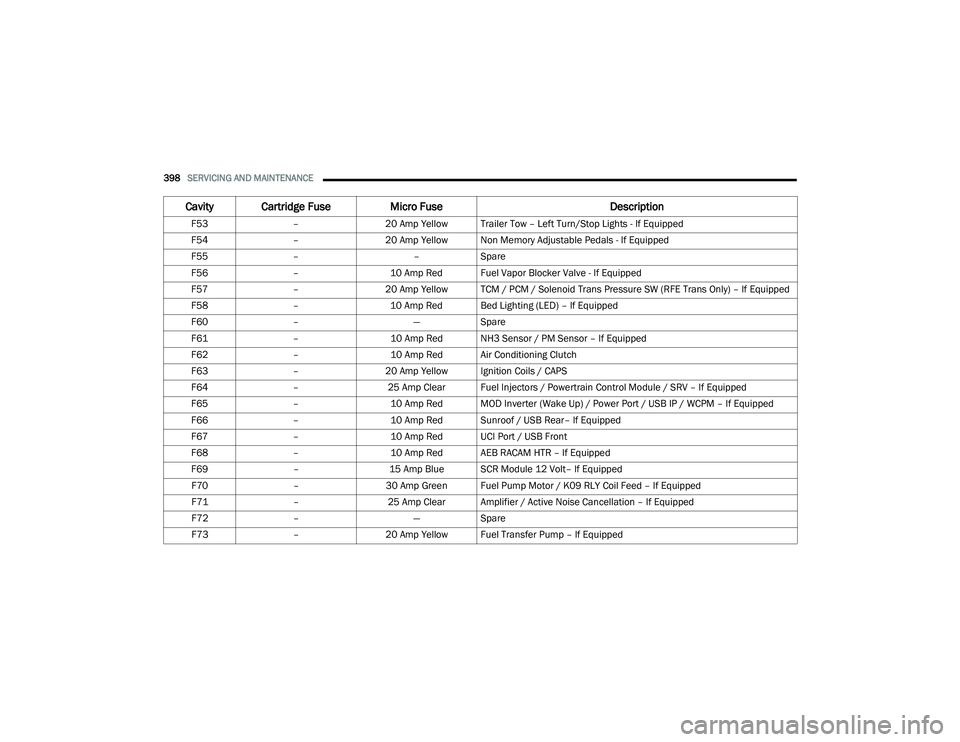
F53–20 Amp Yellow Trailer Tow – Left Turn/Stop Lights - If Equipped
F54 –20 Amp Yellow Non Memory Adjustable Pedals - If Equipped
F55 – –Spare
F56 –10 Amp Red Fuel Vapor Blocker Valve - If Equipped
F57 –20 Amp Yellow TCM / PCM / Solenoid Trans Pressure SW (RFE Trans Only) – If Equipped
F58 –10 Amp Red Bed Lighting (LED) – If Equipped
F60 – —Spare
F61 –10 Amp Red NH3 Sensor / PM Sensor – If Equipped
F62 –10 Amp Red Air Conditioning Clutch
F63 –20 Amp Yellow Ignition Coils / CAPS
F64 –25 Amp Clear Fuel Injectors / Powertrain Control Module / SRV – If Equipped
F65 –10 Amp Red MOD Inverter (Wake Up) / Power Port / USB IP / WCPM – If Equipped
F66 –10 Amp Red Sunroof / USB Rear– If Equipped
F67 –10 Amp Red UCI Port / USB Front
F68 –10 Amp Red AEB RACAM HTR – If Equipped
F69 –15 Amp Blue SCR Module 12 Volt– If Equipped
F70 –30 Amp Green Fuel Pump Motor / K09 RLY Coil Feed – If Equipped
F71 –25 Amp Clear Amplifier / Active Noise Cancellation – If Equipped
F72 – —Spare
F73 –20 Amp Yellow Fuel Transfer Pump – If Equipped
Cavity Cartridge Fuse Micro Fuse Description
21_DPF_OM_EN_USC_t.book Page 398
Page 419 of 463
SERVICING AND MAINTENANCE417
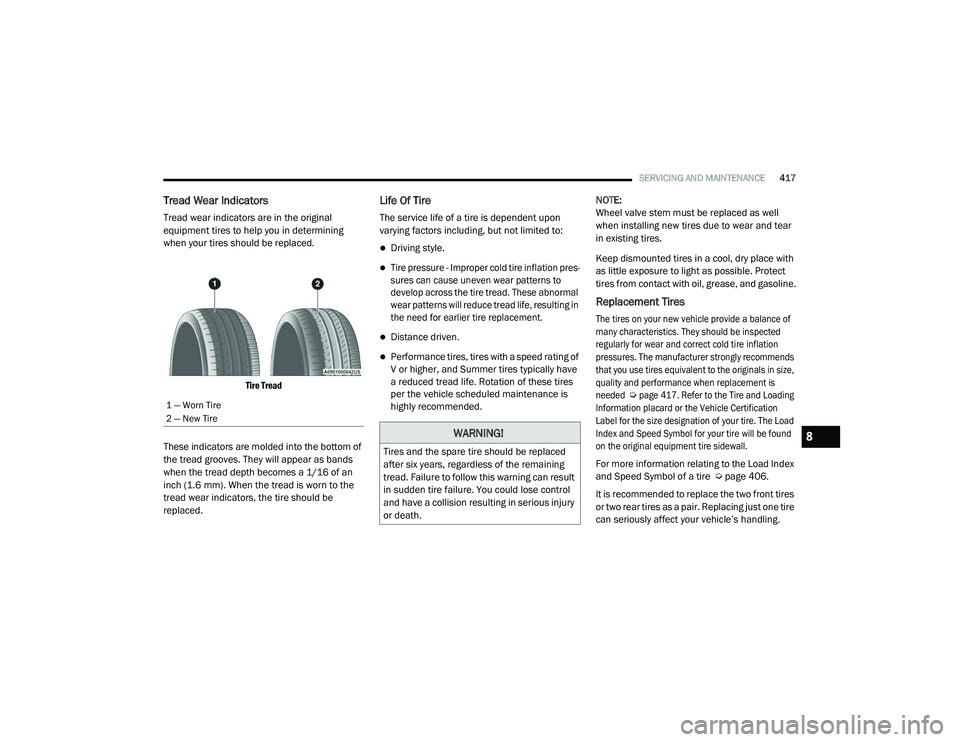
Tread Wear Indicators
Tread wear indicators are in the original
equipment tires to help you in determining
when your tires should be replaced.
Tire Tread
These indicators are molded into the bottom of
the tread grooves. They will appear as bands
when the tread depth becomes a 1/16 of an
inch (1.6 mm). When the tread is worn to the
tread wear indicators, the tire should be
replaced.
Life Of Tire
The service life of a tire is dependent upon
varying factors including, but not limited to:
Driving style.
Tire pressure - Improper cold tire inflation pres -
sures can cause uneven wear patterns to
develop across the tire tread. These abnormal
wear patterns will reduce tread life, resulting in
the need for earlier tire replacement.
Distance driven.
Performance tires, tires with a speed rating of
V or higher, and Summer tires typically have
a reduced tread life. Rotation of these tires
per the vehicle scheduled maintenance is
highly recommended. NOTE:
Wheel valve stem must be replaced as well
when installing new tires due to wear and tear
in existing tires.
Keep dismounted tires in a cool, dry place with
as little exposure to light as possible. Protect
tires from contact with oil, grease, and gasoline.
Replacement Tires
The tires on your new vehicle provide a balance of
many characteristics. They should be inspected
regularly for wear and correct cold tire inflation
pressures. The manufacturer strongly recommends
that you use tires equivalent to the originals in size,
quality and performance when replacement is
needed
Ú
page 417. Refer to the Tire and Loading
Information placard or the Vehicle Certification
Label for the size designation of your tire. The Load
Index and Speed Symbol for your tire will be found
on the original equipment tire sidewall.
For more information relating to the Load Index
and Speed Symbol of a tire Ú page 406.
It is recommended to replace the two front tires
or two rear tires as a pair. Replacing just one tire
can seriously affect your vehicle’s handling.
1 — Worn Tire
2 — New Tire
WARNING!
Tires and the spare tire should be replaced
after six years, regardless of the remaining
tread. Failure to follow this warning can result
in sudden tire failure. You could lose control
and have a collision resulting in serious injury
or death.
8
21_DPF_OM_EN_USC_t.book Page 417
Page 453 of 463
451
Belts, Seat
..................................................... 330Bluetooth Connecting To A Particular Mobile Phone Or Audio Device After Pairing
................262Body Builders Guide........................................ 10Body Mechanism Lubrication........................ 380B-Pillar Location............................................. 411Brake Assist System...................................... 274Brake Control System.................................... 274Brake Fluid.......................................... 387, 444Brake System...................................... 387, 431Fluid Check............................................... 387Master Cylinder......................................... 387Parking...................................................... 137Warning Light............................................ 107Brake/Transmission Interlock....................... 141Bulb Replacement......................................... 401Bulbs, Light.......................................... 332, 401
C
Cab Top Clearance Lights.............................. 405Camera.......................................................... 186Camera, AUX........................................ 188, 194Camera, Rear...................................... 186, 189Capacities, Antifreeze (Engine Coolant)......... 439Capacities, Fluid............................................ 439Caps, FillerOil (Engine)................................................ 364Power Steering.......................................... 163Radiator (Coolant Pressure)...................... 385
Car Washes................................................... 428Carbon Monoxide Warning............................ 333Cargo Light....................................................... 54CD................................................................. 255Cellular Phone.............................................. 269Center High Mounted Stop Light................... 405Center Seat Storage Compartment.................. 67Changing A Flat Tire...................................... 339Charge Air Cooler.......................................... 386Chart, Tire Sizing........................................... 407Check Engine Light (Malfunction
Indicator Light).............................................. 117Checking Your Vehicle For Safety................. 330Checks, Safety.............................................. 330Child Restraint.............................................. 312Child RestraintsBooster Seats........................................... 315Child Seat Installation..................... 323, 325How To Stow An unused ALR Seat Belt.... 322Infant And Child Restraints....................... 313Locating The LATCH Anchorages.............. 320Lower Anchors And Tethers For Children.. 317Older Children And Child Restraints......... 314Seating Positions...................................... 316Clean Air Gasoline......................................... 433CleaningWheels..................................................... 421Climate Control................................................ 58Automatic.................................................... 59Manual........................................................ 62
Cold Weather Operation................................ 122Compact Spare Tire...................................... 419Contract, Service........................................... 446Controls........................................................ 247Cooling Pressure Cap (Radiator Cap)............ 385Cooling System............................................. 383Adding Coolant (Antifreeze)...................... 384Coolant Level................................... 384, 386Cooling Capacity....................................... 439Disposal Of Used Coolant......................... 385Drain, Flush, And Refill............................. 384Inspection................................................. 386Points To Remember................................ 386Pressure Cap............................................ 385Radiator Cap............................................. 385Selection Of Coolant (Antifreeze)..... 384, 440Corrosion Protection..................................... 427Cruise Control (Speed Control)............. 164, 166Cruise Light................................................... 115Customer Assistance.................................... 445Cybersecurity................................................ 220
D
Daytime Running Lights...................................51Dealer Service............................................... 367Defroster, Rear Window...................................62Defroster, Windshield............................ 62, 331Delay (Intermittent) Wipers..............................57Deleting A Phone........................................... 262Diagnostic System, Onboard......................... 116
11
21_DPF_OM_EN_USC_t.book Page 451