belt Ram ProMaster City 2020 User Guide
[x] Cancel search | Manufacturer: RAM, Model Year: 2020, Model line: ProMaster City, Model: Ram ProMaster City 2020Pages: 350, PDF Size: 13.27 MB
Page 114 of 350
SAFETY 111
(Continued)
Lap/Shoulder Belts
All seating positions in your vehicle are equipped with lap/
shoulder belts.
The seat belt webbing retractor will lock only during very
sudden stops or collisions. This feature allows the shoulder
part of the seat belt to move freely with you under normal
conditions. However, in a collision the seat belt will lock and
reduce your risk of striking the inside of the vehicle or being
thrown out of the vehicle.
WARNING!
• Relying on the air bags alone could lead to more severe injuries in a collision. The air bags work with your seat
belt to restrain you properly. In some collisions, the air
bags won’t deploy at all. Always wear your seat belt
even though you have air bags.
• In a collision, you and your passengers can suffer much greater injuries if you are not properly buckled up. You
can strike the interior of your vehicle or other passen -
gers, or you can be thrown out of the vehicle. Always be
sure you and others in your vehicle are buckled up
properly.
• It is dangerous to ride in a cargo area, inside or outside of a vehicle. In a collision, people riding in these areas
are more likely to be seriously injured or killed.
• Do not allow people to ride in any area of your vehicle that is not equipped with seats and seat belts.
• Be sure everyone in your vehicle is in a seat and using a seat belt properly. Occupants, including the driver,
should always wear their seat belts whether or not an
air bag is also provided at their seating position to
minimize the risk of severe injury or death in the event
of a crash.
• Wearing your seat belt incorrectly could make your injuries in a collision much worse. You might suffer
internal injuries, or you could even slide out of the seat
belt. Follow these instructions to wear your seat belt
safely and to keep your passengers safe, too.
• Two people should never be belted into a single seat belt. People belted together can crash into one another
in a collision, hurting one another badly. Never use a
lap/shoulder belt or a lap belt for more than one person,
no matter what their size.
WARNING! (Continued)
4
2020_RAM_PROMASTER_CITY_OM_USA=GUID-7B6A7FCA-79B0-423F-95C5-ED2A949C3D13=1=en=.book Page 111
Page 115 of 350
112 SAFETY
(Continued)
WARNING!
• A lap belt worn too high can increase the risk of injury in a collision. The seat belt forces won’t be at the strong
hip and pelvic bones, but across your abdomen. Always
wear the lap part of your seat belt as low as possible and
keep it snug.
• A twisted seat belt may not protect you properly. In a collision, it could even cut into you. Be sure the seat belt
is flat against your body, without twists. If you can’t
straighten a seat belt in your vehicle, take it to an autho -
rized dealer immediately and have it fixed.
• A seat belt that is buckled into the wrong buckle will not protect you properly. The lap portion could ride too
high on your body, possibly causing internal injuries.
Always buckle your seat belt into the buckle nearest
you.
• A seat belt that is too loose will not protect you prop -
erly. In a sudden stop, you could move too far forward,
increasing the possibility of injury. Wear your seat belt
snugly.
• A seat belt that is worn under your arm is dangerous. Your body could strike the inside surfaces of the
vehicle in a collision, increasing head and neck injury.
A seat belt worn under the arm can cause internal inju -
ries. Ribs aren’t as strong as shoulder bones. Wear the
seat belt over your shoulder so that your strongest
bones will take the force in a collision.
• A shoulder belt placed behind you will not protect you from injury during a collision. You are more likely to
hit your head in a collision if you do not wear your
shoulder belt. The lap and shoulder belt are meant to be
used together.
• A frayed or torn seat belt could rip apart in a collision and leave you with no protection. Inspect the seat belt
system periodically, checking for cuts, frays, or loose
parts. Damaged parts must be replaced immediately.
Do not disassemble or modify the seat belt system. Seat
belt assemblies must be replaced after a collision.
WARNING! (Continued)
2020_RAM_PROMASTER_CITY_OM_USA=GUID-7B6A7FCA-79B0-423F-95C5-ED2A949C3D13=1=en=.book Page 112
Page 116 of 350

SAFETY 113
Lap/Shoulder Belt Operating Instructions
1. Enter the vehicle and close the door. Sit back and adjustthe seat.
2. The seat belt latch plate is above the back of the front seat, and next to your arm in the rear seat (for vehicles
equipped with a rear seat). Grasp the latch plate and pull
out the seat belt. Slide the latch plate up the webbing as
far as necessary to allow the seat belt to go around your
lap.
Pulling Out The Latch Plate 3. When the seat belt is long enough to fit, insert the latch
plate into the buckle until you hear a “click.”
Inserting Latch Plate Into Buckle
4. Position the lap belt so that it is snug and lies low across your hips, below your abdomen. To remove slack in the
lap belt portion, pull up on the shoulder belt. To loosen
the lap belt if it is too tight, tilt the latch plate and pull on
the lap belt. A snug seat belt reduces the risk of sliding
under the seat belt in a collision.
4
2020_RAM_PROMASTER_CITY_OM_USA=GUID-7B6A7FCA-79B0-423F-95C5-ED2A949C3D13=1=en=.book Page 113
Page 117 of 350

114 SAFETY
Positioning The Lap Belt
5. Position the shoulder belt across the shoulder and chest with minimal, if any slack so that it is comfortable and not
resting on your neck. The retractor will withdraw any
slack in the shoulder belt.
6. To release the seat belt, push the red button on the buckle. The seat belt will automatically retract to its stowed posi -
tion. If necessary, slide the latch plate down the webbing
to allow the seat belt to retract fully. Lap/Shoulder Belt Untwisting Procedure
Use the following procedure to untwist a twisted lap/
shoulder belt.
1. Position the latch plate as close as possible to the anchor
point.
2. At about 6 to 12 inches (15 to 30 cm) above the latch plate, grasp and twist the seat belt webbing 180 degrees to
create a fold that begins immediately above the latch
plate.
3. Slide the latch plate upward over the folded webbing. The folded webbing must enter the slot at the top of the
latch plate.
4. Continue to slide the latch plate up until it clears the folded webbing and the seat belt is no longer twisted.
2020_RAM_PROMASTER_CITY_OM_USA=GUID-7B6A7FCA-79B0-423F-95C5-ED2A949C3D13=1=en=.book Page 114
Page 118 of 350

SAFETY 115
Adjustable Upper Shoulder Belt Anchorage
In the driver and outboard front passenger seats, the top of
the shoulder belt can be adjusted upward or downward to
position the seat belt away from your neck. Push or squeeze
the anchorage button to release the anchorage, and move it
up or down to the position that serves you best.Adjustable Anchorage
As a guide, if you are shorter than average, you will prefer
the shoulder belt anchorage in a lower position, and if you
are taller than average, you will prefer the shoulder belt anchorage in a higher position. After you release the
anchorage button, try to move it up or down to make sure
that it is locked in position.
Adjustable Anchorage
NOTE:
The adjustable upper shoulder belt anchorage is equipped
with an Easy Up feature. This feature allows the shoulder
belt anchorage to be adjusted in the upward position without
pushing or squeezing the release button. To verify the
shoulder belt anchorage is latched, pull downward on the
shoulder belt anchorage until it is locked into position.
4
2020_RAM_PROMASTER_CITY_OM_USA=GUID-7B6A7FCA-79B0-423F-95C5-ED2A949C3D13=1=en=.book Page 115
Page 119 of 350
116 SAFETY
Seat Belts And Pregnant Women Seat Belts And Pregnant Women
Seat belts must be worn by all occupants including pregnant
women: the risk of injury in the event of an accident is
reduced for the mother and the unborn child if they are
wearing a seat belt.
Position the lap belt snug and low below the abdomen and
across the strong bones of the hips. Place the shoulder belt
across the chest and away from the neck. Never place the
shoulder belt behind the back or under the arm.WARNING!
• Wearing your seat belt incorrectly could make your injuries in a collision much worse. You might suffer
internal injuries, or you could even slide out of the seat
belt. Follow these instructions to wear your seat belt
safely and to keep your passengers safe, too.
• Position the shoulder belt across the shoulder and chest with minimal, if any slack so that it is comfortable and
not resting on your neck. The retractor will withdraw
any slack in the shoulder belt.
• Misadjustment of the seat belt could reduce the effec -
tiveness of the safety belt in a crash.
• Always make all seat belt height adjustments when the vehicle is stationary.
2020_RAM_PROMASTER_CITY_OM_USA=GUID-7B6A7FCA-79B0-423F-95C5-ED2A949C3D13=1=en=.book Page 116
Page 120 of 350
SAFETY 117
Seat Belt Pretensioner
The front outboard seat belt system is equipped with preten-
sioning devices that are designed to remove slack from the
seat belt in the event of a collision. These devices may
improve the performance of the seat belt by removing slack
from the seat belt early in a collision. Pretensioners work for
all size occupants, including those in child restraints.
NOTE:
These devices are not a substitute for proper seat belt place -
ment by the occupant. The seat belt still must be worn snugly
and positioned properly. The pretensioners are triggered by the Occupant Restraint
Controller (ORC). Like the air bags, the pretensioners are
single use items. A deployed pretensioner or a deployed air
bag must be replaced immediately.
Energy Management Feature
The front outboard seat belt system is equipped with an
Energy Management feature that may help further reduce
the risk of injury in the event of a collision. The seat belt
system has a retractor assembly that is designed to release
webbing in a controlled manner.
4
2020_RAM_PROMASTER_CITY_OM_USA=GUID-7B6A7FCA-79B0-423F-95C5-ED2A949C3D13=1=en=.book Page 117
Page 121 of 350
118 SAFETY
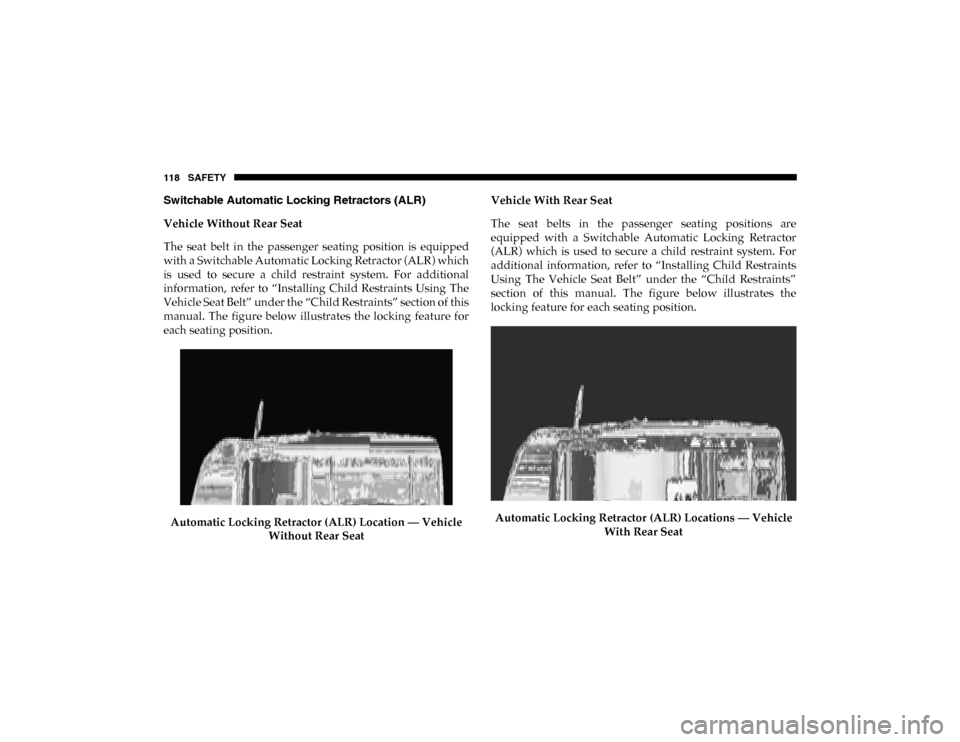
Switchable Automatic Locking Retractors (ALR)
Vehicle Without Rear Seat
The seat belt in the passenger seating position is equipped
with a Switchable Automatic Locking Retractor (ALR) which
is used to secure a child restraint system. For additional
information, refer to “Installing Child Restraints Using The
Vehicle Seat Belt” under the “Child Restraints” section of this
manual. The figure below illustrates the locking feature for
each seating position.Automatic Locking Retractor (ALR) Location — Vehicle Without Rear Seat Vehicle With Rear Seat
The seat belts in the passenger seating positions are
equipped with a Switchable Automatic Locking Retractor
(ALR) which is used to secure a child restraint system. For
additional information, refer to “Installing Child Restraints
Using The Vehicle Seat Belt” under the “Child Restraints”
section of this manual. The figure below illustrates the
locking feature for each seating position.
Automatic Locking Retractor (ALR) Locations — Vehicle With Rear Seat
2020_RAM_PROMASTER_CITY_OM_USA=GUID-7B6A7FCA-79B0-423F-95C5-ED2A949C3D13=1=en=.book Page 118
Page 122 of 350
SAFETY 119
(Continued)
If the passenger seating position is equipped with an ALR
and is being used for normal usage, only pull the seat belt
webbing out far enough to comfortably wrap around the
occupant’s mid-section so as to not activate the ALR. If the
ALR is activated, you will hear a clicking sound as the seat
belt retracts. Allow the webbing to retract completely in this
case and then carefully pull out only the amount of webbing
necessary to comfortably wrap around the occupant’s
mid-section. Slide the latch plate into the buckle until you
hear a "click."
In Automatic Locking Mode, the shoulder belt is automati-
cally pre-locked. The seat belt will still retract to remove any
slack in the shoulder belt. Use the Automatic Locking Mode
anytime a child restraint is installed in a seating position that
has a seat belt with this feature. Children 12 years old and
under should always be properly restrained in the rear seat
of a vehicle with a rear seat. How To Engage The Automatic Locking Mode
1. Buckle the combination lap and shoulder belt.
2. Grasp the shoulder portion and pull downward until the
entire seat belt is extracted.
3. Allow the seat belt to retract. As the seat belt retracts, you will hear a clicking sound. This indicates the seat belt is
now in the Automatic Locking Mode.
WARNING!
• Never place a rear-facing child restraint in front of an air bag. A deploying passenger front air bag can cause
death or serious injury to a child 12 years or younger,
including a child in a rear-facing child restraint.
• Never install a rear-facing child restraint in the frontseat of a vehicle. Only use a rear-facing child restraint
in the rear seat. If the vehicle does not have a rear seat,
do not transport a rear-facing child restraint in that
vehicle.
WARNING! (Continued)
4
2020_RAM_PROMASTER_CITY_OM_USA=GUID-7B6A7FCA-79B0-423F-95C5-ED2A949C3D13=1=en=.book Page 119
Page 123 of 350
120 SAFETY
How To Disengage The Automatic Locking Mode
Unbuckle the combination lap/shoulder belt and allow it to
retract completely to disengage the Automatic Locking
Mode and activate the vehicle sensitive (emergency) locking
mode.Supplemental Restraint Systems (SRS)
Some of the safety features described in this section may be
standard equipment on some models, or may be optional
equipment on others. If you are not sure, ask an authorized
dealer.
The air bag system must be ready to protect you in a colli-
sion. The Occupant Restraint Controller (ORC) monitors the
internal circuits and interconnecting wiring associated with
the electrical Air Bag System Components. Your vehicle may
be equipped with the following Air Bag System Compo -
nents:
Air Bag System Components
• Occupant Restraint Controller (ORC)
• Air Bag Warning Light
• Steering Wheel and Column
• Instrument Panel
• Knee Impact Bolsters
• Driver and Front Passenger Air Bags
• Seat Belt Buckle Switch
WARNING!
• The seat belt assembly must be replaced if the switch -
able Automatic Locking Retractor (ALR) feature or any
other seat belt function is not working properly when
checked according to the procedures in the Service
Manual.
• Failure to replace the seat belt assembly could increase the risk of injury in collisions.
• Do not use the Automatic Locking Mode to restrain occupants who are wearing the seat belt or children
who are using booster seats. The locked mode is only
used to install rear-facing or forward-facing child
restraints that have a harness for restraining the child.
2020_RAM_PROMASTER_CITY_OM_USA=GUID-7B6A7FCA-79B0-423F-95C5-ED2A949C3D13=1=en=.book Page 120