air condition RENAULT ALASKAN 2017 Owners Manual
[x] Cancel search | Manufacturer: RENAULT, Model Year: 2017, Model line: ALASKAN, Model: RENAULT ALASKAN 2017Pages: 340, PDF Size: 6.93 MB
Page 261 of 340
•
Do not galvanise the emergency tyre punc-
ture repair kit.
• Do not use the emergency tyre puncture re-
pair kit under the following conditions. Con-
tact an approved dealer or qualified workshop
or professional road assistance.
–w
hen the sealant has passed its expiration
date (shown on the label attached to the
bottle)
–w hen the cut or the puncture is approxi-
mately 6mm(0.25 in) or longer
–w hen the side of the tyre is damaged
–w hen the vehicle has been driven with a
considerable loss of air from the tyre
–w hen the tyre is completely displaced in-
side or outside the rim
–w hen the tyre rim is damaged
–w hen two or more tyres are flat Getting emergency tyre puncture repair
kit
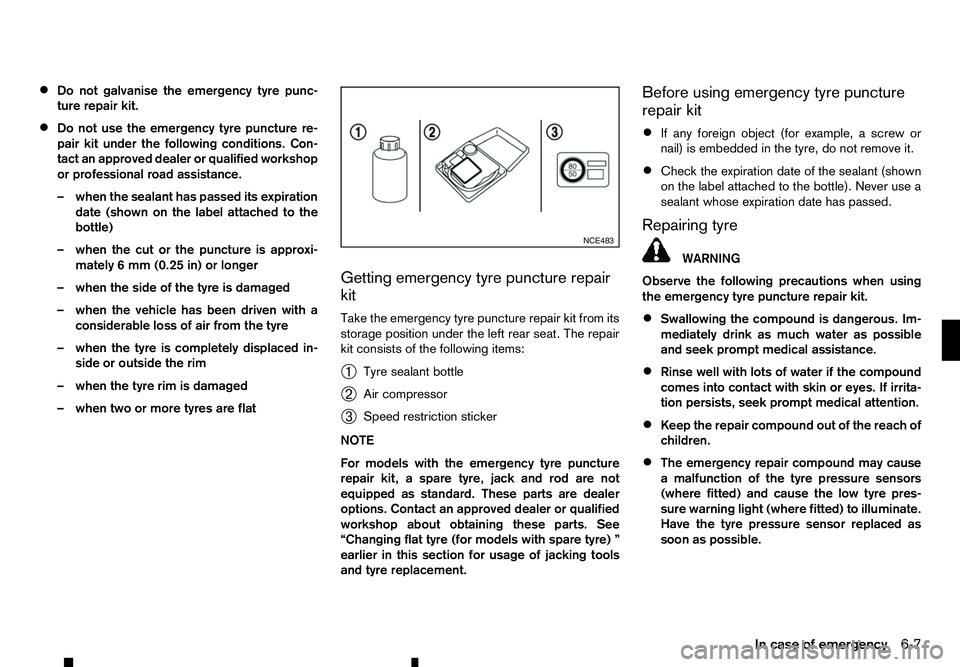
Take the emergency tyre puncture repair kit from its
storage position under the left rear seat. The repair
kit consists of the following items:
➀
Tyre sealant bottle
➁ Air compressor
➂ Speed restriction sticker
NOTE
For models with the emergency tyre puncture
repair kit, aspare tyre, jack and rod are not
equipped as standard. These parts are dealer
options. Contact an approved dealer or qualified
workshop about obtaining these parts. See
“Changing flat tyre (for models with spare tyre) ”
earlier in this section for usage of jacking tools
and tyre replacement. Before using emergency tyre puncture
repair kit
• If any foreign object (for example,
ascrew or
nail) is embedded in the tyre, do not remove it.
• Check the expiration date of the sealant (shown
on the label attached to the bottle). Never use a
sealant whose expiration date has passed.
Repairing tyre WARNING
Observe the following precautions when using
the emergency tyre puncture repair kit.
• Swallowing the compound is dangerous. Im-
mediately drink as much water as possible
and seek prompt medical assistance.
• Rinse well with lots of water if the compound
comes into contact with skin or eyes. If irrita-
tion persists, seek prompt medical attention.
• Keep the repair compound out of the reach of
children.
• The emergency repair compound may cause
am
alfunction of the tyre pressure sensors
(where fitted) and cause the low tyre pres-
sure warning light (where fitted) to illuminate.
Have the tyre pressure sensor replaced as
soon as possible. NCE483
In case of emergency
6-7
Page 265 of 340
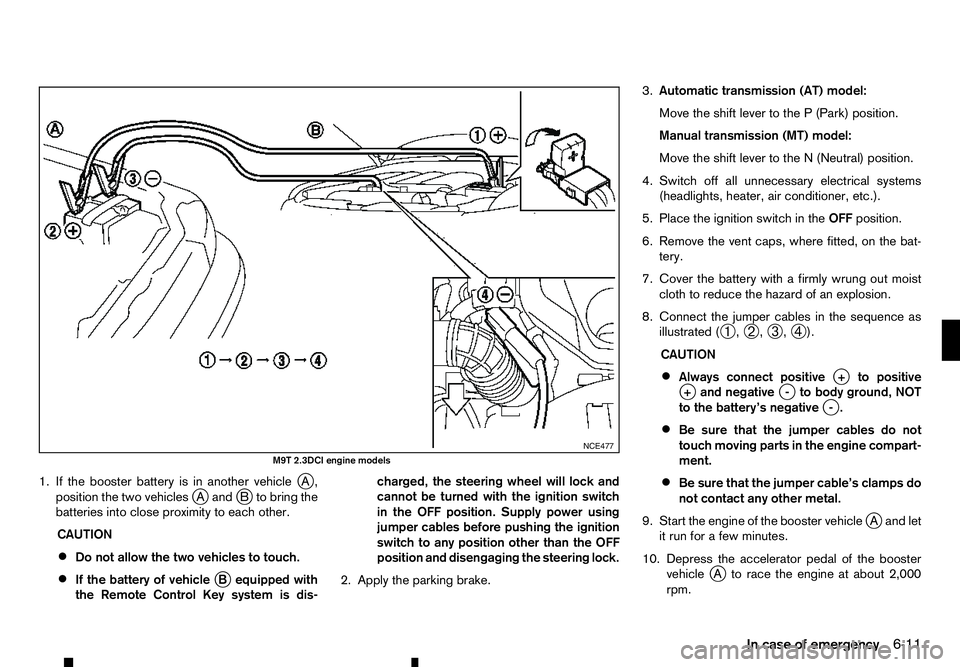
1. If the booster battery is in another vehicle
jA,
position the two vehicles j
Aa ndjBt obring the
batteries into close proximity to each other.
CAUTION
• Do not allow the two vehicles to touch.
• If the battery of vehicle
jBe quipped with
the Remote Control Key system is dis- charged, the steering wheel will lock and
cannot be turned with the ignition switch
in the OFF position. Supply power using
jumper cables before pushing the ignition
switch to any position other than the OFF
position and disengaging the steering lock.
2. Apply the parking brake. 3.
Automatic transmission (AT) model:
Move the shift lever to the P(Park) position.
Manual transmission (MT) model:
Move the shift lever to the N(Neutral) position.
4. Switch off all unnecessary electrical systems (headlights, heater, air conditioner, etc.).
5. Place the ignition switch in the OFFposition.
6. Remove the vent caps, where fitted, on the bat- tery.
7. Cover the battery with afirmly wrung out moist
cloth to reduce the hazard of an explosion.
8. Connect the jumper cables in the sequence as illustrated ( ➀,
➁ ,
➂ ,
➃ ).
CAUTION
• Always connect positive
j+t opositive
j +a nd negative j-t obody ground, NOT
to the battery’s negative j
-.
• Be sure that the jumper cables do not
touch moving parts in the engine compart-
ment.
• Be sure that the jumper cable’s clamps do
not contact any other metal.
9. Start the engine of the booster vehicle j
Aa nd let
it run for afew minutes.
10. Depress the accelerator pedal of the booster vehicle j
At orace the engine at about 2,000
rpm. NCE477
M9T 2.3DCI engine models
In case of emergency6-11
Page 267 of 340
4.
Automatic transmission model:
Move the shift lever to the P(Park) position.
Manual transmission model:
Move the shift lever to the N(Neutral) position.
DO NOT STOP THE ENGINE.
5. Open all the windows.
6. Turn off the air conditioner. Move the tempera- ture control to maximum hot and the fan control
to high speed.
7. Get out from the vehicle.
8. Visually inspect and listen for steam or coolant escaping from the radiator before opening the
bonnet. Wait until no steam or coolant can be
seen before proceeding.
9. Open the engine bonnet.
10. Visually inspect if the cooling fan is running.
11. Visually inspect the radiator and radiator hoses for leakage. If the cooling fan is not running or
the coolant is leaking, stop the engine.
12. After the engine cools down, check the coolant level in the reservoir with the engine running.
Do not open the radiator or coolant reservoir
cap.
13. Add coolant to the reservoir if necessary.
Have your vehicle inspected/repaired at an
approved dealer or qualified workshop. When towing your vehicle, local regulations for tow-
ing must be followed. Incorrect towing equipment
could damage your vehicle. To assure proper tow-
ing and to prevent accidental damage to your ve-
hicle, RENAULT recommends that you have profes-
sional road assistance personnel tow your vehicle. It
is advisable to have the professional road assistant
carefully read the following precautions.
TOWING PRECAUTIONS
• Be sure that the transmission, steering system
and powertrain are in working condition before
towing. If any units are damaged, the vehicle
must be towed using
adolly or flatbed tow truck.
(Two- Wheel Drive (2WD) model)
• RENAULT recommends that your vehicle be
towed with the driving wheels off the ground.
(Two- Wheel Drive (2WD) model)
• To tow
avehicle with automatic transmission,
and appropriate vehicle dolly MUSTbe placed
under the towed vehicles drive wheels. Always
follow the dolly manufacturer’s recommenda-
tions when using their product.
• Always attach safety chains before towing.
• Never tow Four-Wheel Drive (4WD) model with
any of the wheels on the ground as this may
cause serious and expensive damage to the driv-
etrain. TOWING RECOMMENDED BY
RENAULT
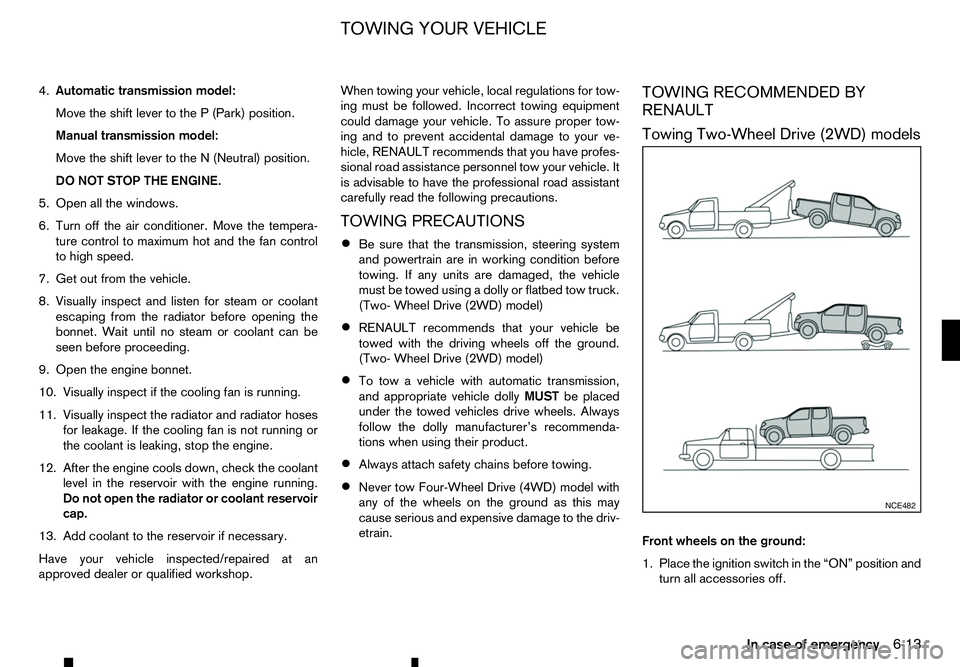
Towing Two-Wheel Drive (2WD) models
Front wheels on the ground:
1. Place the ignition switch in the “ON” position and
turn all accessories off. NCE482
TOWING YOUR VEHICLE
In case of emergency6-13
Page 279 of 340
Lights*:
Clean the headlights on
aregular basis. Make sure
that the headlights, stop lights, tail lights, turn signal
lights, and other lights are all operating properly and
installed securely. Also check the aim of the head-
lights.
Tyres*:
Check the pressure with agauge often and always
prior to long distance trips. Adjust the pressure in all
tyres, including the spare, to the pressure specified.
Check carefully for damage, cuts or excessive wear.
Tyre rotation*:
In the case of Two-Wheel Drive (2WD), and where
front and rear tyres are the same size: tyres should
be rotated every 10,000 km (6,000 miles). Tyres
marked with directional indicators can only be ro-
tated between front and rear. Make sure that the
directional indicators point in the direction of wheel
rotation after the tyre rotation is completed.
In the case of the Four-Wheel Drive and All Wheel
Drive (4WD/AWD), and where front and rear tyres
are the same size: tyres should be rotated every
5,000 km (3,000 miles). Tyres marked with direc-
tional indicators can only be rotated between front
and rear. Make sure that the directional indicators
point in the direction of wheel rotation after the tyre
rotation is completed.
In the case that front tyres are different size from
rear tyres: tyres cannot be rotated.
The timing for tyre rotation may vary according to
your driving habits and the road surface conditions. Tyre Pressure Monitoring System (TPMS)
transmitter components (where fitted):
Replace the TPMS transmitter grommet seal, valve
core and cap when the tyres are replaced due to
wear or age.
Wheel alignment and balance:
If the vehicle should pull to either side while driving
on astraight and level road, or if you detect uneven
or abnormal tyre wear, there may be aneed for
wheel alignment. If the steering wheel or seat vi-
brates at normal highway speeds, wheel balancing
may be needed.
Windscreen:
Clean the windscreen on aregular basis. Check the
windscreen at least every six months for cracks or
other damage. Repair as necessary.
Wiper blades*:
Check for cracks or wear if not functioning cor-
rectly. Replace as necessary.
Inside vehicle
The maintenance items listed here should be
checked on aregular basis, such as when perform-
ing periodic maintenance, cleaning the vehicle, etc.
Accelerator pedal:
Check the pedal for smooth operation and make
sure that the pedal does not catch or require uneven
effort. Keep the floor mats away from the pedal. Brake pedal*:
Check the pedal for smooth operation and make
sure that it is the proper distance from the floor mat
when depressed fully. Check the brake booster
function. Be sure to keep the floor mats away from
the pedal.
Parking brake*:
Check the parking brake operation regularly. Check
that the lever (where fitted) or the pedal (where fit-
ted) has the proper travel. Also make sure that the
vehicle is held securely on
afairly steep hill when
only the parking brake is applied.
Seat belts:
Check that all parts of the seat belt system (for
example, buckles, anchors, adjusters and retrac-
tors) operate properly and smoothly, and are in-
stalled securely. Check the belt webbing for cuts,
fraying, wear or damage.
Steering wheel:
Check for changes in the steering condition, such
as excessive play, hard steering or strange noises.
Warning lights and chimes:
Make sure that all warning lights and chimes are
operating properly.
Windscreen defogger:
Check that the air comes out of the defogger outlets
properly and in good quantity when operating the
heater or air conditioner.
Maintenance and do-it-yourself 8-3
Page 280 of 340
Windscreen wiper and washer*:
Check that the wipers and washer operate properly
and that the wipers do not streak.
Under bonnet and vehicle
The maintenance items listed here should be
checked periodically (for example, each time you
check the engine oil or refuel).
Battery (except for maintenance free batter-
ies)*:
Check the fluid level in each cell. It should be be-
tween the
operated in high temperatures or under severe con-
ditions require frequent checks of the battery fluid
level.
Brake (and clutch) fluid level(s)*:
For Manual Transmission (MT) model: make sure
that the brake and clutch fluid levels are between
the
Except for Manual Transmission (MT) model: make
sure that the brake fluid level is between the
and
Engine coolant level*:
Check the coolant level when the engine is cold.
Make sure that the coolant level is between the
Engine drive belt(s)*:
Make sure that drive belt(s) is/are not frayed, worn,
cracked or oily. Engine oil level*:
Check the level after parking the vehicle (on
alevel
ground) and turning off the engine.
Fluid leaks:
Check under the vehicle for fuel, oil, water or other
fluid leaks after the vehicle has been parked for a
while. Water dripping from the air conditioner after
use is normal. If you should notice any leaks or if fuel
fumes are evident, check for cause and have it cor-
rected immediately.
Power steering fluid level and lines*:
Check the level when the fluid is cold, with the en-
gine off. Check the lines for proper attachment,
leaks, cracks, etc.
Windscreen washer fluid*:
Check that there is adequate fluid in the reservoir.
MAINTENANCE PRECAUTIONS
When performing any inspection or maintenance
work on your vehicle, always take care to prevent
serious accidental injury to yourself or damage to
the vehicle. The following are general precautions
which should be closely observed. WARNING
• Park the vehicle on
alevel surface, apply the
parking brake securely and block the wheels
to prevent the vehicle from moving. Move the
shift lever to the P(Park) position (AT model)
or the shift lever to the N(Neutral) position
(MT model). •
Be sure the ignition switch is in the LOCK
position when performing any parts replace-
ment or repairs.
• Do not work under the bonnet while the en-
gine is hot. Always turn off the engine and
wait until it cools down.
• If you must work with the engine running,
keep your hands, clothing, hair and tools away
from moving fans, belts and any other moving
parts.
• It is advisable to secure or remove any loose
clothing and any jewellery, such as rings,
watches, etc. before working on your vehicle.
• If you must run the engine in an enclosed
space such as
agarage, be sure there is
proper ventilation for exhaust gasses to es-
cape.
• DO NOT GET UNDER
AVEHICLE THAT IS
SUPPORTED BY AJACK.
• Keep smoking materials, flame and sparks
away from fuel and the battery.
• Never connect or disconnect either the bat-
tery or any transistorised component connec-
tor while the ignition switch is in the ON posi-
tion.
8-4 Maintenance and do-it-yourself
Page 284 of 340
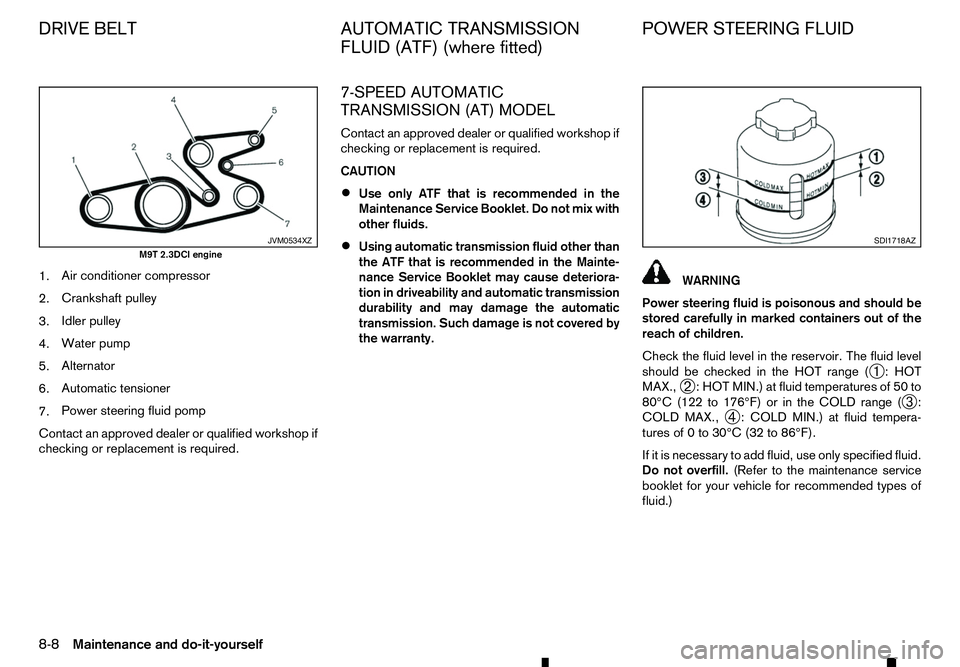
1.
Air conditioner compressor
2. Crankshaft pulley
3. Idler pulley
4. Water pump
5. Alternator
6. Automatic tensioner
7. Power steering fluid pomp
Contact an approved dealer or qualified workshop if
checking or replacement is required. 7-SPEED AUTOMATIC
TRANSMISSION (AT) MODEL
Contact an approved dealer or qualified workshop if
checking or replacement is required.
CAUTION
•
Use only ATF that is recommended in the
Maintenance Service Booklet. Do not mix with
other fluids.
• Using automatic transmission fluid other than
the ATF that is recommended in the Mainte-
nance Service Booklet may cause deteriora-
tion in driveability and automatic transmission
durability and may damage the automatic
transmission. Such damage is not covered by
the warranty. WARNING
Power steering fluid is poisonous and should be
stored carefully in marked containers out of the
reach of children.
Check the fluid level in the reservoir. The fluid level
should be checked in the HOT range ( ➀:H
OT
MAX., ➁:H
OT MIN.) at fluid temperatures of 50 to
80°C (122 to 176°F) or in the COLD range ( ➂:
COLD MAX., ➃:C
OLD MIN.) at fluid tempera-
tures of 0to30°C (32 to 86°F).
If it is necessary to add fluid, use only specified fluid.
Do not overfill. (Refer to the maintenance service
booklet for your vehicle for recommended types of
fluid.) JVM0534XZ
M9T 2.3DCI engine
SDI1718AZ
DRIVE BELT
AUTOMATIC TRANSMISSION
FLUID (ATF) (where fitted) POWER STEERING FLUID
8-8 Maintenance and do-it-yourself
Page 294 of 340
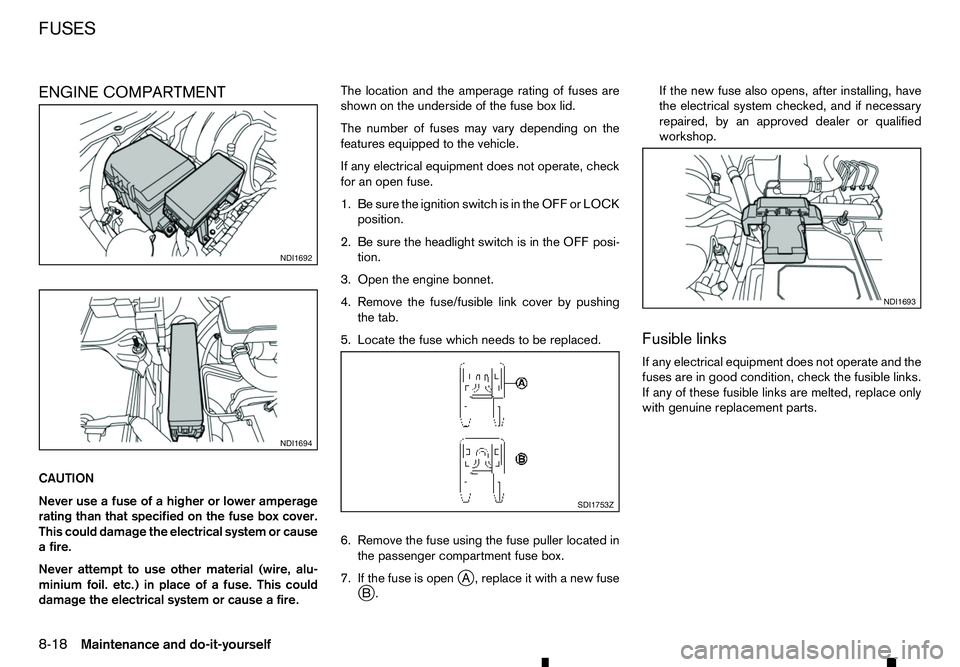
ENGINE COMPARTMENT
CAUTION
Never use afuse of ahigher or lower amperage
rating than that specified on the fuse box cover.
This could damage the electrical system or cause
af ire.
Never attempt to use other material (wire, alu-
minium foil. etc.) in place of afuse. This could
damage the electrical system or cause afire. The location and the amperage rating of fuses are
shown on the underside of the fuse box lid.
The number of fuses may vary depending on the
features equipped to the vehicle.
If any electrical equipment does not operate, check
for an open fuse.
1. Be sure the ignition switch is in the OFF or LOCK
position.
2. Be sure the headlight switch is in the OFF posi- tion.
3. Open the engine bonnet.
4. Remove the fuse/fusible link cover by pushing the tab.
5. Locate the fuse which needs to be replaced.
6. Remove the fuse using the fuse puller located in the passenger compartment fuse box.
7. If the fuse is open j
A, replace it with anew fuse
j B. If the new fuse also opens, after installing, have
the electrical system checked, and if necessary
repaired, by an approved dealer or qualified
workshop.
Fusible links
If any electrical equipment does not operate and the
fuses are in good condition, check the fusible links.
If any of these fusible links are melted, replace only
with genuine replacement parts. NDI1692
NDI1694
SDI1753Z NDI1693
FUSES
8-18
Maintenance and do-it-yourself
Page 307 of 340
9
Technical information
Technical information
Recommended fluids/lubricants and capacities ........ 9-2 Fuel information .................................................. 9-2
Automatic Transmission Fluid (ATF) .................... 9-2
Air conditioner system refrigerant and lubricant ... 9-2
Engine ..................................................................... 9-3
Tyres and wheels ..................................................... 9-4
Dimensions .............................................................. 9-5 Double Cab ........................................................ 9-5
King Cab ............................................................ 9-6
When travelling or registering in another country ...... 9-7
Vehicle identification ................................................ 9-7 Vehicle identification label ................................... 9-7
Vehicle Identification Number (VIN) plate ............ 9-7
Vehicle Identification Number (VIN) ..................... 9-7
Engine serial number .......................................... 9-7
Tyre placard ....................................................... 9-8
Air conditioner specification label ........................ 9-8
Installation of an RF transmitter ................................ 9-8
Radio approval number and information ................... 9-9 Anti-Theft System (ATS), Remote Control Key
or remote keyless system.................................... 9-9
Page 308 of 340
Refer to the maintenance service booklet for your
vehicle for details of recommended fluids/lubricants
and capacities.
FUEL INFORMATION
Diesel engine*
M9T 2.3DCI engine:
Diesel fuel above 50 cetane and with less than 10
ppm of sulphur (EN590) must be used.
* If two types of diesel fuel are available, use
summer or winter fuel properly according to
the following temperature conditions.
• Above –7°C (20°F) ... Summer type diesel fuel.
• Below –7°C (20°F) ... Winter type diesel fuel.
CAUTION
• Do not use home heating oil, petrol or other
alternate fuels in your diesel engine. The use
of those or adding those to diesel fuel can
cause engine damage.
• Do not use summer fuel at temperatures be-
low –7°C (20°F). The cold temperatures will
cause wax to form in the fuel. As
aresult, it
may prevent the engine from running
smoothly. AUTOMATIC TRANSMISSION FLUID
(ATF)
Contact an approved dealer or qualified workshop if
checking or replacement is required.
CAUTION
• Use only ATF that is recommended in the
Maintenance Service Booklet. Do not mix with
other fluids.
• Using automatic transmission fluid other than
the ATF that is recommended in the Mainte-
nance Service Booklet may cause deteriora-
tion in driveability and automatic transmission
durability and may damage the automatic
transmission. Such damage is not covered by
the warranty.
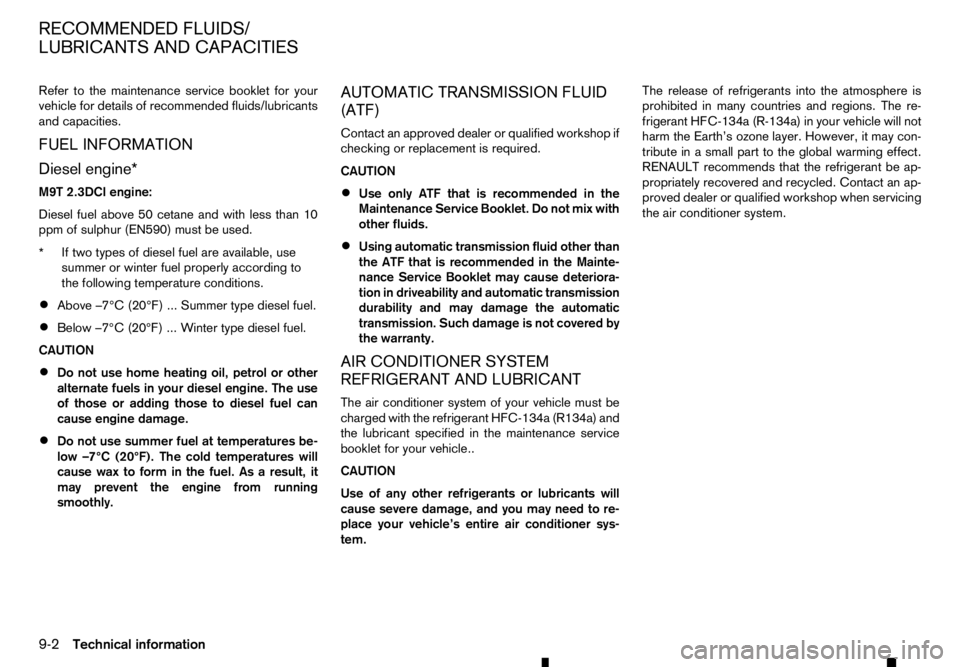
AIR CONDITIONER SYSTEM
REFRIGERANT AND LUBRICANT
The air conditioner system of your vehicle must be
charged with the refrigerant HFC-134a (R134a) and the lubricant specified in the maintenance service
booklet for your vehicle..
CAUTION
Use of any other refrigerants or lubricants will
cause severe damage, and you may need to re-
place your vehicle’s entire air conditioner sys-
tem. The release of refrigerants into the atmosphere is
prohibited in many countries and regions. The re-
frigerant HFC-134a (R-134a) in your vehicle will not
harm the Earth’s ozone layer. However, it may con-
tribute in asmall part to the global warming effect.
RENAULT recommends that the refrigerant be ap-
propriately recovered and recycled. Contact an ap-
proved dealer or qualified workshop when servicing
the air conditioner system.
RECOMMENDED FLUIDS/
LUBRICANTS AND CAPACITIES
9-2
Technical information
Page 314 of 340
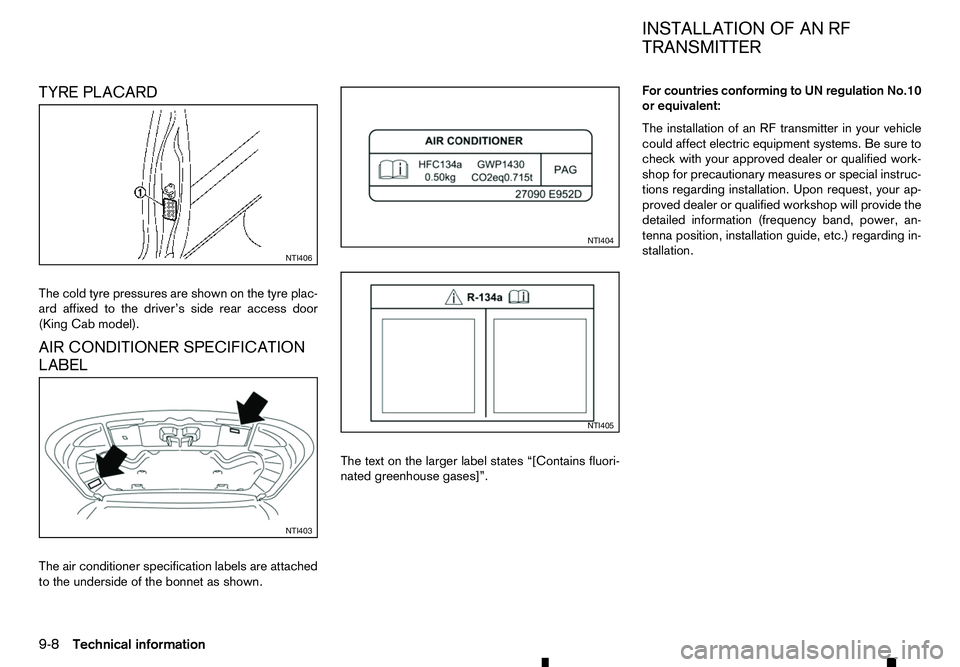
TYRE PLACARD
The cold tyre pressures are shown on the tyre plac-
ard affixed to the driver’s side rear access door
(King Cab model).
AIR CONDITIONER SPECIFICATION
LABEL
The air conditioner specification labels are attached
to the underside of the bonnet as shown. The text on the larger label states “[Contains fluori-
nated greenhouse gases]”.For countries conforming to UN regulation No.10
or equivalent:
The installation of an RF transmitter in your vehicle
could affect electric equipment systems. Be sure to
check with your approved dealer or qualified work-
shop for precautionary measures or special instruc-
tions regarding installation. Upon request, your ap-
proved dealer or qualified workshop will provide the
detailed information (frequency band, power, an-
tenna position, installation guide, etc.) regarding in-
stallation.NTI406
NTI403 NTI404
NTI405INSTALLATION OF AN RF
TRANSMITTER
9-8 Technical information