warning RENAULT ALASKAN 2017 User Guide
[x] Cancel search | Manufacturer: RENAULT, Model Year: 2017, Model line: ALASKAN, Model: RENAULT ALASKAN 2017Pages: 340, PDF Size: 6.93 MB
Page 29 of 340
•
Removal and installation of the pre-tensioner
seat belt system (where fitted) components
should be done by an approved dealer or
qualified workshop.
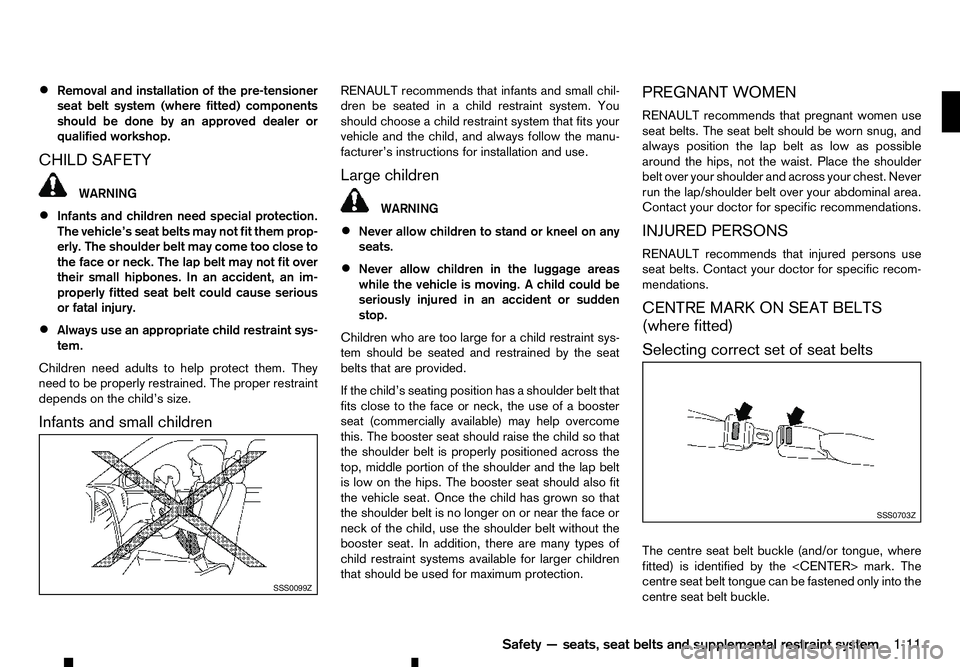
CHILD SAFETY WARNING
• Infants and children need special protection.
The vehicle’s seat belts may not fit them prop- erly. The shoulder belt may come too close to
the face or neck. The lap belt may not fit over
their small hipbones. In an accident, an im-
properly fitted seat belt could cause serious
or fatal injury.
• Always use an appropriate child restraint sys-
tem.
Children need adults to help protect them. They
need to be properly restrained. The proper restraint
depends on the child’s size.
Infants and small children RENAULT recommends that infants and small chil-
dren be seated in
achild restraint system. You
should choose achild restraint system that fits your
vehicle and the child, and always follow the manu-
facturer’s instructions for installation and use.
Large children WARNING
• Never allow children to stand or kneel on any
seats.
• Never allow children in the luggage areas
while the vehicle is moving.
Achild could be
seriously injured in an accident or sudden
stop.
Children who are too large for achild restraint sys-
tem should be seated and restrained by the seat
belts that are provided.
If the child’s seating position has ashoulder belt that
fits close to the face or neck, the use of abooster
seat (commercially available) may help overcome
this. The booster seat should raise the child so that the shoulder belt is properly positioned across the
top, middle portion of the shoulder and the lap belt
is low on the hips. The booster seat should also fit
the vehicle seat. Once the child has grown so that
the shoulder belt is no longer on or near the face or
neck of the child, use the shoulder belt without the
booster seat. In addition, there are many types of
child restraint systems available for larger children
that should be used for maximum protection. PREGNANT WOMEN
RENAULT recommends that pregnant women use
seat belts. The seat belt should be worn snug, and
always position the lap belt as low as possible
around the hips, not the waist. Place the shoulder
belt over your shoulder and across your chest. Never
run the lap/shoulder belt over your abdominal area.
Contact your doctor for specific recommendations.
INJURED PERSONS
RENAULT recommends that injured persons use
seat belts. Contact your doctor for specific recom-
mendations.
CENTRE MARK ON SEAT BELTS
(where fitted)
Selecting correct set of seat belts
The centre seat belt buckle (and/or tongue, where
fitted) is identified by the
centre seat belt tongue can be fastened only into the
centre seat belt buckle.
SSS0099Z SSS0703Z
Safety —seats, seat belts and supplemental restraint system
1-11
Page 30 of 340
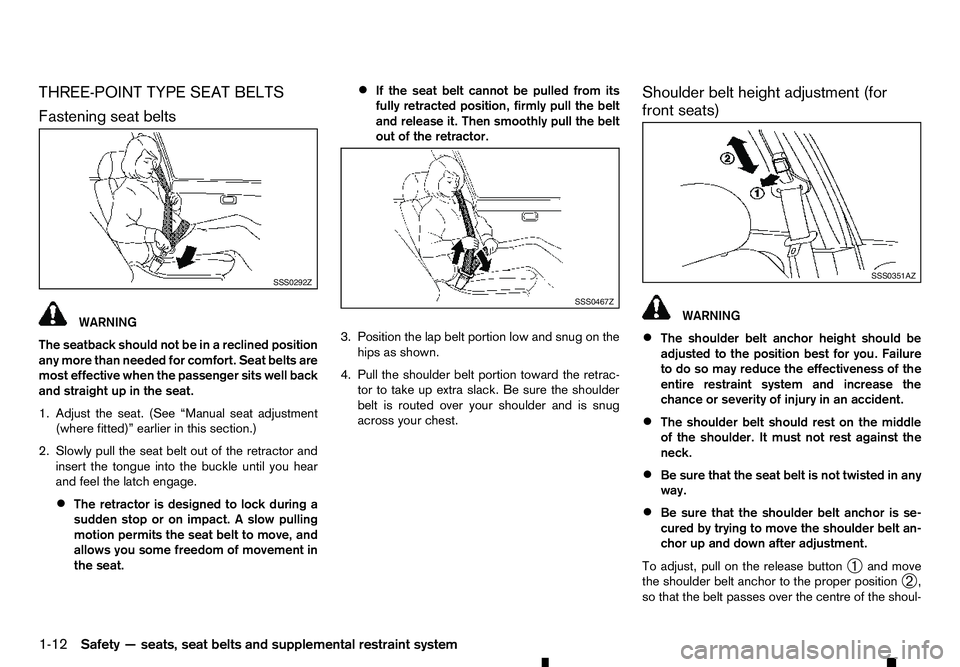
THREE-POINT TYPE SEAT BELTS
Fastening seat belts WARNING
The seatback should not be in
areclined position
any more than needed for comfort. Seat belts are
most effective when the passenger sits well back
and straight up in the seat.
1. Adjust the seat. (See “Manual seat adjustment
(where fitted)” earlier in this section.)
2. Slowly pull the seat belt out of the retractor and insert the tongue into the buckle until you hear
and feel the latch engage.
• The retractor is designed to lock during a
sudden stop or on impact.
Aslow pulling
motion permits the seat belt to move, and
allows you some freedom of movement in
the seat. •
If the seat belt cannot be pulled from its
fully retracted position, firmly pull the belt
and release it. Then smoothly pull the belt
out of the retractor.
3. Position the lap belt portion low and snug on the hips as shown.
4. Pull the shoulder belt portion toward the retrac- tor to take up extra slack. Be sure the shoulder
belt is routed over your shoulder and is snug
across your chest. Shoulder belt height adjustment (for
front seats) WARNING
• The shoulder belt anchor height should be
adjusted to the position best for you. Failure
to do so may reduce the effectiveness of the
entire restraint system and increase the
chance or severity of injury in an accident.
• The shoulder belt should rest on the middle
of the shoulder. It must not rest against the
neck.
• Be sure that the seat belt is not twisted in any
way.
• Be sure that the shoulder belt anchor is se-
cured by trying to move the shoulder belt an-
chor up and down after adjustment.
To adjust, pull on the release button ➀and move
the shoulder belt anchor to the proper position ➁,
so that the belt passes over the centre of the shoul- SSS0292Z
SSS0467Z SSS0351AZ
1-12 Safety —seats, seat belts and supplemental restraint system
Page 31 of 340
der. The belt should be away from your face and
neck, but not falling off your shoulder. Release the
button to lock the shoulder belt anchor into position.
Unfastening seat belts
Push the button on the buckle. The seat belt auto-
matically retracts.
Checking seat belt operation
Seat belt retractors are designed to lock seat belt
movement:
• When the seat belt is pulled quickly from the
retractor.
• When the vehicle slows down rapidly.
To increase your confidence in the seat belts, check
the operation by grasping the shoulder belt and pull-
ing forward quickly. The retractor should lock and
restrict further belt movement. If the retractor does
not lock during this check, contact an approved
dealer or qualified workshop immediately.
TWO-POINT TYPE SEAT BELTS (where fitted)
Fastening seat belts WARNING
Every person who drives or rides in this vehicle
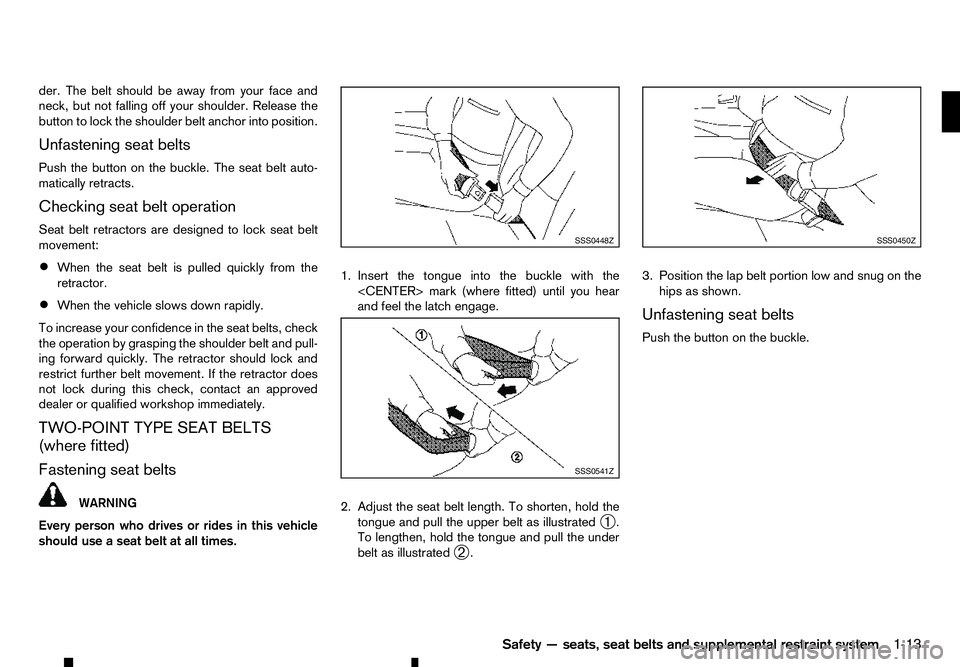
should use aseat belt at all times. 1. Insert the tongue into the buckle with the
and feel the latch engage.
2. Adjust the seat belt length. To shorten, hold the tongue and pull the upper belt as illustrated ➀.
To lengthen, hold the tongue and pull the under
belt as illustrated ➁. 3. Position the lap belt portion low and snug on the
hips as shown.
Unfastening seat belts
Push the button on the buckle. SSS0448Z
SSS0541Z SSS0450Z
Safety —seats, seat belts and supplemental restraint system
1-13
Page 32 of 340
SEAT BELT MAINTENANCE
Periodically check that the seat belt and all the metal
components, such as buckles, tongues, retractors,
flexible wires and anchors, work properly. If loose
parts, deterioration, cuts or other damage on the
seat belt webbing is found, the entire seat belt as-
sembly should be replaced.
If dirt builds up in the shoulder belt guide of the seat
belt anchors, the seat belts may retract slowly. Wipe
the shoulder belt guide with aclean, dry cloth.
To clean the seat belt webbing, apply amild soap
solution or any solution recommended for cleaning
upholstery or carpet. Then wipe with acloth and
allow the seat belts to dry in the shade. Do not allow
the seat belts to retract until they are completely dry. PRECAUTIONS ON CHILD
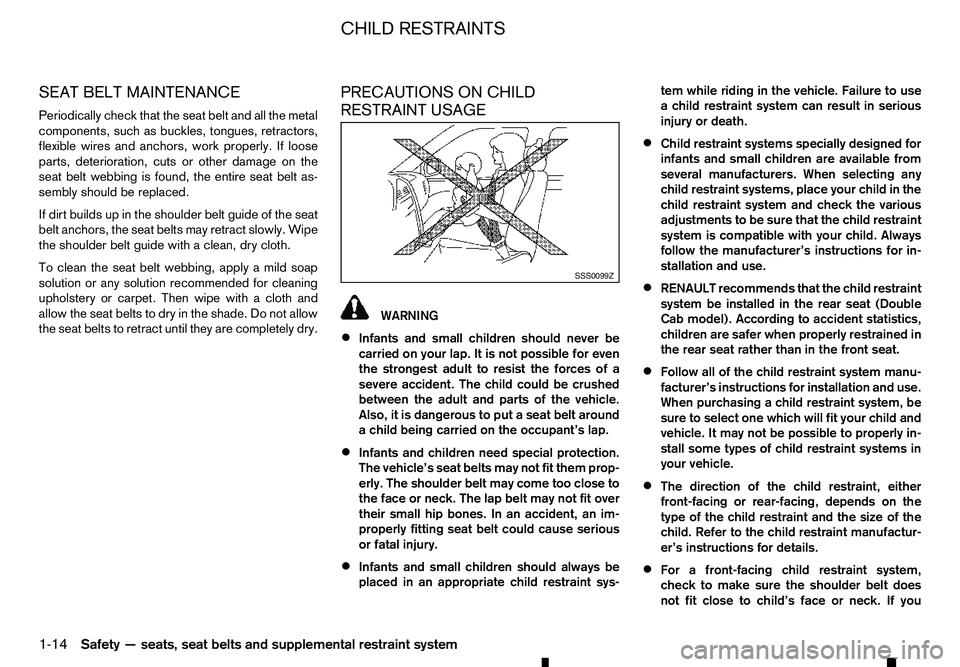
RESTRAINT USAGE WARNING
• Infants and small children should never be
carried on your lap. It is not possible for even
the strongest adult to resist the forces of a
severe accident. The child could be crushed
between the adult and parts of the vehicle.
Also, it is dangerous to put aseat belt around
ac hild being carried on the occupant’s lap.
• Infants and children need special protection.
The vehicle’s seat belts may not fit them prop-
erly. The shoulder belt may come too close to
the face or neck. The lap belt may not fit over
their small hip bones. In an accident, an im-
properly fitting seat belt could cause serious
or fatal injury.
• Infants and small children should always be
placed in an appropriate child restraint sys- tem while riding in the vehicle. Failure to use
ac
hild restraint system can result in serious
injury or death.
• Child restraint systems specially designed for
infants and small children are available from
several manufacturers. When selecting any
child restraint systems, place your child in the
child restraint system and check the various
adjustments to be sure that the child restraint
system is compatible with your child. Always
follow the manufacturer’s instructions for in-
stallation and use.
• RENAULT recommends that the child restraint
system be installed in the rear seat (Double
Cab model). According to accident statistics,
children are safer when properly restrained in
the rear seat rather than in the front seat.
• Follow all of the child restraint system manu-
facturer’s instructions for installation and use.
When purchasing
achild restraint system, be
sure to select one which will fit your child and
vehicle. It may not be possible to properly in- stall some types of child restraint systems in
your vehicle.
• The direction of the child restraint, either
front-facing or rear-facing, depends on the
type of the child restraint and the size of the child. Refer to the child restraint manufactur-
er’s instructions for details.
• For
afront-facing child restraint system,
check to make sure the shoulder belt does
not fit close to child’s face or neck. If you SSS0099Z
CHILD RESTRAINTS
1-14 Safety —seats, seat belts and supplemental restraint system
Page 39 of 340
CHILD RESTRAINT ANCHORAGE
(where fitted)
Your vehicle is designed to accommodate achild
restraint system on the rear seat. When installing a
child restraint system, carefully read and follow the instructions in this manual and those supplied with
the child restraint system. WARNING
Child restraint anchorages are designed to with-
stand only those loads imposed by correctly fit-
ted child restraints. Under no circumstances are
they to be used for adult seat belts, harnesses or
for attaching other items or equipment to the
vehicle. Doing so could damage the child re-
straint anchorages. The child restraint will not be
properly installed using the damaged anchorage,
and achild could be seriously injured or killed in
ac ollision.
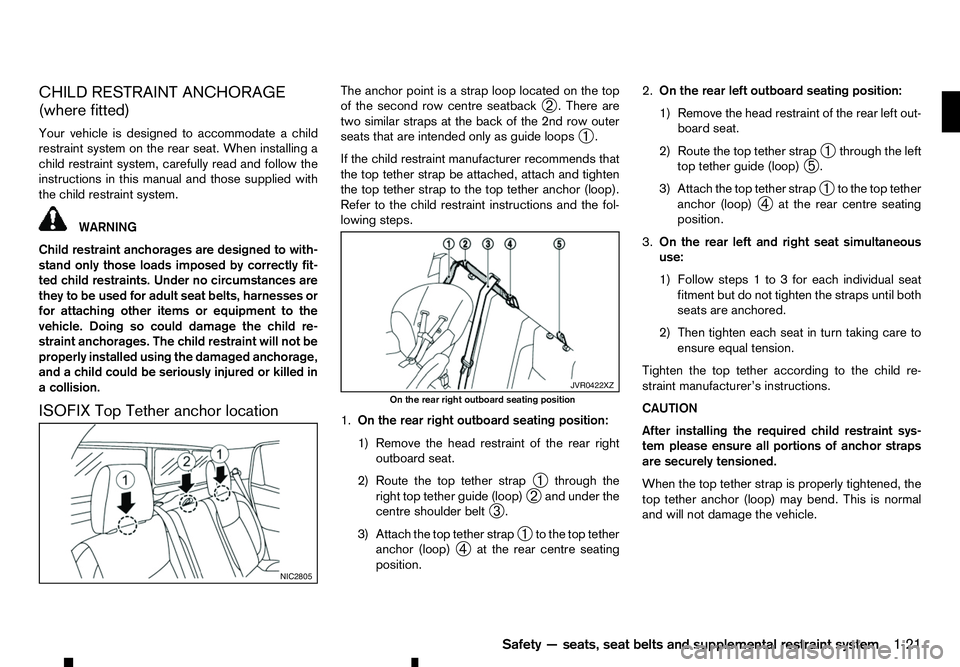
ISOFIX Top Tether anchor location The anchor point is
astrap loop located on the top
of the second row centre seatback ➁.T
here are
two similar straps at the back of the 2nd row outer
seats that are intended only as guide loops ➀.
If the child restraint manufacturer recommends that
the top tether strap be attached, attach and tighten
the top tether strap to the top tether anchor (loop).
Refer to the child restraint instructions and the fol-
lowing steps.
1. On the rear right outboard seating position:
1) Remove the head restraint of the rear right
outboard seat.
2) Route the top tether strap ➀through the
right top tether guide (loop) ➁and under the
centre shoulder belt ➂.
3) Attach the top tether strap ➀to the top tether
anchor (loop) ➃at the rear centre seating
position. 2.
On the rear left outboard seating position:
1) Remove the head restraint of the rear left out-
board seat.
2) Route the top tether strap ➀through the left
top tether guide (loop) ➄.
3) Attach the top tether strap ➀to the top tether
anchor (loop) ➃at the rear centre seating
position.
3. On the rear left and right seat simultaneous
use:
1) Follow steps 1to3for each individual seat
fitment but do not tighten the straps until both
seats are anchored.
2) Then tighten each seat in turn taking care to ensure equal tension.
Tighten the top tether according to the child re-
straint manufacturer’s instructions.
CAUTION
After installing the required child restraint sys-
tem please ensure all portions of anchor straps
are securely tensioned.
When the top tether strap is properly tightened, the
top tether anchor (loop) may bend. This is normal
and will not damage the vehicle. NIC2805 JVR0422XZ
On the rear right outboard seating position
Safety—seats, seat belts and supplemental restraint system 1-21
Page 40 of 340
CHILD RESTRAINT INSTALLATION
USING ISOFIX WARNING
• Attach ISOFIX and i-Size child restraints only
at the specified locations. For the ISOFIX
lower anchor locations, see “ISOFIX lower an-
chor point locations” earlier in this section. If
ac hild restraint is not secured properly, your
child could be seriously injured or killed in an
accident.
• Do not install child restraints that require the
use of
atop tether strap to seating positions
that do not have atop tether anchor.
• Do not secure
achild restraint in the centre
rear seating position using the ISOFIX lower
anchors. The child restraint will not be se-
cured properly.
• Inspect the lower anchors by inserting your
fingers into the lower anchor area and feeling
to make sure there are no obstructions over the ISOFIX anchors, such as seat belt web-
bing or seat cushion material. The child re-
straint will not be secured properly if the
ISOFIX anchors are obstructed.
• Child restraint anchorages are designed to
withstand only those loads imposed by cor-
rectly fitted child restraints. Under no circum-
stance are they to be used for adult seat belts,
harnesses or for attaching other items or
equipment to the vehicle. Doing so could damage the child restraint anchorages. The
child restraint will not be properly installed
using the damaged anchorage, and
achild
could be seriously injured or killed in acolli-
sion.
Installation on rear outboard seats
Front-facing child restraints:
Be sure to follow the child restraint manufacturer’s
instructions for the proper use of your child restraint.
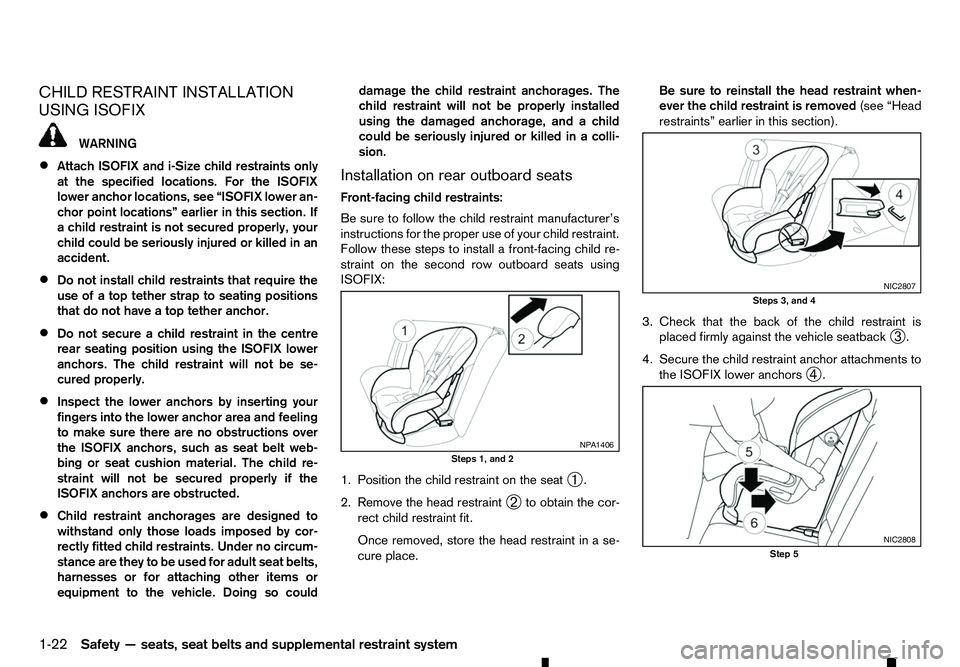
Follow these steps to install afront-facing child re-
straint on the second row outboard seats using
ISOFIX:
1. Position the child restraint on the seat ➀.
2. Remove the head restraint ➁to obtain the cor-
rect child restraint fit.
Once removed, store the head restraint in ase-
cure place. Be sure to reinstall the head restraint when-
ever the child restraint is removed
(see “Head
restraints” earlier in this section).
3. Check that the back of the child restraint is placed firmly against the vehicle seatback ➂.
4. Secure the child restraint anchor attachments to the ISOFIX lower anchors ➃. NP A1406
Steps 1, and 2 NIC2807
Steps 3, and 4
NIC2808
Step 5
1-22 Safety —seats, seat belts and supplemental restraint system
Page 44 of 340
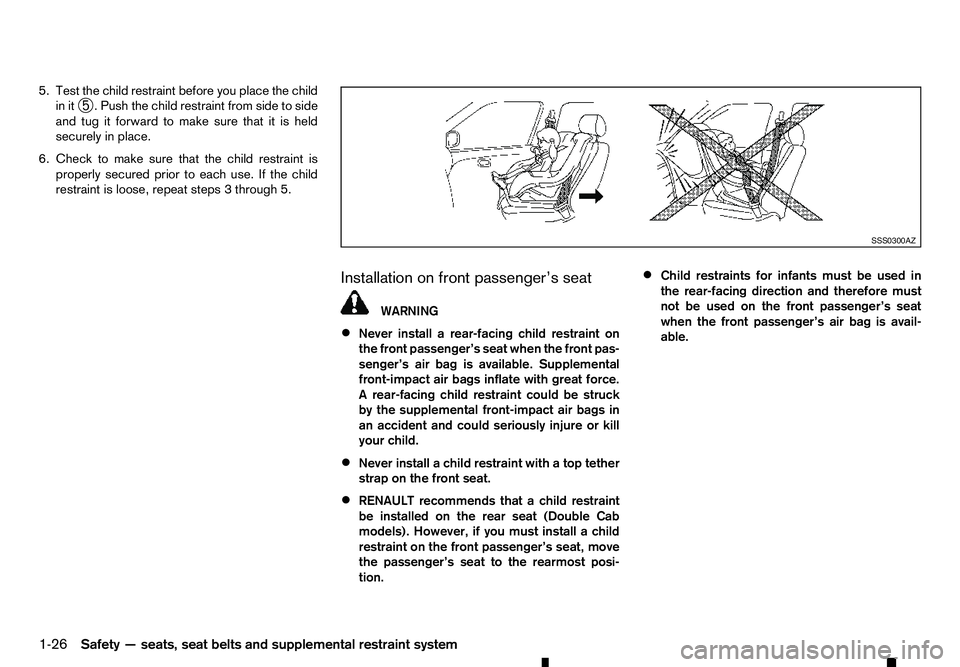
5. Test the child restraint before you place the child
in it ➄.P
ush the child restraint from side to side
and tug it forward to make sure that it is held
securely in place.
6. Check to make sure that the child restraint is properly secured prior to each use. If the child
restraint is loose, repeat steps 3through 5.
Installation on front passenger’s seat WARNING
• Never install
arear-facing child restraint on
the front passenger’s seat when the front pas-
senger’s air bag is available. Supplemental
front-impact air bags inflate with great force.
Ar ear-facing child restraint could be struck
by the supplemental front-impact air bags in
an accident and could seriously injure or kill
your child.
• Never install
achild restraint with atop tether
strap on the front seat.
• RENAULT recommends that
achild restraint
be installed on the rear seat (Double Cab
models). However, if you must install achild
restraint on the front passenger’s seat, move
the passenger’s seat to the rearmost posi-
tion. •
Child restraints for infants must be used in
the rear-facing direction and therefore must
not be used on the front passenger’s seat
when the front passenger’s air bag is avail-
able. SSS0300AZ
1-26 Safety —seats, seat belts and supplemental restraint system
Page 48 of 340
Supplemental side-impact air bag
system (where fitted)
This system can help cushion the impact force to
the chest and pelvis area of the driver and front pas-
senger in certain side-impact collisions. The supple-
mental side-impact air bag is designed to inflate on
the side where the vehicle is impacted.
Supplemental curtain side-impact air
bag system (where fitted)
This system can help cushion the impact force to
the head of the driver and passengers in front seat-
ing positions and rear outboard seating positions
(where fitted) in certain side-impact collisions. The
supplemental curtain side-impact air bag is designed
to inflate on the side where the vehicle is impacted.
The SRS is designed to supplementthe accident
protection provided by the driver’s and passenger’s
seat belts and is notdesigned to substitutefor
them. The SRS can help save lives and reduce seri-
ous injuries. However, inflating air bags may cause
abrasions or other injuries. Air bags do not provide
protection to the lower body. Seat belts should al-
ways be correctly worn and the occupants should
always be seated asuitable distance away from the
steering wheel, instrument panel and door finishers.
(See “Seat belts” earlier in this section.) The air
bags inflate quickly in order to help protect the oc-
cupants. The force of the air bags inflating can in-
crease the risk of injury if the occupants are too
close to, or are against, the air bag modules during
inflation. The air bags will deflate quickly after de-
ployment. The SRS operates only when the ignition switch
is in the ON position.
When the ignition switch is in the ON position,
the SRS air bag warning light illuminates for
about
7seconds and then turns off. This indi-
cates that the SRS is operational. (See “Warning
lights, indicator lights and audible reminders” in
the “2. Instruments and controls” section.)
1-30 Safety —seats, seat belts and supplemental restraint system
Page 49 of 340
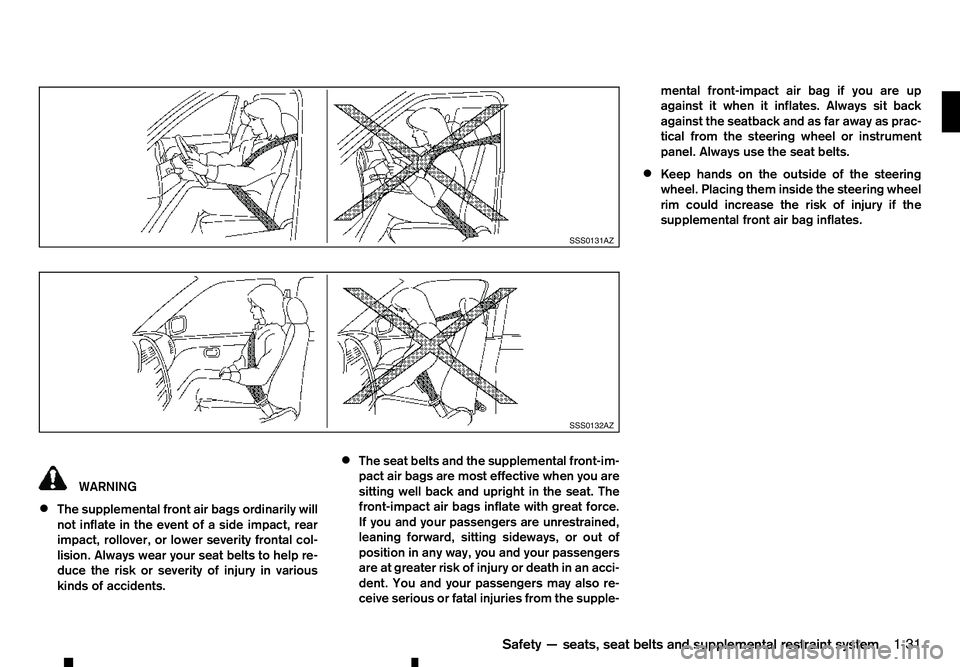
WARNING
• The supplemental front air bags ordinarily will
not inflate in the event of aside impact, rear
impact, rollover, or lower severity frontal col-
lision. Always wear your seat belts to help re-
duce the risk or severity of injury in various
kinds of accidents. •
The seat belts and the supplemental front-im-
pact air bags are most effective when you are
sitting well back and upright in the seat. The
front-impact air bags inflate with great force.
If you and your passengers are unrestrained,
leaning forward, sitting sideways, or out of
position in any way, you and your passengers
are at greater risk of injury or death in an acci-
dent. You and your passengers may also re-
ceive serious or fatal injuries from the supple- mental front-impact air bag if you are up
against it when it inflates. Always sit back against the seatback and as far away as prac-
tical from the steering wheel or instrument
panel. Always use the seat belts.
• Keep hands on the outside of the steering
wheel. Placing them inside the steering wheel
rim could increase the risk of injury if the
supplemental front air bag inflates. SSS0131AZ
SSS0132AZ
Safety —seats, seat belts and supplemental restraint system
1-31
Page 50 of 340
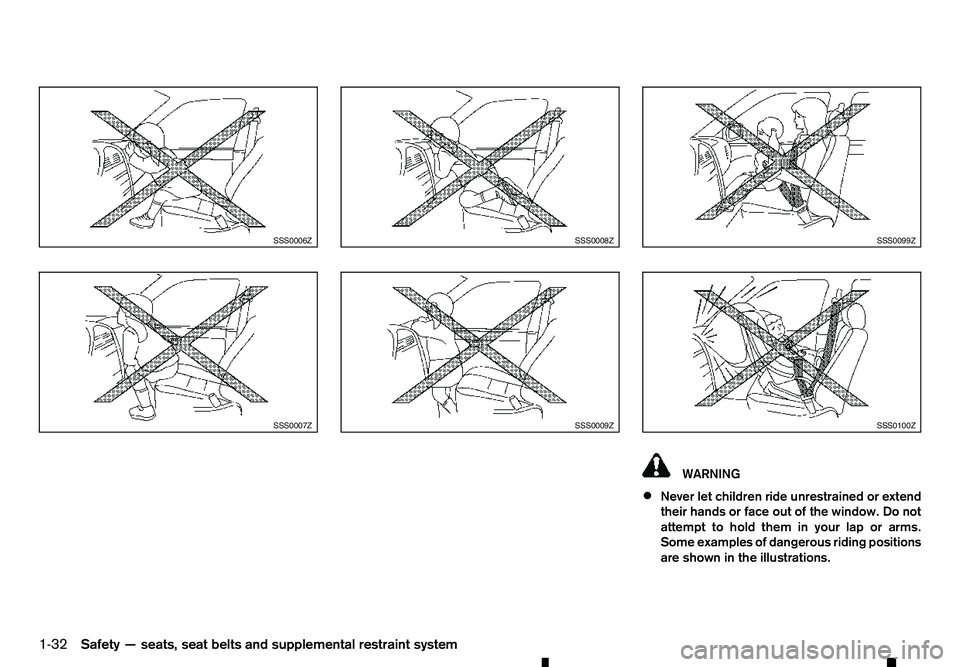
WARNING
• Never let children ride unrestrained or extend
their hands or face out of the window. Do not
attempt to hold them in your lap or arms.
Some examples of dangerous riding positions
are shown in the illustrations. SSS0006Z
SSS0007Z SSS0008Z
SSS0009Z SSS0099Z
SSS0100Z
1-32 Safety —seats, seat belts and supplemental restraint system