manual transmission RENAULT ALASKAN 2017 Owner's Manual
[x] Cancel search | Manufacturer: RENAULT, Model Year: 2017, Model line: ALASKAN, Model: RENAULT ALASKAN 2017Pages: 340, PDF Size: 6.93 MB
Page 256 of 340
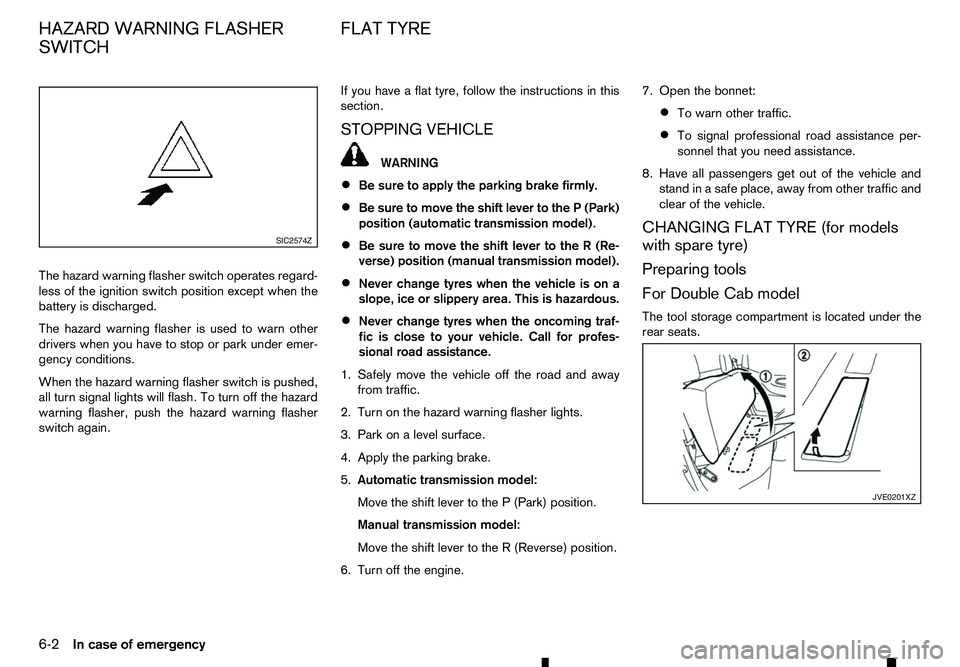
The hazard warning flasher switch operates regard-
less of the ignition switch position except when the
battery is discharged.
The hazard warning flasher is used to warn other drivers when you have to stop or park under emer-
gency conditions.
When the hazard warning flasher switch is pushed,
all turn signal lights will flash. To turn off the hazard
warning flasher, push the hazard warning flasher
switch again. If you have
aflat tyre, follow the instructions in this
section.
STOPPING VEHICLE WARNING
• Be sure to apply the parking brake firmly.
• Be sure to move the shift lever to the
P(Park)
position (automatic transmission model).
• Be sure to move the shift lever to the
R(Re-
verse) position (manual transmission model).
• Never change tyres when the vehicle is on a
slope, ice or slippery area. This is hazardous.
• Never change tyres when the oncoming traf-
fic is close to your vehicle. Call for profes-
sional road assistance.
1. Safely move the vehicle off the road and away from traffic.
2. Turn on the hazard warning flasher lights.
3. Park on alevel surface.
4. Apply the parking brake.
5. Automatic transmission model:
Move the shift lever to the P(Park) position.
Manual transmission model:
Move the shift lever to the R(Reverse) position.
6. Turn off the engine. 7. Open the bonnet:
• To warn other traffic.
• To signal professional road assistance per-
sonnel that you need assistance.
8. Have all passengers get out of the vehicle and stand in asafe place, away from other traffic and
clear of the vehicle.
CHANGING FLAT TYRE (for models
with spare tyre)
Preparing tools
For Double Cab model
The tool storage compartment is located under the
rear seats. SIC2574Z
JVE0201XZ
HAZARD WARNING FLASHER
SWITCH FLAT TYRE
6-2 In case of emergency
Page 265 of 340
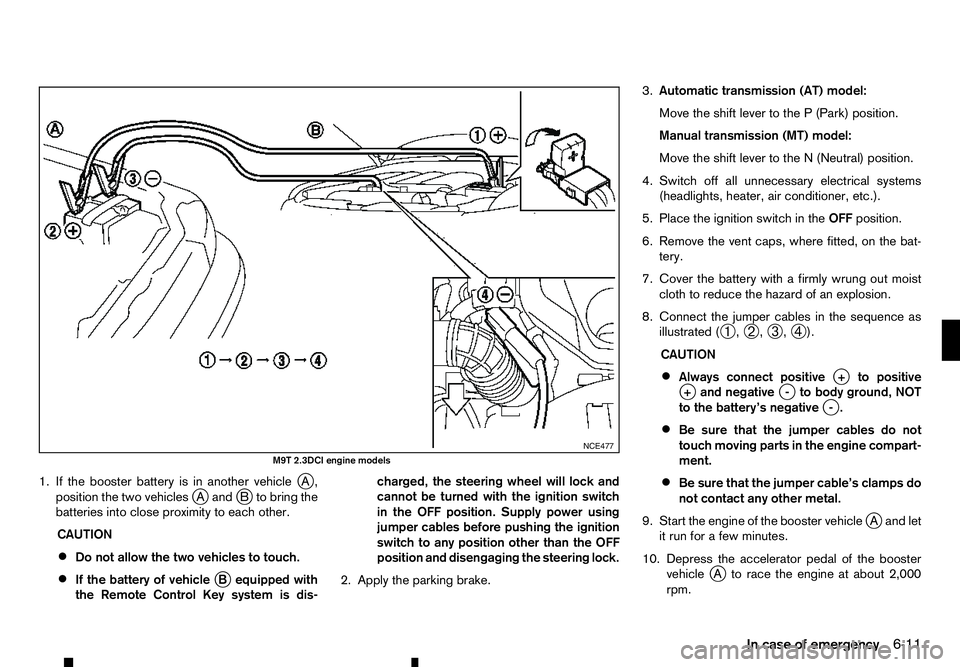
1. If the booster battery is in another vehicle
jA,
position the two vehicles j
Aa ndjBt obring the
batteries into close proximity to each other.
CAUTION
• Do not allow the two vehicles to touch.
• If the battery of vehicle
jBe quipped with
the Remote Control Key system is dis- charged, the steering wheel will lock and
cannot be turned with the ignition switch
in the OFF position. Supply power using
jumper cables before pushing the ignition
switch to any position other than the OFF
position and disengaging the steering lock.
2. Apply the parking brake. 3.
Automatic transmission (AT) model:
Move the shift lever to the P(Park) position.
Manual transmission (MT) model:
Move the shift lever to the N(Neutral) position.
4. Switch off all unnecessary electrical systems (headlights, heater, air conditioner, etc.).
5. Place the ignition switch in the OFFposition.
6. Remove the vent caps, where fitted, on the bat- tery.
7. Cover the battery with afirmly wrung out moist
cloth to reduce the hazard of an explosion.
8. Connect the jumper cables in the sequence as illustrated ( ➀,
➁ ,
➂ ,
➃ ).
CAUTION
• Always connect positive
j+t opositive
j +a nd negative j-t obody ground, NOT
to the battery’s negative j
-.
• Be sure that the jumper cables do not
touch moving parts in the engine compart-
ment.
• Be sure that the jumper cable’s clamps do
not contact any other metal.
9. Start the engine of the booster vehicle j
Aa nd let
it run for afew minutes.
10. Depress the accelerator pedal of the booster vehicle j
At orace the engine at about 2,000
rpm. NCE477
M9T 2.3DCI engine models
In case of emergency6-11
Page 267 of 340
4.
Automatic transmission model:
Move the shift lever to the P(Park) position.
Manual transmission model:
Move the shift lever to the N(Neutral) position.
DO NOT STOP THE ENGINE.
5. Open all the windows.
6. Turn off the air conditioner. Move the tempera- ture control to maximum hot and the fan control
to high speed.
7. Get out from the vehicle.
8. Visually inspect and listen for steam or coolant escaping from the radiator before opening the
bonnet. Wait until no steam or coolant can be
seen before proceeding.
9. Open the engine bonnet.
10. Visually inspect if the cooling fan is running.
11. Visually inspect the radiator and radiator hoses for leakage. If the cooling fan is not running or
the coolant is leaking, stop the engine.
12. After the engine cools down, check the coolant level in the reservoir with the engine running.
Do not open the radiator or coolant reservoir
cap.
13. Add coolant to the reservoir if necessary.
Have your vehicle inspected/repaired at an
approved dealer or qualified workshop. When towing your vehicle, local regulations for tow-
ing must be followed. Incorrect towing equipment
could damage your vehicle. To assure proper tow-
ing and to prevent accidental damage to your ve-
hicle, RENAULT recommends that you have profes-
sional road assistance personnel tow your vehicle. It
is advisable to have the professional road assistant
carefully read the following precautions.
TOWING PRECAUTIONS
• Be sure that the transmission, steering system
and powertrain are in working condition before
towing. If any units are damaged, the vehicle
must be towed using
adolly or flatbed tow truck.
(Two- Wheel Drive (2WD) model)
• RENAULT recommends that your vehicle be
towed with the driving wheels off the ground.
(Two- Wheel Drive (2WD) model)
• To tow
avehicle with automatic transmission,
and appropriate vehicle dolly MUSTbe placed
under the towed vehicles drive wheels. Always
follow the dolly manufacturer’s recommenda-
tions when using their product.
• Always attach safety chains before towing.
• Never tow Four-Wheel Drive (4WD) model with
any of the wheels on the ground as this may
cause serious and expensive damage to the driv-
etrain. TOWING RECOMMENDED BY
RENAULT
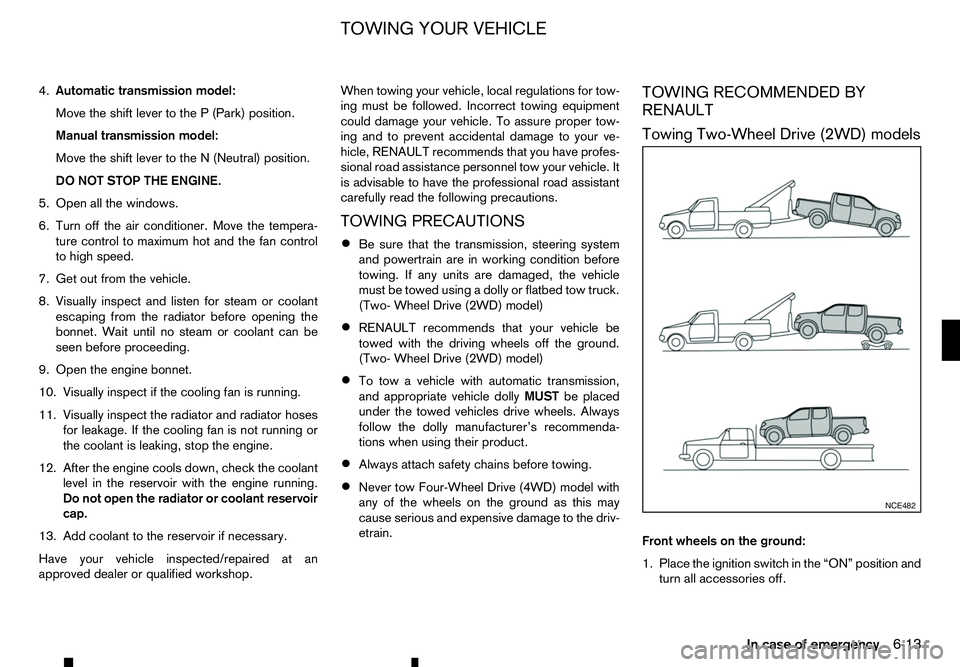
Towing Two-Wheel Drive (2WD) models
Front wheels on the ground:
1. Place the ignition switch in the “ON” position and
turn all accessories off. NCE482
TOWING YOUR VEHICLE
In case of emergency6-13
Page 268 of 340

2. Secure the steering wheel in
astraight ahead
position with rope or similar device.
3. Move the shift lever to the N(Neutral) position.
4. Release the parking brake.
5. Attach safety chains before towing.
Rear wheels on the ground:
RENAULT recommends that towing dollies be used
under the rear wheels when towing your vehicle or
the vehicle be placed on aflatbed tow truck as illus-
trated.
CAUTION
Never tow Automatic Transmission (AT) model
with the rear wheels on the ground. Doing so will
cause serious and expensive damage to the
transmission.
Manual Transmission (MT) model:
If you have to tow aMTvehicle with rear wheels on
the ground, perform the following procedures.
CAUTION
Observe the following restricted towing speeds
and distances.
• Speed: Below 50 km/h (30 MPH)
• Distance: Less than 65 km (40 miles)
1. Place the ignition switch in the “ON” position and turn all accessories off.
2. Move the shift lever to the N(Neutral) position.
3. Release the parking brake. 4. Attach safety chains whenever towing.
All four wheels on the ground:
RENAULT recommends that the vehicle be placed
on
aflatbed tow truck as illustrated.
CAUTION
Never tow Automatic Transmission (AT) model
with all four wheels on the ground. Doing so will
cause serious and expensive damage to the driv-
etrain.
Manual Transmission (MT) model:
If you have to tow aMTvehicle with all four wheels
on the ground, perform the following procedures.
CAUTION
• Never tow
aManual Transmission (MT) model
backward with all four wheels on the ground.
• Observe the following restricted towing
speeds and distances.
–S
peed: Below 50 km/h (30 MPH)
–D istance: Less than 65 km (40 miles)
1. Place the ignition switch in the “ON” position and turn all accessories off.
2. Move the shift lever to the N(Neutral) position.
3. Release the parking brake.
6-14 In case of emergency
Page 280 of 340
Windscreen wiper and washer*:
Check that the wipers and washer operate properly
and that the wipers do not streak.
Under bonnet and vehicle
The maintenance items listed here should be
checked periodically (for example, each time you
check the engine oil or refuel).
Battery (except for maintenance free batter-
ies)*:
Check the fluid level in each cell. It should be be-
tween the
operated in high temperatures or under severe con-
ditions require frequent checks of the battery fluid
level.
Brake (and clutch) fluid level(s)*:
For Manual Transmission (MT) model: make sure
that the brake and clutch fluid levels are between
the
Except for Manual Transmission (MT) model: make
sure that the brake fluid level is between the
and
Engine coolant level*:
Check the coolant level when the engine is cold.
Make sure that the coolant level is between the
Engine drive belt(s)*:
Make sure that drive belt(s) is/are not frayed, worn,
cracked or oily. Engine oil level*:
Check the level after parking the vehicle (on
alevel
ground) and turning off the engine.
Fluid leaks:
Check under the vehicle for fuel, oil, water or other
fluid leaks after the vehicle has been parked for a
while. Water dripping from the air conditioner after
use is normal. If you should notice any leaks or if fuel
fumes are evident, check for cause and have it cor-
rected immediately.
Power steering fluid level and lines*:
Check the level when the fluid is cold, with the en-
gine off. Check the lines for proper attachment,
leaks, cracks, etc.
Windscreen washer fluid*:
Check that there is adequate fluid in the reservoir.
MAINTENANCE PRECAUTIONS
When performing any inspection or maintenance
work on your vehicle, always take care to prevent
serious accidental injury to yourself or damage to
the vehicle. The following are general precautions
which should be closely observed. WARNING
• Park the vehicle on
alevel surface, apply the
parking brake securely and block the wheels
to prevent the vehicle from moving. Move the
shift lever to the P(Park) position (AT model)
or the shift lever to the N(Neutral) position
(MT model). •
Be sure the ignition switch is in the LOCK
position when performing any parts replace-
ment or repairs.
• Do not work under the bonnet while the en-
gine is hot. Always turn off the engine and
wait until it cools down.
• If you must work with the engine running,
keep your hands, clothing, hair and tools away
from moving fans, belts and any other moving
parts.
• It is advisable to secure or remove any loose
clothing and any jewellery, such as rings,
watches, etc. before working on your vehicle.
• If you must run the engine in an enclosed
space such as
agarage, be sure there is
proper ventilation for exhaust gasses to es-
cape.
• DO NOT GET UNDER
AVEHICLE THAT IS
SUPPORTED BY AJACK.
• Keep smoking materials, flame and sparks
away from fuel and the battery.
• Never connect or disconnect either the bat-
tery or any transistorised component connec-
tor while the ignition switch is in the ON posi-
tion.
8-4 Maintenance and do-it-yourself
Page 283 of 340
9. Recheck the oil level with the dipstick.
CAUTION
• The oil level should be checked regularly. Op-
erating your vehicle with an insufficient
amount of oil can damage the engine, and
such damage is not covered by the warranty.
• It is normal to add some oil between oil main-
tenance intervals or during the running-in pe-
riod, depending on the severity of operating
conditions.
CHANGING ENGINE OIL AND OIL
FILTER
Contact an approved dealer or qualified workshop
when the engine oil and oil filter require replace-
ment.
PROTECT ENVIRONMENT
It is illegal to pollute drains, watercourses and soil.
Use authorised waste collection facilities, including
civil amenity sites and garages providing facilities
for disposal of used oil and used oil filters. If in
doubt, contact your local authority for advice on dis-
posal.
The regulations concerning the pollution of the
environment will vary from country to country. REFILLING THE AdBlue® TANK
When the [Refill AdBlue] warning appears in the
vehicle information display, refill the AdBlue® tank
before the tank is empty (see “AdBlue® Selective
Catalytic Reduction (SCR) system (where fitted for
diesel engine model)” in the “5. Starting and driving”
section for the AdBlue® warning display.) Refill the
AdBlue® tank according to the procedures shown
in this section.
CAUTION
•
Use only AdBlue®. Using other fluids will
damage the AdBlue® Selective Catalytic Re-
duction (SCR) system.
• Be careful not to spill AdBlue®. If the AdBlue®
is spilled on the vehicle body, wipe it away
with
awet cloth immediately to avoid paint
damage.
• AdBlue® residues crystallize after
aperiod of
time and contaminate the paint surfaces. If
the spilled AdBlue® has crystallized, use a
sponge and cold water to clean it.
• Be careful not to inhale any ammonia vapours
that may be released. Fill the AdBlue® tank in
well-ventilated areas.
The AdBlue® tank is located underneath the ve-
hicle. (see “AdBlue® filler lid and cap” in the “3. Pre-
driving checks and adjustments” section for the
AdBlue® filler lid location.)
1. Apply the parking brake. 2. Automatic Transmission (AT) model: Move the
shift lever to the P(Park) position.
Manual Transmission (MT) model: Move the shift
lever to the N(Neutral) position.
3. Place the ignition switch in the OFFposition.
4. Open the AdBlue® filler lid.
5. Remove the AdBlue® tank cap by turning it anticlockwise.
6. Refill the AdBlue® tank.
7. Securely install the AdBlue® tank cap.
8. Close the AdBlue® filler lid.
9. Place the ignition switch in the ONposition and
wait for approximately 1minute until the [Refill
AdBlue] warning turns off.
NOTE
In the case that the [ENG can’t start Refill
AdBlue] warning was displayed, check that
the warning turned off, place the ignition
switch in the OFF position once and then startthe engine.
AdBlue® TANK (where fitted for
diesel engine model)
Maintenance and do-it-yourself8-7
Page 327 of 340
–C
hild restraints ..................................................... 1-18, 1-19
–I nstallation ..................................................................... 1-22
J Jump starting ....................................................................... 6-10
K Keys ........................................................................V
.............. 3-2
–B attery replacement ...................................................... 8-13
–R adio approval number and information ........................... 9-9
–R adio approval numbers and information ......................... 9-9
–R emote Control Key ........................................................ 3-7
–R emote Control Key operating range ............................... 3-9
–R emote keyless entry ..................................................... 3-14
–U sing Remote Control Key system ................................... 3-9
L Labels
–A
ir conditioner ................................................................. 9-8
–B attery caution label ...................................................... 8-12
–T yres ........................................................................V
....... 9-8
–V ehicle identification ........................................................ 9-7
Lights ........................................................................V
.......... 8-20
–E xterior —Bulb information ........................................... 8-21
–H eadlight bulb replacement ........................................... 8-21
–I nterior —Information .................................................... 8-22
–L ocations ...................................................................... 8-23
–R eplacement ................................................................. 8-23
–S witch —Fog lights ...................................................... 2-33
–S witch —Hazard warning flasher .................................... 6-2
–W arning lights ................................................................. 2-5 Locks
–H
azard indicator operation ............................................. 3-15
Lumbar support ..................................................................... 1-4
M Maintenance
–G
eneral maintenance ....................................................... 8-2
–P recautions ..................................................................... 8-4
–R equirements .................................................................. 8-2
–S eat belts ...................................................................... 1-14
Manual Transmission (MT)
–O peration ...................................................................... 5-22
–S hifting ........................................................................V
.. 5-22
–S tarting ........................................................................V
. 5-22
Map lights
–O peration ...................................................................... 2-43
Meters and gauges ............................................................... 2-2
–B rightness control ........................................................... 2-4
–E ngine coolant temperature ............................................. 2-3
–F uel ........................................................................V
......... 2-2
–O dometer ........................................................................V
2-2
–O verview ....................................................................... 0-10
–S peedometer .................................................................. 2-2
–T achometer ..................................................................... 2-3
Mirrors
–A djustment .................................................................... 3-25
–A utomatic anti-dazzling inside mirror .............................. 3-24
–F olding ........................................................................V
.. 3-25
–R ear-view (Inside) .......................................................... 3-23
–R ear-view (Outside) ....................................................... 3-25
–V anity mirror .................................................................. 3-26
Mobile phone integration for FM AM radio with CD
player ........................................................................V
. 4-59, 4-65
Index10-5