service RENAULT ALASKAN 2017 Owner's Manual
[x] Cancel search | Manufacturer: RENAULT, Model Year: 2017, Model line: ALASKAN, Model: RENAULT ALASKAN 2017Pages: 340, PDF Size: 6.93 MB
Page 278 of 340
Some day-to-day and regular maintenance is essen-
tial to maintain your vehicle’s good mechanical con-
dition, as well as its emission and engine perfor-
mance.
It is the owner’s responsibility to make sure that the
specified maintenance, as well as general mainte-
nance, is performed.
As the vehicle owner, you are the only one who can
ensure that your vehicle receives the proper mainte-
nance care.
SCHEDULED MAINTENANCE
For your convenience, the required scheduled main-
tenance items are described and listed in aseparate
Warranty Information and Maintenance booklet. You
must refer to that booklet to ensure that necessary
maintenance is performed on your vehicle at regular
intervals.
GENERAL MAINTENANCE
General maintenance includes those items which should be checked during normal day-to-day opera-
tion of the vehicle. They are essential if your vehicle
is to continue to operate properly. It is your respon-
sibility to perform these procedures regularly as pre- scribed.
Performing general maintenance checks requires
minimal mechanical skill and only afew general au-
tomotive tools.
These checks or inspections can be done by your-
self, aqualified technician, or if you prefer, your
approved dealer or qualified workshop. WHERE TO GO FOR SERVICE
If maintenance service is required or your vehicle
appears to malfunction, have the systems checked
and tuned by an authorised approved dealer or
qualified workshop.
During normal day-to-day operation of the vehicle,
general maintenance should be performed regularly
as prescribed in this section. If you detect any un-
usual sounds, vibrations or smells, be sure to check
for the cause or have an approved dealer or quali-
fied workshop do it promptly. In addition, you should
notify an approved dealer or qualified workshop if
you think that repairs are required.
When performing any checks or maintenance work,
closely observe “Maintenance precautions” later in
this section.
EXPLANATION OF GENERAL
MAINTENANCE ITEMS
Additional information on the following items with
“*” is found later in this section.
Outside vehicle
The maintenance items listed here should be per-
formed from time to time, unless otherwise speci-
fied.
Doors and bonnet:
Check that all doors and the bonnet operate
smoothly as well as the tailgate. Also make sure that
all latches lock securely. Lubricate if necessary.
Make sure that the secondary latch keeps the bon-
net from opening when the primary latch is released.
When driving in areas using road salt or other cor-
rosive materials, check lubrication frequently.
MAINTENANCE REQUIREMENTS
GENERAL MAINTENANCE
8-2 Maintenance and do-it-yourself
Page 282 of 340
The radiator is fitted with
apressure cap. To prevent
engine damage, use only aGenuine RENAULT ra-
diator cap or its equivalent when replacement is
required.
CHECKING ENGINE COOLANT
LEVEL
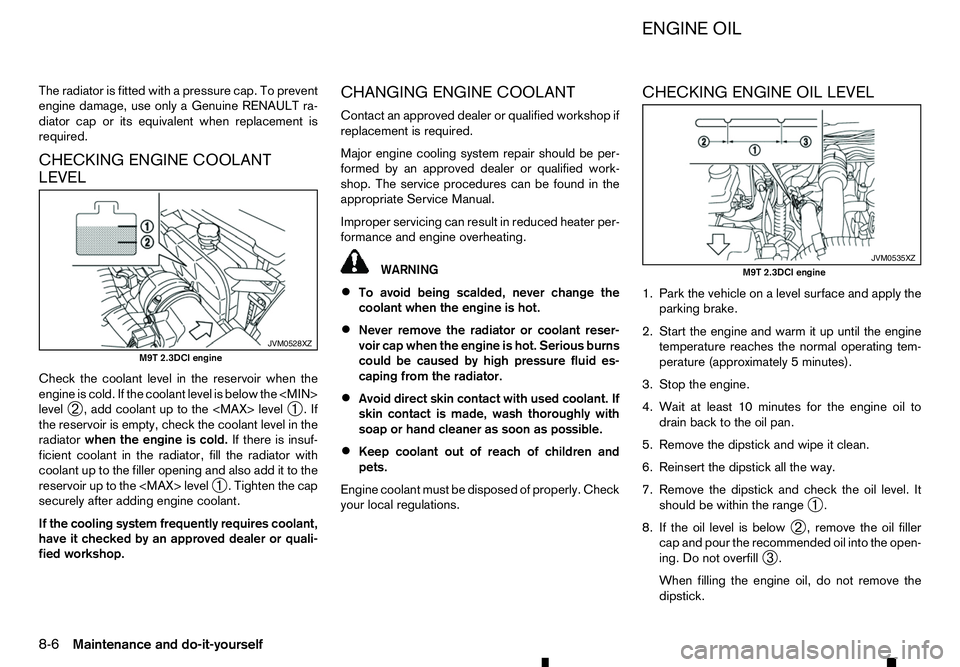
Check the coolant level in the reservoir when the
engine is cold. If the coolant level is below the
level ➁,a
dd coolant up to the
➀.If
the reservoir is empty, check the coolant level in the
radiator when the engine is cold. If there is insuf-
ficient coolant in the radiator, fill the radiator with
coolant up to the filler opening and also add it to the
reservoir up to the
ighten the cap
securely after adding engine coolant.
If the cooling system frequently requires coolant,
have it checked by an approved dealer or quali-
fied workshop. CHANGING ENGINE COOLANT
Contact an approved dealer or qualified workshop if
replacement is required.
Major engine cooling system repair should be per-
formed by an approved dealer or qualified work-
shop. The service procedures can be found in the
appropriate Service Manual.
Improper servicing can result in reduced heater per-
formance and engine overheating.
WARNING
• To avoid being scalded, never change the
coolant when the engine is hot.
• Never remove the radiator or coolant reser-
voir cap when the engine is hot. Serious burns
could be caused by high pressure fluid es-
caping from the radiator.
• Avoid direct skin contact with used coolant. If
skin contact is made, wash thoroughly with
soap or hand cleaner as soon as possible.
• Keep coolant out of reach of children and
pets.
Engine coolant must be disposed of properly. Check
your local regulations. CHECKING ENGINE OIL LEVEL
1. Park the vehicle on
alevel surface and apply the
parking brake.
2. Start the engine and warm it up until the engine temperature reaches the normal operating tem-
perature (approximately 5minutes).
3. Stop the engine.
4. Wait at least 10 minutes for the engine oil to drain back to the oil pan.
5. Remove the dipstick and wipe it clean. 6. Reinsert the dipstick all the way.
7. Remove the dipstick and check the oil level. It should be within the range ➀.
8. If the oil level is below ➁,r
emove the oil filler
cap and pour the recommended oil into the open-
ing. Do not overfill ➂.
When filling the engine oil, do not remove the
dipstick. JVM0528XZ
M9T 2.3DCI engine JVM0535XZ
M9T 2.3DCI engine
ENGINE OIL
8-6 Maintenance and do-it-yourself
Page 284 of 340
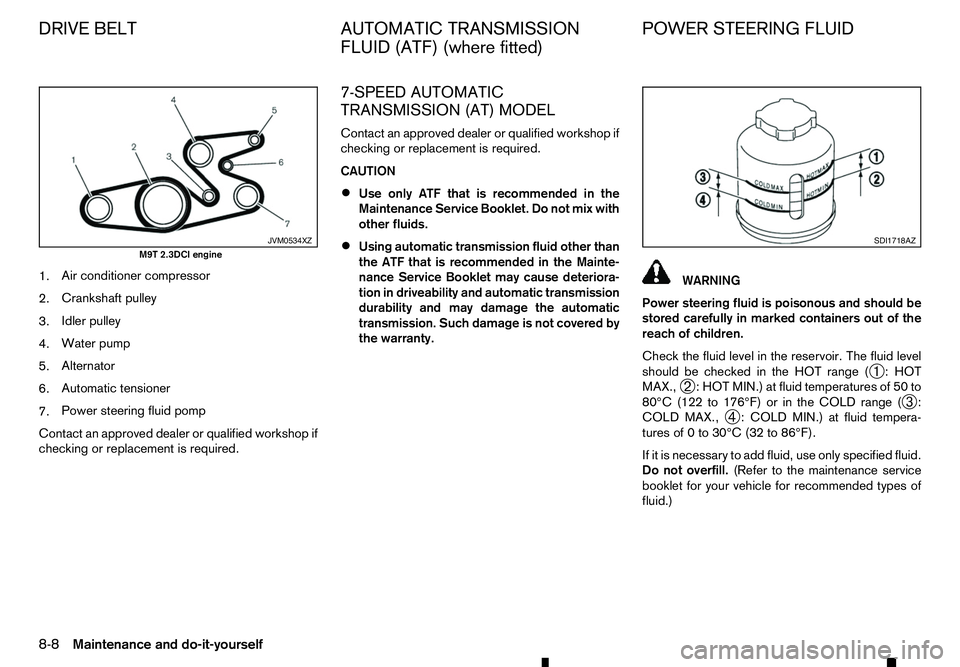
1.
Air conditioner compressor
2. Crankshaft pulley
3. Idler pulley
4. Water pump
5. Alternator
6. Automatic tensioner
7. Power steering fluid pomp
Contact an approved dealer or qualified workshop if
checking or replacement is required. 7-SPEED AUTOMATIC
TRANSMISSION (AT) MODEL
Contact an approved dealer or qualified workshop if
checking or replacement is required.
CAUTION
•
Use only ATF that is recommended in the
Maintenance Service Booklet. Do not mix with
other fluids.
• Using automatic transmission fluid other than
the ATF that is recommended in the Mainte-
nance Service Booklet may cause deteriora-
tion in driveability and automatic transmission
durability and may damage the automatic
transmission. Such damage is not covered by
the warranty. WARNING
Power steering fluid is poisonous and should be
stored carefully in marked containers out of the
reach of children.
Check the fluid level in the reservoir. The fluid level
should be checked in the HOT range ( ➀:H
OT
MAX., ➁:H
OT MIN.) at fluid temperatures of 50 to
80°C (122 to 176°F) or in the COLD range ( ➂:
COLD MAX., ➃:C
OLD MIN.) at fluid tempera-
tures of 0to30°C (32 to 86°F).
If it is necessary to add fluid, use only specified fluid.
Do not overfill. (Refer to the maintenance service
booklet for your vehicle for recommended types of
fluid.) JVM0534XZ
M9T 2.3DCI engine
SDI1718AZ
DRIVE BELT
AUTOMATIC TRANSMISSION
FLUID (ATF) (where fitted) POWER STEERING FLUID
8-8 Maintenance and do-it-yourself
Page 286 of 340
2. While depressing the footbrake pedal, start the
engine. The pedal height should drop alittle.
3. With the footbrake pedal depressed, stop the engine. Keep the pedal depressed for about 30
seconds. The pedal height should not change.
4. Run the engine for 1minute without depressing
the footbrake pedal, then turn it off. Depress the
footbrake pedal several times. The pedal travel
distance will decrease gradually with each de-
pression as the vacuum is released from the
booster.
If the brakes do not operate properly, have the
brakes checked by an approved dealer or qualified
workshop. WARNING
• Use only new fluid from
asealed container.
Old, inferior, or contaminated fluid may dam-
age the brake system. The use of improper
fluids can damage the brake system and af-
fect the vehicle’s stopping ability.
• Clean the filler cap before removing.
• Brake fluid is poisonous and should be stored
carefully in marked containers out of the reach
of children.
CAUTION
• Refilling and checking the brake system
should be left to an approved dealer or quali-
fied workshop who will have the necessary
brake fluid and technical knowledge.
• Do not spill the fluid on painted surfaces. This
will damage the paint. If fluid is spilled, wash
with water.
For details of recommended fluids, refer to the main-
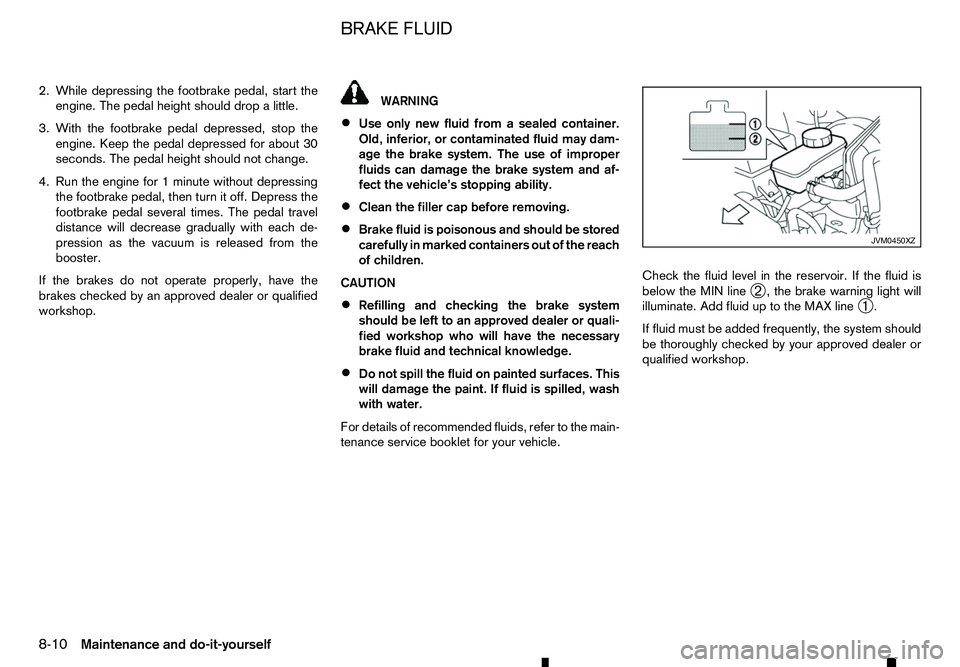
tenance service booklet for your vehicle. Check the fluid level in the reservoir. If the fluid is
below the MIN line
➁,t
he brake warning light will
illuminate. Add fluid up to the MAX line ➀.
If fluid must be added frequently, the system should
be thoroughly checked by your approved dealer or
qualified workshop. JVM0450XZ
BRAKE FLUID
8-10 Maintenance and do-it-yourself
Page 287 of 340
WARNING
• Use only new fluid from
asealed container.
Old, inferior, or contaminated fluid may dam- age the clutch system.
• Clean the filler cap before removing.
• Clutch fluid is poisonous and should be stored
carefully in marked containers out of the reach
of children.
CAUTION
• Refilling and checking the clutch system
should be left to an approved dealer or quali-
fied workshop who will have the necessary
clutch fluid and technical knowledge.
• Do not spill the fluid on painted surfaces. This
will damage the paint. If fluid is spilled, wash
with water.
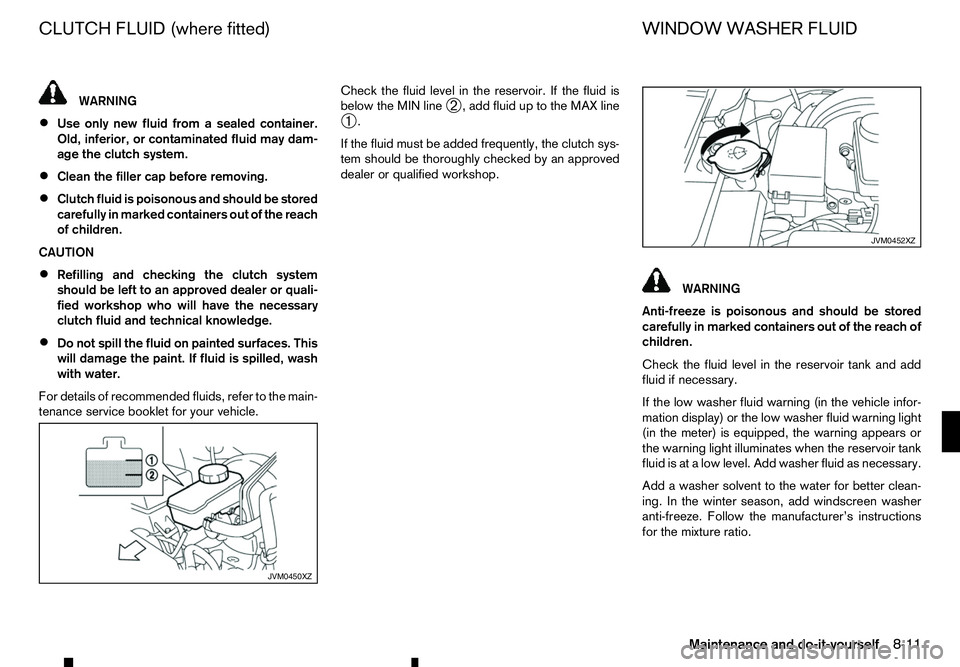
For details of recommended fluids, refer to the main- tenance service booklet for your vehicle. Check the fluid level in the reservoir. If the fluid is
below the MIN line
➁,a
dd fluid up to the MAX line
➀ .
If the fluid must be added frequently, the clutch sys-
tem should be thoroughly checked by an approved
dealer or qualified workshop. WARNING
Anti-freeze is poisonous and should be stored
carefully in marked containers out of the reach of
children.
Check the fluid level in the reservoir tank and add
fluid if necessary.
If the low washer fluid warning (in the vehicle infor-
mation display) or the low washer fluid warning light
(in the meter) is equipped, the warning appears or
the warning light illuminates when the reservoir tank
fluid is at alow level. Add washer fluid as necessary.
Add awasher solvent to the water for better clean-
ing. In the winter season, add windscreen washer
anti-freeze. Follow the manufacturer’s instructions
for the mixture ratio. JVM0450XZ JVM0452XZ
CLUTCH FLUID (where fitted)
WINDOW WASHER FLUID
Maintenance and do-it-yourself 8-11
Page 304 of 340
•
Incorrect tyre selection, fitting, care or main-
tenance can affect vehicle safety with risk of
accident and injury. If in doubt, consult an
approved dealer or qualified workshop or the
tyre manufacturer.
TYRE WEAR AND DAMAGE
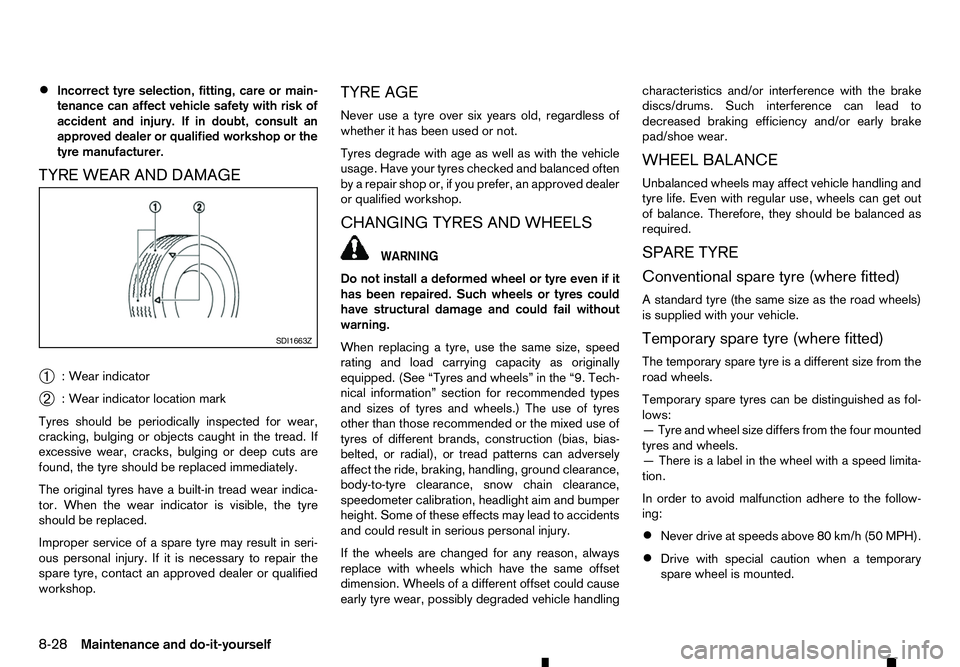
➀ :W
ear indicator
➁ :W
ear indicator location mark
Tyres should be periodically inspected for wear,
cracking, bulging or objects caught in the tread. If
excessive wear, cracks, bulging or deep cuts are
found, the tyre should be replaced immediately.
The original tyres have abuilt-in tread wear indica-
tor. When the wear indicator is visible, the tyre
should be replaced.
Improper service of aspare tyre may result in seri-
ous personal injury. If it is necessary to repair the
spare tyre, contact an approved dealer or qualified
workshop. TYRE AGE
Never use
atyre over six years old, regardless of
whether it has been used or not.
Tyres degrade with age as well as with the vehicle
usage. Have your tyres checked and balanced often
by arepair shop or, if you prefer, an approved dealer
or qualified workshop.
CHANGING TYRES AND WHEELS WARNING
Do not install
adeformed wheel or tyre even if it
has been repaired. Such wheels or tyres could
have structural damage and could fail without
warning.
When replacing atyre, use the same size, speed
rating and load carrying capacity as originally
equipped. (See “Tyres and wheels” in the “9. Tech-
nical information” section for recommended types
and sizes of tyres and wheels.) The use of tyres
other than those recommended or the mixed use of
tyres of different brands, construction (bias, bias-
belted, or radial), or tread patterns can adversely
affect the ride, braking, handling, ground clearance,
body-to-tyre clearance, snow chain clearance,
speedometer calibration, headlight aim and bumper
height. Some of these effects may lead to accidents
and could result in serious personal injury.
If the wheels are changed for any reason, always
replace with wheels which have the same offset
dimension. Wheels of adifferent offset could cause
early tyre wear, possibly degraded vehicle handling characteristics and/or interference with the brake
discs/drums. Such interference can lead to
decreased braking efficiency and/or early brake
pad/shoe wear.
WHEEL BALANCE
Unbalanced wheels may affect vehicle handling and
tyre life. Even with regular use, wheels can get out
of balance. Therefore, they should be balanced as
required.
SPARE TYRE
Conventional spare tyre (where fitted)
As tandard tyre (the same size as the road wheels)
is supplied with your vehicle.
Temporary spare tyre (where fitted)
The temporary spare tyre is adifferent size from the
road wheels.
Temporary spare tyres can be distinguished as fol-
lows:
—T yre and wheel size differs from the four mounted
tyres and wheels.
—T here is alabel in the wheel with aspeed limita-
tion.
In order to avoid malfunction adhere to the follow-
ing:
• Never drive at speeds above 80 km/h (50 MPH).
• Drive with special caution when
atemporary
spare wheel is mounted. SDI1663Z
8-28 Maintenance and do-it-yourself
Page 308 of 340
Refer to the maintenance service booklet for your
vehicle for details of recommended fluids/lubricants
and capacities.
FUEL INFORMATION
Diesel engine*
M9T 2.3DCI engine:
Diesel fuel above 50 cetane and with less than 10
ppm of sulphur (EN590) must be used.
* If two types of diesel fuel are available, use
summer or winter fuel properly according to
the following temperature conditions.
• Above –7°C (20°F) ... Summer type diesel fuel.
• Below –7°C (20°F) ... Winter type diesel fuel.
CAUTION
• Do not use home heating oil, petrol or other
alternate fuels in your diesel engine. The use
of those or adding those to diesel fuel can
cause engine damage.
• Do not use summer fuel at temperatures be-
low –7°C (20°F). The cold temperatures will
cause wax to form in the fuel. As
aresult, it
may prevent the engine from running
smoothly. AUTOMATIC TRANSMISSION FLUID
(ATF)
Contact an approved dealer or qualified workshop if
checking or replacement is required.
CAUTION
• Use only ATF that is recommended in the
Maintenance Service Booklet. Do not mix with
other fluids.
• Using automatic transmission fluid other than
the ATF that is recommended in the Mainte-
nance Service Booklet may cause deteriora-
tion in driveability and automatic transmission
durability and may damage the automatic
transmission. Such damage is not covered by
the warranty.
AIR CONDITIONER SYSTEM
REFRIGERANT AND LUBRICANT
The air conditioner system of your vehicle must be
charged with the refrigerant HFC-134a (R134a) and the lubricant specified in the maintenance service
booklet for your vehicle..
CAUTION
Use of any other refrigerants or lubricants will
cause severe damage, and you may need to re-
place your vehicle’s entire air conditioner sys-
tem. The release of refrigerants into the atmosphere is
prohibited in many countries and regions. The re-
frigerant HFC-134a (R-134a) in your vehicle will not
harm the Earth’s ozone layer. However, it may con-
tribute in asmall part to the global warming effect.
RENAULT recommends that the refrigerant be ap-
propriately recovered and recycled. Contact an ap-
proved dealer or qualified workshop when servicing
the air conditioner system.
RECOMMENDED FLUIDS/
LUBRICANTS AND CAPACITIES
9-2
Technical information
Page 329 of 340
–M
irrors -Outside ........................................................... 3-25
Remote Control Key .............................................................. 3-7
–B attery -Discharge ........................................................ 5-17
–O perating range .............................................................. 3-9
–O peration ........................................................................V
3-9
–P ush-button ignition switch ............................................ 5-15
–R adio approval numbers and information ......................... 9-9
–R emote keyless entry ..................................................... 3-14
–S tarting engine .............................................................. 5-18
–S ystem ........................................................................V
.. 5-15
–T roubleshooting guide ................................................... 3-12
–W arning signals ............................................................. 3-11
Remote keyless entry .......................................................... 3-14
Replacement
–A ir bags ........................................................................V
1-40
–A ir cleaner filter ............................................................. 8-15
–B attery (Key fob) ........................................................... 8-13
–E ngine coolant ................................................................. 8-6
–E ngine oil ........................................................................V
8-7
–E ngine oil filter ................................................................. 8-7
–F uses ........................................................................V
.... 8-18
–L ights ........................................................................V
.... 8-23
–R emote Control Key battery ........................................... 8-14
–W iper blades ................................................................. 8-17
Reversing camera ................................................................. 4-7
–S ettings ........................................................................V
. 4-10
–T ips ........................................................................V
....... 4-10
Roof rail ........................................................................V
...... 2-41
Room light
–O peration ...................................................................... 2-44
–R eplacement ................................................................. 8-23
Running-in schedule .............................................................. 5-2 SSafety
–H
ead restraints ................................................................ 1-6
Seat belts ........................................................................V
...... 1-9
–A djustment .................................................................... 1-12
–C ENTER mark ............................................................... 1-11
–C hecking ...................................................................... 1-13
–C hild safety ................................................................... 1-11
–C hildren -Infants ........................................................... 1-11
–C hildren -Larger ........................................................... 1-11
–C hildren -Small ............................................................. 1-11
–C leaning ........................................................................V
.. 7-4
–I njured persons ............................................................. 1-11
–M aintenance .................................................................. 1-14
–P recautions ..................................................................... 1-9
–P regnant women ........................................................... 1-11
–T hree-point type ............................................................ 1-12
–T wo-point type ............................................................... 1-13
Seats ........................................................................V
............ 1-2
–A djustment (Manual) ........................................................ 1-2
–A djustment (Power) ......................................................... 1-3
–F olding ........................................................................V
.... 1-5
–F ront seats ...................................................................... 1-2
–H ead restraints ................................................................ 1-6
–I SOFIX child restraints ......................................... 1-18, 1-19
–J ump seat ........................................................................V
1-6
–L umbar support ............................................................... 1-4
–R ear ........................................................................V
........ 1-5
–U niversal child restraints (front and rear seats) ............... 1-15
Security system ................................................................... 3-15
Service
–M aintenance .................................................................... 8-2
Spare tyre ........................................................................V
..... 6-3
Speed limiter
–O peration ...................................................................... 5-42
Speedometer ........................................................................V
2-2
Index10-7