parking brake RENAULT ALASKAN 2017 Owner's Guide
[x] Cancel search | Manufacturer: RENAULT, Model Year: 2017, Model line: ALASKAN, Model: RENAULT ALASKAN 2017Pages: 340, PDF Size: 6.93 MB
Page 277 of 340
8
Maintenance and do-it-yourself
Maintenance and do-it-yourself
Maintenance requirements ....................................... 8-2 Scheduled maintenance...................................... 8-2
General maintenance .......................................... 8-2
Where to go for service ...................................... 8-2
General maintenance ............................................... 8-2 Explanation of general maintenance items ........... 8-2
Maintenance precautions .................................... 8-4
Engine compartment check locations ....................... 8-5
Engine cooling system ............................................. 8-5 Checking engine coolant level............................. 8-6
Changing engine coolant .................................... 8-6
Engine oil................................................................. 8-6
Checking engine oil level .................................... 8-6
Changing engine oil and oil filter ......................... 8-7
Protect environment ............................................ 8-7
AdBlue® tank (where fitted for diesel engine
model) ..................................................................... 8-7 Refilling the AdBlue® tank .................................. 8-7
Drive belt ................................................................. 8-8
Automatic Transmission Fluid (ATF) (where fitted).... 8-8 7-speed Automatic Transmission (AT) model....... 8-8
Power steering fluid ................................................. 8-8
Brakes ..................................................................... 8-9 Checking parking brake ...................................... 8-9
Checking footbrake ............................................ 8-9
Brake booster ..................................................... 8-9
Brake fluid ............................................................... 8-10
Clutch fluid (where fitted) ......................................... 8-11 Window washer fluid ............................................... 8-11
Battery..................................................................... 8-12
Vehicle battery .................................................... 8-13
Remote controller battery (where fitted) .............. 8-13
Remote Control Key battery (where fitted)........... 8-14
Air cleaner filter........................................................ 8-15
Wiper blades ........................................................... 8-16 Windscreen wiper blades ................................... 8-16
Variable voltage control system (where fitted) ........... 8-17
Fuses ...................................................................... 8-18 Engine compartment ........................................... 8-18
Passenger compartment ..................................... 8-19
Lights ...................................................................... 8-20
Headlights .......................................................... 8-20
Exterior lights ...................................................... 8-21
Interior lights....................................................... 8-22
Light locations .................................................... 8-23
Tyres and wheels ..................................................... 8-26 Tyre inflation pressure......................................... 8-26
Types of tyres ..................................................... 8-26
Tyre chains ......................................................... 8-27
Tyre rotation ....................................................... 8-27
Tyre wear and damage ....................................... 8-28
Tyre age ............................................................. 8-28
Changing tyres and wheels................................. 8-28
Wheel balance.................................................... 8-28
Spare tyre .......................................................... 8-28
Page 279 of 340
Lights*:
Clean the headlights on
aregular basis. Make sure
that the headlights, stop lights, tail lights, turn signal
lights, and other lights are all operating properly and
installed securely. Also check the aim of the head-
lights.
Tyres*:
Check the pressure with agauge often and always
prior to long distance trips. Adjust the pressure in all
tyres, including the spare, to the pressure specified.
Check carefully for damage, cuts or excessive wear.
Tyre rotation*:
In the case of Two-Wheel Drive (2WD), and where
front and rear tyres are the same size: tyres should
be rotated every 10,000 km (6,000 miles). Tyres
marked with directional indicators can only be ro-
tated between front and rear. Make sure that the
directional indicators point in the direction of wheel
rotation after the tyre rotation is completed.
In the case of the Four-Wheel Drive and All Wheel
Drive (4WD/AWD), and where front and rear tyres
are the same size: tyres should be rotated every
5,000 km (3,000 miles). Tyres marked with direc-
tional indicators can only be rotated between front
and rear. Make sure that the directional indicators
point in the direction of wheel rotation after the tyre
rotation is completed.
In the case that front tyres are different size from
rear tyres: tyres cannot be rotated.
The timing for tyre rotation may vary according to
your driving habits and the road surface conditions. Tyre Pressure Monitoring System (TPMS)
transmitter components (where fitted):
Replace the TPMS transmitter grommet seal, valve
core and cap when the tyres are replaced due to
wear or age.
Wheel alignment and balance:
If the vehicle should pull to either side while driving
on astraight and level road, or if you detect uneven
or abnormal tyre wear, there may be aneed for
wheel alignment. If the steering wheel or seat vi-
brates at normal highway speeds, wheel balancing
may be needed.
Windscreen:
Clean the windscreen on aregular basis. Check the
windscreen at least every six months for cracks or
other damage. Repair as necessary.
Wiper blades*:
Check for cracks or wear if not functioning cor-
rectly. Replace as necessary.
Inside vehicle
The maintenance items listed here should be
checked on aregular basis, such as when perform-
ing periodic maintenance, cleaning the vehicle, etc.
Accelerator pedal:
Check the pedal for smooth operation and make
sure that the pedal does not catch or require uneven
effort. Keep the floor mats away from the pedal. Brake pedal*:
Check the pedal for smooth operation and make
sure that it is the proper distance from the floor mat
when depressed fully. Check the brake booster
function. Be sure to keep the floor mats away from
the pedal.
Parking brake*:
Check the parking brake operation regularly. Check
that the lever (where fitted) or the pedal (where fit-
ted) has the proper travel. Also make sure that the
vehicle is held securely on
afairly steep hill when
only the parking brake is applied.
Seat belts:
Check that all parts of the seat belt system (for
example, buckles, anchors, adjusters and retrac-
tors) operate properly and smoothly, and are in-
stalled securely. Check the belt webbing for cuts,
fraying, wear or damage.
Steering wheel:
Check for changes in the steering condition, such
as excessive play, hard steering or strange noises.
Warning lights and chimes:
Make sure that all warning lights and chimes are
operating properly.
Windscreen defogger:
Check that the air comes out of the defogger outlets
properly and in good quantity when operating the
heater or air conditioner.
Maintenance and do-it-yourself 8-3
Page 280 of 340
Windscreen wiper and washer*:
Check that the wipers and washer operate properly
and that the wipers do not streak.
Under bonnet and vehicle
The maintenance items listed here should be
checked periodically (for example, each time you
check the engine oil or refuel).
Battery (except for maintenance free batter-
ies)*:
Check the fluid level in each cell. It should be be-
tween the
operated in high temperatures or under severe con-
ditions require frequent checks of the battery fluid
level.
Brake (and clutch) fluid level(s)*:
For Manual Transmission (MT) model: make sure
that the brake and clutch fluid levels are between
the
Except for Manual Transmission (MT) model: make
sure that the brake fluid level is between the
and
Engine coolant level*:
Check the coolant level when the engine is cold.
Make sure that the coolant level is between the
Engine drive belt(s)*:
Make sure that drive belt(s) is/are not frayed, worn,
cracked or oily. Engine oil level*:
Check the level after parking the vehicle (on
alevel
ground) and turning off the engine.
Fluid leaks:
Check under the vehicle for fuel, oil, water or other
fluid leaks after the vehicle has been parked for a
while. Water dripping from the air conditioner after
use is normal. If you should notice any leaks or if fuel
fumes are evident, check for cause and have it cor-
rected immediately.
Power steering fluid level and lines*:
Check the level when the fluid is cold, with the en-
gine off. Check the lines for proper attachment,
leaks, cracks, etc.
Windscreen washer fluid*:
Check that there is adequate fluid in the reservoir.
MAINTENANCE PRECAUTIONS
When performing any inspection or maintenance
work on your vehicle, always take care to prevent
serious accidental injury to yourself or damage to
the vehicle. The following are general precautions
which should be closely observed. WARNING
• Park the vehicle on
alevel surface, apply the
parking brake securely and block the wheels
to prevent the vehicle from moving. Move the
shift lever to the P(Park) position (AT model)
or the shift lever to the N(Neutral) position
(MT model). •
Be sure the ignition switch is in the LOCK
position when performing any parts replace-
ment or repairs.
• Do not work under the bonnet while the en-
gine is hot. Always turn off the engine and
wait until it cools down.
• If you must work with the engine running,
keep your hands, clothing, hair and tools away
from moving fans, belts and any other moving
parts.
• It is advisable to secure or remove any loose
clothing and any jewellery, such as rings,
watches, etc. before working on your vehicle.
• If you must run the engine in an enclosed
space such as
agarage, be sure there is
proper ventilation for exhaust gasses to es-
cape.
• DO NOT GET UNDER
AVEHICLE THAT IS
SUPPORTED BY AJACK.
• Keep smoking materials, flame and sparks
away from fuel and the battery.
• Never connect or disconnect either the bat-
tery or any transistorised component connec-
tor while the ignition switch is in the ON posi-
tion.
8-4 Maintenance and do-it-yourself
Page 282 of 340
The radiator is fitted with
apressure cap. To prevent
engine damage, use only aGenuine RENAULT ra-
diator cap or its equivalent when replacement is
required.
CHECKING ENGINE COOLANT
LEVEL
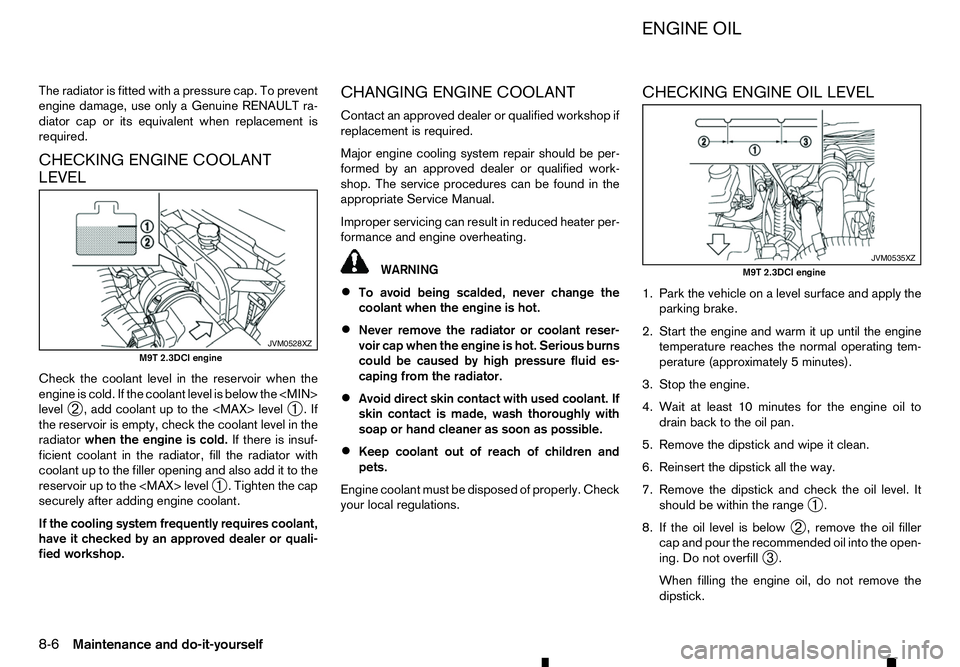
Check the coolant level in the reservoir when the
engine is cold. If the coolant level is below the
level ➁,a
dd coolant up to the
➀.If
the reservoir is empty, check the coolant level in the
radiator when the engine is cold. If there is insuf-
ficient coolant in the radiator, fill the radiator with
coolant up to the filler opening and also add it to the
reservoir up to the
ighten the cap
securely after adding engine coolant.
If the cooling system frequently requires coolant,
have it checked by an approved dealer or quali-
fied workshop. CHANGING ENGINE COOLANT
Contact an approved dealer or qualified workshop if
replacement is required.
Major engine cooling system repair should be per-
formed by an approved dealer or qualified work-
shop. The service procedures can be found in the
appropriate Service Manual.
Improper servicing can result in reduced heater per-
formance and engine overheating.
WARNING
• To avoid being scalded, never change the
coolant when the engine is hot.
• Never remove the radiator or coolant reser-
voir cap when the engine is hot. Serious burns
could be caused by high pressure fluid es-
caping from the radiator.
• Avoid direct skin contact with used coolant. If
skin contact is made, wash thoroughly with
soap or hand cleaner as soon as possible.
• Keep coolant out of reach of children and
pets.
Engine coolant must be disposed of properly. Check
your local regulations. CHECKING ENGINE OIL LEVEL
1. Park the vehicle on
alevel surface and apply the
parking brake.
2. Start the engine and warm it up until the engine temperature reaches the normal operating tem-
perature (approximately 5minutes).
3. Stop the engine.
4. Wait at least 10 minutes for the engine oil to drain back to the oil pan.
5. Remove the dipstick and wipe it clean. 6. Reinsert the dipstick all the way.
7. Remove the dipstick and check the oil level. It should be within the range ➀.
8. If the oil level is below ➁,r
emove the oil filler
cap and pour the recommended oil into the open-
ing. Do not overfill ➂.
When filling the engine oil, do not remove the
dipstick. JVM0528XZ
M9T 2.3DCI engine JVM0535XZ
M9T 2.3DCI engine
ENGINE OIL
8-6 Maintenance and do-it-yourself
Page 283 of 340
9. Recheck the oil level with the dipstick.
CAUTION
• The oil level should be checked regularly. Op-
erating your vehicle with an insufficient
amount of oil can damage the engine, and
such damage is not covered by the warranty.
• It is normal to add some oil between oil main-
tenance intervals or during the running-in pe-
riod, depending on the severity of operating
conditions.
CHANGING ENGINE OIL AND OIL
FILTER
Contact an approved dealer or qualified workshop
when the engine oil and oil filter require replace-
ment.
PROTECT ENVIRONMENT
It is illegal to pollute drains, watercourses and soil.
Use authorised waste collection facilities, including
civil amenity sites and garages providing facilities
for disposal of used oil and used oil filters. If in
doubt, contact your local authority for advice on dis-
posal.
The regulations concerning the pollution of the
environment will vary from country to country. REFILLING THE AdBlue® TANK
When the [Refill AdBlue] warning appears in the
vehicle information display, refill the AdBlue® tank
before the tank is empty (see “AdBlue® Selective
Catalytic Reduction (SCR) system (where fitted for
diesel engine model)” in the “5. Starting and driving”
section for the AdBlue® warning display.) Refill the
AdBlue® tank according to the procedures shown
in this section.
CAUTION
•
Use only AdBlue®. Using other fluids will
damage the AdBlue® Selective Catalytic Re-
duction (SCR) system.
• Be careful not to spill AdBlue®. If the AdBlue®
is spilled on the vehicle body, wipe it away
with
awet cloth immediately to avoid paint
damage.
• AdBlue® residues crystallize after
aperiod of
time and contaminate the paint surfaces. If
the spilled AdBlue® has crystallized, use a
sponge and cold water to clean it.
• Be careful not to inhale any ammonia vapours
that may be released. Fill the AdBlue® tank in
well-ventilated areas.
The AdBlue® tank is located underneath the ve-
hicle. (see “AdBlue® filler lid and cap” in the “3. Pre-
driving checks and adjustments” section for the
AdBlue® filler lid location.)
1. Apply the parking brake. 2. Automatic Transmission (AT) model: Move the
shift lever to the P(Park) position.
Manual Transmission (MT) model: Move the shift
lever to the N(Neutral) position.
3. Place the ignition switch in the OFFposition.
4. Open the AdBlue® filler lid.
5. Remove the AdBlue® tank cap by turning it anticlockwise.
6. Refill the AdBlue® tank.
7. Securely install the AdBlue® tank cap.
8. Close the AdBlue® filler lid.
9. Place the ignition switch in the ONposition and
wait for approximately 1minute until the [Refill
AdBlue] warning turns off.
NOTE
In the case that the [ENG can’t start Refill
AdBlue] warning was displayed, check that
the warning turned off, place the ignition
switch in the OFF position once and then startthe engine.
AdBlue® TANK (where fitted for
diesel engine model)
Maintenance and do-it-yourself8-7
Page 285 of 340
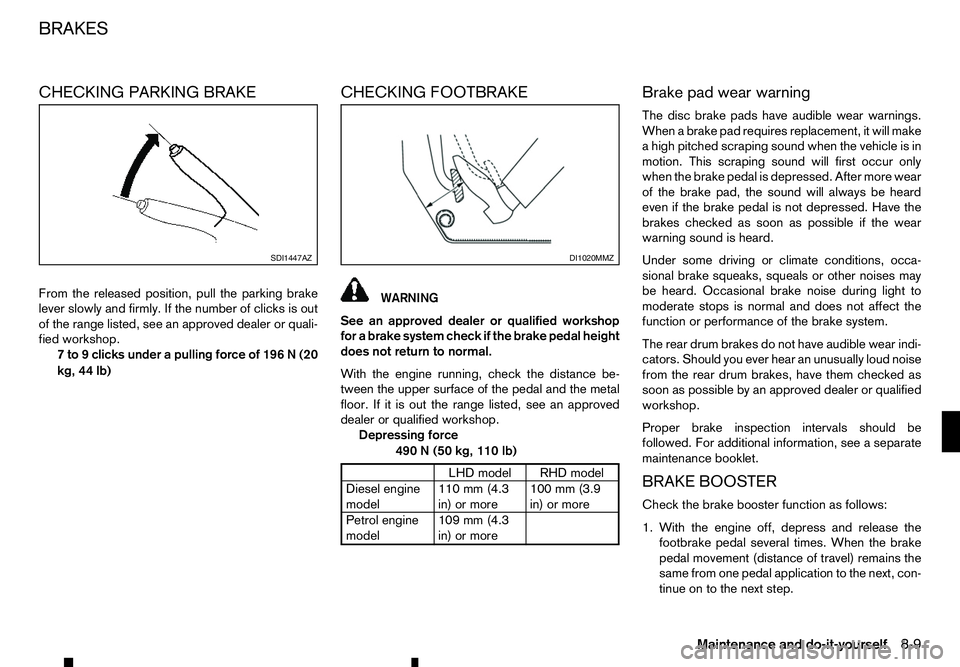
CHECKING PARKING BRAKE
From the released position, pull the parking brake
lever slowly and firmly. If the number of clicks is out
of the range listed, see an approved dealer or quali- fied workshop.
7to9c licks under apulling force of 196 N(20
kg, 44 lb) CHECKING FOOTBRAKE WARNING
See an approved dealer or qualified workshop
for abrake system check if the brake pedal height
does not return to normal.
With the engine running, check the distance be-
tween the upper surface of the pedal and the metal
floor. If it is out the range listed, see an approved
dealer or qualified workshop. Depressing force
490N(50 kg, 110 lb) LHD model RHD model
Diesel engine
model 110 mm (4.3
in) or more100 mm (3.9
in) or more
Petrol engine
model 109 mm (4.3
in) or more Brake pad wear warning
The disc brake pads have audible wear warnings.
When
abrake pad requires replacement, it will make
ah igh pitched scraping sound when the vehicle is in
motion. This scraping sound will first occur only
when the brake pedal is depressed. After more wear
of the brake pad, the sound will always be heard
even if the brake pedal is not depressed. Have the
brakes checked as soon as possible if the wear
warning sound is heard.
Under some driving or climate conditions, occa-
sional brake squeaks, squeals or other noises may
be heard. Occasional brake noise during light to
moderate stops is normal and does not affect the
function or performance of the brake system.
The rear drum brakes do not have audible wear indi-
cators. Should you ever hear an unusually loud noise
from the rear drum brakes, have them checked as
soon as possible by an approved dealer or qualified
workshop.
Proper brake inspection intervals should be
followed. For additional information, see aseparate
maintenance booklet.
BRAKE BOOSTER
Check the brake booster function as follows:
1. With the engine off, depress and release the footbrake pedal several times. When the brake
pedal movement (distance of travel) remains the
same from one pedal application to the next, con-
tinue on to the next step. SDI1447AZ DI1020MMZ
BRAKES
Maintenance and do-it-yourself
8-9
Page 324 of 340
–B
ooster ........................................................................V
... 8-9
–C hecking footbrake ......................................................... 8-9
–C hecking parking brake ................................................... 8-9
–E lectronic Stability Programme (ESP) ............................ 5-33
–F luid ....................................................................... 8-10, 9-2
–P ad wear warning ........................................................... 8-9
–P recautions ................................................................... 5-49
C Capacities and recommendations
–B rake and clutch fluid ...................................................... 9-2
–C oolant ........................................................................V
... 9-2
–F uel ........................................................................V
......... 9-2
–O il ........................................................................V
........... 9-2
–R efrigerant ...................................................................... 9-2
Cargo
–B ed ........................................................................V
....... 3-20
Changing
–E ngine oil filter ................................................................. 8-7
–F lat tyre ........................................................................V
... 6-3
Checking
–B attery fluid level ........................................................... 8-13
–B rake pedal ..................................................................... 8-9
–E ngine oil level ................................................................ 8-6
–P arking brake .................................................................. 8-9
Child restraints .................................................................... 1-14
–A nchorage ........................................................... 1-20, 1-21
–I SOFIX ........................................................ 1-18, 1-19, 1-22
–P recautions ................................................................... 1-14
–S eat belt installation ....................................................... 1-24
–U niversal child restraints (front and rear seats) ............... 1-15
Child safety
–S eat belts ...................................................................... 1-11
Cleaning
–C hrome parts .................................................................. 7-3 –E
xterior ........................................................................V
.... 7-2
–F loor mats ....................................................................... 7-4
–G lass ....................................................................... 7-3, 7-4
–H eadlights ..................................................................... 2-35
–I nterior ........................................................................V
.... 7-3
–S eat belts ........................................................................V
7-4
–U nderbody ...................................................................... 7-3
–W ashing ........................................................................V
.. 7-2
–W axing ........................................................................V
.... 7-2
–W heels ........................................................................V
.... 7-3
–W indow washer nozzle .................................................. 8-16
Clock ........................................................................V
.......... 2-30
Clutch
–F luid ....................................................................... 8-11, 9-2
Cockpit
–O verview ........................................................................V
. 0-6
Cold weather ...................................................................... 5-51
–B attery ........................................................................V
.. 5-51
–C orrosion protection ...................................................... 5-52
–E ngine coolant ............................................................... 5-51
–P arking brake ................................................................ 5-52
–T yre equipment .............................................................. 5-51
–W inter equipment .......................................................... 5-52
Compass
–V ehicle information display ............................................. 2-23
Console box ........................................................................V
2-39
Console side pockets .......................................................... 2-40
Coolant
–C apacity ........................................................................V
.. 9-2
–C hanging engine coolant ................................................. 8-6
–C hecking coolant level ..................................................... 8-6
–C old weather ................................................................ 5-51
–E ngine cooling system ..................................................... 8-5
Corrosion protection ............................................................. 7-5
–C old weather ................................................................ 5-52
–E nvironmental factors ...................................................... 7-5
10-2 Index
Page 328 of 340
O
Odometer ........................................................................V
..... 2-2
Off-road
–P recautions ..................................................................... 5-6
Oil
–C apacity ........................................................................V
.. 9-2
–C hanging engine oil filter ................................................. 8-7
–C hecking oil level ............................................................ 8-6
–D isposal ........................................................................V
.. 8-7
–E ngine oil ........................................................................V
8-6
Overheat
–E ngine ........................................................................V
... 6-12
Overview
–C ockpit ........................................................................V
... 0-6
–E ngine compartment ...................................................... 0-11
–E xterior ........................................................................V
.... 0-3
–I nstrument panel .............................................................. 0-8
–M eters and gauges ........................................................ 0-10
–P assenger compartment .................................................. 0-5
–S eats, Seat belts, Supplemental restraint system ............. 0-2
P Parking ........................................................................V
....... 5-44
–B rake ........................................................................V
.... 3-26
–P arking sensor system ................................................... 5-46
Parking brake
–C hecking ........................................................................V
8-9
–C old weather ................................................................ 5-52
Parking sensors .................................................................. 5-46
–I ndicator ........................................................................V
5-46
–O FF switch ................................................................... 5-47
Passenger compartment ........................................................ 0-5 Phone
–B luetooth® Hands-Free ....................................... 4-59, 4-65
–M obile phone integration ...................................... 4-59, 4-65
Power
–O utlet ........................................................................V
.... 2-38
–P ower steering .............................................................. 5-49
–S teering fluid ................................................................... 8-8
Precautions
–C hild restraints .............................................................. 1-14
–E xhaust gas ..................................................................... 5-3
–M aintenance .................................................................... 8-4
–O ff-road driving ............................................................... 5-6
–O n-pavement driving ....................................................... 5-6
–P arking ........................................................................V
.. 5-44
–P ush-button ignition switch ............................................ 5-15
–S eat belts ........................................................................V
1-9
–S upplemental Restraint System ..................................... 1-29
–T owing ........................................................................V
.. 6-13
–T railer towing ................................................................ 5-48
Pregnant women ................................................................. 1-11
Protection
–C orrosion ........................................................................V
7-5
Push starting ....................................................................... 6-12
R Radio
–A
pproval numbers and information ................................... 9-9
–F MAMr adio with CD (Type A) ..................................... 4-37
–F MAMr adio with CD (Type B) ..................................... 4-52
–T ouchscreen Navigation ................................................ 4-57
–T ransmitter ...................................................................... 9-8
Rear window
–D efogger ....................................................................... 2-34
Rearview
–M irrors
-Inside .............................................................. 3-23
10-6 Index