ESP RENAULT KANGOO 2016 X61 / 2.G User Guide
[x] Cancel search | Manufacturer: RENAULT, Model Year: 2016, Model line: KANGOO, Model: RENAULT KANGOO 2016 X61 / 2.GPages: 173, PDF Size: 3.8 MB
Page 71 of 173
 2.9
ENG_UD14461_2
Environnement (X35 - X44 - X65 - X73 - X77 - X81 - X84 - E84 - L84 - X8\
5 - X91 - B91 - K91 - D91 -")
environment .......................................... (up to the end of the DU) 2.9
ENG_UD14461_2
Environnement (X35 - X44 - X65 - X73 - X77 - X81 - X84 - E84 - L84 - X8\
5 - X91 - B91 - K91 - D91 - X70 - X76 - X83 - X61 - F61 - K61 - X95 - B9\
5 - D95 - K95 - J95 -
ENG_NU_854-2_X76LL_Renault_2
Environment
ENvIRoNMENt
Make your contribution towards pro-
tecting the environment too.
–
Worn parts replaced in the course of
routine vehicle maintenance (vehi-
cle battery, oil filter, air filter, batter-
ies, etc.) and oil containers (empty or
filled with used oil) must be disposed
of through specialist organisations.
–
At the end of the vehicle’s service
life, it should be sent to approved
centres to ensure that it is recycled.
–
In all cases, comply with local legis -
lation.
Recycling
Your vehicle is 85% recyclable and
95% recoverable, in line with European
requirements that will come into force
in 2015.
To achieve these objectives, many of
the vehicle components have been de-
signed to enable them to be recycled.
The materials and structures have been
carefully designed to allow these com-
ponents to be easily removed and re-
processed by specialist companies.
In order to preserve raw material re-
sources, this vehicle incorporates nu-
merous parts made from recycled plas-
tics or renewable materials (vegetable
or animal-derived materials such as
cotton or wool).
Your vehicle has been designed with
respect for the environment in mind for
its entire service life: during production,
use and at the end of its life.
Manufacture
Your vehicle has been manufactured in
a factory which complies with the strict-
est environmental standards.
Furthermore, a system has been imple-
mented for checking all of the vehicle
components.
Emissions
Your vehicle is equipped with a parti-
cle filter system including
a catalytic
converter, an oxygen sensor and an
active carbon filter (the latter prevents
vapour from the petrol tank being re-
leased into the open air).
For certain diesel vehicles, this system
also has a particle filter to reduce the
volume of soot particles emitted.
Page 73 of 173
ABS ...................................................... (up to the end of the DU)
anti-lock braking system: ABS .............. (up to the end of the DU) 2.11
ENG_UD7283_1
Système antiblocage des roues : ABS (X76 - Renault)
ENG_NU_854-2_X76LL_Renault_2
Anti-lock braking system
ANtI-locK BRAKING SyStEM: ABS
Depending on the vehicle, this is com-
posed of:
–
ABS (anti-lock braking system);
– emergency brake assist with, de -
pending on the vehicle, braking
anticipation;
These functions are an ad-
ditional aid in the event of
critical driving conditions,
enabling the vehicle behav-
iour to be adapted to suit the driving
conditions.
However, the functions do not take
the place of the driver. th
ey do
not increase the vehicle’s limits
and should not encourage you
to drive more quickly. Therefore,
they can under no circumstances
replace the vigilance or responsibil-
ity of the driver when manoeuvring
the vehicle (the driver must always
be ready for sudden incidents which
may occur when driving).
ABS (Anti-lock Braking
System)
Under heavy braking, the ABS prevents
the wheels from locking, allowing the
stopping distance to be managed and
keeping control of the vehicle.
Under these circumstances, the vehi-
cle can be steered to avoid an obstacle
whilst braking. In addition, this system
can increase stopping distances, par-
ticularly on roads with low surface grip
(wet ground etc.).
You will feel a pulsation through the
brake pedal each time the system is
activated. The ABS does not in any way
improve the vehicle’s physical perform-
ance relating to the road surface and
roadholding. It is still essential to follow
the rules of good driving practice (such
as driving at a safe distance from the
vehicle in front etc.).
In an emergency, apply firm and
continuous pressure to the brake
pedal. There is no need to pump
it repeatedly. The ABS will modu-
late the force applied in the braking
system.
operating faults:
– If the
x warning light on the in-
strument panel comes on while driv-
ing, braking is still operational ;
–
If the
x and D warning
lights on the instrument panel come
on when driving, this indicates a
fault with the braking system.
In such cases, the ABS and emergency
brake assist are also deactivated and,
depending on the vehicle, the mes-
sages “check ABS” and “check brak-
ing system” appear on the instrument
panel.
Consult an approved dealer.
Yo u r b r a k i n g s y s t e m s
are partially operational.
However, it is dangerous
to brake suddenly and
it is essential to stop immediately,
as soon as traffic conditions allow.
Contact an approved dealer.
Page 74 of 173
emergency brake assist........................ (up to the end of the DU)
emergency braking ............................... (up to the end of the DU)
2.12
ENG_UD7284_1
Assistance au freinage d urgence (X76 - Renault)
ENG_NU_854-2_X76LL_Renault_2
Emergency brake assist
EMERGENcy BRAKE ASSISt
Emergency brake assist
This is an additional system to ABS
which helps reduce vehicle stopping
distances.
o
perating principle
The system detects an emergency
braking situation. In this case, the brak-
ing assistance immediately develops
maximum power and may trigger ABS
regulation.
ABS braking is maintained as long as
the brake pedal is not released.
hazard warning lights
switching on
Depending on the vehicle, these may
light up in the event of sudden decel-
eration.
These functions are an ad-
ditional aid in the event of
critical driving conditions,
enabling the vehicle behav-
iour to be adapted to suit the driving
conditions.
However, the functions do not take
the place of the driver. th
ey do
not increase the vehicle’s limits
and should not encourage you
to drive more quickly. Therefore,
they can under no circumstances
replace the vigilance or responsibil-
ity of the driver when manoeuvring
the vehicle (the driver must always
be ready for sudden incidents which
may occur when driving).
Page 85 of 173
air conditioning ..................................... (up to the end of the DU)
heating system ..................................... (up to the end of the DU)
air conditioning ..................................... (up to the end of the DU)
temperature regulation ......................... (up to the end of the DU)
ventilation ............................................. (up to the end of the DU)
heating and air conditioning system ...................... (current page) 3.11
ENG_UD11524_2
Air conditionné : informations et conseils d’utilisation (X77 ph2\
- Renault)
ENG_NU_854-2_X76LL_Renault_3
Air COnDitiOninG: information and advice on use
Fuel consumption
You will normally notice an increase
in fuel consumption (especially
when driving in town) when the air
conditioning is operating. For vehi-
cles fitted with manual air condition-
ing, switch off the system when it is
not required.
Advice for reducing consumption
and therefore helping to preserve
the environment:
Drive with the air vents open and
the windows closed.
If the vehicle has been parked in
the sun, open the doors for a few
moments to let the hot air escape
before starting the engine.
Maintenance
Refer to the Maintenance Service
Booklet for your vehicle for the in-
spection frequency.
Do not open the refriger-
ant fluid circuit. The fluid
may damage eyes or skin.
note
Presence of water under the ve-
hicle. After prolonged use of the air
conditioning system, it is normal for
water to be present under the ve-
hicle. This is caused by condensa-
tion.
Operating faults
As a general rule, contact your ap-
proved Dealer in the event of an op-
erating fault.
–
r eduction in de-icing, demist -
ing or air conditioning perform-
ance. This may be caused by the
passenger compartment filter
cartridge becoming clogged.
–
no cold air is being produced.
Check that the controls are set
correctly and that the fuses are
sound. Otherwise, switch off the
system.
Do not add anything to the
vehicle’s ventilation circuit
(for example, to remove
bad odours).
t h
ere is a risk of damage or of
fire.
Page 88 of 173
children .................................................................. (current page)
electric windows ................................... (up to the end of the DU)
child safety............................................................. (current page)
3.14
ENG_UD14027_2
Vitres (X76 - Renault)ENG_NU_854-2_X76LL_Renault_3
Jaune NoirNoir texte
Windows
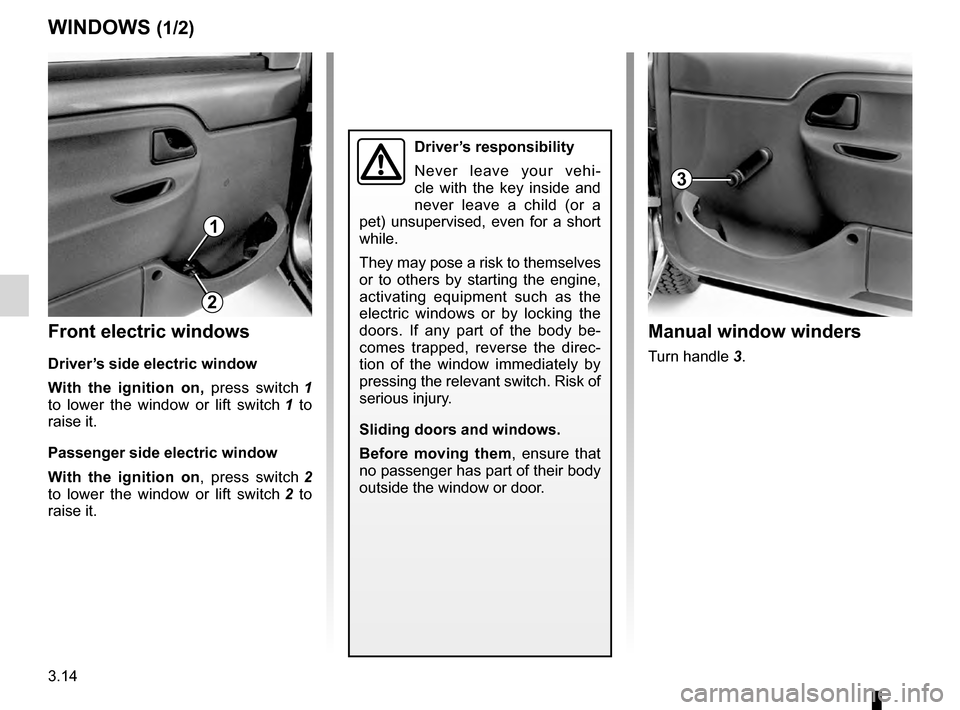
Manual window winders
Turn handle 3.
Front electric windows
Driver’s side electric window
With the ignition on,
press switch 1
t
o lower the window or lift switch 1 to
raise it.
Passenger side electric window
With the ignition on ,
press switch 2
t
o lower the window or lift switch 2 to
raise it.
WinDOWs (1/2)
1
2
3
Driver’s responsibility
Never leave your vehi-
cle with the key inside and
never leave a child (or a
pet) unsupervised, even for a short
while.
They may pose a risk to themselves
or to others by starting the engine,
activating equipment such as the
electric windows or by locking the
doors. If any part of the body be-
comes trapped, reverse the direc-
tion of the window immediately by
pressing the relevant switch. Risk of
serious injury.
s
liding doors and windows.
Before moving them , ensure that
no passenger has part of their body
outside the window or door.
Page 97 of 173

luggage compartment cover ................. (up to the end of the DU) 3.23
ENG_UD7303_1
Cache-bagages (X76 - Renault)
ENG_NU_854-2_X76LL_Renault_3
The luggage compartment cover is
made up of two rigid sections.
It can be used in one of three ways:
A luggage cover in unfolded position.
Luggage cover
Do not place any objects,
especially heavy or solid ob-
jects on the luggage cover.
These may pose a risk to
the vehicle occupants if the driver
has to brake suddenly or if the vehi-
cle is involved in an accident.
C luggage cover removed.
To remove the luggage compartment
cover, place it in the semi-folded posi-
tion, take hold of the end and pull it to-
wards you.
B
luggage cover in semi-folded posi-
tion.
LuGGAGe COver
ABC
Page 108 of 173
4.10
ENG_UD14326_1
Batterie (X76 - Renault)
ENG_NU_854-2_X76LL_Renault_4
Battery
BA tteR y
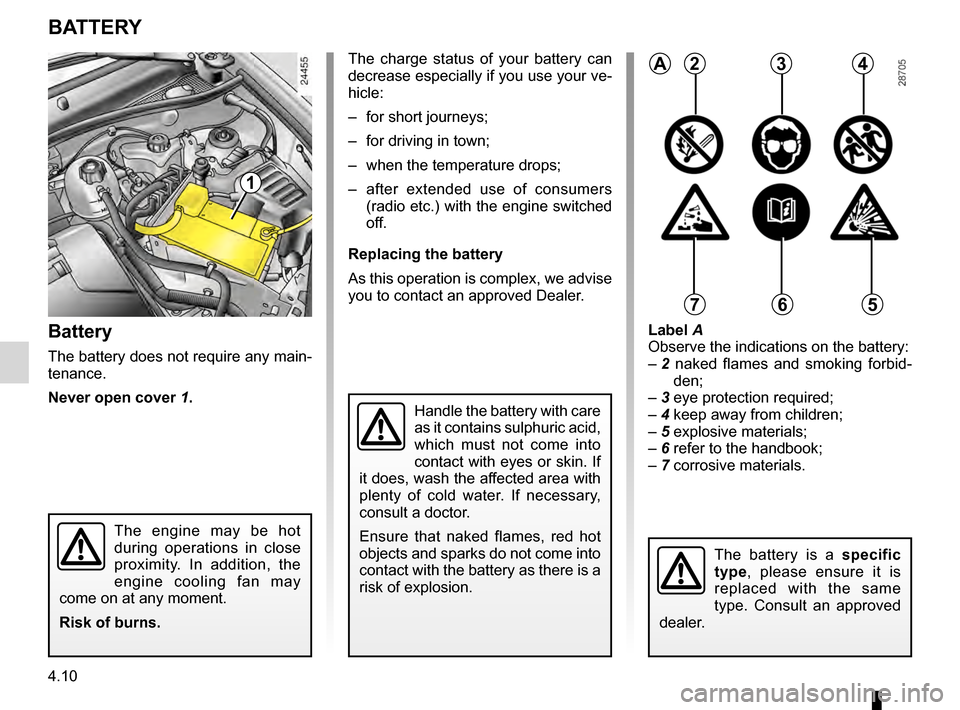
1
Battery
The battery does not require any main-
tenance.
n
ever open cover 1.
The engine may be hot
during operations in close
proximity. In addition, the
engine cooling fan may
come on at any moment.
Risk of burns.
Label A
Observe the indications on the battery:
– 2 n
aked flames and smoking forbid-
den;
–
3 eye protection required;
–
4 keep away from children;
–
5 explosive materials;
–
6 refer to the handbook;
–
7 corrosive materials.
The charge status of your battery can
decrease especially if you use your ve-
hicle:
–
for short journeys;
– for driving in town;
– when the temperature drops;
– after extended use of consumers
(radio etc.) with the engine switched
off.
Replacing the battery
As this operation is complex, we advise
you to contact an approved Dealer.
2A34
657
Handle the battery with care
as it contains sulphuric acid,
which must not come into
contact with eyes or skin. If
it does, wash the affected area with
plenty of cold water. If necessary,
consult a doctor.
Ensure that naked flames, red hot
objects and sparks do not come into
contact with the battery as there is a
risk of explosion.
The battery is a specific
type , please ensure it is
replaced with the same
type. Consult an approved
dealer.
Page 110 of 173
4.12
ENG_UD7309_1
Entretien de la carrosserie (X76 - Renault)
ENG_NU_854-2_X76LL_Renault_4
BOdywORk MAIntenAnCe (2/2)
– Before going through a roller type
car wash, return the windscreen
wiper stalk to park position (refer to
the information on the “Windscreen
wash/wipe” in Section 1). Check the
mounting of external accessories,
additional lights, door mirrors, etc.,
and be sure to hold the wiper blades
and radio aerial in place with adhe-
sive tape.
Remove the radio aerial mast if your
vehicle is fitted with this equipment.
–
Spray mechanical components,
hinges, etc. with products approved
by our Technical Department to
protect them after they have been
cleaned.
We have selected special products
to care for your vehicle and you can
obtain these from the manufactur-
er’s accessory outlets.
– Observe the vehicle stopping dis-
tances when driving on gravelled
surfaces to prevent paint damage.
–
Repair, or have repaired quickly,
areas where the paint has been dam-
aged, to prevent corrosion spread-
ing.
–
Remember to visit the body shop
periodically if your vehicle has an
anti-corrosion warranty. Refer to the
Maintenance Service Booklet.
–
Respect local regulations about
washing vehicles (e.g. do not wash
your vehicle on a public highway).
y ou should
– Wash your car frequently, with the
engine off , with cleaning products
recommended by our Technical
Department (never use abrasive
products) and be sure to jet-rinse
off:
–
spots of tree resin and industrial
grime;
–
bird droppings, which cause
a chemical reaction with the
paint that rapidly discolours
paintwork and may even cause
the paint to peel off;
Wash the vehicle immediately to
remove these marks since it is im-
possible to remove them by pol-
ishing;
–
salt, particularly in the wheel
arches and underneath the body
after driving in areas where the
roads have been gritted;
–
mud in the wheel arches and un -
derneath the body which form
damp patches.
Page 118 of 173
5.6
ENG_UD7315_1
Pneumatiques (X76 - Renault)
ENG_NU_854-2_X76LL_Renault_5
Jaune NoirNoir texte
tyrEs (2/3)
Pressures should be checked when the
tyres are cold; ignore higher pressures
which may be reached in hot weather
or following a fast journey.
If tyre pressures cannot be checked
when the tyres are cold, the normal
pressures must be increased by 0.2 to
0.3 bar (or 3 P
si).
n
ever deflate a hot tyre.
special features: depending on the ve-
hicle, there is an adapter which must be
positioned on the valve before adding
air.
Fitting new tyres
Emergency spare wheel
Refer to the information on “Puncture”
and “Changing a wheel” in Section 5.
t yre pressuresRespect the tyre pressures (including
the emergency spare wheel). Check
them at least once a month and before
a long journey (refer to the label on the
edge of the driver’s door).
incorrect tyre pressures
lead to abnormal tyre wear
and unusually hot running.
These are factors which
may seriously affect safety and lead
to:
–
poor road holding;
– risk of bursting or tread separa -
tion.
The pressure depends on the load
and the speed of use. Adjust the
pressures according to the condi-
tions of use (refer to the information
on “Tyre pressures”).
Please be aware that a
poorly tightened or miss-
ing valve cap can make the
tyres less airtight and lead
to pressure loss.
Always use valve caps identical to
those fitted originally and tighten
them fully.
For safety reasons, this op-
eration must be carried out
by a specialist.
Fitting different tyres may
change your vehicle as follows:
–
may mean that your vehicle no
longer conforms to current regu-
lations;
–
it may change the way it handles
when cornering;
–
it may cause the steering to be
heavy;
–
It may affect the use of snow
chains.
Page 136 of 173

wiper blades ......................................... (up to the end of the DU)
practical advice ..................................... (up to the end of the DU)
windscreen washer/wiper replacing blades .............................. (up to the end of the DU)
5.24
ENG_UD7324_1
Balais d essuie-vitres (X76 - Renault)
ENG_NU_854-2_X76LL_Renault_5
Jaune NoirNoir texte
Wiper blades
replacing windscreen wiper
blades 1
Lift wiper arm 3.
Turn the wiper blade until it is horizon-
tal.
P
ress tab 2 and slide the wiper blade
downwards
to release hook 4 from the
wiper arm.
Slide the blade (A) then lift it ( B) to re-
lease it.
WinDscrEEn WiPEr BlADEs (1/2)
B
A
12
3
4
56
7
refitting a front or rear wiper
blade
Proceed in reverse order. Make sure
that the blade is correctly locked in po-
sition.
replacing the rear screen
wiper
blade (hinged door)
Lift wiper arm 6.
P
ress tab 5 and slide the wiper blade
downwards to release hook
7.
Check the condition of the wiper
blades. You are responsible for their
service life:
–
clean the blades, windscreen and
rear screen regularly with soapy
water;
–
do not use them when the wind -
screen or rear screen are dry;
–
free them from the windscreen or
rear screen when they have not
been used for a long time.