light RENAULT KANGOO ZERO EMISSION 2012 X61 / 2.G Workshop Manual
[x] Cancel search | Manufacturer: RENAULT, Model Year: 2012, Model line: KANGOO ZERO EMISSION, Model: RENAULT KANGOO ZERO EMISSION 2012 X61 / 2.GPages: 213, PDF Size: 6.08 MB
Page 107 of 213
2.16
ENG_UD29323_3
Régulateur-limiteur de vitesses : fonction régulateur (X61 - F61 - Renault)
ENG_NU_911-4_F61e_Renault_2
Jaune NoirNoir texte
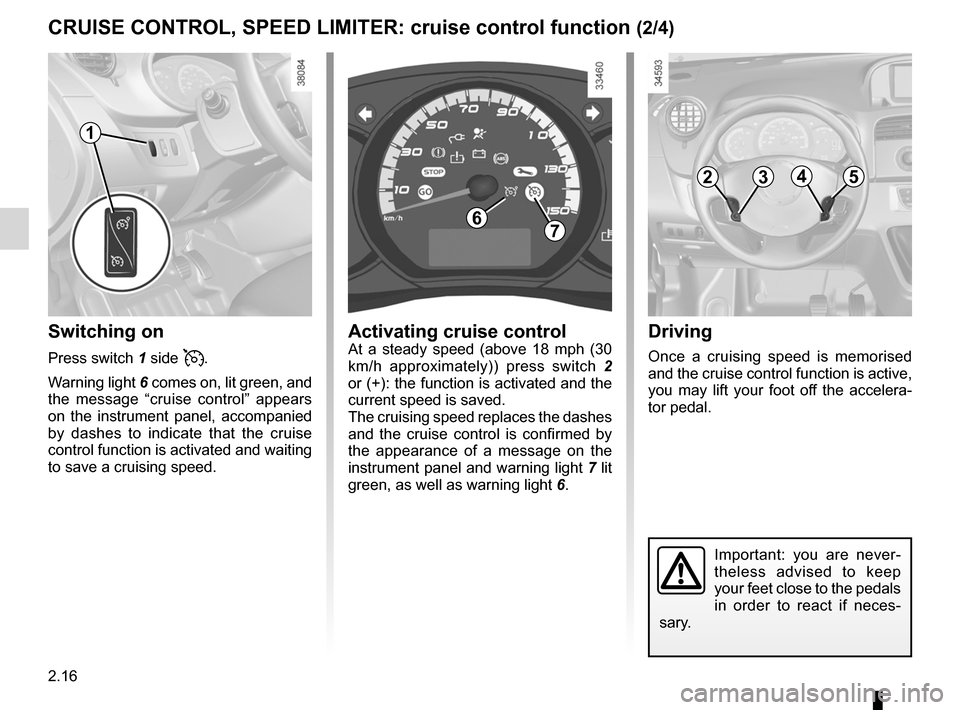
Switching on
Press switch 1 side .
Warning light 6 comes on, lit green, and
the message “cruise control” appears
on the instrument panel, accompanied
by dashes to indicate that the cruise
control function is activated and waiting
to save a cruising speed.
Important: you are never -
theless advised to keep
your feet close to the pedals
in order to react if neces -
sary.
cruiSE cOntrOl, SPEED liMitEr: cruise control function (2/4)
Driving
Once a cruising speed is memorised
and the cruise control function is active,
you may lift your foot off the accelera -
tor pedal.
67
2453
activating cruise controlAt a steady speed (above 18 mph (30
km/h approximately)) press switch 2
or (+): the function is activated and the
current speed is saved.
The cruising speed replaces the dashes
and the cruise control is confirmed by
the appearance of a message on the
instrument panel and warning light 7 lit
green, as well as warning light 6.
1
Page 109 of 213
2.18
ENG_UD29323_3
Régulateur-limiteur de vitesses : fonction régulateur (X61 - F61 - Renault)
ENG_NU_911-4_F61e_Renault_2
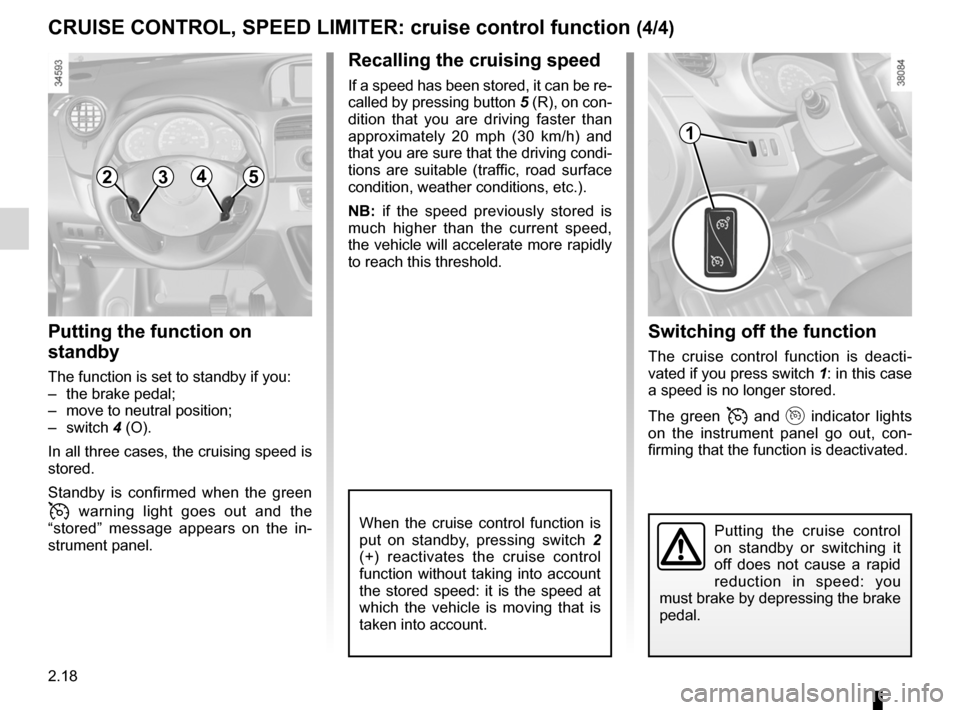
Switching off the function
The cruise control function is deacti -
vated if you press switch 1: in this case
a speed is no longer stored.
The green
and indicator lights
on the instrument panel go out, con -
firming that the function is deactivated.
recalling the cruising speed
If a speed has been stored, it can be re-
called by pressing button 5 (R), on con-
dition that you are driving faster than
approximately 20 mph (30 km/h) and
that you are sure that the driving condi -
tions are suitable (traffic, road surface
condition, weather conditions, etc.).
nb : if the speed previously stored is
much higher than the current speed,
the vehicle will accelerate more rapidly
to reach this threshold.
When the cruise control function is
put on standby, pressing switch 2
(+) reactivates the cruise control
function without taking into account
the stored speed: it is the speed at
which the vehicle is moving that is
taken into account.
Putting the function on
standby
The function is set to standby if you:
– the brake pedal;
– move to neutral position;
– switch 4 (O).
In all three cases, the cruising speed is
stored.
Standby is confirmed when the green
warning light goes out and the
“stored” message appears on the in -
strument panel.
cruiSE cOntrOl, SPEED liMitEr: cruise control function (4/4)
Putting the cruise control
on standby or switching it
off does not cause a rapid
reduction in speed: you
must brake by depressing the brake
pedal.
2453
1
Page 111 of 213
2.20
ENG_UD25285_4
Aide au parking (X61 - F61 - Renault)
ENG_NU_911-4_F61e_Renault_2
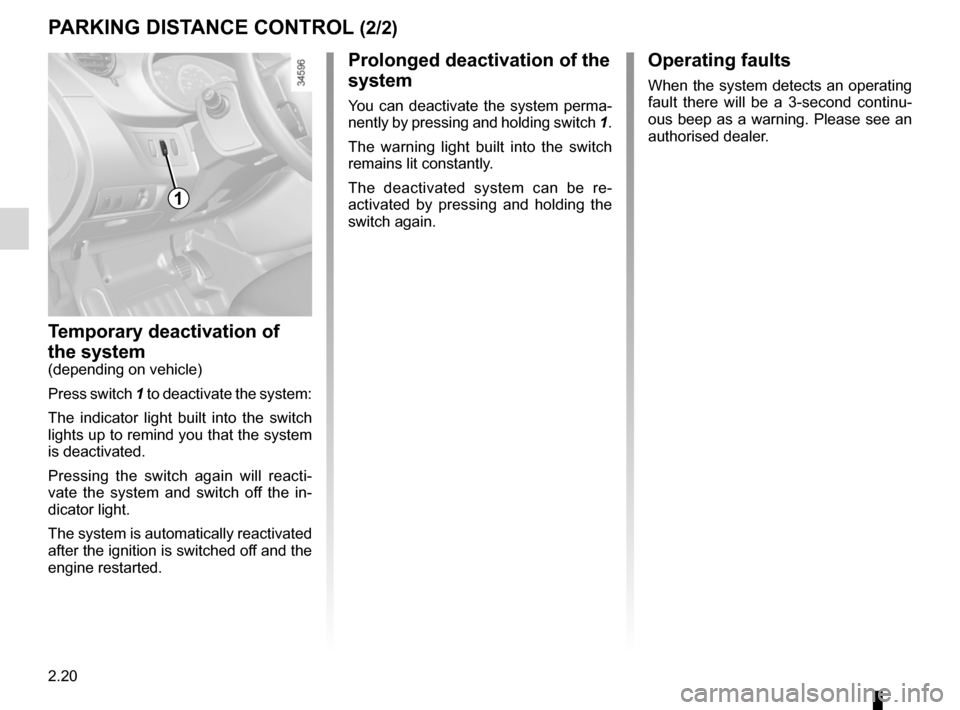
Prolonged deactivation of the
system
You can deactivate the system perma-
nently by pressing and holding switch 1.
The warning light built into the switch
remains lit constantly.
The deactivated system can be re -
activated by pressing and holding the
switch again.
t emporary deactivation of
the system
(depending on vehicle)
Press switch 1 to deactivate the system:
The indicator light built into the switch
lights up to remind you that the system
is deactivated.
Pressing the switch again will reacti -
vate the system and switch off the in -
dicator light.
The system is automatically reactivated
after the ignition is switched off and the
engine restarted.
P arking DiStancE cOntrOl (2/2)
1
Operating faults
When the system detects an operating
fault there will be a 3-second continu -
ous beep as a warning. Please see an
authorised dealer.
Page 112 of 213
3.1
ENG_UD29094_4
Sommaire 3 (X61 - F61 - Renault)
ENG_NU_911-4_F61e_Renault_3
Section 3: Your comfort
Air vents: air outlets . . . . . . . . . . . . . . . . . . . . . . . . . . . . . . . . . . . . . . . . . . . . . . . . . . . . . . . . . . . . . . 3.2
Air conditioning, heating . . . . . . . . . . . . . . . . . . . . . . . . . . . . . . . . . . . . . . . . . . . . . . . . . . . . . . . . . . 3.4
programming . . . . . . . . . . . . . . . . . . . . . . . . . . . . . . . . . . . . . . . . . . . . . . . . . . . . . . . . . . . . . 3.7
Additional heating . . . . . . . . . . . . . . . . . . . . . . . . . . . . . . . . . . . . . . . . . . . . . . . . . . . . . . . . . . . . . . . 3.9
Air conditioning: information and advice on use . . . . . . . . . . . . . . . . . . . . . . . . . . . . . . . . . . . . . . . . 3.11
Interior lighting . . . . . . . . . . . . . . . . . . . . . . . . . . . . . . . . . . . . . . . . . . . . . . . . . . . . . . . . . . . . . . . . . . 3.12
Sun visor/Mirror . . . . . . . . . . . . . . . . . . . . . . . . . . . . . . . . . . . . . . . . . . . . . . . . . . . . . . . . . . . . . . . . . 3.14
Electric windows . . . . . . . . . . . . . . . . . . . . . . . . . . . . . . . . . . . . . . . . . . . . . . . . . . . . . . . . . . . . . . . . 3.15
Half-opening window . . . . . . . . . . . . . . . . . . . . . . . . . . . . . . . . . . . . . . . . . . . . . . . . . . . . . . . . . . . . . 3.16
Ashtrays. . . . . . . . . . . . . . . . . . . . . . . . . . . . . . . . . . . . . . . . . . . . . . . . . . . . . . . . . . . . . . . . . . . . . . . 3.17
Passenger compartment storage space and fittings . . . . . . . . . . . . . . . . . . . . . . . . . . . . . . . . . . . . . 3.18
Rear bench seat . . . . . . . . . . . . . . . . . . . . . . . . . . . . . . . . . . . . . . . . . . . . . . . . . . . . . . . . . . . . . . . . 3.21
Transporting objects in the boot . . . . . . . . . . . . . . . . . . . . . . . . . . . . . . . . . . . . . . . . . . . . . . . . . . . . 3.24
Towbar . . . . . . . . . . . . . . . . . . . . . . . . . . . . . . . . . . . . . . . . . . . . . . . . . . . . . . . . . . . . . . . . . . . . . . . . 3.25
Luggage net . . . . . . . . . . . . . . . . . . . . . . . . . . . . . . . . . . . . . . . . . . . . . . . . . . . . . . . . . . . . . . . . . . . . 3.26
Page 115 of 213
air conditioning ..................................... (up to the end of the DU)
heating system ..................................... (up to the end of the DU)
air conditioning ..................................... (up to the end of the DU)
ventilation ............................................. (up to the end of the DU)
3.4
ENG_UD25325_3
Chauffage, climatisation (X61 électrique - Renault)
ENG_NU_911-4_F61e_Renault_3
Jaune NoirNoir texte
Air conditioning, heating
switching air conditioning on
or off
The air conditioning is switched on (in-
dicator light illuminated) or off (indicator
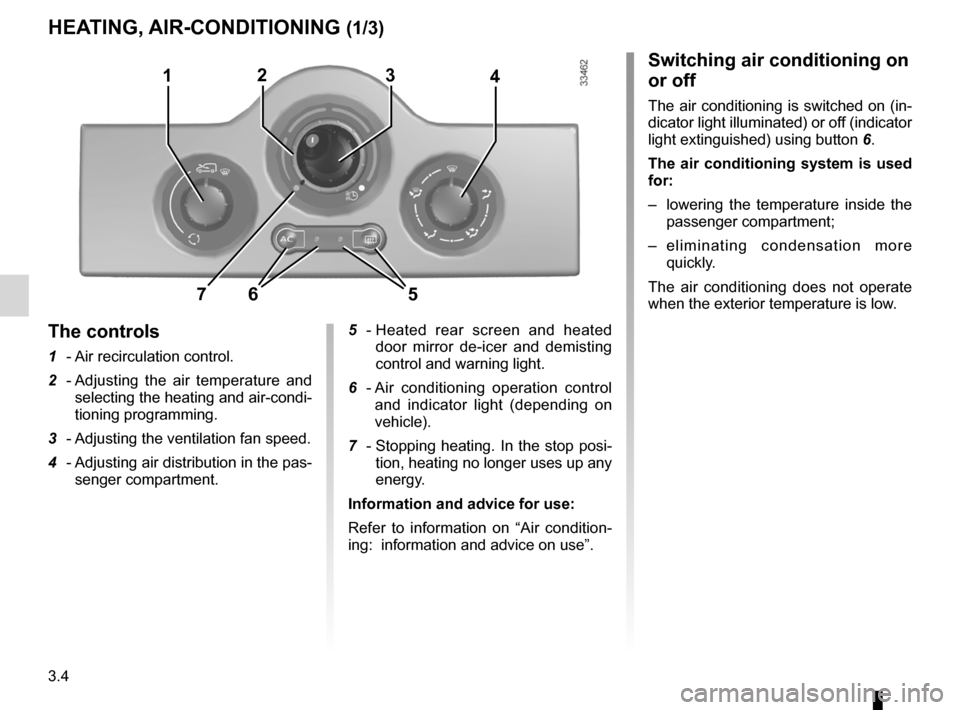
light extinguished) using button 6.
the air conditioning system is used
for:
– lowering the temperature inside the
passenger compartment;
– e l i m i n a t i n g c o n d e n s a t i o n m o r e
quickly.
The air conditioning does not operate
when the exterior temperature is low.
5 - Heated rear screen and heated
door mirror de-icer and demisting
control and warning light.
6 - Air conditioning operation control
and indicator light (depending on
vehicle).
7 - Stopping heating. In the stop posi-
tion, heating no longer uses up any
energy.
information and advice for use:
Refer to information on “Air condition -
ing: information and advice on use”.
the controls
1 - Air recirculation control.
2 -
Adjusting the air temperature and
selecting the heating and air-condi-
tioning programming.
3 - Adjusting the ventilation fan speed.
4 -
Adjusting air distribution in the pas-
senger compartment.
HeA tinG, Air-ConditioninG (1/3)
1423
657
Page 117 of 213
3.6
ENG_UD25325_3
Chauffage, climatisation (X61 électrique - Renault)
ENG_NU_911-4_F61e_Renault_3
Adjusting the ventilation
speed
normal use
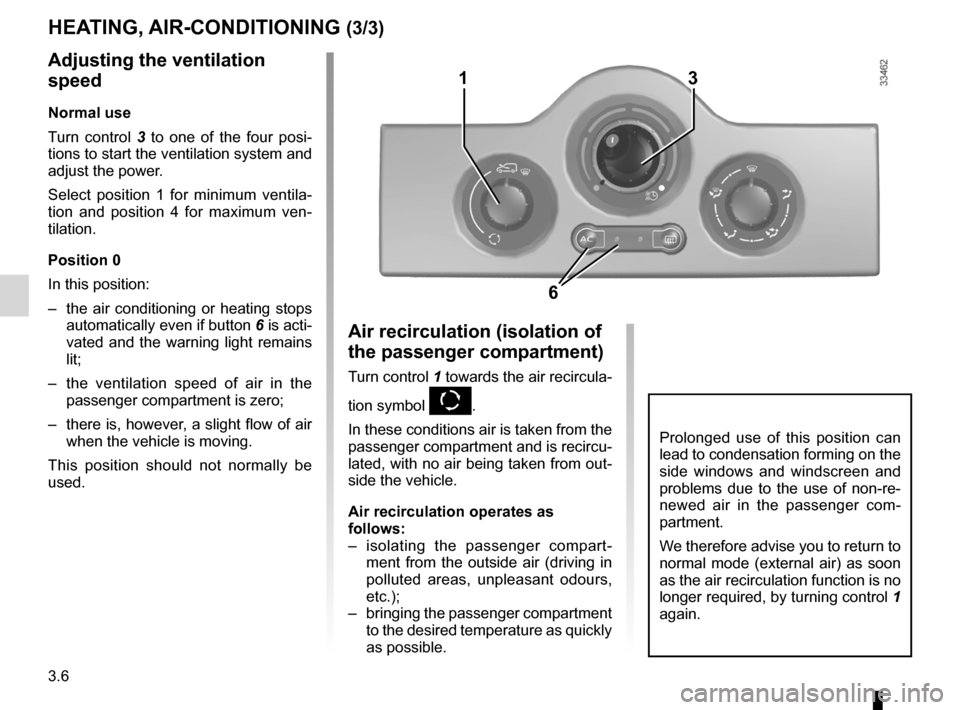
Turn control 3 to one of the four posi -
tions to start the ventilation system and
adjust the power.
Select position 1 for minimum ventila -
tion and position 4 for maximum ven -
tilation.
Position 0
In this position:
– the air conditioning or heating stops
automatically even if button 6 is acti-
vated and the warning light remains
lit;
– the ventilation speed of air in the
passenger compartment is zero;
– there is, however, a slight flow of air
when the vehicle is moving.
This position should not normally be
used.
HeA tinG, Air-ConditioninG (3/3)
Air recirculation (isolation of
the passenger compartment)
Turn control 1 towards the air recircula -
tion symbol
K.
In these conditions air is taken from the
passenger compartment and is recircu-
lated, with no air being taken from out-
side the vehicle.
Air recirculation operates as
follows:
– isolating the passenger compart -
ment from the outside air (driving in
polluted areas, unpleasant odours,
etc.);
– bringing the passenger compartment
to the desired temperature as quickly
as possible.
Prolonged use of this position can
lead to condensation forming on the
side windows and windscreen and
problems due to the use of non-re-
newed air in the passenger com -
partment.
We therefore advise you to return to
normal mode (external air) as soon
as the air recirculation function is no
longer required, by turning control 1
again.
3
6
1
Page 120 of 213
heating system ..................................... (up to the end of the DU)
additional heating ................................. (up to the end of the DU)
3.9
ENG_UD23010_2
Chauffage additionnel (X61 électrique - Renault)
ENG_NU_911-4_F61e_Renault_3
Conditions of use
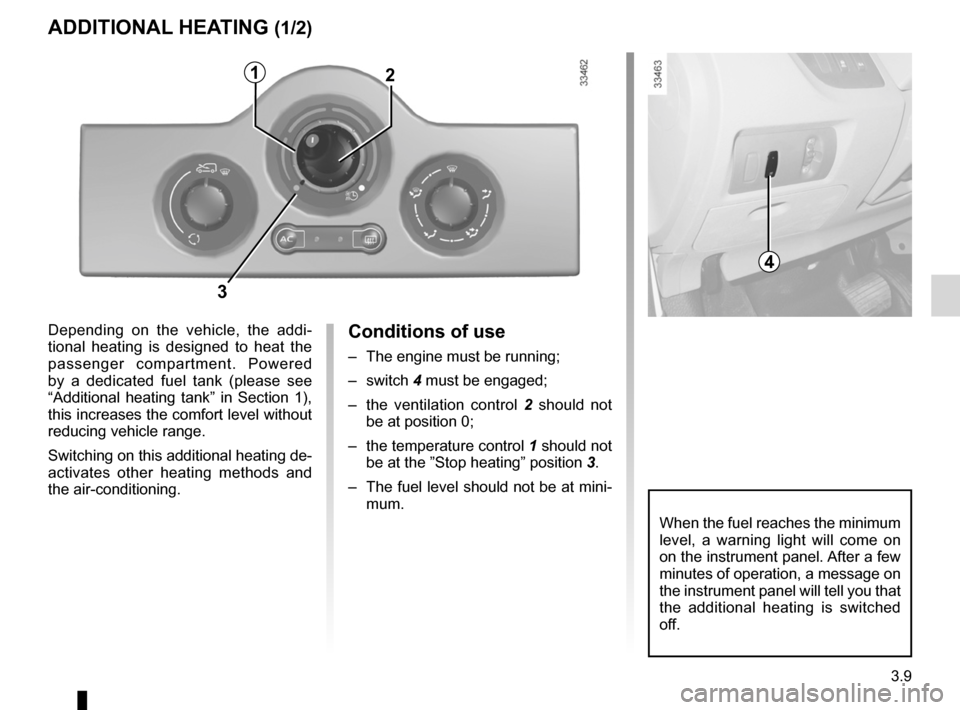
– The engine must be running;
– switch 4 must be engaged;
– the ventilation control 2 should not
be at position 0;
– the temperature control 1 should not
be at the ”Stop heating” position 3.
– The fuel level should not be at mini-
mum.
Additional heating
AdditionAl HeA tinG (1/2)
Depending on the vehicle, the addi -
tional heating is designed to heat the
passenger compartment. Powered
by a dedicated fuel tank (please see
“Additional heating tank” in Section 1),
this increases the comfort level without
reducing vehicle range.
Switching on this additional heating de-
activates other heating methods and
the air-conditioning.
2
When the fuel reaches the minimum
level, a warning light will come on
on the instrument panel. After a few
minutes of operation, a message on
the instrument panel will tell you that
the additional heating is switched
off.
3
4
1
Page 123 of 213
lighting:interior ............................................. (up to the end of the DU)
courtesy light ........................................ (up to the end of the DU)
map reading lights ................................ (up to the end of the DU)
3.12
ENG_UD25343_2
Eclairage intérieur (X61 - F61 - Renault)
ENG_NU_911-4_F61e_Renault_3
Jaune NoirNoir texte
Interior lighting
interior liGHtinG (1/2)
1
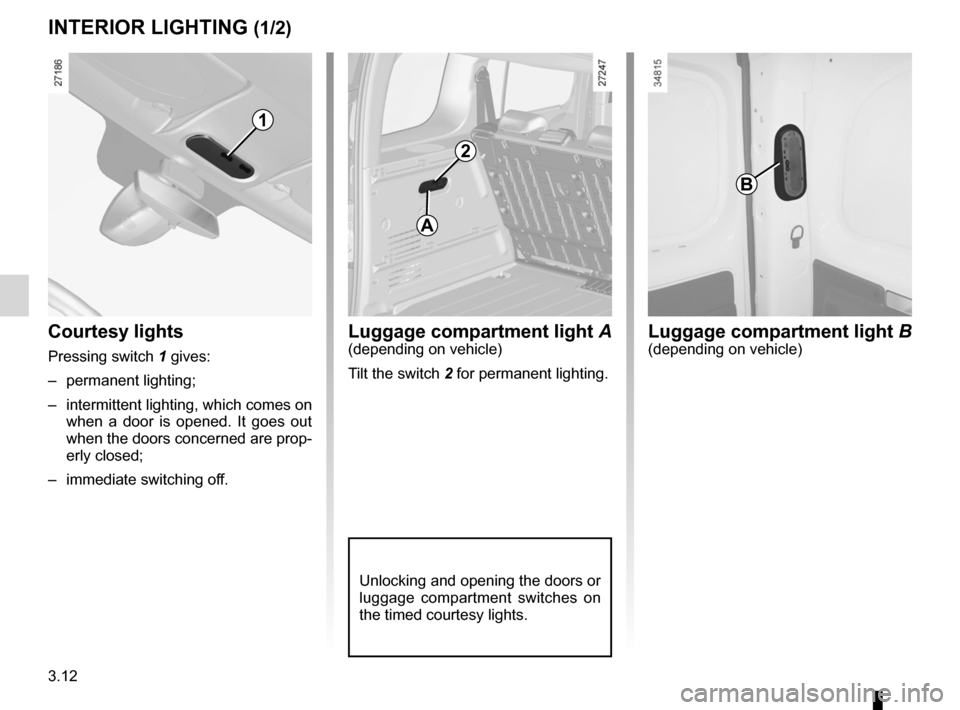
luggage compartment light A(depending on vehicle)
Tilt the switch 2 for permanent lighting.
A
2
Unlocking and opening the doors or
luggage compartment switches on
the timed courtesy lights.
Courtesy lights
Pressing switch 1 gives:
– permanent lighting;
– intermittent lighting, which comes on
when a door is opened. It goes out
when the doors concerned are prop-
erly closed;
– immediate switching off.
B
luggage compartment light B(depending on vehicle)
Page 124 of 213
JauneNoirNoir texte
3.13
ENG_UD25343_2
Eclairage intérieur (X61 - F61 - Renault)
ENG_NU_911-4_F61e_Renault_3
special features
Depending on the vehicle, remote un -
locking of the doors triggers timed light-
ing of the passenger compartment. If
one of the front or rear doors is opened,
the period for which the light is switched
on will start again.
Then the courtesy light and the luggage
compartment light dim and go out.
The lighting timer will cut out for vari -
ous reasons:
– if a door has been open for 15 min-
utes;
– if all the doors have been closed for
15 seconds or 5 minutes, depending
on the vehicle;
– when the ignition is switched on.
interior liGHtinG (2/2)
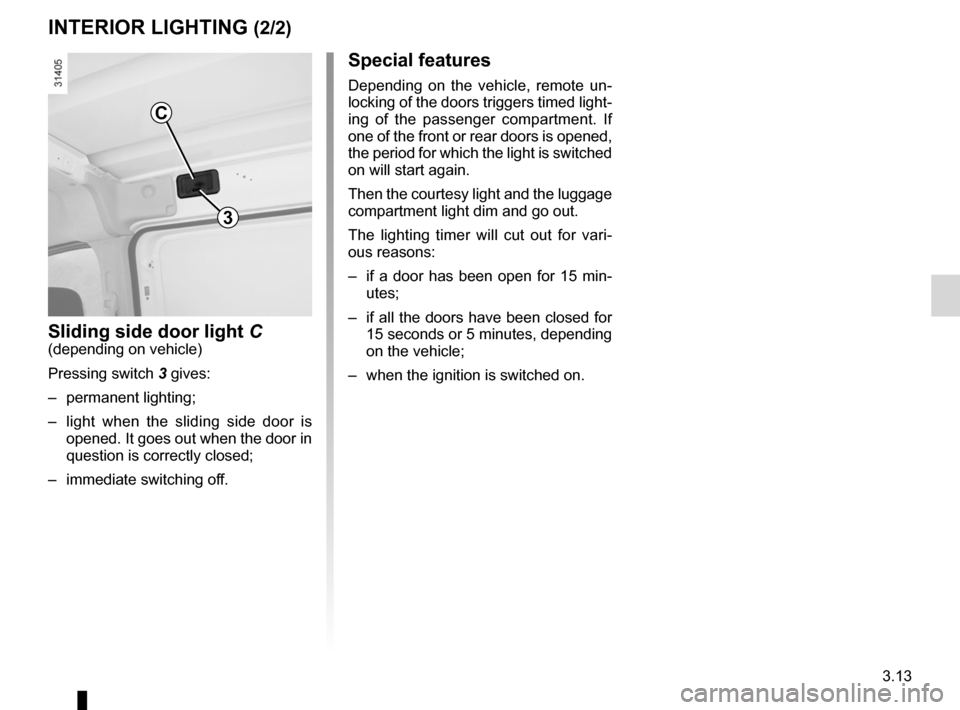
C
sliding side door light C(depending on vehicle)
Pressing switch 3 gives:
– permanent lighting;
– light when the sliding side door is
opened. It goes out when the door in
question is correctly closed;
– immediate switching off.
3
Page 128 of 213
cigar lighter ........................................... (up to the end of the DU)
ashtrays ................................................ (up to the end of the DU)
accessories socket ................................................ (current page)
3.17
ENG_UD23721_2
Cendriers (X61 - F61 - Renault)
ENG_NU_911-4_F61e_Renault_3
Ashtrays
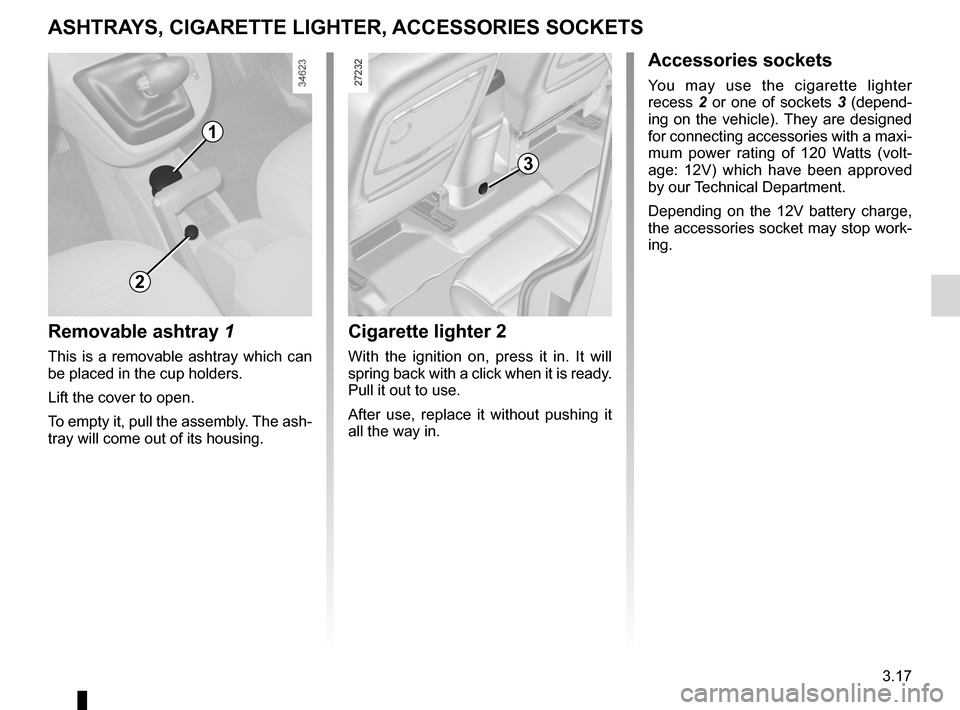
removable ashtray 1
This is a removable ashtray which can
be placed in the cup holders.
Lift the cover to open.
To empty it, pull the assembly. The ash-
tray will come out of its housing.
AsHtrAys, CiGArette liGHter, ACCessories soCkets
1
3
Accessories sockets
You may use the cigarette lighter
recess 2 or one of sockets 3 (depend-
ing on the vehicle). They are designed
for connecting accessories with a maxi-
mum power rating of 120 Watts (volt -
age: 12V) which have been approved
by our Technical Department.
Depending on the 12V battery charge,
the accessories socket may stop work-
ing.
Cigarette lighter 2
With the ignition on, press it in. It will
spring back with a click when it is ready.
Pull it out to use.
After use, replace it without pushing it
all the way in.
2