Eco RENAULT KOLEOS 2018 Owners Manual
[x] Cancel search | Manufacturer: RENAULT, Model Year: 2018, Model line: KOLEOS, Model: RENAULT KOLEOS 2018Pages: 332, PDF Size: 8.91 MB
Page 298 of 332
5.34
TOWING: breakdown recovery (4/4)
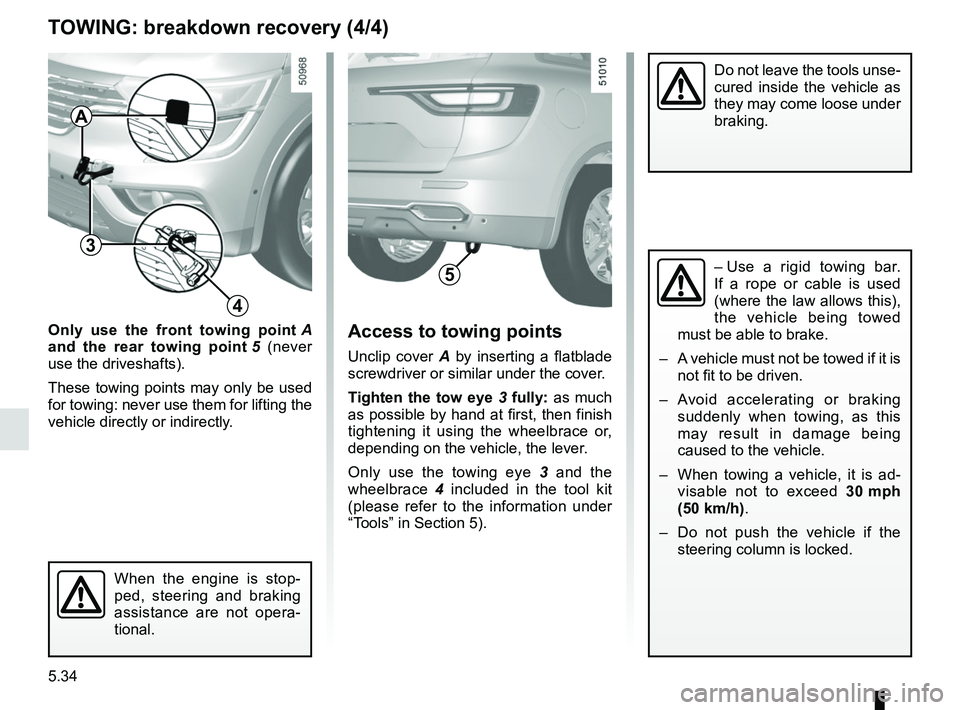
Only use the front towing point A
and the rear towing point 5 (never
use the driveshafts).
These towing points may only be used
for towing: never use them for lifting the
vehicle directly or indirectly.Access to towing points
Unclip cover A by inserting a flatblade
screwdriver or similar under the cover.
Tighten the tow eye 3 fully: as much
as possible by hand at first, then finish
tightening it using the wheelbrace or,
depending on the vehicle, the lever.
Only use the towing eye 3 and the
wheelbrace 4 included in the tool kit
(please refer to the information under
“Tools” in Section 5).
When the engine is stop-
ped, steering and braking
assistance are not opera-
tional.
Do not leave the tools unse-
cured inside the vehicle as
they may come loose under
braking.
– Use a rigid towing bar.
If a rope or cable is used
(where the law allows this),
the vehicle being towed
must be able to brake.
– A vehicle must not be towed if it is not fit to be driven.
– Avoid accelerating or braking suddenly when towing, as this
may result in damage being
caused to the vehicle.
– When towing a vehicle, it is ad- visable not to exceed 30 mph
(50 km/h).
– Do not push the vehicle if the steering column is locked.
3
4
A
5
Page 301 of 332
5.37
OPERATING FAULTS (3/7)
The starter is activatedPOSSIBLE CAUSES WHAT TO DO
The instrument panel indicator lights are
weak or fail to light up and the starter
does not turn. Battery terminals not tight,
battery terminals discon-
nected or oxidised.Retighten or reconnect the terminals, or clean them if
they are oxidised.
Discharged battery or not
operational. Connect another battery to the faulty battery. Refer to
information on “Battery: troubleshooting” in Section 5
or replace the battery if necessary.
Do not push the vehicle if the steering column is
locked.
Faulty circuit. Consult an approved dealer.
The engine will not start. Starting conditions are not
fulfilled.Please refer to the information on “Starting, stopping
the engine” in Section 2.
The RENAULT card does
not work. Please refer to the information on “Starting, stopping
the engine” in Section 2.
The engine cannot be switched off. Card not detected. Please refer to the information on “Starting, stopping
the engine” in Section 2.
Electronic fault. Press the starter button quickly five times.
The steering column remains locked. Steering wheel locked. Move the steering wheel while pressing the engine
start button or, depending on the vehicle, while turning
the key (refer to the information on “Starting, stopping
the engine” in Section 2).
Faulty circuit. Consult an approved dealer.
Page 303 of 332
5.39
OPERATING FAULTS (5/7)
On the roadPOSSIBLE CAUSESWHAT TO DO
Steering becomes heavy. Assistance overheating.
Fault with the electric assistance
motor.
Fault in assistance system. Drive carefully at reduced speed, be aware
of the level of force in the steering wheel
needed to turn the wheels. Consult an ap-
proved dealer.
The engine is overheating. The cool-
ant temperature indicator is in the
warning zone and warning light
® comes on. Engine cooling fan not working. Stop the vehicle, switch off the engine and
contact an approved dealer.
Coolant leaks. Check the coolant reservoir: it should con- tain fluid. If there is no coolant, consult an
approved dealer as soon as possible.
Coolant boiling in the coolant reser-
voir. Mechanical fault: damaged cylinder
head gasket. Stop the engine.
Contact an approved dealer.
Radiator:
If there is a significant lack of coolant, remember that it must never b\
e topped up using cold coolant while
the engine is very warm. After any procedure on the vehicle which has involved even partial drain\
ing of the cooling
system, it must be refilled with a new mixture prepared in the correct p\
roportions. Reminder: only products approved
by our Technical Department may be used for this purpose.
Page 312 of 332

The weights indicated for a basic vehicle without options: they vary dep\
ending on the your vehicle’s equipment. Consult
your approved Dealer.Maximum permissible all-up weight")
6.6
WEIGHTS (in kg)
The weights indicated for a basic vehicle without options: they vary dep\
ending on the your vehicle’s equipment. Consult
your approved Dealer.Maximum permissible all-up weight (MMAC)
Maximum permissible all-up weight (MMTA)
Gross Train Weight (MTR) Weights are indicated on the vehicle identification plate (refer to
the information on “Vehicle identification plates” in Section 6)
Braked Trailer Weight* found by calculating: MTR - MMAC
Unbraked Trailer Weight* 750
Permissible nose weight* 75 or 80 kg depending on the vehicle
(contact your approve dealer)
Maximum permissible load on roof 80 kg (including carrying device)
* Towing weight (towing a caravan, boat, etc.)
Towing is prohibited when the MTR - MMAC calculation is equal to zero, or\
when the MTR is equal to zero (or is not listed) on
the identification plate.
– It is important to comply with the towing weights, governed by local leg\
islation in each country and, in particular, laid down in the Road Traffic Regulations. Contact an approved Dealer about any towing equipment.
– When towing, under no circumstances may the total train weight (vehicle + trailer) be exceeded . However the following is
permitted:
– rear axle MMTA exceeded by no more than 15%,
– maximum MMAC exceeded by no more than 10% or 100 kg (whichever is reach\
ed first).
In either case, the maximum speed of the vehicle and trailer must not ex\
ceed 60 mph (100 km/h) and the tyre pressures must be increased by 0.2 bar (3 PSI).
– The engine output and climbing capability are reduced with altitude. We recommend that the maximum load be reduced by 10% at an altitude of 1,000 metres and by an additional 10% for each 1,0\
00 metres thereafter.
Page 326 of 332

windscreen ...........................................................3.4 → 3.6
dimensions .............................................................\
............. 6")
7.2
ALPHABETICAL INDEX (2/5)
windscreen ...........................................................3.4 → 3.6
dimensions .............................................................\
............. 6.4
dipstick................................................................\
................. 4.4
display ................................................................\
...1.54 → 1.61
doors/tailgate .........................................................\
..1.4 → 1.16
driver assistance.............................. 2.59 → 2.61, 2.69 → 2.76
driver’s position .....................................................1.50 → 1.59
driving ....... 2.2 → 2.9, 2.14 – 2.15, 2.18 → 2.25, 2.31 → 2.38,
2.62 → 2.81, 2.90 → 2.92
driving aids .................. 2.53 – 2.54, 2.59 → 2.61, 2.69 → 2.76
driving position settings ............................................................1.23 → 1.26
driving recommendations ......................................2.21 → 2.25
E
ECO driving ...........................................................2.21 → 2.25
ECO mode ........................................................................\
. 2.22
electric beam height adjustment ............................. 1.85 – 1.86
electric windows ..................................................... 3.19 – 3.20
electronic parking brake ........................................2.18 → 2.20
electronic stability control: ESC .............................2.31 → 2.34
emergency active braking......................................2.39 → 2.49
emergency brake assist.........................................2.31 → 2.34
emergency braking ................................................2.31 → 2.34
emergency key ........................................................... 1.5 – 1.6
emergency spare wheel ............................................. 5.2 – 5.3
engine technical specifications .................................................. 6.5
engine coolant ..................................................................... 4.8
engine oil ...................................................................4.4 → 4.7
engine oil capacity .....................................................4.5 → 4.7
engine oil level ...........................................................4.4 → 4.7
engine specifications .................................................... 6.3, 6.5
engine standby ......................................................2.10 → 2.13
engine start/stop button .............................................2.5 → 2.9
environment ............................................................\
........... 2.27 ESC: electronic stability control ....................1.56, 2.31
→ 2.34
F
4 wheel drive (4WD) ..............................................2.35 → 2.38
F
fatigue detection warning........................................ 2.53 – 2.54
F
faults operating faults ................................................5.35 → 5.41
filter air filter ........................................................................\
. 4.10
oil filter .................................................................4.5 → 4.7
passenger compartment filter ...................................... 4.10
fittings ...............................................................\
.....3.26 → 3.30
front passenger air bag deactivation ................................. 1.47
front seat adjustment ......................................................... 1.20
front seats adjustment ............................................... 1.19 – 1.20, 1.23
with electric controls
.................................................... 1.21
fuel advice on fuel economy ...................................2.21 → 2.25
consumption ....................................................2.21 → 2.25
filling ........................................................1.54, 1.95 → 1.97
grade ................................................................1.95 → 1.97
fuel consumption ...................................................2.21 → 2.25
fuel economy .........................................................2.21 → 2.25
fuel filler cap ..........................................................1.95 → 1.97
fuel level ................................................................1.54 → 1.60
fuel tank capacity ...............................................................\
......... 1.95
fuel tank capacity ...................................................1.95 → 1.97
fuses ..................................................................\
....5.23 → 5.25
Page 331 of 332

A passion for performance
ELF, partner of
RENAULT recommends ELF
Partners in cutting-edge automotive technology, Elf and Renault combine their expertise on both
the racetrack and the city streets. This enduring partnership gives drivers a range of lubricants
perfectly suited to Renault cars. Lasting protection and optimum performance for your engine –
guaranteed. Whether changing the oil or simply topping up, to find the approved ELF lubricant
best suited to your vehicle, ask your Renault dealer for a recommendation or consult your vehi-
cle maintenance handbook.
www.lubricants.elf.com
A brand from
2016-Elf-ENG.indd 118/05/2016 14:20