light RENAULT TWINGO 2012 2.G User Guide
[x] Cancel search | Manufacturer: RENAULT, Model Year: 2012, Model line: TWINGO, Model: RENAULT TWINGO 2012 2.GPages: 220, PDF Size: 6.73 MB
Page 27 of 220
JauneNoirNoir texte
1.21
ENG_UD24708_5
Dispositifs complémentaires à la ceinture avant (X44 - Renault)
ENG_NU_952-4_X44_Renault_1
METhODs OF REsTRAINT IN ADDITION TO ThE FRONT sEAT BELTs (3/4)
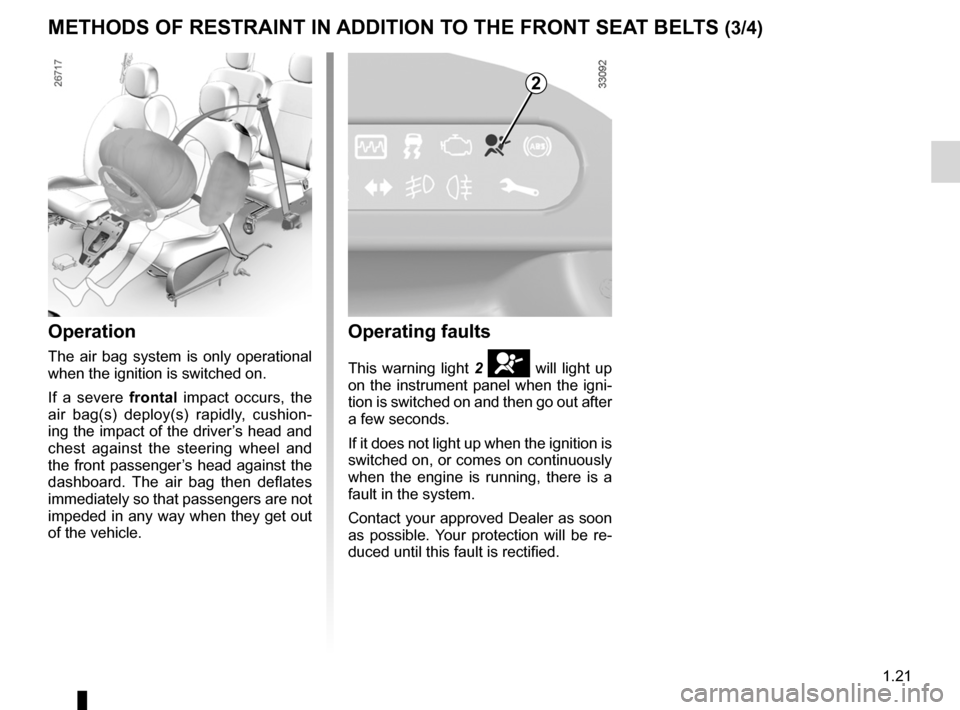
Operation
The air bag system is only operational
when the ignition is switched on.
If a severe frontal impact occurs, the
air bag(s) deploy(s) rapidly, cushion -
ing the impact of the driver’s head and
chest against the steering wheel and
the front passenger’s head against the
dashboard. The air bag then deflates
immediately so that passengers are not
impeded in any way when they get out
of the vehicle.
Operating faults
This warning light 2 å will light up
on the instrument panel when the igni -
tion is switched on and then go out after
a few seconds.
If it does not light up when the ignition is
switched on, or comes on continuously
when the engine is running, there is a
fault in the system.
Contact your approved Dealer as soon
as possible. Your protection will be re-
duced until this fault is rectified.
2
Page 28 of 220

1.22
ENG_UD24708_5
Dispositifs complémentaires à la ceinture avant (X44 - Renault)
ENG_NU_952-4_X44_Renault_1
METhODs OF REsTRAINT IN ADDITION TO ThE FRONT sEAT BELTs (4/4)
All of the warnings below are given so that the air bag is not obstructed in any way when it is deployed and also to pre-
vent the risk of serious injuries caused by items which may be dislodged\
when the air bag deploys.
Warnings concerning the driver’s air bag
– Do not modify the steering wheel or the steering wheel boss.
– Do not cover the steering wheel boss under any circumstances.
– Do not attach any objects (badge, logo, clock, telephone holder, etc.) to the steering wheel boss.
– The steering wheel must not be removed (except by qualified personnel from our Network).
– When driving, do not sit too close to the steering wheel. Sit with your arms slightly bent (see the information on “Adjusting
your driving position” in Section 1). This will allow sufficient space for the air bag to deploy correctly and be fully effective.
Warnings concerning the passenger air bag
– Do not attach or glue any objects (badge, logo, clock, telephone holder, etc.) to the dashboard on or near the air bag.
– Do not place anything between the dashboard and the passenger (pet, umbrella, walking stick, parcels, etc.).
– The passenger must not put his or her feet on the dashboard or seat as there is a risk that serious injuries may occur. In
general, parts of the body should be kept away from the dashboard (knee\
s, hands, head, etc.).
– The systems in addition to the front passenger seat belt should be reactivated as soon as a child seat is removed, to ensure
the protection of the passenger in the event of an impact.
A REAR-FACING ChILD sEAT MUsT NOT BE FITTED TO ThE FRONT p AssENGER sEAT UNLEss
ThE ADDITIONAL REsTRAINT sYsTEMs, I.E. ThE p AssENGER AIR BAG, ARE DEACTIVATED.
(Refer to Section 1 “Child safety: deactivating/activating the front\
passenger air bag”).
Page 41 of 220

ENG_NU_952-4_X44_Renault_1
X = Seat not suitable for fitting child seats.
U = Seat which")
JauneNoirNoir texte
1.35
ENG_UD24497_2
Sécurité enfants : installation du siège enfant (X44 - Renault\
)
ENG_NU_952-4_X44_Renault_1
X = Seat not suitable for fitting child seats.
U = Seat which allows a child seat with “Universal” approval to be installed using a seat belt; check that it can be fitted.
IUF/IL = On equipped vehicles, seat which allows an approved “Universal”/“semi-universal” or “vehicle specific” child seat to be
attached using the ISOFIX system; check that it can be fitted.
(2) Before fitting a rear-facing child seat: raise the seat to the maximum and position it as far back as possible, tilting the seatback
slightly (approximately 25°).
(3) It is recommended to position the rear seat as far back as possible ensuring, if required, that the floor support of the child seat
is resting on the floor in accordance with the child seat instructions.
(4) A carrycot can be installed across the vehicle and will take up two seats. Position the child with his or her feet nearest the door.
(5) Move the front seat as far forward as possible to install a rear-facing child seat, then move back the seat or seats in front as
far as they will go, although without allowing them to come into contact\
with the child seat.
(6) Forward-facing child seat; position the seatback of the child seat in contact with the seatback of the vehicle seat. Adjust the
height of the headrest or remove it if necessary; do not push the seat in front of the child more than halfway back on its runners
and do not recline the seatback more than 25°.
ChILD sAFETY : Fitting a child seat (4/4)
Page 42 of 220

ENG_NU_952-4_X44_Renault_1
Jaune NoirNoir texte
Deactivating/activating the front passenger airbag
Deactivati")
1.36
ENG_UD29224_6
sécurité enfants : désactivation/activation airbag (X44 - Rena\
ult)
ENG_NU_952-4_X44_Renault_1
Jaune NoirNoir texte
Deactivating/activating the front passenger airbag
Deactivating the front
passenger airbags
(on equipped vehicles)
In order to fit a child seat to the front
passenger seat when this is allowed,
you must deactivate the front passen-
ger seat additional restraint devices
(side airbags (depending on vehicle),
front airbags, etc.). To deactivate the restraint devices
supplementary to the front passen
-
ger seat belt: switch off the ignition,
press and turn lock 1 to the OFF posi-
tion. The airbag is deactivated.
With the ignition on, it is essential to
check that warning light 2 is lit on the
instrument panel.
This warning light remains lit to con-
firm that you can fit a child seat, as
the passenger air bag has been de -
activated.
1
ChILD sAFETY : deactivating/activating the front passenger airbag (1/3)
2
The passenger air bag must
only be deactivated or acti-
vated with the ignition off.
If it is interfered with when
the vehicle is being driven, indicator
lights
å and © will come
on.
Switch the ignition off then on again
to reset the air bag in accordance
with the lock.
Page 44 of 220

ENG_NU_952-4_X44_Renault_1
Activating the front
passenger air bags
You should reactivate the air bag a")
1.38
ENG_UD29224_6
sécurité enfants : désactivation/activation airbag (X44 - Rena\
ult)
ENG_NU_952-4_X44_Renault_1
Activating the front
passenger air bags
You should reactivate the air bag as
soon as you remove the child seat from
the front passenger seat to ensure the
protection of the front passenger in the
event of an impact.
To reactivate the restraint devices
supplementary to the front passen -
ger seat belt: switch off the ignition,
press and turn lock 1 to the ON posi -
tion.
With the ignition on, check that the
warning light 2 goes out.
The front passenger seat belt additional
restraint systems are activated.
Operating faults
If the front passenger air bag activa -
tion/deactivation system is faulty, child
seats must NOT be fitted to the front
seat.
Allowing any other passenger to sit in
that seat is not recommended.
Contact your approved dealer as soon
as possible.
The passenger air bag must
only be deactivated or acti-
vated with the ignition off.
If it is interfered with when
the vehicle is being driven, indicator
lights
å and © will come
on.
Switch the ignition off then on again
to reset the air bag in accordance
with the lock.
2
ChILD sAFETY : deactivating/activating the front passenger airbag (3/3)
1
Page 45 of 220
audible and visual signals......................................(current page)
hazard warning lights signal .................................. (current page)
lights: direction indicators ........................................... (current page)
lights: hazard warning ................................................ (current page)
hazard warning lights signal .................................. (current page)
1.39
ENG_UD24710_3
Avertisseurs sonores et lumineux (X44 - Renault)
ENG_NU_952-4_X44_Renault_1
Audible and visual signals
AUDIBLE AND VIsUAL sIGNALs
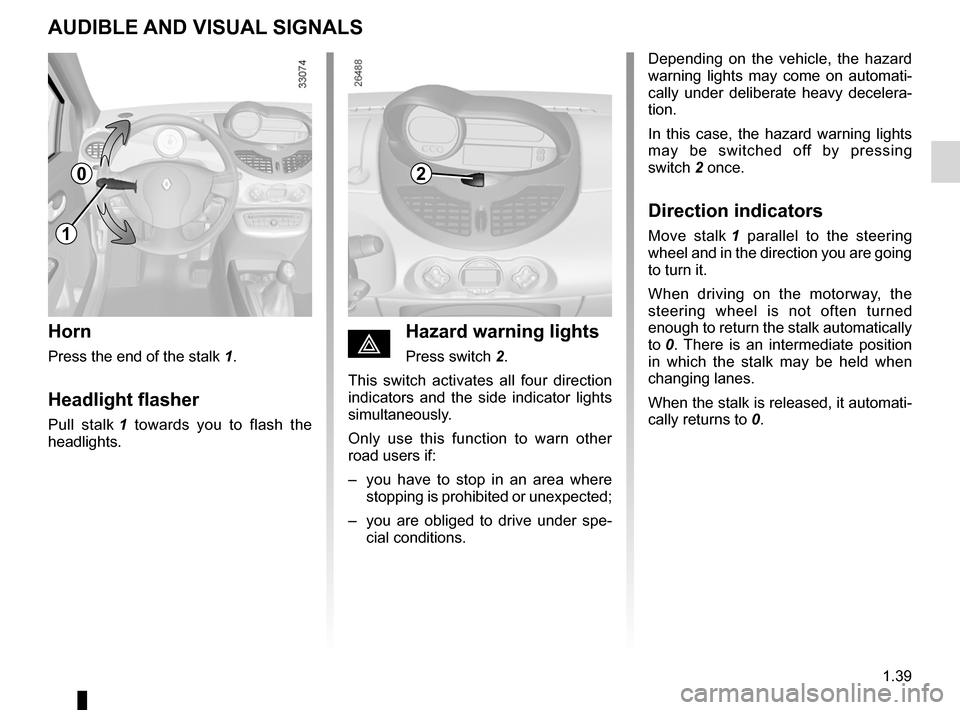
horn
Press the end of the stalk 1.
headlight flasher
Pull stalk 1 towards you to flash the
headlights.
éhazard warning lights
Press switch 2.
This switch activates all four direction
indicators and the side indicator lights
simultaneously.
Only use this function to warn other
road users if:
– you have to stop in an area where
stopping is prohibited or unexpected;
– you are obliged to drive under spe -
cial conditions. Depending on the vehicle, the hazard
warning lights may come on automati
-
cally under deliberate heavy decelera -
tion.
In this case, the hazard warning lights
may be switched off by pressing
switch 2 once.
Direction indicators
Move stalk 1 parallel to the steering
wheel and in the direction you are going
to turn it.
When driving on the motorway, the
steering wheel is not often turned
enough to return the stalk automatically
to 0 . There is an intermediate position
in which the stalk may be held when
changing lanes.
When the stalk is released, it automati-
cally returns to 0.
0
1
2
Page 47 of 220
JauneNoirNoir texte
1.41
ENG_UD24711_5
Poste de conduite direction à gauche (X44 - Renault)
ENG_NU_952-4_X44_Renault_1
DRIVING pOsITION, LEFT-hAND DRIVE (2/2)
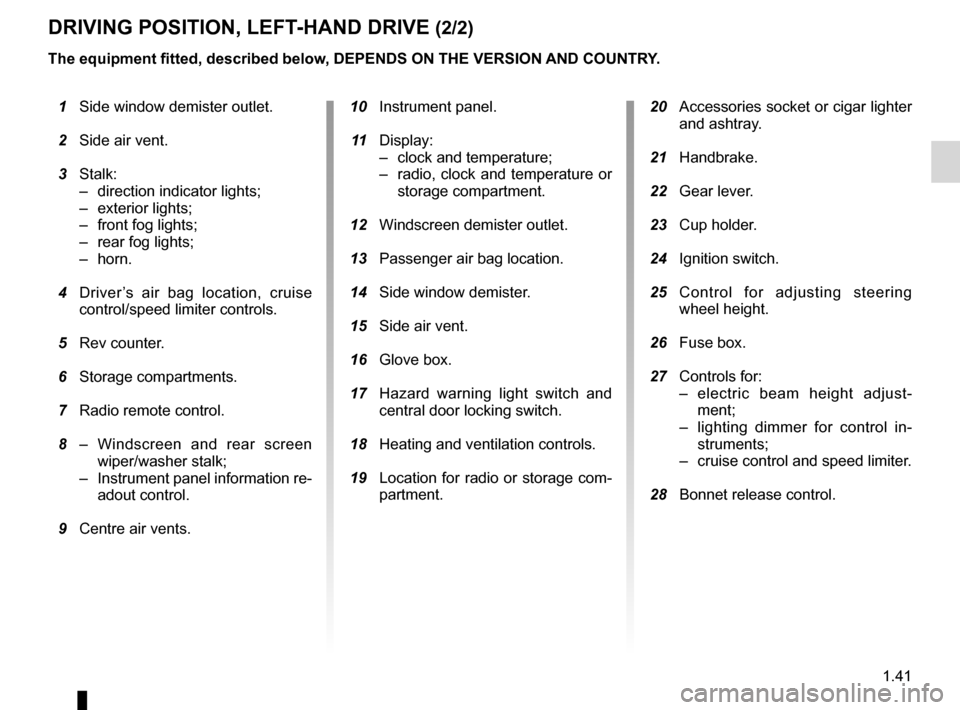
1 Side window demister outlet.
2 Side air vent.
3 Stalk:
– direction indicator lights;
– exterior lights;
– front fog lights;
– rear fog lights;
– horn.
4 Driver ’s air bag location, cruise
control/speed limiter controls.
5 Rev counter.
6 Storage compartments.
7 Radio remote control.
8 – Windscreen and rear screen
wiper/washer stalk;
– Instrument panel information re-
adout control.
9 Centre air vents.
10 Instrument panel.
11 Display:
– clock and temperature;
– radio, clock and temperature or
storage compartment.
12 Windscreen demister outlet.
13 Passenger air bag location.
14 Side window demister.
15 Side air vent.
16 Glove box.
17 Hazard warning light switch and
central door locking switch.
18 Heating and ventilation controls.
19 Location for radio or storage com-
partment.
20 Accessories socket or cigar lighter
and ashtray.
21 Handbrake.
22 Gear lever.
23 Cup holder.
24 Ignition switch.
25 Control for adjusting steering
wheel height.
26 Fuse box.
27 Controls for:
– electric beam height adjust -
ment;
– lighting dimmer for control in -
struments;
– cruise control and speed limiter.
28 Bonnet release control.
The equipment fitted, described below, DEpENDs ON ThE VERsION AND COUNTRY.
Page 49 of 220
JauneNoirNoir texte
1.43
ENG_UD24749_3
Poste de conduite direction à droite (X44 - Renault)
ENG_NU_952-4_X44_Renault_1
DRIVING pOsITION, RIGhT-hAND DRIVE (2/2)
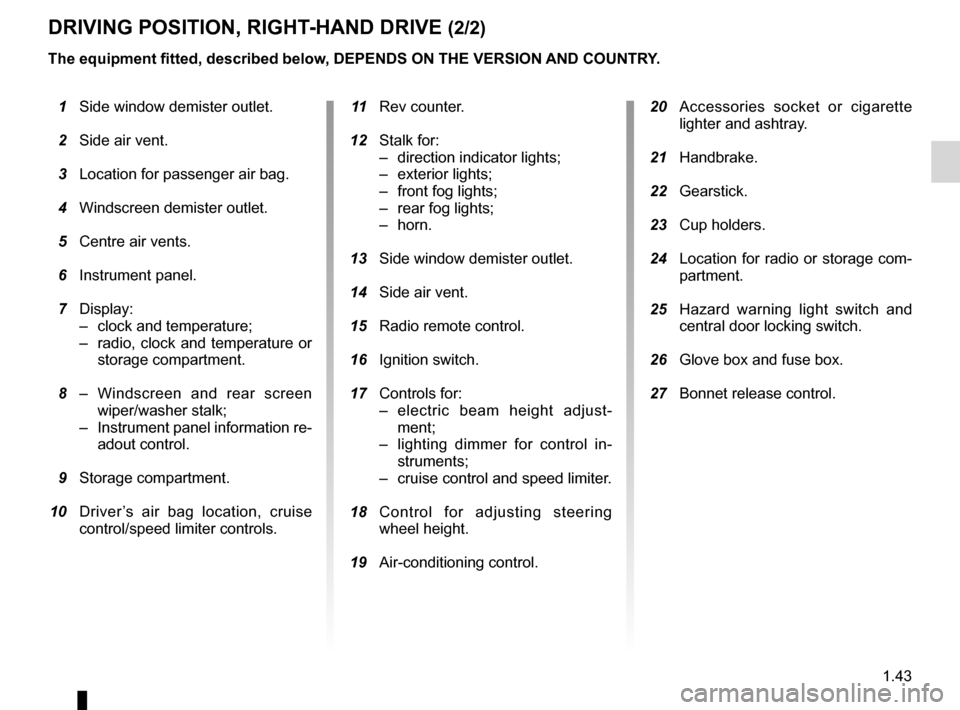
1 Side window demister outlet.
2 Side air vent.
3 Location for passenger air bag.
4 Windscreen demister outlet.
5 Centre air vents.
6 Instrument panel.
7 Display:
– clock and temperature;
– radio, clock and temperature or
storage compartment.
8 – Windscreen and rear screen
wiper/washer stalk;
– Instrument panel information re-
adout control.
9 Storage compartment.
10 Driver ’s air bag location, cruise
control/speed limiter controls.
11 Rev counter.
12 Stalk for:
– direction indicator lights;
– exterior lights;
– front fog lights;
– rear fog lights;
– horn.
13 Side window demister outlet.
14 Side air vent.
15 Radio remote control.
16 Ignition switch.
17 Controls for:
– electric beam height adjust -
ment;
– lighting dimmer for control in -
struments;
– cruise control and speed limiter.
18 Control for adjusting steering
wheel height.
19 Air-conditioning control. 20 Accessories socket or cigarette
lighter and ashtray.
21 Handbrake.
22 Gearstick.
23 Cup holders.
24 Location for radio or storage com-
partment.
25 Hazard warning light switch and
central door locking switch.
26 Glove box and fuse box.
27 Bonnet release control.
The equipment fitted, described below, DEpENDs ON ThE VERsION AND COUNTRY.
Page 50 of 220
controls ................................................. (up to the end of the DU)
instrument panel ................................... (up to the end of the DU)
warning lights ........................................ (up to the end of the DU)
1.44
ENG_UD30823_8
Tableau de bord : témoins lumineux (X44 - Renault)
ENG_NU_952-4_X44_Renault_1
Jaune NoirNoir texte
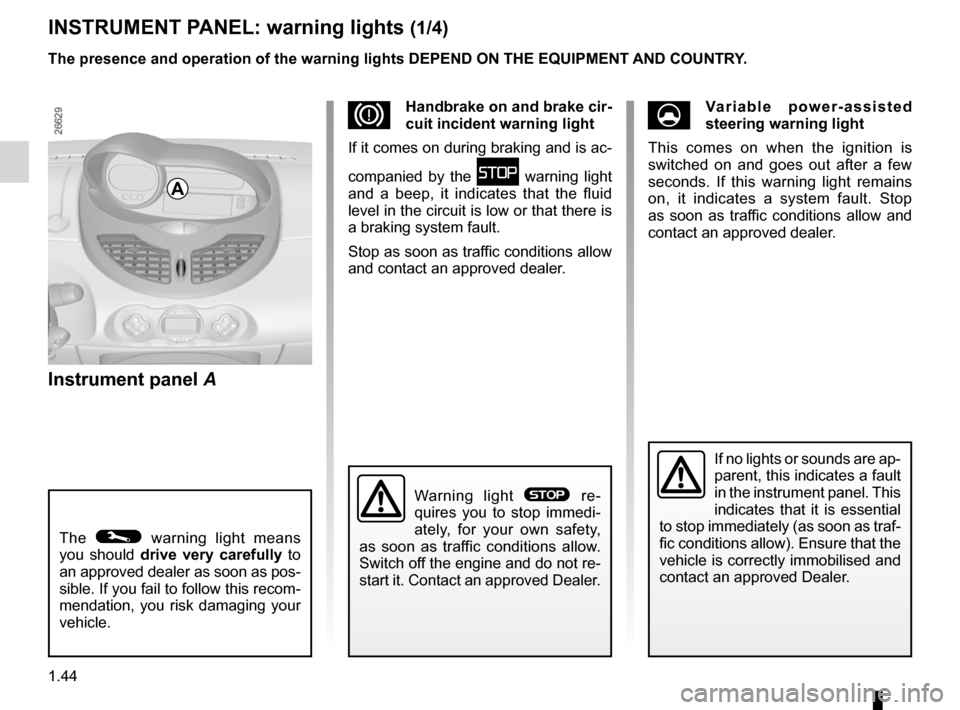
Instrument panel
INsTRUMENT p ANEL: warning lights (1/4)
Dhandbrake on and brake cir-
cuit incident warning light
If it comes on during braking and is ac-
companied by the
û warning light
and a beep, it indicates that the fluid
level in the circuit is low or that there is
a braking system fault.
Stop as soon as traffic conditions allow
and contact an approved dealer.
UVa r i a b l e p o w e r - a s s i s t e d
steering warning light
This comes on when the ignition is
switched on and goes out after a few
seconds. If this warning light remains
on, it indicates a system fault. Stop
as soon as traffic conditions allow and
contact an approved dealer.
If no lights or sounds are ap-
parent, this indicates a fault
in the instrument panel. This
indicates that it is essential
to stop immediately (as soon as traf-
fic conditions allow). Ensure that the
vehicle is correctly immobilised and
contact an approved Dealer.
The © warning light means
you should drive very carefully to
an approved dealer as soon as pos-
sible. If you fail to follow this recom-
mendation, you risk damaging your
vehicle.
Warning light ® re -
quires you to stop immedi -
ately, for your own safety,
as soon as traffic conditions allow.
Switch off the engine and do not re-
start it. Contact an approved Dealer.
Instrument panel A
A
The presence and operation of the warning lights DEpEND ON ThE EQUIpMENT AND COUNTRY.
Page 51 of 220
JauneNoirNoir texte
1.45
ENG_UD30823_8
Tableau de bord : témoins lumineux (X44 - Renault)
ENG_NU_952-4_X44_Renault_1
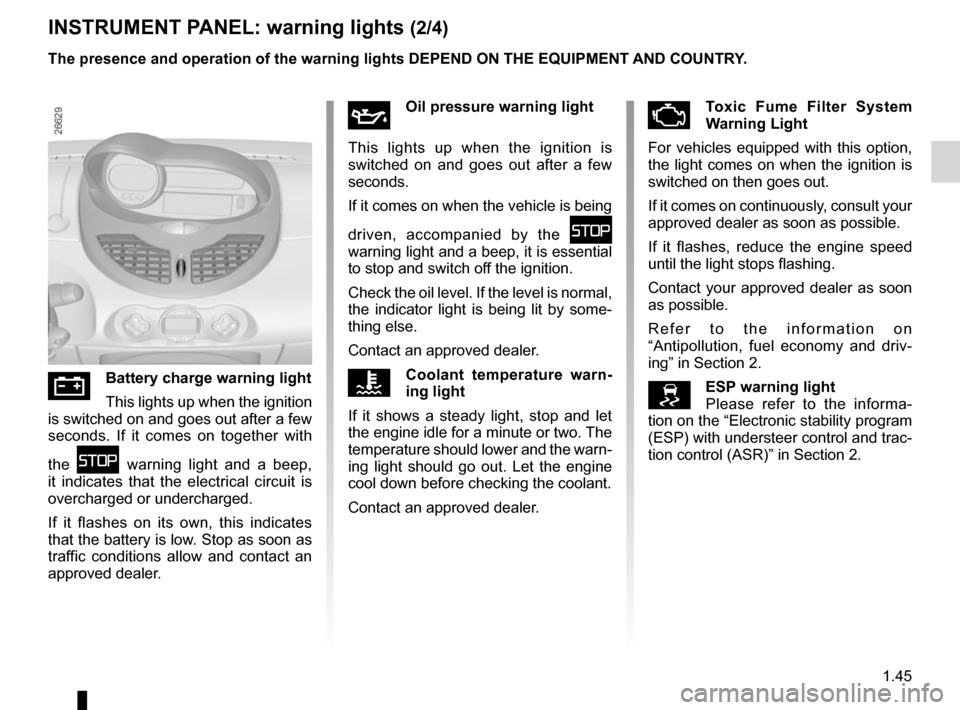
ÄToxic Fume Filter system
Warning Light
For vehicles equipped with this option,
the light comes on when the ignition is
switched on then goes out.
If it comes on continuously, consult your
approved dealer as soon as possible.
If it flashes, reduce the engine speed
until the light stops flashing.
Contact your approved dealer as soon
as possible.
R e f e r t o t h e i n f o r m a t i o n o n
“Antipollution, fuel economy and driv -
ing” in Section 2.
Esp warning light
Please refer to the informa -
tion on the “Electronic stability program
(ESP) with understeer control and trac-
tion control (ASR)” in Section 2.
INsTRUMENT p ANEL: warning lights (2/4)
ÚBattery charge warning light
This lights up when the ignition
is switched on and goes out after a few
seconds. If it comes on together with
the
û warning light and a beep,
it indicates that the electrical circuit is
overcharged or undercharged.
If it flashes on its own, this indicates
that the battery is low. Stop as soon as
traffic conditions allow and contact an
approved dealer.
ÀOil pressure warning light
This lights up when the ignition is
switched on and goes out after a few
seconds.
If it comes on when the vehicle is being
driven, accompanied by the
û
warning light and a beep, it is essential
to stop and switch off the ignition.
Check the oil level. If the level is normal,
the indicator light is being lit by some-
thing else.
Contact an approved dealer.
ÔCoolant temperature warn -
ing light
If it shows a steady light, stop and let
the engine idle for a minute or two. The
temperature should lower and the warn-
ing light should go out. Let the engine
cool down before checking the coolant.
Contact an approved dealer.
The presence and operation of the warning lights DEpEND ON ThE EQUIpMENT AND COUNTRY.