set SAAB 9-3 2007 Owners Manual
[x] Cancel search | Manufacturer: SAAB, Model Year: 2007, Model line: 9-3, Model: SAAB 9-3 2007Pages: 304, PDF Size: 26.16 MB
Page 9 of 304
9
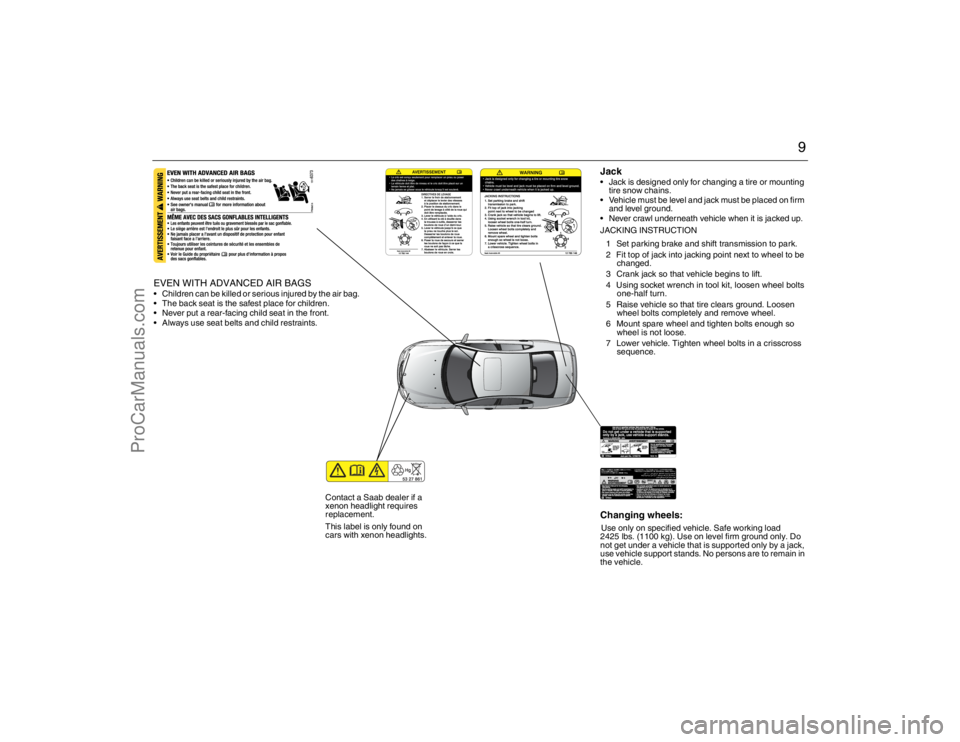
Changing wheels:Use only on specified vehicle. Safe working load
2425 lbs. (1100 kg). Use on level firm ground only. Do
not get under a vehicle that is supported only by a jack,
use vehicle support stands. No persons are to remain in
the vehicle.
Contact a Saab dealer if a
xenon headlight requires
replacement.
This label is only found on
cars with xenon headlights.
EVEN WITH ADVANCED AIR BAGS Children can be killed or serious injured by the air bag.
The back seat is the safest place for children.
Never put a rear-facing child seat in the front.
Always use seat belts and child restraints.
Jack Jack is designed only for changing a tire or mounting
tire snow chains.
Vehicle must be level and jack must be placed on firm
and level ground.
Never crawl underneath vehicle when it is jacked up.
JACKING INSTRUCTION
1 Set parking brake and shift transmission to park.
2 Fit top of jack into jacking point next to wheel to be
changed.
3 Crank jack so that vehicle begins to lift.
4 Using socket wrench in tool kit, loosen wheel bolts
one-half turn.
5 Raise vehicle so that tire clears ground. Loosen
wheel bolts completely and remove wheel.
6 Mount spare wheel and tighten bolts enough so
wheel is not loose.
7 Lower vehicle. Tighten wheel bolts in a crisscross
sequence.
93_U S _M 07.book Page 9 W ednesday, April 12, 2006 9:30 AM
ProCarManuals.com
Page 14 of 304

14 SafetyFront safety beltsFasten the belt by pulling the belt and insert-
ing the tongue in the buckle. Check that it is
securely fastened.
Position the lap part low across the hips.
Grasp the shoulder belt close to the buckle
and pull the belt towards the shoulder to
tighten the lap belt part.
The belt must be as far in on the shoulder as
possible.Press the red button on the belt buckle to
release the belt.
The front safety belts have their lower
anchorage points on the seats. The safety
belts follow the seats when the legroom is
adjusted.
Refer to page 260 for how to check the func-
tion of the safety belts, cleaning, etc.
Belt height adjustment,
Sport Sedan and SportCombiThe belt guide on the door pillar for the front
safety belts can be set at different heights.
The front belt guide in the Convertible is not
adjustable due to the belt being incorpo-
rated into the seat.
To fasten the belt Press the red button to release the belt
The belt guide on door pillar, Sport Sedan
and SportCombi
93_U S _M 07.book Page 14 W ednesday, April 12, 2006 9:30 AM
ProCarManuals.com
Page 22 of 304

22 SafetyWhen the ignition is ON, all seat settings
can be adjusted. When the door is open and
before the remote control has been inserted
into the ignition switch, all seat settings can
be adjusted for up to 20 minutes.
The memory also includes the door mirror
settings.
Storing and restoring settings
1 Adjust the seat and the door mirrors.
The lumbar support is not included by
the memory function.
2 Press and hold the M-button and then
press one of the preselect buttons (1, 2
or 3). A chime will sound to confirm that
the settings have been saved.
To recall programmed settings, press and
hold the desired memory button until the
seat and door mirrors adopt their pro-
grammed positions. The memory function
also includes the door mirror settings.
To facilitate reversing, the passenger-side
door mirror can be angled down, refer to
page 122.93_U S _M 07.book Page 22 W ednesday, April 12, 2006 9:30 AM
ProCarManuals.com
Page 23 of 304
23 Safety
Head restraintsSport Sedan and SportCombi
Head restraint, Convertible, see page 74.
The front seats are equipped with Saab
Active Head Restraints (SAHRs). These are
designed to reduce the risk of neck injury if
the car is hit from behind.
The SAHR is a mechanical system, actu-
ated by body weight. The mechanism is built
into the top of the backrest, where it is con-
nected to the head restraint.In the event of a rear-end crash, the body is
forced back against the backrest. This, in
turn, causes the mechanism to press the
head restraint forward and upward, thus
limiting the backward movement of the
head.
Therefore, the SAHR does not normally
need to be replaced or repaired after a rear-
end crash.
The front and rear head restraints can be
raised and lowered to a number of positions.
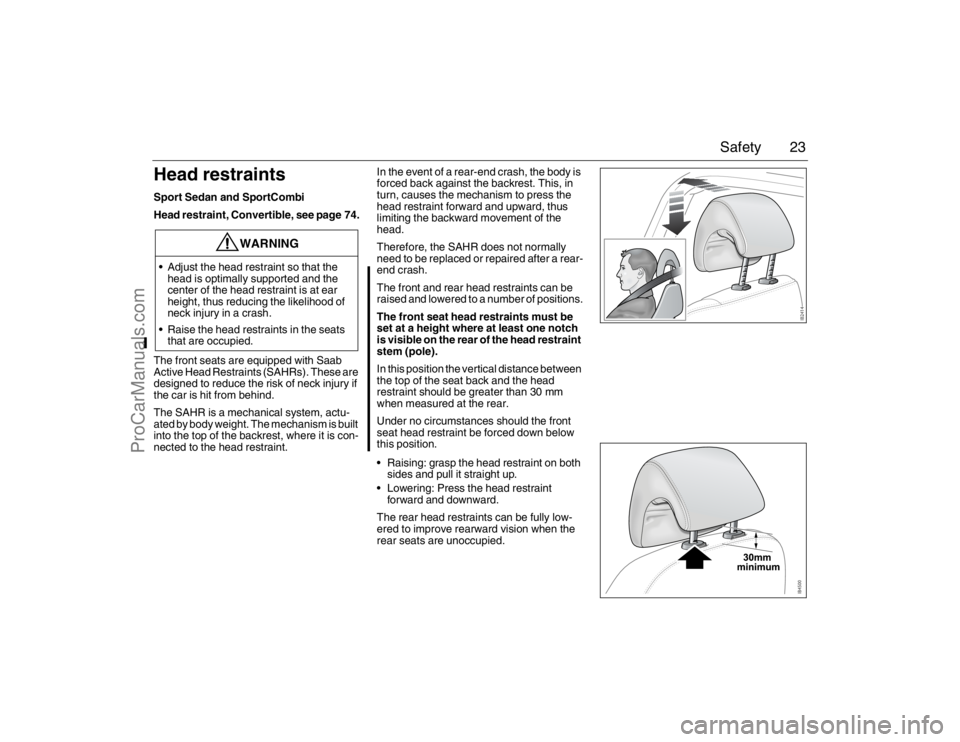
The front seat head restraints must be
set at a height where at least one notch
is visible on the rear of the head restraint
stem (pole).
In this position the vertical distance between
the top of the seat back and the head
restraint should be greater than 30 mm
when measured at the rear.
Under no circumstances should the front
seat head restraint be forced down below
this position.
Raising: grasp the head restraint on both
sides and pull it straight up.
Lowering: Press the head restraint
forward and downward.
The rear head restraints can be fully low-
ered to improve rearward vision when the
rear seats are unoccupied.
WARNING
Adjust the head restraint so that the
head is optimally supported and the
center of the head restraint is at ear
height, thus reducing the likelihood of
neck injury in a crash.
Raise the head restraints in the seats
that are occupied.93_U S _M 07.book Page 23 W ednesday, April 12, 2006 9:30 AM
ProCarManuals.com
Page 45 of 304

45 Safety
Frequently asked questions on
function of the airbagDo you still need to wear a safety belt if air-
bags are fitted?Yes, always! The airbag system compo-
nents merely supplement the car’s normal
safety system. Moreover, the front airbags
will only be actuated in a moderate to severe
frontal, or near-frontal crash, which means,
of course, that they provide no protection in
minor frontal crashes, major rear- or side-
crashes or if the car rolls over.
The safety belts help to reduce the sideway
movement of the body in a crash.
But they also ensure that, if a crash occurs
in which the airbags are inflated, the airbag
will make the optimum contact with the
occupant, i.e. square on from the front. If the
occupant meets the airbag in an offset posi-
tion, the protection afforded will be reduced.
In addition, airbags provide no protection
against a secondary impact occurring in the
same incident. So there is no doubt about
the benefit of wearing safety belts at all
times.
Do not sit too close to the airbag: it needs
room to inflate.
The airbag inflates very quickly and power-
fully in order to protect an adult, before they
are thrown forward, in a serious frontal
crash.
How do I position the seat to leave room for
the airbag to inflate?Don’t have your seat too far forward.
Recline the seat back to increase the dis-
tance between you and the airbag. For short
drivers, special accessory pedal extensions
are available through your Saab dealer.
Airbags inflate extremely rapidly and with
great force – to be fast enough to protect an
adult in the seat.When do the airbags in the steering wheel
and passenger side of the dash board
inflate? The airbag will only be inflated under certain
predetermined conditions in a moderate to
severe frontal, or near-frontal crash,
depending on such factors as the force and
angle of the impact, the speed of the car on
impact, and the resistance to deformation of
the impacting object.
The airbag can only be activated once in the
same incident.
Do not attempt to drive the car after an
airbag has been inflated, even if it is possi-
ble.What won’t trigger the airbag? The airbag will not be activated in all frontal
crashes. For instance, if the car has hit
something relatively soft and yielding (e.g. a
snow drift or a hedge) or a solid object at a The car's impact protection consists of
several different safety features
including the airbags, seatbelts, steer-
ing wheel, seats and dashboard.
These parts are co-ordinated with
each other to provide optimum protec-
tion in the event of a collision, so never
install an airbag from one car into
another.
There is no guarantee that it would
then work satisfactorily in the event of
a collision..
All work involving the scrapping or
replacement of airbags or belt preten-
sioners must be carried out by autho-
rized personnel only.
93_U S _M 07.book Page 45 W ednesday, April 12, 2006 9:30 AM
ProCarManuals.com
Page 57 of 304

57 Security
To avoid any inconvenience, make sure that
anyone using the car is familiar with how the
car alarm and the locking system work.
If the alarm has been tripped since the car
was last locked, the Saab Information Dis-
play (SID) will display:
If a fault arises in the car alarm system, the
Saab Information Display (SID) will display:Arming the car alarmThe alarm is armed when all doors, the hood
and the trunk lid are closed and you lock the
car with the remote control.What trips the alarm?The alarm will be tripped if:
a door, the hood or the trunk lid is opened
somebody tries to hotwire the car
Signals when the alarm is trippedIf the alarm is triggered, the following alarm
signals will be set off:
all direction indicators flash for 5 minutes.
the horn sounds for 30-second intervals
with 10-second breaks (max. 10 cycles).
The signals can vary between markets
and due to legal and insurance require-
ments.
Switching off the alarm if tripped
If the alarm has been triggered (direction
indicators flashing and horn sounding) it can
be turned off by pressing one of the buttons
on the remote control or, if you are sitting in
the car, by turning the ignition to ON (see
below). Alarm tripped during
last arming period.
Theft protection failure.
Contact service.
Turns off lights and horn.
Unlocks car.
Turns off lights and horn.
Car remains locked.
Turns off lights and horn.
Unlocks trunk.
Turns off lights and horn.
Turns on exterior and cabin light-
ing. Car remains locked.
If sitting in the car: Turn the remote
control to ON in the ignition switch
NOTICE It is possible to inadvertently deacti-
vate the car alarm and at the same
time unlock the car, if the button on the
key is pressed by mistake when the
car is still within its range.
When locking the car by remote
control in extremely cold weather, it is
advisable to check that the lock
system has operated properly. To do
so, check that the interior locking
buttons are all down.
If not, unlock and relock the car again.
93_U S _M 07.book Page 57 W ednesday, April 12, 2006 9:30 AM
ProCarManuals.com
Page 74 of 304

74 9-3 ConvertibleHead restraintsThe front seats are equipped with Saab
Active Head Restraints (SAHRs). These are
designed to reduce the risk of neck injury if
the car is hit from behind.
The SAHR is a mechanical system, actu-
ated by body weight. The mechanism is built
into the top of the backrest, where it is con-
nected to the head restraint.
In the event of a rear-end crash, the body is
forced back against the backrest. This, in
turn, causes the mechanism to press the
head restraint forward and upward, thus lim-
iting the backward movement of the head.
The front seat head restraints must be set at
a height where at least one notch is visible
on the rear of the head restraint stem (pole).
In this position the vertical distance between
the top of the seat back and the head
restraint should be greater than 30 mm
when measured at the rear. See page 23.Under no circumstances should the front
seat head restraint be forced down below
this position.The front head restraints can be raised and
lowered to a number of positions, the rear
has two positions.
Raising: grasp the head restraint on both
sides and pull it straight up.
Lowering: Press the head restraint
forward and downward.
The rear head restraints can be fully low-
ered to improve rearward vision when the
rear seats are unoccupied.
WARNING
Adjust the head restraint so that the
head is optimally supported and the
center of the head restraint is at ear
height, thus reducing the likelihood of
neck injury in a crash.
Raise the head restraints in the seats
that are occupied.
Rear head restraint Front head restraint
93_U S _M 07.book Page 74 W ednesday, April 12, 2006 9:30 AM
ProCarManuals.com
Page 82 of 304
82 Instruments and controls
Warning and indicator
lightsThe warnings and indications that can be
shown depend on the engine variant and
equipment level.
This warning light illuminates when a fault
arises in the antilock brake system.
The following message is shown on the
Saab Information Display (SID):
The brake system will continue to function
but without ABS modulation. See also
page 170.
Antilock braking warningAntilock brake malfunc.
Contact service.
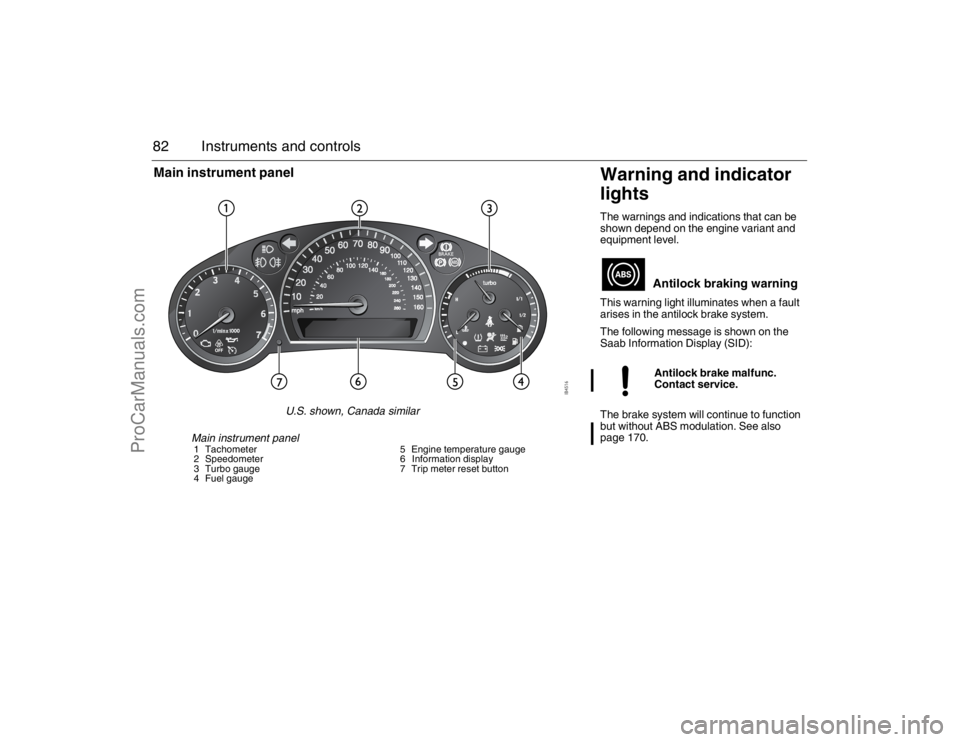
Main instrument panel1 Tachometer
2 Speedometer
3 Turbo gauge
4 Fuel gauge5 Engine temperature gauge
6 Information display
7 Trip meter reset button
Main instrument panel
U.S. shown, Canada similar
93_U S _M 07.book Page 82 W ednesday, April 12, 2006 9:30 AM
ProCarManuals.com
Page 90 of 304
90 Instruments and controlsPress the CLR button to acknowledge a SID
message. If you acknowledge a message
but do nothing about it, the message will be
displayed again the next time you start the
car.
When the engine is switched off the warn-
ing/indicator lights still active are displayed,
this is to remind the driver. At this point the
warning/indicator lights previously acknowl-
edged with the CLR button are also dis-
played.
You can adjust the settings of several of the
car’s systems, such as the alarm3, rain
sensor3 and climate control system. These
are known as Settings se page 94.Odometer and trip meterThe odometer records the distance trav-
elled in miles on U.S. vehicles and on Cana-
dian vehicles the distance indicated is in
kilometres, and the trip meter in miles and
tenths (kilometres and tenths of kilometres
on Canadian vehicles).xx
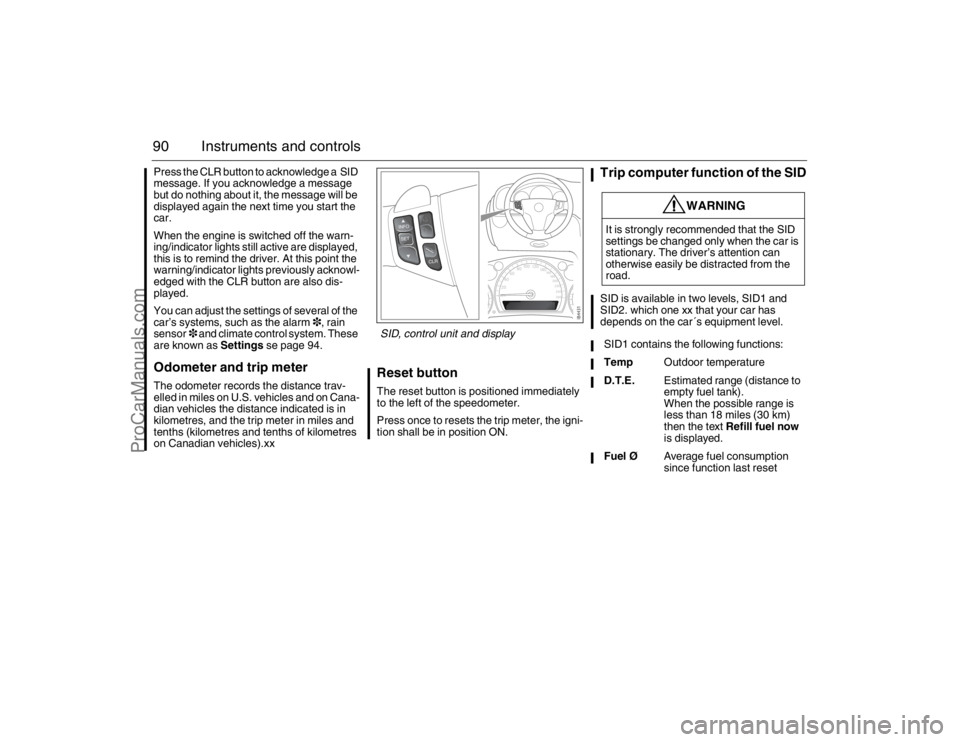
Reset buttonThe reset button is positioned immediately
to the left of the speedometer.
Press once to resets the trip meter, the igni-
tion shall be in position ON.
Trip computer function of the SIDSID is available in two levels, SID1 and
SID2. which one xx that your car has
depends on the car´s equipment level.
WARNING
It is strongly recommended that the SID
settings be changed only when the car is
stationary. The driver’s attention can
otherwise easily be distracted from the
road.
SID1 contains the following functions:
TempOutdoor temperature
D.T.E.Estimated range (distance to
empty fuel tank).
When the possible range is
less than 18 miles (30 km)
then the text Refill fuel now
is displayed.
Fuel ØAverage fuel consumption
since function last reset
SID, control unit and display
93_U S _M 07.book Page 90 W ednesday, April 12, 2006 9:30 AM
ProCarManuals.com
Page 91 of 304
91 Instruments and controls
When the engine is started, the function that
was selected when the engine was
switched off is displayed, with the following
exceptions:
Temp is displayed if the outside tempera-
ture is between 26 and 38°F (–3 and
+3°C).
D.T.E. is displayed if less than or equal to
30 miles (50 km).Outdoor temperature
The Temp function is always activated
(even in NIGHTPANEL mode) if the outdoor
temperature rises or falls to between 26 and
38°F (–3 and +3°C).
If the temperature sensor, located under the
front bumper, is covered by snow or ice,
temperature readings will be unreliable.Setting values
1 Select one of the functions using the
steering wheel controls, or .
Dist (preset to 100 miles (100 km) if not
previously set)
Speed W (preset to 55 mph (90 km/h)
2 Press and hold the SET button until
given audible confirmation.
3 Use the steering wheel controls to select
the value. (Press CLR to reset the
value.)
4 Press the SET button to finish setup.
Using DIST as a trip meter
1 Select Dist using the steering wheel
controls, or .
2 Press and hold the CLR button for
approx. 1 second.
An arrow will now appear on the right-hand
side of the display, indicating that the trip
meter is running. SID2 3 also contains the following fea-
tures:
DistDistance to destinations.
Function can also be used as
a trip meter
Speed ØAverage speed since func-
tion last reset
Speed WSpeed warning (chime)
SettingsSettings of features such as
alarm clock, language and
rain sensor3
Phone3Managing of number list, see
Infotainment Manual.
WARNING
Remember that roads can be icy even at
temperatures of above 38°F (+3°C),
especially on bridges and stretches of
road that are sheltered from the sun.
93_U S _M 07.book Page 91 W ednesday, April 12, 2006 9:30 AM
ProCarManuals.com